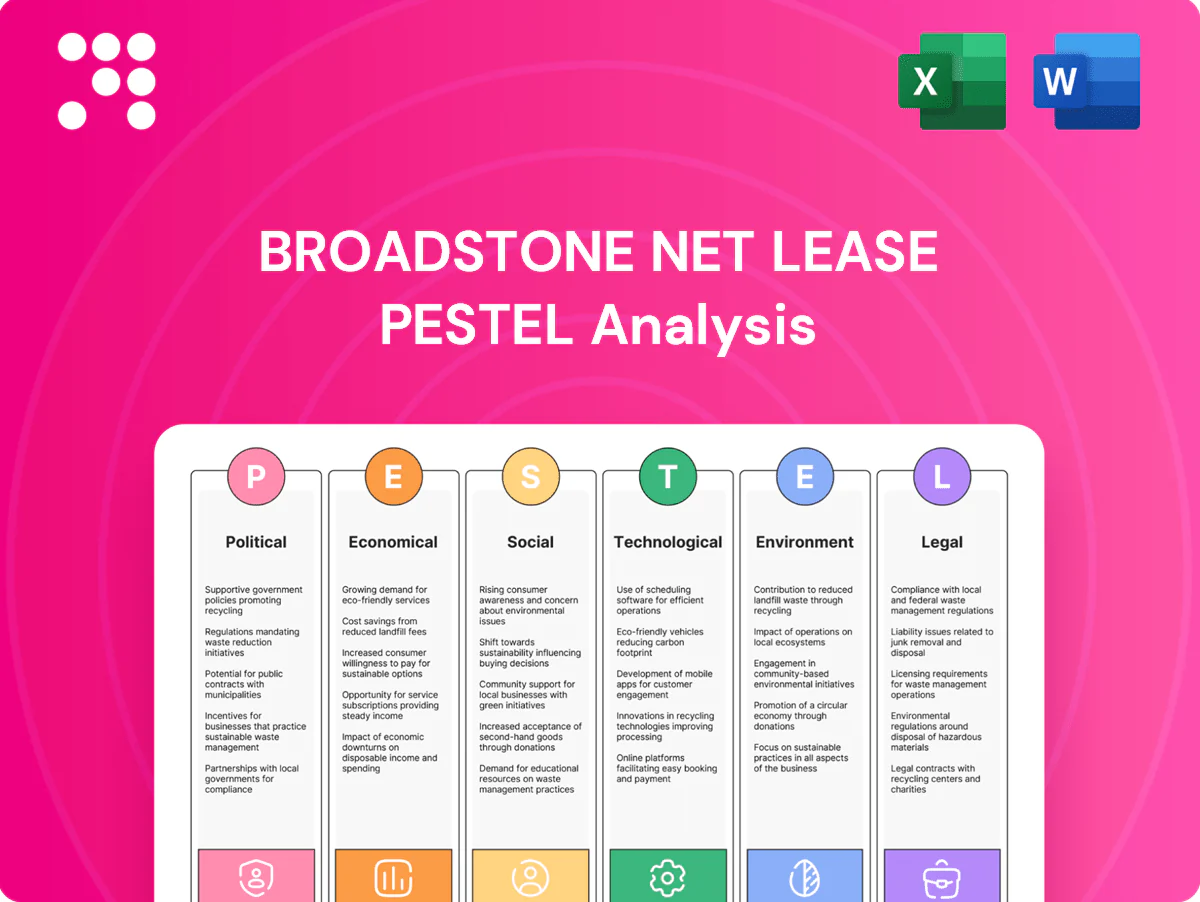
Broadstone Net Lease PESTLE Analysis

Make Smarter Strategic Decisions with a Complete PESTEL View
Discover how political shifts, economic cycles, social trends, technological advances, legal changes, and environmental risks shape Broadstone Net Lease’s trajectory in our targeted PESTLE snapshot. This concise briefing highlights key external pressures and strategic opportunities. Purchase the full PESTLE for an actionable, editable report to guide investment and strategic decisions.
Political factors

Zoning and permitting
Local zoning decisions constrain where Broadstone Net Lease can acquire or develop single-tenant sites, with the REIT operating across 43 states to spread municipal risk; lengthy permitting timelines, often 6–12 months for build-to-suit projects, can delay deliveries and rent commencement; proactive stakeholder engagement reduces entitlement risk and geographic diversification mitigates concentration in any single municipality.
Property tax policy
Property tax rates, averaging about 1.08% of assessed value nationally in 2023 per Tax Foundation, directly drive tenant occupancy costs under Broadstone Net Lease NNN structures. Reassessments, common in many states, can compress tenant coverage ratios and influence renewal decisions when assessed values rise faster than rents. Monitoring appeals and local assessment cycles helps manage pass-through timing and disputes. State policies like California’s Proposition 13 (2% annual cap) can materially alter total cost of occupancy across portfolios.

REIT policy stability
Changes to REIT taxation or distribution rules could force adjustments to payout strategy and capital allocation; REITs must distribute at least 90% of taxable income to retain status. Policymaker stances on pass-through taxation influence investor demand for yield vehicles. Maintaining compliance buffers hedges against regulatory reinterpretation, while engagement with industry associations such as Nareit, representing over 200 REITs, provides early visibility.

Infrastructure and incentives
Government incentives shape site selection for Broadstone Net Lease build-to-suit projects; the 2021 Bipartisan Infrastructure Law (1.2 trillion USD, 550 billion USD new) has boosted regional logistics access and tenant performance. Infrastructure spending raises asset accessibility and rents, while withdrawn incentives can stall tenant-tied expansions. Aligning with regional development priorities improves deal flow.
- Incentives drive site choice
- BIL 1.2 trillion USD impact
- Spending boosts accessibility/rents
- Incentive withdrawal stalls expansions
- Regional alignment increases deals
Trade and geopolitical exposure
Tenants in manufacturing and logistics face tariff-driven cost shocks and supply-chain disruptions that can compress tenant margins and threaten rent coverage; political instability in key sourcing regions raises the risk of cross-border input interruptions. Broadstone Net Lease mitigates knock-on risk through sector and geographic diversification and by using triple-net and inflation-indexed leases. Lease structuring with covenants, rent step-ups and tenant credit screening cushions cash flows during disruptions.
- Tariff/supply shock exposure
- Cross-border instability risks
- Diversification reduces systemic impact
- Lease clauses protect cash flow
Zoning delays in 43 states constrain logistics rent upside
Local zoning across 43 states and 6–12 month permitting delays affect site timing; average property tax ~1.08% of assessed value (Tax Foundation, 2023) raises tenant occupancy costs; REIT rules require distribution of at least 90% of taxable income, constraining capital; the 2021 Bipartisan Infrastructure Law (1.2 trillion USD; 550 billion USD new) improves logistics access and rent upside.
| Factor | Metric | Impact |
|---|---|---|
| Zoning/Permits | 43 states / 6–12 mo | Timing risk |
What is included in the product
 Detailed Word Document
Explores how Political, Economic, Social, Technological, Environmental and Legal forces uniquely affect Broadstone Net Lease, combining data-driven trends and regional regulatory context to identify threats and opportunities for executives and investors, with forward-looking insights for scenario planning.

 Customizable Excel Spreadsheet
Condensed PESTLE summary of Broadstone Net Lease that clarifies regulatory, economic, social, technological, environmental, and legal impacts for swift meeting use, editable for regional context and easily dropped into presentations to align teams and de-risk strategic decisions.
Economic factors

Interest rates and cap rates
Rising rates—federal funds 5.25–5.50% and 10-year Treasury ≈4.0% in mid-2025—have widened net-lease cap rates, pressuring asset values and underwriting. Higher debt costs reduce acquisition yields and can strain dividend coverage unless rent escalations offset them. Broadstone’s fixed-rate, laddered debt strategy stabilizes AFFO while spread management versus corporate bond yields is critical for valuation.
Inflation pass-through
Net leases with CPI escalators help Broadstone Net Lease preserve real rent growth as US CPI ran about 3.3% YoY in mid-2025, while fixed bumps can compress real cash flows when inflation is above historical 2% targets. A mix of CPI and fixed escalators balances predictability and inflation protection. Tenant financial stress, linked to labor market shifts (unemployment ~3.8% mid-2025), raises default risk.

Tenant credit cycles
Macro slowdowns elevate tenant default and restructuring risk; US speculative-grade default rate rose to about 1.6% in 2024, pressuring single-tenant cash flows. Credit underwriting and sector mix (retail/industrial exposure) determine durability of rents in BNL-style portfolios. Sale-leaseback demand often rose in 2023–24 as firms sought liquidity. Proactive landlord-tenant dialogue increases workouts and preserves occupancy.

Construction costs
Build-to-suit economics remain sensitive to materials and labor inflation, which peaked in 2022 and moderated through 2023–24, pressuring margins and capex timing; guaranteed maximum price contracts are used to cap exposure, while longer lead times delay rent commencement and cash flow. Partner selection and preordering key to mitigating price volatility.
- Materials/labor: peaked 2022, moderated 2023–24
- GMP contracts: cap cost exposure
- Lead times: delay rent starts
- Preorder/partners: reduce volatility
Liquidity and capital markets
Equity valuations drive Broadstone Net Lease capacity for external growth, with U.S. REIT sector capitalization elevated after 2024 leading to continued equity access; the 10-year Treasury near 4.4% in mid-2025 raises capital costs and shapes refinancing risk and WACC. ATM programs and DRIPs supply flexible funding while prudent leverage preserves ratings and acquisition competitiveness.
- Equity valuations: support M&A, capital raises
- 10yr Treasury ~4.4%: higher WACC/refinancing risk
- ATM/DRIP: on-demand equity flexibility
- Prudent leverage: protects ratings, bidding power
Zoning delays in 43 states constrain logistics rent upside
Higher rates (fed funds 5.25–5.50%, 10y ≈4.0% mid‑2025) widen cap rates and raise WACC, squeezing valuations and dividend cover. CPI ~3.3% YoY mid‑2025 supports CPI escalators but fixed bumps lose real value. Unemployment ~3.8% and 2024 speculative‑grade defaults ~1.6% heighten tenant risk; conservative leverage and fixed‑rate laddering mitigate refinance shocks.
| Metric | Value |
|---|---|
| Fed funds | 5.25–5.50% |
| 10‑yr Treasury | ≈4.0% |
| CPI YoY | ≈3.3% |
| Unemployment | ≈3.8% |
| Spec‑grade default (2024) | ≈1.6% |
Same Document Delivered
Broadstone Net Lease PESTLE Analysis
The Broadstone Net Lease PESTLE Analysis evaluates political, economic, social, technological, legal, and environmental factors affecting the company and its single-tenant net-lease portfolio. The preview shown here is the exact document you’ll receive after purchase—fully formatted and ready to use. It includes actionable insights and risk implications for investors and managers.

Make Smarter Strategic Decisions with a Complete PESTEL View
Discover how political shifts, economic cycles, social trends, technological advances, legal changes, and environmental risks shape Broadstone Net Lease’s trajectory in our targeted PESTLE snapshot. This concise briefing highlights key external pressures and strategic opportunities. Purchase the full PESTLE for an actionable, editable report to guide investment and strategic decisions.
Political factors
Zoning and permitting
Local zoning decisions constrain where Broadstone Net Lease can acquire or develop single-tenant sites, with the REIT operating across 43 states to spread municipal risk; lengthy permitting timelines, often 6–12 months for build-to-suit projects, can delay deliveries and rent commencement; proactive stakeholder engagement reduces entitlement risk and geographic diversification mitigates concentration in any single municipality.
Property tax policy
Property tax rates, averaging about 1.08% of assessed value nationally in 2023 per Tax Foundation, directly drive tenant occupancy costs under Broadstone Net Lease NNN structures. Reassessments, common in many states, can compress tenant coverage ratios and influence renewal decisions when assessed values rise faster than rents. Monitoring appeals and local assessment cycles helps manage pass-through timing and disputes. State policies like California’s Proposition 13 (2% annual cap) can materially alter total cost of occupancy across portfolios.
REIT policy stability
Changes to REIT taxation or distribution rules could force adjustments to payout strategy and capital allocation; REITs must distribute at least 90% of taxable income to retain status. Policymaker stances on pass-through taxation influence investor demand for yield vehicles. Maintaining compliance buffers hedges against regulatory reinterpretation, while engagement with industry associations such as Nareit, representing over 200 REITs, provides early visibility.
Infrastructure and incentives
Government incentives shape site selection for Broadstone Net Lease build-to-suit projects; the 2021 Bipartisan Infrastructure Law (1.2 trillion USD, 550 billion USD new) has boosted regional logistics access and tenant performance. Infrastructure spending raises asset accessibility and rents, while withdrawn incentives can stall tenant-tied expansions. Aligning with regional development priorities improves deal flow.
- Incentives drive site choice
- BIL 1.2 trillion USD impact
- Spending boosts accessibility/rents
- Incentive withdrawal stalls expansions
- Regional alignment increases deals
Trade and geopolitical exposure
Tenants in manufacturing and logistics face tariff-driven cost shocks and supply-chain disruptions that can compress tenant margins and threaten rent coverage; political instability in key sourcing regions raises the risk of cross-border input interruptions. Broadstone Net Lease mitigates knock-on risk through sector and geographic diversification and by using triple-net and inflation-indexed leases. Lease structuring with covenants, rent step-ups and tenant credit screening cushions cash flows during disruptions.
- Tariff/supply shock exposure
- Cross-border instability risks
- Diversification reduces systemic impact
- Lease clauses protect cash flow
Zoning delays in 43 states constrain logistics rent upside
Local zoning across 43 states and 6–12 month permitting delays affect site timing; average property tax ~1.08% of assessed value (Tax Foundation, 2023) raises tenant occupancy costs; REIT rules require distribution of at least 90% of taxable income, constraining capital; the 2021 Bipartisan Infrastructure Law (1.2 trillion USD; 550 billion USD new) improves logistics access and rent upside.
| Factor | Metric | Impact |
|---|---|---|
| Zoning/Permits | 43 states / 6–12 mo | Timing risk |
What is included in the product
Detailed Word Document
Explores how Political, Economic, Social, Technological, Environmental and Legal forces uniquely affect Broadstone Net Lease, combining data-driven trends and regional regulatory context to identify threats and opportunities for executives and investors, with forward-looking insights for scenario planning.
Customizable Excel Spreadsheet
Condensed PESTLE summary of Broadstone Net Lease that clarifies regulatory, economic, social, technological, environmental, and legal impacts for swift meeting use, editable for regional context and easily dropped into presentations to align teams and de-risk strategic decisions.
Economic factors
Interest rates and cap rates
Rising rates—federal funds 5.25–5.50% and 10-year Treasury ≈4.0% in mid-2025—have widened net-lease cap rates, pressuring asset values and underwriting. Higher debt costs reduce acquisition yields and can strain dividend coverage unless rent escalations offset them. Broadstone’s fixed-rate, laddered debt strategy stabilizes AFFO while spread management versus corporate bond yields is critical for valuation.
Inflation pass-through
Net leases with CPI escalators help Broadstone Net Lease preserve real rent growth as US CPI ran about 3.3% YoY in mid-2025, while fixed bumps can compress real cash flows when inflation is above historical 2% targets. A mix of CPI and fixed escalators balances predictability and inflation protection. Tenant financial stress, linked to labor market shifts (unemployment ~3.8% mid-2025), raises default risk.
Tenant credit cycles
Macro slowdowns elevate tenant default and restructuring risk; US speculative-grade default rate rose to about 1.6% in 2024, pressuring single-tenant cash flows. Credit underwriting and sector mix (retail/industrial exposure) determine durability of rents in BNL-style portfolios. Sale-leaseback demand often rose in 2023–24 as firms sought liquidity. Proactive landlord-tenant dialogue increases workouts and preserves occupancy.
Construction costs
Build-to-suit economics remain sensitive to materials and labor inflation, which peaked in 2022 and moderated through 2023–24, pressuring margins and capex timing; guaranteed maximum price contracts are used to cap exposure, while longer lead times delay rent commencement and cash flow. Partner selection and preordering key to mitigating price volatility.
- Materials/labor: peaked 2022, moderated 2023–24
- GMP contracts: cap cost exposure
- Lead times: delay rent starts
- Preorder/partners: reduce volatility
Liquidity and capital markets
Equity valuations drive Broadstone Net Lease capacity for external growth, with U.S. REIT sector capitalization elevated after 2024 leading to continued equity access; the 10-year Treasury near 4.4% in mid-2025 raises capital costs and shapes refinancing risk and WACC. ATM programs and DRIPs supply flexible funding while prudent leverage preserves ratings and acquisition competitiveness.
- Equity valuations: support M&A, capital raises
- 10yr Treasury ~4.4%: higher WACC/refinancing risk
- ATM/DRIP: on-demand equity flexibility
- Prudent leverage: protects ratings, bidding power
Zoning delays in 43 states constrain logistics rent upside
Higher rates (fed funds 5.25–5.50%, 10y ≈4.0% mid‑2025) widen cap rates and raise WACC, squeezing valuations and dividend cover. CPI ~3.3% YoY mid‑2025 supports CPI escalators but fixed bumps lose real value. Unemployment ~3.8% and 2024 speculative‑grade defaults ~1.6% heighten tenant risk; conservative leverage and fixed‑rate laddering mitigate refinance shocks.
| Metric | Value |
|---|---|
| Fed funds | 5.25–5.50% |
| 10‑yr Treasury | ≈4.0% |
| CPI YoY | ≈3.3% |
| Unemployment | ≈3.8% |
| Spec‑grade default (2024) | ≈1.6% |
Same Document Delivered
Broadstone Net Lease PESTLE Analysis
The Broadstone Net Lease PESTLE Analysis evaluates political, economic, social, technological, legal, and environmental factors affecting the company and its single-tenant net-lease portfolio. The preview shown here is the exact document you’ll receive after purchase—fully formatted and ready to use. It includes actionable insights and risk implications for investors and managers.
Original: $10.00
-65%$10.00
$3.50Description
Make Smarter Strategic Decisions with a Complete PESTEL View
Discover how political shifts, economic cycles, social trends, technological advances, legal changes, and environmental risks shape Broadstone Net Lease’s trajectory in our targeted PESTLE snapshot. This concise briefing highlights key external pressures and strategic opportunities. Purchase the full PESTLE for an actionable, editable report to guide investment and strategic decisions.
Political factors
Zoning and permitting
Local zoning decisions constrain where Broadstone Net Lease can acquire or develop single-tenant sites, with the REIT operating across 43 states to spread municipal risk; lengthy permitting timelines, often 6–12 months for build-to-suit projects, can delay deliveries and rent commencement; proactive stakeholder engagement reduces entitlement risk and geographic diversification mitigates concentration in any single municipality.
Property tax policy
Property tax rates, averaging about 1.08% of assessed value nationally in 2023 per Tax Foundation, directly drive tenant occupancy costs under Broadstone Net Lease NNN structures. Reassessments, common in many states, can compress tenant coverage ratios and influence renewal decisions when assessed values rise faster than rents. Monitoring appeals and local assessment cycles helps manage pass-through timing and disputes. State policies like California’s Proposition 13 (2% annual cap) can materially alter total cost of occupancy across portfolios.
REIT policy stability
Changes to REIT taxation or distribution rules could force adjustments to payout strategy and capital allocation; REITs must distribute at least 90% of taxable income to retain status. Policymaker stances on pass-through taxation influence investor demand for yield vehicles. Maintaining compliance buffers hedges against regulatory reinterpretation, while engagement with industry associations such as Nareit, representing over 200 REITs, provides early visibility.
Infrastructure and incentives
Government incentives shape site selection for Broadstone Net Lease build-to-suit projects; the 2021 Bipartisan Infrastructure Law (1.2 trillion USD, 550 billion USD new) has boosted regional logistics access and tenant performance. Infrastructure spending raises asset accessibility and rents, while withdrawn incentives can stall tenant-tied expansions. Aligning with regional development priorities improves deal flow.
- Incentives drive site choice
- BIL 1.2 trillion USD impact
- Spending boosts accessibility/rents
- Incentive withdrawal stalls expansions
- Regional alignment increases deals
Trade and geopolitical exposure
Tenants in manufacturing and logistics face tariff-driven cost shocks and supply-chain disruptions that can compress tenant margins and threaten rent coverage; political instability in key sourcing regions raises the risk of cross-border input interruptions. Broadstone Net Lease mitigates knock-on risk through sector and geographic diversification and by using triple-net and inflation-indexed leases. Lease structuring with covenants, rent step-ups and tenant credit screening cushions cash flows during disruptions.
- Tariff/supply shock exposure
- Cross-border instability risks
- Diversification reduces systemic impact
- Lease clauses protect cash flow
Zoning delays in 43 states constrain logistics rent upside
Local zoning across 43 states and 6–12 month permitting delays affect site timing; average property tax ~1.08% of assessed value (Tax Foundation, 2023) raises tenant occupancy costs; REIT rules require distribution of at least 90% of taxable income, constraining capital; the 2021 Bipartisan Infrastructure Law (1.2 trillion USD; 550 billion USD new) improves logistics access and rent upside.
| Factor | Metric | Impact |
|---|---|---|
| Zoning/Permits | 43 states / 6–12 mo | Timing risk |
What is included in the product
Detailed Word Document
Explores how Political, Economic, Social, Technological, Environmental and Legal forces uniquely affect Broadstone Net Lease, combining data-driven trends and regional regulatory context to identify threats and opportunities for executives and investors, with forward-looking insights for scenario planning.
Customizable Excel Spreadsheet
Condensed PESTLE summary of Broadstone Net Lease that clarifies regulatory, economic, social, technological, environmental, and legal impacts for swift meeting use, editable for regional context and easily dropped into presentations to align teams and de-risk strategic decisions.
Economic factors
Interest rates and cap rates
Rising rates—federal funds 5.25–5.50% and 10-year Treasury ≈4.0% in mid-2025—have widened net-lease cap rates, pressuring asset values and underwriting. Higher debt costs reduce acquisition yields and can strain dividend coverage unless rent escalations offset them. Broadstone’s fixed-rate, laddered debt strategy stabilizes AFFO while spread management versus corporate bond yields is critical for valuation.
Inflation pass-through
Net leases with CPI escalators help Broadstone Net Lease preserve real rent growth as US CPI ran about 3.3% YoY in mid-2025, while fixed bumps can compress real cash flows when inflation is above historical 2% targets. A mix of CPI and fixed escalators balances predictability and inflation protection. Tenant financial stress, linked to labor market shifts (unemployment ~3.8% mid-2025), raises default risk.
Tenant credit cycles
Macro slowdowns elevate tenant default and restructuring risk; US speculative-grade default rate rose to about 1.6% in 2024, pressuring single-tenant cash flows. Credit underwriting and sector mix (retail/industrial exposure) determine durability of rents in BNL-style portfolios. Sale-leaseback demand often rose in 2023–24 as firms sought liquidity. Proactive landlord-tenant dialogue increases workouts and preserves occupancy.
Construction costs
Build-to-suit economics remain sensitive to materials and labor inflation, which peaked in 2022 and moderated through 2023–24, pressuring margins and capex timing; guaranteed maximum price contracts are used to cap exposure, while longer lead times delay rent commencement and cash flow. Partner selection and preordering key to mitigating price volatility.
- Materials/labor: peaked 2022, moderated 2023–24
- GMP contracts: cap cost exposure
- Lead times: delay rent starts
- Preorder/partners: reduce volatility
Liquidity and capital markets
Equity valuations drive Broadstone Net Lease capacity for external growth, with U.S. REIT sector capitalization elevated after 2024 leading to continued equity access; the 10-year Treasury near 4.4% in mid-2025 raises capital costs and shapes refinancing risk and WACC. ATM programs and DRIPs supply flexible funding while prudent leverage preserves ratings and acquisition competitiveness.
- Equity valuations: support M&A, capital raises
- 10yr Treasury ~4.4%: higher WACC/refinancing risk
- ATM/DRIP: on-demand equity flexibility
- Prudent leverage: protects ratings, bidding power
Zoning delays in 43 states constrain logistics rent upside
Higher rates (fed funds 5.25–5.50%, 10y ≈4.0% mid‑2025) widen cap rates and raise WACC, squeezing valuations and dividend cover. CPI ~3.3% YoY mid‑2025 supports CPI escalators but fixed bumps lose real value. Unemployment ~3.8% and 2024 speculative‑grade defaults ~1.6% heighten tenant risk; conservative leverage and fixed‑rate laddering mitigate refinance shocks.
| Metric | Value |
|---|---|
| Fed funds | 5.25–5.50% |
| 10‑yr Treasury | ≈4.0% |
| CPI YoY | ≈3.3% |
| Unemployment | ≈3.8% |
| Spec‑grade default (2024) | ≈1.6% |
Same Document Delivered
Broadstone Net Lease PESTLE Analysis
The Broadstone Net Lease PESTLE Analysis evaluates political, economic, social, technological, legal, and environmental factors affecting the company and its single-tenant net-lease portfolio. The preview shown here is the exact document you’ll receive after purchase—fully formatted and ready to use. It includes actionable insights and risk implications for investors and managers.











