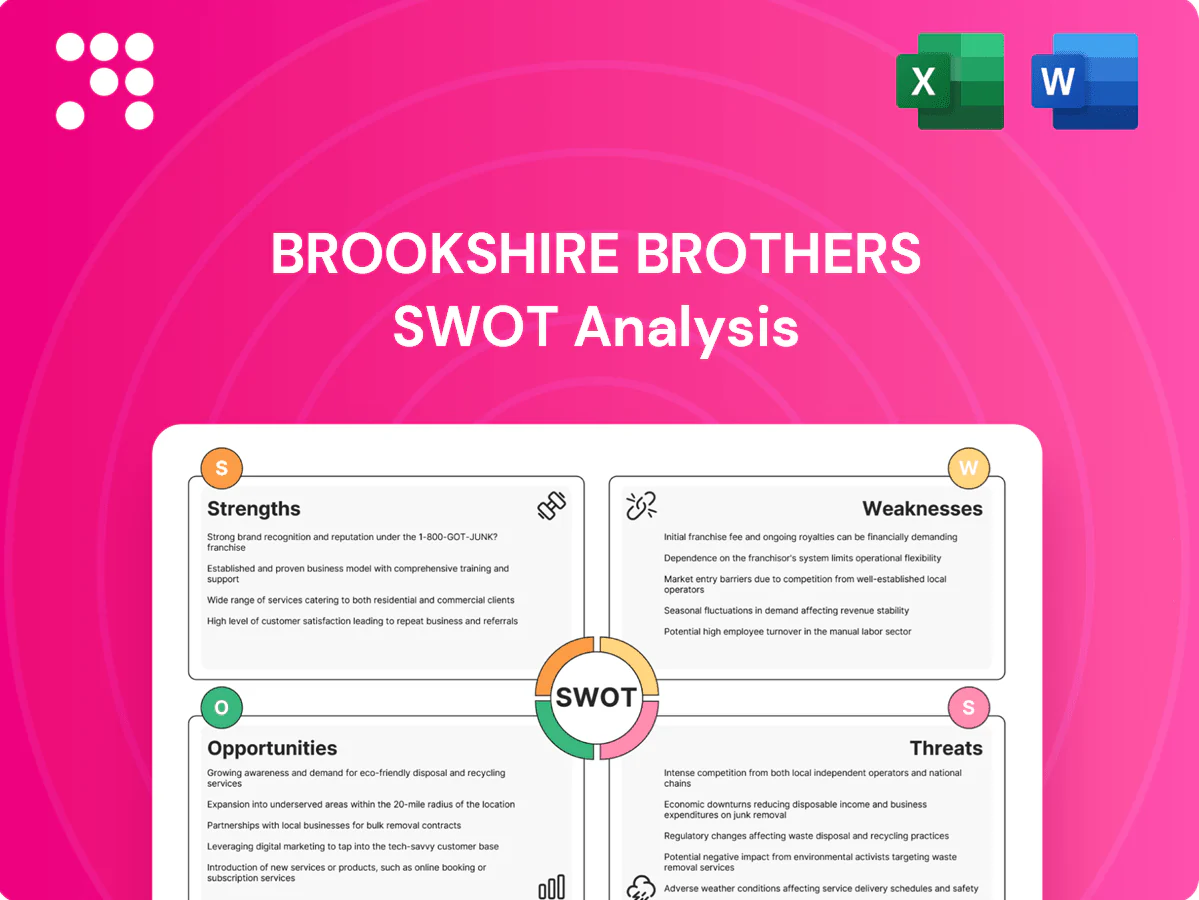
Brookshire Brothers SWOT Analysis

Dive Deeper Into the Company’s Strategic Blueprint
Brookshire Brothers’ SWOT analysis highlights its strong regional brand, customer loyalty, and supply-chain strengths alongside pressures from larger grocers and changing retail dynamics. This concise snapshot reveals strategic opportunities and risks for investors and operators. Purchase the full SWOT analysis for a research-backed, editable report and Excel tools to plan, pitch, or invest with confidence.
Strengths

Deep regional footprint in TX/LA
Concentrated TX/LA operations yield deep local market knowledge, strong store-level relationships, and tailored assortments that boost repeat traffic and trust across a combined ≈34.6 million regional population (TX ≈30.0M, LA ≈4.6M, 2024 est). Proximity cuts logistics complexity vs national peers and enables efficient, locally timed promotions around regional events and seasons.
Multi-format flexibility
Operating supermarkets, convenience and express stores across Texas and Louisiana lets Brookshire Brothers right-size formats to community density and demand, capturing stock-up, fill-in and quick-stop trip missions.
Format optionality optimizes real estate and capital deployment by matching store size and spend to local margins and basket sizes.
Mixing fuel-and-convenience with grocery formats buffers revenue through economic cycles and fuel-price swings, smoothing cash flow and unit-level performance.

Complementary services (pharmacy, fuel, foodservice)
Brookshire Brothers, operating about 117 stores across Texas and Louisiana (company site 2025), leverages in-store pharmacies, fuel pumps and prepared foods to boost basket size and trip frequency. Cross-category convenience strengthens customer stickiness and loyalty economics, raising average spend per visit. These services differentiate the chain from pure-play grocers and generate higher-margin pools beyond center-store grocery.

Community-centric positioning
Brookshire Brothers, family-owned since 1921 and headquartered in Lufkin, Texas, leverages a local service ethos that resonates in small and mid-sized towns; community sponsorships and tailored assortments drive strong goodwill and word-of-mouth, while nimble local decisioning enables rapid response to events and emergencies, helping defend share against big-box encroachment.
- Local heritage: founded 1921, family-owned
- Community programs fuel loyalty and referrals
- Decentralized buying enables fast local responses
Fresh and everyday needs focus
- Perishables drive frequency and quality perception
- High in-stocks on staples build reliability
- Mix supports steady cash flow during softer discretionary periods
Deep TX/LA reach: 34.6M pop, 117 stores, family-owned since 1921
Deep TX/LA footprint (≈34.6M pop, 2024) and ~117 stores (company, 2025) combine local knowledge, format flexibility (supermarkets, C-stores, fuel), strong perishables, in-store pharmacies/prepared foods, and family ownership since 1921 to drive loyalty, higher basket size and resilient cash flow.
| Metric | Value |
|---|---|
| Regional pop (2024) | ≈34.6M |
| Stores (2025) | ≈117 |
| Founded | 1921 |
What is included in the product
 Detailed Word Document
Delivers a strategic overview of Brookshire Brothers’s internal and external business factors, outlining strengths, weaknesses, opportunities, and threats that shape its competitive position and growth prospects in regional grocery markets.

 Customizable Excel Spreadsheet
Provides a concise Brookshire Brothers SWOT matrix for fast, visual strategy alignment across store operations and regional supply chains, relieving analysis bottlenecks.
Weaknesses

Limited geographic scale
Brookshire Brothers' footprint is concentrated in Texas and Louisiana with over 100 stores, capping total addressable market and limiting negotiating leverage versus national grocers such as Kroger (around 2,700 stores in 2024).
Smaller scale drives higher unit costs in procurement and logistics.
It also limits brand awareness outside core counties and makes scaling new initiatives slower and more expensive.
Digital and e-commerce gap risk
Regional chains like Brookshire Brothers risk trailing leaders in app UX, delivery and curbside sophistication as U.S. online grocery penetration reached about 10% in 2024, raising expectations for seamless digital service. Underinvestment can erode retention among convenience-seeking shoppers. Dependence on third-party marketplaces, which commonly charge 15–30% commission, can compress margins. Data and personalization capabilities may lag larger peers with bigger tech budgets.

Capital constraints vs national competitors
Capital-constrained Brookshire Brothers faces pressure as big-box and national grocers outspend on pricing, technology and remodels—Walmart reported about $11 billion in capital expenditures in FY2024 and Kroger roughly $1.5 billion. Higher cost of capital can delay upgrades and expansion, producing dated stores in select markets. During inflationary periods, price perception can worsen and erode share.

Supply chain exposure to Gulf weather
Brookshire Brothers, with over 170 stores across Texas and Louisiana, faces Gulf weather risk: hurricanes and flooding can disrupt distribution and store operations, forcing route closures that raise transportation costs and reduce on-shelf availability. Power outages increase perishables waste and rising insurance and preparedness spending compress margins; NOAA recorded 28 billion-dollar weather disasters in 2023.
- Supply interruptions → higher logistics costs
- Route closures → decreased on-shelf availability
- Outages → increased perishables waste
- Rising insurance/preparedness costs → margin pressure
Brand awareness confined to local markets
Brookshire Brothers' brand awareness is largely confined to East Texas and northwest Louisiana, limiting top-of-funnel acquisition as limited media reach and store footprint reduce visibility to travelers and new residents who often default to national chains. This constrains growth from in-migration into Texas, which had net domestic gains of roughly +373,000 in 2023 (US Census). Marketing efficiency weakens quickly beyond core trade areas, raising customer acquisition costs.
- Limited regional footprint reduces national-name recall
- Travelers/new residents favor national chains, lowering conversion
- Texas net domestic migration +≈373,000 (2023) — opportunity not fully captured
- Higher CAC outside core areas due to low media reach
Regional grocer scale limits procurement, digital growth, capex and weather resilience
Brookshire Brothers' 170+ stores concentrated in TX/LA limit TAM and negotiating leverage versus national grocers (Kroger ~2,700 stores in 2024).
Smaller scale raises procurement and logistics unit costs, lags digital (US online grocery ≈10% in 2024) and relies on third-party marketplaces charging ~15–30%.
Capital constraints vs Walmart capex ≈$11B (FY2024) and Kroger ≈$1.5B slow remodels; weather risk persists after 28 B‑$ disasters in 2023.
| Metric | Brookshire | Benchmark | Impact |
|---|---|---|---|
| Stores | 170+ | Kroger ~2,700 (2024) | Limited scale |
| Online grocery | Lagging | US ≈10% (2024) | Retention risk |
| Third-party fees | Used | 15–30% | Margin pressure |
| CapEx | Constrained | Walmart $11B; Kroger $1.5B (FY2024) | Slower upgrades |
| Weather shocks | Exposure | 28 B‑$ events (2023) | Supply/disruption risk |
What You See Is What You Get
Brookshire Brothers SWOT Analysis
This is the actual SWOT analysis document you’ll receive upon purchase—no surprises, just professional quality. The preview below is taken directly from the full SWOT report you'll get, so what you see is what you'll download. Purchase unlocks the complete, editable version ready for use.

Dive Deeper Into the Company’s Strategic Blueprint
Brookshire Brothers’ SWOT analysis highlights its strong regional brand, customer loyalty, and supply-chain strengths alongside pressures from larger grocers and changing retail dynamics. This concise snapshot reveals strategic opportunities and risks for investors and operators. Purchase the full SWOT analysis for a research-backed, editable report and Excel tools to plan, pitch, or invest with confidence.
Strengths
Deep regional footprint in TX/LA
Concentrated TX/LA operations yield deep local market knowledge, strong store-level relationships, and tailored assortments that boost repeat traffic and trust across a combined ≈34.6 million regional population (TX ≈30.0M, LA ≈4.6M, 2024 est). Proximity cuts logistics complexity vs national peers and enables efficient, locally timed promotions around regional events and seasons.
Multi-format flexibility
Operating supermarkets, convenience and express stores across Texas and Louisiana lets Brookshire Brothers right-size formats to community density and demand, capturing stock-up, fill-in and quick-stop trip missions.
Format optionality optimizes real estate and capital deployment by matching store size and spend to local margins and basket sizes.
Mixing fuel-and-convenience with grocery formats buffers revenue through economic cycles and fuel-price swings, smoothing cash flow and unit-level performance.
Complementary services (pharmacy, fuel, foodservice)
Brookshire Brothers, operating about 117 stores across Texas and Louisiana (company site 2025), leverages in-store pharmacies, fuel pumps and prepared foods to boost basket size and trip frequency. Cross-category convenience strengthens customer stickiness and loyalty economics, raising average spend per visit. These services differentiate the chain from pure-play grocers and generate higher-margin pools beyond center-store grocery.
Community-centric positioning
Brookshire Brothers, family-owned since 1921 and headquartered in Lufkin, Texas, leverages a local service ethos that resonates in small and mid-sized towns; community sponsorships and tailored assortments drive strong goodwill and word-of-mouth, while nimble local decisioning enables rapid response to events and emergencies, helping defend share against big-box encroachment.
- Local heritage: founded 1921, family-owned
- Community programs fuel loyalty and referrals
- Decentralized buying enables fast local responses
Fresh and everyday needs focus
- Perishables drive frequency and quality perception
- High in-stocks on staples build reliability
- Mix supports steady cash flow during softer discretionary periods
Deep TX/LA reach: 34.6M pop, 117 stores, family-owned since 1921
Deep TX/LA footprint (≈34.6M pop, 2024) and ~117 stores (company, 2025) combine local knowledge, format flexibility (supermarkets, C-stores, fuel), strong perishables, in-store pharmacies/prepared foods, and family ownership since 1921 to drive loyalty, higher basket size and resilient cash flow.
| Metric | Value |
|---|---|
| Regional pop (2024) | ≈34.6M |
| Stores (2025) | ≈117 |
| Founded | 1921 |
What is included in the product
Detailed Word Document
Delivers a strategic overview of Brookshire Brothers’s internal and external business factors, outlining strengths, weaknesses, opportunities, and threats that shape its competitive position and growth prospects in regional grocery markets.
Customizable Excel Spreadsheet
Provides a concise Brookshire Brothers SWOT matrix for fast, visual strategy alignment across store operations and regional supply chains, relieving analysis bottlenecks.
Weaknesses
Limited geographic scale
Brookshire Brothers' footprint is concentrated in Texas and Louisiana with over 100 stores, capping total addressable market and limiting negotiating leverage versus national grocers such as Kroger (around 2,700 stores in 2024).
Smaller scale drives higher unit costs in procurement and logistics.
It also limits brand awareness outside core counties and makes scaling new initiatives slower and more expensive.
Digital and e-commerce gap risk
Regional chains like Brookshire Brothers risk trailing leaders in app UX, delivery and curbside sophistication as U.S. online grocery penetration reached about 10% in 2024, raising expectations for seamless digital service. Underinvestment can erode retention among convenience-seeking shoppers. Dependence on third-party marketplaces, which commonly charge 15–30% commission, can compress margins. Data and personalization capabilities may lag larger peers with bigger tech budgets.
Capital constraints vs national competitors
Capital-constrained Brookshire Brothers faces pressure as big-box and national grocers outspend on pricing, technology and remodels—Walmart reported about $11 billion in capital expenditures in FY2024 and Kroger roughly $1.5 billion. Higher cost of capital can delay upgrades and expansion, producing dated stores in select markets. During inflationary periods, price perception can worsen and erode share.
Supply chain exposure to Gulf weather
Brookshire Brothers, with over 170 stores across Texas and Louisiana, faces Gulf weather risk: hurricanes and flooding can disrupt distribution and store operations, forcing route closures that raise transportation costs and reduce on-shelf availability. Power outages increase perishables waste and rising insurance and preparedness spending compress margins; NOAA recorded 28 billion-dollar weather disasters in 2023.
- Supply interruptions → higher logistics costs
- Route closures → decreased on-shelf availability
- Outages → increased perishables waste
- Rising insurance/preparedness costs → margin pressure
Brand awareness confined to local markets
Brookshire Brothers' brand awareness is largely confined to East Texas and northwest Louisiana, limiting top-of-funnel acquisition as limited media reach and store footprint reduce visibility to travelers and new residents who often default to national chains. This constrains growth from in-migration into Texas, which had net domestic gains of roughly +373,000 in 2023 (US Census). Marketing efficiency weakens quickly beyond core trade areas, raising customer acquisition costs.
- Limited regional footprint reduces national-name recall
- Travelers/new residents favor national chains, lowering conversion
- Texas net domestic migration +≈373,000 (2023) — opportunity not fully captured
- Higher CAC outside core areas due to low media reach
Regional grocer scale limits procurement, digital growth, capex and weather resilience
Brookshire Brothers' 170+ stores concentrated in TX/LA limit TAM and negotiating leverage versus national grocers (Kroger ~2,700 stores in 2024).
Smaller scale raises procurement and logistics unit costs, lags digital (US online grocery ≈10% in 2024) and relies on third-party marketplaces charging ~15–30%.
Capital constraints vs Walmart capex ≈$11B (FY2024) and Kroger ≈$1.5B slow remodels; weather risk persists after 28 B‑$ disasters in 2023.
| Metric | Brookshire | Benchmark | Impact |
|---|---|---|---|
| Stores | 170+ | Kroger ~2,700 (2024) | Limited scale |
| Online grocery | Lagging | US ≈10% (2024) | Retention risk |
| Third-party fees | Used | 15–30% | Margin pressure |
| CapEx | Constrained | Walmart $11B; Kroger $1.5B (FY2024) | Slower upgrades |
| Weather shocks | Exposure | 28 B‑$ events (2023) | Supply/disruption risk |
What You See Is What You Get
Brookshire Brothers SWOT Analysis
This is the actual SWOT analysis document you’ll receive upon purchase—no surprises, just professional quality. The preview below is taken directly from the full SWOT report you'll get, so what you see is what you'll download. Purchase unlocks the complete, editable version ready for use.
Description
Dive Deeper Into the Company’s Strategic Blueprint
Brookshire Brothers’ SWOT analysis highlights its strong regional brand, customer loyalty, and supply-chain strengths alongside pressures from larger grocers and changing retail dynamics. This concise snapshot reveals strategic opportunities and risks for investors and operators. Purchase the full SWOT analysis for a research-backed, editable report and Excel tools to plan, pitch, or invest with confidence.
Strengths
Deep regional footprint in TX/LA
Concentrated TX/LA operations yield deep local market knowledge, strong store-level relationships, and tailored assortments that boost repeat traffic and trust across a combined ≈34.6 million regional population (TX ≈30.0M, LA ≈4.6M, 2024 est). Proximity cuts logistics complexity vs national peers and enables efficient, locally timed promotions around regional events and seasons.
Multi-format flexibility
Operating supermarkets, convenience and express stores across Texas and Louisiana lets Brookshire Brothers right-size formats to community density and demand, capturing stock-up, fill-in and quick-stop trip missions.
Format optionality optimizes real estate and capital deployment by matching store size and spend to local margins and basket sizes.
Mixing fuel-and-convenience with grocery formats buffers revenue through economic cycles and fuel-price swings, smoothing cash flow and unit-level performance.
Complementary services (pharmacy, fuel, foodservice)
Brookshire Brothers, operating about 117 stores across Texas and Louisiana (company site 2025), leverages in-store pharmacies, fuel pumps and prepared foods to boost basket size and trip frequency. Cross-category convenience strengthens customer stickiness and loyalty economics, raising average spend per visit. These services differentiate the chain from pure-play grocers and generate higher-margin pools beyond center-store grocery.
Community-centric positioning
Brookshire Brothers, family-owned since 1921 and headquartered in Lufkin, Texas, leverages a local service ethos that resonates in small and mid-sized towns; community sponsorships and tailored assortments drive strong goodwill and word-of-mouth, while nimble local decisioning enables rapid response to events and emergencies, helping defend share against big-box encroachment.
- Local heritage: founded 1921, family-owned
- Community programs fuel loyalty and referrals
- Decentralized buying enables fast local responses
Fresh and everyday needs focus
- Perishables drive frequency and quality perception
- High in-stocks on staples build reliability
- Mix supports steady cash flow during softer discretionary periods
Deep TX/LA reach: 34.6M pop, 117 stores, family-owned since 1921
Deep TX/LA footprint (≈34.6M pop, 2024) and ~117 stores (company, 2025) combine local knowledge, format flexibility (supermarkets, C-stores, fuel), strong perishables, in-store pharmacies/prepared foods, and family ownership since 1921 to drive loyalty, higher basket size and resilient cash flow.
| Metric | Value |
|---|---|
| Regional pop (2024) | ≈34.6M |
| Stores (2025) | ≈117 |
| Founded | 1921 |
What is included in the product
Detailed Word Document
Delivers a strategic overview of Brookshire Brothers’s internal and external business factors, outlining strengths, weaknesses, opportunities, and threats that shape its competitive position and growth prospects in regional grocery markets.
Customizable Excel Spreadsheet
Provides a concise Brookshire Brothers SWOT matrix for fast, visual strategy alignment across store operations and regional supply chains, relieving analysis bottlenecks.
Weaknesses
Limited geographic scale
Brookshire Brothers' footprint is concentrated in Texas and Louisiana with over 100 stores, capping total addressable market and limiting negotiating leverage versus national grocers such as Kroger (around 2,700 stores in 2024).
Smaller scale drives higher unit costs in procurement and logistics.
It also limits brand awareness outside core counties and makes scaling new initiatives slower and more expensive.
Digital and e-commerce gap risk
Regional chains like Brookshire Brothers risk trailing leaders in app UX, delivery and curbside sophistication as U.S. online grocery penetration reached about 10% in 2024, raising expectations for seamless digital service. Underinvestment can erode retention among convenience-seeking shoppers. Dependence on third-party marketplaces, which commonly charge 15–30% commission, can compress margins. Data and personalization capabilities may lag larger peers with bigger tech budgets.
Capital constraints vs national competitors
Capital-constrained Brookshire Brothers faces pressure as big-box and national grocers outspend on pricing, technology and remodels—Walmart reported about $11 billion in capital expenditures in FY2024 and Kroger roughly $1.5 billion. Higher cost of capital can delay upgrades and expansion, producing dated stores in select markets. During inflationary periods, price perception can worsen and erode share.
Supply chain exposure to Gulf weather
Brookshire Brothers, with over 170 stores across Texas and Louisiana, faces Gulf weather risk: hurricanes and flooding can disrupt distribution and store operations, forcing route closures that raise transportation costs and reduce on-shelf availability. Power outages increase perishables waste and rising insurance and preparedness spending compress margins; NOAA recorded 28 billion-dollar weather disasters in 2023.
- Supply interruptions → higher logistics costs
- Route closures → decreased on-shelf availability
- Outages → increased perishables waste
- Rising insurance/preparedness costs → margin pressure
Brand awareness confined to local markets
Brookshire Brothers' brand awareness is largely confined to East Texas and northwest Louisiana, limiting top-of-funnel acquisition as limited media reach and store footprint reduce visibility to travelers and new residents who often default to national chains. This constrains growth from in-migration into Texas, which had net domestic gains of roughly +373,000 in 2023 (US Census). Marketing efficiency weakens quickly beyond core trade areas, raising customer acquisition costs.
- Limited regional footprint reduces national-name recall
- Travelers/new residents favor national chains, lowering conversion
- Texas net domestic migration +≈373,000 (2023) — opportunity not fully captured
- Higher CAC outside core areas due to low media reach
Regional grocer scale limits procurement, digital growth, capex and weather resilience
Brookshire Brothers' 170+ stores concentrated in TX/LA limit TAM and negotiating leverage versus national grocers (Kroger ~2,700 stores in 2024).
Smaller scale raises procurement and logistics unit costs, lags digital (US online grocery ≈10% in 2024) and relies on third-party marketplaces charging ~15–30%.
Capital constraints vs Walmart capex ≈$11B (FY2024) and Kroger ≈$1.5B slow remodels; weather risk persists after 28 B‑$ disasters in 2023.
| Metric | Brookshire | Benchmark | Impact |
|---|---|---|---|
| Stores | 170+ | Kroger ~2,700 (2024) | Limited scale |
| Online grocery | Lagging | US ≈10% (2024) | Retention risk |
| Third-party fees | Used | 15–30% | Margin pressure |
| CapEx | Constrained | Walmart $11B; Kroger $1.5B (FY2024) | Slower upgrades |
| Weather shocks | Exposure | 28 B‑$ events (2023) | Supply/disruption risk |
What You See Is What You Get
Brookshire Brothers SWOT Analysis
This is the actual SWOT analysis document you’ll receive upon purchase—no surprises, just professional quality. The preview below is taken directly from the full SWOT report you'll get, so what you see is what you'll download. Purchase unlocks the complete, editable version ready for use.











