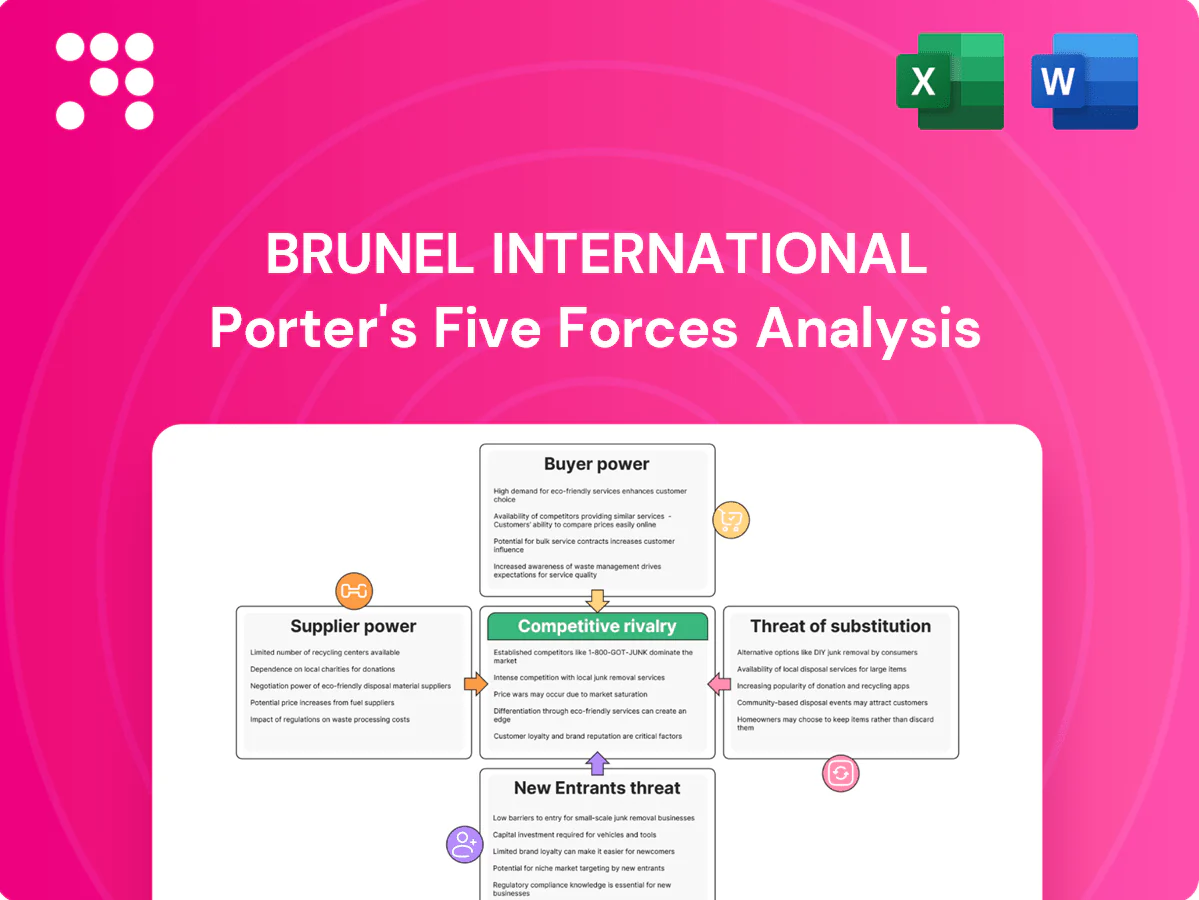
Brunel International Porter's Five Forces Analysis

Elevate Your Analysis with the Complete Porter's Five Forces Analysis
Brunel International faces moderate buyer power and niche supplier influence, while industry fragmentation and regulatory complexity shape its competitive landscape. Threats from digital substitutes and new entrants are emerging but tempered by established client relationships and scale. This preview is just the beginning. The full analysis provides a complete strategic snapshot with force-by-force ratings, visuals, and business implications tailored to Brunel International.
Suppliers Bargaining Power

Scarce specialist talent
Highly skilled engineers, IT experts and energy specialists are scarce, giving candidates leverage on rates and contract terms. Scarcity is acute in niche subsea, H2 and EV domains, driving bidding for talent. Brunel must invest in talent communities and proactive pipelines to secure supply. Premium pay and flexible models are often needed, with rate premiums commonly exceeding 25% in 2024.
Multi-channel sourcing dependence
Dependence on job boards, LinkedIn, and niche vendors raises sourcing costs and reduces candidate exclusivity for Brunel.
LinkedIn had over 930 million members in 2024, so platform policy or pricing shifts can quickly compress margins.
Building direct pipelines, proprietary databases and referral programs reduces third-party power and lowers reliance on paid channels.

Compliance-heavy categories
Oil & gas and regulated projects demand certifications, visas and strict HSE compliance that only a small subset of suppliers hold. Qualified contractors therefore command higher rates and extract premiums. Brunel’s global mobility and compliance capability, operating in 50+ countries in 2024, partially offsets this power. Still, scarce credentials sustain strong supplier bargaining strength.

Worker preferences and flexibility
Worker preferences for remote/hybrid work, shorter contract cycles and rapid onboarding have increased supplier negotiating power; in 2024 about 70% of professionals favored hybrid arrangements and 64% cited speed-to-offer as decisive, so transparent payroll and sub-48-hour offers drive conversion. Agencies slow on process lose candidates; Brunel must deliver superior contractor experience to retain supply and control costs.
- Hybrid preference: 70% (2024)
- Speed decisive: 64% (2024)
- Priority: rapid onboarding, transparent payroll
Regional scarcity and mobility
Location constraints in remote sites and emerging markets elevate supplier power for Brunel, where operating across 30+ emerging markets in 2024 concentrates demand for skilled crews and increases reliance on relocation and rotation packages. Mobility support, including rotation rostering and travel logistics, converts scarce supply into secured placements and can lift placement rates materially. Local partnerships expand candidate pools and mitigate supply bottlenecks.
- 30+ markets 2024
- Relocation/rotation = critical lever
- Mobility support secures placements
- Local partnerships widen pool
Scarce niche engineers push supplier premiums >25% as hybrid 70% and speed fuel bidding
Scarce niche engineers and certified contractors give suppliers strong leverage, driving rate premiums >25% in 2024 and bidding for talent. Dependence on job boards (LinkedIn 930M members in 2024) and agencies raises sourcing costs; Brunel’s 50+ country mobility and 30+ emerging markets footprint partly offsets credential and location power. Hybrid preference (70%) and speed-to-offer (64%) elevate supplier negotiation.
| Metric | 2024 |
|---|---|
| Rate premium | >25% |
| LinkedIn members | 930M |
| Hybrid preference | 70% |
| Speed decisive | 64% |
| Brunel footprint | 50+ countries, 30+ emerging markets |
What is included in the product
 Detailed Word Document
Tailored Porter's Five Forces analysis for Brunel International that uncovers key drivers of competition, customer and supplier power, and market entry risks. Identifies disruptive threats, substitutes and strategic barriers protecting incumbency, with detailed insights to support investor materials and strategy decks.

 Customizable Excel Spreadsheet
A concise one-sheet Porter's Five Forces for Brunel International—visual spider chart with editable pressure levels to instantly pinpoint strategic pain points; no macros, easy to customize for scenarios, and ready to drop into decks or integrate with Excel/Word reports.
Customers Bargaining Power

Large enterprise consolidation
Over 60% of global clients now channel contingent spend through MSP/VMS and framework agreements, concentrating buying power and limiting supplier leverage. Standardized SLAs and rate cards have produced single-digit margin compression across the sector in 2024, while competitive tenders intensify price pressure. Brunel must publish demonstrable KPIs — fill rates, time-to-fill, retention and NPS — to justify and defend its rates.
Low switching costs
Low switching costs mean clients commonly multi-source across 2–3 agencies with minimal friction, making substitution easy when offerings are comparable. Differentiation through demonstrable domain expertise and faster turnaround drives procurement choices and price premia. Contract stickiness is therefore performance- and compliance-led: top-quartile suppliers typically achieve renewal rates above 80% in comparable logistics/service markets.

Outcome and project-based buying
Shift to statement-of-work and project delivery lets clients demand risk-sharing, driving milestone payments, warranties and blended rates that can erode hourly margins. Buyers increasingly negotiate for milestones and blended fees; industry surveys in 2024 suggest about 60% of large contracts include risk-sharing clauses. That pressure deepens client ties, and Brunel can upsell PMO and turnkey services to rebalance pricing power.

Demand cyclicality
Energy-price swings (>30% in 2024) and tech spending cycles amplify buyer leverage in downturns, cutting port volumes and forcing price concessions; throughput can fall up to 15% in weak phases, pressuring utilization and margins. Flexible capacity and exposure to diversified sectors (industrial, offshore, renewables) hedge this cyclicality, while long-term contracts and frame agreements smooth demand volatility.
- Energy swing: >30% (2024)
- Volume drop: up to 15% in downturns
- Hedge: flexibility + sector diversification + long-term contracts
Data transparency via VMS
Data transparency via VMS gives buyers clear market rates and supplier KPIs, enabling tougher negotiations; 2024 industry surveys report ~62% of enterprises using VMS analytics to benchmark rates and performance. Benchmarking narrows pricing dispersion, forcing suppliers to justify premiums with superior fill time and quality, while continuous reporting sustains leverage.
- VMS analytics: market rates, supplier KPIs
- Benchmarking: reduces price dispersion
- Premiums require better fill time & quality
- Continuous reporting: preserves negotiating power
Buyers Empowered: >60% Spend via MSP/VMS, VMS Analytics Compress Pricing
Buyers are highly empowered: >60% of spend flows via MSP/VMS in 2024, driving single-digit sector margin compression and tougher tenders. Low switching costs mean multi-sourcing (2–3 suppliers) is common; top-quartile suppliers see >80% renewal. Risk-sharing appears in ~60% of large contracts, while VMS analytics (≈62%) standardize benchmarks and compress pricing.
| Metric | 2024 |
|---|---|
| MSP/VMS penetration | >60% |
| VMS analytics use | ≈62% |
| Risk-sharing in large contracts | ≈60% |
| Top-quartile renewal | >80% |
| Throughput drop in downturn | up to 15% |
What You See Is What You Get
Brunel International Porter's Five Forces Analysis
This preview displays the exact Brunel International Porter's Five Forces analysis you'll receive after purchase—no placeholders or samples. The full, professionally formatted document is ready for immediate download and use the moment you complete payment. What you see is what you get.

Elevate Your Analysis with the Complete Porter's Five Forces Analysis
Brunel International faces moderate buyer power and niche supplier influence, while industry fragmentation and regulatory complexity shape its competitive landscape. Threats from digital substitutes and new entrants are emerging but tempered by established client relationships and scale. This preview is just the beginning. The full analysis provides a complete strategic snapshot with force-by-force ratings, visuals, and business implications tailored to Brunel International.
Suppliers Bargaining Power
Scarce specialist talent
Highly skilled engineers, IT experts and energy specialists are scarce, giving candidates leverage on rates and contract terms. Scarcity is acute in niche subsea, H2 and EV domains, driving bidding for talent. Brunel must invest in talent communities and proactive pipelines to secure supply. Premium pay and flexible models are often needed, with rate premiums commonly exceeding 25% in 2024.
Multi-channel sourcing dependence
Dependence on job boards, LinkedIn, and niche vendors raises sourcing costs and reduces candidate exclusivity for Brunel.
LinkedIn had over 930 million members in 2024, so platform policy or pricing shifts can quickly compress margins.
Building direct pipelines, proprietary databases and referral programs reduces third-party power and lowers reliance on paid channels.
Compliance-heavy categories
Oil & gas and regulated projects demand certifications, visas and strict HSE compliance that only a small subset of suppliers hold. Qualified contractors therefore command higher rates and extract premiums. Brunel’s global mobility and compliance capability, operating in 50+ countries in 2024, partially offsets this power. Still, scarce credentials sustain strong supplier bargaining strength.
Worker preferences and flexibility
Worker preferences for remote/hybrid work, shorter contract cycles and rapid onboarding have increased supplier negotiating power; in 2024 about 70% of professionals favored hybrid arrangements and 64% cited speed-to-offer as decisive, so transparent payroll and sub-48-hour offers drive conversion. Agencies slow on process lose candidates; Brunel must deliver superior contractor experience to retain supply and control costs.
- Hybrid preference: 70% (2024)
- Speed decisive: 64% (2024)
- Priority: rapid onboarding, transparent payroll
Regional scarcity and mobility
Location constraints in remote sites and emerging markets elevate supplier power for Brunel, where operating across 30+ emerging markets in 2024 concentrates demand for skilled crews and increases reliance on relocation and rotation packages. Mobility support, including rotation rostering and travel logistics, converts scarce supply into secured placements and can lift placement rates materially. Local partnerships expand candidate pools and mitigate supply bottlenecks.
- 30+ markets 2024
- Relocation/rotation = critical lever
- Mobility support secures placements
- Local partnerships widen pool
Scarce niche engineers push supplier premiums >25% as hybrid 70% and speed fuel bidding
Scarce niche engineers and certified contractors give suppliers strong leverage, driving rate premiums >25% in 2024 and bidding for talent. Dependence on job boards (LinkedIn 930M members in 2024) and agencies raises sourcing costs; Brunel’s 50+ country mobility and 30+ emerging markets footprint partly offsets credential and location power. Hybrid preference (70%) and speed-to-offer (64%) elevate supplier negotiation.
| Metric | 2024 |
|---|---|
| Rate premium | >25% |
| LinkedIn members | 930M |
| Hybrid preference | 70% |
| Speed decisive | 64% |
| Brunel footprint | 50+ countries, 30+ emerging markets |
What is included in the product
Detailed Word Document
Tailored Porter's Five Forces analysis for Brunel International that uncovers key drivers of competition, customer and supplier power, and market entry risks. Identifies disruptive threats, substitutes and strategic barriers protecting incumbency, with detailed insights to support investor materials and strategy decks.
Customizable Excel Spreadsheet
A concise one-sheet Porter's Five Forces for Brunel International—visual spider chart with editable pressure levels to instantly pinpoint strategic pain points; no macros, easy to customize for scenarios, and ready to drop into decks or integrate with Excel/Word reports.
Customers Bargaining Power
Large enterprise consolidation
Over 60% of global clients now channel contingent spend through MSP/VMS and framework agreements, concentrating buying power and limiting supplier leverage. Standardized SLAs and rate cards have produced single-digit margin compression across the sector in 2024, while competitive tenders intensify price pressure. Brunel must publish demonstrable KPIs — fill rates, time-to-fill, retention and NPS — to justify and defend its rates.
Low switching costs
Low switching costs mean clients commonly multi-source across 2–3 agencies with minimal friction, making substitution easy when offerings are comparable. Differentiation through demonstrable domain expertise and faster turnaround drives procurement choices and price premia. Contract stickiness is therefore performance- and compliance-led: top-quartile suppliers typically achieve renewal rates above 80% in comparable logistics/service markets.
Outcome and project-based buying
Shift to statement-of-work and project delivery lets clients demand risk-sharing, driving milestone payments, warranties and blended rates that can erode hourly margins. Buyers increasingly negotiate for milestones and blended fees; industry surveys in 2024 suggest about 60% of large contracts include risk-sharing clauses. That pressure deepens client ties, and Brunel can upsell PMO and turnkey services to rebalance pricing power.
Demand cyclicality
Energy-price swings (>30% in 2024) and tech spending cycles amplify buyer leverage in downturns, cutting port volumes and forcing price concessions; throughput can fall up to 15% in weak phases, pressuring utilization and margins. Flexible capacity and exposure to diversified sectors (industrial, offshore, renewables) hedge this cyclicality, while long-term contracts and frame agreements smooth demand volatility.
- Energy swing: >30% (2024)
- Volume drop: up to 15% in downturns
- Hedge: flexibility + sector diversification + long-term contracts
Data transparency via VMS
Data transparency via VMS gives buyers clear market rates and supplier KPIs, enabling tougher negotiations; 2024 industry surveys report ~62% of enterprises using VMS analytics to benchmark rates and performance. Benchmarking narrows pricing dispersion, forcing suppliers to justify premiums with superior fill time and quality, while continuous reporting sustains leverage.
- VMS analytics: market rates, supplier KPIs
- Benchmarking: reduces price dispersion
- Premiums require better fill time & quality
- Continuous reporting: preserves negotiating power
Buyers Empowered: >60% Spend via MSP/VMS, VMS Analytics Compress Pricing
Buyers are highly empowered: >60% of spend flows via MSP/VMS in 2024, driving single-digit sector margin compression and tougher tenders. Low switching costs mean multi-sourcing (2–3 suppliers) is common; top-quartile suppliers see >80% renewal. Risk-sharing appears in ~60% of large contracts, while VMS analytics (≈62%) standardize benchmarks and compress pricing.
| Metric | 2024 |
|---|---|
| MSP/VMS penetration | >60% |
| VMS analytics use | ≈62% |
| Risk-sharing in large contracts | ≈60% |
| Top-quartile renewal | >80% |
| Throughput drop in downturn | up to 15% |
What You See Is What You Get
Brunel International Porter's Five Forces Analysis
This preview displays the exact Brunel International Porter's Five Forces analysis you'll receive after purchase—no placeholders or samples. The full, professionally formatted document is ready for immediate download and use the moment you complete payment. What you see is what you get.
Description
Elevate Your Analysis with the Complete Porter's Five Forces Analysis
Brunel International faces moderate buyer power and niche supplier influence, while industry fragmentation and regulatory complexity shape its competitive landscape. Threats from digital substitutes and new entrants are emerging but tempered by established client relationships and scale. This preview is just the beginning. The full analysis provides a complete strategic snapshot with force-by-force ratings, visuals, and business implications tailored to Brunel International.
Suppliers Bargaining Power
Scarce specialist talent
Highly skilled engineers, IT experts and energy specialists are scarce, giving candidates leverage on rates and contract terms. Scarcity is acute in niche subsea, H2 and EV domains, driving bidding for talent. Brunel must invest in talent communities and proactive pipelines to secure supply. Premium pay and flexible models are often needed, with rate premiums commonly exceeding 25% in 2024.
Multi-channel sourcing dependence
Dependence on job boards, LinkedIn, and niche vendors raises sourcing costs and reduces candidate exclusivity for Brunel.
LinkedIn had over 930 million members in 2024, so platform policy or pricing shifts can quickly compress margins.
Building direct pipelines, proprietary databases and referral programs reduces third-party power and lowers reliance on paid channels.
Compliance-heavy categories
Oil & gas and regulated projects demand certifications, visas and strict HSE compliance that only a small subset of suppliers hold. Qualified contractors therefore command higher rates and extract premiums. Brunel’s global mobility and compliance capability, operating in 50+ countries in 2024, partially offsets this power. Still, scarce credentials sustain strong supplier bargaining strength.
Worker preferences and flexibility
Worker preferences for remote/hybrid work, shorter contract cycles and rapid onboarding have increased supplier negotiating power; in 2024 about 70% of professionals favored hybrid arrangements and 64% cited speed-to-offer as decisive, so transparent payroll and sub-48-hour offers drive conversion. Agencies slow on process lose candidates; Brunel must deliver superior contractor experience to retain supply and control costs.
- Hybrid preference: 70% (2024)
- Speed decisive: 64% (2024)
- Priority: rapid onboarding, transparent payroll
Regional scarcity and mobility
Location constraints in remote sites and emerging markets elevate supplier power for Brunel, where operating across 30+ emerging markets in 2024 concentrates demand for skilled crews and increases reliance on relocation and rotation packages. Mobility support, including rotation rostering and travel logistics, converts scarce supply into secured placements and can lift placement rates materially. Local partnerships expand candidate pools and mitigate supply bottlenecks.
- 30+ markets 2024
- Relocation/rotation = critical lever
- Mobility support secures placements
- Local partnerships widen pool
Scarce niche engineers push supplier premiums >25% as hybrid 70% and speed fuel bidding
Scarce niche engineers and certified contractors give suppliers strong leverage, driving rate premiums >25% in 2024 and bidding for talent. Dependence on job boards (LinkedIn 930M members in 2024) and agencies raises sourcing costs; Brunel’s 50+ country mobility and 30+ emerging markets footprint partly offsets credential and location power. Hybrid preference (70%) and speed-to-offer (64%) elevate supplier negotiation.
| Metric | 2024 |
|---|---|
| Rate premium | >25% |
| LinkedIn members | 930M |
| Hybrid preference | 70% |
| Speed decisive | 64% |
| Brunel footprint | 50+ countries, 30+ emerging markets |
What is included in the product
Detailed Word Document
Tailored Porter's Five Forces analysis for Brunel International that uncovers key drivers of competition, customer and supplier power, and market entry risks. Identifies disruptive threats, substitutes and strategic barriers protecting incumbency, with detailed insights to support investor materials and strategy decks.
Customizable Excel Spreadsheet
A concise one-sheet Porter's Five Forces for Brunel International—visual spider chart with editable pressure levels to instantly pinpoint strategic pain points; no macros, easy to customize for scenarios, and ready to drop into decks or integrate with Excel/Word reports.
Customers Bargaining Power
Large enterprise consolidation
Over 60% of global clients now channel contingent spend through MSP/VMS and framework agreements, concentrating buying power and limiting supplier leverage. Standardized SLAs and rate cards have produced single-digit margin compression across the sector in 2024, while competitive tenders intensify price pressure. Brunel must publish demonstrable KPIs — fill rates, time-to-fill, retention and NPS — to justify and defend its rates.
Low switching costs
Low switching costs mean clients commonly multi-source across 2–3 agencies with minimal friction, making substitution easy when offerings are comparable. Differentiation through demonstrable domain expertise and faster turnaround drives procurement choices and price premia. Contract stickiness is therefore performance- and compliance-led: top-quartile suppliers typically achieve renewal rates above 80% in comparable logistics/service markets.
Outcome and project-based buying
Shift to statement-of-work and project delivery lets clients demand risk-sharing, driving milestone payments, warranties and blended rates that can erode hourly margins. Buyers increasingly negotiate for milestones and blended fees; industry surveys in 2024 suggest about 60% of large contracts include risk-sharing clauses. That pressure deepens client ties, and Brunel can upsell PMO and turnkey services to rebalance pricing power.
Demand cyclicality
Energy-price swings (>30% in 2024) and tech spending cycles amplify buyer leverage in downturns, cutting port volumes and forcing price concessions; throughput can fall up to 15% in weak phases, pressuring utilization and margins. Flexible capacity and exposure to diversified sectors (industrial, offshore, renewables) hedge this cyclicality, while long-term contracts and frame agreements smooth demand volatility.
- Energy swing: >30% (2024)
- Volume drop: up to 15% in downturns
- Hedge: flexibility + sector diversification + long-term contracts
Data transparency via VMS
Data transparency via VMS gives buyers clear market rates and supplier KPIs, enabling tougher negotiations; 2024 industry surveys report ~62% of enterprises using VMS analytics to benchmark rates and performance. Benchmarking narrows pricing dispersion, forcing suppliers to justify premiums with superior fill time and quality, while continuous reporting sustains leverage.
- VMS analytics: market rates, supplier KPIs
- Benchmarking: reduces price dispersion
- Premiums require better fill time & quality
- Continuous reporting: preserves negotiating power
Buyers Empowered: >60% Spend via MSP/VMS, VMS Analytics Compress Pricing
Buyers are highly empowered: >60% of spend flows via MSP/VMS in 2024, driving single-digit sector margin compression and tougher tenders. Low switching costs mean multi-sourcing (2–3 suppliers) is common; top-quartile suppliers see >80% renewal. Risk-sharing appears in ~60% of large contracts, while VMS analytics (≈62%) standardize benchmarks and compress pricing.
| Metric | 2024 |
|---|---|
| MSP/VMS penetration | >60% |
| VMS analytics use | ≈62% |
| Risk-sharing in large contracts | ≈60% |
| Top-quartile renewal | >80% |
| Throughput drop in downturn | up to 15% |
What You See Is What You Get
Brunel International Porter's Five Forces Analysis
This preview displays the exact Brunel International Porter's Five Forces analysis you'll receive after purchase—no placeholders or samples. The full, professionally formatted document is ready for immediate download and use the moment you complete payment. What you see is what you get.











