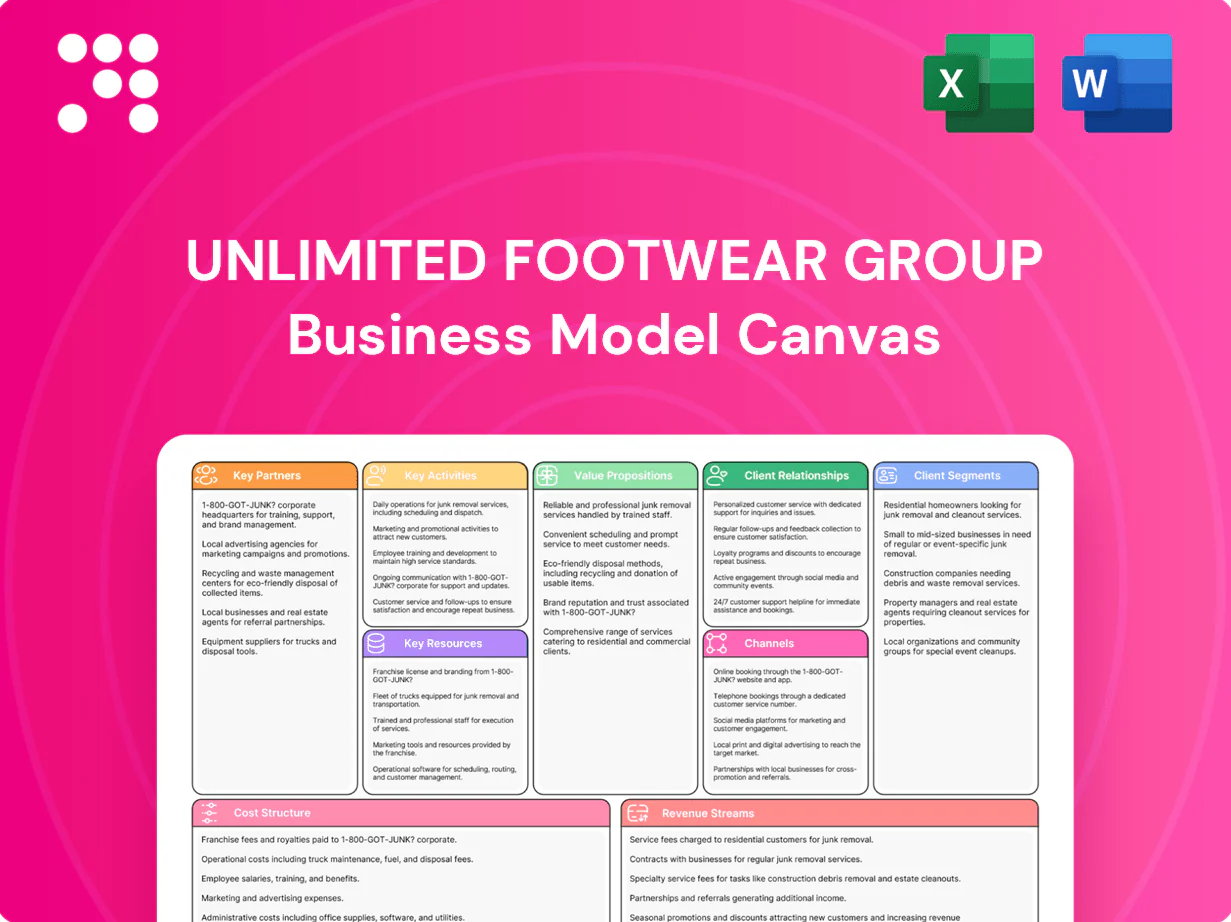
Unlimited Footwear Group Business Model Canvas

Discover the strategic core of a leading footwear group: 3 Business Model Canvas insights
Discover the strategic core of Unlimited Footwear Group with our concise Business Model Canvas overview—three key insights into its value proposition, channels, and revenue model. Want the complete, editable canvas with section-by-section analysis and financial implications? Purchase the full Word/Excel version to benchmark and apply these strategies today.
Partnerships

Tier-1 and Tier-2 factories
Tier-1 and Tier-2 partners in China, Vietnam and India enable scalable, seasonal production supporting the $455B global footwear market (2024) and Vietnam's $16B footwear exports (2023). Long-term contracts secure capacity, MOQs typically 500–2,000 pairs and 8–12 week lead times. Co-development on lasts, molds and materials raises fit and durability, while BSCI/Sedex, RSL and REACH compliance mitigates supply risk.
Material and component suppliers
Leather tanneries, synthetic-upper mills, sole and hardware vendors underpin product performance and cost in a global footwear market exceeding $450 billion in 2024. Preferred supplier programs lock in pricing, secure innovation access and traceability across 60–80% of production volume for scale partners. Collaboration on sustainable materials reinforces brand positioning as demand for greener footwear rises, while vendor-managed inventory can cut stockouts by up to 50% and shorten replenishment cycles.

Retailers and distributors
Department stores, specialty footwear chains and regional distributors extend Unlimited Footwear Group reach into core and new markets, tapping a global footwear market worth an estimated $455 billion in 2024. Joint business planning aligns assortments, promotions and sell-through targets—wholesale partners target 70–85% sell-through on seasonal ranges. EDI and shared POS data, used by ~90% of major retailers, speed replenishment and reduce markdowns. Exclusive capsule collections drive differentiation and customer loyalty.

Logistics and 3PL partners
Global freight forwarders, customs brokers and 3PLs handle inbound, warehousing and last‑mile for Unlimited Footwear, with multi‑node networks boosting wholesale and DTC service levels; Armstrong & Associates projected the global 3PL market > $1.4T in 2024. Value‑added QC, labeling and returns reduce SKU lead times and cost per order, while carrier diversification mitigates disruptions and peak surcharges.
- global‑3PL:$1.4T‑2024
- services:QC,labeling,returns
- multi‑node:improved DTC/wholesale SLAs
- diversification:risk/peak protection
Brand, tech, and marketing allies
Trend agencies, designers, and influencers accelerate product relevance and speed to market, with influencer-driven launches lifting early sell-through by as much as 30% in 2024. PLM/ERP/ecommerce platforms unify concept-to-consumer data, cutting time-to-market up to 30% and reducing SKU errors that erode margins. Marketplaces and payment providers broaden reach and conversion; sustainability and compliance auditors reduce regulatory risk and improve brand trust—critical as 2024 ESG scrutiny increases.
- Trend agencies/influencers: +30% early sell-through (2024)
- PLM/ERP/ecommerce: up to 30% faster time-to-market
- Marketplaces/payments: expanded reach and conversion
- Sustainability auditors: lower compliance risk, boost credibility
Tier-1/2 Asia factories secure seasonal capacity for a $455B footwear market
Tier‑1/2 factories in China, Vietnam, India secure seasonal capacity for a $455B global footwear market (2024); MOQs 500–2,000 pairs, 8–12 week lead times. Preferred suppliers cover 60–80% volume, co‑development improves fit/durability and sustainability. 3PLs/3PL market $1.4T (2024) and influencers/PLM lift early sell‑through +30% and cut time‑to‑market up to 30% (2024).
| Metric | Value | Source (year) |
|---|---|---|
| Global market | $455B | Industry (2024) |
| Vietnam exports | $16B | Trade (2023) |
| 3PL market | $1.4T | Armstrong (2024) |
What is included in the product
 Detailed Word Document
A concise, investor-ready Business Model Canvas for Unlimited Footwear Group outlining customer segments, channels, value propositions, revenue streams, key partners and resources, plus risks and competitive advantages to support strategic decisions and funding pitches.

 Customizable Excel Spreadsheet
High-level view of Unlimited Footwear Group’s business model with editable cells, relieving the pain of scattered strategic information by consolidating value propositions, channels, and cost drivers into one clean, shareable snapshot for fast decision-making.
Activities

Design and product development
Seasonal concepting, trend translation and last/mold creation drive collection appeal across Unlimited Footwear Group, which in 2024 operates the Bullboxer, Rehab and Nubikk brands and is listed on Euronext Amsterdam. Rapid prototyping and fit testing ensure consistent comfort and sizing. Material selection balances quality, cost and sustainability priorities. Line building aligns each brand identity with evolving consumer demand.
Sourcing and supplier management
Factory allocation optimizes cost, capacity and lead-times across regions to match demand; in 2024 the global footwear market was ~USD 390 billion, increasing pressure on margins. Negotiations lock pricing, payment terms and quality KPIs. Compliance audits enforce social and chemical standards. Continuous improvement programs target defect and return rate reductions.

Brand marketing and merchandising
Campaigns position each brand distinctly across gender and lifestyle, driving targeted reach and premium perception. Visual merchandising and storytelling boost online and in-store conversion and average basket value. Influencer and PR activations leverage a global influencer market forecast at about 24 billion USD in 2024 to build awareness efficiently while channel-specific assortment curation maximizes margin and sell-through.

Sales and channel management
Wholesale account management secures orders and replenishment, preserving channel revenue while reducing stockouts; wholesale remains core to scaled footwear brands. DTC ecommerce optimization targets UX, conversion (industry average ~2–3% in 2024) and AOV uplift through personalization and checkout improvements. Marketplace operations keep listings, content and pricing integrity—Amazon holds roughly 40% of US online retail—while international expansion mixes distributors with select direct-entry to control margins.
- Wholesale: order/replenishment focus
- DTC: UX, conversion 2–3% (2024), AOV
- Marketplace: listings, pricing integrity
- Intl: distributors + direct for margin/control
Demand planning and fulfillment
SKU-level forecasting aligns buys to sell-through targets, improving turnover and supporting Unlimited Footwear Group’s 2024 omnichannel push; inventory allocation prioritizes margin and service, lifting gross margin contribution by ~4 percentage points year-over-year. Warehouse operations enable fast pick-pack-ship and reduced return friction, keeping e-commerce return rates near the 2024 apparel average of ~18%. Post-sales analytics drive reorders and markdown cadence based on real-time sell-through and margin impact.
- SKU forecasting: sell-through alignment
- Allocation: margin & service priority
- Ops: fast pick-pack-ship, lower returns (~18% 2024)
- Analytics: reorder & markdown optimization
Seasonal prototyping, material & factory optimization; market ~USD 390B
Seasonal concepting, rapid prototyping and material selection for Bullboxer, Rehab and Nubikk (Euronext 2024) drive collection appeal and fit. Factory allocation, pricing negotiations and compliance audits optimize cost, lead-times and quality while targeting defect reductions; global footwear market ~USD 390B (2024). Omnichannel focus: wholesale scale, DTC conversion 2–3% (2024), e‑commerce returns ~18%, Amazon ~40% US.
| Metric | 2024 |
|---|---|
| Global footwear market | ~USD 390B |
| DTC conversion | 2–3% |
| E‑commerce returns | ~18% |
| Amazon US share | ~40% |
What You See Is What You Get
Business Model Canvas
The document you're previewing is the actual Unlimited Footwear Group Business Model Canvas—not a mockup. When you purchase, you'll receive this exact file with all sections intact, ready to edit, present, and share. Delivery includes the full document in editable Word and Excel formats.

Discover the strategic core of a leading footwear group: 3 Business Model Canvas insights
Discover the strategic core of Unlimited Footwear Group with our concise Business Model Canvas overview—three key insights into its value proposition, channels, and revenue model. Want the complete, editable canvas with section-by-section analysis and financial implications? Purchase the full Word/Excel version to benchmark and apply these strategies today.
Partnerships
Tier-1 and Tier-2 factories
Tier-1 and Tier-2 partners in China, Vietnam and India enable scalable, seasonal production supporting the $455B global footwear market (2024) and Vietnam's $16B footwear exports (2023). Long-term contracts secure capacity, MOQs typically 500–2,000 pairs and 8–12 week lead times. Co-development on lasts, molds and materials raises fit and durability, while BSCI/Sedex, RSL and REACH compliance mitigates supply risk.
Material and component suppliers
Leather tanneries, synthetic-upper mills, sole and hardware vendors underpin product performance and cost in a global footwear market exceeding $450 billion in 2024. Preferred supplier programs lock in pricing, secure innovation access and traceability across 60–80% of production volume for scale partners. Collaboration on sustainable materials reinforces brand positioning as demand for greener footwear rises, while vendor-managed inventory can cut stockouts by up to 50% and shorten replenishment cycles.
Retailers and distributors
Department stores, specialty footwear chains and regional distributors extend Unlimited Footwear Group reach into core and new markets, tapping a global footwear market worth an estimated $455 billion in 2024. Joint business planning aligns assortments, promotions and sell-through targets—wholesale partners target 70–85% sell-through on seasonal ranges. EDI and shared POS data, used by ~90% of major retailers, speed replenishment and reduce markdowns. Exclusive capsule collections drive differentiation and customer loyalty.
Logistics and 3PL partners
Global freight forwarders, customs brokers and 3PLs handle inbound, warehousing and last‑mile for Unlimited Footwear, with multi‑node networks boosting wholesale and DTC service levels; Armstrong & Associates projected the global 3PL market > $1.4T in 2024. Value‑added QC, labeling and returns reduce SKU lead times and cost per order, while carrier diversification mitigates disruptions and peak surcharges.
- global‑3PL:$1.4T‑2024
- services:QC,labeling,returns
- multi‑node:improved DTC/wholesale SLAs
- diversification:risk/peak protection
Brand, tech, and marketing allies
Trend agencies, designers, and influencers accelerate product relevance and speed to market, with influencer-driven launches lifting early sell-through by as much as 30% in 2024. PLM/ERP/ecommerce platforms unify concept-to-consumer data, cutting time-to-market up to 30% and reducing SKU errors that erode margins. Marketplaces and payment providers broaden reach and conversion; sustainability and compliance auditors reduce regulatory risk and improve brand trust—critical as 2024 ESG scrutiny increases.
- Trend agencies/influencers: +30% early sell-through (2024)
- PLM/ERP/ecommerce: up to 30% faster time-to-market
- Marketplaces/payments: expanded reach and conversion
- Sustainability auditors: lower compliance risk, boost credibility
Tier-1/2 Asia factories secure seasonal capacity for a $455B footwear market
Tier‑1/2 factories in China, Vietnam, India secure seasonal capacity for a $455B global footwear market (2024); MOQs 500–2,000 pairs, 8–12 week lead times. Preferred suppliers cover 60–80% volume, co‑development improves fit/durability and sustainability. 3PLs/3PL market $1.4T (2024) and influencers/PLM lift early sell‑through +30% and cut time‑to‑market up to 30% (2024).
| Metric | Value | Source (year) |
|---|---|---|
| Global market | $455B | Industry (2024) |
| Vietnam exports | $16B | Trade (2023) |
| 3PL market | $1.4T | Armstrong (2024) |
What is included in the product
Detailed Word Document
A concise, investor-ready Business Model Canvas for Unlimited Footwear Group outlining customer segments, channels, value propositions, revenue streams, key partners and resources, plus risks and competitive advantages to support strategic decisions and funding pitches.
Customizable Excel Spreadsheet
High-level view of Unlimited Footwear Group’s business model with editable cells, relieving the pain of scattered strategic information by consolidating value propositions, channels, and cost drivers into one clean, shareable snapshot for fast decision-making.
Activities
Design and product development
Seasonal concepting, trend translation and last/mold creation drive collection appeal across Unlimited Footwear Group, which in 2024 operates the Bullboxer, Rehab and Nubikk brands and is listed on Euronext Amsterdam. Rapid prototyping and fit testing ensure consistent comfort and sizing. Material selection balances quality, cost and sustainability priorities. Line building aligns each brand identity with evolving consumer demand.
Sourcing and supplier management
Factory allocation optimizes cost, capacity and lead-times across regions to match demand; in 2024 the global footwear market was ~USD 390 billion, increasing pressure on margins. Negotiations lock pricing, payment terms and quality KPIs. Compliance audits enforce social and chemical standards. Continuous improvement programs target defect and return rate reductions.
Brand marketing and merchandising
Campaigns position each brand distinctly across gender and lifestyle, driving targeted reach and premium perception. Visual merchandising and storytelling boost online and in-store conversion and average basket value. Influencer and PR activations leverage a global influencer market forecast at about 24 billion USD in 2024 to build awareness efficiently while channel-specific assortment curation maximizes margin and sell-through.
Sales and channel management
Wholesale account management secures orders and replenishment, preserving channel revenue while reducing stockouts; wholesale remains core to scaled footwear brands. DTC ecommerce optimization targets UX, conversion (industry average ~2–3% in 2024) and AOV uplift through personalization and checkout improvements. Marketplace operations keep listings, content and pricing integrity—Amazon holds roughly 40% of US online retail—while international expansion mixes distributors with select direct-entry to control margins.
- Wholesale: order/replenishment focus
- DTC: UX, conversion 2–3% (2024), AOV
- Marketplace: listings, pricing integrity
- Intl: distributors + direct for margin/control
Demand planning and fulfillment
SKU-level forecasting aligns buys to sell-through targets, improving turnover and supporting Unlimited Footwear Group’s 2024 omnichannel push; inventory allocation prioritizes margin and service, lifting gross margin contribution by ~4 percentage points year-over-year. Warehouse operations enable fast pick-pack-ship and reduced return friction, keeping e-commerce return rates near the 2024 apparel average of ~18%. Post-sales analytics drive reorders and markdown cadence based on real-time sell-through and margin impact.
- SKU forecasting: sell-through alignment
- Allocation: margin & service priority
- Ops: fast pick-pack-ship, lower returns (~18% 2024)
- Analytics: reorder & markdown optimization
Seasonal prototyping, material & factory optimization; market ~USD 390B
Seasonal concepting, rapid prototyping and material selection for Bullboxer, Rehab and Nubikk (Euronext 2024) drive collection appeal and fit. Factory allocation, pricing negotiations and compliance audits optimize cost, lead-times and quality while targeting defect reductions; global footwear market ~USD 390B (2024). Omnichannel focus: wholesale scale, DTC conversion 2–3% (2024), e‑commerce returns ~18%, Amazon ~40% US.
| Metric | 2024 |
|---|---|
| Global footwear market | ~USD 390B |
| DTC conversion | 2–3% |
| E‑commerce returns | ~18% |
| Amazon US share | ~40% |
What You See Is What You Get
Business Model Canvas
The document you're previewing is the actual Unlimited Footwear Group Business Model Canvas—not a mockup. When you purchase, you'll receive this exact file with all sections intact, ready to edit, present, and share. Delivery includes the full document in editable Word and Excel formats.
Original: $10.00
-65%$10.00
$3.50Description
Discover the strategic core of a leading footwear group: 3 Business Model Canvas insights
Discover the strategic core of Unlimited Footwear Group with our concise Business Model Canvas overview—three key insights into its value proposition, channels, and revenue model. Want the complete, editable canvas with section-by-section analysis and financial implications? Purchase the full Word/Excel version to benchmark and apply these strategies today.
Partnerships
Tier-1 and Tier-2 factories
Tier-1 and Tier-2 partners in China, Vietnam and India enable scalable, seasonal production supporting the $455B global footwear market (2024) and Vietnam's $16B footwear exports (2023). Long-term contracts secure capacity, MOQs typically 500–2,000 pairs and 8–12 week lead times. Co-development on lasts, molds and materials raises fit and durability, while BSCI/Sedex, RSL and REACH compliance mitigates supply risk.
Material and component suppliers
Leather tanneries, synthetic-upper mills, sole and hardware vendors underpin product performance and cost in a global footwear market exceeding $450 billion in 2024. Preferred supplier programs lock in pricing, secure innovation access and traceability across 60–80% of production volume for scale partners. Collaboration on sustainable materials reinforces brand positioning as demand for greener footwear rises, while vendor-managed inventory can cut stockouts by up to 50% and shorten replenishment cycles.
Retailers and distributors
Department stores, specialty footwear chains and regional distributors extend Unlimited Footwear Group reach into core and new markets, tapping a global footwear market worth an estimated $455 billion in 2024. Joint business planning aligns assortments, promotions and sell-through targets—wholesale partners target 70–85% sell-through on seasonal ranges. EDI and shared POS data, used by ~90% of major retailers, speed replenishment and reduce markdowns. Exclusive capsule collections drive differentiation and customer loyalty.
Logistics and 3PL partners
Global freight forwarders, customs brokers and 3PLs handle inbound, warehousing and last‑mile for Unlimited Footwear, with multi‑node networks boosting wholesale and DTC service levels; Armstrong & Associates projected the global 3PL market > $1.4T in 2024. Value‑added QC, labeling and returns reduce SKU lead times and cost per order, while carrier diversification mitigates disruptions and peak surcharges.
- global‑3PL:$1.4T‑2024
- services:QC,labeling,returns
- multi‑node:improved DTC/wholesale SLAs
- diversification:risk/peak protection
Brand, tech, and marketing allies
Trend agencies, designers, and influencers accelerate product relevance and speed to market, with influencer-driven launches lifting early sell-through by as much as 30% in 2024. PLM/ERP/ecommerce platforms unify concept-to-consumer data, cutting time-to-market up to 30% and reducing SKU errors that erode margins. Marketplaces and payment providers broaden reach and conversion; sustainability and compliance auditors reduce regulatory risk and improve brand trust—critical as 2024 ESG scrutiny increases.
- Trend agencies/influencers: +30% early sell-through (2024)
- PLM/ERP/ecommerce: up to 30% faster time-to-market
- Marketplaces/payments: expanded reach and conversion
- Sustainability auditors: lower compliance risk, boost credibility
Tier-1/2 Asia factories secure seasonal capacity for a $455B footwear market
Tier‑1/2 factories in China, Vietnam, India secure seasonal capacity for a $455B global footwear market (2024); MOQs 500–2,000 pairs, 8–12 week lead times. Preferred suppliers cover 60–80% volume, co‑development improves fit/durability and sustainability. 3PLs/3PL market $1.4T (2024) and influencers/PLM lift early sell‑through +30% and cut time‑to‑market up to 30% (2024).
| Metric | Value | Source (year) |
|---|---|---|
| Global market | $455B | Industry (2024) |
| Vietnam exports | $16B | Trade (2023) |
| 3PL market | $1.4T | Armstrong (2024) |
What is included in the product
Detailed Word Document
A concise, investor-ready Business Model Canvas for Unlimited Footwear Group outlining customer segments, channels, value propositions, revenue streams, key partners and resources, plus risks and competitive advantages to support strategic decisions and funding pitches.
Customizable Excel Spreadsheet
High-level view of Unlimited Footwear Group’s business model with editable cells, relieving the pain of scattered strategic information by consolidating value propositions, channels, and cost drivers into one clean, shareable snapshot for fast decision-making.
Activities
Design and product development
Seasonal concepting, trend translation and last/mold creation drive collection appeal across Unlimited Footwear Group, which in 2024 operates the Bullboxer, Rehab and Nubikk brands and is listed on Euronext Amsterdam. Rapid prototyping and fit testing ensure consistent comfort and sizing. Material selection balances quality, cost and sustainability priorities. Line building aligns each brand identity with evolving consumer demand.
Sourcing and supplier management
Factory allocation optimizes cost, capacity and lead-times across regions to match demand; in 2024 the global footwear market was ~USD 390 billion, increasing pressure on margins. Negotiations lock pricing, payment terms and quality KPIs. Compliance audits enforce social and chemical standards. Continuous improvement programs target defect and return rate reductions.
Brand marketing and merchandising
Campaigns position each brand distinctly across gender and lifestyle, driving targeted reach and premium perception. Visual merchandising and storytelling boost online and in-store conversion and average basket value. Influencer and PR activations leverage a global influencer market forecast at about 24 billion USD in 2024 to build awareness efficiently while channel-specific assortment curation maximizes margin and sell-through.
Sales and channel management
Wholesale account management secures orders and replenishment, preserving channel revenue while reducing stockouts; wholesale remains core to scaled footwear brands. DTC ecommerce optimization targets UX, conversion (industry average ~2–3% in 2024) and AOV uplift through personalization and checkout improvements. Marketplace operations keep listings, content and pricing integrity—Amazon holds roughly 40% of US online retail—while international expansion mixes distributors with select direct-entry to control margins.
- Wholesale: order/replenishment focus
- DTC: UX, conversion 2–3% (2024), AOV
- Marketplace: listings, pricing integrity
- Intl: distributors + direct for margin/control
Demand planning and fulfillment
SKU-level forecasting aligns buys to sell-through targets, improving turnover and supporting Unlimited Footwear Group’s 2024 omnichannel push; inventory allocation prioritizes margin and service, lifting gross margin contribution by ~4 percentage points year-over-year. Warehouse operations enable fast pick-pack-ship and reduced return friction, keeping e-commerce return rates near the 2024 apparel average of ~18%. Post-sales analytics drive reorders and markdown cadence based on real-time sell-through and margin impact.
- SKU forecasting: sell-through alignment
- Allocation: margin & service priority
- Ops: fast pick-pack-ship, lower returns (~18% 2024)
- Analytics: reorder & markdown optimization
Seasonal prototyping, material & factory optimization; market ~USD 390B
Seasonal concepting, rapid prototyping and material selection for Bullboxer, Rehab and Nubikk (Euronext 2024) drive collection appeal and fit. Factory allocation, pricing negotiations and compliance audits optimize cost, lead-times and quality while targeting defect reductions; global footwear market ~USD 390B (2024). Omnichannel focus: wholesale scale, DTC conversion 2–3% (2024), e‑commerce returns ~18%, Amazon ~40% US.
| Metric | 2024 |
|---|---|
| Global footwear market | ~USD 390B |
| DTC conversion | 2–3% |
| E‑commerce returns | ~18% |
| Amazon US share | ~40% |
What You See Is What You Get
Business Model Canvas
The document you're previewing is the actual Unlimited Footwear Group Business Model Canvas—not a mockup. When you purchase, you'll receive this exact file with all sections intact, ready to edit, present, and share. Delivery includes the full document in editable Word and Excel formats.











