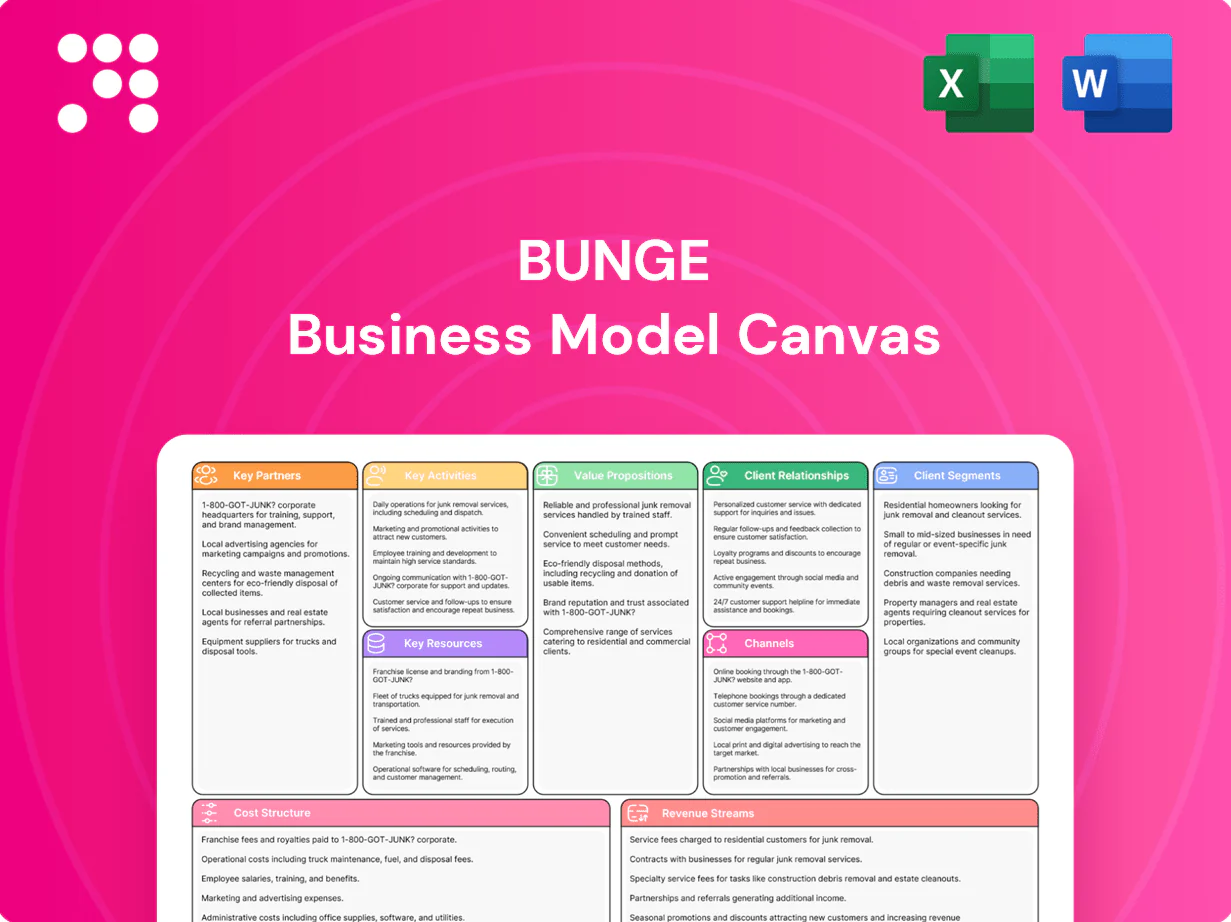
Bunge Business Model Canvas

Unlock the strategic blueprint of a global agribusiness trader with a concise Business Model Canvas
Unlock Bunge’s strategic blueprint with a concise Business Model Canvas that maps its value proposition, key partners, distribution channels and revenue streams. This snapshot reveals how Bunge scales commodities trading, processing and logistics to capture margins. Ideal for investors, consultants and strategists seeking actionable insights. Purchase the full, editable Canvas (Word & Excel) to benchmark or adapt these proven strategies.
Partnerships

Global farmers and producer cooperatives
Bunge partners with growers and producer cooperatives across 40+ countries to secure steady oilseed and grain supplies, supporting handling of tens of millions of tonnes annually. Long-term origination relationships improve quality, traceability and planting alignment. Agronomy support and offtake contracts help farmers de-risk production, underpinning reliable throughput for Bunge’s global processing assets.
Shipping, logistics, and port operators
Strategic alliances with ocean carriers, barge fleets, railroads and terminal operators secure integrated global movement for Bunge, enabling prioritized routing and contingency options. Coordinated scheduling across modes reduces demurrage and port bottlenecks, improving vessel and rail turnaround. Preferred capacity agreements and multi-modal solutions cut transit time and logistics cost while joint safety and ESG standards strengthen reliability and regulatory compliance.

Refiners, biofuel producers, and energy partners
Collaborations with refiners, biofuel producers, and energy partners align Bunge feedstock supply to rising renewable diesel, SAF, and biodiesel demand, securing consistent sourcing and market access. Co-investments and offtake contracts stabilize volumes and margins through multi-year agreements and shared plant economics. Technical partnerships refine feedstock specs and improve process yields, expanding access to higher-value low-carbon markets.

Food manufacturers and ingredient innovators
Food manufacturers and ingredient innovators co-develop tailored oils, meals and specialty ingredients with Bunge, aligning formulations to improve functionality, nutrition and cost-in-use while meeting commercial specs. Joint R&D partnerships drive iterative trials and scale-up, and collaborative forecasting smooths supply volatility across seasons. Robust quality and certification programs ensure compliance with strict food safety standards.
- Co-development of tailored oils and meals
- Joint R&D to improve functionality and nutrition
- Collaborative forecasting to reduce supply volatility
- Quality and certification programs for food safety
Regulators, certification bodies, and NGOs
Engagement with regulators, certification bodies, and NGOs ensures compliance with trade, biofuel, and sustainability rules, including the EU Deforestation Regulation coming into force Dec 30, 2024.
Certification partnerships (ISCC, RTRS) enable traceable, deforestation-free supply chains and meet growing buyer and investor due-diligence expectations.
Independent third-party audits strengthen credibility with customers and investors, while policy dialogue helps shape pragmatic, scalable standards.
- regulatory compliance — EUDR effective 30‑Dec‑2024
- certifications — ISCC, RTRS for traceability
- audits — independent verification boosts investor confidence
- policy dialogue — drives scalable industry standards
Origin in 40+ countries ensures multimodal logistics and EUDR compliance
Bunge secures oilseed and grain supply via origination partnerships with growers and cooperatives in 40+ countries, underpinning global processing throughput. Strategic alliances with ocean carriers, barge, rail and terminals ensure prioritized multimodal logistics and reduced demurrage. Certification and regulatory partnerships (ISCC, RTRS) support compliance with the EU Deforestation Regulation effective 30‑Dec‑2024.
| Metric | Value |
|---|---|
| Countries | 40+ |
| Key certifications | ISCC, RTRS |
| EUDR effective | 30‑Dec‑2024 |
What is included in the product
 Detailed Word Document
A comprehensive Business Model Canvas for Bunge outlining customer segments, channels, value propositions, key activities, resources, partners, cost structure, and revenue streams across 9 blocks. Reflects real-world agribusiness operations, includes competitive advantage analysis and SWOT insights—ideal for presentations, investor discussions, and strategic decision-making.

 Customizable Excel Spreadsheet
High-level view of Bunge’s business model with editable cells; condenses strategy into a digestible one-page snapshot that saves hours of structuring, enables quick comparisons, and supports team collaboration and boardroom-ready presentations.
Activities

Origination and procurement of commodities
Bunge sources oilseeds and grains across 40+ growing regions, managing bids, contracts and intake quality across its supply chain. Seasonal planning aligns volumes with crush and export programs, coordinating shipment windows for millions of tonnes annually. Supplier development programs and traceability initiatives expanded in 2024 to strengthen origin monitoring and resilience.
Processing, crushing, and refining
Assets convert raw crops into oils, meals, flours and specialty ingredients, with Bunge processing about 64 million tonnes of oilseeds and grains in 2024. Continuous improvement programs raised plant uptime ~2 percentage points and cut energy intensity roughly 5%, boosting yields and margins. Rigorous food safety and QA systems (HACCP, FSMA alignment) secure product consistency and traceability. Dynamic capacity balancing across regions matches local demand and optimizes margin capture.

Trading, merchandising, and hedging
Commercial teams optimize basis, spreads and cross-market arbitrage to capture margins across origination and processing; Bunge reported FY2023 net sales of 68.7 billion USD and continued similar high-volume flows into 2024. Risk tools hedge price, currency and freight exposures, reducing earnings volatility and supporting H1 2024 adjusted EBITDA of about 1.9 billion USD. Structured deals lock in margins on integrated flows while data-led decisions improve timing and allocation.

Logistics, storage, and export operations
Ports, silos and company fleets provide Bunge with end-to-end flow control, linking origination to export; scheduling reduces handling losses and lifts asset turns, lowering costs. Rigorous compliance and trade documentation speed cross-border clearance, while contingency routing limits delays from weather or geopolitical events; USDA reports world grain trade ~460 million tonnes in 2023/24.
- Flow control: ports, silos, fleets
- Scheduling: lower losses & costs
- Compliance: streamlined exports
- Contingency routing: disruption mitigation
R&D, sustainability, and traceability programs
R&D develops differentiated ingredients and low-carbon feedstocks, accelerating product innovation and decarbonization across supply chains. Monitoring and third-party certification track origin and ESG attributes to enforce supplier compliance and sustainability targets. Digital trace systems deliver chain-of-custody transparency, supporting deforestation-free and regenerative-practice programs.
Oilseed/grain processor: 64 Mt, 1.9 B USD H1 EBITDA
Bunge sources and contracts oilseeds/grains across 40+ regions, aligning seasonal intake to crush and export programs. Plants processed about 64 million tonnes in 2024 while CI efforts raised uptime ~2 pp and cut energy intensity ~5%. Commercial hedging and structured deals supported H1 2024 adjusted EBITDA ~1.9 billion USD, with FY2023 net sales 68.7 billion USD.
| Metric | 2023/24 |
|---|---|
| Processed volume | 64 Mt (2024) |
| Net sales | 68.7 B USD (FY2023) |
| Adj. EBITDA H1 | ~1.9 B USD (H1 2024) |
| World grain trade | ~460 Mt (2023/24) |
Preview Before You Purchase
Business Model Canvas
The document you're previewing is the actual Bunge Business Model Canvas—not a mockup. After purchase you’ll receive this same file, complete and formatted, ready to edit and present. No filler or surprises; what you see is what you’ll download.

Unlock the strategic blueprint of a global agribusiness trader with a concise Business Model Canvas
Unlock Bunge’s strategic blueprint with a concise Business Model Canvas that maps its value proposition, key partners, distribution channels and revenue streams. This snapshot reveals how Bunge scales commodities trading, processing and logistics to capture margins. Ideal for investors, consultants and strategists seeking actionable insights. Purchase the full, editable Canvas (Word & Excel) to benchmark or adapt these proven strategies.
Partnerships
Global farmers and producer cooperatives
Bunge partners with growers and producer cooperatives across 40+ countries to secure steady oilseed and grain supplies, supporting handling of tens of millions of tonnes annually. Long-term origination relationships improve quality, traceability and planting alignment. Agronomy support and offtake contracts help farmers de-risk production, underpinning reliable throughput for Bunge’s global processing assets.
Shipping, logistics, and port operators
Strategic alliances with ocean carriers, barge fleets, railroads and terminal operators secure integrated global movement for Bunge, enabling prioritized routing and contingency options. Coordinated scheduling across modes reduces demurrage and port bottlenecks, improving vessel and rail turnaround. Preferred capacity agreements and multi-modal solutions cut transit time and logistics cost while joint safety and ESG standards strengthen reliability and regulatory compliance.
Refiners, biofuel producers, and energy partners
Collaborations with refiners, biofuel producers, and energy partners align Bunge feedstock supply to rising renewable diesel, SAF, and biodiesel demand, securing consistent sourcing and market access. Co-investments and offtake contracts stabilize volumes and margins through multi-year agreements and shared plant economics. Technical partnerships refine feedstock specs and improve process yields, expanding access to higher-value low-carbon markets.
Food manufacturers and ingredient innovators
Food manufacturers and ingredient innovators co-develop tailored oils, meals and specialty ingredients with Bunge, aligning formulations to improve functionality, nutrition and cost-in-use while meeting commercial specs. Joint R&D partnerships drive iterative trials and scale-up, and collaborative forecasting smooths supply volatility across seasons. Robust quality and certification programs ensure compliance with strict food safety standards.
- Co-development of tailored oils and meals
- Joint R&D to improve functionality and nutrition
- Collaborative forecasting to reduce supply volatility
- Quality and certification programs for food safety
Regulators, certification bodies, and NGOs
Engagement with regulators, certification bodies, and NGOs ensures compliance with trade, biofuel, and sustainability rules, including the EU Deforestation Regulation coming into force Dec 30, 2024.
Certification partnerships (ISCC, RTRS) enable traceable, deforestation-free supply chains and meet growing buyer and investor due-diligence expectations.
Independent third-party audits strengthen credibility with customers and investors, while policy dialogue helps shape pragmatic, scalable standards.
- regulatory compliance — EUDR effective 30‑Dec‑2024
- certifications — ISCC, RTRS for traceability
- audits — independent verification boosts investor confidence
- policy dialogue — drives scalable industry standards
Origin in 40+ countries ensures multimodal logistics and EUDR compliance
Bunge secures oilseed and grain supply via origination partnerships with growers and cooperatives in 40+ countries, underpinning global processing throughput. Strategic alliances with ocean carriers, barge, rail and terminals ensure prioritized multimodal logistics and reduced demurrage. Certification and regulatory partnerships (ISCC, RTRS) support compliance with the EU Deforestation Regulation effective 30‑Dec‑2024.
| Metric | Value |
|---|---|
| Countries | 40+ |
| Key certifications | ISCC, RTRS |
| EUDR effective | 30‑Dec‑2024 |
What is included in the product
Detailed Word Document
A comprehensive Business Model Canvas for Bunge outlining customer segments, channels, value propositions, key activities, resources, partners, cost structure, and revenue streams across 9 blocks. Reflects real-world agribusiness operations, includes competitive advantage analysis and SWOT insights—ideal for presentations, investor discussions, and strategic decision-making.
Customizable Excel Spreadsheet
High-level view of Bunge’s business model with editable cells; condenses strategy into a digestible one-page snapshot that saves hours of structuring, enables quick comparisons, and supports team collaboration and boardroom-ready presentations.
Activities
Origination and procurement of commodities
Bunge sources oilseeds and grains across 40+ growing regions, managing bids, contracts and intake quality across its supply chain. Seasonal planning aligns volumes with crush and export programs, coordinating shipment windows for millions of tonnes annually. Supplier development programs and traceability initiatives expanded in 2024 to strengthen origin monitoring and resilience.
Processing, crushing, and refining
Assets convert raw crops into oils, meals, flours and specialty ingredients, with Bunge processing about 64 million tonnes of oilseeds and grains in 2024. Continuous improvement programs raised plant uptime ~2 percentage points and cut energy intensity roughly 5%, boosting yields and margins. Rigorous food safety and QA systems (HACCP, FSMA alignment) secure product consistency and traceability. Dynamic capacity balancing across regions matches local demand and optimizes margin capture.
Trading, merchandising, and hedging
Commercial teams optimize basis, spreads and cross-market arbitrage to capture margins across origination and processing; Bunge reported FY2023 net sales of 68.7 billion USD and continued similar high-volume flows into 2024. Risk tools hedge price, currency and freight exposures, reducing earnings volatility and supporting H1 2024 adjusted EBITDA of about 1.9 billion USD. Structured deals lock in margins on integrated flows while data-led decisions improve timing and allocation.
Logistics, storage, and export operations
Ports, silos and company fleets provide Bunge with end-to-end flow control, linking origination to export; scheduling reduces handling losses and lifts asset turns, lowering costs. Rigorous compliance and trade documentation speed cross-border clearance, while contingency routing limits delays from weather or geopolitical events; USDA reports world grain trade ~460 million tonnes in 2023/24.
- Flow control: ports, silos, fleets
- Scheduling: lower losses & costs
- Compliance: streamlined exports
- Contingency routing: disruption mitigation
R&D, sustainability, and traceability programs
R&D develops differentiated ingredients and low-carbon feedstocks, accelerating product innovation and decarbonization across supply chains. Monitoring and third-party certification track origin and ESG attributes to enforce supplier compliance and sustainability targets. Digital trace systems deliver chain-of-custody transparency, supporting deforestation-free and regenerative-practice programs.
Oilseed/grain processor: 64 Mt, 1.9 B USD H1 EBITDA
Bunge sources and contracts oilseeds/grains across 40+ regions, aligning seasonal intake to crush and export programs. Plants processed about 64 million tonnes in 2024 while CI efforts raised uptime ~2 pp and cut energy intensity ~5%. Commercial hedging and structured deals supported H1 2024 adjusted EBITDA ~1.9 billion USD, with FY2023 net sales 68.7 billion USD.
| Metric | 2023/24 |
|---|---|
| Processed volume | 64 Mt (2024) |
| Net sales | 68.7 B USD (FY2023) |
| Adj. EBITDA H1 | ~1.9 B USD (H1 2024) |
| World grain trade | ~460 Mt (2023/24) |
Preview Before You Purchase
Business Model Canvas
The document you're previewing is the actual Bunge Business Model Canvas—not a mockup. After purchase you’ll receive this same file, complete and formatted, ready to edit and present. No filler or surprises; what you see is what you’ll download.
Description
Unlock the strategic blueprint of a global agribusiness trader with a concise Business Model Canvas
Unlock Bunge’s strategic blueprint with a concise Business Model Canvas that maps its value proposition, key partners, distribution channels and revenue streams. This snapshot reveals how Bunge scales commodities trading, processing and logistics to capture margins. Ideal for investors, consultants and strategists seeking actionable insights. Purchase the full, editable Canvas (Word & Excel) to benchmark or adapt these proven strategies.
Partnerships
Global farmers and producer cooperatives
Bunge partners with growers and producer cooperatives across 40+ countries to secure steady oilseed and grain supplies, supporting handling of tens of millions of tonnes annually. Long-term origination relationships improve quality, traceability and planting alignment. Agronomy support and offtake contracts help farmers de-risk production, underpinning reliable throughput for Bunge’s global processing assets.
Shipping, logistics, and port operators
Strategic alliances with ocean carriers, barge fleets, railroads and terminal operators secure integrated global movement for Bunge, enabling prioritized routing and contingency options. Coordinated scheduling across modes reduces demurrage and port bottlenecks, improving vessel and rail turnaround. Preferred capacity agreements and multi-modal solutions cut transit time and logistics cost while joint safety and ESG standards strengthen reliability and regulatory compliance.
Refiners, biofuel producers, and energy partners
Collaborations with refiners, biofuel producers, and energy partners align Bunge feedstock supply to rising renewable diesel, SAF, and biodiesel demand, securing consistent sourcing and market access. Co-investments and offtake contracts stabilize volumes and margins through multi-year agreements and shared plant economics. Technical partnerships refine feedstock specs and improve process yields, expanding access to higher-value low-carbon markets.
Food manufacturers and ingredient innovators
Food manufacturers and ingredient innovators co-develop tailored oils, meals and specialty ingredients with Bunge, aligning formulations to improve functionality, nutrition and cost-in-use while meeting commercial specs. Joint R&D partnerships drive iterative trials and scale-up, and collaborative forecasting smooths supply volatility across seasons. Robust quality and certification programs ensure compliance with strict food safety standards.
- Co-development of tailored oils and meals
- Joint R&D to improve functionality and nutrition
- Collaborative forecasting to reduce supply volatility
- Quality and certification programs for food safety
Regulators, certification bodies, and NGOs
Engagement with regulators, certification bodies, and NGOs ensures compliance with trade, biofuel, and sustainability rules, including the EU Deforestation Regulation coming into force Dec 30, 2024.
Certification partnerships (ISCC, RTRS) enable traceable, deforestation-free supply chains and meet growing buyer and investor due-diligence expectations.
Independent third-party audits strengthen credibility with customers and investors, while policy dialogue helps shape pragmatic, scalable standards.
- regulatory compliance — EUDR effective 30‑Dec‑2024
- certifications — ISCC, RTRS for traceability
- audits — independent verification boosts investor confidence
- policy dialogue — drives scalable industry standards
Origin in 40+ countries ensures multimodal logistics and EUDR compliance
Bunge secures oilseed and grain supply via origination partnerships with growers and cooperatives in 40+ countries, underpinning global processing throughput. Strategic alliances with ocean carriers, barge, rail and terminals ensure prioritized multimodal logistics and reduced demurrage. Certification and regulatory partnerships (ISCC, RTRS) support compliance with the EU Deforestation Regulation effective 30‑Dec‑2024.
| Metric | Value |
|---|---|
| Countries | 40+ |
| Key certifications | ISCC, RTRS |
| EUDR effective | 30‑Dec‑2024 |
What is included in the product
Detailed Word Document
A comprehensive Business Model Canvas for Bunge outlining customer segments, channels, value propositions, key activities, resources, partners, cost structure, and revenue streams across 9 blocks. Reflects real-world agribusiness operations, includes competitive advantage analysis and SWOT insights—ideal for presentations, investor discussions, and strategic decision-making.
Customizable Excel Spreadsheet
High-level view of Bunge’s business model with editable cells; condenses strategy into a digestible one-page snapshot that saves hours of structuring, enables quick comparisons, and supports team collaboration and boardroom-ready presentations.
Activities
Origination and procurement of commodities
Bunge sources oilseeds and grains across 40+ growing regions, managing bids, contracts and intake quality across its supply chain. Seasonal planning aligns volumes with crush and export programs, coordinating shipment windows for millions of tonnes annually. Supplier development programs and traceability initiatives expanded in 2024 to strengthen origin monitoring and resilience.
Processing, crushing, and refining
Assets convert raw crops into oils, meals, flours and specialty ingredients, with Bunge processing about 64 million tonnes of oilseeds and grains in 2024. Continuous improvement programs raised plant uptime ~2 percentage points and cut energy intensity roughly 5%, boosting yields and margins. Rigorous food safety and QA systems (HACCP, FSMA alignment) secure product consistency and traceability. Dynamic capacity balancing across regions matches local demand and optimizes margin capture.
Trading, merchandising, and hedging
Commercial teams optimize basis, spreads and cross-market arbitrage to capture margins across origination and processing; Bunge reported FY2023 net sales of 68.7 billion USD and continued similar high-volume flows into 2024. Risk tools hedge price, currency and freight exposures, reducing earnings volatility and supporting H1 2024 adjusted EBITDA of about 1.9 billion USD. Structured deals lock in margins on integrated flows while data-led decisions improve timing and allocation.
Logistics, storage, and export operations
Ports, silos and company fleets provide Bunge with end-to-end flow control, linking origination to export; scheduling reduces handling losses and lifts asset turns, lowering costs. Rigorous compliance and trade documentation speed cross-border clearance, while contingency routing limits delays from weather or geopolitical events; USDA reports world grain trade ~460 million tonnes in 2023/24.
- Flow control: ports, silos, fleets
- Scheduling: lower losses & costs
- Compliance: streamlined exports
- Contingency routing: disruption mitigation
R&D, sustainability, and traceability programs
R&D develops differentiated ingredients and low-carbon feedstocks, accelerating product innovation and decarbonization across supply chains. Monitoring and third-party certification track origin and ESG attributes to enforce supplier compliance and sustainability targets. Digital trace systems deliver chain-of-custody transparency, supporting deforestation-free and regenerative-practice programs.
Oilseed/grain processor: 64 Mt, 1.9 B USD H1 EBITDA
Bunge sources and contracts oilseeds/grains across 40+ regions, aligning seasonal intake to crush and export programs. Plants processed about 64 million tonnes in 2024 while CI efforts raised uptime ~2 pp and cut energy intensity ~5%. Commercial hedging and structured deals supported H1 2024 adjusted EBITDA ~1.9 billion USD, with FY2023 net sales 68.7 billion USD.
| Metric | 2023/24 |
|---|---|
| Processed volume | 64 Mt (2024) |
| Net sales | 68.7 B USD (FY2023) |
| Adj. EBITDA H1 | ~1.9 B USD (H1 2024) |
| World grain trade | ~460 Mt (2023/24) |
Preview Before You Purchase
Business Model Canvas
The document you're previewing is the actual Bunge Business Model Canvas—not a mockup. After purchase you’ll receive this same file, complete and formatted, ready to edit and present. No filler or surprises; what you see is what you’ll download.











