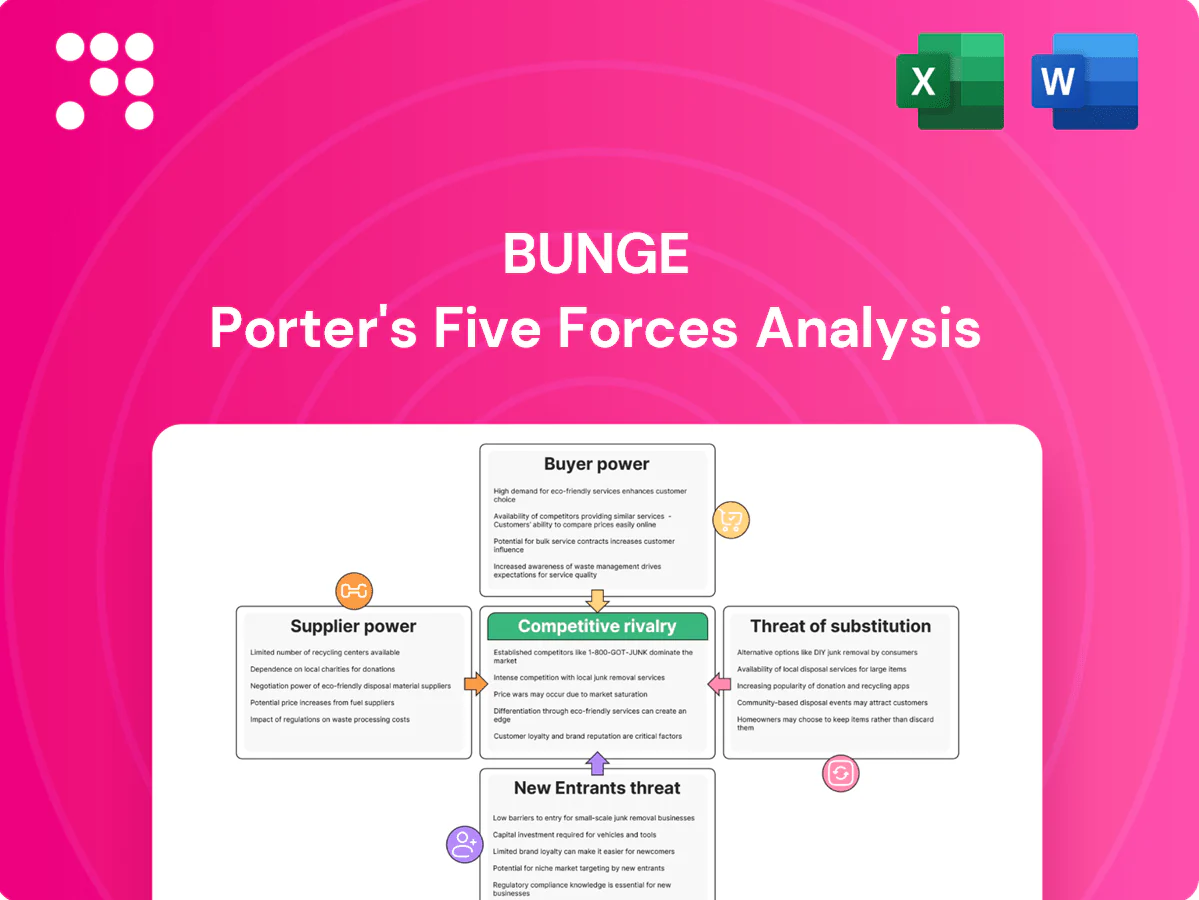
Bunge Porter's Five Forces Analysis

Elevate Your Analysis with the Complete Porter's Five Forces Analysis
Bunge faces intense supplier bargaining for inputs, moderate buyer power, significant rivalry among global agribusinesses, low threat of substitutes but rising regulatory and new-entrant risks. This brief snapshot only scratches the surface. Unlock the full Porter's Five Forces Analysis to explore Bunge’s competitive dynamics and actionable strategy recommendations.
Suppliers Bargaining Power

Fragmented farmer base with regional pockets of leverage
Millions of farmers supply oilseeds and grains, so supplier concentration is generally low, but key origins—Brazil, Argentina and the U.S. Midwest—hold outsized share in the 2023/24 season, giving large growers and co-ops local leverage. Harvest seasonality and localized storage bottlenecks amplify short-term bargaining power during peak windows. Bunge mitigates this through multi-origin sourcing and long-term origination programs with growers and co-ops.
Volatility from weather, geopolitics, and trade policy
Climate shocks, export bans, and logistics bottlenecks have tightened supply and lifted supplier leverage, with FOB benchmarks spiking as much as 25% in stressed 2023–24 corridors. When FOB jumps, suppliers secure stronger terms and higher premiums for guaranteed delivery, often 10–30% above spot. Diversified origination and hedging blunt impacts—studies show roughly 15% downside reduction—but cannot fully eliminate volatility.

Quality, traceability, and sustainability premiums
Certified deforestation-free, non-GMO, and identity-preserved crops command meaningful premiums, strengthening supplier leverage as buyers compete for compliant volumes. Suppliers meeting ESG and traceability demands secure bargaining power because regulatory and customer requirements are shifting specification risk upstream. Bunge pays premiums to secure compliant supply and offsets costs through differentiated downstream contracts and value-added trading spreads.

Alternative crop choices and planting flexibility
Farmers shift among soy, corn, sunflower and canola based on relative margins; in 2024 CME soybean futures averaged about 13.00 USD/bu versus corn near 4.50 USD/bu, boosting switching when competing crop margins widen. Forward contracts and agronomic support lower but do not eliminate switching. Bunge's multi-crop crush flexibility mitigates supplier leverage by shifting throughput to more available oilseeds.
- Higher competing crop margins increase supplier leverage
- 2024 soybean ~13.00 USD/bu, corn ~4.50 USD/bu
- Forward contracts reduce but do not prevent switching
- Multi-crop crush flexibility lowers Bunge's supply risk
Infrastructure and storage owners as chokepoints
Infrastructure choke points—local elevator operators, barge fleets, and port terminals—can bottle‑neck flows and elevate bargaining power over exporters. Control of first‑mile/last‑mile assets strengthens these suppliers’ negotiating positions, while Bunge’s owned elevators and terminals in core regions (Bunge is one of the global Big Four agribusiness firms) mitigate that risk. In underbuilt regions, dependence on third‑party assets raises acquisition prices and terminal fees, compressing margins.
- Local elevators/barge fleets: bottlenecks at origin
- Bunge-owned assets: reduce supplier leverage in core markets
- Underbuilt regions: higher fees and acquisition costs
Origins: Brazil, Argentina, US Midwest; FOB spikes ~25%, delivery premiums 10-30%
Supplier concentration is low overall but Brazil, Argentina and U.S. Midwest dominated 2023/24 origins, boosting local leverage during harvest windows. 2024 FOB spikes reached ~25% in stressed corridors; suppliers earned 10–30% delivery premiums while Bunge’s multi‑origin sourcing and origination programs cut exposure. Certified non‑GMO/deforestation‑free volumes commanded premiums; forward contracts and owned terminals reduce but do not remove supplier power.
| Metric | 2023/24–2024 |
|---|---|
| Soybean price (CME avg) | ~13.00 USD/bu (2024) |
| Corn price (CME avg) | ~4.50 USD/bu (2024) |
| FOB spike | up to 25% in stressed corridors |
| Delivery premium | 10–30% |
What is included in the product
 Detailed Word Document
Tailored Porter's Five Forces analysis of Bunge, uncovering key drivers of competition, supplier and buyer power, threats from substitutes and new entrants, plus strategic implications for pricing, margins, and market share in agribusiness and food ingredients.

 Customizable Excel Spreadsheet
A concise one-sheet Porter's Five Forces for Bunge that visualizes supplier, buyer, rivalry, entrant and substitute pressures with an editable spider chart—perfect for quick strategic decisions or slide-ready summaries. Customize scores for changing commodity cycles or regulation scenarios without macros, then drop into decks or dashboards.
Customers Bargaining Power

Large CPGs, feed producers, and biofuel refiners concentrate demand
Blue-chip CPGs, feed producers and biofuel refiners buy in multi-million to multi-billion-dollar volumes and in 2024 negotiated aggressively on price and service, leveraging scale, planning sophistication and alternative global sourcing. Their options lift buyer power, while multi-year supply agreements commonly lock in volume discounts and reduce spot exposure. Bunge emphasizes reliability, quality and risk-management to retain these accounts.
Commodity-like inputs with high price transparency
CBOT futures and published basis make pricing highly visible—CBOT soybean open interest exceeded 1 million contracts in 2024—letting buyers time purchases and arbitrage origins to squeeze margins. Value-add shifts to logistics, customization and just-in-time delivery. Thin processing spreads in 2024 amplified sensitivity to buyer leverage.

Switching costs moderate; qualification and specs matter
While many suppliers exist, qualifying mills and meeting exact specs creates friction: onboarding often requires 3–6 months of audits and test shipments. Food safety, ESG and traceability mandates (GS1 lot-level or equivalent by 2024) limit easy switching, yet over 60% of buyers still multi-source to mitigate risk. Service failures quickly shift volumes to rivals, pressuring suppliers on timeliness and compliance.

Demand cyclicality and reformulation agility
CPGs routinely reformulate among soy, canola, sunflower and palm oils in response to relative prices and availability; in 2024 global vegetable oil stocks recovered, pushing spot spreads narrower and strengthening buyer leverage. Feed rations and biofuel feedstocks shift with crush and biodiesel margins, giving purchasers optionality in oversupplied markets. Bunge mitigates this by offering blended oil solutions and technical formulation support to retain volumes.
Working capital and contract structures as levers
Buyers push for favorable credit terms, tolling and consignment, shifting inventory and working capital burdens onto suppliers; longer tenors and inventory financing effectively move balance-sheet pressure downstream while compressing supplier margins. Bunge leverages trade finance solutions to differentiate and win business but concedes margin to accommodate credit-heavy contracts. Performance clauses and service SLAs are increasingly standard asks that tie payments to delivery and quality metrics.
- Buyers: favorable credit, tolling, consignment
- Impact: longer tenors transfer balance-sheet burden
- Bunge: trade finance as differentiator, margin concession
- Contracts: performance clauses and SLAs common
2024: Large CPGs, biofuel buyers push tougher terms as CBOT soybean OI exceeds 1,000,000
Large CPGs, feed and biofuel buyers exert high bargaining power in 2024, using scale, global sourcing and visible CBOT pricing (soybean open interest >1,000,000 contracts) to push margins and terms. Multi-year contracts lower spot exposure but over 60% of buyers multi-source; vegetable oil stock recovery in 2024 tightened seller margins. Buyers demand longer tenors, tolling and consignment; Bunge leans on blended products, trade finance and SLAs to retain volumes.
| Metric | 2024 Value |
|---|---|
| CBOT soybean open interest | >1,000,000 contracts |
| Buyers multi-sourcing | >60% |
| Market effect | Vegetable oil stocks recovered — tighter seller margins |
Same Document Delivered
Bunge Porter's Five Forces Analysis
This preview shows the exact Bunge Porter's Five Forces Analysis you'll receive immediately after purchase—no surprises, no placeholders. The file covers competitive rivalry, supplier and buyer power, threats of entry and substitutes, and strategic implications. It's fully formatted and ready to download and use the moment you buy.

Elevate Your Analysis with the Complete Porter's Five Forces Analysis
Bunge faces intense supplier bargaining for inputs, moderate buyer power, significant rivalry among global agribusinesses, low threat of substitutes but rising regulatory and new-entrant risks. This brief snapshot only scratches the surface. Unlock the full Porter's Five Forces Analysis to explore Bunge’s competitive dynamics and actionable strategy recommendations.
Suppliers Bargaining Power
Fragmented farmer base with regional pockets of leverage
Millions of farmers supply oilseeds and grains, so supplier concentration is generally low, but key origins—Brazil, Argentina and the U.S. Midwest—hold outsized share in the 2023/24 season, giving large growers and co-ops local leverage. Harvest seasonality and localized storage bottlenecks amplify short-term bargaining power during peak windows. Bunge mitigates this through multi-origin sourcing and long-term origination programs with growers and co-ops.
Volatility from weather, geopolitics, and trade policy
Climate shocks, export bans, and logistics bottlenecks have tightened supply and lifted supplier leverage, with FOB benchmarks spiking as much as 25% in stressed 2023–24 corridors. When FOB jumps, suppliers secure stronger terms and higher premiums for guaranteed delivery, often 10–30% above spot. Diversified origination and hedging blunt impacts—studies show roughly 15% downside reduction—but cannot fully eliminate volatility.
Quality, traceability, and sustainability premiums
Certified deforestation-free, non-GMO, and identity-preserved crops command meaningful premiums, strengthening supplier leverage as buyers compete for compliant volumes. Suppliers meeting ESG and traceability demands secure bargaining power because regulatory and customer requirements are shifting specification risk upstream. Bunge pays premiums to secure compliant supply and offsets costs through differentiated downstream contracts and value-added trading spreads.
Alternative crop choices and planting flexibility
Farmers shift among soy, corn, sunflower and canola based on relative margins; in 2024 CME soybean futures averaged about 13.00 USD/bu versus corn near 4.50 USD/bu, boosting switching when competing crop margins widen. Forward contracts and agronomic support lower but do not eliminate switching. Bunge's multi-crop crush flexibility mitigates supplier leverage by shifting throughput to more available oilseeds.
- Higher competing crop margins increase supplier leverage
- 2024 soybean ~13.00 USD/bu, corn ~4.50 USD/bu
- Forward contracts reduce but do not prevent switching
- Multi-crop crush flexibility lowers Bunge's supply risk
Infrastructure and storage owners as chokepoints
Infrastructure choke points—local elevator operators, barge fleets, and port terminals—can bottle‑neck flows and elevate bargaining power over exporters. Control of first‑mile/last‑mile assets strengthens these suppliers’ negotiating positions, while Bunge’s owned elevators and terminals in core regions (Bunge is one of the global Big Four agribusiness firms) mitigate that risk. In underbuilt regions, dependence on third‑party assets raises acquisition prices and terminal fees, compressing margins.
- Local elevators/barge fleets: bottlenecks at origin
- Bunge-owned assets: reduce supplier leverage in core markets
- Underbuilt regions: higher fees and acquisition costs
Origins: Brazil, Argentina, US Midwest; FOB spikes ~25%, delivery premiums 10-30%
Supplier concentration is low overall but Brazil, Argentina and U.S. Midwest dominated 2023/24 origins, boosting local leverage during harvest windows. 2024 FOB spikes reached ~25% in stressed corridors; suppliers earned 10–30% delivery premiums while Bunge’s multi‑origin sourcing and origination programs cut exposure. Certified non‑GMO/deforestation‑free volumes commanded premiums; forward contracts and owned terminals reduce but do not remove supplier power.
| Metric | 2023/24–2024 |
|---|---|
| Soybean price (CME avg) | ~13.00 USD/bu (2024) |
| Corn price (CME avg) | ~4.50 USD/bu (2024) |
| FOB spike | up to 25% in stressed corridors |
| Delivery premium | 10–30% |
What is included in the product
Detailed Word Document
Tailored Porter's Five Forces analysis of Bunge, uncovering key drivers of competition, supplier and buyer power, threats from substitutes and new entrants, plus strategic implications for pricing, margins, and market share in agribusiness and food ingredients.
Customizable Excel Spreadsheet
A concise one-sheet Porter's Five Forces for Bunge that visualizes supplier, buyer, rivalry, entrant and substitute pressures with an editable spider chart—perfect for quick strategic decisions or slide-ready summaries. Customize scores for changing commodity cycles or regulation scenarios without macros, then drop into decks or dashboards.
Customers Bargaining Power
Large CPGs, feed producers, and biofuel refiners concentrate demand
Blue-chip CPGs, feed producers and biofuel refiners buy in multi-million to multi-billion-dollar volumes and in 2024 negotiated aggressively on price and service, leveraging scale, planning sophistication and alternative global sourcing. Their options lift buyer power, while multi-year supply agreements commonly lock in volume discounts and reduce spot exposure. Bunge emphasizes reliability, quality and risk-management to retain these accounts.
Commodity-like inputs with high price transparency
CBOT futures and published basis make pricing highly visible—CBOT soybean open interest exceeded 1 million contracts in 2024—letting buyers time purchases and arbitrage origins to squeeze margins. Value-add shifts to logistics, customization and just-in-time delivery. Thin processing spreads in 2024 amplified sensitivity to buyer leverage.
Switching costs moderate; qualification and specs matter
While many suppliers exist, qualifying mills and meeting exact specs creates friction: onboarding often requires 3–6 months of audits and test shipments. Food safety, ESG and traceability mandates (GS1 lot-level or equivalent by 2024) limit easy switching, yet over 60% of buyers still multi-source to mitigate risk. Service failures quickly shift volumes to rivals, pressuring suppliers on timeliness and compliance.
Demand cyclicality and reformulation agility
CPGs routinely reformulate among soy, canola, sunflower and palm oils in response to relative prices and availability; in 2024 global vegetable oil stocks recovered, pushing spot spreads narrower and strengthening buyer leverage. Feed rations and biofuel feedstocks shift with crush and biodiesel margins, giving purchasers optionality in oversupplied markets. Bunge mitigates this by offering blended oil solutions and technical formulation support to retain volumes.
Working capital and contract structures as levers
Buyers push for favorable credit terms, tolling and consignment, shifting inventory and working capital burdens onto suppliers; longer tenors and inventory financing effectively move balance-sheet pressure downstream while compressing supplier margins. Bunge leverages trade finance solutions to differentiate and win business but concedes margin to accommodate credit-heavy contracts. Performance clauses and service SLAs are increasingly standard asks that tie payments to delivery and quality metrics.
- Buyers: favorable credit, tolling, consignment
- Impact: longer tenors transfer balance-sheet burden
- Bunge: trade finance as differentiator, margin concession
- Contracts: performance clauses and SLAs common
2024: Large CPGs, biofuel buyers push tougher terms as CBOT soybean OI exceeds 1,000,000
Large CPGs, feed and biofuel buyers exert high bargaining power in 2024, using scale, global sourcing and visible CBOT pricing (soybean open interest >1,000,000 contracts) to push margins and terms. Multi-year contracts lower spot exposure but over 60% of buyers multi-source; vegetable oil stock recovery in 2024 tightened seller margins. Buyers demand longer tenors, tolling and consignment; Bunge leans on blended products, trade finance and SLAs to retain volumes.
| Metric | 2024 Value |
|---|---|
| CBOT soybean open interest | >1,000,000 contracts |
| Buyers multi-sourcing | >60% |
| Market effect | Vegetable oil stocks recovered — tighter seller margins |
Same Document Delivered
Bunge Porter's Five Forces Analysis
This preview shows the exact Bunge Porter's Five Forces Analysis you'll receive immediately after purchase—no surprises, no placeholders. The file covers competitive rivalry, supplier and buyer power, threats of entry and substitutes, and strategic implications. It's fully formatted and ready to download and use the moment you buy.
Original: $10.00
-65%$10.00
$3.50Description
Elevate Your Analysis with the Complete Porter's Five Forces Analysis
Bunge faces intense supplier bargaining for inputs, moderate buyer power, significant rivalry among global agribusinesses, low threat of substitutes but rising regulatory and new-entrant risks. This brief snapshot only scratches the surface. Unlock the full Porter's Five Forces Analysis to explore Bunge’s competitive dynamics and actionable strategy recommendations.
Suppliers Bargaining Power
Fragmented farmer base with regional pockets of leverage
Millions of farmers supply oilseeds and grains, so supplier concentration is generally low, but key origins—Brazil, Argentina and the U.S. Midwest—hold outsized share in the 2023/24 season, giving large growers and co-ops local leverage. Harvest seasonality and localized storage bottlenecks amplify short-term bargaining power during peak windows. Bunge mitigates this through multi-origin sourcing and long-term origination programs with growers and co-ops.
Volatility from weather, geopolitics, and trade policy
Climate shocks, export bans, and logistics bottlenecks have tightened supply and lifted supplier leverage, with FOB benchmarks spiking as much as 25% in stressed 2023–24 corridors. When FOB jumps, suppliers secure stronger terms and higher premiums for guaranteed delivery, often 10–30% above spot. Diversified origination and hedging blunt impacts—studies show roughly 15% downside reduction—but cannot fully eliminate volatility.
Quality, traceability, and sustainability premiums
Certified deforestation-free, non-GMO, and identity-preserved crops command meaningful premiums, strengthening supplier leverage as buyers compete for compliant volumes. Suppliers meeting ESG and traceability demands secure bargaining power because regulatory and customer requirements are shifting specification risk upstream. Bunge pays premiums to secure compliant supply and offsets costs through differentiated downstream contracts and value-added trading spreads.
Alternative crop choices and planting flexibility
Farmers shift among soy, corn, sunflower and canola based on relative margins; in 2024 CME soybean futures averaged about 13.00 USD/bu versus corn near 4.50 USD/bu, boosting switching when competing crop margins widen. Forward contracts and agronomic support lower but do not eliminate switching. Bunge's multi-crop crush flexibility mitigates supplier leverage by shifting throughput to more available oilseeds.
- Higher competing crop margins increase supplier leverage
- 2024 soybean ~13.00 USD/bu, corn ~4.50 USD/bu
- Forward contracts reduce but do not prevent switching
- Multi-crop crush flexibility lowers Bunge's supply risk
Infrastructure and storage owners as chokepoints
Infrastructure choke points—local elevator operators, barge fleets, and port terminals—can bottle‑neck flows and elevate bargaining power over exporters. Control of first‑mile/last‑mile assets strengthens these suppliers’ negotiating positions, while Bunge’s owned elevators and terminals in core regions (Bunge is one of the global Big Four agribusiness firms) mitigate that risk. In underbuilt regions, dependence on third‑party assets raises acquisition prices and terminal fees, compressing margins.
- Local elevators/barge fleets: bottlenecks at origin
- Bunge-owned assets: reduce supplier leverage in core markets
- Underbuilt regions: higher fees and acquisition costs
Origins: Brazil, Argentina, US Midwest; FOB spikes ~25%, delivery premiums 10-30%
Supplier concentration is low overall but Brazil, Argentina and U.S. Midwest dominated 2023/24 origins, boosting local leverage during harvest windows. 2024 FOB spikes reached ~25% in stressed corridors; suppliers earned 10–30% delivery premiums while Bunge’s multi‑origin sourcing and origination programs cut exposure. Certified non‑GMO/deforestation‑free volumes commanded premiums; forward contracts and owned terminals reduce but do not remove supplier power.
| Metric | 2023/24–2024 |
|---|---|
| Soybean price (CME avg) | ~13.00 USD/bu (2024) |
| Corn price (CME avg) | ~4.50 USD/bu (2024) |
| FOB spike | up to 25% in stressed corridors |
| Delivery premium | 10–30% |
What is included in the product
Detailed Word Document
Tailored Porter's Five Forces analysis of Bunge, uncovering key drivers of competition, supplier and buyer power, threats from substitutes and new entrants, plus strategic implications for pricing, margins, and market share in agribusiness and food ingredients.
Customizable Excel Spreadsheet
A concise one-sheet Porter's Five Forces for Bunge that visualizes supplier, buyer, rivalry, entrant and substitute pressures with an editable spider chart—perfect for quick strategic decisions or slide-ready summaries. Customize scores for changing commodity cycles or regulation scenarios without macros, then drop into decks or dashboards.
Customers Bargaining Power
Large CPGs, feed producers, and biofuel refiners concentrate demand
Blue-chip CPGs, feed producers and biofuel refiners buy in multi-million to multi-billion-dollar volumes and in 2024 negotiated aggressively on price and service, leveraging scale, planning sophistication and alternative global sourcing. Their options lift buyer power, while multi-year supply agreements commonly lock in volume discounts and reduce spot exposure. Bunge emphasizes reliability, quality and risk-management to retain these accounts.
Commodity-like inputs with high price transparency
CBOT futures and published basis make pricing highly visible—CBOT soybean open interest exceeded 1 million contracts in 2024—letting buyers time purchases and arbitrage origins to squeeze margins. Value-add shifts to logistics, customization and just-in-time delivery. Thin processing spreads in 2024 amplified sensitivity to buyer leverage.
Switching costs moderate; qualification and specs matter
While many suppliers exist, qualifying mills and meeting exact specs creates friction: onboarding often requires 3–6 months of audits and test shipments. Food safety, ESG and traceability mandates (GS1 lot-level or equivalent by 2024) limit easy switching, yet over 60% of buyers still multi-source to mitigate risk. Service failures quickly shift volumes to rivals, pressuring suppliers on timeliness and compliance.
Demand cyclicality and reformulation agility
CPGs routinely reformulate among soy, canola, sunflower and palm oils in response to relative prices and availability; in 2024 global vegetable oil stocks recovered, pushing spot spreads narrower and strengthening buyer leverage. Feed rations and biofuel feedstocks shift with crush and biodiesel margins, giving purchasers optionality in oversupplied markets. Bunge mitigates this by offering blended oil solutions and technical formulation support to retain volumes.
Working capital and contract structures as levers
Buyers push for favorable credit terms, tolling and consignment, shifting inventory and working capital burdens onto suppliers; longer tenors and inventory financing effectively move balance-sheet pressure downstream while compressing supplier margins. Bunge leverages trade finance solutions to differentiate and win business but concedes margin to accommodate credit-heavy contracts. Performance clauses and service SLAs are increasingly standard asks that tie payments to delivery and quality metrics.
- Buyers: favorable credit, tolling, consignment
- Impact: longer tenors transfer balance-sheet burden
- Bunge: trade finance as differentiator, margin concession
- Contracts: performance clauses and SLAs common
2024: Large CPGs, biofuel buyers push tougher terms as CBOT soybean OI exceeds 1,000,000
Large CPGs, feed and biofuel buyers exert high bargaining power in 2024, using scale, global sourcing and visible CBOT pricing (soybean open interest >1,000,000 contracts) to push margins and terms. Multi-year contracts lower spot exposure but over 60% of buyers multi-source; vegetable oil stock recovery in 2024 tightened seller margins. Buyers demand longer tenors, tolling and consignment; Bunge leans on blended products, trade finance and SLAs to retain volumes.
| Metric | 2024 Value |
|---|---|
| CBOT soybean open interest | >1,000,000 contracts |
| Buyers multi-sourcing | >60% |
| Market effect | Vegetable oil stocks recovered — tighter seller margins |
Same Document Delivered
Bunge Porter's Five Forces Analysis
This preview shows the exact Bunge Porter's Five Forces Analysis you'll receive immediately after purchase—no surprises, no placeholders. The file covers competitive rivalry, supplier and buyer power, threats of entry and substitutes, and strategic implications. It's fully formatted and ready to download and use the moment you buy.











