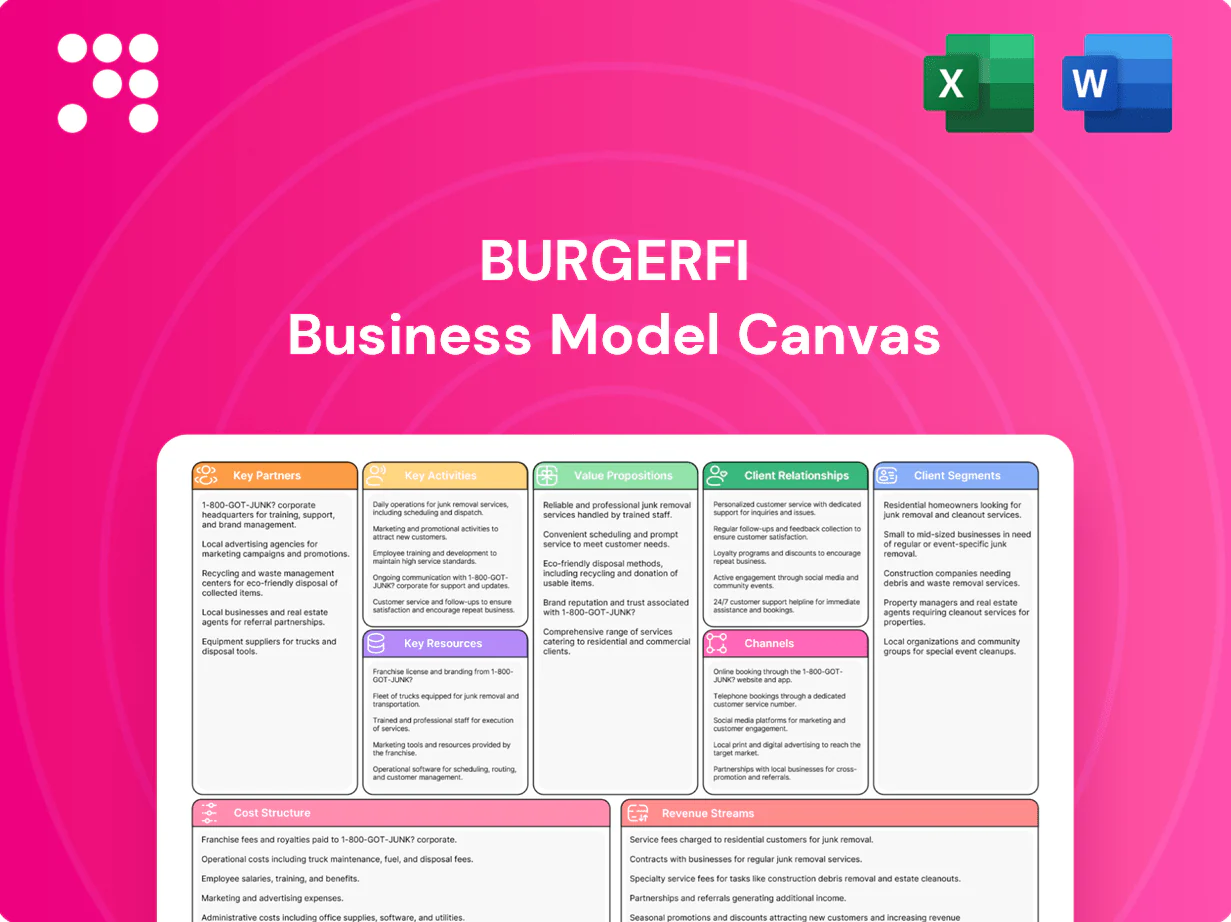
BurgerFi Business Model Canvas

Three-page Business Model Canvas: fast-casual burger chain playbook for investors and founders
Unlock BurgerFi’s strategic playbook with a concise Business Model Canvas that maps value propositions, customer segments, revenue streams and partnerships in one place. This three-page snapshot teases key growth levers—get the full Word/Excel canvas for a section-by-section breakdown and actionable insights. Perfect for investors, consultants, and founders ready to benchmark or replicate success.
Partnerships

Premium beef suppliers
Strategic relationships with certified Angus and natural protein suppliers ensure consistent, hormone- and antibiotic-free beef, with BurgerFi stating in 2024 that it uses 100% certified Angus beef free of added hormones and antibiotics.
Long-term contracts with primary suppliers stabilize pricing and supply continuity, reducing commodity volatility exposure for restaurant operations.
Co-marketing on animal welfare and sourcing transparency reinforces brand trust, while regular supplier audits safeguard traceability and sustainability claims.
Produce & dairy networks
Regional produce and dairy partners supply BurgerFi with fresh vegetables, buns, cheeses and frozen custard inputs, and in 2024 the brand emphasized local sourcing to support menu freshness. Multi-sourcing across several suppliers reduces disruption risk and enables seasonal menu rotations. Cold-chain logistics partners preserve product freshness and safety, while sustainability-aligned vendors support the chain’s eco-friendly positioning.

Franchisees & area developers
Franchisees and area developers supply local capital and market knowledge, driving most BurgerFi expansion while sharing risk; franchised restaurants made up roughly two-thirds of U.S. chain units in 2023–24. Area developers accelerate multi-unit growth and ensure operational consistency through standardized rollouts. Centralized training, QA, and co-funded marketing sustain brand cohesion. Performance dashboards tie incentives to sales, customer experience, and food-safety KPIs.

Delivery & tech platforms
Partnerships with third-party delivery marketplaces boost BurgerFi reach and convenience, tapping platforms where DoorDash held roughly 64% US market share in 2023 and delivery remained a core growth channel into 2024. POS, loyalty, and ordering tech providers enable true omnichannel ordering and richer first-party data capture for CRM and LTV optimization. API integrations ensure kitchen routing and real-time menu sync, cutting ticket times and misorders. Co-promotions with platforms drive trial and shift mix toward higher off-premise sales.
- Delivery reach: DoorDash ~64% US share (2023)
- Omnichannel data: POS + loyalty = first-party capture
- API sync: kitchen routing + menu consistency
- Co-promos: increases off-premise mix and trial
Real estate & sustainability allies
Real estate partners — landlords, brokers, and REITs — secure high-traffic sites critical for BurgerFi growth, while build-out contractors and equipment OEMs compress openings; average fast-casual unit build-out cost in 2024 ranged about $750,000–$1.2M. Sustainability allies supply eco materials, energy-efficient equipment and waste programs, and utility/recycling vendors cut operating footprint and costs, improving margins and ESG metrics.
- Site access: landlords, brokers, REITs
- Build: contractors, OEMs — $750k–$1.2M build-out (2024)
- Sustainability: eco materials, energy-efficient kit
- Ops: utility & recycling vendors reduce costs
Omnichannel growth: 100% certified beef, 66% franchised units, delivery-led
Strategic suppliers provide 100% certified Angus beef (no added hormones/antibiotics in 2024), regional produce/dairy ensure freshness and multi-sourcing reduces disruption. Franchisees/area developers supply capital and local know‑how (≈two‑thirds of U.S. units in 2023–24). Delivery, POS and logistics partners (DoorDash ~64% US share in 2023) expand reach and omnichannel data capture.
| Partner | Role | 2024 metric |
|---|---|---|
| Certified Angus suppliers | Protein sourcing | 100% Angus, no hormones/antibiotics |
| Franchisees | Growth/capital | ~66% U.S. units (2023–24) |
| Delivery platforms | Off‑premise sales | DoorDash ~64% US (2023) |
| Build contractors | Unit openings | $750k–$1.2M build‑out (2024) |
What is included in the product
 Detailed Word Document
A concise, pre-written Business Model Canvas for BurgerFi outlining customer segments, channels, value propositions, revenue streams, key activities/resources/partners and cost structure across 9 blocks, with competitive advantages and SWOT insight—ready for presentations, investor discussions, and strategic planning.

 Customizable Excel Spreadsheet
High-level, editable Business Model Canvas for BurgerFi that immediately surfaces cost, supply, and franchise pain points, saving hours by condensing strategy into a shareable one-page snapshot for rapid team alignment and decision-making.
Activities

Culinary development
Menu innovation for chef-crafted burgers, tenders, hot dogs, sides, and custard drives differentiation, supporting product-led traffic across BurgerFi's 120+ locations (2024). Limited-time offers sustain excitement and seasonal relevance, historically lifting unit sales during promos. Cross-brand R&D leverages Anthony’s items and shared ingredients to cut development time and SKU complexity. Costing and nutrition analysis optimize margins and transparency for franchisees and consumers.
Restaurant operations
Daily execution across dine-in, takeout and delivery at BurgerFi (about 120 locations in 2024) focuses on speed and quality to protect average ticket and repeat visits. Strict food-safety protocols, standardized prep and line choreography drive menu consistency across the system. Dynamic labor scheduling targets throughput while controlling labor hours, and proactive equipment maintenance preserves uptime and product integrity.

Franchise support
Franchise support at BurgerFi combines standardized training, field coaching and quarterly operational audits to lift franchise performance across a network of over 150 restaurants (2024). Centralized marketing toolkits and local store marketing guidance drive traffic and brand consistency, while supply chain coordination secures ingredient quality and cost control at scale. Ongoing benchmarking and KPIs (sales, ticket, labor %) enable targeted interventions and unit-level improvement.

Brand marketing
Digital, social, and loyalty campaigns drive repeat visits and higher AOV by targeting users with personalized offers and mobile ordering incentives; community events and cause marketing reinforce BurgerFi’s premium, eco-friendly positioning. Marketplace optimization increases delivery visibility and conversion on aggregators, while PR and influencer activations amplify awareness for new menu items and openings.
- Digital & loyalty: personalized offers
- Community: cause-driven events
- Marketplace: delivery visibility
- PR/influencers: launch awareness
Site selection & development
Data-driven trade-area analysis prioritizes high-ROI locations using 2024 site-analytics benchmarks; lease negotiation and construction management target 90–120 day turnkey builds to minimize time-to-open. Prototype design balances guest experience with pilot stores reporting ~10% energy savings in 2024, and post-opening reviews refine future site criteria.
- Trade-area ROI focus (2024 benchmarks)
- 90–120 day time-to-open target
- Prototype = guest experience + ~10% energy savings
- Post-opening performance reviews
Menu R&D and limited-time promos drove unit sales across 120+ locations in 2024
Menu R&D and limited-time offers drive product-led traffic across 120+ locations in 2024, improving unit sales during promos. Operations enforce standardized prep, food safety and dynamic labor to protect ticket and repeat visits. Franchise support, centralized marketing and supply-chain coordination lift performance across 150+ restaurants (2024).
| Metric | Value |
|---|---|
| Locations (2024) | 120+ |
| System units (2024) | 150+ |
| Time-to-open | 90–120 days |
| Prototype energy savings | ~10% |
Full Document Unlocks After Purchase
Business Model Canvas
The document you're previewing is the exact BurgerFi Business Model Canvas you will receive after purchase. It’s not a mockup—this live preview matches the final deliverable, formatted and structured for immediate use. Upon purchase you’ll download the complete file (Word and Excel), ready to edit, present, and share—no surprises.

Three-page Business Model Canvas: fast-casual burger chain playbook for investors and founders
Unlock BurgerFi’s strategic playbook with a concise Business Model Canvas that maps value propositions, customer segments, revenue streams and partnerships in one place. This three-page snapshot teases key growth levers—get the full Word/Excel canvas for a section-by-section breakdown and actionable insights. Perfect for investors, consultants, and founders ready to benchmark or replicate success.
Partnerships
Premium beef suppliers
Strategic relationships with certified Angus and natural protein suppliers ensure consistent, hormone- and antibiotic-free beef, with BurgerFi stating in 2024 that it uses 100% certified Angus beef free of added hormones and antibiotics.
Long-term contracts with primary suppliers stabilize pricing and supply continuity, reducing commodity volatility exposure for restaurant operations.
Co-marketing on animal welfare and sourcing transparency reinforces brand trust, while regular supplier audits safeguard traceability and sustainability claims.
Produce & dairy networks
Regional produce and dairy partners supply BurgerFi with fresh vegetables, buns, cheeses and frozen custard inputs, and in 2024 the brand emphasized local sourcing to support menu freshness. Multi-sourcing across several suppliers reduces disruption risk and enables seasonal menu rotations. Cold-chain logistics partners preserve product freshness and safety, while sustainability-aligned vendors support the chain’s eco-friendly positioning.
Franchisees & area developers
Franchisees and area developers supply local capital and market knowledge, driving most BurgerFi expansion while sharing risk; franchised restaurants made up roughly two-thirds of U.S. chain units in 2023–24. Area developers accelerate multi-unit growth and ensure operational consistency through standardized rollouts. Centralized training, QA, and co-funded marketing sustain brand cohesion. Performance dashboards tie incentives to sales, customer experience, and food-safety KPIs.
Delivery & tech platforms
Partnerships with third-party delivery marketplaces boost BurgerFi reach and convenience, tapping platforms where DoorDash held roughly 64% US market share in 2023 and delivery remained a core growth channel into 2024. POS, loyalty, and ordering tech providers enable true omnichannel ordering and richer first-party data capture for CRM and LTV optimization. API integrations ensure kitchen routing and real-time menu sync, cutting ticket times and misorders. Co-promotions with platforms drive trial and shift mix toward higher off-premise sales.
- Delivery reach: DoorDash ~64% US share (2023)
- Omnichannel data: POS + loyalty = first-party capture
- API sync: kitchen routing + menu consistency
- Co-promos: increases off-premise mix and trial
Real estate & sustainability allies
Real estate partners — landlords, brokers, and REITs — secure high-traffic sites critical for BurgerFi growth, while build-out contractors and equipment OEMs compress openings; average fast-casual unit build-out cost in 2024 ranged about $750,000–$1.2M. Sustainability allies supply eco materials, energy-efficient equipment and waste programs, and utility/recycling vendors cut operating footprint and costs, improving margins and ESG metrics.
- Site access: landlords, brokers, REITs
- Build: contractors, OEMs — $750k–$1.2M build-out (2024)
- Sustainability: eco materials, energy-efficient kit
- Ops: utility & recycling vendors reduce costs
Omnichannel growth: 100% certified beef, 66% franchised units, delivery-led
Strategic suppliers provide 100% certified Angus beef (no added hormones/antibiotics in 2024), regional produce/dairy ensure freshness and multi-sourcing reduces disruption. Franchisees/area developers supply capital and local know‑how (≈two‑thirds of U.S. units in 2023–24). Delivery, POS and logistics partners (DoorDash ~64% US share in 2023) expand reach and omnichannel data capture.
| Partner | Role | 2024 metric |
|---|---|---|
| Certified Angus suppliers | Protein sourcing | 100% Angus, no hormones/antibiotics |
| Franchisees | Growth/capital | ~66% U.S. units (2023–24) |
| Delivery platforms | Off‑premise sales | DoorDash ~64% US (2023) |
| Build contractors | Unit openings | $750k–$1.2M build‑out (2024) |
What is included in the product
Detailed Word Document
A concise, pre-written Business Model Canvas for BurgerFi outlining customer segments, channels, value propositions, revenue streams, key activities/resources/partners and cost structure across 9 blocks, with competitive advantages and SWOT insight—ready for presentations, investor discussions, and strategic planning.
Customizable Excel Spreadsheet
High-level, editable Business Model Canvas for BurgerFi that immediately surfaces cost, supply, and franchise pain points, saving hours by condensing strategy into a shareable one-page snapshot for rapid team alignment and decision-making.
Activities
Culinary development
Menu innovation for chef-crafted burgers, tenders, hot dogs, sides, and custard drives differentiation, supporting product-led traffic across BurgerFi's 120+ locations (2024). Limited-time offers sustain excitement and seasonal relevance, historically lifting unit sales during promos. Cross-brand R&D leverages Anthony’s items and shared ingredients to cut development time and SKU complexity. Costing and nutrition analysis optimize margins and transparency for franchisees and consumers.
Restaurant operations
Daily execution across dine-in, takeout and delivery at BurgerFi (about 120 locations in 2024) focuses on speed and quality to protect average ticket and repeat visits. Strict food-safety protocols, standardized prep and line choreography drive menu consistency across the system. Dynamic labor scheduling targets throughput while controlling labor hours, and proactive equipment maintenance preserves uptime and product integrity.
Franchise support
Franchise support at BurgerFi combines standardized training, field coaching and quarterly operational audits to lift franchise performance across a network of over 150 restaurants (2024). Centralized marketing toolkits and local store marketing guidance drive traffic and brand consistency, while supply chain coordination secures ingredient quality and cost control at scale. Ongoing benchmarking and KPIs (sales, ticket, labor %) enable targeted interventions and unit-level improvement.
Brand marketing
Digital, social, and loyalty campaigns drive repeat visits and higher AOV by targeting users with personalized offers and mobile ordering incentives; community events and cause marketing reinforce BurgerFi’s premium, eco-friendly positioning. Marketplace optimization increases delivery visibility and conversion on aggregators, while PR and influencer activations amplify awareness for new menu items and openings.
- Digital & loyalty: personalized offers
- Community: cause-driven events
- Marketplace: delivery visibility
- PR/influencers: launch awareness
Site selection & development
Data-driven trade-area analysis prioritizes high-ROI locations using 2024 site-analytics benchmarks; lease negotiation and construction management target 90–120 day turnkey builds to minimize time-to-open. Prototype design balances guest experience with pilot stores reporting ~10% energy savings in 2024, and post-opening reviews refine future site criteria.
- Trade-area ROI focus (2024 benchmarks)
- 90–120 day time-to-open target
- Prototype = guest experience + ~10% energy savings
- Post-opening performance reviews
Menu R&D and limited-time promos drove unit sales across 120+ locations in 2024
Menu R&D and limited-time offers drive product-led traffic across 120+ locations in 2024, improving unit sales during promos. Operations enforce standardized prep, food safety and dynamic labor to protect ticket and repeat visits. Franchise support, centralized marketing and supply-chain coordination lift performance across 150+ restaurants (2024).
| Metric | Value |
|---|---|
| Locations (2024) | 120+ |
| System units (2024) | 150+ |
| Time-to-open | 90–120 days |
| Prototype energy savings | ~10% |
Full Document Unlocks After Purchase
Business Model Canvas
The document you're previewing is the exact BurgerFi Business Model Canvas you will receive after purchase. It’s not a mockup—this live preview matches the final deliverable, formatted and structured for immediate use. Upon purchase you’ll download the complete file (Word and Excel), ready to edit, present, and share—no surprises.
Original: $10.00
-65%$10.00
$3.50Description
Three-page Business Model Canvas: fast-casual burger chain playbook for investors and founders
Unlock BurgerFi’s strategic playbook with a concise Business Model Canvas that maps value propositions, customer segments, revenue streams and partnerships in one place. This three-page snapshot teases key growth levers—get the full Word/Excel canvas for a section-by-section breakdown and actionable insights. Perfect for investors, consultants, and founders ready to benchmark or replicate success.
Partnerships
Premium beef suppliers
Strategic relationships with certified Angus and natural protein suppliers ensure consistent, hormone- and antibiotic-free beef, with BurgerFi stating in 2024 that it uses 100% certified Angus beef free of added hormones and antibiotics.
Long-term contracts with primary suppliers stabilize pricing and supply continuity, reducing commodity volatility exposure for restaurant operations.
Co-marketing on animal welfare and sourcing transparency reinforces brand trust, while regular supplier audits safeguard traceability and sustainability claims.
Produce & dairy networks
Regional produce and dairy partners supply BurgerFi with fresh vegetables, buns, cheeses and frozen custard inputs, and in 2024 the brand emphasized local sourcing to support menu freshness. Multi-sourcing across several suppliers reduces disruption risk and enables seasonal menu rotations. Cold-chain logistics partners preserve product freshness and safety, while sustainability-aligned vendors support the chain’s eco-friendly positioning.
Franchisees & area developers
Franchisees and area developers supply local capital and market knowledge, driving most BurgerFi expansion while sharing risk; franchised restaurants made up roughly two-thirds of U.S. chain units in 2023–24. Area developers accelerate multi-unit growth and ensure operational consistency through standardized rollouts. Centralized training, QA, and co-funded marketing sustain brand cohesion. Performance dashboards tie incentives to sales, customer experience, and food-safety KPIs.
Delivery & tech platforms
Partnerships with third-party delivery marketplaces boost BurgerFi reach and convenience, tapping platforms where DoorDash held roughly 64% US market share in 2023 and delivery remained a core growth channel into 2024. POS, loyalty, and ordering tech providers enable true omnichannel ordering and richer first-party data capture for CRM and LTV optimization. API integrations ensure kitchen routing and real-time menu sync, cutting ticket times and misorders. Co-promotions with platforms drive trial and shift mix toward higher off-premise sales.
- Delivery reach: DoorDash ~64% US share (2023)
- Omnichannel data: POS + loyalty = first-party capture
- API sync: kitchen routing + menu consistency
- Co-promos: increases off-premise mix and trial
Real estate & sustainability allies
Real estate partners — landlords, brokers, and REITs — secure high-traffic sites critical for BurgerFi growth, while build-out contractors and equipment OEMs compress openings; average fast-casual unit build-out cost in 2024 ranged about $750,000–$1.2M. Sustainability allies supply eco materials, energy-efficient equipment and waste programs, and utility/recycling vendors cut operating footprint and costs, improving margins and ESG metrics.
- Site access: landlords, brokers, REITs
- Build: contractors, OEMs — $750k–$1.2M build-out (2024)
- Sustainability: eco materials, energy-efficient kit
- Ops: utility & recycling vendors reduce costs
Omnichannel growth: 100% certified beef, 66% franchised units, delivery-led
Strategic suppliers provide 100% certified Angus beef (no added hormones/antibiotics in 2024), regional produce/dairy ensure freshness and multi-sourcing reduces disruption. Franchisees/area developers supply capital and local know‑how (≈two‑thirds of U.S. units in 2023–24). Delivery, POS and logistics partners (DoorDash ~64% US share in 2023) expand reach and omnichannel data capture.
| Partner | Role | 2024 metric |
|---|---|---|
| Certified Angus suppliers | Protein sourcing | 100% Angus, no hormones/antibiotics |
| Franchisees | Growth/capital | ~66% U.S. units (2023–24) |
| Delivery platforms | Off‑premise sales | DoorDash ~64% US (2023) |
| Build contractors | Unit openings | $750k–$1.2M build‑out (2024) |
What is included in the product
Detailed Word Document
A concise, pre-written Business Model Canvas for BurgerFi outlining customer segments, channels, value propositions, revenue streams, key activities/resources/partners and cost structure across 9 blocks, with competitive advantages and SWOT insight—ready for presentations, investor discussions, and strategic planning.
Customizable Excel Spreadsheet
High-level, editable Business Model Canvas for BurgerFi that immediately surfaces cost, supply, and franchise pain points, saving hours by condensing strategy into a shareable one-page snapshot for rapid team alignment and decision-making.
Activities
Culinary development
Menu innovation for chef-crafted burgers, tenders, hot dogs, sides, and custard drives differentiation, supporting product-led traffic across BurgerFi's 120+ locations (2024). Limited-time offers sustain excitement and seasonal relevance, historically lifting unit sales during promos. Cross-brand R&D leverages Anthony’s items and shared ingredients to cut development time and SKU complexity. Costing and nutrition analysis optimize margins and transparency for franchisees and consumers.
Restaurant operations
Daily execution across dine-in, takeout and delivery at BurgerFi (about 120 locations in 2024) focuses on speed and quality to protect average ticket and repeat visits. Strict food-safety protocols, standardized prep and line choreography drive menu consistency across the system. Dynamic labor scheduling targets throughput while controlling labor hours, and proactive equipment maintenance preserves uptime and product integrity.
Franchise support
Franchise support at BurgerFi combines standardized training, field coaching and quarterly operational audits to lift franchise performance across a network of over 150 restaurants (2024). Centralized marketing toolkits and local store marketing guidance drive traffic and brand consistency, while supply chain coordination secures ingredient quality and cost control at scale. Ongoing benchmarking and KPIs (sales, ticket, labor %) enable targeted interventions and unit-level improvement.
Brand marketing
Digital, social, and loyalty campaigns drive repeat visits and higher AOV by targeting users with personalized offers and mobile ordering incentives; community events and cause marketing reinforce BurgerFi’s premium, eco-friendly positioning. Marketplace optimization increases delivery visibility and conversion on aggregators, while PR and influencer activations amplify awareness for new menu items and openings.
- Digital & loyalty: personalized offers
- Community: cause-driven events
- Marketplace: delivery visibility
- PR/influencers: launch awareness
Site selection & development
Data-driven trade-area analysis prioritizes high-ROI locations using 2024 site-analytics benchmarks; lease negotiation and construction management target 90–120 day turnkey builds to minimize time-to-open. Prototype design balances guest experience with pilot stores reporting ~10% energy savings in 2024, and post-opening reviews refine future site criteria.
- Trade-area ROI focus (2024 benchmarks)
- 90–120 day time-to-open target
- Prototype = guest experience + ~10% energy savings
- Post-opening performance reviews
Menu R&D and limited-time promos drove unit sales across 120+ locations in 2024
Menu R&D and limited-time offers drive product-led traffic across 120+ locations in 2024, improving unit sales during promos. Operations enforce standardized prep, food safety and dynamic labor to protect ticket and repeat visits. Franchise support, centralized marketing and supply-chain coordination lift performance across 150+ restaurants (2024).
| Metric | Value |
|---|---|
| Locations (2024) | 120+ |
| System units (2024) | 150+ |
| Time-to-open | 90–120 days |
| Prototype energy savings | ~10% |
Full Document Unlocks After Purchase
Business Model Canvas
The document you're previewing is the exact BurgerFi Business Model Canvas you will receive after purchase. It’s not a mockup—this live preview matches the final deliverable, formatted and structured for immediate use. Upon purchase you’ll download the complete file (Word and Excel), ready to edit, present, and share—no surprises.











