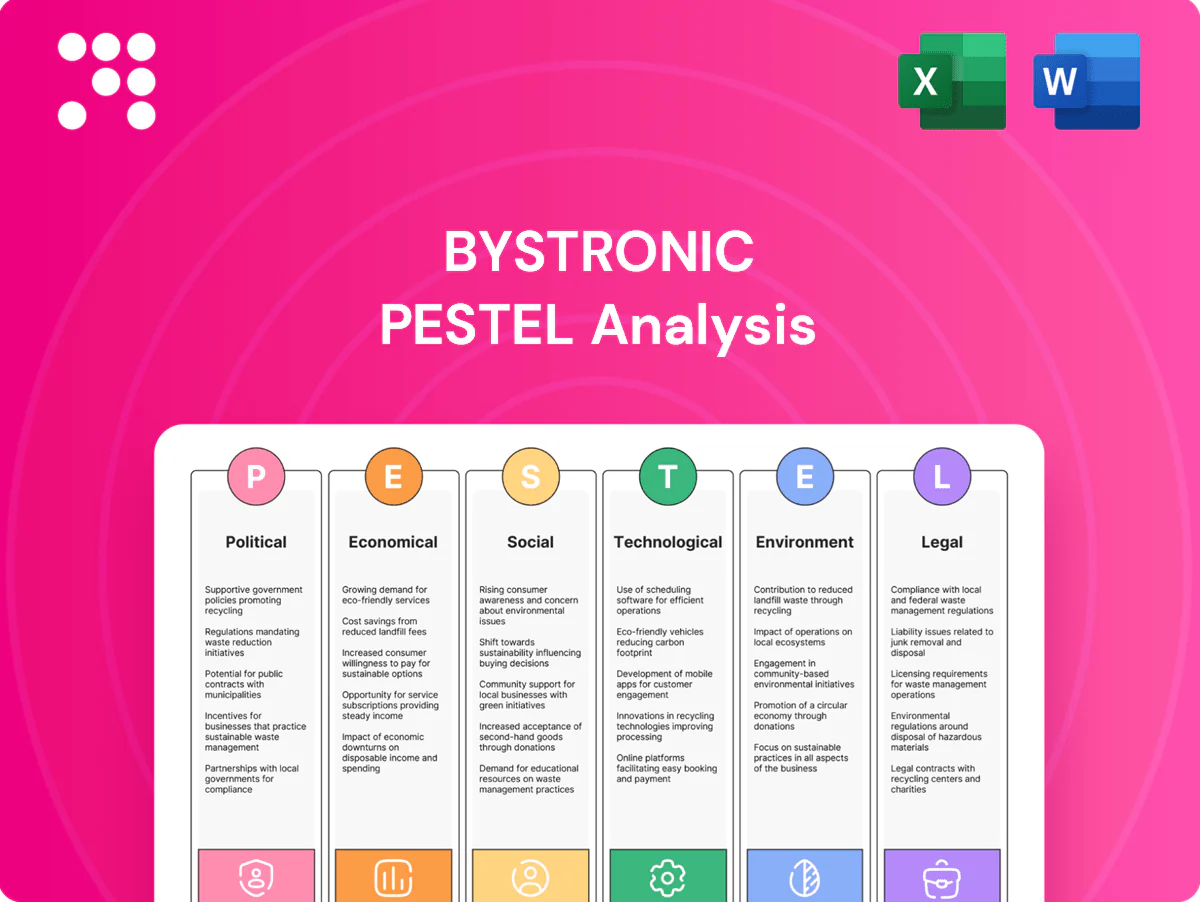
Bystronic PESTLE Analysis

Your Shortcut to Market Insight Starts Here
Uncover how political, economic, social, technological, legal and environmental forces shape Bystronic’s strategic path with our targeted PESTLE analysis. Use these insights to spot risks and growth opportunities. Purchase the full report for the complete, actionable breakdown.
Political factors

Trade policy and tariffs
Shifts in US-EU-China trade relations can quickly change duties on industrial machinery and components, with US Section 232 steel tariffs still at 25% and global trade volatility raising protectionist measures. Tariffs on steel, electronics or finished machines compress Bystronic’s pricing power and margins against an average applied MFN tariff for machinery near 3%. Proactive localization and dual-sourcing reduce exposure to sudden tariff shocks. Monitoring anti-dumping actions in metals markets remains critical to input-cost stability.
Industrial policy and subsidies
Government incentives for advanced manufacturing and reshoring—notably the US Inflation Reduction Act (~$369bn), the CHIPS Act ($52bn) and EU IPCEI initiatives mobilizing tens of billions—are driving customer capex and lifting automation spend; aligning Bystronic solutions to subsidy criteria accelerates deal conversion, while tapping Horizon Europe (€95.5bn) and national productivity funds and partnering with public R&D bodies de-risks innovation.

Geopolitical supply chain risk
Regional tensions and export controls on high-power lasers and motion-control electronics can interrupt inputs and after-sales parts flows, forcing Bystronic to reroute sourcing and inventory; Bystronic operates direct sales and service in over 30 countries, aiding regional responsiveness.
Sanctions regimes and dual-use controls require rigorous partner and transaction screening and compliance frameworks to avoid fines and shipment blocks.
Building regional assembly hubs and inventory buffers in key markets enhances resilience and, combined with scenario planning, helps maintain delivery reliability under sudden trade restrictions.

Public procurement and localization
Local-content rules in infrastructure and defense-adjacent fabrication shape supplier selection; public procurement represents roughly 12% of GDP in OECD countries, so complying with localization boosts tender eligibility. Offering localized service, training and spare parts and using joint ventures helps meet domestic participation thresholds and transparent reporting strengthens bid viability.
- Local-content compliance
- Localized service & spares
- Joint ventures for domestic share
- Transparent reporting for tenders
Regulatory stability and standards diplomacy
Alignment with evolving ISO/EN standards eases market access, noting ISO has published over 25,000 standards and the EU market covers about 447 million consumers (Eurostat 2024). Active participation in standards bodies lets Bystronic influence requirements and reduce compliance surprises. Stable political environments shorten approval timelines and diversifying regulatory exposure cuts country-specific disruption risks.
- ISO count: 25,000+
- EU market: ~447M people
- Standards engagement: shapes future rules
- Diversification: lowers country-specific risk
Tariffs, controls and local-content rules shift regional manufacturing; incentives drive automation
Trade tariffs (US Section 232 steel 25%) and rising protectionism compress margins; export controls and sanctions disrupt laser/electronics supply. Public incentives (US IRA ~$369bn, CHIPS $52bn; Horizon Europe €95.5bn) boost automation capex. Local-content rules and public procurement (~12% OECD GDP) make regional assembly, JV and compliance critical.
| Item | Metric | Value |
|---|---|---|
| Steel tariff | US Section 232 | 25% |
| IRA | US manufacturing incentives | ~$369bn |
| CHIPS | Semiconductor funding | $52bn |
| Horizon Europe | R&D budget | €95.5bn |
| Public procurement | OECD %GDP | ~12% |
What is included in the product
 Detailed Word Document
Explores how macro-environmental factors uniquely affect Bystronic across Political, Economic, Social, Technological, Environmental and Legal dimensions, with each section backed by current data and industry-specific examples. Designed for executives and investors to identify risks, opportunities, and forward-looking scenarios.

 Customizable Excel Spreadsheet
Bystronic PESTLE Analysis condenses external risks and opportunities into a clear, categorized summary for quick reference in meetings or presentations, enabling rapid alignment across teams and tailoring with editable notes for specific regions or business lines.
Economic factors

Capital expenditure cycles
Customer capex for sheet-metal equipment closely follows PMI and industrial output — S&P Global Global Manufacturing PMI rose from ~46.9 in 2023 to ~50.2 in 2024, while world manufacturing output swung from -1.2% (2023) to +2.4% (2024), driving sharp demand for laser cutters and press brakes in expansions; downturns shift spend to retrofits, service and software, and Bystronic’s flexible financing programs can reduce order volatility.
Interest rates and financing
Higher global policy rates—US federal funds around 5.25–5.50% and ECB deposit rate near 4.00% in 2024–25—raise leasing costs and can delay capital expenditures for Bystronic customers. Vendor financing and lender partnerships have preserved order flow in 2024 by offering staged payments and leasing alternatives. Hedging is used to manage interest and credit risk on multi-year deals, while clear ROI cases shorten payback concerns.

Currency volatility (CHF/EUR/USD/CNY)
As a Swiss-headquartered group, CHF strength—EUR/CHF ~0.98 and USD/CHF ~0.92 in July 2025—can compress export margins, with CHF up roughly 2.5% versus the euro in 2024. Pricing in customer currencies and local production costs act as natural hedges, while FX swings alter component sourcing economics, notably against CNY (~0.13 CHF). Transparent, formula-based surcharges preserve margin discipline.

Input costs and availability
Fluctuations in steel, precision optics, semiconductors and drives continued to drive BOM cost and lead‑time volatility, with global HRC prices down ~20% from 2022 peaks and semiconductor lead times easing to roughly 10–12 weeks by 2024, improving sourcing predictability for Bystronic.
Long‑term supplier contracts and 3–6 month buffer inventories, combined with design‑to‑cost and modular product architectures, have limited gross‑margin erosion; real‑time supply‑risk monitoring tools improved on‑time delivery rates.
- impact: BOM volatility from ±15–25%
- inventories: 3–6 months buffer
- lead times: semiconductors ~10–12 weeks (2024)
- margin protection: design‑to‑cost + modularity
Aftermarket and software revenue
Recurring revenue from services, consumables and software smooths Bystronic cash flows and margins, while upgrades and process-optimization modules raise customer throughput and reduce unit cost per part; higher attach rates lift customer lifetime value and data-driven service models (predictive maintenance, remote diagnostics) increase lock-in by enabling continuous value capture.
Tariffs, controls and local-content rules shift regional manufacturing; incentives drive automation
Global manufacturing recovery (S&P PMI ~50.2; output +2.4% in 2024) lifted capex for lasers/presses, while high policy rates (Fed 5.25–5.50%, ECB ~4.0% in 2024–25) raised leasing costs and extended payback periods. CHF strength (EUR/CHF ~0.98, USD/CHF ~0.92 in Jul 2025) and BOM volatility (±15–25%) pressure margins; 3–6 month buffers and modular design limited impact.
| Metric | Value |
|---|---|
| S&P Global PMI (2024) | ~50.2 |
| World manufacturing output (2024) | +2.4% |
| Policy rates (2024–25) | Fed 5.25–5.50% / ECB ~4.0% |
| FX (Jul 2025) | EUR/CHF ~0.98, USD/CHF ~0.92 |
| BOM volatility | ±15–25% |
| Inventory buffer | 3–6 months |
| Semiconductor lead times (2024) | ~10–12 weeks |
Preview Before You Purchase
Bystronic PESTLE Analysis
The Bystronic PESTLE Analysis preview shown here is the exact document you’ll receive after purchase—fully formatted and ready to use. This is a real screenshot of the product you’re buying, delivered exactly as shown with no placeholders or teasers. The layout, content, and structure visible here are exactly what you’ll download immediately after payment.

Your Shortcut to Market Insight Starts Here
Uncover how political, economic, social, technological, legal and environmental forces shape Bystronic’s strategic path with our targeted PESTLE analysis. Use these insights to spot risks and growth opportunities. Purchase the full report for the complete, actionable breakdown.
Political factors
Trade policy and tariffs
Shifts in US-EU-China trade relations can quickly change duties on industrial machinery and components, with US Section 232 steel tariffs still at 25% and global trade volatility raising protectionist measures. Tariffs on steel, electronics or finished machines compress Bystronic’s pricing power and margins against an average applied MFN tariff for machinery near 3%. Proactive localization and dual-sourcing reduce exposure to sudden tariff shocks. Monitoring anti-dumping actions in metals markets remains critical to input-cost stability.
Industrial policy and subsidies
Government incentives for advanced manufacturing and reshoring—notably the US Inflation Reduction Act (~$369bn), the CHIPS Act ($52bn) and EU IPCEI initiatives mobilizing tens of billions—are driving customer capex and lifting automation spend; aligning Bystronic solutions to subsidy criteria accelerates deal conversion, while tapping Horizon Europe (€95.5bn) and national productivity funds and partnering with public R&D bodies de-risks innovation.
Geopolitical supply chain risk
Regional tensions and export controls on high-power lasers and motion-control electronics can interrupt inputs and after-sales parts flows, forcing Bystronic to reroute sourcing and inventory; Bystronic operates direct sales and service in over 30 countries, aiding regional responsiveness.
Sanctions regimes and dual-use controls require rigorous partner and transaction screening and compliance frameworks to avoid fines and shipment blocks.
Building regional assembly hubs and inventory buffers in key markets enhances resilience and, combined with scenario planning, helps maintain delivery reliability under sudden trade restrictions.
Public procurement and localization
Local-content rules in infrastructure and defense-adjacent fabrication shape supplier selection; public procurement represents roughly 12% of GDP in OECD countries, so complying with localization boosts tender eligibility. Offering localized service, training and spare parts and using joint ventures helps meet domestic participation thresholds and transparent reporting strengthens bid viability.
- Local-content compliance
- Localized service & spares
- Joint ventures for domestic share
- Transparent reporting for tenders
Regulatory stability and standards diplomacy
Alignment with evolving ISO/EN standards eases market access, noting ISO has published over 25,000 standards and the EU market covers about 447 million consumers (Eurostat 2024). Active participation in standards bodies lets Bystronic influence requirements and reduce compliance surprises. Stable political environments shorten approval timelines and diversifying regulatory exposure cuts country-specific disruption risks.
- ISO count: 25,000+
- EU market: ~447M people
- Standards engagement: shapes future rules
- Diversification: lowers country-specific risk
Tariffs, controls and local-content rules shift regional manufacturing; incentives drive automation
Trade tariffs (US Section 232 steel 25%) and rising protectionism compress margins; export controls and sanctions disrupt laser/electronics supply. Public incentives (US IRA ~$369bn, CHIPS $52bn; Horizon Europe €95.5bn) boost automation capex. Local-content rules and public procurement (~12% OECD GDP) make regional assembly, JV and compliance critical.
| Item | Metric | Value |
|---|---|---|
| Steel tariff | US Section 232 | 25% |
| IRA | US manufacturing incentives | ~$369bn |
| CHIPS | Semiconductor funding | $52bn |
| Horizon Europe | R&D budget | €95.5bn |
| Public procurement | OECD %GDP | ~12% |
What is included in the product
Detailed Word Document
Explores how macro-environmental factors uniquely affect Bystronic across Political, Economic, Social, Technological, Environmental and Legal dimensions, with each section backed by current data and industry-specific examples. Designed for executives and investors to identify risks, opportunities, and forward-looking scenarios.
Customizable Excel Spreadsheet
Bystronic PESTLE Analysis condenses external risks and opportunities into a clear, categorized summary for quick reference in meetings or presentations, enabling rapid alignment across teams and tailoring with editable notes for specific regions or business lines.
Economic factors
Capital expenditure cycles
Customer capex for sheet-metal equipment closely follows PMI and industrial output — S&P Global Global Manufacturing PMI rose from ~46.9 in 2023 to ~50.2 in 2024, while world manufacturing output swung from -1.2% (2023) to +2.4% (2024), driving sharp demand for laser cutters and press brakes in expansions; downturns shift spend to retrofits, service and software, and Bystronic’s flexible financing programs can reduce order volatility.
Interest rates and financing
Higher global policy rates—US federal funds around 5.25–5.50% and ECB deposit rate near 4.00% in 2024–25—raise leasing costs and can delay capital expenditures for Bystronic customers. Vendor financing and lender partnerships have preserved order flow in 2024 by offering staged payments and leasing alternatives. Hedging is used to manage interest and credit risk on multi-year deals, while clear ROI cases shorten payback concerns.
Currency volatility (CHF/EUR/USD/CNY)
As a Swiss-headquartered group, CHF strength—EUR/CHF ~0.98 and USD/CHF ~0.92 in July 2025—can compress export margins, with CHF up roughly 2.5% versus the euro in 2024. Pricing in customer currencies and local production costs act as natural hedges, while FX swings alter component sourcing economics, notably against CNY (~0.13 CHF). Transparent, formula-based surcharges preserve margin discipline.
Input costs and availability
Fluctuations in steel, precision optics, semiconductors and drives continued to drive BOM cost and lead‑time volatility, with global HRC prices down ~20% from 2022 peaks and semiconductor lead times easing to roughly 10–12 weeks by 2024, improving sourcing predictability for Bystronic.
Long‑term supplier contracts and 3–6 month buffer inventories, combined with design‑to‑cost and modular product architectures, have limited gross‑margin erosion; real‑time supply‑risk monitoring tools improved on‑time delivery rates.
- impact: BOM volatility from ±15–25%
- inventories: 3–6 months buffer
- lead times: semiconductors ~10–12 weeks (2024)
- margin protection: design‑to‑cost + modularity
Aftermarket and software revenue
Recurring revenue from services, consumables and software smooths Bystronic cash flows and margins, while upgrades and process-optimization modules raise customer throughput and reduce unit cost per part; higher attach rates lift customer lifetime value and data-driven service models (predictive maintenance, remote diagnostics) increase lock-in by enabling continuous value capture.
Tariffs, controls and local-content rules shift regional manufacturing; incentives drive automation
Global manufacturing recovery (S&P PMI ~50.2; output +2.4% in 2024) lifted capex for lasers/presses, while high policy rates (Fed 5.25–5.50%, ECB ~4.0% in 2024–25) raised leasing costs and extended payback periods. CHF strength (EUR/CHF ~0.98, USD/CHF ~0.92 in Jul 2025) and BOM volatility (±15–25%) pressure margins; 3–6 month buffers and modular design limited impact.
| Metric | Value |
|---|---|
| S&P Global PMI (2024) | ~50.2 |
| World manufacturing output (2024) | +2.4% |
| Policy rates (2024–25) | Fed 5.25–5.50% / ECB ~4.0% |
| FX (Jul 2025) | EUR/CHF ~0.98, USD/CHF ~0.92 |
| BOM volatility | ±15–25% |
| Inventory buffer | 3–6 months |
| Semiconductor lead times (2024) | ~10–12 weeks |
Preview Before You Purchase
Bystronic PESTLE Analysis
The Bystronic PESTLE Analysis preview shown here is the exact document you’ll receive after purchase—fully formatted and ready to use. This is a real screenshot of the product you’re buying, delivered exactly as shown with no placeholders or teasers. The layout, content, and structure visible here are exactly what you’ll download immediately after payment.
Description
Your Shortcut to Market Insight Starts Here
Uncover how political, economic, social, technological, legal and environmental forces shape Bystronic’s strategic path with our targeted PESTLE analysis. Use these insights to spot risks and growth opportunities. Purchase the full report for the complete, actionable breakdown.
Political factors
Trade policy and tariffs
Shifts in US-EU-China trade relations can quickly change duties on industrial machinery and components, with US Section 232 steel tariffs still at 25% and global trade volatility raising protectionist measures. Tariffs on steel, electronics or finished machines compress Bystronic’s pricing power and margins against an average applied MFN tariff for machinery near 3%. Proactive localization and dual-sourcing reduce exposure to sudden tariff shocks. Monitoring anti-dumping actions in metals markets remains critical to input-cost stability.
Industrial policy and subsidies
Government incentives for advanced manufacturing and reshoring—notably the US Inflation Reduction Act (~$369bn), the CHIPS Act ($52bn) and EU IPCEI initiatives mobilizing tens of billions—are driving customer capex and lifting automation spend; aligning Bystronic solutions to subsidy criteria accelerates deal conversion, while tapping Horizon Europe (€95.5bn) and national productivity funds and partnering with public R&D bodies de-risks innovation.
Geopolitical supply chain risk
Regional tensions and export controls on high-power lasers and motion-control electronics can interrupt inputs and after-sales parts flows, forcing Bystronic to reroute sourcing and inventory; Bystronic operates direct sales and service in over 30 countries, aiding regional responsiveness.
Sanctions regimes and dual-use controls require rigorous partner and transaction screening and compliance frameworks to avoid fines and shipment blocks.
Building regional assembly hubs and inventory buffers in key markets enhances resilience and, combined with scenario planning, helps maintain delivery reliability under sudden trade restrictions.
Public procurement and localization
Local-content rules in infrastructure and defense-adjacent fabrication shape supplier selection; public procurement represents roughly 12% of GDP in OECD countries, so complying with localization boosts tender eligibility. Offering localized service, training and spare parts and using joint ventures helps meet domestic participation thresholds and transparent reporting strengthens bid viability.
- Local-content compliance
- Localized service & spares
- Joint ventures for domestic share
- Transparent reporting for tenders
Regulatory stability and standards diplomacy
Alignment with evolving ISO/EN standards eases market access, noting ISO has published over 25,000 standards and the EU market covers about 447 million consumers (Eurostat 2024). Active participation in standards bodies lets Bystronic influence requirements and reduce compliance surprises. Stable political environments shorten approval timelines and diversifying regulatory exposure cuts country-specific disruption risks.
- ISO count: 25,000+
- EU market: ~447M people
- Standards engagement: shapes future rules
- Diversification: lowers country-specific risk
Tariffs, controls and local-content rules shift regional manufacturing; incentives drive automation
Trade tariffs (US Section 232 steel 25%) and rising protectionism compress margins; export controls and sanctions disrupt laser/electronics supply. Public incentives (US IRA ~$369bn, CHIPS $52bn; Horizon Europe €95.5bn) boost automation capex. Local-content rules and public procurement (~12% OECD GDP) make regional assembly, JV and compliance critical.
| Item | Metric | Value |
|---|---|---|
| Steel tariff | US Section 232 | 25% |
| IRA | US manufacturing incentives | ~$369bn |
| CHIPS | Semiconductor funding | $52bn |
| Horizon Europe | R&D budget | €95.5bn |
| Public procurement | OECD %GDP | ~12% |
What is included in the product
Detailed Word Document
Explores how macro-environmental factors uniquely affect Bystronic across Political, Economic, Social, Technological, Environmental and Legal dimensions, with each section backed by current data and industry-specific examples. Designed for executives and investors to identify risks, opportunities, and forward-looking scenarios.
Customizable Excel Spreadsheet
Bystronic PESTLE Analysis condenses external risks and opportunities into a clear, categorized summary for quick reference in meetings or presentations, enabling rapid alignment across teams and tailoring with editable notes for specific regions or business lines.
Economic factors
Capital expenditure cycles
Customer capex for sheet-metal equipment closely follows PMI and industrial output — S&P Global Global Manufacturing PMI rose from ~46.9 in 2023 to ~50.2 in 2024, while world manufacturing output swung from -1.2% (2023) to +2.4% (2024), driving sharp demand for laser cutters and press brakes in expansions; downturns shift spend to retrofits, service and software, and Bystronic’s flexible financing programs can reduce order volatility.
Interest rates and financing
Higher global policy rates—US federal funds around 5.25–5.50% and ECB deposit rate near 4.00% in 2024–25—raise leasing costs and can delay capital expenditures for Bystronic customers. Vendor financing and lender partnerships have preserved order flow in 2024 by offering staged payments and leasing alternatives. Hedging is used to manage interest and credit risk on multi-year deals, while clear ROI cases shorten payback concerns.
Currency volatility (CHF/EUR/USD/CNY)
As a Swiss-headquartered group, CHF strength—EUR/CHF ~0.98 and USD/CHF ~0.92 in July 2025—can compress export margins, with CHF up roughly 2.5% versus the euro in 2024. Pricing in customer currencies and local production costs act as natural hedges, while FX swings alter component sourcing economics, notably against CNY (~0.13 CHF). Transparent, formula-based surcharges preserve margin discipline.
Input costs and availability
Fluctuations in steel, precision optics, semiconductors and drives continued to drive BOM cost and lead‑time volatility, with global HRC prices down ~20% from 2022 peaks and semiconductor lead times easing to roughly 10–12 weeks by 2024, improving sourcing predictability for Bystronic.
Long‑term supplier contracts and 3–6 month buffer inventories, combined with design‑to‑cost and modular product architectures, have limited gross‑margin erosion; real‑time supply‑risk monitoring tools improved on‑time delivery rates.
- impact: BOM volatility from ±15–25%
- inventories: 3–6 months buffer
- lead times: semiconductors ~10–12 weeks (2024)
- margin protection: design‑to‑cost + modularity
Aftermarket and software revenue
Recurring revenue from services, consumables and software smooths Bystronic cash flows and margins, while upgrades and process-optimization modules raise customer throughput and reduce unit cost per part; higher attach rates lift customer lifetime value and data-driven service models (predictive maintenance, remote diagnostics) increase lock-in by enabling continuous value capture.
Tariffs, controls and local-content rules shift regional manufacturing; incentives drive automation
Global manufacturing recovery (S&P PMI ~50.2; output +2.4% in 2024) lifted capex for lasers/presses, while high policy rates (Fed 5.25–5.50%, ECB ~4.0% in 2024–25) raised leasing costs and extended payback periods. CHF strength (EUR/CHF ~0.98, USD/CHF ~0.92 in Jul 2025) and BOM volatility (±15–25%) pressure margins; 3–6 month buffers and modular design limited impact.
| Metric | Value |
|---|---|
| S&P Global PMI (2024) | ~50.2 |
| World manufacturing output (2024) | +2.4% |
| Policy rates (2024–25) | Fed 5.25–5.50% / ECB ~4.0% |
| FX (Jul 2025) | EUR/CHF ~0.98, USD/CHF ~0.92 |
| BOM volatility | ±15–25% |
| Inventory buffer | 3–6 months |
| Semiconductor lead times (2024) | ~10–12 weeks |
Preview Before You Purchase
Bystronic PESTLE Analysis
The Bystronic PESTLE Analysis preview shown here is the exact document you’ll receive after purchase—fully formatted and ready to use. This is a real screenshot of the product you’re buying, delivered exactly as shown with no placeholders or teasers. The layout, content, and structure visible here are exactly what you’ll download immediately after payment.











