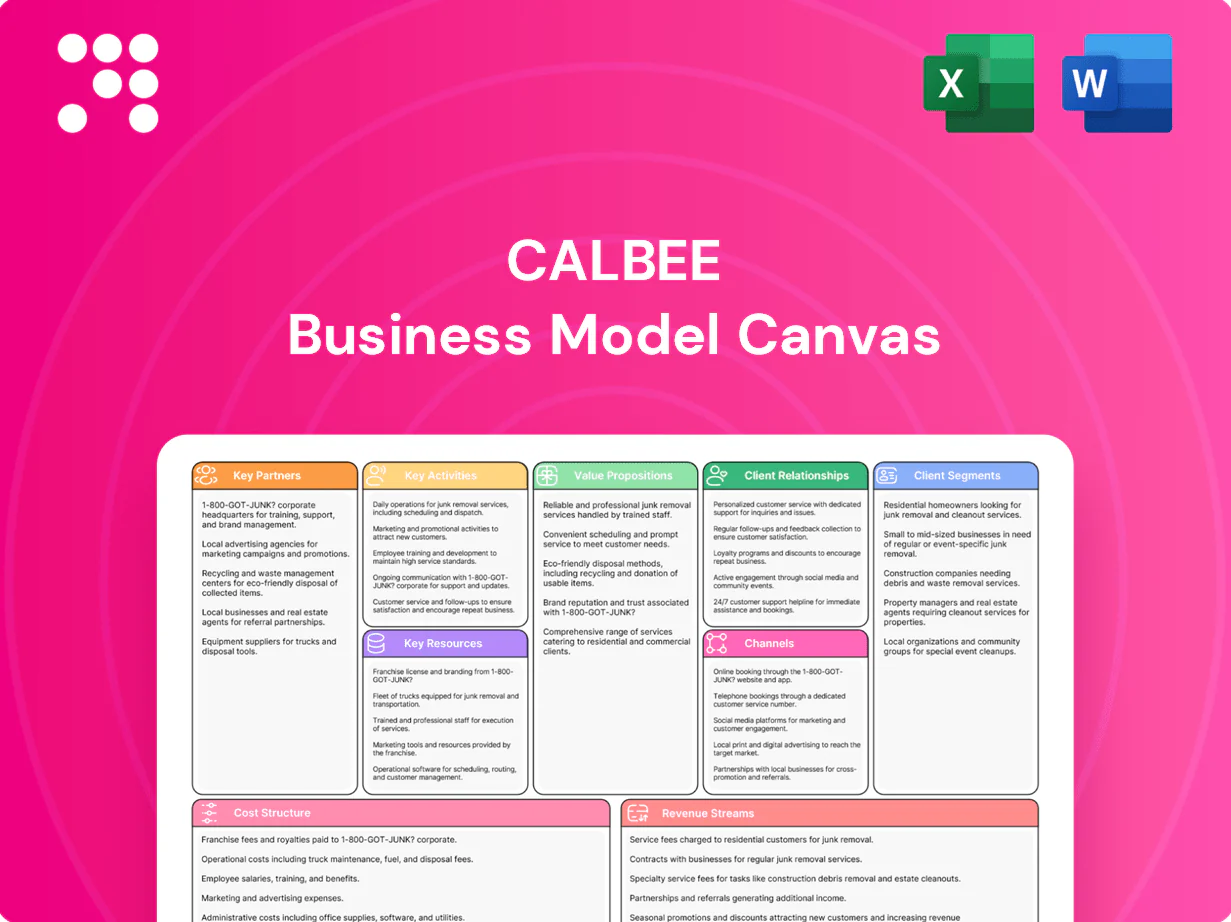
Calbee Business Model Canvas

Concise Business Model Canvas: decode a leading snack maker's value engine
Quickly understand Calbee’s value engine with our Business Model Canvas—covering customer segments, value propositions, channels and revenue models. This concise analysis reveals how Calbee scales, innovates, and defends market share. Ideal for investors, consultants, and founders seeking actionable strategy. Download the full, editable Canvas to adapt and apply these insights.
Partnerships

Potato, seafood, and grain suppliers
Partnering with contracted farmers and fisheries ensures reliable access to high-quality potatoes, shrimp, and grains, supporting Calbee’s product lineup that helped deliver consolidated net sales of 436.9 billion yen in FY2024.
Long-term agreements stabilize pricing and improve crop planning, while joint quality programs align suppliers with food safety and sustainability standards such as traceability and reduced antibiotics in shrimp.
Diversified sourcing across regions mitigates climate and yield risks, lowering supply-disruption exposure for Calbee’s manufacturing network.
Packaging and ingredient technology providers
Suppliers of seasonings, oils and functional ingredients enable Calbee to differentiate flavors and extend shelf-life through tailored formulations, while packaging firms supply barrier films and recyclable materials to reduce spoilage and plastic use. Co-development projects with ingredient and packaging partners drive cost savings and progress on Calbee’s sustainability targets. Ongoing technical service support improves process efficiency and product consistency.

Distributors, retailers, and convenience chains
Strategic ties with supermarkets, convenience stores, and wholesalers maximize shelf presence and velocity, supporting Calbee’s consolidated net sales of ¥336.6 billion in FY2023; convenience chains drive repeat purchase frequency. Joint promotions and POS/data sharing optimize assortments and dynamic pricing, improving category sell-through. National distributors extend reach across Japan and Asia as overseas sales ~30% of group revenue, while performance-based agreements align incentives across the value chain.

Co-packers and manufacturing partners
External plants give Calbee surge capacity, localization, and specialty formats while flexible contracts lower capex and preserve service levels; shared QA protocols enforce consistent brand standards and geographic proximity cuts lead times and logistics costs.
- Surge capacity
- Flexible contracts reduce capex
- Shared QA protects brand
- Proximity shortens lead times
R&D, universities, and marketing collaborators
R&D collaborations with universities accelerated ingredient and processing advances for Calbee, enabling reduced-salt and fiber-enriched SKUs rolled out in 2024; academic labs cut formulation cycle times by months. Co-branding with IP owners and retailers produced limited editions in 2024 that industry reports show can lift store traffic up to 20%. Insights agencies shaped flavor roadmaps and pack architecture; regulatory advisors ensured export compliance across ASEAN and EU markets.
- Academic R&D: faster formulation cycles
- Co-branding: limited editions → ~20% traffic uplift
- Insights agencies: data-driven flavor & pack design
- Regulatory advisors: ASEAN/EU export compliance
FY2024 net sales 436.9 bn yen, long-term contracts and ≈30% overseas lift
Partnered farmers/fisheries secure inputs for FY2024 consolidated net sales of 436.9 billion yen; long-term contracts stabilize costs and quality. Retail, distributor and co-development ties (overseas ≈30% of group revenue) boost shelf presence and innovation while external plants provide surge capacity and lower capex. R&D and packaging partners accelerated reduced-salt and fiber-enriched SKUs in 2024.
| Metric | Value |
|---|---|
| FY2024 net sales | 436.9 bn yen |
| FY2023 net sales | 336.6 bn yen |
| Overseas share | ≈30% |
What is included in the product
 Detailed Word Document
A concise, investor-ready Business Model Canvas for Calbee outlining its nine blocks—customer segments, value propositions, channels, customer relationships, revenue streams, key resources, activities, partners, and cost structure—plus competitive analysis and SWOT insights to support strategic decisions and funding presentations.

 Customizable Excel Spreadsheet
High-level view of Calbee’s business model with editable cells, relieving the pain of mapping complex product lines, supply-chain partnerships and channel strategies into one concise, shareable snapshot for faster decision-making.
Activities

Raw material sourcing and quality control
Forecasting demand and contracting crops balance cost and availability, aligning procurement to Calbee’s scale (consolidated net sales ~454 billion yen in FY2024). Strict incoming inspection, lot-level traceability and HACCP controls maintain food safety across supply chains. Regular supplier audits and agronomy support programs lift yields and quality. Risk management addresses seasonality, crop failure and geopolitical exposure.
Snack manufacturing and process optimization
Frying, baking, seasoning and packaging are core operations in Calbee’s snack production; in 2024 the company accelerated factory automation to improve consistency and labor productivity. OEE tracking and lean methods are used to cut waste and downtime, while continuous improvement programs aim to lower unit costs and enhance product quality. Automation rollouts in 2024 targeted higher throughput and reduced variability.

Product development and flavor innovation
Consumer research at Calbee guides new flavors, textures, and formats through targeted sensory panels and market segmentation, informing R&D priorities. Rapid prototyping and pilot kitchens compress time-to-market, enabling iterative tweaks before scale-up. Nutritional reformulation aligns products with health trends and regulations, reducing sodium and trans fats. Limited-edition releases create excitement and serve as live market tests for broader rollouts.

Brand marketing and trade promotion
Integrated multimedia campaigns build Calbee brand equity across TV, digital and OOH, reinforcing flagship SKUs and seasonal launches.
In-store activations and price promotions drive trial and repeat, with retail display tactics shown to lift short-term sales by up to 30% (Nielsen 2024).
Data-driven segmentation personalizes messages via CRM and loyalty data, improving campaign ROAS and repeat-purchase rates.
Close collaboration with retailers secures premium shelf space and endcap placements, increasing purchase visibility and conversion.
- media_integration
- in-store_activation
- data_personalization
- retailer_partnership
Distribution, logistics, and export management
Network planning aligns plants, warehouses and routes-to-market to support Calbee's exports to 30+ markets, optimizing fill rates and transport cost. Cold-spot reduction and tighter inventory control drive freshness and targeted waste cuts while maintaining inventory turns around 8–10x. Compliance, labeling and documentation enable cross-border sales and tariff-neutral routing. Strategic partnerships optimize last-mile delivery and vending replenishment with thousands of partner outlets.
- Network: plants, warehouses, routes
- Freshness: cold-spot reduction, inventory turns ~8–10x
- Compliance: labeling, documentation for 30+ markets
- Partnerships: last-mile and vending replenishment
Demand planning, automation and R&D scale snacks to ¥454B and 30+ export markets
Demand planning and contracted sourcing support Calbee’s scale (consolidated net sales ~454 billion yen FY2024) and mitigate seasonality. Automated frying, packaging and OEE-driven CI reduce unit costs and boost throughput. Consumer R&D, reformulation and rapid prototyping drive SKU innovation. Distribution network sustains exports to 30+ markets with inventory turns ~8–10x.
| Metric | Value |
|---|---|
| Net sales FY2024 | ~454 billion yen |
| Inventory turns | 8–10x |
| Export markets | 30+ |
| Promo lift (Nielsen 2024) | up to 30% |
What You See Is What You Get
Business Model Canvas
The document previewed here is the actual Calbee Business Model Canvas, not a mockup or sample. When you purchase, you’ll receive this exact file—complete, editable, and formatted exactly as shown—ready for presentation or analysis. No hidden pages, no altered content: what you see in the preview is the same deliverable you’ll download after buying.

Concise Business Model Canvas: decode a leading snack maker's value engine
Quickly understand Calbee’s value engine with our Business Model Canvas—covering customer segments, value propositions, channels and revenue models. This concise analysis reveals how Calbee scales, innovates, and defends market share. Ideal for investors, consultants, and founders seeking actionable strategy. Download the full, editable Canvas to adapt and apply these insights.
Partnerships
Potato, seafood, and grain suppliers
Partnering with contracted farmers and fisheries ensures reliable access to high-quality potatoes, shrimp, and grains, supporting Calbee’s product lineup that helped deliver consolidated net sales of 436.9 billion yen in FY2024.
Long-term agreements stabilize pricing and improve crop planning, while joint quality programs align suppliers with food safety and sustainability standards such as traceability and reduced antibiotics in shrimp.
Diversified sourcing across regions mitigates climate and yield risks, lowering supply-disruption exposure for Calbee’s manufacturing network.
Packaging and ingredient technology providers
Suppliers of seasonings, oils and functional ingredients enable Calbee to differentiate flavors and extend shelf-life through tailored formulations, while packaging firms supply barrier films and recyclable materials to reduce spoilage and plastic use. Co-development projects with ingredient and packaging partners drive cost savings and progress on Calbee’s sustainability targets. Ongoing technical service support improves process efficiency and product consistency.
Distributors, retailers, and convenience chains
Strategic ties with supermarkets, convenience stores, and wholesalers maximize shelf presence and velocity, supporting Calbee’s consolidated net sales of ¥336.6 billion in FY2023; convenience chains drive repeat purchase frequency. Joint promotions and POS/data sharing optimize assortments and dynamic pricing, improving category sell-through. National distributors extend reach across Japan and Asia as overseas sales ~30% of group revenue, while performance-based agreements align incentives across the value chain.
Co-packers and manufacturing partners
External plants give Calbee surge capacity, localization, and specialty formats while flexible contracts lower capex and preserve service levels; shared QA protocols enforce consistent brand standards and geographic proximity cuts lead times and logistics costs.
- Surge capacity
- Flexible contracts reduce capex
- Shared QA protects brand
- Proximity shortens lead times
R&D, universities, and marketing collaborators
R&D collaborations with universities accelerated ingredient and processing advances for Calbee, enabling reduced-salt and fiber-enriched SKUs rolled out in 2024; academic labs cut formulation cycle times by months. Co-branding with IP owners and retailers produced limited editions in 2024 that industry reports show can lift store traffic up to 20%. Insights agencies shaped flavor roadmaps and pack architecture; regulatory advisors ensured export compliance across ASEAN and EU markets.
- Academic R&D: faster formulation cycles
- Co-branding: limited editions → ~20% traffic uplift
- Insights agencies: data-driven flavor & pack design
- Regulatory advisors: ASEAN/EU export compliance
FY2024 net sales 436.9 bn yen, long-term contracts and ≈30% overseas lift
Partnered farmers/fisheries secure inputs for FY2024 consolidated net sales of 436.9 billion yen; long-term contracts stabilize costs and quality. Retail, distributor and co-development ties (overseas ≈30% of group revenue) boost shelf presence and innovation while external plants provide surge capacity and lower capex. R&D and packaging partners accelerated reduced-salt and fiber-enriched SKUs in 2024.
| Metric | Value |
|---|---|
| FY2024 net sales | 436.9 bn yen |
| FY2023 net sales | 336.6 bn yen |
| Overseas share | ≈30% |
What is included in the product
Detailed Word Document
A concise, investor-ready Business Model Canvas for Calbee outlining its nine blocks—customer segments, value propositions, channels, customer relationships, revenue streams, key resources, activities, partners, and cost structure—plus competitive analysis and SWOT insights to support strategic decisions and funding presentations.
Customizable Excel Spreadsheet
High-level view of Calbee’s business model with editable cells, relieving the pain of mapping complex product lines, supply-chain partnerships and channel strategies into one concise, shareable snapshot for faster decision-making.
Activities
Raw material sourcing and quality control
Forecasting demand and contracting crops balance cost and availability, aligning procurement to Calbee’s scale (consolidated net sales ~454 billion yen in FY2024). Strict incoming inspection, lot-level traceability and HACCP controls maintain food safety across supply chains. Regular supplier audits and agronomy support programs lift yields and quality. Risk management addresses seasonality, crop failure and geopolitical exposure.
Snack manufacturing and process optimization
Frying, baking, seasoning and packaging are core operations in Calbee’s snack production; in 2024 the company accelerated factory automation to improve consistency and labor productivity. OEE tracking and lean methods are used to cut waste and downtime, while continuous improvement programs aim to lower unit costs and enhance product quality. Automation rollouts in 2024 targeted higher throughput and reduced variability.
Product development and flavor innovation
Consumer research at Calbee guides new flavors, textures, and formats through targeted sensory panels and market segmentation, informing R&D priorities. Rapid prototyping and pilot kitchens compress time-to-market, enabling iterative tweaks before scale-up. Nutritional reformulation aligns products with health trends and regulations, reducing sodium and trans fats. Limited-edition releases create excitement and serve as live market tests for broader rollouts.
Brand marketing and trade promotion
Integrated multimedia campaigns build Calbee brand equity across TV, digital and OOH, reinforcing flagship SKUs and seasonal launches.
In-store activations and price promotions drive trial and repeat, with retail display tactics shown to lift short-term sales by up to 30% (Nielsen 2024).
Data-driven segmentation personalizes messages via CRM and loyalty data, improving campaign ROAS and repeat-purchase rates.
Close collaboration with retailers secures premium shelf space and endcap placements, increasing purchase visibility and conversion.
- media_integration
- in-store_activation
- data_personalization
- retailer_partnership
Distribution, logistics, and export management
Network planning aligns plants, warehouses and routes-to-market to support Calbee's exports to 30+ markets, optimizing fill rates and transport cost. Cold-spot reduction and tighter inventory control drive freshness and targeted waste cuts while maintaining inventory turns around 8–10x. Compliance, labeling and documentation enable cross-border sales and tariff-neutral routing. Strategic partnerships optimize last-mile delivery and vending replenishment with thousands of partner outlets.
- Network: plants, warehouses, routes
- Freshness: cold-spot reduction, inventory turns ~8–10x
- Compliance: labeling, documentation for 30+ markets
- Partnerships: last-mile and vending replenishment
Demand planning, automation and R&D scale snacks to ¥454B and 30+ export markets
Demand planning and contracted sourcing support Calbee’s scale (consolidated net sales ~454 billion yen FY2024) and mitigate seasonality. Automated frying, packaging and OEE-driven CI reduce unit costs and boost throughput. Consumer R&D, reformulation and rapid prototyping drive SKU innovation. Distribution network sustains exports to 30+ markets with inventory turns ~8–10x.
| Metric | Value |
|---|---|
| Net sales FY2024 | ~454 billion yen |
| Inventory turns | 8–10x |
| Export markets | 30+ |
| Promo lift (Nielsen 2024) | up to 30% |
What You See Is What You Get
Business Model Canvas
The document previewed here is the actual Calbee Business Model Canvas, not a mockup or sample. When you purchase, you’ll receive this exact file—complete, editable, and formatted exactly as shown—ready for presentation or analysis. No hidden pages, no altered content: what you see in the preview is the same deliverable you’ll download after buying.
Description
Concise Business Model Canvas: decode a leading snack maker's value engine
Quickly understand Calbee’s value engine with our Business Model Canvas—covering customer segments, value propositions, channels and revenue models. This concise analysis reveals how Calbee scales, innovates, and defends market share. Ideal for investors, consultants, and founders seeking actionable strategy. Download the full, editable Canvas to adapt and apply these insights.
Partnerships
Potato, seafood, and grain suppliers
Partnering with contracted farmers and fisheries ensures reliable access to high-quality potatoes, shrimp, and grains, supporting Calbee’s product lineup that helped deliver consolidated net sales of 436.9 billion yen in FY2024.
Long-term agreements stabilize pricing and improve crop planning, while joint quality programs align suppliers with food safety and sustainability standards such as traceability and reduced antibiotics in shrimp.
Diversified sourcing across regions mitigates climate and yield risks, lowering supply-disruption exposure for Calbee’s manufacturing network.
Packaging and ingredient technology providers
Suppliers of seasonings, oils and functional ingredients enable Calbee to differentiate flavors and extend shelf-life through tailored formulations, while packaging firms supply barrier films and recyclable materials to reduce spoilage and plastic use. Co-development projects with ingredient and packaging partners drive cost savings and progress on Calbee’s sustainability targets. Ongoing technical service support improves process efficiency and product consistency.
Distributors, retailers, and convenience chains
Strategic ties with supermarkets, convenience stores, and wholesalers maximize shelf presence and velocity, supporting Calbee’s consolidated net sales of ¥336.6 billion in FY2023; convenience chains drive repeat purchase frequency. Joint promotions and POS/data sharing optimize assortments and dynamic pricing, improving category sell-through. National distributors extend reach across Japan and Asia as overseas sales ~30% of group revenue, while performance-based agreements align incentives across the value chain.
Co-packers and manufacturing partners
External plants give Calbee surge capacity, localization, and specialty formats while flexible contracts lower capex and preserve service levels; shared QA protocols enforce consistent brand standards and geographic proximity cuts lead times and logistics costs.
- Surge capacity
- Flexible contracts reduce capex
- Shared QA protects brand
- Proximity shortens lead times
R&D, universities, and marketing collaborators
R&D collaborations with universities accelerated ingredient and processing advances for Calbee, enabling reduced-salt and fiber-enriched SKUs rolled out in 2024; academic labs cut formulation cycle times by months. Co-branding with IP owners and retailers produced limited editions in 2024 that industry reports show can lift store traffic up to 20%. Insights agencies shaped flavor roadmaps and pack architecture; regulatory advisors ensured export compliance across ASEAN and EU markets.
- Academic R&D: faster formulation cycles
- Co-branding: limited editions → ~20% traffic uplift
- Insights agencies: data-driven flavor & pack design
- Regulatory advisors: ASEAN/EU export compliance
FY2024 net sales 436.9 bn yen, long-term contracts and ≈30% overseas lift
Partnered farmers/fisheries secure inputs for FY2024 consolidated net sales of 436.9 billion yen; long-term contracts stabilize costs and quality. Retail, distributor and co-development ties (overseas ≈30% of group revenue) boost shelf presence and innovation while external plants provide surge capacity and lower capex. R&D and packaging partners accelerated reduced-salt and fiber-enriched SKUs in 2024.
| Metric | Value |
|---|---|
| FY2024 net sales | 436.9 bn yen |
| FY2023 net sales | 336.6 bn yen |
| Overseas share | ≈30% |
What is included in the product
Detailed Word Document
A concise, investor-ready Business Model Canvas for Calbee outlining its nine blocks—customer segments, value propositions, channels, customer relationships, revenue streams, key resources, activities, partners, and cost structure—plus competitive analysis and SWOT insights to support strategic decisions and funding presentations.
Customizable Excel Spreadsheet
High-level view of Calbee’s business model with editable cells, relieving the pain of mapping complex product lines, supply-chain partnerships and channel strategies into one concise, shareable snapshot for faster decision-making.
Activities
Raw material sourcing and quality control
Forecasting demand and contracting crops balance cost and availability, aligning procurement to Calbee’s scale (consolidated net sales ~454 billion yen in FY2024). Strict incoming inspection, lot-level traceability and HACCP controls maintain food safety across supply chains. Regular supplier audits and agronomy support programs lift yields and quality. Risk management addresses seasonality, crop failure and geopolitical exposure.
Snack manufacturing and process optimization
Frying, baking, seasoning and packaging are core operations in Calbee’s snack production; in 2024 the company accelerated factory automation to improve consistency and labor productivity. OEE tracking and lean methods are used to cut waste and downtime, while continuous improvement programs aim to lower unit costs and enhance product quality. Automation rollouts in 2024 targeted higher throughput and reduced variability.
Product development and flavor innovation
Consumer research at Calbee guides new flavors, textures, and formats through targeted sensory panels and market segmentation, informing R&D priorities. Rapid prototyping and pilot kitchens compress time-to-market, enabling iterative tweaks before scale-up. Nutritional reformulation aligns products with health trends and regulations, reducing sodium and trans fats. Limited-edition releases create excitement and serve as live market tests for broader rollouts.
Brand marketing and trade promotion
Integrated multimedia campaigns build Calbee brand equity across TV, digital and OOH, reinforcing flagship SKUs and seasonal launches.
In-store activations and price promotions drive trial and repeat, with retail display tactics shown to lift short-term sales by up to 30% (Nielsen 2024).
Data-driven segmentation personalizes messages via CRM and loyalty data, improving campaign ROAS and repeat-purchase rates.
Close collaboration with retailers secures premium shelf space and endcap placements, increasing purchase visibility and conversion.
- media_integration
- in-store_activation
- data_personalization
- retailer_partnership
Distribution, logistics, and export management
Network planning aligns plants, warehouses and routes-to-market to support Calbee's exports to 30+ markets, optimizing fill rates and transport cost. Cold-spot reduction and tighter inventory control drive freshness and targeted waste cuts while maintaining inventory turns around 8–10x. Compliance, labeling and documentation enable cross-border sales and tariff-neutral routing. Strategic partnerships optimize last-mile delivery and vending replenishment with thousands of partner outlets.
- Network: plants, warehouses, routes
- Freshness: cold-spot reduction, inventory turns ~8–10x
- Compliance: labeling, documentation for 30+ markets
- Partnerships: last-mile and vending replenishment
Demand planning, automation and R&D scale snacks to ¥454B and 30+ export markets
Demand planning and contracted sourcing support Calbee’s scale (consolidated net sales ~454 billion yen FY2024) and mitigate seasonality. Automated frying, packaging and OEE-driven CI reduce unit costs and boost throughput. Consumer R&D, reformulation and rapid prototyping drive SKU innovation. Distribution network sustains exports to 30+ markets with inventory turns ~8–10x.
| Metric | Value |
|---|---|
| Net sales FY2024 | ~454 billion yen |
| Inventory turns | 8–10x |
| Export markets | 30+ |
| Promo lift (Nielsen 2024) | up to 30% |
What You See Is What You Get
Business Model Canvas
The document previewed here is the actual Calbee Business Model Canvas, not a mockup or sample. When you purchase, you’ll receive this exact file—complete, editable, and formatted exactly as shown—ready for presentation or analysis. No hidden pages, no altered content: what you see in the preview is the same deliverable you’ll download after buying.











