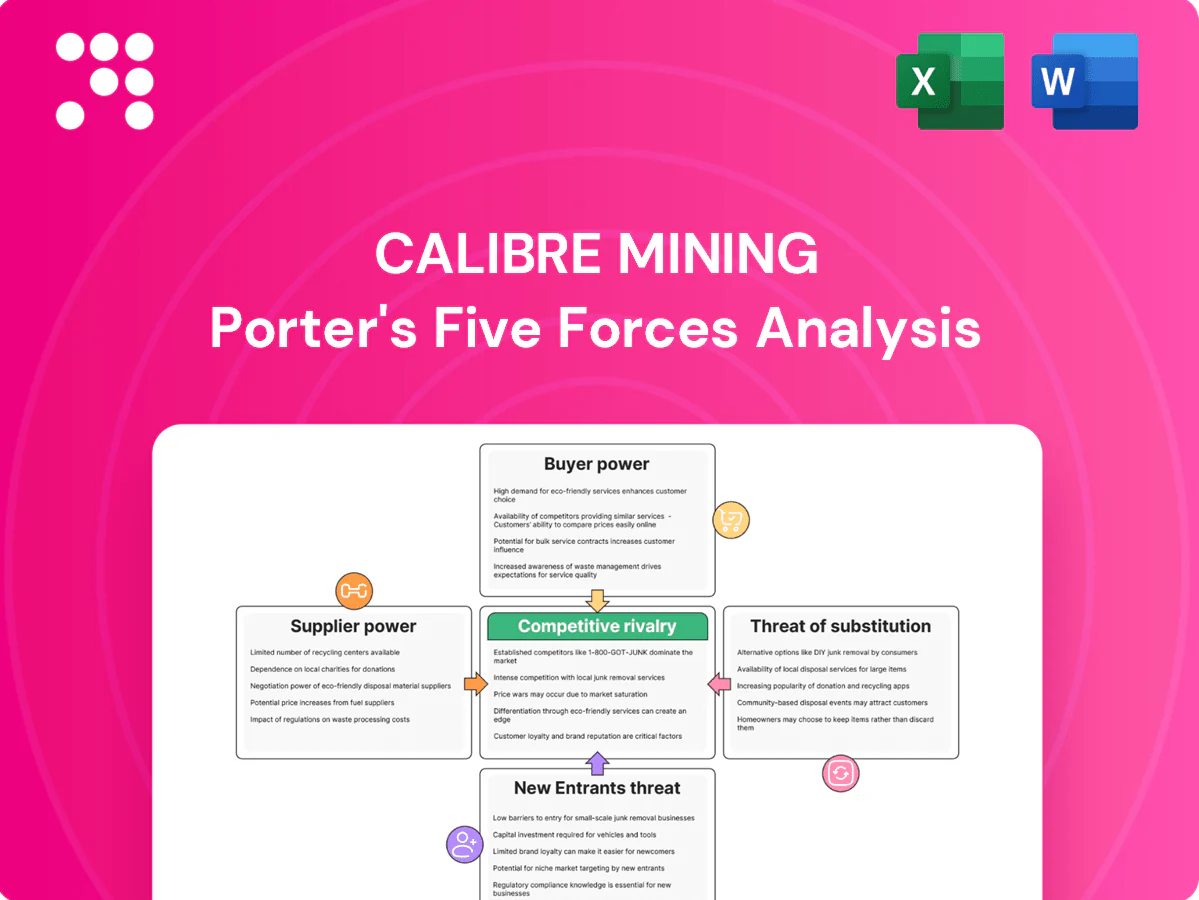
Calibre Mining Porter's Five Forces Analysis

Go Beyond the Preview—Access the Full Strategic Report
Calibre Mining faces intense rivalry from established gold producers, concentrated supplier power for specialized mining inputs, and moderate buyer leverage in a price-sensitive market, while barriers to entry limit new competitors but exploration substitutes and geopolitical risks create uncertainty. This snapshot teases key dynamics—unlock the full Porter's Five Forces Analysis for force-by-force ratings, visuals, and actionable strategy recommendations.
Suppliers Bargaining Power

Concentrated critical inputs
Explosives suppliers such as Orica, Enaex and Dyno Nobel and key cyanide and OEM part producers are few, concentrating supplier power for Calibre. Strict safety certifications (eg ISO 45001) and limited substitution mean switching is constrained, with lead times commonly 3–9 months. Long procurement cycles and certification hurdles increase dependence; Calibre can mitigate risk via multi-sourcing and 60–90 day inventory buffers.
Energy and fuel exposure
Energy reliability and diesel pricing in Nicaragua directly affect Calibre Mining’s operating costs and uptime, with diesel prices averaging about $1.05–1.15 per litre in Nicaragua in 2024 and fuel typically representing roughly 15–25% of open-pit gold mining operating costs. Limited regional suppliers and infrastructure bottlenecks, including import dependency and constrained storage/transport, increase supplier leverage and outage risk. Hedging strategies and efficiency projects (fuel-saving drills, RNG trials) can mitigate price volatility, while on-site generation (diesel gensets or hybrid systems) reduces outages but requires material capex and fuel-storage management.

Specialized contractors
Specialized drilling, mining and haulage contractors command leverage for Calibre in tight markets, with contractor rates rising as gold rallied to an average near US$2,100/oz in 2024, tightening fleet availability and pressuring service quality. Performance‑based contracts and selective insourcing have lowered operational risk and cost volatility. Investment in local workforce development can expand vendor pools and reduce reliance on scarce specialized fleets.

Logistics and permitting frictions
- Fewer compliant carriers = higher supplier leverage
- Port/customs delays increase turnaround costs
- Scheduling discipline cuts demurrage and risk
ESG and compliance requirements
Suppliers must meet stringent safety, Cyanide Code, and human-rights audits, narrowing the pool of qualified vendors and increasing their pricing power for Calibre Mining.
- Fewer compliant vendors → higher negotiation leverage
- Long-term ESG partnerships → lock in cost stability
- Transparent procurement → reduces opportunistic pricing
Supplier power, 3–9 mo lead times and 15–25% fuel OPEX squeeze margins
Concentrated suppliers (Orica, Enaex, Dyno Nobel) and certified chemicals raise supplier power; lead times 3–9 months constrain switching. Diesel (~$1.05–1.15/L in Nicaragua, 2024) and fuel at 15–25% of OPEX increase leverage. Contractors tightened as gold ~US$2,100/oz in 2024; multi-sourcing, 60–90 day stock, hedges and insourcing reduce risk.
| Supplier | Concentration | Lead time | 2024 impact |
|---|---|---|---|
| Explosives/chemicals | High | 3–9 mo | Production risk/cost↑ |
What is included in the product
 Detailed Word Document
Porter’s Five Forces analysis for Calibre Mining uncovers competitive intensity, supplier and buyer power, entry barriers, substitutes, and key disruptive threats shaping its pricing and profitability.

 Customizable Excel Spreadsheet
A concise, one-sheet Porter’s Five Forces for Calibre Mining that maps supplier, buyer, rivalry, substitutes and entry pressures—customizable for new data and ready to drop into pitch decks or dashboards for rapid strategic decisions.
Customers Bargaining Power

Commodity price taker
Gold trades in a deep, liquid market (annual mined supply ~3,400 t) with LBMA/COMEX-standardized pricing, so individual refiners have limited influence; Calibre’s realized price closely tracks LBMA spot benchmarks. Variances from benchmark stem mainly from dore grade, payable gold, and logistics-driven premiums or treatment charges, which typically move by single- to low-double-digit dollars per ounce.
Few qualified refiners
LBMA-compliant refiners are limited—82 on the LBMA Good Delivery List for gold in 2024—giving buyers leverage to set assay standards, penalties and payment timing. Calibre can narrow discounts by diversifying offtakes and sustaining tight quality controls; robust security and provenance documentation (chain-of-custody, conflict-free certifications) reduces buyer-driven haircuts.

Assay and settlement terms
Buyers control assays, moisture and impurity penalties and settlement windows, giving refiners leverage to alter payable gold and timing of cash flows. Small shifts in assay or penalty terms can materially affect Calibre Mining’s working capital and short-term liquidity. Independent umpire assays and negotiated service level agreements mitigate value erosion and disputes. Consistent doré quality and predictable recoveries strengthen Calibre’s negotiating position with refiners.

ESG and sanctions screening
Refiners in 2024 tightened KYC/AML and ESG sourcing, with over 70% demanding chain-of-custody and sanctions screening; non-compliant lots face exclusion or deeper discounts, eroding seller leverage. Robust traceability, third-party audits and certification preserve access to top-tier refiners and premium pricing, shifting some bargaining power back to compliant Calibre sellers.
- refiners: >70% require traceability
- risk: exclusion/discounts
- mitigation: third-party audits
Limited product differentiation
Gold is fungible and global supply (~3,500 tonnes in 2024) and average gold price (~2,100 USD/oz in 2024) keep buyer switching costs low; Calibre wins on reliability and regulatory compliance rather than product specs, which limits buyers' ability to push price but shifts leverage to contract terms and payment/settlement clauses. Reliable delivery can secure preferential offtake terms.
- Fungibility: low switching costs
- 2024 avg gold: ~2,100 USD/oz
- Calibre edge: delivery, compliance
- Impact: price capped; contract leverage
3,500 t supply limits buyers; 82 refiners enforce terms
Buyers exert moderate power: gold fungibility and ~3,500 t global supply (2024) with avg price ~2,100 USD/oz limit price pressure, but 82 LBMA refiners and strict assays/KYC give buyers leverage on terms. >70% refiners demand traceability, creating discount risk; Calibre mitigates via compliance, consistent doré and diversified offtakes to protect cashflow.
| Metric | 2024 | Impact |
|---|---|---|
| Global supply | ~3,500 t | Low price influence |
| Avg gold | ~2,100 USD/oz | Benchmark pricing |
| LBMA refiners | 82 | Contract leverage |
What You See Is What You Get
Calibre Mining Porter's Five Forces Analysis
This preview shows the exact Porter's Five Forces analysis for Calibre Mining you'll receive upon purchase—no placeholders or samples. The document is fully formatted, professionally written, and ready for immediate download and use. Purchase grants instant access to this identical file, complete and final.

Go Beyond the Preview—Access the Full Strategic Report
Calibre Mining faces intense rivalry from established gold producers, concentrated supplier power for specialized mining inputs, and moderate buyer leverage in a price-sensitive market, while barriers to entry limit new competitors but exploration substitutes and geopolitical risks create uncertainty. This snapshot teases key dynamics—unlock the full Porter's Five Forces Analysis for force-by-force ratings, visuals, and actionable strategy recommendations.
Suppliers Bargaining Power
Concentrated critical inputs
Explosives suppliers such as Orica, Enaex and Dyno Nobel and key cyanide and OEM part producers are few, concentrating supplier power for Calibre. Strict safety certifications (eg ISO 45001) and limited substitution mean switching is constrained, with lead times commonly 3–9 months. Long procurement cycles and certification hurdles increase dependence; Calibre can mitigate risk via multi-sourcing and 60–90 day inventory buffers.
Energy and fuel exposure
Energy reliability and diesel pricing in Nicaragua directly affect Calibre Mining’s operating costs and uptime, with diesel prices averaging about $1.05–1.15 per litre in Nicaragua in 2024 and fuel typically representing roughly 15–25% of open-pit gold mining operating costs. Limited regional suppliers and infrastructure bottlenecks, including import dependency and constrained storage/transport, increase supplier leverage and outage risk. Hedging strategies and efficiency projects (fuel-saving drills, RNG trials) can mitigate price volatility, while on-site generation (diesel gensets or hybrid systems) reduces outages but requires material capex and fuel-storage management.
Specialized contractors
Specialized drilling, mining and haulage contractors command leverage for Calibre in tight markets, with contractor rates rising as gold rallied to an average near US$2,100/oz in 2024, tightening fleet availability and pressuring service quality. Performance‑based contracts and selective insourcing have lowered operational risk and cost volatility. Investment in local workforce development can expand vendor pools and reduce reliance on scarce specialized fleets.
Logistics and permitting frictions
- Fewer compliant carriers = higher supplier leverage
- Port/customs delays increase turnaround costs
- Scheduling discipline cuts demurrage and risk
ESG and compliance requirements
Suppliers must meet stringent safety, Cyanide Code, and human-rights audits, narrowing the pool of qualified vendors and increasing their pricing power for Calibre Mining.
- Fewer compliant vendors → higher negotiation leverage
- Long-term ESG partnerships → lock in cost stability
- Transparent procurement → reduces opportunistic pricing
Supplier power, 3–9 mo lead times and 15–25% fuel OPEX squeeze margins
Concentrated suppliers (Orica, Enaex, Dyno Nobel) and certified chemicals raise supplier power; lead times 3–9 months constrain switching. Diesel (~$1.05–1.15/L in Nicaragua, 2024) and fuel at 15–25% of OPEX increase leverage. Contractors tightened as gold ~US$2,100/oz in 2024; multi-sourcing, 60–90 day stock, hedges and insourcing reduce risk.
| Supplier | Concentration | Lead time | 2024 impact |
|---|---|---|---|
| Explosives/chemicals | High | 3–9 mo | Production risk/cost↑ |
What is included in the product
Detailed Word Document
Porter’s Five Forces analysis for Calibre Mining uncovers competitive intensity, supplier and buyer power, entry barriers, substitutes, and key disruptive threats shaping its pricing and profitability.
Customizable Excel Spreadsheet
A concise, one-sheet Porter’s Five Forces for Calibre Mining that maps supplier, buyer, rivalry, substitutes and entry pressures—customizable for new data and ready to drop into pitch decks or dashboards for rapid strategic decisions.
Customers Bargaining Power
Commodity price taker
Gold trades in a deep, liquid market (annual mined supply ~3,400 t) with LBMA/COMEX-standardized pricing, so individual refiners have limited influence; Calibre’s realized price closely tracks LBMA spot benchmarks. Variances from benchmark stem mainly from dore grade, payable gold, and logistics-driven premiums or treatment charges, which typically move by single- to low-double-digit dollars per ounce.
Few qualified refiners
LBMA-compliant refiners are limited—82 on the LBMA Good Delivery List for gold in 2024—giving buyers leverage to set assay standards, penalties and payment timing. Calibre can narrow discounts by diversifying offtakes and sustaining tight quality controls; robust security and provenance documentation (chain-of-custody, conflict-free certifications) reduces buyer-driven haircuts.
Assay and settlement terms
Buyers control assays, moisture and impurity penalties and settlement windows, giving refiners leverage to alter payable gold and timing of cash flows. Small shifts in assay or penalty terms can materially affect Calibre Mining’s working capital and short-term liquidity. Independent umpire assays and negotiated service level agreements mitigate value erosion and disputes. Consistent doré quality and predictable recoveries strengthen Calibre’s negotiating position with refiners.
ESG and sanctions screening
Refiners in 2024 tightened KYC/AML and ESG sourcing, with over 70% demanding chain-of-custody and sanctions screening; non-compliant lots face exclusion or deeper discounts, eroding seller leverage. Robust traceability, third-party audits and certification preserve access to top-tier refiners and premium pricing, shifting some bargaining power back to compliant Calibre sellers.
- refiners: >70% require traceability
- risk: exclusion/discounts
- mitigation: third-party audits
Limited product differentiation
Gold is fungible and global supply (~3,500 tonnes in 2024) and average gold price (~2,100 USD/oz in 2024) keep buyer switching costs low; Calibre wins on reliability and regulatory compliance rather than product specs, which limits buyers' ability to push price but shifts leverage to contract terms and payment/settlement clauses. Reliable delivery can secure preferential offtake terms.
- Fungibility: low switching costs
- 2024 avg gold: ~2,100 USD/oz
- Calibre edge: delivery, compliance
- Impact: price capped; contract leverage
3,500 t supply limits buyers; 82 refiners enforce terms
Buyers exert moderate power: gold fungibility and ~3,500 t global supply (2024) with avg price ~2,100 USD/oz limit price pressure, but 82 LBMA refiners and strict assays/KYC give buyers leverage on terms. >70% refiners demand traceability, creating discount risk; Calibre mitigates via compliance, consistent doré and diversified offtakes to protect cashflow.
| Metric | 2024 | Impact |
|---|---|---|
| Global supply | ~3,500 t | Low price influence |
| Avg gold | ~2,100 USD/oz | Benchmark pricing |
| LBMA refiners | 82 | Contract leverage |
What You See Is What You Get
Calibre Mining Porter's Five Forces Analysis
This preview shows the exact Porter's Five Forces analysis for Calibre Mining you'll receive upon purchase—no placeholders or samples. The document is fully formatted, professionally written, and ready for immediate download and use. Purchase grants instant access to this identical file, complete and final.
Original: $10.00
-65%$10.00
$3.50Description
Go Beyond the Preview—Access the Full Strategic Report
Calibre Mining faces intense rivalry from established gold producers, concentrated supplier power for specialized mining inputs, and moderate buyer leverage in a price-sensitive market, while barriers to entry limit new competitors but exploration substitutes and geopolitical risks create uncertainty. This snapshot teases key dynamics—unlock the full Porter's Five Forces Analysis for force-by-force ratings, visuals, and actionable strategy recommendations.
Suppliers Bargaining Power
Concentrated critical inputs
Explosives suppliers such as Orica, Enaex and Dyno Nobel and key cyanide and OEM part producers are few, concentrating supplier power for Calibre. Strict safety certifications (eg ISO 45001) and limited substitution mean switching is constrained, with lead times commonly 3–9 months. Long procurement cycles and certification hurdles increase dependence; Calibre can mitigate risk via multi-sourcing and 60–90 day inventory buffers.
Energy and fuel exposure
Energy reliability and diesel pricing in Nicaragua directly affect Calibre Mining’s operating costs and uptime, with diesel prices averaging about $1.05–1.15 per litre in Nicaragua in 2024 and fuel typically representing roughly 15–25% of open-pit gold mining operating costs. Limited regional suppliers and infrastructure bottlenecks, including import dependency and constrained storage/transport, increase supplier leverage and outage risk. Hedging strategies and efficiency projects (fuel-saving drills, RNG trials) can mitigate price volatility, while on-site generation (diesel gensets or hybrid systems) reduces outages but requires material capex and fuel-storage management.
Specialized contractors
Specialized drilling, mining and haulage contractors command leverage for Calibre in tight markets, with contractor rates rising as gold rallied to an average near US$2,100/oz in 2024, tightening fleet availability and pressuring service quality. Performance‑based contracts and selective insourcing have lowered operational risk and cost volatility. Investment in local workforce development can expand vendor pools and reduce reliance on scarce specialized fleets.
Logistics and permitting frictions
- Fewer compliant carriers = higher supplier leverage
- Port/customs delays increase turnaround costs
- Scheduling discipline cuts demurrage and risk
ESG and compliance requirements
Suppliers must meet stringent safety, Cyanide Code, and human-rights audits, narrowing the pool of qualified vendors and increasing their pricing power for Calibre Mining.
- Fewer compliant vendors → higher negotiation leverage
- Long-term ESG partnerships → lock in cost stability
- Transparent procurement → reduces opportunistic pricing
Supplier power, 3–9 mo lead times and 15–25% fuel OPEX squeeze margins
Concentrated suppliers (Orica, Enaex, Dyno Nobel) and certified chemicals raise supplier power; lead times 3–9 months constrain switching. Diesel (~$1.05–1.15/L in Nicaragua, 2024) and fuel at 15–25% of OPEX increase leverage. Contractors tightened as gold ~US$2,100/oz in 2024; multi-sourcing, 60–90 day stock, hedges and insourcing reduce risk.
| Supplier | Concentration | Lead time | 2024 impact |
|---|---|---|---|
| Explosives/chemicals | High | 3–9 mo | Production risk/cost↑ |
What is included in the product
Detailed Word Document
Porter’s Five Forces analysis for Calibre Mining uncovers competitive intensity, supplier and buyer power, entry barriers, substitutes, and key disruptive threats shaping its pricing and profitability.
Customizable Excel Spreadsheet
A concise, one-sheet Porter’s Five Forces for Calibre Mining that maps supplier, buyer, rivalry, substitutes and entry pressures—customizable for new data and ready to drop into pitch decks or dashboards for rapid strategic decisions.
Customers Bargaining Power
Commodity price taker
Gold trades in a deep, liquid market (annual mined supply ~3,400 t) with LBMA/COMEX-standardized pricing, so individual refiners have limited influence; Calibre’s realized price closely tracks LBMA spot benchmarks. Variances from benchmark stem mainly from dore grade, payable gold, and logistics-driven premiums or treatment charges, which typically move by single- to low-double-digit dollars per ounce.
Few qualified refiners
LBMA-compliant refiners are limited—82 on the LBMA Good Delivery List for gold in 2024—giving buyers leverage to set assay standards, penalties and payment timing. Calibre can narrow discounts by diversifying offtakes and sustaining tight quality controls; robust security and provenance documentation (chain-of-custody, conflict-free certifications) reduces buyer-driven haircuts.
Assay and settlement terms
Buyers control assays, moisture and impurity penalties and settlement windows, giving refiners leverage to alter payable gold and timing of cash flows. Small shifts in assay or penalty terms can materially affect Calibre Mining’s working capital and short-term liquidity. Independent umpire assays and negotiated service level agreements mitigate value erosion and disputes. Consistent doré quality and predictable recoveries strengthen Calibre’s negotiating position with refiners.
ESG and sanctions screening
Refiners in 2024 tightened KYC/AML and ESG sourcing, with over 70% demanding chain-of-custody and sanctions screening; non-compliant lots face exclusion or deeper discounts, eroding seller leverage. Robust traceability, third-party audits and certification preserve access to top-tier refiners and premium pricing, shifting some bargaining power back to compliant Calibre sellers.
- refiners: >70% require traceability
- risk: exclusion/discounts
- mitigation: third-party audits
Limited product differentiation
Gold is fungible and global supply (~3,500 tonnes in 2024) and average gold price (~2,100 USD/oz in 2024) keep buyer switching costs low; Calibre wins on reliability and regulatory compliance rather than product specs, which limits buyers' ability to push price but shifts leverage to contract terms and payment/settlement clauses. Reliable delivery can secure preferential offtake terms.
- Fungibility: low switching costs
- 2024 avg gold: ~2,100 USD/oz
- Calibre edge: delivery, compliance
- Impact: price capped; contract leverage
3,500 t supply limits buyers; 82 refiners enforce terms
Buyers exert moderate power: gold fungibility and ~3,500 t global supply (2024) with avg price ~2,100 USD/oz limit price pressure, but 82 LBMA refiners and strict assays/KYC give buyers leverage on terms. >70% refiners demand traceability, creating discount risk; Calibre mitigates via compliance, consistent doré and diversified offtakes to protect cashflow.
| Metric | 2024 | Impact |
|---|---|---|
| Global supply | ~3,500 t | Low price influence |
| Avg gold | ~2,100 USD/oz | Benchmark pricing |
| LBMA refiners | 82 | Contract leverage |
What You See Is What You Get
Calibre Mining Porter's Five Forces Analysis
This preview shows the exact Porter's Five Forces analysis for Calibre Mining you'll receive upon purchase—no placeholders or samples. The document is fully formatted, professionally written, and ready for immediate download and use. Purchase grants instant access to this identical file, complete and final.











