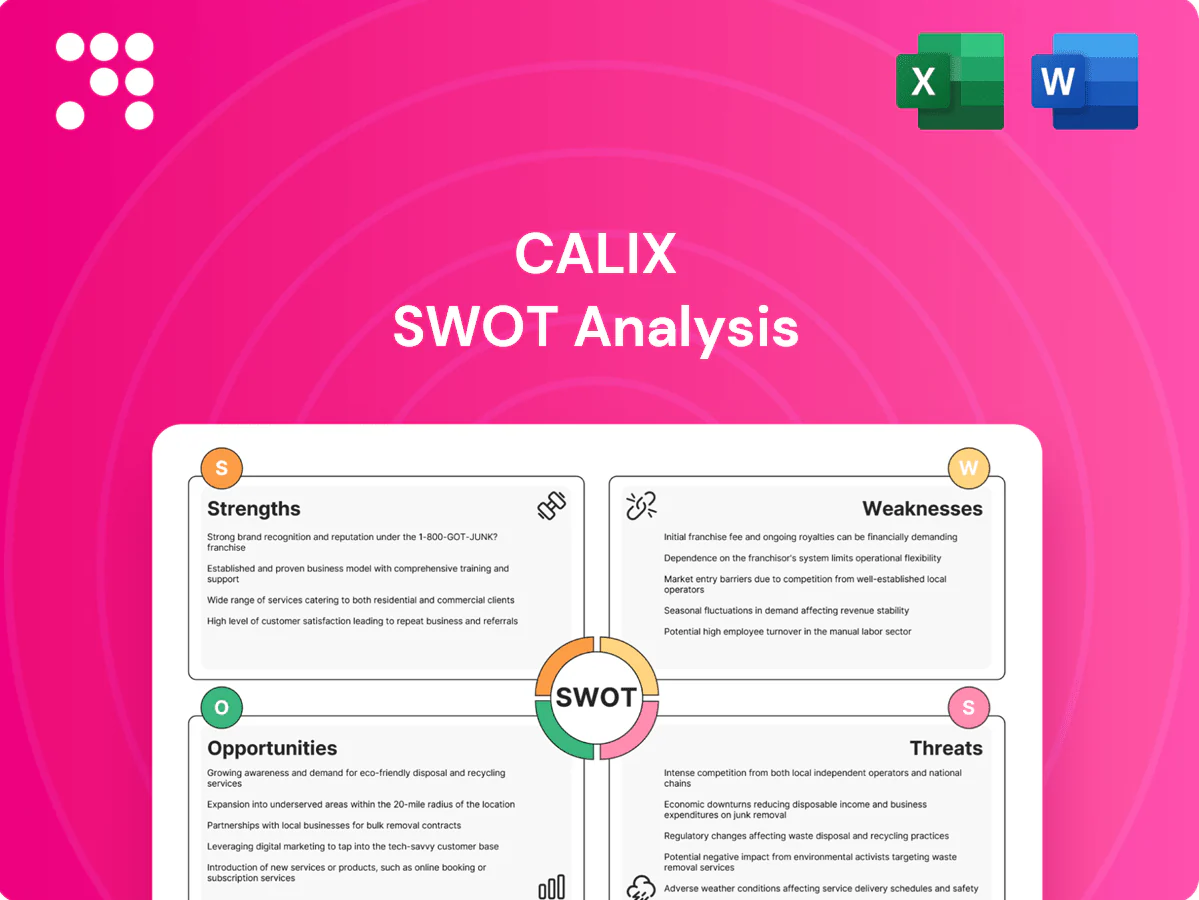
Calix SWOT Analysis

Make Insightful Decisions Backed by Expert Research
Explore Calix’s competitive strengths, market risks, and strategic growth levers in this concise SWOT snapshot—perfect for investors and advisors seeking a quick read. For actionable, research-backed recommendations, purchase the full SWOT analysis to receive a professionally formatted Word report and editable Excel matrix. Unlock the complete insights you need to plan, pitch, or invest with confidence.
Strengths

Cloud-first platform
Calix’s cloud-first, software-centric architecture lets CSPs roll out features like managed Wi‑Fi and enhanced home experiences rapidly without heavy on-prem complexity, improving scalability and lowering total cost of ownership while enabling continuous updates that help providers keep offerings differentiated.
End-to-end CSP solutions
Calix’s end-to-end CSP solutions—integrating systems, software, and services—simplify operations for over 1,200 service providers and supported a 2024 revenue base near $790 million, reducing vendor sprawl and interoperability risks. Unified control enables roughly 25% faster troubleshooting and measurable uplifts in subscriber experience. This integration increases account stickiness and expansion potential per customer, driving higher lifetime value.

Recurring revenue and services
Software subscriptions and managed services drive predictable, higher-margin revenue for Calix, with recurring streams supporting service profitability and cash flow. CSPs gain continuous support, analytics and automation that improve uptime and experience KPIs, aligning Calix incentives with customer success. This deepens relationships and raises switching costs, helping retention and lifetime value—recurring revenue comprised a majority of reported revenue in 2024.

Subscriber analytics & experience
Calix subscriber analytics deliver data-driven insights that let CSPs segment customers, target upsells, and proactively resolve issues, improving QoE and cutting churn; Calix reported fiscal 2024 revenue of about $1.16B, reflecting growing monetization of software and services. Actionable analytics enable new service tiers and bundles so CSPs can monetize beyond basic broadband and lift ARPU.
- Segment customers for targeted upsell
- Proactive issue resolution reduces churn
- Home-network visibility improves QoE
- Supports new tiers/bundles to grow ARPU
Strong CSP focus and expertise
Calix is purpose-built for communications service providers’ workflows and economics, sharpening product-market fit and accelerating time-to-value; its field-proven deployments with regional and rural ISPs strengthen credibility and reduce sales friction. The focused CSP strategy guides roadmap prioritization and support, reinforcing retention and upsell in a services-heavy market.
- Serves thousands of CSPs globally
- Field-proven in regional/rural ISPs
- Improves time-to-value and product-market fit
- Aligns roadmap and support to CSP economics
Cloud-first software platform accelerates rollouts, lowers TCO and boosts CSP ARPU
Calix’s cloud-first, software-centric platform drives rapid feature rollouts and lowers TCO, serving >1,200 CSPs and delivering fiscal 2024 revenue of ~$1.16B with recurring software/services forming the majority. End-to-end solutions shorten troubleshooting ~25%, boost ARPU via analytics-led upsells, and raise customer stickiness through managed services and field-proven CSP focus.
| Metric | 2024 |
|---|---|
| Revenue | $1.16B |
| CSP customers | >1,200 |
| Troubleshoot speed | ~25% faster |
What is included in the product
 Detailed Word Document
Provides a concise SWOT analysis of Calix, outlining the company’s core strengths and weaknesses while mapping market opportunities and external threats shaping its strategic position.

 Customizable Excel Spreadsheet
Provides a concise Calix SWOT matrix for fast, visual strategy alignment, helping executives and teams quickly identify strengths, weaknesses, opportunities, and threats for rapid decision-making.
Weaknesses

Exposure to CSP capex
Calix’s growth is highly correlated with communications service provider capex cycles, so slowdowns or delays in network builds directly depress bookings and revenue; Calix reported roughly $612 million in fiscal 2024 revenue, illustrating sensitivity to provider spending. Budget reprioritization by CSPs can push deployments beyond planned windows, creating uneven order flows. This cyclicality complicates forecasting and resource planning, increasing working-capital and staffing volatility.
Competitive pressure
Calix faces intense competitive pressure from large vendors (Cisco, Nokia) and niche Wi‑Fi providers (Ubiquiti, Ruckus), with buyers leveraging alternatives to negotiate aggressively; Calix reported roughly $489.6M revenue in FY2024, leaving margin room under price pressure. Differentiation requires rapid innovation and sustained R&D, and procurement bake‑offs and pilot programs often extend sales cycles, delaying revenue realization.

Hardware supply dependencies
Calix hardware relies on third-party components with lead times that spiked above 20 weeks during recent supply shocks, creating logistics and inventory risk. Component cost inflation of roughly 10–30% in 2020–22 squeezed industry margins and can do so again. Lengthy certification and redesign cycles slow substitution, and supplier disruptions can postpone customer rollouts and revenue recognition.

Product concentration
Dependence on a few flagship platforms raises portfolio risk for Calix; underperformance or supply disruption in a core product line can materially affect quarterly results and bookings. Diversification across use cases and customer segments remains a work in progress, leaving growth tied to core broadband access and software platforms. Concentration also makes those platforms primary targets for competitors and pricing pressure.
- High portfolio concentration
- Core-line ripple effects on revenue
- Diversification still evolving
- Increased competitive targeting
Customer concentration
Larger communications service providers (CSPs) account for a disproportionate share of Calix revenue, making the company sensitive to order swings from a few customers.
Churn or reduced orders by a top account would be material to quarterly performance and could force rapid cost or inventory adjustments.
Pricing leverage often shifts toward major buyers, increasing negotiation pressure and compressing margins; this concentration raises revenue volatility and customer negotiation risk.
- High customer concentration
- Material single-account risk
- Pricing pressure from major CSPs
- Greater revenue volatility
Access-equipment vendor hit by CSP capex cyclicality, pricing squeeze and >20-week supply risk
Calix is cyclical with CSP capex—FY2024 revenue ~$612M—so provider slowdowns quickly hit bookings and cash flow. Intense competition from Cisco, Nokia and niche players compresses pricing and extends sales cycles. Hardware supply risks persist (lead times >20 weeks) and product concentration leaves revenue exposed to a few large CSPs.
| Metric | Value |
|---|---|
| FY2024 revenue | $612M |
| Supply lead times | >20 weeks |
| Component inflation (2020–22) | 10–30% |
| Customer concentration | Disproportionate share by large CSPs |
Preview Before You Purchase
Calix SWOT Analysis
This is the actual SWOT analysis document you’ll receive upon purchase—no surprises, just professional quality. The preview below is pulled directly from the full Calix SWOT report and reflects the same structured, editable file you'll download after checkout. Buy now to unlock the complete, detailed version ready for use in presentations and strategy work.

Make Insightful Decisions Backed by Expert Research
Explore Calix’s competitive strengths, market risks, and strategic growth levers in this concise SWOT snapshot—perfect for investors and advisors seeking a quick read. For actionable, research-backed recommendations, purchase the full SWOT analysis to receive a professionally formatted Word report and editable Excel matrix. Unlock the complete insights you need to plan, pitch, or invest with confidence.
Strengths
Cloud-first platform
Calix’s cloud-first, software-centric architecture lets CSPs roll out features like managed Wi‑Fi and enhanced home experiences rapidly without heavy on-prem complexity, improving scalability and lowering total cost of ownership while enabling continuous updates that help providers keep offerings differentiated.
End-to-end CSP solutions
Calix’s end-to-end CSP solutions—integrating systems, software, and services—simplify operations for over 1,200 service providers and supported a 2024 revenue base near $790 million, reducing vendor sprawl and interoperability risks. Unified control enables roughly 25% faster troubleshooting and measurable uplifts in subscriber experience. This integration increases account stickiness and expansion potential per customer, driving higher lifetime value.
Recurring revenue and services
Software subscriptions and managed services drive predictable, higher-margin revenue for Calix, with recurring streams supporting service profitability and cash flow. CSPs gain continuous support, analytics and automation that improve uptime and experience KPIs, aligning Calix incentives with customer success. This deepens relationships and raises switching costs, helping retention and lifetime value—recurring revenue comprised a majority of reported revenue in 2024.
Subscriber analytics & experience
Calix subscriber analytics deliver data-driven insights that let CSPs segment customers, target upsells, and proactively resolve issues, improving QoE and cutting churn; Calix reported fiscal 2024 revenue of about $1.16B, reflecting growing monetization of software and services. Actionable analytics enable new service tiers and bundles so CSPs can monetize beyond basic broadband and lift ARPU.
- Segment customers for targeted upsell
- Proactive issue resolution reduces churn
- Home-network visibility improves QoE
- Supports new tiers/bundles to grow ARPU
Strong CSP focus and expertise
Calix is purpose-built for communications service providers’ workflows and economics, sharpening product-market fit and accelerating time-to-value; its field-proven deployments with regional and rural ISPs strengthen credibility and reduce sales friction. The focused CSP strategy guides roadmap prioritization and support, reinforcing retention and upsell in a services-heavy market.
- Serves thousands of CSPs globally
- Field-proven in regional/rural ISPs
- Improves time-to-value and product-market fit
- Aligns roadmap and support to CSP economics
Cloud-first software platform accelerates rollouts, lowers TCO and boosts CSP ARPU
Calix’s cloud-first, software-centric platform drives rapid feature rollouts and lowers TCO, serving >1,200 CSPs and delivering fiscal 2024 revenue of ~$1.16B with recurring software/services forming the majority. End-to-end solutions shorten troubleshooting ~25%, boost ARPU via analytics-led upsells, and raise customer stickiness through managed services and field-proven CSP focus.
| Metric | 2024 |
|---|---|
| Revenue | $1.16B |
| CSP customers | >1,200 |
| Troubleshoot speed | ~25% faster |
What is included in the product
Detailed Word Document
Provides a concise SWOT analysis of Calix, outlining the company’s core strengths and weaknesses while mapping market opportunities and external threats shaping its strategic position.
Customizable Excel Spreadsheet
Provides a concise Calix SWOT matrix for fast, visual strategy alignment, helping executives and teams quickly identify strengths, weaknesses, opportunities, and threats for rapid decision-making.
Weaknesses
Exposure to CSP capex
Calix’s growth is highly correlated with communications service provider capex cycles, so slowdowns or delays in network builds directly depress bookings and revenue; Calix reported roughly $612 million in fiscal 2024 revenue, illustrating sensitivity to provider spending. Budget reprioritization by CSPs can push deployments beyond planned windows, creating uneven order flows. This cyclicality complicates forecasting and resource planning, increasing working-capital and staffing volatility.
Competitive pressure
Calix faces intense competitive pressure from large vendors (Cisco, Nokia) and niche Wi‑Fi providers (Ubiquiti, Ruckus), with buyers leveraging alternatives to negotiate aggressively; Calix reported roughly $489.6M revenue in FY2024, leaving margin room under price pressure. Differentiation requires rapid innovation and sustained R&D, and procurement bake‑offs and pilot programs often extend sales cycles, delaying revenue realization.
Hardware supply dependencies
Calix hardware relies on third-party components with lead times that spiked above 20 weeks during recent supply shocks, creating logistics and inventory risk. Component cost inflation of roughly 10–30% in 2020–22 squeezed industry margins and can do so again. Lengthy certification and redesign cycles slow substitution, and supplier disruptions can postpone customer rollouts and revenue recognition.
Product concentration
Dependence on a few flagship platforms raises portfolio risk for Calix; underperformance or supply disruption in a core product line can materially affect quarterly results and bookings. Diversification across use cases and customer segments remains a work in progress, leaving growth tied to core broadband access and software platforms. Concentration also makes those platforms primary targets for competitors and pricing pressure.
- High portfolio concentration
- Core-line ripple effects on revenue
- Diversification still evolving
- Increased competitive targeting
Customer concentration
Larger communications service providers (CSPs) account for a disproportionate share of Calix revenue, making the company sensitive to order swings from a few customers.
Churn or reduced orders by a top account would be material to quarterly performance and could force rapid cost or inventory adjustments.
Pricing leverage often shifts toward major buyers, increasing negotiation pressure and compressing margins; this concentration raises revenue volatility and customer negotiation risk.
- High customer concentration
- Material single-account risk
- Pricing pressure from major CSPs
- Greater revenue volatility
Access-equipment vendor hit by CSP capex cyclicality, pricing squeeze and >20-week supply risk
Calix is cyclical with CSP capex—FY2024 revenue ~$612M—so provider slowdowns quickly hit bookings and cash flow. Intense competition from Cisco, Nokia and niche players compresses pricing and extends sales cycles. Hardware supply risks persist (lead times >20 weeks) and product concentration leaves revenue exposed to a few large CSPs.
| Metric | Value |
|---|---|
| FY2024 revenue | $612M |
| Supply lead times | >20 weeks |
| Component inflation (2020–22) | 10–30% |
| Customer concentration | Disproportionate share by large CSPs |
Preview Before You Purchase
Calix SWOT Analysis
This is the actual SWOT analysis document you’ll receive upon purchase—no surprises, just professional quality. The preview below is pulled directly from the full Calix SWOT report and reflects the same structured, editable file you'll download after checkout. Buy now to unlock the complete, detailed version ready for use in presentations and strategy work.
Description
Make Insightful Decisions Backed by Expert Research
Explore Calix’s competitive strengths, market risks, and strategic growth levers in this concise SWOT snapshot—perfect for investors and advisors seeking a quick read. For actionable, research-backed recommendations, purchase the full SWOT analysis to receive a professionally formatted Word report and editable Excel matrix. Unlock the complete insights you need to plan, pitch, or invest with confidence.
Strengths
Cloud-first platform
Calix’s cloud-first, software-centric architecture lets CSPs roll out features like managed Wi‑Fi and enhanced home experiences rapidly without heavy on-prem complexity, improving scalability and lowering total cost of ownership while enabling continuous updates that help providers keep offerings differentiated.
End-to-end CSP solutions
Calix’s end-to-end CSP solutions—integrating systems, software, and services—simplify operations for over 1,200 service providers and supported a 2024 revenue base near $790 million, reducing vendor sprawl and interoperability risks. Unified control enables roughly 25% faster troubleshooting and measurable uplifts in subscriber experience. This integration increases account stickiness and expansion potential per customer, driving higher lifetime value.
Recurring revenue and services
Software subscriptions and managed services drive predictable, higher-margin revenue for Calix, with recurring streams supporting service profitability and cash flow. CSPs gain continuous support, analytics and automation that improve uptime and experience KPIs, aligning Calix incentives with customer success. This deepens relationships and raises switching costs, helping retention and lifetime value—recurring revenue comprised a majority of reported revenue in 2024.
Subscriber analytics & experience
Calix subscriber analytics deliver data-driven insights that let CSPs segment customers, target upsells, and proactively resolve issues, improving QoE and cutting churn; Calix reported fiscal 2024 revenue of about $1.16B, reflecting growing monetization of software and services. Actionable analytics enable new service tiers and bundles so CSPs can monetize beyond basic broadband and lift ARPU.
- Segment customers for targeted upsell
- Proactive issue resolution reduces churn
- Home-network visibility improves QoE
- Supports new tiers/bundles to grow ARPU
Strong CSP focus and expertise
Calix is purpose-built for communications service providers’ workflows and economics, sharpening product-market fit and accelerating time-to-value; its field-proven deployments with regional and rural ISPs strengthen credibility and reduce sales friction. The focused CSP strategy guides roadmap prioritization and support, reinforcing retention and upsell in a services-heavy market.
- Serves thousands of CSPs globally
- Field-proven in regional/rural ISPs
- Improves time-to-value and product-market fit
- Aligns roadmap and support to CSP economics
Cloud-first software platform accelerates rollouts, lowers TCO and boosts CSP ARPU
Calix’s cloud-first, software-centric platform drives rapid feature rollouts and lowers TCO, serving >1,200 CSPs and delivering fiscal 2024 revenue of ~$1.16B with recurring software/services forming the majority. End-to-end solutions shorten troubleshooting ~25%, boost ARPU via analytics-led upsells, and raise customer stickiness through managed services and field-proven CSP focus.
| Metric | 2024 |
|---|---|
| Revenue | $1.16B |
| CSP customers | >1,200 |
| Troubleshoot speed | ~25% faster |
What is included in the product
Detailed Word Document
Provides a concise SWOT analysis of Calix, outlining the company’s core strengths and weaknesses while mapping market opportunities and external threats shaping its strategic position.
Customizable Excel Spreadsheet
Provides a concise Calix SWOT matrix for fast, visual strategy alignment, helping executives and teams quickly identify strengths, weaknesses, opportunities, and threats for rapid decision-making.
Weaknesses
Exposure to CSP capex
Calix’s growth is highly correlated with communications service provider capex cycles, so slowdowns or delays in network builds directly depress bookings and revenue; Calix reported roughly $612 million in fiscal 2024 revenue, illustrating sensitivity to provider spending. Budget reprioritization by CSPs can push deployments beyond planned windows, creating uneven order flows. This cyclicality complicates forecasting and resource planning, increasing working-capital and staffing volatility.
Competitive pressure
Calix faces intense competitive pressure from large vendors (Cisco, Nokia) and niche Wi‑Fi providers (Ubiquiti, Ruckus), with buyers leveraging alternatives to negotiate aggressively; Calix reported roughly $489.6M revenue in FY2024, leaving margin room under price pressure. Differentiation requires rapid innovation and sustained R&D, and procurement bake‑offs and pilot programs often extend sales cycles, delaying revenue realization.
Hardware supply dependencies
Calix hardware relies on third-party components with lead times that spiked above 20 weeks during recent supply shocks, creating logistics and inventory risk. Component cost inflation of roughly 10–30% in 2020–22 squeezed industry margins and can do so again. Lengthy certification and redesign cycles slow substitution, and supplier disruptions can postpone customer rollouts and revenue recognition.
Product concentration
Dependence on a few flagship platforms raises portfolio risk for Calix; underperformance or supply disruption in a core product line can materially affect quarterly results and bookings. Diversification across use cases and customer segments remains a work in progress, leaving growth tied to core broadband access and software platforms. Concentration also makes those platforms primary targets for competitors and pricing pressure.
- High portfolio concentration
- Core-line ripple effects on revenue
- Diversification still evolving
- Increased competitive targeting
Customer concentration
Larger communications service providers (CSPs) account for a disproportionate share of Calix revenue, making the company sensitive to order swings from a few customers.
Churn or reduced orders by a top account would be material to quarterly performance and could force rapid cost or inventory adjustments.
Pricing leverage often shifts toward major buyers, increasing negotiation pressure and compressing margins; this concentration raises revenue volatility and customer negotiation risk.
- High customer concentration
- Material single-account risk
- Pricing pressure from major CSPs
- Greater revenue volatility
Access-equipment vendor hit by CSP capex cyclicality, pricing squeeze and >20-week supply risk
Calix is cyclical with CSP capex—FY2024 revenue ~$612M—so provider slowdowns quickly hit bookings and cash flow. Intense competition from Cisco, Nokia and niche players compresses pricing and extends sales cycles. Hardware supply risks persist (lead times >20 weeks) and product concentration leaves revenue exposed to a few large CSPs.
| Metric | Value |
|---|---|
| FY2024 revenue | $612M |
| Supply lead times | >20 weeks |
| Component inflation (2020–22) | 10–30% |
| Customer concentration | Disproportionate share by large CSPs |
Preview Before You Purchase
Calix SWOT Analysis
This is the actual SWOT analysis document you’ll receive upon purchase—no surprises, just professional quality. The preview below is pulled directly from the full Calix SWOT report and reflects the same structured, editable file you'll download after checkout. Buy now to unlock the complete, detailed version ready for use in presentations and strategy work.











