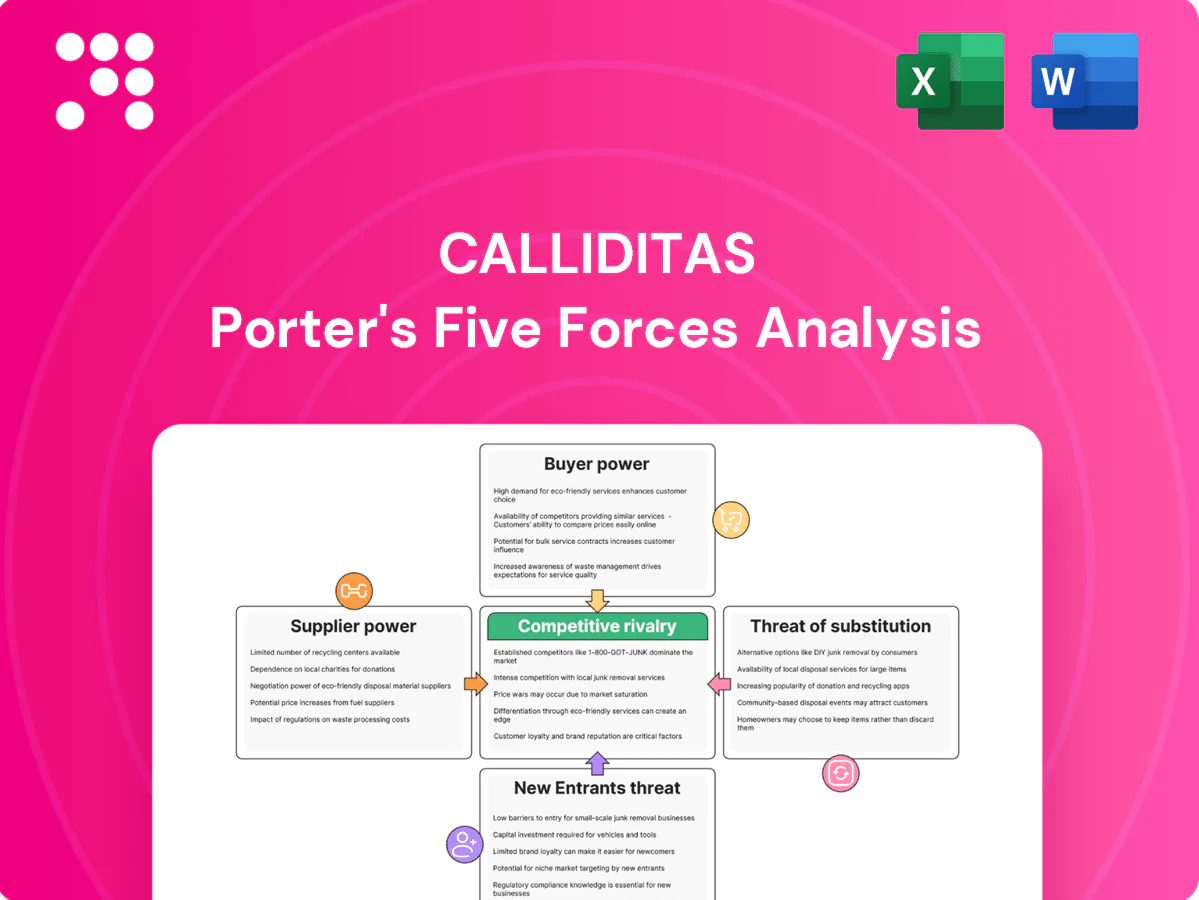
Calliditas Porter's Five Forces Analysis

From Overview to Strategy Blueprint
Calliditas’s Porter's Five Forces snapshot highlights key pressures—buyer power, supplier influence, substitutes, entrant threats, and competitive rivalry—shaping its niche in specialty renal therapies. The summary outlines strategic risks and opportunities that matter to investors and management. This brief snapshot only scratches the surface. Unlock the full Porter's Five Forces Analysis to explore Calliditas’s competitive dynamics, market pressures, and strategic advantages in detail.
Suppliers Bargaining Power

Concentrated CMO base
Calliditas depends on a concentrated group of specialized CMOs for targeted-release budesonide and capsule technologies, giving suppliers elevated leverage.
The limited pool of GMP-capable manufacturers for complex oral delayed-release forms raises switching costs and creates bottlenecks during capacity constraints.
Lengthy qualification, tech transfer and validation timelines further strengthen supplier bargaining power; dual sourcing can reduce dependence but is costly and time-consuming.
Specialty excipients and equipment
Proprietary coatings, excipients, and encapsulation equipment for gut-targeted delivery remain non-commoditized, concentrating dependency on a few specialist vendors; the global pharmaceutical excipients market was valued at about $9.6 billion in 2023, underscoring niche pricing power. Limited alternates elevate supplier leverage, so disruptions or price hikes can delay production and inflate costs. Long-term supply agreements mitigate risk but supplier bargaining still tilts in their favor.

Clinical and diagnostic inputs
Access to central labs such as LabCorp, Quest and Eurofins and to specialized renal biopsy and validated proteinuria/eGFR assays underpins Calliditas clinical programs and post-marketing evidence in 2024, creating dependence on a few providers. These specialized providers command premium pricing and switching labs risks data discontinuity and regulatory acceptability. Their accreditation and expertise confer moderate supplier power.

KOLs and trial site networks
Key nephrology investigators and high-volume IgAN centers, referenced in KDIGO 2021 guidance, are scarce and wield outsized influence; their endorsement materially shapes guideline uptake and payer coverage decisions. Competition for their limited bandwidth increases trial costs and contractual concessions, slowing enrollment and raising risk that evidence generation timelines and quality suffer.
- Influence: KOLs drive guideline/payer adoption
- Constraint: limited high-volume sites
- Impact: higher trial costs, slower evidence
Specialty distribution partners
Orphan drug distribution for Calliditas depends on specialty pharmacies and a narrow set of wholesalers, with the US market dominated by three wholesalers holding about 85% of distribution as of 2024; this concentration enables fee and service-level negotiations that favor distributors. Access programs, REMS-like services and cold-chain logistics add operational leverage, and contracting can temper but not eliminate supplier power.
- Channel concentration: top 3 wholesalers ~85% (2024)
- Service leverage: REMS/access programs, cold-chain demands
- Mitigation: contracting reduces but does not remove supplier bargaining power
Concentrated CMOs and wholesalers raise supply-switching risk for targeted-release budesonide
Calliditas faces elevated supplier power from a concentrated set of GMP CMOs for targeted-release budesonide and proprietary excipients/coatings, raising switching costs and bottleneck risk. Lab vendors, key nephrology KOLs and high-volume IgAN sites exert outsized influence on trials and evidence generation. Channel concentration (top 3 US wholesalers ~85% in 2024) and specialized service premiums sustain supplier leverage.
| Item | Metric | Year |
|---|---|---|
| Pharma excipients market | $9.6B | 2023 |
| Top 3 US wholesalers | ~85% | 2024 |
| GMP CMOs for delayed-release | Very limited | 2024 |
| Major lab providers | LabCorp/Quest/Eurofins dominance | 2024 |
What is included in the product
 Detailed Word Document
Tailored Porter’s Five Forces analysis for Calliditas, uncovering key competitive drivers, supplier and buyer influence on pricing, barriers deterring new entrants, and disruptive substitutes or emerging threats to market share—delivered in an editable format for integration into investor decks, strategic plans, or academic work.

 Customizable Excel Spreadsheet
A concise one-sheet Porter's Five Forces for Calliditas that distills competitive, supplier, buyer, entrant and substitute pressures to clarify strategic priorities. Customizable pressure levels and a clean layout make it easy to drop into pitch decks or boardroom slides for fast, actionable decisions.
Customers Bargaining Power

Payers and HTA gatekeepers
US payers, PBMs (top three covering ~80% of scripts in 2024) and EU HTA bodies (eg NICE £20–30k/QALY) tightly control access and price; orphan status eases entry but budget impact and comparative effectiveness dominate negotiations. Prior auth, step edits (RAAS/SGLT2 first) and rebates (often 20–50%) cut net price, while eGFR slope and proteinuria benefit data—tied to avoiding dialysis (~$90k/year)—are essential to defend value.
Concentrated prescribers
Nephrologists at specialized IgAN centers write a disproportionate share of prescriptions, giving them outsized influence on formulary placement and treatment pathways. Their concentration means targeted education and generation of real-world evidence are essential to drive and sustain adoption. Loss of one or more key centers can materially reduce volumes and slow market penetration.

Patient advocacy influence
Rare disease communities are vocal and shape access and adherence dynamics; WHO estimates ~300 million people live with rare diseases globally and ~70% are genetic, concentrating influence in small, organized cohorts. Advocacy can bolster value recognition but simultaneously pressures affordability given specialty rare-disease therapies often launch at six-figure annual prices. Expectations for co-pay support and manufacturer assistance programs constrain pricing flexibility, while transparent outcomes communication and real-world evidence are essential to maintain trust.

International tendering
International tendering in EU markets often compresses price — tenders drive discounts typically in the 20–60% range in 2023–24 procurement rounds — and single‑winner or ranked tenders shift bargaining power firmly to payers; purchasers increasingly demand real‑world outcomes or risk‑sharing contracts, while suppliers may accept volume commitments in exchange for lower margins.
- Price compression: 20–60% in recent EU tenders (2023–24)
- Buyer leverage: single‑winner/ranked tenders increase bargaining power
- Contracts: growing use of real‑world outcomes/risk‑sharing
- Trade‑off: volume guarantees vs margin pressure
Availability of alternatives
Supportive care expansion — RAAS inhibitors (reduce CKD progression ~20–30%) and SGLT2 inhibitors (DAPA‑CKD: 39% reduction in CKD progression composite) — plus emerging IgAN agents increase buyer options, enabling payers to push prices. Therapeutic interchange and step therapy (used in many large formularies, ~60% adoption) intensify negotiations, while clear differentiation on hard outcomes (ESRD, eGFR preservation) reduces buyer leverage.
- RAAS: ~20–30% CKD risk reduction
- SGLT2: DAPA‑CKD 39% composite risk reduction
- Formulary step therapy: ~60% adoption
- Hard‑outcome differentiation lowers buyer power
Price pressure from PBMs and EU tenders; avoiding dialysis saves $90k/yr
US PBMs/Payers (top three cover ~80% scripts) and EU HTA/tenders (20–60% discounts in 2023–24) exert high price pressure; rebates commonly 20–50% and prior auth/step edits (~60% formularies) constrain net revenue. Nephrologist concentration and rare‑disease advocacy drive access but raise affordability expectations; avoiding dialysis (~$90k/year) and DAPA‑CKD 39% benefit underpin value arguments.
| Metric | Value |
|---|---|
| PBM coverage | ~80% |
| EU tender discounts | 20–60% |
| Rebates | 20–50% |
| Step therapy adoption | ~60% |
| Dialysis cost | $90k/yr |
| DAPA‑CKD effect | 39% |
Preview the Actual Deliverable
Calliditas Porter's Five Forces Analysis
This preview shows the exact Calliditas Porter’s Five Forces Analysis you’ll receive immediately after purchase—no mockups, no placeholders. The document is fully written, professionally formatted and ready for download and use the moment you buy. You’re viewing the final deliverable and will get instant access to this identical file upon payment.

From Overview to Strategy Blueprint
Calliditas’s Porter's Five Forces snapshot highlights key pressures—buyer power, supplier influence, substitutes, entrant threats, and competitive rivalry—shaping its niche in specialty renal therapies. The summary outlines strategic risks and opportunities that matter to investors and management. This brief snapshot only scratches the surface. Unlock the full Porter's Five Forces Analysis to explore Calliditas’s competitive dynamics, market pressures, and strategic advantages in detail.
Suppliers Bargaining Power
Concentrated CMO base
Calliditas depends on a concentrated group of specialized CMOs for targeted-release budesonide and capsule technologies, giving suppliers elevated leverage.
The limited pool of GMP-capable manufacturers for complex oral delayed-release forms raises switching costs and creates bottlenecks during capacity constraints.
Lengthy qualification, tech transfer and validation timelines further strengthen supplier bargaining power; dual sourcing can reduce dependence but is costly and time-consuming.
Specialty excipients and equipment
Proprietary coatings, excipients, and encapsulation equipment for gut-targeted delivery remain non-commoditized, concentrating dependency on a few specialist vendors; the global pharmaceutical excipients market was valued at about $9.6 billion in 2023, underscoring niche pricing power. Limited alternates elevate supplier leverage, so disruptions or price hikes can delay production and inflate costs. Long-term supply agreements mitigate risk but supplier bargaining still tilts in their favor.
Clinical and diagnostic inputs
Access to central labs such as LabCorp, Quest and Eurofins and to specialized renal biopsy and validated proteinuria/eGFR assays underpins Calliditas clinical programs and post-marketing evidence in 2024, creating dependence on a few providers. These specialized providers command premium pricing and switching labs risks data discontinuity and regulatory acceptability. Their accreditation and expertise confer moderate supplier power.
KOLs and trial site networks
Key nephrology investigators and high-volume IgAN centers, referenced in KDIGO 2021 guidance, are scarce and wield outsized influence; their endorsement materially shapes guideline uptake and payer coverage decisions. Competition for their limited bandwidth increases trial costs and contractual concessions, slowing enrollment and raising risk that evidence generation timelines and quality suffer.
- Influence: KOLs drive guideline/payer adoption
- Constraint: limited high-volume sites
- Impact: higher trial costs, slower evidence
Specialty distribution partners
Orphan drug distribution for Calliditas depends on specialty pharmacies and a narrow set of wholesalers, with the US market dominated by three wholesalers holding about 85% of distribution as of 2024; this concentration enables fee and service-level negotiations that favor distributors. Access programs, REMS-like services and cold-chain logistics add operational leverage, and contracting can temper but not eliminate supplier power.
- Channel concentration: top 3 wholesalers ~85% (2024)
- Service leverage: REMS/access programs, cold-chain demands
- Mitigation: contracting reduces but does not remove supplier bargaining power
Concentrated CMOs and wholesalers raise supply-switching risk for targeted-release budesonide
Calliditas faces elevated supplier power from a concentrated set of GMP CMOs for targeted-release budesonide and proprietary excipients/coatings, raising switching costs and bottleneck risk. Lab vendors, key nephrology KOLs and high-volume IgAN sites exert outsized influence on trials and evidence generation. Channel concentration (top 3 US wholesalers ~85% in 2024) and specialized service premiums sustain supplier leverage.
| Item | Metric | Year |
|---|---|---|
| Pharma excipients market | $9.6B | 2023 |
| Top 3 US wholesalers | ~85% | 2024 |
| GMP CMOs for delayed-release | Very limited | 2024 |
| Major lab providers | LabCorp/Quest/Eurofins dominance | 2024 |
What is included in the product
Detailed Word Document
Tailored Porter’s Five Forces analysis for Calliditas, uncovering key competitive drivers, supplier and buyer influence on pricing, barriers deterring new entrants, and disruptive substitutes or emerging threats to market share—delivered in an editable format for integration into investor decks, strategic plans, or academic work.
Customizable Excel Spreadsheet
A concise one-sheet Porter's Five Forces for Calliditas that distills competitive, supplier, buyer, entrant and substitute pressures to clarify strategic priorities. Customizable pressure levels and a clean layout make it easy to drop into pitch decks or boardroom slides for fast, actionable decisions.
Customers Bargaining Power
Payers and HTA gatekeepers
US payers, PBMs (top three covering ~80% of scripts in 2024) and EU HTA bodies (eg NICE £20–30k/QALY) tightly control access and price; orphan status eases entry but budget impact and comparative effectiveness dominate negotiations. Prior auth, step edits (RAAS/SGLT2 first) and rebates (often 20–50%) cut net price, while eGFR slope and proteinuria benefit data—tied to avoiding dialysis (~$90k/year)—are essential to defend value.
Concentrated prescribers
Nephrologists at specialized IgAN centers write a disproportionate share of prescriptions, giving them outsized influence on formulary placement and treatment pathways. Their concentration means targeted education and generation of real-world evidence are essential to drive and sustain adoption. Loss of one or more key centers can materially reduce volumes and slow market penetration.
Patient advocacy influence
Rare disease communities are vocal and shape access and adherence dynamics; WHO estimates ~300 million people live with rare diseases globally and ~70% are genetic, concentrating influence in small, organized cohorts. Advocacy can bolster value recognition but simultaneously pressures affordability given specialty rare-disease therapies often launch at six-figure annual prices. Expectations for co-pay support and manufacturer assistance programs constrain pricing flexibility, while transparent outcomes communication and real-world evidence are essential to maintain trust.
International tendering
International tendering in EU markets often compresses price — tenders drive discounts typically in the 20–60% range in 2023–24 procurement rounds — and single‑winner or ranked tenders shift bargaining power firmly to payers; purchasers increasingly demand real‑world outcomes or risk‑sharing contracts, while suppliers may accept volume commitments in exchange for lower margins.
- Price compression: 20–60% in recent EU tenders (2023–24)
- Buyer leverage: single‑winner/ranked tenders increase bargaining power
- Contracts: growing use of real‑world outcomes/risk‑sharing
- Trade‑off: volume guarantees vs margin pressure
Availability of alternatives
Supportive care expansion — RAAS inhibitors (reduce CKD progression ~20–30%) and SGLT2 inhibitors (DAPA‑CKD: 39% reduction in CKD progression composite) — plus emerging IgAN agents increase buyer options, enabling payers to push prices. Therapeutic interchange and step therapy (used in many large formularies, ~60% adoption) intensify negotiations, while clear differentiation on hard outcomes (ESRD, eGFR preservation) reduces buyer leverage.
- RAAS: ~20–30% CKD risk reduction
- SGLT2: DAPA‑CKD 39% composite risk reduction
- Formulary step therapy: ~60% adoption
- Hard‑outcome differentiation lowers buyer power
Price pressure from PBMs and EU tenders; avoiding dialysis saves $90k/yr
US PBMs/Payers (top three cover ~80% scripts) and EU HTA/tenders (20–60% discounts in 2023–24) exert high price pressure; rebates commonly 20–50% and prior auth/step edits (~60% formularies) constrain net revenue. Nephrologist concentration and rare‑disease advocacy drive access but raise affordability expectations; avoiding dialysis (~$90k/year) and DAPA‑CKD 39% benefit underpin value arguments.
| Metric | Value |
|---|---|
| PBM coverage | ~80% |
| EU tender discounts | 20–60% |
| Rebates | 20–50% |
| Step therapy adoption | ~60% |
| Dialysis cost | $90k/yr |
| DAPA‑CKD effect | 39% |
Preview the Actual Deliverable
Calliditas Porter's Five Forces Analysis
This preview shows the exact Calliditas Porter’s Five Forces Analysis you’ll receive immediately after purchase—no mockups, no placeholders. The document is fully written, professionally formatted and ready for download and use the moment you buy. You’re viewing the final deliverable and will get instant access to this identical file upon payment.
Description
From Overview to Strategy Blueprint
Calliditas’s Porter's Five Forces snapshot highlights key pressures—buyer power, supplier influence, substitutes, entrant threats, and competitive rivalry—shaping its niche in specialty renal therapies. The summary outlines strategic risks and opportunities that matter to investors and management. This brief snapshot only scratches the surface. Unlock the full Porter's Five Forces Analysis to explore Calliditas’s competitive dynamics, market pressures, and strategic advantages in detail.
Suppliers Bargaining Power
Concentrated CMO base
Calliditas depends on a concentrated group of specialized CMOs for targeted-release budesonide and capsule technologies, giving suppliers elevated leverage.
The limited pool of GMP-capable manufacturers for complex oral delayed-release forms raises switching costs and creates bottlenecks during capacity constraints.
Lengthy qualification, tech transfer and validation timelines further strengthen supplier bargaining power; dual sourcing can reduce dependence but is costly and time-consuming.
Specialty excipients and equipment
Proprietary coatings, excipients, and encapsulation equipment for gut-targeted delivery remain non-commoditized, concentrating dependency on a few specialist vendors; the global pharmaceutical excipients market was valued at about $9.6 billion in 2023, underscoring niche pricing power. Limited alternates elevate supplier leverage, so disruptions or price hikes can delay production and inflate costs. Long-term supply agreements mitigate risk but supplier bargaining still tilts in their favor.
Clinical and diagnostic inputs
Access to central labs such as LabCorp, Quest and Eurofins and to specialized renal biopsy and validated proteinuria/eGFR assays underpins Calliditas clinical programs and post-marketing evidence in 2024, creating dependence on a few providers. These specialized providers command premium pricing and switching labs risks data discontinuity and regulatory acceptability. Their accreditation and expertise confer moderate supplier power.
KOLs and trial site networks
Key nephrology investigators and high-volume IgAN centers, referenced in KDIGO 2021 guidance, are scarce and wield outsized influence; their endorsement materially shapes guideline uptake and payer coverage decisions. Competition for their limited bandwidth increases trial costs and contractual concessions, slowing enrollment and raising risk that evidence generation timelines and quality suffer.
- Influence: KOLs drive guideline/payer adoption
- Constraint: limited high-volume sites
- Impact: higher trial costs, slower evidence
Specialty distribution partners
Orphan drug distribution for Calliditas depends on specialty pharmacies and a narrow set of wholesalers, with the US market dominated by three wholesalers holding about 85% of distribution as of 2024; this concentration enables fee and service-level negotiations that favor distributors. Access programs, REMS-like services and cold-chain logistics add operational leverage, and contracting can temper but not eliminate supplier power.
- Channel concentration: top 3 wholesalers ~85% (2024)
- Service leverage: REMS/access programs, cold-chain demands
- Mitigation: contracting reduces but does not remove supplier bargaining power
Concentrated CMOs and wholesalers raise supply-switching risk for targeted-release budesonide
Calliditas faces elevated supplier power from a concentrated set of GMP CMOs for targeted-release budesonide and proprietary excipients/coatings, raising switching costs and bottleneck risk. Lab vendors, key nephrology KOLs and high-volume IgAN sites exert outsized influence on trials and evidence generation. Channel concentration (top 3 US wholesalers ~85% in 2024) and specialized service premiums sustain supplier leverage.
| Item | Metric | Year |
|---|---|---|
| Pharma excipients market | $9.6B | 2023 |
| Top 3 US wholesalers | ~85% | 2024 |
| GMP CMOs for delayed-release | Very limited | 2024 |
| Major lab providers | LabCorp/Quest/Eurofins dominance | 2024 |
What is included in the product
Detailed Word Document
Tailored Porter’s Five Forces analysis for Calliditas, uncovering key competitive drivers, supplier and buyer influence on pricing, barriers deterring new entrants, and disruptive substitutes or emerging threats to market share—delivered in an editable format for integration into investor decks, strategic plans, or academic work.
Customizable Excel Spreadsheet
A concise one-sheet Porter's Five Forces for Calliditas that distills competitive, supplier, buyer, entrant and substitute pressures to clarify strategic priorities. Customizable pressure levels and a clean layout make it easy to drop into pitch decks or boardroom slides for fast, actionable decisions.
Customers Bargaining Power
Payers and HTA gatekeepers
US payers, PBMs (top three covering ~80% of scripts in 2024) and EU HTA bodies (eg NICE £20–30k/QALY) tightly control access and price; orphan status eases entry but budget impact and comparative effectiveness dominate negotiations. Prior auth, step edits (RAAS/SGLT2 first) and rebates (often 20–50%) cut net price, while eGFR slope and proteinuria benefit data—tied to avoiding dialysis (~$90k/year)—are essential to defend value.
Concentrated prescribers
Nephrologists at specialized IgAN centers write a disproportionate share of prescriptions, giving them outsized influence on formulary placement and treatment pathways. Their concentration means targeted education and generation of real-world evidence are essential to drive and sustain adoption. Loss of one or more key centers can materially reduce volumes and slow market penetration.
Patient advocacy influence
Rare disease communities are vocal and shape access and adherence dynamics; WHO estimates ~300 million people live with rare diseases globally and ~70% are genetic, concentrating influence in small, organized cohorts. Advocacy can bolster value recognition but simultaneously pressures affordability given specialty rare-disease therapies often launch at six-figure annual prices. Expectations for co-pay support and manufacturer assistance programs constrain pricing flexibility, while transparent outcomes communication and real-world evidence are essential to maintain trust.
International tendering
International tendering in EU markets often compresses price — tenders drive discounts typically in the 20–60% range in 2023–24 procurement rounds — and single‑winner or ranked tenders shift bargaining power firmly to payers; purchasers increasingly demand real‑world outcomes or risk‑sharing contracts, while suppliers may accept volume commitments in exchange for lower margins.
- Price compression: 20–60% in recent EU tenders (2023–24)
- Buyer leverage: single‑winner/ranked tenders increase bargaining power
- Contracts: growing use of real‑world outcomes/risk‑sharing
- Trade‑off: volume guarantees vs margin pressure
Availability of alternatives
Supportive care expansion — RAAS inhibitors (reduce CKD progression ~20–30%) and SGLT2 inhibitors (DAPA‑CKD: 39% reduction in CKD progression composite) — plus emerging IgAN agents increase buyer options, enabling payers to push prices. Therapeutic interchange and step therapy (used in many large formularies, ~60% adoption) intensify negotiations, while clear differentiation on hard outcomes (ESRD, eGFR preservation) reduces buyer leverage.
- RAAS: ~20–30% CKD risk reduction
- SGLT2: DAPA‑CKD 39% composite risk reduction
- Formulary step therapy: ~60% adoption
- Hard‑outcome differentiation lowers buyer power
Price pressure from PBMs and EU tenders; avoiding dialysis saves $90k/yr
US PBMs/Payers (top three cover ~80% scripts) and EU HTA/tenders (20–60% discounts in 2023–24) exert high price pressure; rebates commonly 20–50% and prior auth/step edits (~60% formularies) constrain net revenue. Nephrologist concentration and rare‑disease advocacy drive access but raise affordability expectations; avoiding dialysis (~$90k/year) and DAPA‑CKD 39% benefit underpin value arguments.
| Metric | Value |
|---|---|
| PBM coverage | ~80% |
| EU tender discounts | 20–60% |
| Rebates | 20–50% |
| Step therapy adoption | ~60% |
| Dialysis cost | $90k/yr |
| DAPA‑CKD effect | 39% |
Preview the Actual Deliverable
Calliditas Porter's Five Forces Analysis
This preview shows the exact Calliditas Porter’s Five Forces Analysis you’ll receive immediately after purchase—no mockups, no placeholders. The document is fully written, professionally formatted and ready for download and use the moment you buy. You’re viewing the final deliverable and will get instant access to this identical file upon payment.











