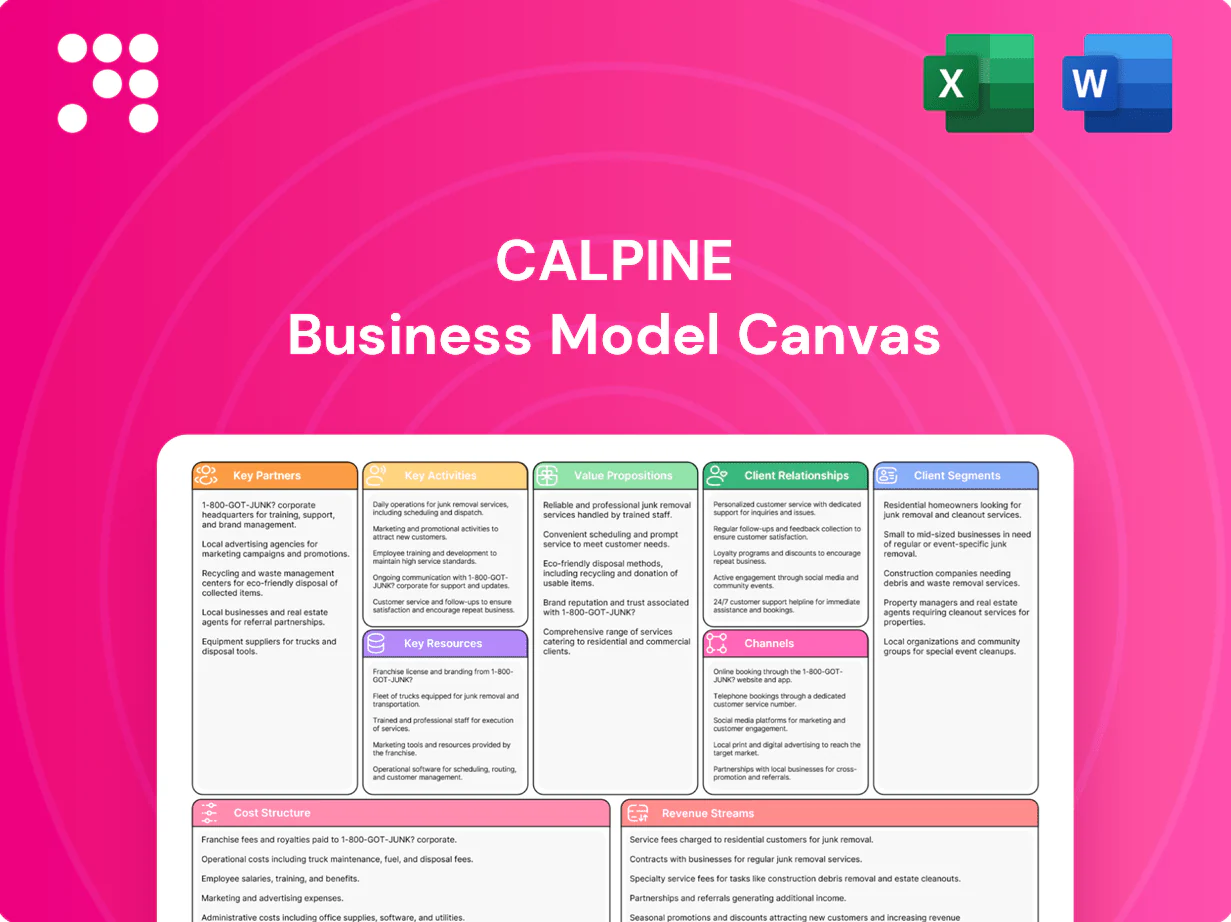
Calpine Business Model Canvas

Unlock the strategic blueprint of a leading power producer with a Business Model Canvas
Unlock the full strategic blueprint behind Calpine's business model. This in-depth Business Model Canvas reveals value drivers, revenue streams, and operational levers that power its market leadership. Ideal for investors, consultants, and founders—download the editable Word and Excel canvas to benchmark, plan, and act.
Partnerships

Natural gas suppliers and pipeline operators
Secure, competitively priced gas supply is essential for Calpine’s combined-cycle and peaker fleet operations; Calpine operates about 26 GW of gas-fired and geothermal capacity as of 2024. Long-term transportation and storage arrangements stabilize delivered fuel costs and availability across seasonal demand swings. Close coordination with pipeline schedulers supports reliable dispatch, minimizes imbalance charges and enables more effective hedging strategies.
Geothermal resource owners and technology providers
Land leaseholders, steam-field developers and well-service firms underpin geothermal output at assets like The Geysers (about 725 MW operated by Calpine), while OEMs and specialty contractors support turbines, brine handling and reinjection systems. These partners reduce downtime and sustain reservoirs, enabling baseload capacity factors commonly in the 70–90% range and multiyear asset-life extension that preserves revenue streams.

ISOs/RTOs and transmission operators
ISOs/RTOs (PJM, ERCOT, CAISO) enable Calpine to bid energy, capacity and ancillary services across organized markets; Calpine's ~26 GW fleet relies on these markets for revenue optimization. Transmission operators manage interconnection, congestion and reliability coordination; close engagement supports compliance, outage planning and market-optimized bidding.

Equipment OEMs, EPCs, and O&M service providers
Equipment OEMs supplying turbines, HRSGs and controls deliver performance upgrades and spare parts that sustain Calpine’s ~26 GW fleet (2024); EPC and specialty maintenance partners perform major overhauls and life-extension projects; multi-year service agreements drive availability, efficiency and transfer warranty risk to vendors.
- OEM upgrades: heat-rate and reliability gains
- EPC/specialty: planned overhauls, life-extension
- Service agreements: availability, efficiency, warranty risk management
Financial institutions and hedging counterparties
Banks, insurers, and commodity counterparties underwrite project finance and risk management for Calpine, enabling capital for its roughly 26 GW fleet across about 80 facilities (2024).
Credit facilities and interest‑rate or commodity hedges (swaps, caps) stabilize cash flows and protect against volatility in gas and power markets.
- Project finance via syndicated bank loans
- Hedges covering fuel and interest exposure
- Structured products for tolling, PPAs, capacity monetization
Gas, geothermal partners and hedges underpin 26 GW fleet revenue
Calpine depends on secured gas supply and transport for its ~26 GW gas/geothermal fleet (2024). Geothermal partners sustain The Geysers ~725 MW and reservoir longevity. ISOs/RTOs and TOs enable market revenue across ~80 facilities. Banks, insurers and counterparties provide project finance, credit lines and hedges to stabilize cash flow.
| Partner | Role | 2024 metric |
|---|---|---|
| Gas suppliers | Fuel/transport | 26 GW fueled |
| Geothermal operators | Reservoir & O&M | 725 MW Geysers |
| Financial | Finance/hedges | ~80 facilities |
What is included in the product
 Detailed Word Document
A comprehensive, pre-written Business Model Canvas for Calpine detailing customer segments, channels, value propositions, revenue streams, key resources and partners, and cost structure, reflecting real-world power-generation operations and strategic plans; ideal for presentations, investor discussions, and strategic analysis with SWOT-linked insights.

 Customizable Excel Spreadsheet
High-level view of Calpine's power-generation business model with editable cells, condensing strategy, revenue streams, asset portfolios, and regulatory touchpoints into a one-page snapshot for quick review, collaboration, and boardroom decision-making.
Activities

Power generation and real-time dispatch
Operate a roughly 26 GW fleet of gas-fired and geothermal plants (2024) to meet market demand and reliability needs across ISO markets. Optimize start-stop cycles, heat rates and emissions within unit constraints to maximize availability and margin. Coordinate with grid operators for scheduling, fast ramping and ancillary services to support system reliability.
Market bidding and portfolio optimization
Submit energy, capacity and ancillary offers into PJM, ERCOT, CAISO, NYISO, MISO and ISO‑NE while managing a fleet of over 25 GW of dispatchable capacity (2024). Hedge exposures with forwards, options and tolling agreements to lock margins. Continuously balance fuel costs, planned outages and real‑time market conditions to maximize margin.

Asset maintenance and performance upgrades
Calpine conducts preventive and corrective maintenance to sustain fleet availability above 90%, supporting reliability across roughly 26 GW of gas-fired capacity. Targeted turbine upgrades, digital controls and heat-rate improvements typically deliver 1–3% efficiency gains and lower variable O&M. Planned outages are scheduled seasonally to match peak demand and contractual blackout windows, minimizing revenue disruption.

Fuel procurement and logistics
- Term vs spot: balances price security and flexibility
- Storage: cushions seasonal and intraday variability
- Transport & imbalances: reduces curtailment risk
- Market integration: aligns hedges with dispatch and spark spreads
Regulatory compliance and environmental management
Calpine, the largest US generator from natural gas and geothermal, maintains multi-jurisdictional permits and emissions monitoring and reporting to EPA and state agencies; at the Geysers geothermal field (~725 MW) it enforces reinjection and waste controls. The company manages water use and waste streams to meet state standards and engages actively in ISO/RTO and policy processes that shape market rules.
- Permits & reporting: EPA/state compliance
- Geothermal: Geysers reinjection ~725 MW
- Policy engagement: ISO/RTO market rule input
Operate ~26 GW fleet, >90% availability across six ISOs
Operate ~26 GW portfolio (2024) of gas-fired and 725 MW geothermal at the Geysers to meet ISO reliability needs. Submit energy, capacity and ancillary offers into PJM, ERCOT, CAISO, NYISO, MISO and ISO‑NE while hedging via forwards, options and tolling. Sustain fleet availability >90%, optimize heat rates, manage fuel (term/spot/storage) and emissions reporting to EPA/state agencies.
| Metric | Value (2024) |
|---|---|
| Total capacity | ~26 GW |
| Geothermal (Geysers) | ~725 MW |
| Availability | >90% |
| Markets | PJM, ERCOT, CAISO, NYISO, MISO, ISO‑NE |
| US gas generation share | ~40% |
Full Version Awaits
Business Model Canvas
The document you're previewing is the actual Calpine Business Model Canvas you will receive—it's not a mockup. Upon purchase you'll get this same professional file in Word and Excel formats. The full deliverable is formatted, editable, and ready to use for analysis or presentations. No extras or placeholders—what you see is what you get.

Unlock the strategic blueprint of a leading power producer with a Business Model Canvas
Unlock the full strategic blueprint behind Calpine's business model. This in-depth Business Model Canvas reveals value drivers, revenue streams, and operational levers that power its market leadership. Ideal for investors, consultants, and founders—download the editable Word and Excel canvas to benchmark, plan, and act.
Partnerships
Natural gas suppliers and pipeline operators
Secure, competitively priced gas supply is essential for Calpine’s combined-cycle and peaker fleet operations; Calpine operates about 26 GW of gas-fired and geothermal capacity as of 2024. Long-term transportation and storage arrangements stabilize delivered fuel costs and availability across seasonal demand swings. Close coordination with pipeline schedulers supports reliable dispatch, minimizes imbalance charges and enables more effective hedging strategies.
Geothermal resource owners and technology providers
Land leaseholders, steam-field developers and well-service firms underpin geothermal output at assets like The Geysers (about 725 MW operated by Calpine), while OEMs and specialty contractors support turbines, brine handling and reinjection systems. These partners reduce downtime and sustain reservoirs, enabling baseload capacity factors commonly in the 70–90% range and multiyear asset-life extension that preserves revenue streams.
ISOs/RTOs and transmission operators
ISOs/RTOs (PJM, ERCOT, CAISO) enable Calpine to bid energy, capacity and ancillary services across organized markets; Calpine's ~26 GW fleet relies on these markets for revenue optimization. Transmission operators manage interconnection, congestion and reliability coordination; close engagement supports compliance, outage planning and market-optimized bidding.
Equipment OEMs, EPCs, and O&M service providers
Equipment OEMs supplying turbines, HRSGs and controls deliver performance upgrades and spare parts that sustain Calpine’s ~26 GW fleet (2024); EPC and specialty maintenance partners perform major overhauls and life-extension projects; multi-year service agreements drive availability, efficiency and transfer warranty risk to vendors.
- OEM upgrades: heat-rate and reliability gains
- EPC/specialty: planned overhauls, life-extension
- Service agreements: availability, efficiency, warranty risk management
Financial institutions and hedging counterparties
Banks, insurers, and commodity counterparties underwrite project finance and risk management for Calpine, enabling capital for its roughly 26 GW fleet across about 80 facilities (2024).
Credit facilities and interest‑rate or commodity hedges (swaps, caps) stabilize cash flows and protect against volatility in gas and power markets.
- Project finance via syndicated bank loans
- Hedges covering fuel and interest exposure
- Structured products for tolling, PPAs, capacity monetization
Gas, geothermal partners and hedges underpin 26 GW fleet revenue
Calpine depends on secured gas supply and transport for its ~26 GW gas/geothermal fleet (2024). Geothermal partners sustain The Geysers ~725 MW and reservoir longevity. ISOs/RTOs and TOs enable market revenue across ~80 facilities. Banks, insurers and counterparties provide project finance, credit lines and hedges to stabilize cash flow.
| Partner | Role | 2024 metric |
|---|---|---|
| Gas suppliers | Fuel/transport | 26 GW fueled |
| Geothermal operators | Reservoir & O&M | 725 MW Geysers |
| Financial | Finance/hedges | ~80 facilities |
What is included in the product
Detailed Word Document
A comprehensive, pre-written Business Model Canvas for Calpine detailing customer segments, channels, value propositions, revenue streams, key resources and partners, and cost structure, reflecting real-world power-generation operations and strategic plans; ideal for presentations, investor discussions, and strategic analysis with SWOT-linked insights.
Customizable Excel Spreadsheet
High-level view of Calpine's power-generation business model with editable cells, condensing strategy, revenue streams, asset portfolios, and regulatory touchpoints into a one-page snapshot for quick review, collaboration, and boardroom decision-making.
Activities
Power generation and real-time dispatch
Operate a roughly 26 GW fleet of gas-fired and geothermal plants (2024) to meet market demand and reliability needs across ISO markets. Optimize start-stop cycles, heat rates and emissions within unit constraints to maximize availability and margin. Coordinate with grid operators for scheduling, fast ramping and ancillary services to support system reliability.
Market bidding and portfolio optimization
Submit energy, capacity and ancillary offers into PJM, ERCOT, CAISO, NYISO, MISO and ISO‑NE while managing a fleet of over 25 GW of dispatchable capacity (2024). Hedge exposures with forwards, options and tolling agreements to lock margins. Continuously balance fuel costs, planned outages and real‑time market conditions to maximize margin.
Asset maintenance and performance upgrades
Calpine conducts preventive and corrective maintenance to sustain fleet availability above 90%, supporting reliability across roughly 26 GW of gas-fired capacity. Targeted turbine upgrades, digital controls and heat-rate improvements typically deliver 1–3% efficiency gains and lower variable O&M. Planned outages are scheduled seasonally to match peak demand and contractual blackout windows, minimizing revenue disruption.
Fuel procurement and logistics
- Term vs spot: balances price security and flexibility
- Storage: cushions seasonal and intraday variability
- Transport & imbalances: reduces curtailment risk
- Market integration: aligns hedges with dispatch and spark spreads
Regulatory compliance and environmental management
Calpine, the largest US generator from natural gas and geothermal, maintains multi-jurisdictional permits and emissions monitoring and reporting to EPA and state agencies; at the Geysers geothermal field (~725 MW) it enforces reinjection and waste controls. The company manages water use and waste streams to meet state standards and engages actively in ISO/RTO and policy processes that shape market rules.
- Permits & reporting: EPA/state compliance
- Geothermal: Geysers reinjection ~725 MW
- Policy engagement: ISO/RTO market rule input
Operate ~26 GW fleet, >90% availability across six ISOs
Operate ~26 GW portfolio (2024) of gas-fired and 725 MW geothermal at the Geysers to meet ISO reliability needs. Submit energy, capacity and ancillary offers into PJM, ERCOT, CAISO, NYISO, MISO and ISO‑NE while hedging via forwards, options and tolling. Sustain fleet availability >90%, optimize heat rates, manage fuel (term/spot/storage) and emissions reporting to EPA/state agencies.
| Metric | Value (2024) |
|---|---|
| Total capacity | ~26 GW |
| Geothermal (Geysers) | ~725 MW |
| Availability | >90% |
| Markets | PJM, ERCOT, CAISO, NYISO, MISO, ISO‑NE |
| US gas generation share | ~40% |
Full Version Awaits
Business Model Canvas
The document you're previewing is the actual Calpine Business Model Canvas you will receive—it's not a mockup. Upon purchase you'll get this same professional file in Word and Excel formats. The full deliverable is formatted, editable, and ready to use for analysis or presentations. No extras or placeholders—what you see is what you get.
Description
Unlock the strategic blueprint of a leading power producer with a Business Model Canvas
Unlock the full strategic blueprint behind Calpine's business model. This in-depth Business Model Canvas reveals value drivers, revenue streams, and operational levers that power its market leadership. Ideal for investors, consultants, and founders—download the editable Word and Excel canvas to benchmark, plan, and act.
Partnerships
Natural gas suppliers and pipeline operators
Secure, competitively priced gas supply is essential for Calpine’s combined-cycle and peaker fleet operations; Calpine operates about 26 GW of gas-fired and geothermal capacity as of 2024. Long-term transportation and storage arrangements stabilize delivered fuel costs and availability across seasonal demand swings. Close coordination with pipeline schedulers supports reliable dispatch, minimizes imbalance charges and enables more effective hedging strategies.
Geothermal resource owners and technology providers
Land leaseholders, steam-field developers and well-service firms underpin geothermal output at assets like The Geysers (about 725 MW operated by Calpine), while OEMs and specialty contractors support turbines, brine handling and reinjection systems. These partners reduce downtime and sustain reservoirs, enabling baseload capacity factors commonly in the 70–90% range and multiyear asset-life extension that preserves revenue streams.
ISOs/RTOs and transmission operators
ISOs/RTOs (PJM, ERCOT, CAISO) enable Calpine to bid energy, capacity and ancillary services across organized markets; Calpine's ~26 GW fleet relies on these markets for revenue optimization. Transmission operators manage interconnection, congestion and reliability coordination; close engagement supports compliance, outage planning and market-optimized bidding.
Equipment OEMs, EPCs, and O&M service providers
Equipment OEMs supplying turbines, HRSGs and controls deliver performance upgrades and spare parts that sustain Calpine’s ~26 GW fleet (2024); EPC and specialty maintenance partners perform major overhauls and life-extension projects; multi-year service agreements drive availability, efficiency and transfer warranty risk to vendors.
- OEM upgrades: heat-rate and reliability gains
- EPC/specialty: planned overhauls, life-extension
- Service agreements: availability, efficiency, warranty risk management
Financial institutions and hedging counterparties
Banks, insurers, and commodity counterparties underwrite project finance and risk management for Calpine, enabling capital for its roughly 26 GW fleet across about 80 facilities (2024).
Credit facilities and interest‑rate or commodity hedges (swaps, caps) stabilize cash flows and protect against volatility in gas and power markets.
- Project finance via syndicated bank loans
- Hedges covering fuel and interest exposure
- Structured products for tolling, PPAs, capacity monetization
Gas, geothermal partners and hedges underpin 26 GW fleet revenue
Calpine depends on secured gas supply and transport for its ~26 GW gas/geothermal fleet (2024). Geothermal partners sustain The Geysers ~725 MW and reservoir longevity. ISOs/RTOs and TOs enable market revenue across ~80 facilities. Banks, insurers and counterparties provide project finance, credit lines and hedges to stabilize cash flow.
| Partner | Role | 2024 metric |
|---|---|---|
| Gas suppliers | Fuel/transport | 26 GW fueled |
| Geothermal operators | Reservoir & O&M | 725 MW Geysers |
| Financial | Finance/hedges | ~80 facilities |
What is included in the product
Detailed Word Document
A comprehensive, pre-written Business Model Canvas for Calpine detailing customer segments, channels, value propositions, revenue streams, key resources and partners, and cost structure, reflecting real-world power-generation operations and strategic plans; ideal for presentations, investor discussions, and strategic analysis with SWOT-linked insights.
Customizable Excel Spreadsheet
High-level view of Calpine's power-generation business model with editable cells, condensing strategy, revenue streams, asset portfolios, and regulatory touchpoints into a one-page snapshot for quick review, collaboration, and boardroom decision-making.
Activities
Power generation and real-time dispatch
Operate a roughly 26 GW fleet of gas-fired and geothermal plants (2024) to meet market demand and reliability needs across ISO markets. Optimize start-stop cycles, heat rates and emissions within unit constraints to maximize availability and margin. Coordinate with grid operators for scheduling, fast ramping and ancillary services to support system reliability.
Market bidding and portfolio optimization
Submit energy, capacity and ancillary offers into PJM, ERCOT, CAISO, NYISO, MISO and ISO‑NE while managing a fleet of over 25 GW of dispatchable capacity (2024). Hedge exposures with forwards, options and tolling agreements to lock margins. Continuously balance fuel costs, planned outages and real‑time market conditions to maximize margin.
Asset maintenance and performance upgrades
Calpine conducts preventive and corrective maintenance to sustain fleet availability above 90%, supporting reliability across roughly 26 GW of gas-fired capacity. Targeted turbine upgrades, digital controls and heat-rate improvements typically deliver 1–3% efficiency gains and lower variable O&M. Planned outages are scheduled seasonally to match peak demand and contractual blackout windows, minimizing revenue disruption.
Fuel procurement and logistics
- Term vs spot: balances price security and flexibility
- Storage: cushions seasonal and intraday variability
- Transport & imbalances: reduces curtailment risk
- Market integration: aligns hedges with dispatch and spark spreads
Regulatory compliance and environmental management
Calpine, the largest US generator from natural gas and geothermal, maintains multi-jurisdictional permits and emissions monitoring and reporting to EPA and state agencies; at the Geysers geothermal field (~725 MW) it enforces reinjection and waste controls. The company manages water use and waste streams to meet state standards and engages actively in ISO/RTO and policy processes that shape market rules.
- Permits & reporting: EPA/state compliance
- Geothermal: Geysers reinjection ~725 MW
- Policy engagement: ISO/RTO market rule input
Operate ~26 GW fleet, >90% availability across six ISOs
Operate ~26 GW portfolio (2024) of gas-fired and 725 MW geothermal at the Geysers to meet ISO reliability needs. Submit energy, capacity and ancillary offers into PJM, ERCOT, CAISO, NYISO, MISO and ISO‑NE while hedging via forwards, options and tolling. Sustain fleet availability >90%, optimize heat rates, manage fuel (term/spot/storage) and emissions reporting to EPA/state agencies.
| Metric | Value (2024) |
|---|---|
| Total capacity | ~26 GW |
| Geothermal (Geysers) | ~725 MW |
| Availability | >90% |
| Markets | PJM, ERCOT, CAISO, NYISO, MISO, ISO‑NE |
| US gas generation share | ~40% |
Full Version Awaits
Business Model Canvas
The document you're previewing is the actual Calpine Business Model Canvas you will receive—it's not a mockup. Upon purchase you'll get this same professional file in Word and Excel formats. The full deliverable is formatted, editable, and ready to use for analysis or presentations. No extras or placeholders—what you see is what you get.











