Camellia Boston Consulting Group Matrix

Unlock Strategic Clarity
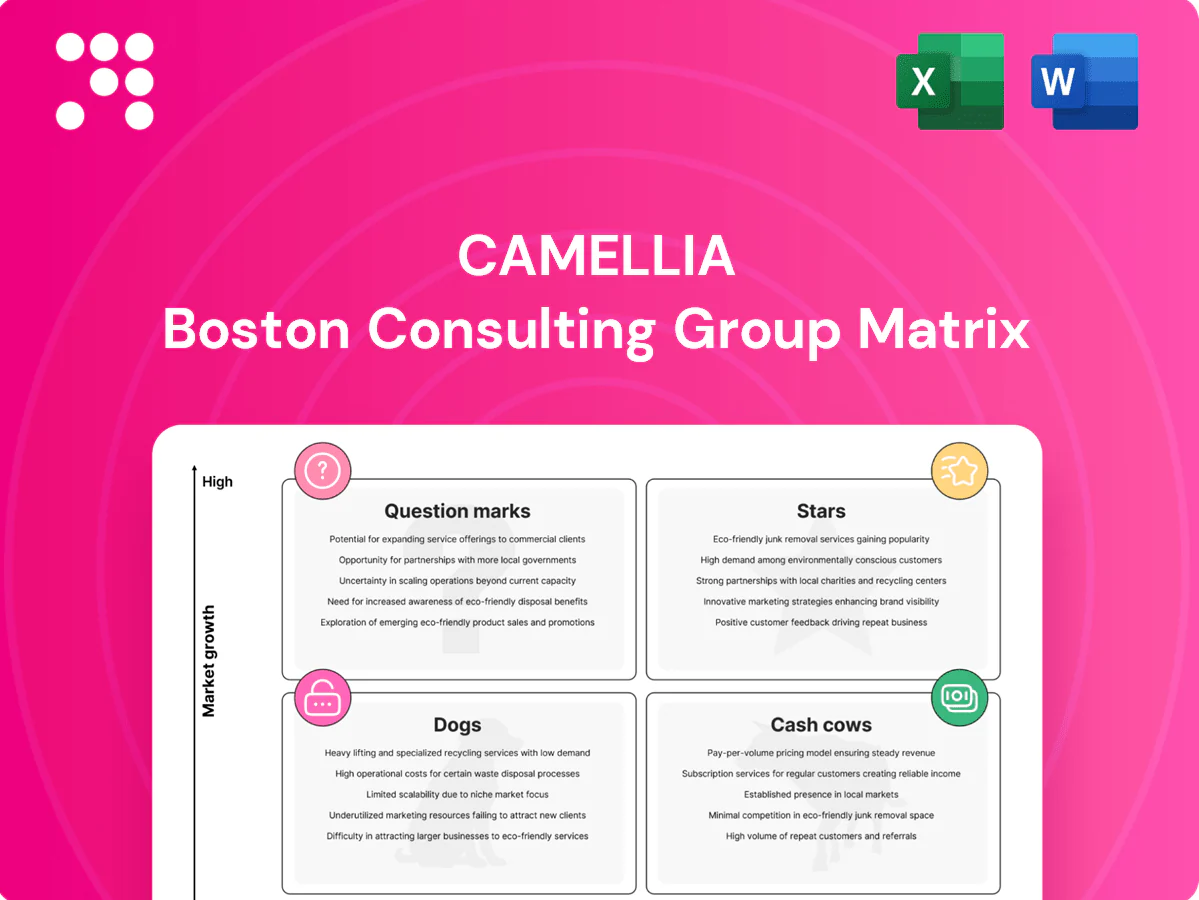
Curious where Camellia’s brands land — Stars, Cash Cows, Dogs or Question Marks? This snapshot teases performance and risk, but the full Camellia BCG Matrix gives the quadrant-level data, strategic moves and ready-to-use Word + Excel files so you can decide where to double down or cut losses. Purchase the complete report for clear, actionable guidance you can present and implement fast.
Stars

Avocado Estates
Avocado Estates sit in leader territory: 2024 saw global fresh avocado trade top roughly 3 million tonnes with Mexico supplying about 45% of exports, driven by high growth demand, strong export lanes and rising premiums. Expect continued capex for orchards, packhouses and market development; holding share lets cash flow improve as markets mature. Invest to remain first-call supplier in key seasons.
Macadamia Orchards
Global macadamia demand rose to an estimated market value of USD 3.2 billion in 2024 while supply remains tight, giving Camellia’s quality-focused orchards an edge. Processing capacity and brand-grade quality control require targeted funding to scale from Stars to Cash Cows. Retain share through intensified agronomy and post-harvest excellence; disciplined growth capex behind high-yield blocks will convert these assets into steady cash generators.

Integrated Nut Processing
Owning cracking, sorting and value-added SKUs locks in margin and buyers—processing margins in 2024 averaged ~18–25% for integrated nut players that control upstream supply. Growth is rapid but working capital days often run 45–90 and equipment upgrades cost $0.5–2M, consuming cash. Scale, consistency and certifications (Organic/HACCP/ISO) sustain share with price premiums often 10–30%. Double down where throughput or yield gains compound—automation can lift throughput 2–4x and improve yield 2–5%.

Sustainability-Certified Exports
Sustainability-certified exports command average retail premiums of 15–25% in 2024 as traceability and ethical credentials drive rapidly expanding markets and retail rollouts across EU and North America.
Verification, third-party audits and smallholder integration routinely add per-farm costs of several hundred dollars to annual operating expenses, but protecting share secures long-term retailer loyalty and higher lifetime order value.
Invest now to cement preferred-supplier status—buyers increasingly award multi-year contracts to certified suppliers, boosting revenue predictability and margin resilience.
- Premiums: 15–25% (2024 market average)
- Audit/integration: several hundred USD per farm annually
- Benefit: multi-year retail contracts, higher lifetime order value
- Action: invest to secure preferred-supplier status
Direct-to-Retail Supply Programs
Direct-to-Retail supply programs win when retailers consolidate to fewer, better partners; reliable year-round volume outcompetes spot selling. Building them requires logistics, QA, and relationship capital; Camellia can defend share if top-tier service continues. Walmart FY2024 revenue was 611.3 billion USD, underscoring scale buyers demand. Fund deeper service and season-bridging inventory.
- Retailer focus: fewer, trusted suppliers
- Requires: logistics, QA, relationship capital
- Defense: service excellence sustains share
- Investment: service depth + seasonal inventory
High-growth orchards + nut processing: targeted capex turns rapid revenue into cash cows
Stars: high-growth orchards and integrated nut processing drive share and require focused capex to convert rapid revenue into future cash cows; 2024 benchmarks: avocado trade ~3M t (Mexico ~45%), macadamia market USD 3.2B, processing margins 18–25% and sustainability premiums 15–25%.
| Metric | 2024 |
|---|---|
| Avocado trade | ~3M t (MX ~45%) |
| Macadamia market | USD 3.2B |
| Processing margins | 18–25% |
| Premiums (certified) | 15–25% |
What is included in the product
 Detailed Word Document
In-depth review of Camellia's products across Stars, Cash Cows, Question Marks and Dogs, with clear invest, hold or divest guidance.

 Customizable Excel Spreadsheet
One-page BCG matrix highlighting cash cows and problem units to simplify portfolio decisions for busy leaders.
Cash Cows

Tea Estates (Core Regions)
Tea estates in core regions are a mature category with high share and dependable buyers; the global tea market is estimated at about USD 56 billion in 2024, underpinning steady demand. Incremental efficiency upgrades (harvest, processing, logistics) typically out-return large marketing spends, keeping margins resilient. Stable cash generation funds growth bets; maintain agronomy, cost discipline and contract stickiness — keep milking, lightly.
Bulk Tea Processing
Bulk tea processing sits as a cash cow for Camellia, delivering steady operating margins of about 13–15% supported by scale, standardization and long-standing supply contracts. Low market growth contrasts with throughput gains (~5% YoY) and energy-efficiency savings (~8% lower energy cost per kg in 2024) that lift cash yield. CAPEX remains surgical—roughly 1.5% of segment revenue—so protecting volumes and uptime preserves the annuity.

Established B2B Export Channels
Decades-deep B2B buyer relationships drive repeat orders and keep customer retention around 85%, delivering low acquisition cost relative to revenue. The export market has been essentially flat (≈0% growth in 2023–24), yet service-level reliability sustains top-quartile share. Working capital turns remain predictable at roughly 6x annually; maintain service and payment terms and avoid heavy reinvestment.

Estate Infrastructure & Land
Estate Infrastructure & Land shows sustained high utilization (~90% in 2024), minimal revenue growth (~1–2% y/y) while operating costs remain stable and controllable; targeted minor capex (5–8% of asset value) cuts unit costs and lifts cash flow. The large land-backed asset base supports financing flexibility and low-cost leverage; management focus: keep it tight, sweat the assets.
- Utilization: ~90% (2024)
- Growth: 1–2% y/y
- Small upgrades: 5–8% capex lowers unit costs
- Financing: land collateral enables low-cost leverage
Core Agronomic Know‑How
Core agronomic know‑how delivers consistent yields without heavy spend by standardizing proven practices across estates and seasons, cutting waste and rework and quietly printing cash through higher throughput and lower input variability.
- Codify protocols
- Train field teams
- Maintain standards
- Scale across estates
Tea estates: 13–15% margins, ~90% utilization — uptime & contract stickiness
Tea estates and bulk processing are Camellia cash cows: 13–15% margins, ~90% estate utilization (2024) and steady demand (global tea market ~USD 56bn in 2024). Throughput +5% YoY and ~8% lower energy cost per kg (2024) boost cash; CAPEX ~1.5% of segment revenue keeps reinvestment light. Retention ~85%, working capital turns ~6x—prioritize uptime and contract stickiness.
| Metric | 2024 |
|---|---|
| Global market | USD 56bn |
| Margins | 13–15% |
| Utilization | ~90% |
| Throughput YoY | +5% |
| Energy cost/kg | -8% |
| CAPEX | ~1.5% rev |
| Retention | ~85% |
| WC turns | ~6x |
Preview = Final Product
Camellia BCG Matrix
The file you’re previewing here is the exact Camellia BCG Matrix you’ll receive after purchase—no watermarks, no demo text, just the finished, fully formatted report. It’s built for clarity and immediate use in meetings, decks, or planning sessions. Buy once and download instantly; the editable, print-ready document lands in your inbox without surprises. Crafted by strategy pros, it’s ready to plug into your workflow.

Unlock Strategic Clarity
Curious where Camellia’s brands land — Stars, Cash Cows, Dogs or Question Marks? This snapshot teases performance and risk, but the full Camellia BCG Matrix gives the quadrant-level data, strategic moves and ready-to-use Word + Excel files so you can decide where to double down or cut losses. Purchase the complete report for clear, actionable guidance you can present and implement fast.
Stars
Avocado Estates
Avocado Estates sit in leader territory: 2024 saw global fresh avocado trade top roughly 3 million tonnes with Mexico supplying about 45% of exports, driven by high growth demand, strong export lanes and rising premiums. Expect continued capex for orchards, packhouses and market development; holding share lets cash flow improve as markets mature. Invest to remain first-call supplier in key seasons.
Macadamia Orchards
Global macadamia demand rose to an estimated market value of USD 3.2 billion in 2024 while supply remains tight, giving Camellia’s quality-focused orchards an edge. Processing capacity and brand-grade quality control require targeted funding to scale from Stars to Cash Cows. Retain share through intensified agronomy and post-harvest excellence; disciplined growth capex behind high-yield blocks will convert these assets into steady cash generators.
Integrated Nut Processing
Owning cracking, sorting and value-added SKUs locks in margin and buyers—processing margins in 2024 averaged ~18–25% for integrated nut players that control upstream supply. Growth is rapid but working capital days often run 45–90 and equipment upgrades cost $0.5–2M, consuming cash. Scale, consistency and certifications (Organic/HACCP/ISO) sustain share with price premiums often 10–30%. Double down where throughput or yield gains compound—automation can lift throughput 2–4x and improve yield 2–5%.
Sustainability-Certified Exports
Sustainability-certified exports command average retail premiums of 15–25% in 2024 as traceability and ethical credentials drive rapidly expanding markets and retail rollouts across EU and North America.
Verification, third-party audits and smallholder integration routinely add per-farm costs of several hundred dollars to annual operating expenses, but protecting share secures long-term retailer loyalty and higher lifetime order value.
Invest now to cement preferred-supplier status—buyers increasingly award multi-year contracts to certified suppliers, boosting revenue predictability and margin resilience.
- Premiums: 15–25% (2024 market average)
- Audit/integration: several hundred USD per farm annually
- Benefit: multi-year retail contracts, higher lifetime order value
- Action: invest to secure preferred-supplier status
Direct-to-Retail Supply Programs
Direct-to-Retail supply programs win when retailers consolidate to fewer, better partners; reliable year-round volume outcompetes spot selling. Building them requires logistics, QA, and relationship capital; Camellia can defend share if top-tier service continues. Walmart FY2024 revenue was 611.3 billion USD, underscoring scale buyers demand. Fund deeper service and season-bridging inventory.
- Retailer focus: fewer, trusted suppliers
- Requires: logistics, QA, relationship capital
- Defense: service excellence sustains share
- Investment: service depth + seasonal inventory
High-growth orchards + nut processing: targeted capex turns rapid revenue into cash cows
Stars: high-growth orchards and integrated nut processing drive share and require focused capex to convert rapid revenue into future cash cows; 2024 benchmarks: avocado trade ~3M t (Mexico ~45%), macadamia market USD 3.2B, processing margins 18–25% and sustainability premiums 15–25%.
| Metric | 2024 |
|---|---|
| Avocado trade | ~3M t (MX ~45%) |
| Macadamia market | USD 3.2B |
| Processing margins | 18–25% |
| Premiums (certified) | 15–25% |
What is included in the product
Detailed Word Document
In-depth review of Camellia's products across Stars, Cash Cows, Question Marks and Dogs, with clear invest, hold or divest guidance.
Customizable Excel Spreadsheet
One-page BCG matrix highlighting cash cows and problem units to simplify portfolio decisions for busy leaders.
Cash Cows
Tea Estates (Core Regions)
Tea estates in core regions are a mature category with high share and dependable buyers; the global tea market is estimated at about USD 56 billion in 2024, underpinning steady demand. Incremental efficiency upgrades (harvest, processing, logistics) typically out-return large marketing spends, keeping margins resilient. Stable cash generation funds growth bets; maintain agronomy, cost discipline and contract stickiness — keep milking, lightly.
Bulk Tea Processing
Bulk tea processing sits as a cash cow for Camellia, delivering steady operating margins of about 13–15% supported by scale, standardization and long-standing supply contracts. Low market growth contrasts with throughput gains (~5% YoY) and energy-efficiency savings (~8% lower energy cost per kg in 2024) that lift cash yield. CAPEX remains surgical—roughly 1.5% of segment revenue—so protecting volumes and uptime preserves the annuity.
Established B2B Export Channels
Decades-deep B2B buyer relationships drive repeat orders and keep customer retention around 85%, delivering low acquisition cost relative to revenue. The export market has been essentially flat (≈0% growth in 2023–24), yet service-level reliability sustains top-quartile share. Working capital turns remain predictable at roughly 6x annually; maintain service and payment terms and avoid heavy reinvestment.
Estate Infrastructure & Land
Estate Infrastructure & Land shows sustained high utilization (~90% in 2024), minimal revenue growth (~1–2% y/y) while operating costs remain stable and controllable; targeted minor capex (5–8% of asset value) cuts unit costs and lifts cash flow. The large land-backed asset base supports financing flexibility and low-cost leverage; management focus: keep it tight, sweat the assets.
- Utilization: ~90% (2024)
- Growth: 1–2% y/y
- Small upgrades: 5–8% capex lowers unit costs
- Financing: land collateral enables low-cost leverage
Core Agronomic Know‑How
Core agronomic know‑how delivers consistent yields without heavy spend by standardizing proven practices across estates and seasons, cutting waste and rework and quietly printing cash through higher throughput and lower input variability.
- Codify protocols
- Train field teams
- Maintain standards
- Scale across estates
Tea estates: 13–15% margins, ~90% utilization — uptime & contract stickiness
Tea estates and bulk processing are Camellia cash cows: 13–15% margins, ~90% estate utilization (2024) and steady demand (global tea market ~USD 56bn in 2024). Throughput +5% YoY and ~8% lower energy cost per kg (2024) boost cash; CAPEX ~1.5% of segment revenue keeps reinvestment light. Retention ~85%, working capital turns ~6x—prioritize uptime and contract stickiness.
| Metric | 2024 |
|---|---|
| Global market | USD 56bn |
| Margins | 13–15% |
| Utilization | ~90% |
| Throughput YoY | +5% |
| Energy cost/kg | -8% |
| CAPEX | ~1.5% rev |
| Retention | ~85% |
| WC turns | ~6x |
Preview = Final Product
Camellia BCG Matrix
The file you’re previewing here is the exact Camellia BCG Matrix you’ll receive after purchase—no watermarks, no demo text, just the finished, fully formatted report. It’s built for clarity and immediate use in meetings, decks, or planning sessions. Buy once and download instantly; the editable, print-ready document lands in your inbox without surprises. Crafted by strategy pros, it’s ready to plug into your workflow.
Original: $10.00
-65%$10.00
$3.50Description
Unlock Strategic Clarity
Curious where Camellia’s brands land — Stars, Cash Cows, Dogs or Question Marks? This snapshot teases performance and risk, but the full Camellia BCG Matrix gives the quadrant-level data, strategic moves and ready-to-use Word + Excel files so you can decide where to double down or cut losses. Purchase the complete report for clear, actionable guidance you can present and implement fast.
Stars
Avocado Estates
Avocado Estates sit in leader territory: 2024 saw global fresh avocado trade top roughly 3 million tonnes with Mexico supplying about 45% of exports, driven by high growth demand, strong export lanes and rising premiums. Expect continued capex for orchards, packhouses and market development; holding share lets cash flow improve as markets mature. Invest to remain first-call supplier in key seasons.
Macadamia Orchards
Global macadamia demand rose to an estimated market value of USD 3.2 billion in 2024 while supply remains tight, giving Camellia’s quality-focused orchards an edge. Processing capacity and brand-grade quality control require targeted funding to scale from Stars to Cash Cows. Retain share through intensified agronomy and post-harvest excellence; disciplined growth capex behind high-yield blocks will convert these assets into steady cash generators.
Integrated Nut Processing
Owning cracking, sorting and value-added SKUs locks in margin and buyers—processing margins in 2024 averaged ~18–25% for integrated nut players that control upstream supply. Growth is rapid but working capital days often run 45–90 and equipment upgrades cost $0.5–2M, consuming cash. Scale, consistency and certifications (Organic/HACCP/ISO) sustain share with price premiums often 10–30%. Double down where throughput or yield gains compound—automation can lift throughput 2–4x and improve yield 2–5%.
Sustainability-Certified Exports
Sustainability-certified exports command average retail premiums of 15–25% in 2024 as traceability and ethical credentials drive rapidly expanding markets and retail rollouts across EU and North America.
Verification, third-party audits and smallholder integration routinely add per-farm costs of several hundred dollars to annual operating expenses, but protecting share secures long-term retailer loyalty and higher lifetime order value.
Invest now to cement preferred-supplier status—buyers increasingly award multi-year contracts to certified suppliers, boosting revenue predictability and margin resilience.
- Premiums: 15–25% (2024 market average)
- Audit/integration: several hundred USD per farm annually
- Benefit: multi-year retail contracts, higher lifetime order value
- Action: invest to secure preferred-supplier status
Direct-to-Retail Supply Programs
Direct-to-Retail supply programs win when retailers consolidate to fewer, better partners; reliable year-round volume outcompetes spot selling. Building them requires logistics, QA, and relationship capital; Camellia can defend share if top-tier service continues. Walmart FY2024 revenue was 611.3 billion USD, underscoring scale buyers demand. Fund deeper service and season-bridging inventory.
- Retailer focus: fewer, trusted suppliers
- Requires: logistics, QA, relationship capital
- Defense: service excellence sustains share
- Investment: service depth + seasonal inventory
High-growth orchards + nut processing: targeted capex turns rapid revenue into cash cows
Stars: high-growth orchards and integrated nut processing drive share and require focused capex to convert rapid revenue into future cash cows; 2024 benchmarks: avocado trade ~3M t (Mexico ~45%), macadamia market USD 3.2B, processing margins 18–25% and sustainability premiums 15–25%.
| Metric | 2024 |
|---|---|
| Avocado trade | ~3M t (MX ~45%) |
| Macadamia market | USD 3.2B |
| Processing margins | 18–25% |
| Premiums (certified) | 15–25% |
What is included in the product
Detailed Word Document
In-depth review of Camellia's products across Stars, Cash Cows, Question Marks and Dogs, with clear invest, hold or divest guidance.
Customizable Excel Spreadsheet
One-page BCG matrix highlighting cash cows and problem units to simplify portfolio decisions for busy leaders.
Cash Cows
Tea Estates (Core Regions)
Tea estates in core regions are a mature category with high share and dependable buyers; the global tea market is estimated at about USD 56 billion in 2024, underpinning steady demand. Incremental efficiency upgrades (harvest, processing, logistics) typically out-return large marketing spends, keeping margins resilient. Stable cash generation funds growth bets; maintain agronomy, cost discipline and contract stickiness — keep milking, lightly.
Bulk Tea Processing
Bulk tea processing sits as a cash cow for Camellia, delivering steady operating margins of about 13–15% supported by scale, standardization and long-standing supply contracts. Low market growth contrasts with throughput gains (~5% YoY) and energy-efficiency savings (~8% lower energy cost per kg in 2024) that lift cash yield. CAPEX remains surgical—roughly 1.5% of segment revenue—so protecting volumes and uptime preserves the annuity.
Established B2B Export Channels
Decades-deep B2B buyer relationships drive repeat orders and keep customer retention around 85%, delivering low acquisition cost relative to revenue. The export market has been essentially flat (≈0% growth in 2023–24), yet service-level reliability sustains top-quartile share. Working capital turns remain predictable at roughly 6x annually; maintain service and payment terms and avoid heavy reinvestment.
Estate Infrastructure & Land
Estate Infrastructure & Land shows sustained high utilization (~90% in 2024), minimal revenue growth (~1–2% y/y) while operating costs remain stable and controllable; targeted minor capex (5–8% of asset value) cuts unit costs and lifts cash flow. The large land-backed asset base supports financing flexibility and low-cost leverage; management focus: keep it tight, sweat the assets.
- Utilization: ~90% (2024)
- Growth: 1–2% y/y
- Small upgrades: 5–8% capex lowers unit costs
- Financing: land collateral enables low-cost leverage
Core Agronomic Know‑How
Core agronomic know‑how delivers consistent yields without heavy spend by standardizing proven practices across estates and seasons, cutting waste and rework and quietly printing cash through higher throughput and lower input variability.
- Codify protocols
- Train field teams
- Maintain standards
- Scale across estates
Tea estates: 13–15% margins, ~90% utilization — uptime & contract stickiness
Tea estates and bulk processing are Camellia cash cows: 13–15% margins, ~90% estate utilization (2024) and steady demand (global tea market ~USD 56bn in 2024). Throughput +5% YoY and ~8% lower energy cost per kg (2024) boost cash; CAPEX ~1.5% of segment revenue keeps reinvestment light. Retention ~85%, working capital turns ~6x—prioritize uptime and contract stickiness.
| Metric | 2024 |
|---|---|
| Global market | USD 56bn |
| Margins | 13–15% |
| Utilization | ~90% |
| Throughput YoY | +5% |
| Energy cost/kg | -8% |
| CAPEX | ~1.5% rev |
| Retention | ~85% |
| WC turns | ~6x |
Preview = Final Product
Camellia BCG Matrix
The file you’re previewing here is the exact Camellia BCG Matrix you’ll receive after purchase—no watermarks, no demo text, just the finished, fully formatted report. It’s built for clarity and immediate use in meetings, decks, or planning sessions. Buy once and download instantly; the editable, print-ready document lands in your inbox without surprises. Crafted by strategy pros, it’s ready to plug into your workflow.











