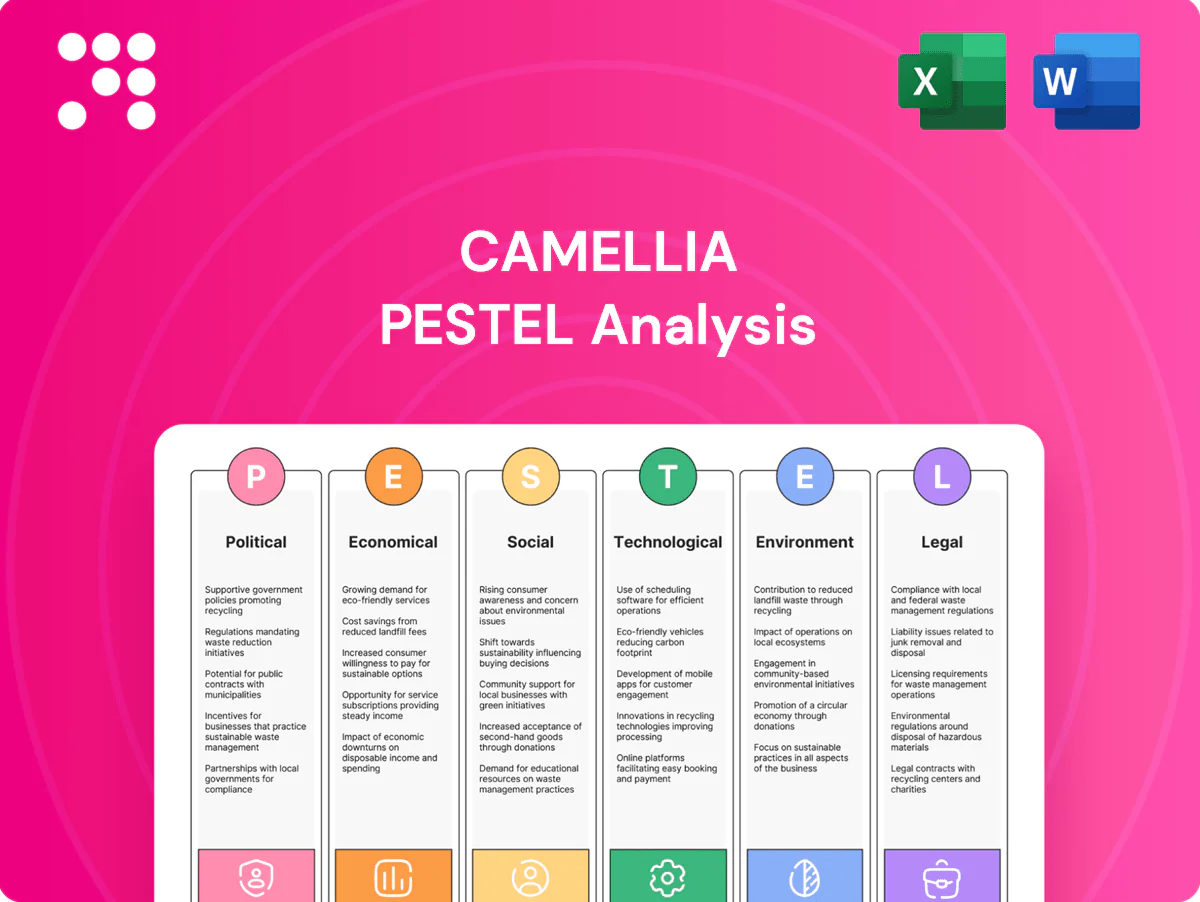
Camellia PESTLE Analysis

Plan Smarter. Present Sharper. Compete Stronger.
Our Camellia PESTLE Analysis pinpoints the political, economic, social, technological, legal and environmental forces shaping the company’s outlook. Clear, evidence-backed insights help you assess regulatory risk, market opportunities and sustainability pressures. Ideal for investors and strategists — purchase the full report for the complete, editable breakdown and actionable recommendations.
Political factors

Multi-country policy volatility
Operating estates across three continents—Africa, Asia and Latin America—exposes Camellia to shifting agricultural, tax and trade policies that can alter margins overnight. Sudden export curbs or subsidy changes have immediate P&L impact, so active government relations and scenario planning preserve supply continuity. Diversification across jurisdictions mitigates the risk of single-country shocks.
Geopolitical trade dynamics
Global tea, nut and avocado flows are highly sensitive to tariffs, sanctions and bilateral deals; global avocado exports reached about 3.1m tonnes in 2022, illustrating scale at risk. Preferential access to EU/UK/US markets can shift demand and pricing materially. Political tensions disrupt logistics corridors and raised Red Sea transit insurance by up to c.400% in 2023. Hedging routes and diversifying customer bases reduces disruption risk.

Rural governance and land rights
Local land tenure and customary rights—estimated by UN agencies to govern around 65% of rural land in many developing countries—directly affect Camellia estate stability and scope for expansion. Clear titles, community agreements and alignment with national authorities are essential to secure capital allocations and bank financing. Political shifts can reopen land-use debates after elections or reforms, so proactive stakeholder engagement reduces conflict and reputational risk.

Infrastructure and public investment
State investment in roads, ports and power directly shapes Camellia’s farm-to-market efficiency; rural road upgrades can cut transport times and costs by up to 30% (World Bank) and reduce post-harvest losses. Political cycles drive funding continuity and project quality, with interruptions risking chilled-processing rollouts. Public-private partnerships have expanded cold-chain and processing capacity globally, improving export reliability.
- Road upgrades: -30% transport costs (World Bank)
- PPP role: unlocks processing/cold chain capacity
- Political cycles: affect funding continuity and quality
- Advocacy: vital for export reliability
Food security and strategic crops
Governments may prioritise domestic food security over exports during shocks; FAO tracked more than 30 export restrictions on staple crops in 2020–21, raising trade risk for firms like Camellia. Water-use or crop-choice restrictions are rising: WRI flagged 33 countries at extremely high water stress, constraining irrigation options. Aligning with national development plans preserves licences and goodwill, while engaging in local value-add and processing tends to secure policy support and incentives.
- Export restrictions: >30 countries (FAO, 2020–21)
- Water stress: 33 countries extremely high (WRI)
- Align with national plans to protect licences
- Local value-add often yields policy support
Political risk and export shocks threaten avocado margins; diversify jurisdictions and secure PPPs
Camellia faces acute political risk from trade policy shifts, export curbs and subsidies across Africa, Asia and Latin America, requiring active government relations and scenario planning. Key stressors include tariff/sanction volatility, land-tenure disputes and infrastructure funding swings that can alter margins quickly. Mitigants: jurisdictional diversification, local stakeholder agreements and PPPs to secure supply and processing continuity.
| Indicator | Value |
|---|---|
| Global avocado exports (2022) | 3.1m t |
| Red Sea transit insurance spike (2023) | +c.400% |
| Road upgrade impact (World Bank) | -30% transport costs |
| Countries extremely high water stress (WRI) | 33 |
What is included in the product
 Detailed Word Document
Explores how external macro-environmental factors uniquely affect the Camellia across Political, Economic, Social, Technological, Environmental and Legal dimensions, with each section backed by current data and trends; designed for executives and investors, it delivers clean, insert-ready analysis with forward-looking insights to spot risks and opportunities.

 Customizable Excel Spreadsheet
A concise, visually segmented Camellia PESTLE summary that can be dropped into presentations, annotated with region- or business-specific notes, and easily shared to speed alignment, support risk discussions, and streamline strategic planning.
Economic factors

Commodity price cycles
Tea and nut markets display cyclical swings driven by supply, weather and demand; global tea output stood at about 6.0 million tonnes in 2023 (FAO), amplifying sensitivity to crop shocks. Price troughs compress cash flow and defer capex, while peaks attract competitors and erode margins. Camellia’s diversified crop mix smooths revenue volatility, and use of forward contracts and floor pricing helps stabilise earnings.
Currency and inflation exposure
Camellia faces currency and inflation exposure as revenues from exports and commodity sales are often denominated in hard currencies while operating costs are incurred in local currencies, causing FX swings and local inflation to distort margins and valuations. Treasury hedging programs and increased local sourcing have been used to dampen volatility and protect cash flow. Index-linked pricing and contractual cost pass-through mechanisms further help preserve profitability in high-inflation environments.

Labor-intensive cost structure
Handpicking tea and specialty crops drives a high labor share, often representing 40–60% of field-level costs in estate operations similar to Camellia’s plantations. Recent wage inflation (annual increases of c.6–10% in key sourcing countries in 2023–24) and productivity gaps materially raise unit costs. Targeted mechanization and incentive schemes have lifted output per worker by c.20–30% in pilot estates, while seasonal workforce planning cuts overtime and crop wastage.

Demand shifts in premium produce
Demand for premium produce such as avocados and macadamias is supported by rising middle classes and health trends; global avocado production was about 8.8 million tonnes (FAO 2022), underpinning steady premium pricing, while recessions drive some consumers to cheaper substitutes, pressuring volumes and margins. Channel diversification across retail, foodservice and ingredient sales hedges demand; branding and certifications sustain price premia.
- Rising middle class: supports premium demand
- Recession risk: trade-down to substitutes
- Channel hedge: retail/foodservice/ingredients
- Branding/certifications: defend premia
Capex and return hurdles
Orchards and factories require long-dated investments with gestation lags typically 3–7 years, so discounting materially affects NPV and payback. Discount rates and cost of capital set viability thresholds; with UK 10y gilt near 4.3% (mid‑2025) and lending costs ~5–6%, agri project hurdle IRRs commonly target 10–12%. Phased planting and modular processing shorten payback and improve IRR visibility, while portfolio pruning recycles capital into higher‑return (>12%) assets.
- Gestation: 3–7 years
- Market rates: UK 10y ≈ 4.3% (mid‑2025)
- Typical hurdle IRR: 10–12%
- Strategy: phased planting, modular processing, portfolio pruning
Political risk and export shocks threaten avocado margins; diversify jurisdictions and secure PPPs
Tea output ~6.0m t (2023 FAO); avocado ~8.8m t (2022 FAO). Labour 40–60% of field costs; wage rises 6–10% (2023–24). FX/inflation and export pricing drive margin swings; UK 10y ≈4.3% (mid‑2025), hurdle IRR 10–12%.
| Metric | Value |
|---|---|
| Tea output | 6.0m t (2023) |
| Avocado | 8.8m t (2022) |
| Labour share | 40–60% |
| UK 10y | ≈4.3% (mid‑2025) |
What You See Is What You Get
Camellia PESTLE Analysis
The Camellia PESTLE Analysis preview shown here is the exact document you’ll receive after purchase—fully formatted and ready to use. The layout, content, and structure visible are identical to the downloadable file. No placeholders or teasers—this is the final, professionally structured report.

Plan Smarter. Present Sharper. Compete Stronger.
Our Camellia PESTLE Analysis pinpoints the political, economic, social, technological, legal and environmental forces shaping the company’s outlook. Clear, evidence-backed insights help you assess regulatory risk, market opportunities and sustainability pressures. Ideal for investors and strategists — purchase the full report for the complete, editable breakdown and actionable recommendations.
Political factors
Multi-country policy volatility
Operating estates across three continents—Africa, Asia and Latin America—exposes Camellia to shifting agricultural, tax and trade policies that can alter margins overnight. Sudden export curbs or subsidy changes have immediate P&L impact, so active government relations and scenario planning preserve supply continuity. Diversification across jurisdictions mitigates the risk of single-country shocks.
Geopolitical trade dynamics
Global tea, nut and avocado flows are highly sensitive to tariffs, sanctions and bilateral deals; global avocado exports reached about 3.1m tonnes in 2022, illustrating scale at risk. Preferential access to EU/UK/US markets can shift demand and pricing materially. Political tensions disrupt logistics corridors and raised Red Sea transit insurance by up to c.400% in 2023. Hedging routes and diversifying customer bases reduces disruption risk.
Rural governance and land rights
Local land tenure and customary rights—estimated by UN agencies to govern around 65% of rural land in many developing countries—directly affect Camellia estate stability and scope for expansion. Clear titles, community agreements and alignment with national authorities are essential to secure capital allocations and bank financing. Political shifts can reopen land-use debates after elections or reforms, so proactive stakeholder engagement reduces conflict and reputational risk.
Infrastructure and public investment
State investment in roads, ports and power directly shapes Camellia’s farm-to-market efficiency; rural road upgrades can cut transport times and costs by up to 30% (World Bank) and reduce post-harvest losses. Political cycles drive funding continuity and project quality, with interruptions risking chilled-processing rollouts. Public-private partnerships have expanded cold-chain and processing capacity globally, improving export reliability.
- Road upgrades: -30% transport costs (World Bank)
- PPP role: unlocks processing/cold chain capacity
- Political cycles: affect funding continuity and quality
- Advocacy: vital for export reliability
Food security and strategic crops
Governments may prioritise domestic food security over exports during shocks; FAO tracked more than 30 export restrictions on staple crops in 2020–21, raising trade risk for firms like Camellia. Water-use or crop-choice restrictions are rising: WRI flagged 33 countries at extremely high water stress, constraining irrigation options. Aligning with national development plans preserves licences and goodwill, while engaging in local value-add and processing tends to secure policy support and incentives.
- Export restrictions: >30 countries (FAO, 2020–21)
- Water stress: 33 countries extremely high (WRI)
- Align with national plans to protect licences
- Local value-add often yields policy support
Political risk and export shocks threaten avocado margins; diversify jurisdictions and secure PPPs
Camellia faces acute political risk from trade policy shifts, export curbs and subsidies across Africa, Asia and Latin America, requiring active government relations and scenario planning. Key stressors include tariff/sanction volatility, land-tenure disputes and infrastructure funding swings that can alter margins quickly. Mitigants: jurisdictional diversification, local stakeholder agreements and PPPs to secure supply and processing continuity.
| Indicator | Value |
|---|---|
| Global avocado exports (2022) | 3.1m t |
| Red Sea transit insurance spike (2023) | +c.400% |
| Road upgrade impact (World Bank) | -30% transport costs |
| Countries extremely high water stress (WRI) | 33 |
What is included in the product
Detailed Word Document
Explores how external macro-environmental factors uniquely affect the Camellia across Political, Economic, Social, Technological, Environmental and Legal dimensions, with each section backed by current data and trends; designed for executives and investors, it delivers clean, insert-ready analysis with forward-looking insights to spot risks and opportunities.
Customizable Excel Spreadsheet
A concise, visually segmented Camellia PESTLE summary that can be dropped into presentations, annotated with region- or business-specific notes, and easily shared to speed alignment, support risk discussions, and streamline strategic planning.
Economic factors
Commodity price cycles
Tea and nut markets display cyclical swings driven by supply, weather and demand; global tea output stood at about 6.0 million tonnes in 2023 (FAO), amplifying sensitivity to crop shocks. Price troughs compress cash flow and defer capex, while peaks attract competitors and erode margins. Camellia’s diversified crop mix smooths revenue volatility, and use of forward contracts and floor pricing helps stabilise earnings.
Currency and inflation exposure
Camellia faces currency and inflation exposure as revenues from exports and commodity sales are often denominated in hard currencies while operating costs are incurred in local currencies, causing FX swings and local inflation to distort margins and valuations. Treasury hedging programs and increased local sourcing have been used to dampen volatility and protect cash flow. Index-linked pricing and contractual cost pass-through mechanisms further help preserve profitability in high-inflation environments.
Labor-intensive cost structure
Handpicking tea and specialty crops drives a high labor share, often representing 40–60% of field-level costs in estate operations similar to Camellia’s plantations. Recent wage inflation (annual increases of c.6–10% in key sourcing countries in 2023–24) and productivity gaps materially raise unit costs. Targeted mechanization and incentive schemes have lifted output per worker by c.20–30% in pilot estates, while seasonal workforce planning cuts overtime and crop wastage.
Demand shifts in premium produce
Demand for premium produce such as avocados and macadamias is supported by rising middle classes and health trends; global avocado production was about 8.8 million tonnes (FAO 2022), underpinning steady premium pricing, while recessions drive some consumers to cheaper substitutes, pressuring volumes and margins. Channel diversification across retail, foodservice and ingredient sales hedges demand; branding and certifications sustain price premia.
- Rising middle class: supports premium demand
- Recession risk: trade-down to substitutes
- Channel hedge: retail/foodservice/ingredients
- Branding/certifications: defend premia
Capex and return hurdles
Orchards and factories require long-dated investments with gestation lags typically 3–7 years, so discounting materially affects NPV and payback. Discount rates and cost of capital set viability thresholds; with UK 10y gilt near 4.3% (mid‑2025) and lending costs ~5–6%, agri project hurdle IRRs commonly target 10–12%. Phased planting and modular processing shorten payback and improve IRR visibility, while portfolio pruning recycles capital into higher‑return (>12%) assets.
- Gestation: 3–7 years
- Market rates: UK 10y ≈ 4.3% (mid‑2025)
- Typical hurdle IRR: 10–12%
- Strategy: phased planting, modular processing, portfolio pruning
Political risk and export shocks threaten avocado margins; diversify jurisdictions and secure PPPs
Tea output ~6.0m t (2023 FAO); avocado ~8.8m t (2022 FAO). Labour 40–60% of field costs; wage rises 6–10% (2023–24). FX/inflation and export pricing drive margin swings; UK 10y ≈4.3% (mid‑2025), hurdle IRR 10–12%.
| Metric | Value |
|---|---|
| Tea output | 6.0m t (2023) |
| Avocado | 8.8m t (2022) |
| Labour share | 40–60% |
| UK 10y | ≈4.3% (mid‑2025) |
What You See Is What You Get
Camellia PESTLE Analysis
The Camellia PESTLE Analysis preview shown here is the exact document you’ll receive after purchase—fully formatted and ready to use. The layout, content, and structure visible are identical to the downloadable file. No placeholders or teasers—this is the final, professionally structured report.
Original: $10.00
-65%$10.00
$3.50Description
Plan Smarter. Present Sharper. Compete Stronger.
Our Camellia PESTLE Analysis pinpoints the political, economic, social, technological, legal and environmental forces shaping the company’s outlook. Clear, evidence-backed insights help you assess regulatory risk, market opportunities and sustainability pressures. Ideal for investors and strategists — purchase the full report for the complete, editable breakdown and actionable recommendations.
Political factors
Multi-country policy volatility
Operating estates across three continents—Africa, Asia and Latin America—exposes Camellia to shifting agricultural, tax and trade policies that can alter margins overnight. Sudden export curbs or subsidy changes have immediate P&L impact, so active government relations and scenario planning preserve supply continuity. Diversification across jurisdictions mitigates the risk of single-country shocks.
Geopolitical trade dynamics
Global tea, nut and avocado flows are highly sensitive to tariffs, sanctions and bilateral deals; global avocado exports reached about 3.1m tonnes in 2022, illustrating scale at risk. Preferential access to EU/UK/US markets can shift demand and pricing materially. Political tensions disrupt logistics corridors and raised Red Sea transit insurance by up to c.400% in 2023. Hedging routes and diversifying customer bases reduces disruption risk.
Rural governance and land rights
Local land tenure and customary rights—estimated by UN agencies to govern around 65% of rural land in many developing countries—directly affect Camellia estate stability and scope for expansion. Clear titles, community agreements and alignment with national authorities are essential to secure capital allocations and bank financing. Political shifts can reopen land-use debates after elections or reforms, so proactive stakeholder engagement reduces conflict and reputational risk.
Infrastructure and public investment
State investment in roads, ports and power directly shapes Camellia’s farm-to-market efficiency; rural road upgrades can cut transport times and costs by up to 30% (World Bank) and reduce post-harvest losses. Political cycles drive funding continuity and project quality, with interruptions risking chilled-processing rollouts. Public-private partnerships have expanded cold-chain and processing capacity globally, improving export reliability.
- Road upgrades: -30% transport costs (World Bank)
- PPP role: unlocks processing/cold chain capacity
- Political cycles: affect funding continuity and quality
- Advocacy: vital for export reliability
Food security and strategic crops
Governments may prioritise domestic food security over exports during shocks; FAO tracked more than 30 export restrictions on staple crops in 2020–21, raising trade risk for firms like Camellia. Water-use or crop-choice restrictions are rising: WRI flagged 33 countries at extremely high water stress, constraining irrigation options. Aligning with national development plans preserves licences and goodwill, while engaging in local value-add and processing tends to secure policy support and incentives.
- Export restrictions: >30 countries (FAO, 2020–21)
- Water stress: 33 countries extremely high (WRI)
- Align with national plans to protect licences
- Local value-add often yields policy support
Political risk and export shocks threaten avocado margins; diversify jurisdictions and secure PPPs
Camellia faces acute political risk from trade policy shifts, export curbs and subsidies across Africa, Asia and Latin America, requiring active government relations and scenario planning. Key stressors include tariff/sanction volatility, land-tenure disputes and infrastructure funding swings that can alter margins quickly. Mitigants: jurisdictional diversification, local stakeholder agreements and PPPs to secure supply and processing continuity.
| Indicator | Value |
|---|---|
| Global avocado exports (2022) | 3.1m t |
| Red Sea transit insurance spike (2023) | +c.400% |
| Road upgrade impact (World Bank) | -30% transport costs |
| Countries extremely high water stress (WRI) | 33 |
What is included in the product
Detailed Word Document
Explores how external macro-environmental factors uniquely affect the Camellia across Political, Economic, Social, Technological, Environmental and Legal dimensions, with each section backed by current data and trends; designed for executives and investors, it delivers clean, insert-ready analysis with forward-looking insights to spot risks and opportunities.
Customizable Excel Spreadsheet
A concise, visually segmented Camellia PESTLE summary that can be dropped into presentations, annotated with region- or business-specific notes, and easily shared to speed alignment, support risk discussions, and streamline strategic planning.
Economic factors
Commodity price cycles
Tea and nut markets display cyclical swings driven by supply, weather and demand; global tea output stood at about 6.0 million tonnes in 2023 (FAO), amplifying sensitivity to crop shocks. Price troughs compress cash flow and defer capex, while peaks attract competitors and erode margins. Camellia’s diversified crop mix smooths revenue volatility, and use of forward contracts and floor pricing helps stabilise earnings.
Currency and inflation exposure
Camellia faces currency and inflation exposure as revenues from exports and commodity sales are often denominated in hard currencies while operating costs are incurred in local currencies, causing FX swings and local inflation to distort margins and valuations. Treasury hedging programs and increased local sourcing have been used to dampen volatility and protect cash flow. Index-linked pricing and contractual cost pass-through mechanisms further help preserve profitability in high-inflation environments.
Labor-intensive cost structure
Handpicking tea and specialty crops drives a high labor share, often representing 40–60% of field-level costs in estate operations similar to Camellia’s plantations. Recent wage inflation (annual increases of c.6–10% in key sourcing countries in 2023–24) and productivity gaps materially raise unit costs. Targeted mechanization and incentive schemes have lifted output per worker by c.20–30% in pilot estates, while seasonal workforce planning cuts overtime and crop wastage.
Demand shifts in premium produce
Demand for premium produce such as avocados and macadamias is supported by rising middle classes and health trends; global avocado production was about 8.8 million tonnes (FAO 2022), underpinning steady premium pricing, while recessions drive some consumers to cheaper substitutes, pressuring volumes and margins. Channel diversification across retail, foodservice and ingredient sales hedges demand; branding and certifications sustain price premia.
- Rising middle class: supports premium demand
- Recession risk: trade-down to substitutes
- Channel hedge: retail/foodservice/ingredients
- Branding/certifications: defend premia
Capex and return hurdles
Orchards and factories require long-dated investments with gestation lags typically 3–7 years, so discounting materially affects NPV and payback. Discount rates and cost of capital set viability thresholds; with UK 10y gilt near 4.3% (mid‑2025) and lending costs ~5–6%, agri project hurdle IRRs commonly target 10–12%. Phased planting and modular processing shorten payback and improve IRR visibility, while portfolio pruning recycles capital into higher‑return (>12%) assets.
- Gestation: 3–7 years
- Market rates: UK 10y ≈ 4.3% (mid‑2025)
- Typical hurdle IRR: 10–12%
- Strategy: phased planting, modular processing, portfolio pruning
Political risk and export shocks threaten avocado margins; diversify jurisdictions and secure PPPs
Tea output ~6.0m t (2023 FAO); avocado ~8.8m t (2022 FAO). Labour 40–60% of field costs; wage rises 6–10% (2023–24). FX/inflation and export pricing drive margin swings; UK 10y ≈4.3% (mid‑2025), hurdle IRR 10–12%.
| Metric | Value |
|---|---|
| Tea output | 6.0m t (2023) |
| Avocado | 8.8m t (2022) |
| Labour share | 40–60% |
| UK 10y | ≈4.3% (mid‑2025) |
What You See Is What You Get
Camellia PESTLE Analysis
The Camellia PESTLE Analysis preview shown here is the exact document you’ll receive after purchase—fully formatted and ready to use. The layout, content, and structure visible are identical to the downloadable file. No placeholders or teasers—this is the final, professionally structured report.











