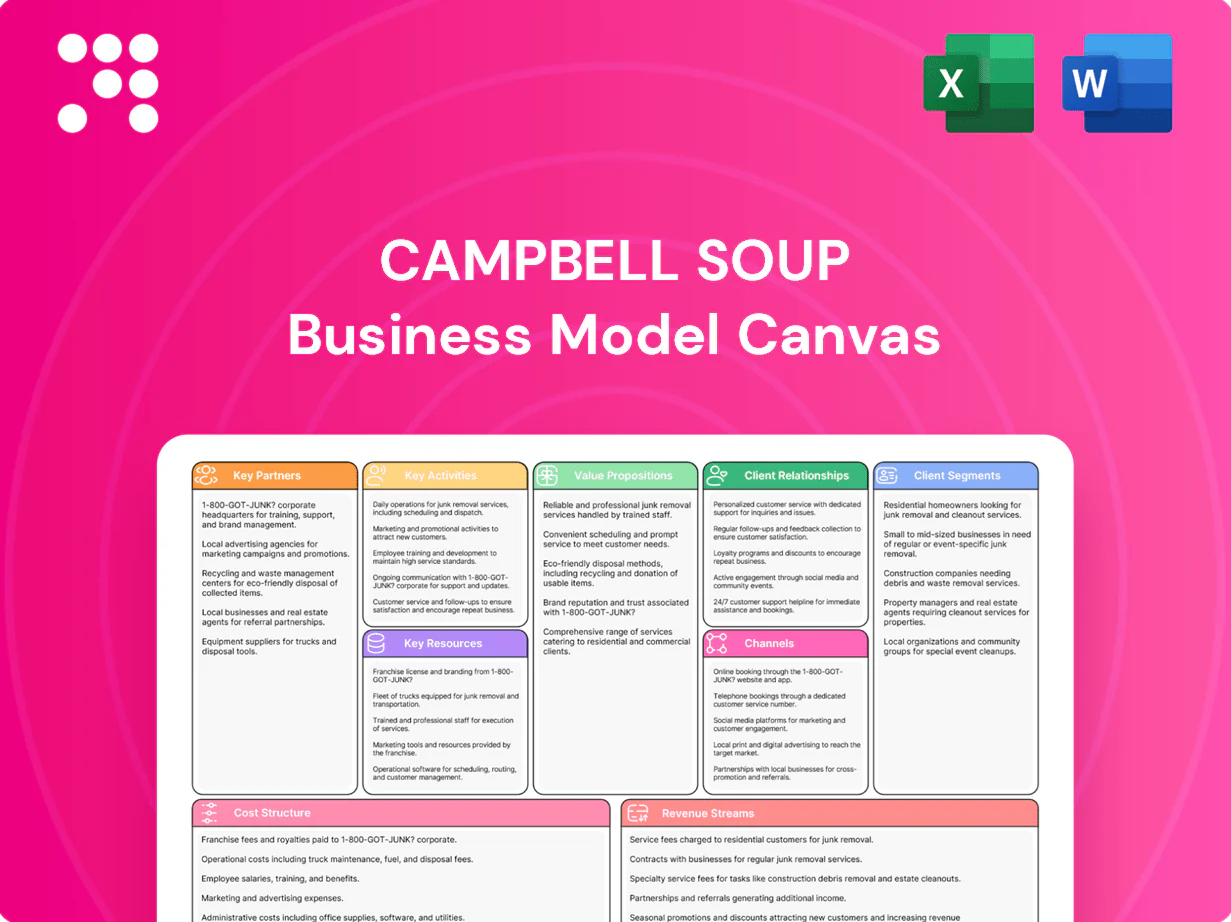
Campbell Soup Business Model Canvas

Business Model Canvas: Uncover value, partners, segments and revenue levers for CPG growth
Unlock the full strategic blueprint behind Campbell Soup's business model. This in-depth Business Model Canvas uncovers value propositions, customer segments, key partners and revenue levers to reveal growth and margin drivers. Download the complete Word/Excel canvas to benchmark, plan, and act.
Partnerships

Strategic retailers & grocers
Collaborations with mass merchandisers, supermarkets, club and convenience chains secure shelf space and category visibility for Campbell, supporting the majority of the companys ~$7.6 billion fiscal 2024 net sales. Joint business planning with top retailers aligns promotions and assortment to maximize velocity and margin. Shared POS and inventory data inform pricing, replenishment and in-store execution, driving volume and improving on-shelf availability.
Ingredient & packaging suppliers
Agri-producers and processors supply vegetables, grains, meats and seasonings under multi-year contracts that Campbell uses to stabilize input costs and quality. Packaging partners deliver cans, cartons, pouches and growing volumes of recycled/sustainably sourced materials as Campbell pursues its 2030 goal of 100% recyclable, reusable or compostable packaging (announced 2024). Long-term contracts and dual sourcing across regions mitigate supply risk and commodity volatility.

Co-manufacturers & copackers
Co-manufacturers and copackers give Campbell flexible external capacity and specialty capabilities, enabling rapid scaling for seasonal or promotional spikes; in 2024 Campbell continued leveraging third-party plants to optimize production. Quality and food-safety standards are tightly governed through supplier audits and SQF/HACCP compliance, supporting efficient capital deployment and lower fixed-capacity investment.

Logistics & distribution providers
Campbell Soup Company (CPB) relies on 3PLs and carriers to move finished goods from manufacturing plants to customer DCs and retail stores, coordinating temperature-controlled and shelf-stable flows to protect quality and shelf life. Ongoing network optimization programs target improved service levels and lower logistics cost through route rationalization and consolidated shipments. Strategic partnerships focus on elevating on-time, in-full delivery performance and reducing spoilage risk.
- CPB partnership with 3PLs for plant-to-DC/store transport
- Coordinated temp-controlled and shelf-stable flows
- Network optimization to improve service and reduce cost
- Focus on on-time, in-full delivery and lower spoilage
Technology, data, and innovation partners
Analytics firms, retailers’ data platforms and R&D collaborators drive product insights and development for Campbell, supporting efforts while Campbell reported roughly $7.6 billion in net sales in fiscal 2024; marketing tech enables targeted campaigns and automation/AI partners improve manufacturing throughput and forecasting accuracy. Universities and labs advance nutrition and recyclable packaging innovation.
- Analytics partners: retailer POS and loyalty integration
- Marketing tech: personalized digital spend
- AI/automation: yield and demand forecast uplift
- Academia: nutrition and packaging R&D
Retail & supplier partnerships secure shelf space and supply — $7.6B
Collaborations with retailers, suppliers, co-manufacturers and 3PLs secure shelf space and supply continuity, supporting CPB's ~$7.6B fiscal 2024 net sales. Multi-year supplier contracts, dual sourcing and SQF/HACCP audits reduce input and food-safety risk. Packaging partners target 100% recyclable/reusable/compostable by 2030.
| Partner | 2024 metric |
|---|---|
| Retailers | $7.6B sales |
| Suppliers | Multi-year contracts, dual sourcing |
| Packaging | 100% by 2030 |
What is included in the product
 Detailed Word Document
A comprehensive Business Model Canvas tailored to Campbell Soup's strategy, covering customer segments, channels, value propositions and cost/revenue structures across the 9 classic blocks, with insights on competitive advantages and linked SWOT analysis reflecting real-world operations—ideal for presentations, investor discussions, and strategic decision-making.

 Customizable Excel Spreadsheet
Condenses Campbell Soup’s strategy into a digestible, one-page Business Model Canvas to quickly identify core components and relieve planning bottlenecks. Shareable and editable for team collaboration, it saves hours of structuring while keeping the framework flexible for new insights.
Activities

Product R&D and innovation
Campbell drives product R&D and innovation to develop new soups, sauces, snacks and beverages that match evolving tastes while reporting FY2024 net sales of $9.1 billion. The team prioritizes reformulation for reduced sodium, cleaner labels and sustainable ingredients, using rapid testing and consumer validation panels to iterate quickly. Brand renovation and limited-time offerings are managed to capture trial and refresh core franchises.
Manufacturing & quality assurance
Campbell operates dedicated plants for canning, baking, frying and aseptic processing, supported by food-safety certifications such as SQF and GFSI-aligned protocols and routine third-party audits. Continuous-improvement initiatives target yield gains and waste reductions, contributing to gross-margin resilience; Campbell reported fiscal 2023 net sales near $8.0 billion and maintained capex focused on plant upgrades (~$125 million). Preventive maintenance programs prioritize uptime and asset reliability across the manufacturing network.

Supply chain planning & procurement
Supply chain planning for Campbell aligns demand forecasting across Meals & Beverages and Snacks using category-level POS and customer shipment data to support roughly $8.0 billion in 2024 net sales. Procurement focuses on securing ingredients and packaging at scale through long-term supplier contracts and strategic sourcing for staples like tomatoes, dairy, and aluminum. Network and inventory optimization balances service and cost via DC rationalization and working-capital targets to reduce stockouts and lower carrying costs. Commodity hedging and contingency plans mitigate price volatility and supply disruptions across the value chain.

Brand marketing & trade promotion
Campbell centers brand marketing and trade promotion on TV, digital and social campaigns combined with in-store promotions and price packs negotiated with major retailers to drive trial and velocity; CPG peers averaged about 9% of revenue on marketing in 2024. Category leadership includes planogram support and retailer co-marketing, with continuous performance measurement and ROI optimization to reallocate spend toward high-ROAS channels.
- TV, digital, social
- In-store promos & price packs
- Planogram & category leadership
- Performance measurement → ROI optimization
Sales, category management, and revenue growth
- Joint business planning
- Pricing, mix, pack architecture
- E-commerce content & retail media
- Data-driven assortment & shelving
R&D and supply-chain drive FY2024 net sales $9.1B, plant capex $125M
Campbell focuses R&D, manufacturing excellence, supply-chain optimization and trade/brand marketing to support FY2024 net sales of $9.1B. Operations emphasize food-safety certifications, preventive maintenance and targeted plant capex (~$125M) to protect margins. Demand planning, strategic sourcing and retail joint-business planning drive assortment, promotions and e-commerce growth.
| Metric | 2024 |
|---|---|
| Net sales | $9.1B |
| Plant capex | ~$125M |
| Marketing (% revenue) | ~9% |
Delivered as Displayed
Business Model Canvas
The Campbell Soup Business Model Canvas preview shown here is the actual deliverable, not a mockup or sample. When you purchase, you’ll receive this exact file—complete, formatted, and ready for use. The same content is provided in editable Word and Excel formats so you can present, edit, or share without surprises.

Business Model Canvas: Uncover value, partners, segments and revenue levers for CPG growth
Unlock the full strategic blueprint behind Campbell Soup's business model. This in-depth Business Model Canvas uncovers value propositions, customer segments, key partners and revenue levers to reveal growth and margin drivers. Download the complete Word/Excel canvas to benchmark, plan, and act.
Partnerships
Strategic retailers & grocers
Collaborations with mass merchandisers, supermarkets, club and convenience chains secure shelf space and category visibility for Campbell, supporting the majority of the companys ~$7.6 billion fiscal 2024 net sales. Joint business planning with top retailers aligns promotions and assortment to maximize velocity and margin. Shared POS and inventory data inform pricing, replenishment and in-store execution, driving volume and improving on-shelf availability.
Ingredient & packaging suppliers
Agri-producers and processors supply vegetables, grains, meats and seasonings under multi-year contracts that Campbell uses to stabilize input costs and quality. Packaging partners deliver cans, cartons, pouches and growing volumes of recycled/sustainably sourced materials as Campbell pursues its 2030 goal of 100% recyclable, reusable or compostable packaging (announced 2024). Long-term contracts and dual sourcing across regions mitigate supply risk and commodity volatility.
Co-manufacturers & copackers
Co-manufacturers and copackers give Campbell flexible external capacity and specialty capabilities, enabling rapid scaling for seasonal or promotional spikes; in 2024 Campbell continued leveraging third-party plants to optimize production. Quality and food-safety standards are tightly governed through supplier audits and SQF/HACCP compliance, supporting efficient capital deployment and lower fixed-capacity investment.
Logistics & distribution providers
Campbell Soup Company (CPB) relies on 3PLs and carriers to move finished goods from manufacturing plants to customer DCs and retail stores, coordinating temperature-controlled and shelf-stable flows to protect quality and shelf life. Ongoing network optimization programs target improved service levels and lower logistics cost through route rationalization and consolidated shipments. Strategic partnerships focus on elevating on-time, in-full delivery performance and reducing spoilage risk.
- CPB partnership with 3PLs for plant-to-DC/store transport
- Coordinated temp-controlled and shelf-stable flows
- Network optimization to improve service and reduce cost
- Focus on on-time, in-full delivery and lower spoilage
Technology, data, and innovation partners
Analytics firms, retailers’ data platforms and R&D collaborators drive product insights and development for Campbell, supporting efforts while Campbell reported roughly $7.6 billion in net sales in fiscal 2024; marketing tech enables targeted campaigns and automation/AI partners improve manufacturing throughput and forecasting accuracy. Universities and labs advance nutrition and recyclable packaging innovation.
- Analytics partners: retailer POS and loyalty integration
- Marketing tech: personalized digital spend
- AI/automation: yield and demand forecast uplift
- Academia: nutrition and packaging R&D
Retail & supplier partnerships secure shelf space and supply — $7.6B
Collaborations with retailers, suppliers, co-manufacturers and 3PLs secure shelf space and supply continuity, supporting CPB's ~$7.6B fiscal 2024 net sales. Multi-year supplier contracts, dual sourcing and SQF/HACCP audits reduce input and food-safety risk. Packaging partners target 100% recyclable/reusable/compostable by 2030.
| Partner | 2024 metric |
|---|---|
| Retailers | $7.6B sales |
| Suppliers | Multi-year contracts, dual sourcing |
| Packaging | 100% by 2030 |
What is included in the product
Detailed Word Document
A comprehensive Business Model Canvas tailored to Campbell Soup's strategy, covering customer segments, channels, value propositions and cost/revenue structures across the 9 classic blocks, with insights on competitive advantages and linked SWOT analysis reflecting real-world operations—ideal for presentations, investor discussions, and strategic decision-making.
Customizable Excel Spreadsheet
Condenses Campbell Soup’s strategy into a digestible, one-page Business Model Canvas to quickly identify core components and relieve planning bottlenecks. Shareable and editable for team collaboration, it saves hours of structuring while keeping the framework flexible for new insights.
Activities
Product R&D and innovation
Campbell drives product R&D and innovation to develop new soups, sauces, snacks and beverages that match evolving tastes while reporting FY2024 net sales of $9.1 billion. The team prioritizes reformulation for reduced sodium, cleaner labels and sustainable ingredients, using rapid testing and consumer validation panels to iterate quickly. Brand renovation and limited-time offerings are managed to capture trial and refresh core franchises.
Manufacturing & quality assurance
Campbell operates dedicated plants for canning, baking, frying and aseptic processing, supported by food-safety certifications such as SQF and GFSI-aligned protocols and routine third-party audits. Continuous-improvement initiatives target yield gains and waste reductions, contributing to gross-margin resilience; Campbell reported fiscal 2023 net sales near $8.0 billion and maintained capex focused on plant upgrades (~$125 million). Preventive maintenance programs prioritize uptime and asset reliability across the manufacturing network.
Supply chain planning & procurement
Supply chain planning for Campbell aligns demand forecasting across Meals & Beverages and Snacks using category-level POS and customer shipment data to support roughly $8.0 billion in 2024 net sales. Procurement focuses on securing ingredients and packaging at scale through long-term supplier contracts and strategic sourcing for staples like tomatoes, dairy, and aluminum. Network and inventory optimization balances service and cost via DC rationalization and working-capital targets to reduce stockouts and lower carrying costs. Commodity hedging and contingency plans mitigate price volatility and supply disruptions across the value chain.
Brand marketing & trade promotion
Campbell centers brand marketing and trade promotion on TV, digital and social campaigns combined with in-store promotions and price packs negotiated with major retailers to drive trial and velocity; CPG peers averaged about 9% of revenue on marketing in 2024. Category leadership includes planogram support and retailer co-marketing, with continuous performance measurement and ROI optimization to reallocate spend toward high-ROAS channels.
- TV, digital, social
- In-store promos & price packs
- Planogram & category leadership
- Performance measurement → ROI optimization
Sales, category management, and revenue growth
- Joint business planning
- Pricing, mix, pack architecture
- E-commerce content & retail media
- Data-driven assortment & shelving
R&D and supply-chain drive FY2024 net sales $9.1B, plant capex $125M
Campbell focuses R&D, manufacturing excellence, supply-chain optimization and trade/brand marketing to support FY2024 net sales of $9.1B. Operations emphasize food-safety certifications, preventive maintenance and targeted plant capex (~$125M) to protect margins. Demand planning, strategic sourcing and retail joint-business planning drive assortment, promotions and e-commerce growth.
| Metric | 2024 |
|---|---|
| Net sales | $9.1B |
| Plant capex | ~$125M |
| Marketing (% revenue) | ~9% |
Delivered as Displayed
Business Model Canvas
The Campbell Soup Business Model Canvas preview shown here is the actual deliverable, not a mockup or sample. When you purchase, you’ll receive this exact file—complete, formatted, and ready for use. The same content is provided in editable Word and Excel formats so you can present, edit, or share without surprises.
Original: $10.00
-65%$10.00
$3.50Description
Business Model Canvas: Uncover value, partners, segments and revenue levers for CPG growth
Unlock the full strategic blueprint behind Campbell Soup's business model. This in-depth Business Model Canvas uncovers value propositions, customer segments, key partners and revenue levers to reveal growth and margin drivers. Download the complete Word/Excel canvas to benchmark, plan, and act.
Partnerships
Strategic retailers & grocers
Collaborations with mass merchandisers, supermarkets, club and convenience chains secure shelf space and category visibility for Campbell, supporting the majority of the companys ~$7.6 billion fiscal 2024 net sales. Joint business planning with top retailers aligns promotions and assortment to maximize velocity and margin. Shared POS and inventory data inform pricing, replenishment and in-store execution, driving volume and improving on-shelf availability.
Ingredient & packaging suppliers
Agri-producers and processors supply vegetables, grains, meats and seasonings under multi-year contracts that Campbell uses to stabilize input costs and quality. Packaging partners deliver cans, cartons, pouches and growing volumes of recycled/sustainably sourced materials as Campbell pursues its 2030 goal of 100% recyclable, reusable or compostable packaging (announced 2024). Long-term contracts and dual sourcing across regions mitigate supply risk and commodity volatility.
Co-manufacturers & copackers
Co-manufacturers and copackers give Campbell flexible external capacity and specialty capabilities, enabling rapid scaling for seasonal or promotional spikes; in 2024 Campbell continued leveraging third-party plants to optimize production. Quality and food-safety standards are tightly governed through supplier audits and SQF/HACCP compliance, supporting efficient capital deployment and lower fixed-capacity investment.
Logistics & distribution providers
Campbell Soup Company (CPB) relies on 3PLs and carriers to move finished goods from manufacturing plants to customer DCs and retail stores, coordinating temperature-controlled and shelf-stable flows to protect quality and shelf life. Ongoing network optimization programs target improved service levels and lower logistics cost through route rationalization and consolidated shipments. Strategic partnerships focus on elevating on-time, in-full delivery performance and reducing spoilage risk.
- CPB partnership with 3PLs for plant-to-DC/store transport
- Coordinated temp-controlled and shelf-stable flows
- Network optimization to improve service and reduce cost
- Focus on on-time, in-full delivery and lower spoilage
Technology, data, and innovation partners
Analytics firms, retailers’ data platforms and R&D collaborators drive product insights and development for Campbell, supporting efforts while Campbell reported roughly $7.6 billion in net sales in fiscal 2024; marketing tech enables targeted campaigns and automation/AI partners improve manufacturing throughput and forecasting accuracy. Universities and labs advance nutrition and recyclable packaging innovation.
- Analytics partners: retailer POS and loyalty integration
- Marketing tech: personalized digital spend
- AI/automation: yield and demand forecast uplift
- Academia: nutrition and packaging R&D
Retail & supplier partnerships secure shelf space and supply — $7.6B
Collaborations with retailers, suppliers, co-manufacturers and 3PLs secure shelf space and supply continuity, supporting CPB's ~$7.6B fiscal 2024 net sales. Multi-year supplier contracts, dual sourcing and SQF/HACCP audits reduce input and food-safety risk. Packaging partners target 100% recyclable/reusable/compostable by 2030.
| Partner | 2024 metric |
|---|---|
| Retailers | $7.6B sales |
| Suppliers | Multi-year contracts, dual sourcing |
| Packaging | 100% by 2030 |
What is included in the product
Detailed Word Document
A comprehensive Business Model Canvas tailored to Campbell Soup's strategy, covering customer segments, channels, value propositions and cost/revenue structures across the 9 classic blocks, with insights on competitive advantages and linked SWOT analysis reflecting real-world operations—ideal for presentations, investor discussions, and strategic decision-making.
Customizable Excel Spreadsheet
Condenses Campbell Soup’s strategy into a digestible, one-page Business Model Canvas to quickly identify core components and relieve planning bottlenecks. Shareable and editable for team collaboration, it saves hours of structuring while keeping the framework flexible for new insights.
Activities
Product R&D and innovation
Campbell drives product R&D and innovation to develop new soups, sauces, snacks and beverages that match evolving tastes while reporting FY2024 net sales of $9.1 billion. The team prioritizes reformulation for reduced sodium, cleaner labels and sustainable ingredients, using rapid testing and consumer validation panels to iterate quickly. Brand renovation and limited-time offerings are managed to capture trial and refresh core franchises.
Manufacturing & quality assurance
Campbell operates dedicated plants for canning, baking, frying and aseptic processing, supported by food-safety certifications such as SQF and GFSI-aligned protocols and routine third-party audits. Continuous-improvement initiatives target yield gains and waste reductions, contributing to gross-margin resilience; Campbell reported fiscal 2023 net sales near $8.0 billion and maintained capex focused on plant upgrades (~$125 million). Preventive maintenance programs prioritize uptime and asset reliability across the manufacturing network.
Supply chain planning & procurement
Supply chain planning for Campbell aligns demand forecasting across Meals & Beverages and Snacks using category-level POS and customer shipment data to support roughly $8.0 billion in 2024 net sales. Procurement focuses on securing ingredients and packaging at scale through long-term supplier contracts and strategic sourcing for staples like tomatoes, dairy, and aluminum. Network and inventory optimization balances service and cost via DC rationalization and working-capital targets to reduce stockouts and lower carrying costs. Commodity hedging and contingency plans mitigate price volatility and supply disruptions across the value chain.
Brand marketing & trade promotion
Campbell centers brand marketing and trade promotion on TV, digital and social campaigns combined with in-store promotions and price packs negotiated with major retailers to drive trial and velocity; CPG peers averaged about 9% of revenue on marketing in 2024. Category leadership includes planogram support and retailer co-marketing, with continuous performance measurement and ROI optimization to reallocate spend toward high-ROAS channels.
- TV, digital, social
- In-store promos & price packs
- Planogram & category leadership
- Performance measurement → ROI optimization
Sales, category management, and revenue growth
- Joint business planning
- Pricing, mix, pack architecture
- E-commerce content & retail media
- Data-driven assortment & shelving
R&D and supply-chain drive FY2024 net sales $9.1B, plant capex $125M
Campbell focuses R&D, manufacturing excellence, supply-chain optimization and trade/brand marketing to support FY2024 net sales of $9.1B. Operations emphasize food-safety certifications, preventive maintenance and targeted plant capex (~$125M) to protect margins. Demand planning, strategic sourcing and retail joint-business planning drive assortment, promotions and e-commerce growth.
| Metric | 2024 |
|---|---|
| Net sales | $9.1B |
| Plant capex | ~$125M |
| Marketing (% revenue) | ~9% |
Delivered as Displayed
Business Model Canvas
The Campbell Soup Business Model Canvas preview shown here is the actual deliverable, not a mockup or sample. When you purchase, you’ll receive this exact file—complete, formatted, and ready for use. The same content is provided in editable Word and Excel formats so you can present, edit, or share without surprises.











