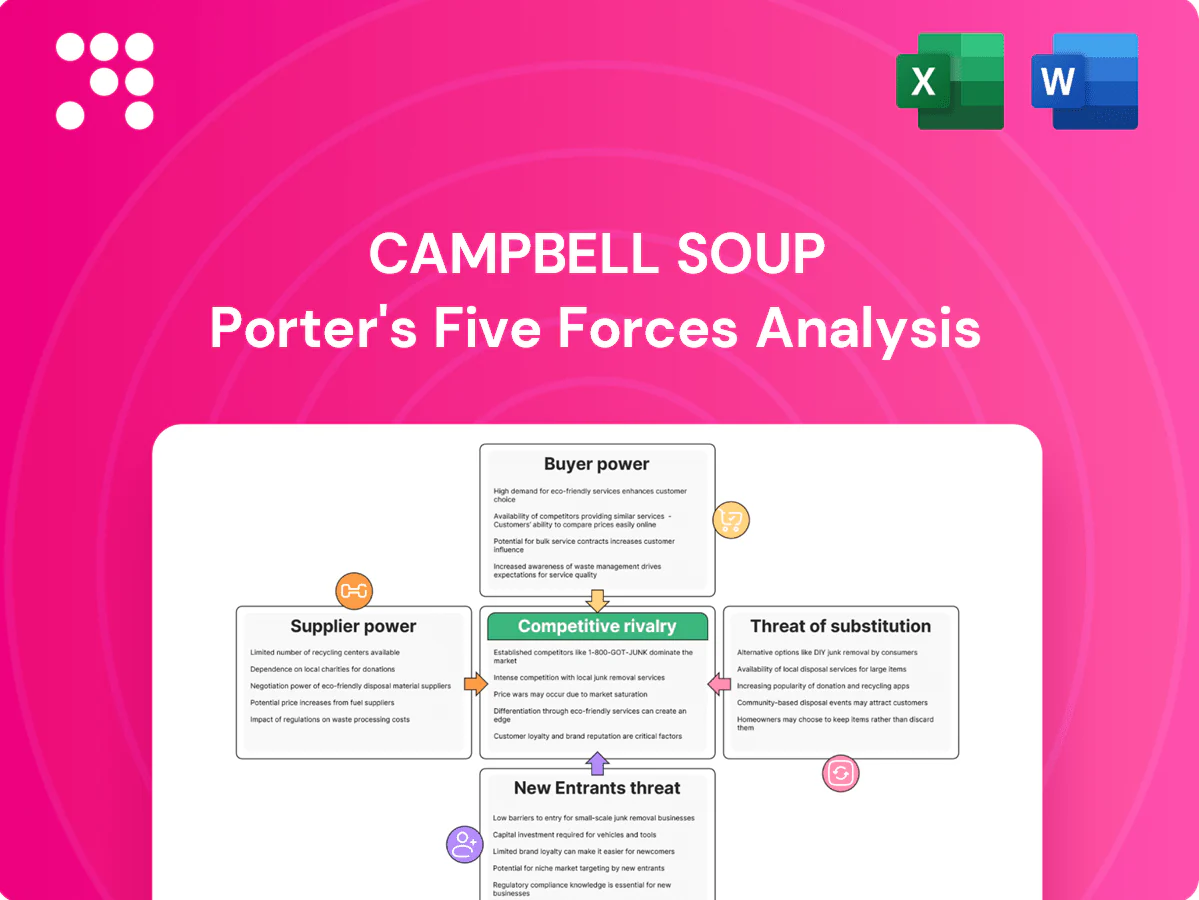
Campbell Soup Porter's Five Forces Analysis

Don't Miss the Bigger Picture
Campbell Soup faces moderate buyer power, limited supplier leverage, and persistent rivalry from major food players and private labels, while substitutes and niche startups add pressure on margins. This brief snapshot only scratches the surface. Unlock the full Porter's Five Forces Analysis to explore Campbell Soup’s competitive dynamics and strategic advantages in detail.
Suppliers Bargaining Power

Diverse agri-input base
Campbell sources vegetables, grains, dairy, meat and packaging from a broad supplier base across regions, which limits concentration risk; Campbell reported fiscal 2024 net sales of $6.7 billion. Commodity markets and seasonality still inject volatility that suppliers can leverage in tight cycles. Long-term contracts and hedging dampen price swings but do not eliminate bargaining pressure. Supplier switching is feasible for many inputs, though quality specs and certifications create some stickiness.
Packaging and logistics influence
Specialized cans, flexible films and cartons come from a narrower supplier base—consolidation leaves top vendors controlling a large share of capacity, raising leverage for select suppliers. Transportation capacity and fuel costs materially affect delivered cost; U.S. diesel averaged about $3.90/gal in 2024, adding volatility for bulky soups and snacks. Campbell’s scale (around $7.8B net sales in 2023) enables multi-sourcing and network optimization to negotiate terms, though disruptions like 2021–22 container shortages showed supplier power can spike temporarily.

Branded ingredients are limited
Most inputs for Campbell are commodity commodities, limiting supplier differentiation and bargaining power, though proprietary flavor systems and specialty seasonings give select suppliers outsized margins. Campbell reported increased investment in internal R&D in its 2024 annual report to reduce reliance on third-party flavor houses. Dual-sourcing and strict QA/confidential formulations still slow rapid supplier substitution.

ESG and compliance requirements
Rising sustainability, traceability, and food-safety standards narrow the qualified supplier pool, increasing reliance on vetted partners; in 2024 Campbell continued vendor development programs to expand capacity and align standards. Compliance investments by suppliers create pricing power or pass-throughs, while regulatory shifts can strengthen incumbents with proven compliance records.
Weather and geopolitical shocks
Droughts, crop diseases and 2024 geopolitical tensions tightened supplies and pushed up procurement costs, giving suppliers leverage for key inputs like tomatoes, potatoes and grains used across Campbell Soup lines; inventory buffers and diversified sourcing lowered exposure but remained finite, while hedging helped smooth cost volatility yet could not fully offset structural squeezes.
- 2024: concentrated supplier leverage for tomatoes, potatoes, grains
- Mitigants: inventory buffers, diversified sourcing, hedging
- Residual risk: structural supply squeezes despite risk management
Broad supplier base cuts supply risk; $6.7B sales; diesel pressure
Campbell's broad supplier base for vegetables, grains, dairy and packaging limits concentration risk; fiscal 2024 net sales were $6.7B. Concentration persists for cans/films; U.S. diesel averaged $3.90/gal in 2024, raising logistics cost. Sustainability and compliance shrink qualified suppliers, increasing pricing power.
| Metric | 2024 | Impact |
|---|---|---|
| Net sales | $6.7B | Negotiating leverage |
| Diesel | $3.90/gal | Higher transport costs |
| Key inputs | Tomatoes/potatoes/grains | Concentrated supply pressure |
What is included in the product
 Detailed Word Document
Uncovers competitive pressures facing Campbell Soup by analyzing rivalry, supplier and buyer power, threat of new entrants, and substitutes, highlighting pricing influence, market entry barriers, and disruptive substitutes to inform strategy and investor decisions.

 Customizable Excel Spreadsheet
A concise Porter’s Five Forces one-sheet for Campbell Soup that visualizes supplier, buyer, rivalry, entrant and substitute pressures—customizable pressures and a radar chart make strategic weak points instantly actionable for decks or boardrooms.
Customers Bargaining Power

Retailer consolidation
Large grocers, club stores and mass merchandisers—top four retailers accounting for roughly 40% of US grocery sales in 2024—exercise substantial negotiating leverage, extracting trade spend, slotting fees and extended payment terms. FMCG manufacturers typically allocate about 15–20% of revenue to trade promotion, pressuring Campbell’s margins. Campbell’s iconic SKUs blunt buyer power but do not eliminate demands; joint business planning and category captaincy can recover better economics.
Private label alternatives
Retailer brands in soups, broths, sauces and snacks, with private-label share rising to about 17.6% of US grocery in 2024 (NielsenIQ), give credible lower-priced options that heighten price sensitivity and cap Campbell’s pricing headroom. Campbell leans on taste, quality and brand heritage to defend share, while using targeted promotions and pack architecture (downsizing, multipacks) to manage and narrow price gaps.

E-commerce and omnichannel
E-commerce and omnichannel increase price transparency and switching ease as roughly 8–10% of U.S. grocery sales moved online in 2024, amplifying review and search ranking impacts that raise visibility costs. Campbell boosts DTC content, retail-media spend and assortment optimization to protect velocity, while subscription and bundle mechanics reduce churn and increase lifetime value.

Foodservice buyer dynamics
Institutional and restaurant buyers press Campbell on volume, consistency and cost-per-serving, driving aggressive bids that compress margins; U.S. foodservice sales topped $1 trillion in 2024 (National Restaurant Association), amplifying buyer scale and leverage. Campbell leverages scale and ready-to-serve formats to win contracts, while custom formulations lock customers in but raise operational complexity and margin variability.
- Buyers negotiate on volume and consistency
- Menu cycles and cost-per-serving compress margins
- Scale and ready-to-serve formats win contracts
- Custom formulations increase stickiness and complexity
Consumer health and value focus
End consumers increasingly prioritize sodium reduction, clean labels and price-per-meal, driving higher elasticity during inflationary phases and more trading down; Campbell’s 2024 assortment expansion into better-for-you variants and multi-pack value formats aims to protect basket share and margins.
- 2024: better-for-you SKUs expansion to capture health-focused demand
- Multi-pack/value formats used to limit trading down
- Steady innovation cadence supports willingness to pay
Grocery power shift: Top-4 retailers, heavy trade spend, private-label pricing pressure
Top 4 retailers ~40% of US grocery sales (2024) extract trade spend (15–20% of revenue), slotting fees and payment terms; private-label (17.6% in 2024) and online (8–10% of grocery sales) raise price sensitivity; foodservice (> $1T sales 2024) demands scale; Campbell leans on brand, B4U SKUs and multipacks.
| Metric | 2024 | Impact |
|---|---|---|
| Top-4 retailer share | ~40% | High negotiating leverage |
| Private-label | 17.6% | Caps pricing |
| Trade spend | 15–20% rev | Margin pressure |
Full Version Awaits
Campbell Soup Porter's Five Forces Analysis
This preview shows the exact document you'll receive immediately after purchase—no surprises, no placeholders. The Campbell Soup Porter’s Five Forces analysis evaluates threat of new entrants, supplier and buyer power, rivalry among incumbents, and substitute products in the packaged foods and snacks sector, considering scale, distribution, brand strength, and input cost exposure. It provides actionable insights on competitive pressures, margin risks, and strategic levers for growth.

Don't Miss the Bigger Picture
Campbell Soup faces moderate buyer power, limited supplier leverage, and persistent rivalry from major food players and private labels, while substitutes and niche startups add pressure on margins. This brief snapshot only scratches the surface. Unlock the full Porter's Five Forces Analysis to explore Campbell Soup’s competitive dynamics and strategic advantages in detail.
Suppliers Bargaining Power
Diverse agri-input base
Campbell sources vegetables, grains, dairy, meat and packaging from a broad supplier base across regions, which limits concentration risk; Campbell reported fiscal 2024 net sales of $6.7 billion. Commodity markets and seasonality still inject volatility that suppliers can leverage in tight cycles. Long-term contracts and hedging dampen price swings but do not eliminate bargaining pressure. Supplier switching is feasible for many inputs, though quality specs and certifications create some stickiness.
Packaging and logistics influence
Specialized cans, flexible films and cartons come from a narrower supplier base—consolidation leaves top vendors controlling a large share of capacity, raising leverage for select suppliers. Transportation capacity and fuel costs materially affect delivered cost; U.S. diesel averaged about $3.90/gal in 2024, adding volatility for bulky soups and snacks. Campbell’s scale (around $7.8B net sales in 2023) enables multi-sourcing and network optimization to negotiate terms, though disruptions like 2021–22 container shortages showed supplier power can spike temporarily.
Branded ingredients are limited
Most inputs for Campbell are commodity commodities, limiting supplier differentiation and bargaining power, though proprietary flavor systems and specialty seasonings give select suppliers outsized margins. Campbell reported increased investment in internal R&D in its 2024 annual report to reduce reliance on third-party flavor houses. Dual-sourcing and strict QA/confidential formulations still slow rapid supplier substitution.
ESG and compliance requirements
Rising sustainability, traceability, and food-safety standards narrow the qualified supplier pool, increasing reliance on vetted partners; in 2024 Campbell continued vendor development programs to expand capacity and align standards. Compliance investments by suppliers create pricing power or pass-throughs, while regulatory shifts can strengthen incumbents with proven compliance records.
Weather and geopolitical shocks
Droughts, crop diseases and 2024 geopolitical tensions tightened supplies and pushed up procurement costs, giving suppliers leverage for key inputs like tomatoes, potatoes and grains used across Campbell Soup lines; inventory buffers and diversified sourcing lowered exposure but remained finite, while hedging helped smooth cost volatility yet could not fully offset structural squeezes.
- 2024: concentrated supplier leverage for tomatoes, potatoes, grains
- Mitigants: inventory buffers, diversified sourcing, hedging
- Residual risk: structural supply squeezes despite risk management
Broad supplier base cuts supply risk; $6.7B sales; diesel pressure
Campbell's broad supplier base for vegetables, grains, dairy and packaging limits concentration risk; fiscal 2024 net sales were $6.7B. Concentration persists for cans/films; U.S. diesel averaged $3.90/gal in 2024, raising logistics cost. Sustainability and compliance shrink qualified suppliers, increasing pricing power.
| Metric | 2024 | Impact |
|---|---|---|
| Net sales | $6.7B | Negotiating leverage |
| Diesel | $3.90/gal | Higher transport costs |
| Key inputs | Tomatoes/potatoes/grains | Concentrated supply pressure |
What is included in the product
Detailed Word Document
Uncovers competitive pressures facing Campbell Soup by analyzing rivalry, supplier and buyer power, threat of new entrants, and substitutes, highlighting pricing influence, market entry barriers, and disruptive substitutes to inform strategy and investor decisions.
Customizable Excel Spreadsheet
A concise Porter’s Five Forces one-sheet for Campbell Soup that visualizes supplier, buyer, rivalry, entrant and substitute pressures—customizable pressures and a radar chart make strategic weak points instantly actionable for decks or boardrooms.
Customers Bargaining Power
Retailer consolidation
Large grocers, club stores and mass merchandisers—top four retailers accounting for roughly 40% of US grocery sales in 2024—exercise substantial negotiating leverage, extracting trade spend, slotting fees and extended payment terms. FMCG manufacturers typically allocate about 15–20% of revenue to trade promotion, pressuring Campbell’s margins. Campbell’s iconic SKUs blunt buyer power but do not eliminate demands; joint business planning and category captaincy can recover better economics.
Private label alternatives
Retailer brands in soups, broths, sauces and snacks, with private-label share rising to about 17.6% of US grocery in 2024 (NielsenIQ), give credible lower-priced options that heighten price sensitivity and cap Campbell’s pricing headroom. Campbell leans on taste, quality and brand heritage to defend share, while using targeted promotions and pack architecture (downsizing, multipacks) to manage and narrow price gaps.
E-commerce and omnichannel
E-commerce and omnichannel increase price transparency and switching ease as roughly 8–10% of U.S. grocery sales moved online in 2024, amplifying review and search ranking impacts that raise visibility costs. Campbell boosts DTC content, retail-media spend and assortment optimization to protect velocity, while subscription and bundle mechanics reduce churn and increase lifetime value.
Foodservice buyer dynamics
Institutional and restaurant buyers press Campbell on volume, consistency and cost-per-serving, driving aggressive bids that compress margins; U.S. foodservice sales topped $1 trillion in 2024 (National Restaurant Association), amplifying buyer scale and leverage. Campbell leverages scale and ready-to-serve formats to win contracts, while custom formulations lock customers in but raise operational complexity and margin variability.
- Buyers negotiate on volume and consistency
- Menu cycles and cost-per-serving compress margins
- Scale and ready-to-serve formats win contracts
- Custom formulations increase stickiness and complexity
Consumer health and value focus
End consumers increasingly prioritize sodium reduction, clean labels and price-per-meal, driving higher elasticity during inflationary phases and more trading down; Campbell’s 2024 assortment expansion into better-for-you variants and multi-pack value formats aims to protect basket share and margins.
- 2024: better-for-you SKUs expansion to capture health-focused demand
- Multi-pack/value formats used to limit trading down
- Steady innovation cadence supports willingness to pay
Grocery power shift: Top-4 retailers, heavy trade spend, private-label pricing pressure
Top 4 retailers ~40% of US grocery sales (2024) extract trade spend (15–20% of revenue), slotting fees and payment terms; private-label (17.6% in 2024) and online (8–10% of grocery sales) raise price sensitivity; foodservice (> $1T sales 2024) demands scale; Campbell leans on brand, B4U SKUs and multipacks.
| Metric | 2024 | Impact |
|---|---|---|
| Top-4 retailer share | ~40% | High negotiating leverage |
| Private-label | 17.6% | Caps pricing |
| Trade spend | 15–20% rev | Margin pressure |
Full Version Awaits
Campbell Soup Porter's Five Forces Analysis
This preview shows the exact document you'll receive immediately after purchase—no surprises, no placeholders. The Campbell Soup Porter’s Five Forces analysis evaluates threat of new entrants, supplier and buyer power, rivalry among incumbents, and substitute products in the packaged foods and snacks sector, considering scale, distribution, brand strength, and input cost exposure. It provides actionable insights on competitive pressures, margin risks, and strategic levers for growth.
Original: $10.00
-65%$10.00
$3.50Description
Don't Miss the Bigger Picture
Campbell Soup faces moderate buyer power, limited supplier leverage, and persistent rivalry from major food players and private labels, while substitutes and niche startups add pressure on margins. This brief snapshot only scratches the surface. Unlock the full Porter's Five Forces Analysis to explore Campbell Soup’s competitive dynamics and strategic advantages in detail.
Suppliers Bargaining Power
Diverse agri-input base
Campbell sources vegetables, grains, dairy, meat and packaging from a broad supplier base across regions, which limits concentration risk; Campbell reported fiscal 2024 net sales of $6.7 billion. Commodity markets and seasonality still inject volatility that suppliers can leverage in tight cycles. Long-term contracts and hedging dampen price swings but do not eliminate bargaining pressure. Supplier switching is feasible for many inputs, though quality specs and certifications create some stickiness.
Packaging and logistics influence
Specialized cans, flexible films and cartons come from a narrower supplier base—consolidation leaves top vendors controlling a large share of capacity, raising leverage for select suppliers. Transportation capacity and fuel costs materially affect delivered cost; U.S. diesel averaged about $3.90/gal in 2024, adding volatility for bulky soups and snacks. Campbell’s scale (around $7.8B net sales in 2023) enables multi-sourcing and network optimization to negotiate terms, though disruptions like 2021–22 container shortages showed supplier power can spike temporarily.
Branded ingredients are limited
Most inputs for Campbell are commodity commodities, limiting supplier differentiation and bargaining power, though proprietary flavor systems and specialty seasonings give select suppliers outsized margins. Campbell reported increased investment in internal R&D in its 2024 annual report to reduce reliance on third-party flavor houses. Dual-sourcing and strict QA/confidential formulations still slow rapid supplier substitution.
ESG and compliance requirements
Rising sustainability, traceability, and food-safety standards narrow the qualified supplier pool, increasing reliance on vetted partners; in 2024 Campbell continued vendor development programs to expand capacity and align standards. Compliance investments by suppliers create pricing power or pass-throughs, while regulatory shifts can strengthen incumbents with proven compliance records.
Weather and geopolitical shocks
Droughts, crop diseases and 2024 geopolitical tensions tightened supplies and pushed up procurement costs, giving suppliers leverage for key inputs like tomatoes, potatoes and grains used across Campbell Soup lines; inventory buffers and diversified sourcing lowered exposure but remained finite, while hedging helped smooth cost volatility yet could not fully offset structural squeezes.
- 2024: concentrated supplier leverage for tomatoes, potatoes, grains
- Mitigants: inventory buffers, diversified sourcing, hedging
- Residual risk: structural supply squeezes despite risk management
Broad supplier base cuts supply risk; $6.7B sales; diesel pressure
Campbell's broad supplier base for vegetables, grains, dairy and packaging limits concentration risk; fiscal 2024 net sales were $6.7B. Concentration persists for cans/films; U.S. diesel averaged $3.90/gal in 2024, raising logistics cost. Sustainability and compliance shrink qualified suppliers, increasing pricing power.
| Metric | 2024 | Impact |
|---|---|---|
| Net sales | $6.7B | Negotiating leverage |
| Diesel | $3.90/gal | Higher transport costs |
| Key inputs | Tomatoes/potatoes/grains | Concentrated supply pressure |
What is included in the product
Detailed Word Document
Uncovers competitive pressures facing Campbell Soup by analyzing rivalry, supplier and buyer power, threat of new entrants, and substitutes, highlighting pricing influence, market entry barriers, and disruptive substitutes to inform strategy and investor decisions.
Customizable Excel Spreadsheet
A concise Porter’s Five Forces one-sheet for Campbell Soup that visualizes supplier, buyer, rivalry, entrant and substitute pressures—customizable pressures and a radar chart make strategic weak points instantly actionable for decks or boardrooms.
Customers Bargaining Power
Retailer consolidation
Large grocers, club stores and mass merchandisers—top four retailers accounting for roughly 40% of US grocery sales in 2024—exercise substantial negotiating leverage, extracting trade spend, slotting fees and extended payment terms. FMCG manufacturers typically allocate about 15–20% of revenue to trade promotion, pressuring Campbell’s margins. Campbell’s iconic SKUs blunt buyer power but do not eliminate demands; joint business planning and category captaincy can recover better economics.
Private label alternatives
Retailer brands in soups, broths, sauces and snacks, with private-label share rising to about 17.6% of US grocery in 2024 (NielsenIQ), give credible lower-priced options that heighten price sensitivity and cap Campbell’s pricing headroom. Campbell leans on taste, quality and brand heritage to defend share, while using targeted promotions and pack architecture (downsizing, multipacks) to manage and narrow price gaps.
E-commerce and omnichannel
E-commerce and omnichannel increase price transparency and switching ease as roughly 8–10% of U.S. grocery sales moved online in 2024, amplifying review and search ranking impacts that raise visibility costs. Campbell boosts DTC content, retail-media spend and assortment optimization to protect velocity, while subscription and bundle mechanics reduce churn and increase lifetime value.
Foodservice buyer dynamics
Institutional and restaurant buyers press Campbell on volume, consistency and cost-per-serving, driving aggressive bids that compress margins; U.S. foodservice sales topped $1 trillion in 2024 (National Restaurant Association), amplifying buyer scale and leverage. Campbell leverages scale and ready-to-serve formats to win contracts, while custom formulations lock customers in but raise operational complexity and margin variability.
- Buyers negotiate on volume and consistency
- Menu cycles and cost-per-serving compress margins
- Scale and ready-to-serve formats win contracts
- Custom formulations increase stickiness and complexity
Consumer health and value focus
End consumers increasingly prioritize sodium reduction, clean labels and price-per-meal, driving higher elasticity during inflationary phases and more trading down; Campbell’s 2024 assortment expansion into better-for-you variants and multi-pack value formats aims to protect basket share and margins.
- 2024: better-for-you SKUs expansion to capture health-focused demand
- Multi-pack/value formats used to limit trading down
- Steady innovation cadence supports willingness to pay
Grocery power shift: Top-4 retailers, heavy trade spend, private-label pricing pressure
Top 4 retailers ~40% of US grocery sales (2024) extract trade spend (15–20% of revenue), slotting fees and payment terms; private-label (17.6% in 2024) and online (8–10% of grocery sales) raise price sensitivity; foodservice (> $1T sales 2024) demands scale; Campbell leans on brand, B4U SKUs and multipacks.
| Metric | 2024 | Impact |
|---|---|---|
| Top-4 retailer share | ~40% | High negotiating leverage |
| Private-label | 17.6% | Caps pricing |
| Trade spend | 15–20% rev | Margin pressure |
Full Version Awaits
Campbell Soup Porter's Five Forces Analysis
This preview shows the exact document you'll receive immediately after purchase—no surprises, no placeholders. The Campbell Soup Porter’s Five Forces analysis evaluates threat of new entrants, supplier and buyer power, rivalry among incumbents, and substitute products in the packaged foods and snacks sector, considering scale, distribution, brand strength, and input cost exposure. It provides actionable insights on competitive pressures, margin risks, and strategic levers for growth.











