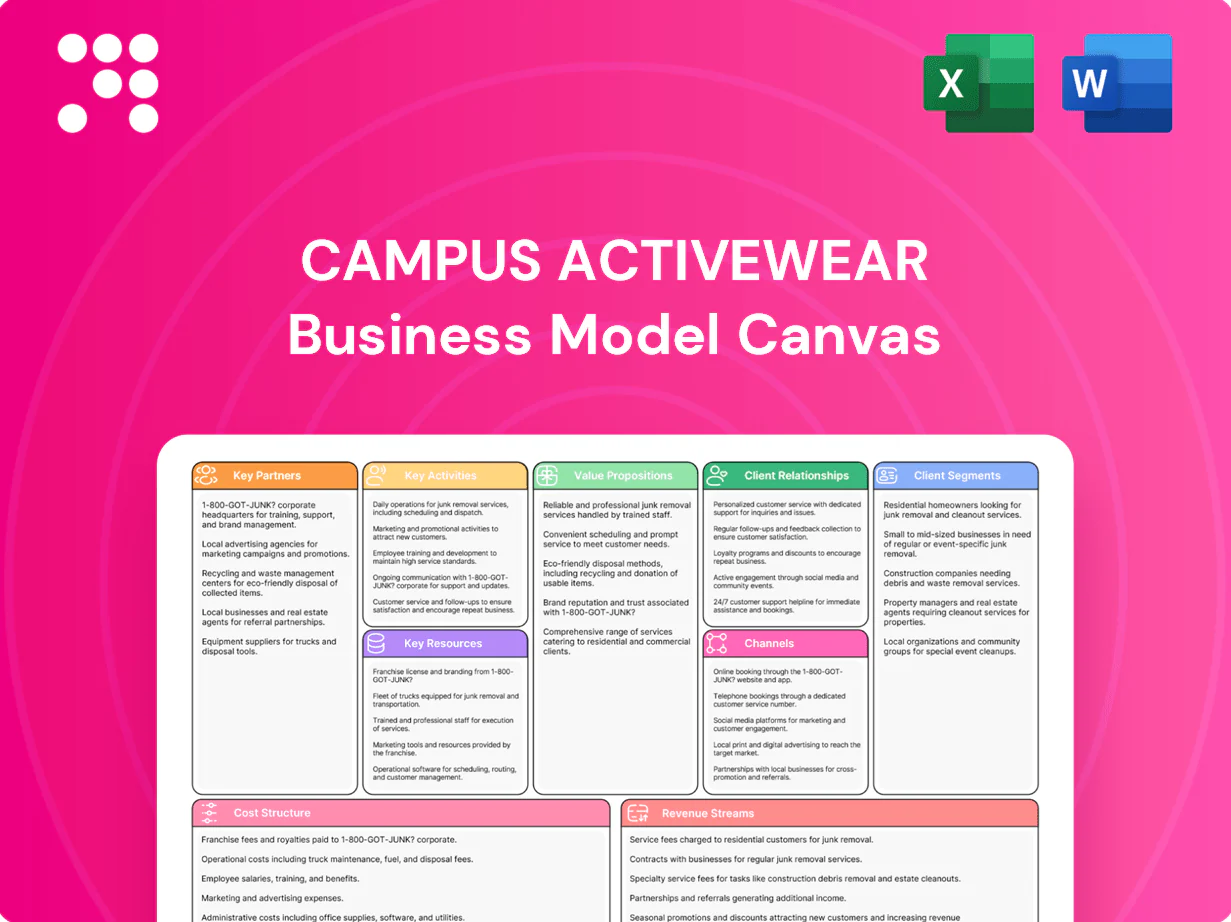
Campus Activewear Business Model Canvas

Unlock retail activewear Business Model Canvas — 3 advantages, customer segments, profit levers
Unlock Campus Activewear's strategic playbook with our concise Business Model Canvas—three core advantages, clear customer segments, and profit levers revealed. This short preview shows how they win; the full Canvas (Word & Excel) contains section-by-section insights, metrics, and strategic moves. Buy the complete pack to benchmark, plan, or pitch with confidence.
Partnerships

Raw material suppliers
Partner with EVA, rubber, PU, mesh and adhesive suppliers to secure stable pricing and quality, targeting contract coverage aligned with 2024 sourcing plans. Long-term contracts mitigate input volatility and ensure consistent materials for production. Co-develop formulations to improve comfort, durability and weight. Build dual sourcing to reduce single-supplier risk and maintain continuity.
Contract manufacturers & OEMs
Campus Activewear augments in-house capacity with reliable regional contract manufacturers and OEMs to meet retail and D2C demand. Shared quality standards, tooling specifications and rolling forecasts increased throughput and alignment during FY2024. Flexible third-party capacity smooths seasonality and new-product launches, while joint Kaizen programs with partners target cost and defect reduction.

Distribution & retail partners
Cultivate multi-brand outlet owners, regional distributors, and franchisees to expand Campus Activewear’s reach across 10,000+ retail touchpoints reported in 2024, offering trade promotions, retail training, and merchandising support to boost sell-through. Joint sell-through plans and co-marketing lift inventory turns—Campus cites a 20% faster turn in partnered stores (2024 pilots). Regular data sharing aligns assortment and automated replenishment, reducing stockouts by ~15% year-over-year in 2024.

E-commerce marketplaces
Leverage Amazon, Flipkart, Myntra and Ajio to access India’s ~USD 120B online retail GMV in 2024, running co-funded campaigns (platform support up to 50%) and exclusive drops to lift visibility and conversion; marketplace commission ranges typically 8–18%.
- API sync: cut fulfillment errors and OOS by ~30–40%
- Analytics: improve SKU sell-through ~15%
- Co-fund: up to 50% marketing support
Logistics & tech partners
Campus Activewear partners with 3PLs for warehousing, last-mile and reverse logistics tapping a global 3PL market ~USD 1.3T; use payment gateways, OMS/WMS and analytics firms to streamline ops. Data-led routing aims to boost OTIF by 10–20% and cut RTO (India e‑commerce RTO ~12–15% in 2024). Implement RFID/barcoding to improve traceability and cut picking errors ~50%.
- Tie-up: 3PLs for warehousing, last-mile, reverse logistics
- Tech: payment gateways, OMS/WMS, analytics
- Performance: OTIF +10–20%, RTO down from ~12–15%
- Traceability: RFID/barcode, ~50% fewer pick errors
Scale via supplier dual-sourcing, regional OEMs and marketplaces for faster turns, fewer stockouts
Partner with raw-material suppliers for 2024 contract coverage and dual sourcing to stabilize costs; joint R&D raised comfort/durability. Use regional OEMs and Kaizen to scale seasonality, raising throughput; partnered stores (10,000+ touchpoints in 2024) saw ~20% faster turns and ~15% fewer stockouts. Leverage marketplaces (India online GMV ~USD 120B in 2024; fees 8–18%) and 3PLs to improve OTIF +10–20% and cut RTO (12–15%).
| Metric | 2024 |
|---|---|
| Retail touchpoints | 10,000+ |
| Online GMV (India) | USD 120B |
| Store turn improvement | ~20% |
| Stockouts reduction | ~15% |
| OTIF uplift | +10–20% |
| RTO | 12–15% |
What is included in the product
 Detailed Word Document
A concise, pre-written Business Model Canvas for Campus Activewear outlining customer segments, channels, value propositions, revenue streams, key partners and activities across the 9 BMC blocks. Ideal for investors and strategists, it links competitive advantages and SWOT insights to real-world operations for presentations, funding pitches, and strategic decision-making.

 Customizable Excel Spreadsheet
High-level view of Campus Activewear’s business model with editable cells to quickly pinpoint distribution, inventory, and margin pain points and streamline corrective actions.
Activities

Design & product development
Researching biomechanics and trend data informs distinct running, walking and casual ranges; rapid prototyping runs on 12-week cycles with iterative wear-testing to ensure fit and durability. Seasonal planning spans four lines balancing core SKUs with fashion drops, while cost-engineering aims for under 10% unit-cost reductions to protect quality and margins.
Sourcing & quality assurance
Negotiate materials and manage vendor scorecards targeting on-time delivery >95% and defect rates <2%, enforcing specs through PO clauses and corrective action plans. Inline and final inspections—aiming to cut defects ~50%—minimize returns and warranty costs. Chemical and performance tests follow Oeko‑Tex, AATCC and ASTM benchmarks to ensure compliance. Continuous improvement programs reduce scrap and rework, improving yield and margins.

Manufacturing & capacity planning
Synchronize in-house lines and OEMs to meet demand by allocating production dynamically (typical split 80:20) and routing 30% of surge volumes to vetted OEM partners. Optimize batch sizes, changeovers and takt times to cut changeover losses by ~25% and raise throughput ~18%. Preventive maintenance programs sustain machine uptime above 96%. Maintain a 15–25% capacity buffer to absorb promotions and festival peaks.

Sales, merchandising & trade marketing
Plan regional and channel assortments to hit an 85% target sell-through within 12 weeks, execute VM, planograms and POP to drive a 5–15% conversion uplift, run trade schemes with retailer training (aim 90% outlet coverage) and monitor daily sell-out POS data to adjust replenishment within 7 days.
Digital marketing & e-commerce ops
Manage Campus D2C site, marketplace listings and performance ads to capture part of India’s ~900 million internet users (2024); optimize PDPs, reviews and dynamic pricing to lift conversion and AOV. Oversee pick-pack-ship, SLA adherence and returns to cut cost per order; use cohort analytics to boost retention and LTV.
- site ops
- marketplace mgmt
- PDP & pricing
- logistics SLA
- cohort LTV
Performance footwear roadmap: 12-week prototyping, 95%+ on-time, under 2% defects, 85% sell-through
Research, 12-week prototyping and wear-testing deliver running/walking/casual ranges; seasonal planning balances core vs drops while targeting >10% unit-cost savings. Vendor scorecards drive on-time >95% and defects <2%; inspections and CI cut defects ~50%. Production split 80:20 (in-house:OEM), 15–25% capacity buffer, uptime >96%. Merchandising targets 85% sell-through in 12 weeks; VM lifts conversion 5–15%; D2C taps ~900M internet users (2024).
| Metric | Target/2024 |
|---|---|
| On-time | >95% |
| Defect rate | <2% |
| Uptime | >96% |
| Sell-through | 85%/12w |
What You See Is What You Get
Business Model Canvas
The preview you're viewing is the exact Campus Activewear Business Model Canvas file you will receive after purchase; it's not a mockup. This live snapshot reflects the full document's content, structure, and formatting. Upon purchase you'll get the same complete, editable file, ready for presentation, analysis, or customization.

Unlock retail activewear Business Model Canvas — 3 advantages, customer segments, profit levers
Unlock Campus Activewear's strategic playbook with our concise Business Model Canvas—three core advantages, clear customer segments, and profit levers revealed. This short preview shows how they win; the full Canvas (Word & Excel) contains section-by-section insights, metrics, and strategic moves. Buy the complete pack to benchmark, plan, or pitch with confidence.
Partnerships
Raw material suppliers
Partner with EVA, rubber, PU, mesh and adhesive suppliers to secure stable pricing and quality, targeting contract coverage aligned with 2024 sourcing plans. Long-term contracts mitigate input volatility and ensure consistent materials for production. Co-develop formulations to improve comfort, durability and weight. Build dual sourcing to reduce single-supplier risk and maintain continuity.
Contract manufacturers & OEMs
Campus Activewear augments in-house capacity with reliable regional contract manufacturers and OEMs to meet retail and D2C demand. Shared quality standards, tooling specifications and rolling forecasts increased throughput and alignment during FY2024. Flexible third-party capacity smooths seasonality and new-product launches, while joint Kaizen programs with partners target cost and defect reduction.
Distribution & retail partners
Cultivate multi-brand outlet owners, regional distributors, and franchisees to expand Campus Activewear’s reach across 10,000+ retail touchpoints reported in 2024, offering trade promotions, retail training, and merchandising support to boost sell-through. Joint sell-through plans and co-marketing lift inventory turns—Campus cites a 20% faster turn in partnered stores (2024 pilots). Regular data sharing aligns assortment and automated replenishment, reducing stockouts by ~15% year-over-year in 2024.
E-commerce marketplaces
Leverage Amazon, Flipkart, Myntra and Ajio to access India’s ~USD 120B online retail GMV in 2024, running co-funded campaigns (platform support up to 50%) and exclusive drops to lift visibility and conversion; marketplace commission ranges typically 8–18%.
- API sync: cut fulfillment errors and OOS by ~30–40%
- Analytics: improve SKU sell-through ~15%
- Co-fund: up to 50% marketing support
Logistics & tech partners
Campus Activewear partners with 3PLs for warehousing, last-mile and reverse logistics tapping a global 3PL market ~USD 1.3T; use payment gateways, OMS/WMS and analytics firms to streamline ops. Data-led routing aims to boost OTIF by 10–20% and cut RTO (India e‑commerce RTO ~12–15% in 2024). Implement RFID/barcoding to improve traceability and cut picking errors ~50%.
- Tie-up: 3PLs for warehousing, last-mile, reverse logistics
- Tech: payment gateways, OMS/WMS, analytics
- Performance: OTIF +10–20%, RTO down from ~12–15%
- Traceability: RFID/barcode, ~50% fewer pick errors
Scale via supplier dual-sourcing, regional OEMs and marketplaces for faster turns, fewer stockouts
Partner with raw-material suppliers for 2024 contract coverage and dual sourcing to stabilize costs; joint R&D raised comfort/durability. Use regional OEMs and Kaizen to scale seasonality, raising throughput; partnered stores (10,000+ touchpoints in 2024) saw ~20% faster turns and ~15% fewer stockouts. Leverage marketplaces (India online GMV ~USD 120B in 2024; fees 8–18%) and 3PLs to improve OTIF +10–20% and cut RTO (12–15%).
| Metric | 2024 |
|---|---|
| Retail touchpoints | 10,000+ |
| Online GMV (India) | USD 120B |
| Store turn improvement | ~20% |
| Stockouts reduction | ~15% |
| OTIF uplift | +10–20% |
| RTO | 12–15% |
What is included in the product
Detailed Word Document
A concise, pre-written Business Model Canvas for Campus Activewear outlining customer segments, channels, value propositions, revenue streams, key partners and activities across the 9 BMC blocks. Ideal for investors and strategists, it links competitive advantages and SWOT insights to real-world operations for presentations, funding pitches, and strategic decision-making.
Customizable Excel Spreadsheet
High-level view of Campus Activewear’s business model with editable cells to quickly pinpoint distribution, inventory, and margin pain points and streamline corrective actions.
Activities
Design & product development
Researching biomechanics and trend data informs distinct running, walking and casual ranges; rapid prototyping runs on 12-week cycles with iterative wear-testing to ensure fit and durability. Seasonal planning spans four lines balancing core SKUs with fashion drops, while cost-engineering aims for under 10% unit-cost reductions to protect quality and margins.
Sourcing & quality assurance
Negotiate materials and manage vendor scorecards targeting on-time delivery >95% and defect rates <2%, enforcing specs through PO clauses and corrective action plans. Inline and final inspections—aiming to cut defects ~50%—minimize returns and warranty costs. Chemical and performance tests follow Oeko‑Tex, AATCC and ASTM benchmarks to ensure compliance. Continuous improvement programs reduce scrap and rework, improving yield and margins.
Manufacturing & capacity planning
Synchronize in-house lines and OEMs to meet demand by allocating production dynamically (typical split 80:20) and routing 30% of surge volumes to vetted OEM partners. Optimize batch sizes, changeovers and takt times to cut changeover losses by ~25% and raise throughput ~18%. Preventive maintenance programs sustain machine uptime above 96%. Maintain a 15–25% capacity buffer to absorb promotions and festival peaks.
Sales, merchandising & trade marketing
Plan regional and channel assortments to hit an 85% target sell-through within 12 weeks, execute VM, planograms and POP to drive a 5–15% conversion uplift, run trade schemes with retailer training (aim 90% outlet coverage) and monitor daily sell-out POS data to adjust replenishment within 7 days.
Digital marketing & e-commerce ops
Manage Campus D2C site, marketplace listings and performance ads to capture part of India’s ~900 million internet users (2024); optimize PDPs, reviews and dynamic pricing to lift conversion and AOV. Oversee pick-pack-ship, SLA adherence and returns to cut cost per order; use cohort analytics to boost retention and LTV.
- site ops
- marketplace mgmt
- PDP & pricing
- logistics SLA
- cohort LTV
Performance footwear roadmap: 12-week prototyping, 95%+ on-time, under 2% defects, 85% sell-through
Research, 12-week prototyping and wear-testing deliver running/walking/casual ranges; seasonal planning balances core vs drops while targeting >10% unit-cost savings. Vendor scorecards drive on-time >95% and defects <2%; inspections and CI cut defects ~50%. Production split 80:20 (in-house:OEM), 15–25% capacity buffer, uptime >96%. Merchandising targets 85% sell-through in 12 weeks; VM lifts conversion 5–15%; D2C taps ~900M internet users (2024).
| Metric | Target/2024 |
|---|---|
| On-time | >95% |
| Defect rate | <2% |
| Uptime | >96% |
| Sell-through | 85%/12w |
What You See Is What You Get
Business Model Canvas
The preview you're viewing is the exact Campus Activewear Business Model Canvas file you will receive after purchase; it's not a mockup. This live snapshot reflects the full document's content, structure, and formatting. Upon purchase you'll get the same complete, editable file, ready for presentation, analysis, or customization.
Original: $10.00
-65%$10.00
$3.50Description
Unlock retail activewear Business Model Canvas — 3 advantages, customer segments, profit levers
Unlock Campus Activewear's strategic playbook with our concise Business Model Canvas—three core advantages, clear customer segments, and profit levers revealed. This short preview shows how they win; the full Canvas (Word & Excel) contains section-by-section insights, metrics, and strategic moves. Buy the complete pack to benchmark, plan, or pitch with confidence.
Partnerships
Raw material suppliers
Partner with EVA, rubber, PU, mesh and adhesive suppliers to secure stable pricing and quality, targeting contract coverage aligned with 2024 sourcing plans. Long-term contracts mitigate input volatility and ensure consistent materials for production. Co-develop formulations to improve comfort, durability and weight. Build dual sourcing to reduce single-supplier risk and maintain continuity.
Contract manufacturers & OEMs
Campus Activewear augments in-house capacity with reliable regional contract manufacturers and OEMs to meet retail and D2C demand. Shared quality standards, tooling specifications and rolling forecasts increased throughput and alignment during FY2024. Flexible third-party capacity smooths seasonality and new-product launches, while joint Kaizen programs with partners target cost and defect reduction.
Distribution & retail partners
Cultivate multi-brand outlet owners, regional distributors, and franchisees to expand Campus Activewear’s reach across 10,000+ retail touchpoints reported in 2024, offering trade promotions, retail training, and merchandising support to boost sell-through. Joint sell-through plans and co-marketing lift inventory turns—Campus cites a 20% faster turn in partnered stores (2024 pilots). Regular data sharing aligns assortment and automated replenishment, reducing stockouts by ~15% year-over-year in 2024.
E-commerce marketplaces
Leverage Amazon, Flipkart, Myntra and Ajio to access India’s ~USD 120B online retail GMV in 2024, running co-funded campaigns (platform support up to 50%) and exclusive drops to lift visibility and conversion; marketplace commission ranges typically 8–18%.
- API sync: cut fulfillment errors and OOS by ~30–40%
- Analytics: improve SKU sell-through ~15%
- Co-fund: up to 50% marketing support
Logistics & tech partners
Campus Activewear partners with 3PLs for warehousing, last-mile and reverse logistics tapping a global 3PL market ~USD 1.3T; use payment gateways, OMS/WMS and analytics firms to streamline ops. Data-led routing aims to boost OTIF by 10–20% and cut RTO (India e‑commerce RTO ~12–15% in 2024). Implement RFID/barcoding to improve traceability and cut picking errors ~50%.
- Tie-up: 3PLs for warehousing, last-mile, reverse logistics
- Tech: payment gateways, OMS/WMS, analytics
- Performance: OTIF +10–20%, RTO down from ~12–15%
- Traceability: RFID/barcode, ~50% fewer pick errors
Scale via supplier dual-sourcing, regional OEMs and marketplaces for faster turns, fewer stockouts
Partner with raw-material suppliers for 2024 contract coverage and dual sourcing to stabilize costs; joint R&D raised comfort/durability. Use regional OEMs and Kaizen to scale seasonality, raising throughput; partnered stores (10,000+ touchpoints in 2024) saw ~20% faster turns and ~15% fewer stockouts. Leverage marketplaces (India online GMV ~USD 120B in 2024; fees 8–18%) and 3PLs to improve OTIF +10–20% and cut RTO (12–15%).
| Metric | 2024 |
|---|---|
| Retail touchpoints | 10,000+ |
| Online GMV (India) | USD 120B |
| Store turn improvement | ~20% |
| Stockouts reduction | ~15% |
| OTIF uplift | +10–20% |
| RTO | 12–15% |
What is included in the product
Detailed Word Document
A concise, pre-written Business Model Canvas for Campus Activewear outlining customer segments, channels, value propositions, revenue streams, key partners and activities across the 9 BMC blocks. Ideal for investors and strategists, it links competitive advantages and SWOT insights to real-world operations for presentations, funding pitches, and strategic decision-making.
Customizable Excel Spreadsheet
High-level view of Campus Activewear’s business model with editable cells to quickly pinpoint distribution, inventory, and margin pain points and streamline corrective actions.
Activities
Design & product development
Researching biomechanics and trend data informs distinct running, walking and casual ranges; rapid prototyping runs on 12-week cycles with iterative wear-testing to ensure fit and durability. Seasonal planning spans four lines balancing core SKUs with fashion drops, while cost-engineering aims for under 10% unit-cost reductions to protect quality and margins.
Sourcing & quality assurance
Negotiate materials and manage vendor scorecards targeting on-time delivery >95% and defect rates <2%, enforcing specs through PO clauses and corrective action plans. Inline and final inspections—aiming to cut defects ~50%—minimize returns and warranty costs. Chemical and performance tests follow Oeko‑Tex, AATCC and ASTM benchmarks to ensure compliance. Continuous improvement programs reduce scrap and rework, improving yield and margins.
Manufacturing & capacity planning
Synchronize in-house lines and OEMs to meet demand by allocating production dynamically (typical split 80:20) and routing 30% of surge volumes to vetted OEM partners. Optimize batch sizes, changeovers and takt times to cut changeover losses by ~25% and raise throughput ~18%. Preventive maintenance programs sustain machine uptime above 96%. Maintain a 15–25% capacity buffer to absorb promotions and festival peaks.
Sales, merchandising & trade marketing
Plan regional and channel assortments to hit an 85% target sell-through within 12 weeks, execute VM, planograms and POP to drive a 5–15% conversion uplift, run trade schemes with retailer training (aim 90% outlet coverage) and monitor daily sell-out POS data to adjust replenishment within 7 days.
Digital marketing & e-commerce ops
Manage Campus D2C site, marketplace listings and performance ads to capture part of India’s ~900 million internet users (2024); optimize PDPs, reviews and dynamic pricing to lift conversion and AOV. Oversee pick-pack-ship, SLA adherence and returns to cut cost per order; use cohort analytics to boost retention and LTV.
- site ops
- marketplace mgmt
- PDP & pricing
- logistics SLA
- cohort LTV
Performance footwear roadmap: 12-week prototyping, 95%+ on-time, under 2% defects, 85% sell-through
Research, 12-week prototyping and wear-testing deliver running/walking/casual ranges; seasonal planning balances core vs drops while targeting >10% unit-cost savings. Vendor scorecards drive on-time >95% and defects <2%; inspections and CI cut defects ~50%. Production split 80:20 (in-house:OEM), 15–25% capacity buffer, uptime >96%. Merchandising targets 85% sell-through in 12 weeks; VM lifts conversion 5–15%; D2C taps ~900M internet users (2024).
| Metric | Target/2024 |
|---|---|
| On-time | >95% |
| Defect rate | <2% |
| Uptime | >96% |
| Sell-through | 85%/12w |
What You See Is What You Get
Business Model Canvas
The preview you're viewing is the exact Campus Activewear Business Model Canvas file you will receive after purchase; it's not a mockup. This live snapshot reflects the full document's content, structure, and formatting. Upon purchase you'll get the same complete, editable file, ready for presentation, analysis, or customization.











