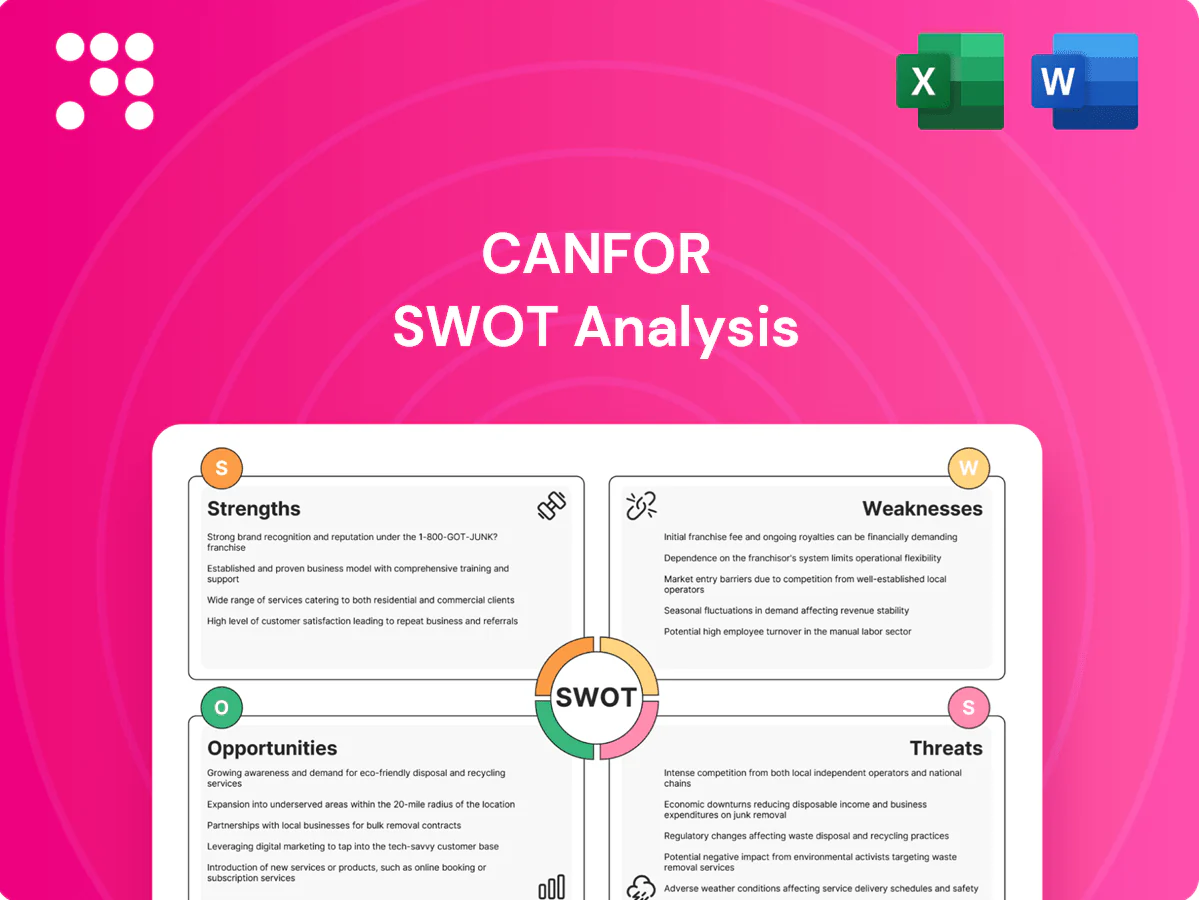
Canfor SWOT Analysis

Elevate Your Analysis with the Complete SWOT Report
Canfor SWOT reveals timber-focused strengths, cost and regulatory risks, and growth levers across lumber, pulp and renewables. Our full SWOT provides financial context, strategic implications and prioritized actions for investors and managers. Purchase the complete, editable report (Word + Excel) to plan, pitch, and act with confidence.
Strengths

Global scale and market leadership
Canfor is one of the top-three North American producers of softwood lumber with integrated pulp and paper operations and diversified mill and forest assets across Canada, the US and global export markets.
That scale drives purchasing power and operating leverage, lowering unit costs and expanding market access across housing and industrial end-markets.
Leadership gives Canfor pricing influence and supports multi-year supply contracts with large customers, improving resilience through housing cycles.
Diverse product portfolio
Canfor's exposure across lumber, pulp, paper and by-products mitigates single-commodity risk, supporting stability as the company reported around CAD 5.0 billion in revenue in 2023. End-use diversity spanning residential construction, repair/remodel and industrial customers smooths revenue through differing demand cycles. This product mix enables cross-selling opportunities and optimized fiber utilization, improving margin resilience across market swings.

Sustainable forestry and certification
Canfor's sustainable forest management, including SFI and PEFC certifications, bolsters trust and access to eco-conscious buyers; Canfor reported CAD 4.7 billion revenue in 2023, supporting scale advantage. Responsible practices lower regulatory and reputational risk and align with LEED/BREEAM procurement, strengthening pricing power. Long-term certified supply underpins timber security.

Operational integration and efficiency
Operational integration at Canfor links sawmills, pulp operations and timberlands to lower unit costs, optimize fiber use and reduce waste, while logistics networks improve delivery efficiency. Vertical integration enhances control over raw-material quality and supply continuity. Data-driven continuous-improvement programs boost yields and uptime, supporting competitiveness in weak price cycles.
- Integrated mills, fiber optimization
- Logistics networks reduce unit costs
- Vertical integration secures raw materials
- Data-driven ops increase yields/uptime
Renewable energy and green materials presence
Canfor's investments in biomass energy and low-carbon wood products create diversified revenue streams and on-site cost offsets by converting residues into heat and power, lowering mill operating expenses while cutting scope 1 emissions. Monetizing residues through bioenergy and pellet pathways reduces landfill use and supports circularity, while green engineered wood meets rising demand from carbon-conscious construction markets. These capabilities enhance access to sustainability-linked financing and strategic partnerships focused on decarbonization.
- Biomass energy: revenue diversification and fuel cost offsets
- Residue monetization: emissions reduction and circularity
- Green materials: alignment with low-carbon construction demand
- Financing: improves eligibility for sustainability-linked loans and partnerships
Top-three North American softwood producer with vertical integration, CAD 4.7bn revenue
Canfor is a top-three North American softwood lumber producer with integrated mills, pulp and timberlands, reporting CAD 4.7 billion revenue in 2023.
Scale and vertical integration lower unit costs, secure fiber supply and enable cross-selling across lumber, pulp, paper and bioenergy.
Sustainability certifications (SFI/PEFC) and bioenergy investments strengthen access to green markets and sustainability-linked financing.
| Metric | Value (2023) |
|---|---|
| Revenue | CAD 4.7bn |
| Geography | Canada, US, exports |
| Certifications | SFI, PEFC |
What is included in the product
 Detailed Word Document
Delivers a strategic overview of Canfor’s internal and external business factors, outlining strengths, weaknesses, opportunities, and threats that shape its competitive position and growth prospects.

 Customizable Excel Spreadsheet
Provides a concise Canfor SWOT matrix for fast strategic alignment and decision-making, with an editable layout for quick updates and seamless integration into reports and stakeholder presentations.
Weaknesses

High exposure to cyclical housing demand
Canfor's lumber sales move closely with new housing starts and R&R activity, making revenue sensitive to construction cycles; lumber prices swung over 70% from the 2021 peak to later troughs, compressing volumes and pricing during downturns. High fixed-cost mill capacity magnifies earnings volatility and drove stretched margins in weak quarters. Forecasting demand is critical yet difficult amid rapid cycle shifts.
Commodity price volatility
Canfor faces acute commodity price volatility: Random Lengths framing lumber peaked near US$1,700/mbf in 2021 then plunged toward ~US$300/mbf by 2023, while NBSK pulp saw similarly large swings, driving abrupt revenue shifts. Sharp price moves can outpace mill cost adjustments and working-capital timing, compressing margins. Hedging is limited for some species and grades, reducing protection. Earnings and cash-flow visibility remain inconsistent quarter-to-quarter.

Capital intensity and maintenance burden
Mills require ongoing capex for reliability, safety and modernization, and Canfor’s significant maintenance spend leads to periodic large shutdowns that disrupt output and strain working capital. Paybacks on mill upgrades depend on stable lumber pricing and sustained throughput, which remain cyclical. High capital intensity limits Canfor’s strategic flexibility for acquisitions or dividend policy during downturns.

Regulatory and compliance cost load
Regulatory and compliance cost load increases Canfor’s operating complexity as environmental, safety, and forestry rules drive higher permitting, monitoring, and capital expenditures; permitting and audit timelines have delayed mill upgrades and harvest plans. Non-compliance risks fines and reputational damage that can affect timber supply contracts and market access, while evolving standards force continuous investment in systems and training.
- Environmental, safety, forestry regulations raise costs
- Permitting and audits can delay projects
- Non-compliance risks fines and reputation
- Evolving standards require ongoing investment
Geographic and supply chain vulnerabilities
Operations clustered in wildfire- and severe-weather-prone BC and Alberta expose Canfor to mill shutdowns and inventory loss; 2023–24 western North America fire seasons caused notable log shortages and disruptions across the industry. Log supply and transport bottlenecks push delivered costs higher, while cross-border shipments to the US (~70% of Canadian lumber exports) face paperwork and delay risk, amplifying regional shocks.
- Wildfire/weather exposure
- Higher delivered costs from log/transport constraints
- Cross-border paperwork/delay risk
- Regional concentration amplifies localized shocks
Lumber price collapse and concentrated operations magnify cyclical earnings and supply risks
Canfor is highly cyclical: lumber revenue tracks US housing starts and fell as Random Lengths framing lumber swung from ~US$1,700/mbf (2021) to ~US$300/mbf (2023), compressing margins. High fixed-cost mills and capital intensity magnify earnings volatility and limit flexibility. Operations concentrated in BC/Alberta raise wildfire, supply and cross-border disruption risks.
| Metric | Value |
|---|---|
| Peak lumber (2021) | ~US$1,700/mbf |
| Trough (2023) | ~US$300/mbf |
| Can export share to US | ~70% |
Preview the Actual Deliverable
Canfor SWOT Analysis
This is the actual SWOT analysis document you'll receive upon purchase—no surprises, just professional quality. The preview below is taken directly from the full SWOT report you'll get, covering Canfor's strengths, weaknesses, opportunities and threats in a ready-to-use format. Purchase unlocks the entire editable file immediately after checkout.

Elevate Your Analysis with the Complete SWOT Report
Canfor SWOT reveals timber-focused strengths, cost and regulatory risks, and growth levers across lumber, pulp and renewables. Our full SWOT provides financial context, strategic implications and prioritized actions for investors and managers. Purchase the complete, editable report (Word + Excel) to plan, pitch, and act with confidence.
Strengths
Global scale and market leadership
Canfor is one of the top-three North American producers of softwood lumber with integrated pulp and paper operations and diversified mill and forest assets across Canada, the US and global export markets.
That scale drives purchasing power and operating leverage, lowering unit costs and expanding market access across housing and industrial end-markets.
Leadership gives Canfor pricing influence and supports multi-year supply contracts with large customers, improving resilience through housing cycles.
Diverse product portfolio
Canfor's exposure across lumber, pulp, paper and by-products mitigates single-commodity risk, supporting stability as the company reported around CAD 5.0 billion in revenue in 2023. End-use diversity spanning residential construction, repair/remodel and industrial customers smooths revenue through differing demand cycles. This product mix enables cross-selling opportunities and optimized fiber utilization, improving margin resilience across market swings.
Sustainable forestry and certification
Canfor's sustainable forest management, including SFI and PEFC certifications, bolsters trust and access to eco-conscious buyers; Canfor reported CAD 4.7 billion revenue in 2023, supporting scale advantage. Responsible practices lower regulatory and reputational risk and align with LEED/BREEAM procurement, strengthening pricing power. Long-term certified supply underpins timber security.
Operational integration and efficiency
Operational integration at Canfor links sawmills, pulp operations and timberlands to lower unit costs, optimize fiber use and reduce waste, while logistics networks improve delivery efficiency. Vertical integration enhances control over raw-material quality and supply continuity. Data-driven continuous-improvement programs boost yields and uptime, supporting competitiveness in weak price cycles.
- Integrated mills, fiber optimization
- Logistics networks reduce unit costs
- Vertical integration secures raw materials
- Data-driven ops increase yields/uptime
Renewable energy and green materials presence
Canfor's investments in biomass energy and low-carbon wood products create diversified revenue streams and on-site cost offsets by converting residues into heat and power, lowering mill operating expenses while cutting scope 1 emissions. Monetizing residues through bioenergy and pellet pathways reduces landfill use and supports circularity, while green engineered wood meets rising demand from carbon-conscious construction markets. These capabilities enhance access to sustainability-linked financing and strategic partnerships focused on decarbonization.
- Biomass energy: revenue diversification and fuel cost offsets
- Residue monetization: emissions reduction and circularity
- Green materials: alignment with low-carbon construction demand
- Financing: improves eligibility for sustainability-linked loans and partnerships
Top-three North American softwood producer with vertical integration, CAD 4.7bn revenue
Canfor is a top-three North American softwood lumber producer with integrated mills, pulp and timberlands, reporting CAD 4.7 billion revenue in 2023.
Scale and vertical integration lower unit costs, secure fiber supply and enable cross-selling across lumber, pulp, paper and bioenergy.
Sustainability certifications (SFI/PEFC) and bioenergy investments strengthen access to green markets and sustainability-linked financing.
| Metric | Value (2023) |
|---|---|
| Revenue | CAD 4.7bn |
| Geography | Canada, US, exports |
| Certifications | SFI, PEFC |
What is included in the product
Detailed Word Document
Delivers a strategic overview of Canfor’s internal and external business factors, outlining strengths, weaknesses, opportunities, and threats that shape its competitive position and growth prospects.
Customizable Excel Spreadsheet
Provides a concise Canfor SWOT matrix for fast strategic alignment and decision-making, with an editable layout for quick updates and seamless integration into reports and stakeholder presentations.
Weaknesses
High exposure to cyclical housing demand
Canfor's lumber sales move closely with new housing starts and R&R activity, making revenue sensitive to construction cycles; lumber prices swung over 70% from the 2021 peak to later troughs, compressing volumes and pricing during downturns. High fixed-cost mill capacity magnifies earnings volatility and drove stretched margins in weak quarters. Forecasting demand is critical yet difficult amid rapid cycle shifts.
Commodity price volatility
Canfor faces acute commodity price volatility: Random Lengths framing lumber peaked near US$1,700/mbf in 2021 then plunged toward ~US$300/mbf by 2023, while NBSK pulp saw similarly large swings, driving abrupt revenue shifts. Sharp price moves can outpace mill cost adjustments and working-capital timing, compressing margins. Hedging is limited for some species and grades, reducing protection. Earnings and cash-flow visibility remain inconsistent quarter-to-quarter.
Capital intensity and maintenance burden
Mills require ongoing capex for reliability, safety and modernization, and Canfor’s significant maintenance spend leads to periodic large shutdowns that disrupt output and strain working capital. Paybacks on mill upgrades depend on stable lumber pricing and sustained throughput, which remain cyclical. High capital intensity limits Canfor’s strategic flexibility for acquisitions or dividend policy during downturns.
Regulatory and compliance cost load
Regulatory and compliance cost load increases Canfor’s operating complexity as environmental, safety, and forestry rules drive higher permitting, monitoring, and capital expenditures; permitting and audit timelines have delayed mill upgrades and harvest plans. Non-compliance risks fines and reputational damage that can affect timber supply contracts and market access, while evolving standards force continuous investment in systems and training.
- Environmental, safety, forestry regulations raise costs
- Permitting and audits can delay projects
- Non-compliance risks fines and reputation
- Evolving standards require ongoing investment
Geographic and supply chain vulnerabilities
Operations clustered in wildfire- and severe-weather-prone BC and Alberta expose Canfor to mill shutdowns and inventory loss; 2023–24 western North America fire seasons caused notable log shortages and disruptions across the industry. Log supply and transport bottlenecks push delivered costs higher, while cross-border shipments to the US (~70% of Canadian lumber exports) face paperwork and delay risk, amplifying regional shocks.
- Wildfire/weather exposure
- Higher delivered costs from log/transport constraints
- Cross-border paperwork/delay risk
- Regional concentration amplifies localized shocks
Lumber price collapse and concentrated operations magnify cyclical earnings and supply risks
Canfor is highly cyclical: lumber revenue tracks US housing starts and fell as Random Lengths framing lumber swung from ~US$1,700/mbf (2021) to ~US$300/mbf (2023), compressing margins. High fixed-cost mills and capital intensity magnify earnings volatility and limit flexibility. Operations concentrated in BC/Alberta raise wildfire, supply and cross-border disruption risks.
| Metric | Value |
|---|---|
| Peak lumber (2021) | ~US$1,700/mbf |
| Trough (2023) | ~US$300/mbf |
| Can export share to US | ~70% |
Preview the Actual Deliverable
Canfor SWOT Analysis
This is the actual SWOT analysis document you'll receive upon purchase—no surprises, just professional quality. The preview below is taken directly from the full SWOT report you'll get, covering Canfor's strengths, weaknesses, opportunities and threats in a ready-to-use format. Purchase unlocks the entire editable file immediately after checkout.
Original: $10.00
-65%$10.00
$3.50Description
Elevate Your Analysis with the Complete SWOT Report
Canfor SWOT reveals timber-focused strengths, cost and regulatory risks, and growth levers across lumber, pulp and renewables. Our full SWOT provides financial context, strategic implications and prioritized actions for investors and managers. Purchase the complete, editable report (Word + Excel) to plan, pitch, and act with confidence.
Strengths
Global scale and market leadership
Canfor is one of the top-three North American producers of softwood lumber with integrated pulp and paper operations and diversified mill and forest assets across Canada, the US and global export markets.
That scale drives purchasing power and operating leverage, lowering unit costs and expanding market access across housing and industrial end-markets.
Leadership gives Canfor pricing influence and supports multi-year supply contracts with large customers, improving resilience through housing cycles.
Diverse product portfolio
Canfor's exposure across lumber, pulp, paper and by-products mitigates single-commodity risk, supporting stability as the company reported around CAD 5.0 billion in revenue in 2023. End-use diversity spanning residential construction, repair/remodel and industrial customers smooths revenue through differing demand cycles. This product mix enables cross-selling opportunities and optimized fiber utilization, improving margin resilience across market swings.
Sustainable forestry and certification
Canfor's sustainable forest management, including SFI and PEFC certifications, bolsters trust and access to eco-conscious buyers; Canfor reported CAD 4.7 billion revenue in 2023, supporting scale advantage. Responsible practices lower regulatory and reputational risk and align with LEED/BREEAM procurement, strengthening pricing power. Long-term certified supply underpins timber security.
Operational integration and efficiency
Operational integration at Canfor links sawmills, pulp operations and timberlands to lower unit costs, optimize fiber use and reduce waste, while logistics networks improve delivery efficiency. Vertical integration enhances control over raw-material quality and supply continuity. Data-driven continuous-improvement programs boost yields and uptime, supporting competitiveness in weak price cycles.
- Integrated mills, fiber optimization
- Logistics networks reduce unit costs
- Vertical integration secures raw materials
- Data-driven ops increase yields/uptime
Renewable energy and green materials presence
Canfor's investments in biomass energy and low-carbon wood products create diversified revenue streams and on-site cost offsets by converting residues into heat and power, lowering mill operating expenses while cutting scope 1 emissions. Monetizing residues through bioenergy and pellet pathways reduces landfill use and supports circularity, while green engineered wood meets rising demand from carbon-conscious construction markets. These capabilities enhance access to sustainability-linked financing and strategic partnerships focused on decarbonization.
- Biomass energy: revenue diversification and fuel cost offsets
- Residue monetization: emissions reduction and circularity
- Green materials: alignment with low-carbon construction demand
- Financing: improves eligibility for sustainability-linked loans and partnerships
Top-three North American softwood producer with vertical integration, CAD 4.7bn revenue
Canfor is a top-three North American softwood lumber producer with integrated mills, pulp and timberlands, reporting CAD 4.7 billion revenue in 2023.
Scale and vertical integration lower unit costs, secure fiber supply and enable cross-selling across lumber, pulp, paper and bioenergy.
Sustainability certifications (SFI/PEFC) and bioenergy investments strengthen access to green markets and sustainability-linked financing.
| Metric | Value (2023) |
|---|---|
| Revenue | CAD 4.7bn |
| Geography | Canada, US, exports |
| Certifications | SFI, PEFC |
What is included in the product
Detailed Word Document
Delivers a strategic overview of Canfor’s internal and external business factors, outlining strengths, weaknesses, opportunities, and threats that shape its competitive position and growth prospects.
Customizable Excel Spreadsheet
Provides a concise Canfor SWOT matrix for fast strategic alignment and decision-making, with an editable layout for quick updates and seamless integration into reports and stakeholder presentations.
Weaknesses
High exposure to cyclical housing demand
Canfor's lumber sales move closely with new housing starts and R&R activity, making revenue sensitive to construction cycles; lumber prices swung over 70% from the 2021 peak to later troughs, compressing volumes and pricing during downturns. High fixed-cost mill capacity magnifies earnings volatility and drove stretched margins in weak quarters. Forecasting demand is critical yet difficult amid rapid cycle shifts.
Commodity price volatility
Canfor faces acute commodity price volatility: Random Lengths framing lumber peaked near US$1,700/mbf in 2021 then plunged toward ~US$300/mbf by 2023, while NBSK pulp saw similarly large swings, driving abrupt revenue shifts. Sharp price moves can outpace mill cost adjustments and working-capital timing, compressing margins. Hedging is limited for some species and grades, reducing protection. Earnings and cash-flow visibility remain inconsistent quarter-to-quarter.
Capital intensity and maintenance burden
Mills require ongoing capex for reliability, safety and modernization, and Canfor’s significant maintenance spend leads to periodic large shutdowns that disrupt output and strain working capital. Paybacks on mill upgrades depend on stable lumber pricing and sustained throughput, which remain cyclical. High capital intensity limits Canfor’s strategic flexibility for acquisitions or dividend policy during downturns.
Regulatory and compliance cost load
Regulatory and compliance cost load increases Canfor’s operating complexity as environmental, safety, and forestry rules drive higher permitting, monitoring, and capital expenditures; permitting and audit timelines have delayed mill upgrades and harvest plans. Non-compliance risks fines and reputational damage that can affect timber supply contracts and market access, while evolving standards force continuous investment in systems and training.
- Environmental, safety, forestry regulations raise costs
- Permitting and audits can delay projects
- Non-compliance risks fines and reputation
- Evolving standards require ongoing investment
Geographic and supply chain vulnerabilities
Operations clustered in wildfire- and severe-weather-prone BC and Alberta expose Canfor to mill shutdowns and inventory loss; 2023–24 western North America fire seasons caused notable log shortages and disruptions across the industry. Log supply and transport bottlenecks push delivered costs higher, while cross-border shipments to the US (~70% of Canadian lumber exports) face paperwork and delay risk, amplifying regional shocks.
- Wildfire/weather exposure
- Higher delivered costs from log/transport constraints
- Cross-border paperwork/delay risk
- Regional concentration amplifies localized shocks
Lumber price collapse and concentrated operations magnify cyclical earnings and supply risks
Canfor is highly cyclical: lumber revenue tracks US housing starts and fell as Random Lengths framing lumber swung from ~US$1,700/mbf (2021) to ~US$300/mbf (2023), compressing margins. High fixed-cost mills and capital intensity magnify earnings volatility and limit flexibility. Operations concentrated in BC/Alberta raise wildfire, supply and cross-border disruption risks.
| Metric | Value |
|---|---|
| Peak lumber (2021) | ~US$1,700/mbf |
| Trough (2023) | ~US$300/mbf |
| Can export share to US | ~70% |
Preview the Actual Deliverable
Canfor SWOT Analysis
This is the actual SWOT analysis document you'll receive upon purchase—no surprises, just professional quality. The preview below is taken directly from the full SWOT report you'll get, covering Canfor's strengths, weaknesses, opportunities and threats in a ready-to-use format. Purchase unlocks the entire editable file immediately after checkout.











