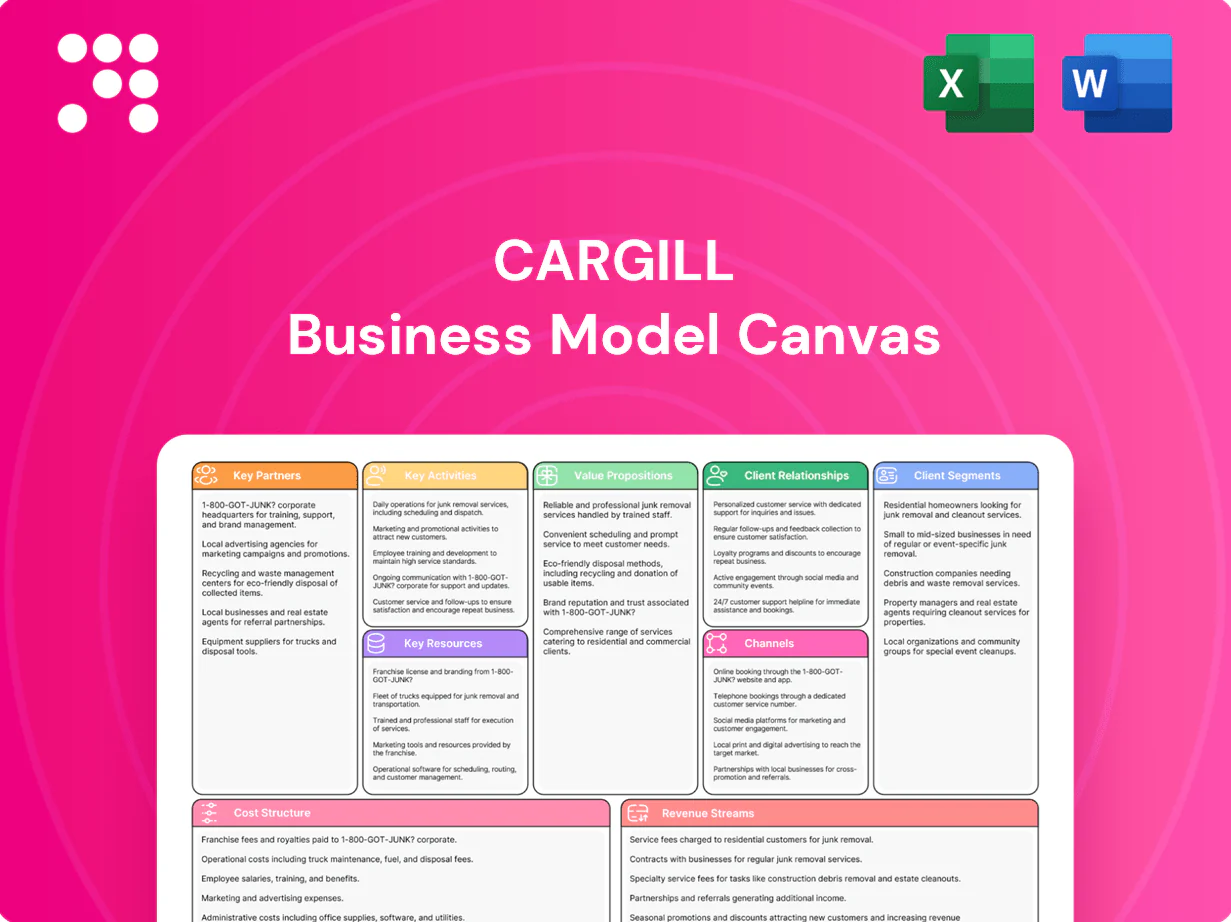
Cargill Business Model Canvas

Unlock a leading agri-food producer Business Model Canvas for investor and strategist use
Unlock Cargill’s strategic playbook with a concise Business Model Canvas that maps its value propositions, key partners, and revenue engines. This snapshot reveals how Cargill scales, mitigates risk, and captures market share across agri-food value chains. Download the full Canvas in Word/Excel for a section-by-section guide ideal for investors, strategists, and founders.
Partnerships

Farmers, producer groups, and co-ops
Core supply partnerships with farmers, producer groups and co-ops secure reliable, scalable sourcing—Cargill reported over 165 billion USD in net sales in 2023, underpinned by sourcing from more than 1 million farmers globally. Cargill funds agronomy support, sustainability programs and traceability systems to boost yields and meet certification standards. Long-term contracts stabilize volumes and prices, cutting procurement volatility for both parties.
Logistics, shipping, and port operators
Global ocean carriers, railroads, barge lines and terminal operators move roughly 80% of world trade by volume, enabling low-cost bulk commodity flows that underpin Cargill’s scale. Integrated logistics partnerships cut bottlenecks and can shorten lead times across origin-to-destination chains, supporting seasonal arbitrage via access to strategic ports and storage hubs. Joint investments in terminals and equipment boost throughput, safety and emissions performance through efficiency gains and cleaner fuels.

Food manufacturers and retailers
Downstream alliances align ingredient, protein and private‑label specs across Cargill’s 70+ country footprint and 155,000 employees to meet retailer needs. Co‑development accelerates taste, texture and clean‑label launches as private‑label holds ~18% of US grocery sales (2024). Joint forecasting can cut stockouts up to 30%, improving shelf availability. Sustainability and traceability programs (net‑zero by 2050 pledge) strengthen brand value.

Technology, data, and equipment providers
Technology, data, and equipment partners supply processing lines, automation, analytics, and digital platforms that increase throughput and traceability; Deloitte reports IoT-enabled predictive maintenance can cut unplanned downtime by ~50% and maintenance costs by ~20%, lowering energy use and OPEX. Data partnerships improve risk modeling, dynamic pricing and logistics optimization using real-time trade and weather feeds; joint R&D with universities and startups accelerates food‑science and alternative‑protein launches.
- Partners: OEMs, SaaS analytics, cloud/data providers
- Impact: ~50% less downtime, ~20% lower maintenance costs
- Data uses: risk, pricing, routing optimization
- R&D: faster alternative‑protein prototyping and scale‑up
Financial institutions and risk counterparties
Banks, insurers and hedging counterparties provide trade finance, liquidity and risk transfer for Cargill, using structured products to hedge commodity, FX, interest rate and credit exposures; ICC estimated a global trade finance gap of about 1.7 trillion in 2024, underscoring the role of these partners. Collaboration with counterparties enables customer risk solutions and tailored hedges, while diversification across dozens of counterparties enhances resilience across cycles.
- Trade finance: ICC 1.7T (2024)
- Hedges: commodity, FX, rates, credit
- Collaboration: customer risk solutions
- Diversification: dozens of counterparties
1M+ farmers, logistics & finance underpin $165B global net sales
Core supplier ties with 1M+ farmers underpin Cargills $165B net sales (2023) and 155,000 employees across 70+ countries. Logistics partners enable bulk flows (~80% world trade by vol) and terminal investments cut delays. Financial counterparties help address a $1.7T trade finance gap (ICC, 2024) and hedge commodity/FX risk. Tech and co‑development speed product launches; private‑label ~18% US grocery sales (2024).
| Partner | Role | Metric |
|---|---|---|
| Farmers/co‑ops | Sourcing | 1M+ farmers |
| Logistics | Transport/storage | ~80% trade vol |
| Banks/insurers | Finance/hedge | $1.7T gap (2024) |
What is included in the product
 Detailed Word Document
A comprehensive Business Model Canvas for Cargill mapping its nine blocks—customer segments to revenue streams—detailing value propositions, global agribusiness channels, key partnerships, and cost structures; includes competitive advantages, SWOT-linked insights and investor-ready narrative for strategic decision-making.

 Customizable Excel Spreadsheet
High-level view of Cargill’s business model with editable cells, enabling rapid identification of core components and pain points across supply chain, sourcing, and risk management for quick team alignment and decision-making.
Activities

Global sourcing and origination
Cargill aggregates grains, oilseeds and soft commodities from diversified geographies, managing quality, RTRS and ISCC certifications and end-to-end traceability. Seasonal timing and basis management optimize procurement costs, while local origination hubs across 70+ countries and a ~155,000-strong workforce de-risk political and weather-related disruptions.
Processing and value-added manufacturing
Crushing, milling, refining and formulation convert raw commodities into food- and feed-grade ingredients, leveraging Cargill’s global manufacturing network operating in 70+ countries and about 155,000 employees in 2024. Standardized quality systems ensure consistent industrial and food outputs across sites. Dynamic capacity balancing maximizes margins by shifting throughput among facilities. Continuous improvement programs target waste cuts and lower energy intensity across plants.

Trading, merchandising, and risk management
Active physical and paper trading captures arbitrage and spreads across grains and proteins, supporting Cargill’s scale (roughly $180 billion in sales reported for 2023) while hedging shields inventories and forward contracts from price swings. Structured risk solutions tailor FX and commodity hedges to customer exposures; market intelligence and analytics — including realtime futures and basis models — guide position sizing and dynamic pricing.

Logistics, storage, and distribution
Owning or contracting elevators, warehouses and fleets ensures throughput and resilience; as of 2024 Cargill employs about 155,000 people supporting global logistics. Continuous optimization targets lower demurrage and freight spend while cold chain and just-in-time delivery uphold customer SLAs. Inventory management balances carrying costs against target service levels.
- Throughput resilience
- Demurrage & freight reduction
- Cold chain & JIT SLAs
- Inventory vs carry cost
R&D and product innovation
R&D in food science, animal nutrition and sustainability underpins Cargill’s differentiated ingredient and feed offerings, supporting product performance and lower environmental footprints.
Pilots and application labs co-create solutions with customers and use regulatory and sensory testing to secure market acceptance and compliance.
Pipeline prioritization follows market trends and margin potential; Cargill reported roughly $165 billion revenue in 2023, guiding 2024 R&D focus toward high-margin sustainable proteins and feed additives.
- Food science-led formulations
- Application labs for co-creation
- Regulatory & sensory testing
- Pipeline prioritized by market & margin
Global agribusiness: $180B, 155k staff, 70+ countries
Cargill sources grains, oilseeds and soft commodities across 70+ countries with RTRS/ISCC traceability and a ~155,000 workforce (2024).
Global crushing, milling and refining network balances capacity and continuous-improvement to support industrial and food-grade outputs; company reported ~$180B sales in 2023.
Active physical/paper trading, logistics ownership and R&D in sustainable proteins and feeds underpin margin capture, risk hedging and customer solutions.
| Metric | Value |
|---|---|
| Revenue (2023) | $180B |
| Workforce (2024) | ~155,000 |
| Countries | 70+ |
Full Version Awaits
Business Model Canvas
The Cargill Business Model Canvas shown here is the actual document you’ll receive after purchase, not a mockup. This preview contains real content and layout from the final file, fully editable and ready to use. When you buy, you’ll download the same complete canvas with all sections included. No placeholders, no surprises—what you see is what you get.

Unlock a leading agri-food producer Business Model Canvas for investor and strategist use
Unlock Cargill’s strategic playbook with a concise Business Model Canvas that maps its value propositions, key partners, and revenue engines. This snapshot reveals how Cargill scales, mitigates risk, and captures market share across agri-food value chains. Download the full Canvas in Word/Excel for a section-by-section guide ideal for investors, strategists, and founders.
Partnerships
Farmers, producer groups, and co-ops
Core supply partnerships with farmers, producer groups and co-ops secure reliable, scalable sourcing—Cargill reported over 165 billion USD in net sales in 2023, underpinned by sourcing from more than 1 million farmers globally. Cargill funds agronomy support, sustainability programs and traceability systems to boost yields and meet certification standards. Long-term contracts stabilize volumes and prices, cutting procurement volatility for both parties.
Logistics, shipping, and port operators
Global ocean carriers, railroads, barge lines and terminal operators move roughly 80% of world trade by volume, enabling low-cost bulk commodity flows that underpin Cargill’s scale. Integrated logistics partnerships cut bottlenecks and can shorten lead times across origin-to-destination chains, supporting seasonal arbitrage via access to strategic ports and storage hubs. Joint investments in terminals and equipment boost throughput, safety and emissions performance through efficiency gains and cleaner fuels.
Food manufacturers and retailers
Downstream alliances align ingredient, protein and private‑label specs across Cargill’s 70+ country footprint and 155,000 employees to meet retailer needs. Co‑development accelerates taste, texture and clean‑label launches as private‑label holds ~18% of US grocery sales (2024). Joint forecasting can cut stockouts up to 30%, improving shelf availability. Sustainability and traceability programs (net‑zero by 2050 pledge) strengthen brand value.
Technology, data, and equipment providers
Technology, data, and equipment partners supply processing lines, automation, analytics, and digital platforms that increase throughput and traceability; Deloitte reports IoT-enabled predictive maintenance can cut unplanned downtime by ~50% and maintenance costs by ~20%, lowering energy use and OPEX. Data partnerships improve risk modeling, dynamic pricing and logistics optimization using real-time trade and weather feeds; joint R&D with universities and startups accelerates food‑science and alternative‑protein launches.
- Partners: OEMs, SaaS analytics, cloud/data providers
- Impact: ~50% less downtime, ~20% lower maintenance costs
- Data uses: risk, pricing, routing optimization
- R&D: faster alternative‑protein prototyping and scale‑up
Financial institutions and risk counterparties
Banks, insurers and hedging counterparties provide trade finance, liquidity and risk transfer for Cargill, using structured products to hedge commodity, FX, interest rate and credit exposures; ICC estimated a global trade finance gap of about 1.7 trillion in 2024, underscoring the role of these partners. Collaboration with counterparties enables customer risk solutions and tailored hedges, while diversification across dozens of counterparties enhances resilience across cycles.
- Trade finance: ICC 1.7T (2024)
- Hedges: commodity, FX, rates, credit
- Collaboration: customer risk solutions
- Diversification: dozens of counterparties
1M+ farmers, logistics & finance underpin $165B global net sales
Core supplier ties with 1M+ farmers underpin Cargills $165B net sales (2023) and 155,000 employees across 70+ countries. Logistics partners enable bulk flows (~80% world trade by vol) and terminal investments cut delays. Financial counterparties help address a $1.7T trade finance gap (ICC, 2024) and hedge commodity/FX risk. Tech and co‑development speed product launches; private‑label ~18% US grocery sales (2024).
| Partner | Role | Metric |
|---|---|---|
| Farmers/co‑ops | Sourcing | 1M+ farmers |
| Logistics | Transport/storage | ~80% trade vol |
| Banks/insurers | Finance/hedge | $1.7T gap (2024) |
What is included in the product
Detailed Word Document
A comprehensive Business Model Canvas for Cargill mapping its nine blocks—customer segments to revenue streams—detailing value propositions, global agribusiness channels, key partnerships, and cost structures; includes competitive advantages, SWOT-linked insights and investor-ready narrative for strategic decision-making.
Customizable Excel Spreadsheet
High-level view of Cargill’s business model with editable cells, enabling rapid identification of core components and pain points across supply chain, sourcing, and risk management for quick team alignment and decision-making.
Activities
Global sourcing and origination
Cargill aggregates grains, oilseeds and soft commodities from diversified geographies, managing quality, RTRS and ISCC certifications and end-to-end traceability. Seasonal timing and basis management optimize procurement costs, while local origination hubs across 70+ countries and a ~155,000-strong workforce de-risk political and weather-related disruptions.
Processing and value-added manufacturing
Crushing, milling, refining and formulation convert raw commodities into food- and feed-grade ingredients, leveraging Cargill’s global manufacturing network operating in 70+ countries and about 155,000 employees in 2024. Standardized quality systems ensure consistent industrial and food outputs across sites. Dynamic capacity balancing maximizes margins by shifting throughput among facilities. Continuous improvement programs target waste cuts and lower energy intensity across plants.
Trading, merchandising, and risk management
Active physical and paper trading captures arbitrage and spreads across grains and proteins, supporting Cargill’s scale (roughly $180 billion in sales reported for 2023) while hedging shields inventories and forward contracts from price swings. Structured risk solutions tailor FX and commodity hedges to customer exposures; market intelligence and analytics — including realtime futures and basis models — guide position sizing and dynamic pricing.
Logistics, storage, and distribution
Owning or contracting elevators, warehouses and fleets ensures throughput and resilience; as of 2024 Cargill employs about 155,000 people supporting global logistics. Continuous optimization targets lower demurrage and freight spend while cold chain and just-in-time delivery uphold customer SLAs. Inventory management balances carrying costs against target service levels.
- Throughput resilience
- Demurrage & freight reduction
- Cold chain & JIT SLAs
- Inventory vs carry cost
R&D and product innovation
R&D in food science, animal nutrition and sustainability underpins Cargill’s differentiated ingredient and feed offerings, supporting product performance and lower environmental footprints.
Pilots and application labs co-create solutions with customers and use regulatory and sensory testing to secure market acceptance and compliance.
Pipeline prioritization follows market trends and margin potential; Cargill reported roughly $165 billion revenue in 2023, guiding 2024 R&D focus toward high-margin sustainable proteins and feed additives.
- Food science-led formulations
- Application labs for co-creation
- Regulatory & sensory testing
- Pipeline prioritized by market & margin
Global agribusiness: $180B, 155k staff, 70+ countries
Cargill sources grains, oilseeds and soft commodities across 70+ countries with RTRS/ISCC traceability and a ~155,000 workforce (2024).
Global crushing, milling and refining network balances capacity and continuous-improvement to support industrial and food-grade outputs; company reported ~$180B sales in 2023.
Active physical/paper trading, logistics ownership and R&D in sustainable proteins and feeds underpin margin capture, risk hedging and customer solutions.
| Metric | Value |
|---|---|
| Revenue (2023) | $180B |
| Workforce (2024) | ~155,000 |
| Countries | 70+ |
Full Version Awaits
Business Model Canvas
The Cargill Business Model Canvas shown here is the actual document you’ll receive after purchase, not a mockup. This preview contains real content and layout from the final file, fully editable and ready to use. When you buy, you’ll download the same complete canvas with all sections included. No placeholders, no surprises—what you see is what you get.
Original: $10.00
-65%$10.00
$3.50Description
Unlock a leading agri-food producer Business Model Canvas for investor and strategist use
Unlock Cargill’s strategic playbook with a concise Business Model Canvas that maps its value propositions, key partners, and revenue engines. This snapshot reveals how Cargill scales, mitigates risk, and captures market share across agri-food value chains. Download the full Canvas in Word/Excel for a section-by-section guide ideal for investors, strategists, and founders.
Partnerships
Farmers, producer groups, and co-ops
Core supply partnerships with farmers, producer groups and co-ops secure reliable, scalable sourcing—Cargill reported over 165 billion USD in net sales in 2023, underpinned by sourcing from more than 1 million farmers globally. Cargill funds agronomy support, sustainability programs and traceability systems to boost yields and meet certification standards. Long-term contracts stabilize volumes and prices, cutting procurement volatility for both parties.
Logistics, shipping, and port operators
Global ocean carriers, railroads, barge lines and terminal operators move roughly 80% of world trade by volume, enabling low-cost bulk commodity flows that underpin Cargill’s scale. Integrated logistics partnerships cut bottlenecks and can shorten lead times across origin-to-destination chains, supporting seasonal arbitrage via access to strategic ports and storage hubs. Joint investments in terminals and equipment boost throughput, safety and emissions performance through efficiency gains and cleaner fuels.
Food manufacturers and retailers
Downstream alliances align ingredient, protein and private‑label specs across Cargill’s 70+ country footprint and 155,000 employees to meet retailer needs. Co‑development accelerates taste, texture and clean‑label launches as private‑label holds ~18% of US grocery sales (2024). Joint forecasting can cut stockouts up to 30%, improving shelf availability. Sustainability and traceability programs (net‑zero by 2050 pledge) strengthen brand value.
Technology, data, and equipment providers
Technology, data, and equipment partners supply processing lines, automation, analytics, and digital platforms that increase throughput and traceability; Deloitte reports IoT-enabled predictive maintenance can cut unplanned downtime by ~50% and maintenance costs by ~20%, lowering energy use and OPEX. Data partnerships improve risk modeling, dynamic pricing and logistics optimization using real-time trade and weather feeds; joint R&D with universities and startups accelerates food‑science and alternative‑protein launches.
- Partners: OEMs, SaaS analytics, cloud/data providers
- Impact: ~50% less downtime, ~20% lower maintenance costs
- Data uses: risk, pricing, routing optimization
- R&D: faster alternative‑protein prototyping and scale‑up
Financial institutions and risk counterparties
Banks, insurers and hedging counterparties provide trade finance, liquidity and risk transfer for Cargill, using structured products to hedge commodity, FX, interest rate and credit exposures; ICC estimated a global trade finance gap of about 1.7 trillion in 2024, underscoring the role of these partners. Collaboration with counterparties enables customer risk solutions and tailored hedges, while diversification across dozens of counterparties enhances resilience across cycles.
- Trade finance: ICC 1.7T (2024)
- Hedges: commodity, FX, rates, credit
- Collaboration: customer risk solutions
- Diversification: dozens of counterparties
1M+ farmers, logistics & finance underpin $165B global net sales
Core supplier ties with 1M+ farmers underpin Cargills $165B net sales (2023) and 155,000 employees across 70+ countries. Logistics partners enable bulk flows (~80% world trade by vol) and terminal investments cut delays. Financial counterparties help address a $1.7T trade finance gap (ICC, 2024) and hedge commodity/FX risk. Tech and co‑development speed product launches; private‑label ~18% US grocery sales (2024).
| Partner | Role | Metric |
|---|---|---|
| Farmers/co‑ops | Sourcing | 1M+ farmers |
| Logistics | Transport/storage | ~80% trade vol |
| Banks/insurers | Finance/hedge | $1.7T gap (2024) |
What is included in the product
Detailed Word Document
A comprehensive Business Model Canvas for Cargill mapping its nine blocks—customer segments to revenue streams—detailing value propositions, global agribusiness channels, key partnerships, and cost structures; includes competitive advantages, SWOT-linked insights and investor-ready narrative for strategic decision-making.
Customizable Excel Spreadsheet
High-level view of Cargill’s business model with editable cells, enabling rapid identification of core components and pain points across supply chain, sourcing, and risk management for quick team alignment and decision-making.
Activities
Global sourcing and origination
Cargill aggregates grains, oilseeds and soft commodities from diversified geographies, managing quality, RTRS and ISCC certifications and end-to-end traceability. Seasonal timing and basis management optimize procurement costs, while local origination hubs across 70+ countries and a ~155,000-strong workforce de-risk political and weather-related disruptions.
Processing and value-added manufacturing
Crushing, milling, refining and formulation convert raw commodities into food- and feed-grade ingredients, leveraging Cargill’s global manufacturing network operating in 70+ countries and about 155,000 employees in 2024. Standardized quality systems ensure consistent industrial and food outputs across sites. Dynamic capacity balancing maximizes margins by shifting throughput among facilities. Continuous improvement programs target waste cuts and lower energy intensity across plants.
Trading, merchandising, and risk management
Active physical and paper trading captures arbitrage and spreads across grains and proteins, supporting Cargill’s scale (roughly $180 billion in sales reported for 2023) while hedging shields inventories and forward contracts from price swings. Structured risk solutions tailor FX and commodity hedges to customer exposures; market intelligence and analytics — including realtime futures and basis models — guide position sizing and dynamic pricing.
Logistics, storage, and distribution
Owning or contracting elevators, warehouses and fleets ensures throughput and resilience; as of 2024 Cargill employs about 155,000 people supporting global logistics. Continuous optimization targets lower demurrage and freight spend while cold chain and just-in-time delivery uphold customer SLAs. Inventory management balances carrying costs against target service levels.
- Throughput resilience
- Demurrage & freight reduction
- Cold chain & JIT SLAs
- Inventory vs carry cost
R&D and product innovation
R&D in food science, animal nutrition and sustainability underpins Cargill’s differentiated ingredient and feed offerings, supporting product performance and lower environmental footprints.
Pilots and application labs co-create solutions with customers and use regulatory and sensory testing to secure market acceptance and compliance.
Pipeline prioritization follows market trends and margin potential; Cargill reported roughly $165 billion revenue in 2023, guiding 2024 R&D focus toward high-margin sustainable proteins and feed additives.
- Food science-led formulations
- Application labs for co-creation
- Regulatory & sensory testing
- Pipeline prioritized by market & margin
Global agribusiness: $180B, 155k staff, 70+ countries
Cargill sources grains, oilseeds and soft commodities across 70+ countries with RTRS/ISCC traceability and a ~155,000 workforce (2024).
Global crushing, milling and refining network balances capacity and continuous-improvement to support industrial and food-grade outputs; company reported ~$180B sales in 2023.
Active physical/paper trading, logistics ownership and R&D in sustainable proteins and feeds underpin margin capture, risk hedging and customer solutions.
| Metric | Value |
|---|---|
| Revenue (2023) | $180B |
| Workforce (2024) | ~155,000 |
| Countries | 70+ |
Full Version Awaits
Business Model Canvas
The Cargill Business Model Canvas shown here is the actual document you’ll receive after purchase, not a mockup. This preview contains real content and layout from the final file, fully editable and ready to use. When you buy, you’ll download the same complete canvas with all sections included. No placeholders, no surprises—what you see is what you get.











