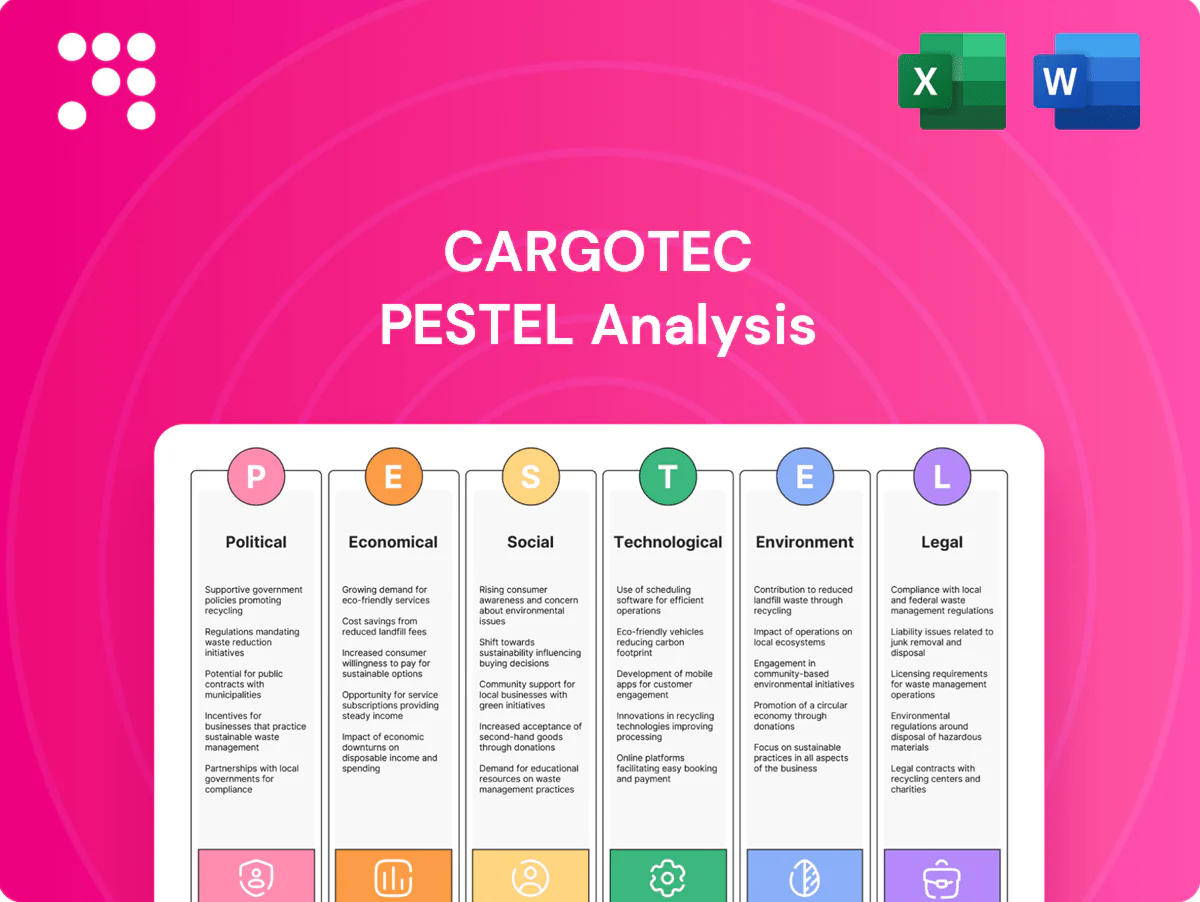
Cargotec PESTLE Analysis

Skip the Research. Get the Strategy.
Discover how political, economic, social, technological, legal and environmental forces are reshaping Cargotec’s strategy and market position. This concise PESTLE highlights key risks and opportunities for investors and planners. Buy the full analysis to access the detailed, actionable insights you need now.
Political factors

Trade policy and tariffs
Cargotec’s Kalmar and Hiab cross customs zones, leaving steel and component costs vulnerable to tariff swings such as the US 25% steel tariffs, which can materially raise unit costs and compress margins. Shifts in EU, US and China policy reshape cost structures and pricing power, while preferential agreements can cut tariffs to near 0% and speed deliveries. Sanctions and export controls (eg Russia 2022 measures) can outright block contracts; active hedging and multi-sourcing buffer volatility.
Geopolitical instability and conflict
Projects at ports and shipyards are highly sensitive to regional conflicts and maritime security tensions; Suez/Red Sea routes account for about 12% of global trade value and the Strait of Hormuz transits roughly 20% of seaborne oil, so disruptions hit delivery routes, insurance and customer capex timing. Defense- and security-linked shipbuilding can partly offset softness in MacGregor commercial orders, and scenario planning plus rerouting (Cape route adds ~10–14 days) are critical mitigants.

Public infrastructure and stimulus spending
Government-backed port modernization and green-infrastructure programs — backed by US IIJA $1.2tn (of which $550bn new) and the EU Recovery and Resilience Facility €723.8bn — drive Kalmar order intake; fiscal cycles and elections shift timing of grants and PPPs for terminals and intermodal hubs. Re-shoring industrial policy lifts distribution center capex and automation demand, while multi-year public frameworks materially improve visibility for multi-year equipment contracts.

Regulatory alignment across regions
Operating in over 100 countries forces Cargotec to navigate divergent standards and homologation requirements, increasing engineering complexity and aftersales burden; UNECE WP.29 and WTO TBT remain key harmonization routes while EU CBAM transition (since 2023) raises compliance focus. Political pushes for regional content rules such as Buy America can force manufacturing localization.
- Operating footprint: 100+ countries
- Key forums: UNECE WP.29, WTO TBT
- Regulatory impact: localization risk from Buy America/CBAM
- Commercial effect: higher engineering and aftersales complexity
Environmental diplomacy and maritime policy
Environmental diplomacy and maritime policy are steering port electrification and fleet renewal—EU Fit for 55 (55% GHG cut by 2030) and the IMO initial strategy (at least 50% GHG reduction by 2050) push demand for electrified terminals and low-emission ships, shaping Cargotec offerings.
- IMO target: ≥50% GHG cut by 2050
- EU Fit for 55: 55% by 2030
- MacGregor: focus on ship-efficiency tech
- Kalmar: shore power/zero-emission handling roadmap
- Policy reversals can pause buyer CAPEX
Tariffs, sanctions and trade-route shocks raise costs while electrification funding spurs demand
Cargotec faces tariff, sanction and localization risks across 100+ countries, with Buy America and CBAM raising compliance and localization costs; trade-route shocks (Suez/Red Sea ~12% value, Strait of Hormuz ~20% oil transit) disrupt delivery and insurance. Government programs (US IIJA $1.2tn, EU RRF €723.8bn) and IMO/EU climate targets (IMO ≥50% by 2050, Fit for 55: 55% by 2030) drive electrification demand.
| Metric | Value |
|---|---|
| Operating footprint | 100+ countries |
| IIJA | $1.2tn |
| EU RRF | €723.8bn |
| Suez/Red Sea exposure | ~12% trade value |
| IMO target | ≥50% GHG by 2050 |
What is included in the product
 Detailed Word Document
Explores how macro-environmental factors uniquely affect Cargotec across Political, Economic, Social, Technological, Environmental and Legal dimensions, with data-backed trends and region/industry specificity to identify threats and opportunities; designed for executives and investors and including forward-looking insights for scenario planning and strategy integration.

 Customizable Excel Spreadsheet
A concise, visually segmented PESTLE summary of Cargotec that’s easily customizable for region or business line, ideal for PowerPoints and quick team alignment while supporting external risk discussions and consultant reporting.
Economic factors

Global trade and container throughput
Kalmar’s volumes closely track global container traffic and terminal capex cycles; global container throughput was around 800 million TEU in 2023, making terminal refresh cycles a key demand driver for handling equipment.
Trade slowdowns, blank sailings and inventory destocking across 2022–24 depressed equipment orders and service activity, while port congestion and volume rebounds lift demand for cranes, RTGs and automation.
Longer service contracts and spare-parts agreements provide partial counter-cyclical revenue stability for Cargotec/Kalmar.
Commodity and input cost inflation
Steel (European HRC ~€700–900/t in 2024), hydraulics and electronics cost inflation have squeezed Hiab and Kalmar margins, with electronics still ~15–25% above pre‑pandemic levels; lead‑time volatility forces indexation and strict pricing clauses to protect margins. Supplier consolidation and multi‑year agreements have moderated spot spikes, but delayed cost pass‑through can depress near‑term profitability.

Interest rates and financing availability
Capital equipment purchases for Cargotec are highly rate-sensitive as global policy rates stayed elevated through 2024–H1 2025 (US Fed funds ~5.25%, ECB deposit ~4.00%), lengthening sales cycles and shifting customers toward refurbishment and services. Vendor financing and compelling TCO propositions have sustained order intake by reducing upfront cost barriers. Cuts in policy rates can unlock deferred terminal automation projects and accelerate fleet renewals.

FX exposure and translation risk
Cargotec faces FX exposure as revenues and costs are earned in EUR, USD, SEK, CNY and other currencies, creating mismatch risk that materially affected reported earnings in FY2024 through translation volatility between major pairs.
Currency swings influence competitiveness in global bids; natural hedges and derivatives are used to smooth P&L impact, while pricing in customer currencies can secure contracts but transfers FX risk onto Cargotec.
- Revenue/cost currencies: EUR, USD, SEK, CNY
- Hedging: natural hedges + derivatives to reduce earnings volatility
- Pricing trade-off: win rates vs. retained FX risk
Cyclicality and aftermarket resilience
Original equipment sales at Cargotec are highly cyclical, while spare parts and lifecycle services provide steadier revenue streams and higher margin stability.
A growing installed base underpins recurring revenues and reduces earnings volatility, with downturns shifting demand from new units to repairs and upgrades, supporting aftermarket resilience.
Tariffs, sanctions and trade-route shocks raise costs while electrification funding spurs demand
Kalmar volumes track global container throughput (~800m TEU in 2023) making terminal capex cycles a primary demand driver. Elevated policy rates (Fed ~5.25%, ECB deposit ~4.00% through H1 2025) lengthened sales cycles, favoring refurbishments and vendor financing. Input inflation (EU HRC €700–900/t in 2024; electronics +15–25% vs pre‑pandemic) squeezed margins despite multi‑year supplier deals. FX (EUR, USD, SEK, CNY) and hedging shape competitiveness and reported earnings.
| Metric | Value |
|---|---|
| Global TEU | ~800m (2023) |
| Fed / ECB | ~5.25% / ~4.00% (2024–H1 2025) |
| HRC | €700–900/t (2024) |
| Electronics vs 2019 | +15–25% |
Preview Before You Purchase
Cargotec PESTLE Analysis
The Cargotec PESTLE Analysis shown here is the actual, fully formatted document you’ll receive after purchase—professionally structured and ready to use. The content, layout, and insights visible in this preview are exactly what you’ll download instantly upon payment.

Skip the Research. Get the Strategy.
Discover how political, economic, social, technological, legal and environmental forces are reshaping Cargotec’s strategy and market position. This concise PESTLE highlights key risks and opportunities for investors and planners. Buy the full analysis to access the detailed, actionable insights you need now.
Political factors
Trade policy and tariffs
Cargotec’s Kalmar and Hiab cross customs zones, leaving steel and component costs vulnerable to tariff swings such as the US 25% steel tariffs, which can materially raise unit costs and compress margins. Shifts in EU, US and China policy reshape cost structures and pricing power, while preferential agreements can cut tariffs to near 0% and speed deliveries. Sanctions and export controls (eg Russia 2022 measures) can outright block contracts; active hedging and multi-sourcing buffer volatility.
Geopolitical instability and conflict
Projects at ports and shipyards are highly sensitive to regional conflicts and maritime security tensions; Suez/Red Sea routes account for about 12% of global trade value and the Strait of Hormuz transits roughly 20% of seaborne oil, so disruptions hit delivery routes, insurance and customer capex timing. Defense- and security-linked shipbuilding can partly offset softness in MacGregor commercial orders, and scenario planning plus rerouting (Cape route adds ~10–14 days) are critical mitigants.
Public infrastructure and stimulus spending
Government-backed port modernization and green-infrastructure programs — backed by US IIJA $1.2tn (of which $550bn new) and the EU Recovery and Resilience Facility €723.8bn — drive Kalmar order intake; fiscal cycles and elections shift timing of grants and PPPs for terminals and intermodal hubs. Re-shoring industrial policy lifts distribution center capex and automation demand, while multi-year public frameworks materially improve visibility for multi-year equipment contracts.
Regulatory alignment across regions
Operating in over 100 countries forces Cargotec to navigate divergent standards and homologation requirements, increasing engineering complexity and aftersales burden; UNECE WP.29 and WTO TBT remain key harmonization routes while EU CBAM transition (since 2023) raises compliance focus. Political pushes for regional content rules such as Buy America can force manufacturing localization.
- Operating footprint: 100+ countries
- Key forums: UNECE WP.29, WTO TBT
- Regulatory impact: localization risk from Buy America/CBAM
- Commercial effect: higher engineering and aftersales complexity
Environmental diplomacy and maritime policy
Environmental diplomacy and maritime policy are steering port electrification and fleet renewal—EU Fit for 55 (55% GHG cut by 2030) and the IMO initial strategy (at least 50% GHG reduction by 2050) push demand for electrified terminals and low-emission ships, shaping Cargotec offerings.
- IMO target: ≥50% GHG cut by 2050
- EU Fit for 55: 55% by 2030
- MacGregor: focus on ship-efficiency tech
- Kalmar: shore power/zero-emission handling roadmap
- Policy reversals can pause buyer CAPEX
Tariffs, sanctions and trade-route shocks raise costs while electrification funding spurs demand
Cargotec faces tariff, sanction and localization risks across 100+ countries, with Buy America and CBAM raising compliance and localization costs; trade-route shocks (Suez/Red Sea ~12% value, Strait of Hormuz ~20% oil transit) disrupt delivery and insurance. Government programs (US IIJA $1.2tn, EU RRF €723.8bn) and IMO/EU climate targets (IMO ≥50% by 2050, Fit for 55: 55% by 2030) drive electrification demand.
| Metric | Value |
|---|---|
| Operating footprint | 100+ countries |
| IIJA | $1.2tn |
| EU RRF | €723.8bn |
| Suez/Red Sea exposure | ~12% trade value |
| IMO target | ≥50% GHG by 2050 |
What is included in the product
Detailed Word Document
Explores how macro-environmental factors uniquely affect Cargotec across Political, Economic, Social, Technological, Environmental and Legal dimensions, with data-backed trends and region/industry specificity to identify threats and opportunities; designed for executives and investors and including forward-looking insights for scenario planning and strategy integration.
Customizable Excel Spreadsheet
A concise, visually segmented PESTLE summary of Cargotec that’s easily customizable for region or business line, ideal for PowerPoints and quick team alignment while supporting external risk discussions and consultant reporting.
Economic factors
Global trade and container throughput
Kalmar’s volumes closely track global container traffic and terminal capex cycles; global container throughput was around 800 million TEU in 2023, making terminal refresh cycles a key demand driver for handling equipment.
Trade slowdowns, blank sailings and inventory destocking across 2022–24 depressed equipment orders and service activity, while port congestion and volume rebounds lift demand for cranes, RTGs and automation.
Longer service contracts and spare-parts agreements provide partial counter-cyclical revenue stability for Cargotec/Kalmar.
Commodity and input cost inflation
Steel (European HRC ~€700–900/t in 2024), hydraulics and electronics cost inflation have squeezed Hiab and Kalmar margins, with electronics still ~15–25% above pre‑pandemic levels; lead‑time volatility forces indexation and strict pricing clauses to protect margins. Supplier consolidation and multi‑year agreements have moderated spot spikes, but delayed cost pass‑through can depress near‑term profitability.
Interest rates and financing availability
Capital equipment purchases for Cargotec are highly rate-sensitive as global policy rates stayed elevated through 2024–H1 2025 (US Fed funds ~5.25%, ECB deposit ~4.00%), lengthening sales cycles and shifting customers toward refurbishment and services. Vendor financing and compelling TCO propositions have sustained order intake by reducing upfront cost barriers. Cuts in policy rates can unlock deferred terminal automation projects and accelerate fleet renewals.
FX exposure and translation risk
Cargotec faces FX exposure as revenues and costs are earned in EUR, USD, SEK, CNY and other currencies, creating mismatch risk that materially affected reported earnings in FY2024 through translation volatility between major pairs.
Currency swings influence competitiveness in global bids; natural hedges and derivatives are used to smooth P&L impact, while pricing in customer currencies can secure contracts but transfers FX risk onto Cargotec.
- Revenue/cost currencies: EUR, USD, SEK, CNY
- Hedging: natural hedges + derivatives to reduce earnings volatility
- Pricing trade-off: win rates vs. retained FX risk
Cyclicality and aftermarket resilience
Original equipment sales at Cargotec are highly cyclical, while spare parts and lifecycle services provide steadier revenue streams and higher margin stability.
A growing installed base underpins recurring revenues and reduces earnings volatility, with downturns shifting demand from new units to repairs and upgrades, supporting aftermarket resilience.
Tariffs, sanctions and trade-route shocks raise costs while electrification funding spurs demand
Kalmar volumes track global container throughput (~800m TEU in 2023) making terminal capex cycles a primary demand driver. Elevated policy rates (Fed ~5.25%, ECB deposit ~4.00% through H1 2025) lengthened sales cycles, favoring refurbishments and vendor financing. Input inflation (EU HRC €700–900/t in 2024; electronics +15–25% vs pre‑pandemic) squeezed margins despite multi‑year supplier deals. FX (EUR, USD, SEK, CNY) and hedging shape competitiveness and reported earnings.
| Metric | Value |
|---|---|
| Global TEU | ~800m (2023) |
| Fed / ECB | ~5.25% / ~4.00% (2024–H1 2025) |
| HRC | €700–900/t (2024) |
| Electronics vs 2019 | +15–25% |
Preview Before You Purchase
Cargotec PESTLE Analysis
The Cargotec PESTLE Analysis shown here is the actual, fully formatted document you’ll receive after purchase—professionally structured and ready to use. The content, layout, and insights visible in this preview are exactly what you’ll download instantly upon payment.
Original: $10.00
-65%$10.00
$3.50Description
Skip the Research. Get the Strategy.
Discover how political, economic, social, technological, legal and environmental forces are reshaping Cargotec’s strategy and market position. This concise PESTLE highlights key risks and opportunities for investors and planners. Buy the full analysis to access the detailed, actionable insights you need now.
Political factors
Trade policy and tariffs
Cargotec’s Kalmar and Hiab cross customs zones, leaving steel and component costs vulnerable to tariff swings such as the US 25% steel tariffs, which can materially raise unit costs and compress margins. Shifts in EU, US and China policy reshape cost structures and pricing power, while preferential agreements can cut tariffs to near 0% and speed deliveries. Sanctions and export controls (eg Russia 2022 measures) can outright block contracts; active hedging and multi-sourcing buffer volatility.
Geopolitical instability and conflict
Projects at ports and shipyards are highly sensitive to regional conflicts and maritime security tensions; Suez/Red Sea routes account for about 12% of global trade value and the Strait of Hormuz transits roughly 20% of seaborne oil, so disruptions hit delivery routes, insurance and customer capex timing. Defense- and security-linked shipbuilding can partly offset softness in MacGregor commercial orders, and scenario planning plus rerouting (Cape route adds ~10–14 days) are critical mitigants.
Public infrastructure and stimulus spending
Government-backed port modernization and green-infrastructure programs — backed by US IIJA $1.2tn (of which $550bn new) and the EU Recovery and Resilience Facility €723.8bn — drive Kalmar order intake; fiscal cycles and elections shift timing of grants and PPPs for terminals and intermodal hubs. Re-shoring industrial policy lifts distribution center capex and automation demand, while multi-year public frameworks materially improve visibility for multi-year equipment contracts.
Regulatory alignment across regions
Operating in over 100 countries forces Cargotec to navigate divergent standards and homologation requirements, increasing engineering complexity and aftersales burden; UNECE WP.29 and WTO TBT remain key harmonization routes while EU CBAM transition (since 2023) raises compliance focus. Political pushes for regional content rules such as Buy America can force manufacturing localization.
- Operating footprint: 100+ countries
- Key forums: UNECE WP.29, WTO TBT
- Regulatory impact: localization risk from Buy America/CBAM
- Commercial effect: higher engineering and aftersales complexity
Environmental diplomacy and maritime policy
Environmental diplomacy and maritime policy are steering port electrification and fleet renewal—EU Fit for 55 (55% GHG cut by 2030) and the IMO initial strategy (at least 50% GHG reduction by 2050) push demand for electrified terminals and low-emission ships, shaping Cargotec offerings.
- IMO target: ≥50% GHG cut by 2050
- EU Fit for 55: 55% by 2030
- MacGregor: focus on ship-efficiency tech
- Kalmar: shore power/zero-emission handling roadmap
- Policy reversals can pause buyer CAPEX
Tariffs, sanctions and trade-route shocks raise costs while electrification funding spurs demand
Cargotec faces tariff, sanction and localization risks across 100+ countries, with Buy America and CBAM raising compliance and localization costs; trade-route shocks (Suez/Red Sea ~12% value, Strait of Hormuz ~20% oil transit) disrupt delivery and insurance. Government programs (US IIJA $1.2tn, EU RRF €723.8bn) and IMO/EU climate targets (IMO ≥50% by 2050, Fit for 55: 55% by 2030) drive electrification demand.
| Metric | Value |
|---|---|
| Operating footprint | 100+ countries |
| IIJA | $1.2tn |
| EU RRF | €723.8bn |
| Suez/Red Sea exposure | ~12% trade value |
| IMO target | ≥50% GHG by 2050 |
What is included in the product
Detailed Word Document
Explores how macro-environmental factors uniquely affect Cargotec across Political, Economic, Social, Technological, Environmental and Legal dimensions, with data-backed trends and region/industry specificity to identify threats and opportunities; designed for executives and investors and including forward-looking insights for scenario planning and strategy integration.
Customizable Excel Spreadsheet
A concise, visually segmented PESTLE summary of Cargotec that’s easily customizable for region or business line, ideal for PowerPoints and quick team alignment while supporting external risk discussions and consultant reporting.
Economic factors
Global trade and container throughput
Kalmar’s volumes closely track global container traffic and terminal capex cycles; global container throughput was around 800 million TEU in 2023, making terminal refresh cycles a key demand driver for handling equipment.
Trade slowdowns, blank sailings and inventory destocking across 2022–24 depressed equipment orders and service activity, while port congestion and volume rebounds lift demand for cranes, RTGs and automation.
Longer service contracts and spare-parts agreements provide partial counter-cyclical revenue stability for Cargotec/Kalmar.
Commodity and input cost inflation
Steel (European HRC ~€700–900/t in 2024), hydraulics and electronics cost inflation have squeezed Hiab and Kalmar margins, with electronics still ~15–25% above pre‑pandemic levels; lead‑time volatility forces indexation and strict pricing clauses to protect margins. Supplier consolidation and multi‑year agreements have moderated spot spikes, but delayed cost pass‑through can depress near‑term profitability.
Interest rates and financing availability
Capital equipment purchases for Cargotec are highly rate-sensitive as global policy rates stayed elevated through 2024–H1 2025 (US Fed funds ~5.25%, ECB deposit ~4.00%), lengthening sales cycles and shifting customers toward refurbishment and services. Vendor financing and compelling TCO propositions have sustained order intake by reducing upfront cost barriers. Cuts in policy rates can unlock deferred terminal automation projects and accelerate fleet renewals.
FX exposure and translation risk
Cargotec faces FX exposure as revenues and costs are earned in EUR, USD, SEK, CNY and other currencies, creating mismatch risk that materially affected reported earnings in FY2024 through translation volatility between major pairs.
Currency swings influence competitiveness in global bids; natural hedges and derivatives are used to smooth P&L impact, while pricing in customer currencies can secure contracts but transfers FX risk onto Cargotec.
- Revenue/cost currencies: EUR, USD, SEK, CNY
- Hedging: natural hedges + derivatives to reduce earnings volatility
- Pricing trade-off: win rates vs. retained FX risk
Cyclicality and aftermarket resilience
Original equipment sales at Cargotec are highly cyclical, while spare parts and lifecycle services provide steadier revenue streams and higher margin stability.
A growing installed base underpins recurring revenues and reduces earnings volatility, with downturns shifting demand from new units to repairs and upgrades, supporting aftermarket resilience.
Tariffs, sanctions and trade-route shocks raise costs while electrification funding spurs demand
Kalmar volumes track global container throughput (~800m TEU in 2023) making terminal capex cycles a primary demand driver. Elevated policy rates (Fed ~5.25%, ECB deposit ~4.00% through H1 2025) lengthened sales cycles, favoring refurbishments and vendor financing. Input inflation (EU HRC €700–900/t in 2024; electronics +15–25% vs pre‑pandemic) squeezed margins despite multi‑year supplier deals. FX (EUR, USD, SEK, CNY) and hedging shape competitiveness and reported earnings.
| Metric | Value |
|---|---|
| Global TEU | ~800m (2023) |
| Fed / ECB | ~5.25% / ~4.00% (2024–H1 2025) |
| HRC | €700–900/t (2024) |
| Electronics vs 2019 | +15–25% |
Preview Before You Purchase
Cargotec PESTLE Analysis
The Cargotec PESTLE Analysis shown here is the actual, fully formatted document you’ll receive after purchase—professionally structured and ready to use. The content, layout, and insights visible in this preview are exactly what you’ll download instantly upon payment.











