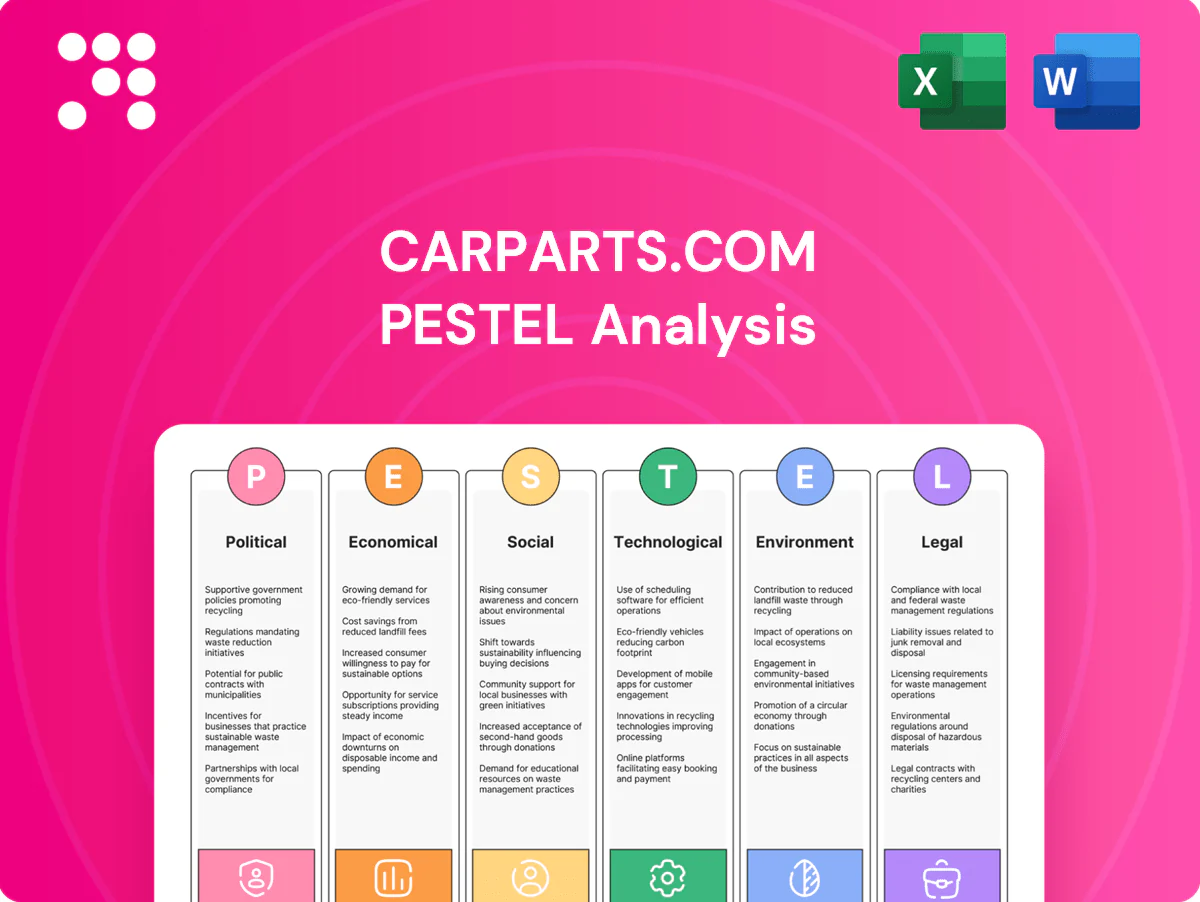
CarParts.com PESTLE Analysis

Skip the Research. Get the Strategy.
Discover how political shifts, economic cycles, social trends, and emerging tech are shaping CarParts.com's strategic outlook in our concise PESTLE snapshot—perfect for investors and strategists. This brief highlights key risks and opportunities; the full analysis delivers deep-dive evidence, scenarios, and actionable recommendations. Buy the complete PESTLE now to make informed decisions with confidence.
Political factors

Trade policy and tariffs on auto parts
Import duties on steel (25%) and aluminum (10%) under Section 232 and Section 301 China tariffs (up to 25%) on many auto parts can swing landed costs and pricing power.
Shifts in U.S.–China relations and U.S.–Mexico trade rules (USMCA in force since 2020) affect sourcing strategies and margin stability.
CarParts.com must diversify suppliers and negotiate long-term contracts to hedge tariff risks; political stability in manufacturing hubs also influences supply continuity.
Infrastructure and logistics policy
Federal and state investments under the 2021 IIJA (total $1.2 trillion, including about $110 billion for roads and bridges) lower transit times and unit delivery costs for CarParts.com by improving freight corridors. Incentives and tax credits for modern warehouses and last‑mile hubs boost distribution efficiency and can cut fulfillment costs. Federal fuel tax remains 18.4¢/gal with average state gas tax ~38¢ (2024), affecting carrier rates. Expanded port and rail grants (PIDP scaled up to roughly $450M/year) ease congestion and improve reliability.

Government incentives for EV transition
Subsidies like the US Inflation Reduction Act credit up to 7,500 USD and targets (US 50% new EVs by 2030) plus global EV share ≈14% in 2023 accelerate a shift from ICE parts to EV‑specific components. Policy roadmaps help CarParts.com reweight SKU mix and inventory bets toward chargers, battery modules and thermal systems. Leveraging incentives in marketing can boost qualifying product sales; misalignment risks obsolete ICE inventory and write‑downs.

Procurement and Buy American preferences
Public-sector and fleet procurement preferences for domestic content shape CarParts.com sourcing and supplier selection; the 2021 Infrastructure Investment and Jobs Act (roughly $1.2 trillion) and annual federal procurement exceeding $600 billion expand institutional demand for Made in USA parts. Strict Buy American content rules can raise costs and limit vendor options, while clear origin labeling reduces political and reputational risk.
- Institutional demand: IIJA $1.2 trillion — access to large fleet/infrastructure buyers
- Cost/constraint: domestic-content rules can limit suppliers and elevate input costs
- Mitigation: transparent country-of-origin labeling lowers political/reputation exposure
Data governance and digital trade rules
Cross-border data flow restrictions and localization rules force CarParts.com to design segmented platform architecture; political scrutiny of foreign tech vendors can disrupt integrations. Compliance with EU DSA/DMA and the EU‑US Data Privacy Framework (adopted 2023) is essential for seamless e‑commerce; robust governance reassures regulators and customers.
- EU-US Data Privacy Framework: 2023
- 130+ jurisdictions with data protection laws
- Vendor scrutiny affects partnerships
- Compliance = operational continuity
Tariffs and EV incentives reshape supply chains as infrastructure cuts freight costs
Tariffs (Section 232: steel 25%, aluminum 10%; Section 301: China tariffs up to 25%) drive landed cost volatility and sourcing shifts. IIJA ~$1.2T with ~$110B for roads reduces transit times and freight costs; PIDP ~$450M/yr eases ports. IRA EV credit up to $7,500 and US EV target 50% new sales by 2030 push SKU reweighting to EV parts. Data rules (EU-US DPF 2023) require segmented platform compliance.
| Policy | Key figure |
|---|---|
| Steel/aluminum tariffs | 25% / 10% |
| IIJA | $1.2T; $110B roads |
| IRA EV credit | $7,500 |
| Data framework | EU-US DPF 2023 |
What is included in the product
 Detailed Word Document
Explores how macro-environmental factors uniquely affect CarParts.com across Political, Economic, Social, Technological, Environmental and Legal dimensions, with data-driven trends and specific examples; designed to help executives, consultants and investors identify threats, opportunities and support scenario planning and funding discussions.

 Customizable Excel Spreadsheet
CarParts.com PESTLE distills macro risks and opportunities into a clean, segmented summary for quick decision-making, shareable across teams and editable for local or product-specific notes.
Economic factors

Cyclical demand tied to miles driven
Vehicle miles driven rose to about 3.29 trillion VMT in 2023 (FHWA), driving higher wear and parts demand, while recessions and WFH cut usage sharply (VMT fell ~13% in April 2020). Fuel price swings (U.S. average roughly $3.43/gal in 2024, EIA) alter driving and maintenance timing. CarParts.com can track mobility and VMT trends to forecast category demand; counter‑cyclical DIY repairs increased during downturns, partially offsetting declines.
Consumer price sensitivity and inflation
Rising input costs and freight pressure have kept retail price and basket-size sensitivity high, with U.S. CPI averaging about 3.4% in 2024 and June 2025 YoY near 3.3%, compressing margins. Price‑elastic DIY customers increasingly compare across marketplaces, driving conversion through aggressive price checks. Dynamic pricing and a growing private‑label mix can defend margins by ~100–200 bps. Clear value propositions and targeted promotions lift conversion in tight budgets.

Supply chain costs and FX volatility
Ocean and parcel rate swings—Drewry WCI fell from ~10,000 USD/FEU in 2021 to ~1,500–2,000 USD/FEU by mid‑2023—plus FX moves (typical ±5–10% annual swings) materially affect CarParts.com COGS and delivery economics. Hedging, nearshoring and multi‑port routing can stabilize margins, while lead‑time variability strains working capital. Data‑driven demand planning cuts stockouts and markdowns, improving turnover.

Competitive intensity in online auto parts
Rising marketplace entrants and OEM direct channels are compressing take rates and raising customer-acquisition costs, forcing CarParts.com to defend margins. Economies of scale in fulfillment and assortment are decisive for unit economics and margin recovery. CarParts.com must optimize CAC/LTV through SEO, SEM and loyalty programs while using availability and fitment accuracy as differentiation to sustain share.
- Marketplace entrants reduce take rates
- Fulfillment scale drives margins
- Optimize CAC/LTV: SEO, SEM, loyalty
- Availability + fitment accuracy = defensible share
Aging vehicle fleet dynamics
Older vehicles require more maintenance, boosting replacement-parts demand; US average vehicle age rose to about 12.6 years in 2024 (IHS/S&P Global), while elevated new‑vehicle transaction prices averaged roughly $46,900 in 2024 (Cox Automotive), prolonging ownership and expanding demand for broad aftermarket and remanufactured parts; inventory must reflect aging trends across makes/models.
- Avg vehicle age: 12.6 years (2024)
- Avg new‑car transaction price: ~$46,900 (2024)
- Higher ownership duration = sustained aftermarket & reman demand
Tariffs and EV incentives reshape supply chains as infrastructure cuts freight costs
Higher VMT (3.29T in 2023) and avg vehicle age 12.6 yrs (2024) sustain aftermarket demand, while $3.43/gal fuel (2024) and 3.4% CPI (2024) shift driving/maintenance timing and compress margins. Freight/FX swings and rising CAC pressure unit economics; scale, private‑label and dynamic pricing can recover ~100–200 bps.
| Metric | Value |
|---|---|
| VMT (2023) | 3.29T |
| Avg vehicle age (2024) | 12.6 yrs |
| Avg new car price (2024) | $46,900 |
| U.S. avg fuel (2024) | $3.43/gal |
| CPI (2024) | 3.4% |
Same Document Delivered
CarParts.com PESTLE Analysis
The preview of the CarParts.com PESTLE Analysis is the exact, fully formatted document you’ll receive after purchase—professionally structured with no placeholders. It contains the same in-depth political, economic, social, technological, legal and environmental insights shown here, ready to download and use immediately upon checkout.

Skip the Research. Get the Strategy.
Discover how political shifts, economic cycles, social trends, and emerging tech are shaping CarParts.com's strategic outlook in our concise PESTLE snapshot—perfect for investors and strategists. This brief highlights key risks and opportunities; the full analysis delivers deep-dive evidence, scenarios, and actionable recommendations. Buy the complete PESTLE now to make informed decisions with confidence.
Political factors
Trade policy and tariffs on auto parts
Import duties on steel (25%) and aluminum (10%) under Section 232 and Section 301 China tariffs (up to 25%) on many auto parts can swing landed costs and pricing power.
Shifts in U.S.–China relations and U.S.–Mexico trade rules (USMCA in force since 2020) affect sourcing strategies and margin stability.
CarParts.com must diversify suppliers and negotiate long-term contracts to hedge tariff risks; political stability in manufacturing hubs also influences supply continuity.
Infrastructure and logistics policy
Federal and state investments under the 2021 IIJA (total $1.2 trillion, including about $110 billion for roads and bridges) lower transit times and unit delivery costs for CarParts.com by improving freight corridors. Incentives and tax credits for modern warehouses and last‑mile hubs boost distribution efficiency and can cut fulfillment costs. Federal fuel tax remains 18.4¢/gal with average state gas tax ~38¢ (2024), affecting carrier rates. Expanded port and rail grants (PIDP scaled up to roughly $450M/year) ease congestion and improve reliability.
Government incentives for EV transition
Subsidies like the US Inflation Reduction Act credit up to 7,500 USD and targets (US 50% new EVs by 2030) plus global EV share ≈14% in 2023 accelerate a shift from ICE parts to EV‑specific components. Policy roadmaps help CarParts.com reweight SKU mix and inventory bets toward chargers, battery modules and thermal systems. Leveraging incentives in marketing can boost qualifying product sales; misalignment risks obsolete ICE inventory and write‑downs.
Procurement and Buy American preferences
Public-sector and fleet procurement preferences for domestic content shape CarParts.com sourcing and supplier selection; the 2021 Infrastructure Investment and Jobs Act (roughly $1.2 trillion) and annual federal procurement exceeding $600 billion expand institutional demand for Made in USA parts. Strict Buy American content rules can raise costs and limit vendor options, while clear origin labeling reduces political and reputational risk.
- Institutional demand: IIJA $1.2 trillion — access to large fleet/infrastructure buyers
- Cost/constraint: domestic-content rules can limit suppliers and elevate input costs
- Mitigation: transparent country-of-origin labeling lowers political/reputation exposure
Data governance and digital trade rules
Cross-border data flow restrictions and localization rules force CarParts.com to design segmented platform architecture; political scrutiny of foreign tech vendors can disrupt integrations. Compliance with EU DSA/DMA and the EU‑US Data Privacy Framework (adopted 2023) is essential for seamless e‑commerce; robust governance reassures regulators and customers.
- EU-US Data Privacy Framework: 2023
- 130+ jurisdictions with data protection laws
- Vendor scrutiny affects partnerships
- Compliance = operational continuity
Tariffs and EV incentives reshape supply chains as infrastructure cuts freight costs
Tariffs (Section 232: steel 25%, aluminum 10%; Section 301: China tariffs up to 25%) drive landed cost volatility and sourcing shifts. IIJA ~$1.2T with ~$110B for roads reduces transit times and freight costs; PIDP ~$450M/yr eases ports. IRA EV credit up to $7,500 and US EV target 50% new sales by 2030 push SKU reweighting to EV parts. Data rules (EU-US DPF 2023) require segmented platform compliance.
| Policy | Key figure |
|---|---|
| Steel/aluminum tariffs | 25% / 10% |
| IIJA | $1.2T; $110B roads |
| IRA EV credit | $7,500 |
| Data framework | EU-US DPF 2023 |
What is included in the product
Detailed Word Document
Explores how macro-environmental factors uniquely affect CarParts.com across Political, Economic, Social, Technological, Environmental and Legal dimensions, with data-driven trends and specific examples; designed to help executives, consultants and investors identify threats, opportunities and support scenario planning and funding discussions.
Customizable Excel Spreadsheet
CarParts.com PESTLE distills macro risks and opportunities into a clean, segmented summary for quick decision-making, shareable across teams and editable for local or product-specific notes.
Economic factors
Cyclical demand tied to miles driven
Vehicle miles driven rose to about 3.29 trillion VMT in 2023 (FHWA), driving higher wear and parts demand, while recessions and WFH cut usage sharply (VMT fell ~13% in April 2020). Fuel price swings (U.S. average roughly $3.43/gal in 2024, EIA) alter driving and maintenance timing. CarParts.com can track mobility and VMT trends to forecast category demand; counter‑cyclical DIY repairs increased during downturns, partially offsetting declines.
Consumer price sensitivity and inflation
Rising input costs and freight pressure have kept retail price and basket-size sensitivity high, with U.S. CPI averaging about 3.4% in 2024 and June 2025 YoY near 3.3%, compressing margins. Price‑elastic DIY customers increasingly compare across marketplaces, driving conversion through aggressive price checks. Dynamic pricing and a growing private‑label mix can defend margins by ~100–200 bps. Clear value propositions and targeted promotions lift conversion in tight budgets.
Supply chain costs and FX volatility
Ocean and parcel rate swings—Drewry WCI fell from ~10,000 USD/FEU in 2021 to ~1,500–2,000 USD/FEU by mid‑2023—plus FX moves (typical ±5–10% annual swings) materially affect CarParts.com COGS and delivery economics. Hedging, nearshoring and multi‑port routing can stabilize margins, while lead‑time variability strains working capital. Data‑driven demand planning cuts stockouts and markdowns, improving turnover.
Competitive intensity in online auto parts
Rising marketplace entrants and OEM direct channels are compressing take rates and raising customer-acquisition costs, forcing CarParts.com to defend margins. Economies of scale in fulfillment and assortment are decisive for unit economics and margin recovery. CarParts.com must optimize CAC/LTV through SEO, SEM and loyalty programs while using availability and fitment accuracy as differentiation to sustain share.
- Marketplace entrants reduce take rates
- Fulfillment scale drives margins
- Optimize CAC/LTV: SEO, SEM, loyalty
- Availability + fitment accuracy = defensible share
Aging vehicle fleet dynamics
Older vehicles require more maintenance, boosting replacement-parts demand; US average vehicle age rose to about 12.6 years in 2024 (IHS/S&P Global), while elevated new‑vehicle transaction prices averaged roughly $46,900 in 2024 (Cox Automotive), prolonging ownership and expanding demand for broad aftermarket and remanufactured parts; inventory must reflect aging trends across makes/models.
- Avg vehicle age: 12.6 years (2024)
- Avg new‑car transaction price: ~$46,900 (2024)
- Higher ownership duration = sustained aftermarket & reman demand
Tariffs and EV incentives reshape supply chains as infrastructure cuts freight costs
Higher VMT (3.29T in 2023) and avg vehicle age 12.6 yrs (2024) sustain aftermarket demand, while $3.43/gal fuel (2024) and 3.4% CPI (2024) shift driving/maintenance timing and compress margins. Freight/FX swings and rising CAC pressure unit economics; scale, private‑label and dynamic pricing can recover ~100–200 bps.
| Metric | Value |
|---|---|
| VMT (2023) | 3.29T |
| Avg vehicle age (2024) | 12.6 yrs |
| Avg new car price (2024) | $46,900 |
| U.S. avg fuel (2024) | $3.43/gal |
| CPI (2024) | 3.4% |
Same Document Delivered
CarParts.com PESTLE Analysis
The preview of the CarParts.com PESTLE Analysis is the exact, fully formatted document you’ll receive after purchase—professionally structured with no placeholders. It contains the same in-depth political, economic, social, technological, legal and environmental insights shown here, ready to download and use immediately upon checkout.
Original: $10.00
-65%$10.00
$3.50Description
Skip the Research. Get the Strategy.
Discover how political shifts, economic cycles, social trends, and emerging tech are shaping CarParts.com's strategic outlook in our concise PESTLE snapshot—perfect for investors and strategists. This brief highlights key risks and opportunities; the full analysis delivers deep-dive evidence, scenarios, and actionable recommendations. Buy the complete PESTLE now to make informed decisions with confidence.
Political factors
Trade policy and tariffs on auto parts
Import duties on steel (25%) and aluminum (10%) under Section 232 and Section 301 China tariffs (up to 25%) on many auto parts can swing landed costs and pricing power.
Shifts in U.S.–China relations and U.S.–Mexico trade rules (USMCA in force since 2020) affect sourcing strategies and margin stability.
CarParts.com must diversify suppliers and negotiate long-term contracts to hedge tariff risks; political stability in manufacturing hubs also influences supply continuity.
Infrastructure and logistics policy
Federal and state investments under the 2021 IIJA (total $1.2 trillion, including about $110 billion for roads and bridges) lower transit times and unit delivery costs for CarParts.com by improving freight corridors. Incentives and tax credits for modern warehouses and last‑mile hubs boost distribution efficiency and can cut fulfillment costs. Federal fuel tax remains 18.4¢/gal with average state gas tax ~38¢ (2024), affecting carrier rates. Expanded port and rail grants (PIDP scaled up to roughly $450M/year) ease congestion and improve reliability.
Government incentives for EV transition
Subsidies like the US Inflation Reduction Act credit up to 7,500 USD and targets (US 50% new EVs by 2030) plus global EV share ≈14% in 2023 accelerate a shift from ICE parts to EV‑specific components. Policy roadmaps help CarParts.com reweight SKU mix and inventory bets toward chargers, battery modules and thermal systems. Leveraging incentives in marketing can boost qualifying product sales; misalignment risks obsolete ICE inventory and write‑downs.
Procurement and Buy American preferences
Public-sector and fleet procurement preferences for domestic content shape CarParts.com sourcing and supplier selection; the 2021 Infrastructure Investment and Jobs Act (roughly $1.2 trillion) and annual federal procurement exceeding $600 billion expand institutional demand for Made in USA parts. Strict Buy American content rules can raise costs and limit vendor options, while clear origin labeling reduces political and reputational risk.
- Institutional demand: IIJA $1.2 trillion — access to large fleet/infrastructure buyers
- Cost/constraint: domestic-content rules can limit suppliers and elevate input costs
- Mitigation: transparent country-of-origin labeling lowers political/reputation exposure
Data governance and digital trade rules
Cross-border data flow restrictions and localization rules force CarParts.com to design segmented platform architecture; political scrutiny of foreign tech vendors can disrupt integrations. Compliance with EU DSA/DMA and the EU‑US Data Privacy Framework (adopted 2023) is essential for seamless e‑commerce; robust governance reassures regulators and customers.
- EU-US Data Privacy Framework: 2023
- 130+ jurisdictions with data protection laws
- Vendor scrutiny affects partnerships
- Compliance = operational continuity
Tariffs and EV incentives reshape supply chains as infrastructure cuts freight costs
Tariffs (Section 232: steel 25%, aluminum 10%; Section 301: China tariffs up to 25%) drive landed cost volatility and sourcing shifts. IIJA ~$1.2T with ~$110B for roads reduces transit times and freight costs; PIDP ~$450M/yr eases ports. IRA EV credit up to $7,500 and US EV target 50% new sales by 2030 push SKU reweighting to EV parts. Data rules (EU-US DPF 2023) require segmented platform compliance.
| Policy | Key figure |
|---|---|
| Steel/aluminum tariffs | 25% / 10% |
| IIJA | $1.2T; $110B roads |
| IRA EV credit | $7,500 |
| Data framework | EU-US DPF 2023 |
What is included in the product
Detailed Word Document
Explores how macro-environmental factors uniquely affect CarParts.com across Political, Economic, Social, Technological, Environmental and Legal dimensions, with data-driven trends and specific examples; designed to help executives, consultants and investors identify threats, opportunities and support scenario planning and funding discussions.
Customizable Excel Spreadsheet
CarParts.com PESTLE distills macro risks and opportunities into a clean, segmented summary for quick decision-making, shareable across teams and editable for local or product-specific notes.
Economic factors
Cyclical demand tied to miles driven
Vehicle miles driven rose to about 3.29 trillion VMT in 2023 (FHWA), driving higher wear and parts demand, while recessions and WFH cut usage sharply (VMT fell ~13% in April 2020). Fuel price swings (U.S. average roughly $3.43/gal in 2024, EIA) alter driving and maintenance timing. CarParts.com can track mobility and VMT trends to forecast category demand; counter‑cyclical DIY repairs increased during downturns, partially offsetting declines.
Consumer price sensitivity and inflation
Rising input costs and freight pressure have kept retail price and basket-size sensitivity high, with U.S. CPI averaging about 3.4% in 2024 and June 2025 YoY near 3.3%, compressing margins. Price‑elastic DIY customers increasingly compare across marketplaces, driving conversion through aggressive price checks. Dynamic pricing and a growing private‑label mix can defend margins by ~100–200 bps. Clear value propositions and targeted promotions lift conversion in tight budgets.
Supply chain costs and FX volatility
Ocean and parcel rate swings—Drewry WCI fell from ~10,000 USD/FEU in 2021 to ~1,500–2,000 USD/FEU by mid‑2023—plus FX moves (typical ±5–10% annual swings) materially affect CarParts.com COGS and delivery economics. Hedging, nearshoring and multi‑port routing can stabilize margins, while lead‑time variability strains working capital. Data‑driven demand planning cuts stockouts and markdowns, improving turnover.
Competitive intensity in online auto parts
Rising marketplace entrants and OEM direct channels are compressing take rates and raising customer-acquisition costs, forcing CarParts.com to defend margins. Economies of scale in fulfillment and assortment are decisive for unit economics and margin recovery. CarParts.com must optimize CAC/LTV through SEO, SEM and loyalty programs while using availability and fitment accuracy as differentiation to sustain share.
- Marketplace entrants reduce take rates
- Fulfillment scale drives margins
- Optimize CAC/LTV: SEO, SEM, loyalty
- Availability + fitment accuracy = defensible share
Aging vehicle fleet dynamics
Older vehicles require more maintenance, boosting replacement-parts demand; US average vehicle age rose to about 12.6 years in 2024 (IHS/S&P Global), while elevated new‑vehicle transaction prices averaged roughly $46,900 in 2024 (Cox Automotive), prolonging ownership and expanding demand for broad aftermarket and remanufactured parts; inventory must reflect aging trends across makes/models.
- Avg vehicle age: 12.6 years (2024)
- Avg new‑car transaction price: ~$46,900 (2024)
- Higher ownership duration = sustained aftermarket & reman demand
Tariffs and EV incentives reshape supply chains as infrastructure cuts freight costs
Higher VMT (3.29T in 2023) and avg vehicle age 12.6 yrs (2024) sustain aftermarket demand, while $3.43/gal fuel (2024) and 3.4% CPI (2024) shift driving/maintenance timing and compress margins. Freight/FX swings and rising CAC pressure unit economics; scale, private‑label and dynamic pricing can recover ~100–200 bps.
| Metric | Value |
|---|---|
| VMT (2023) | 3.29T |
| Avg vehicle age (2024) | 12.6 yrs |
| Avg new car price (2024) | $46,900 |
| U.S. avg fuel (2024) | $3.43/gal |
| CPI (2024) | 3.4% |
Same Document Delivered
CarParts.com PESTLE Analysis
The preview of the CarParts.com PESTLE Analysis is the exact, fully formatted document you’ll receive after purchase—professionally structured with no placeholders. It contains the same in-depth political, economic, social, technological, legal and environmental insights shown here, ready to download and use immediately upon checkout.











