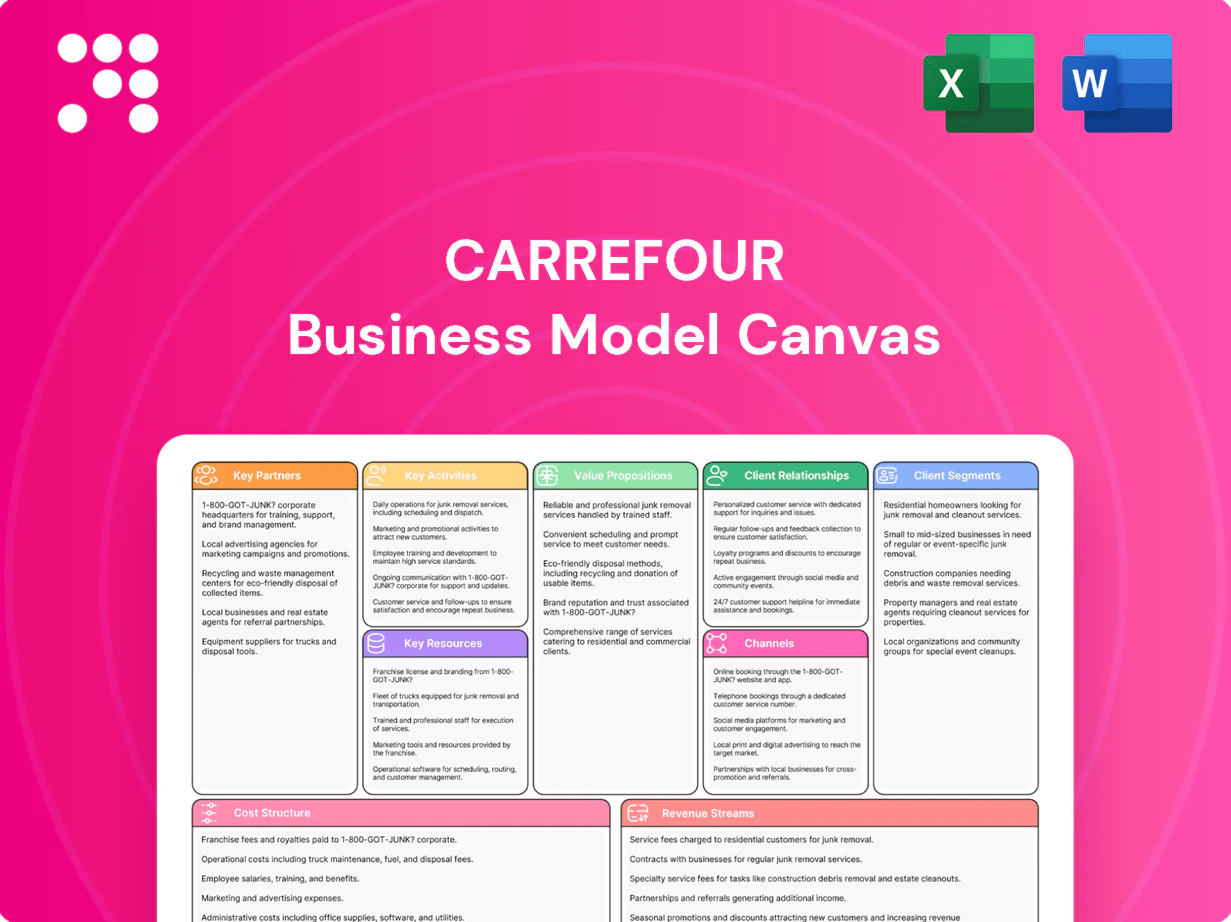
Carrefour Business Model Canvas

Retail leader Business Model Canvas: concise value, partners, revenue & cost insights
Unlock Carrefour's strategic blueprint with our concise Business Model Canvas: revealing value propositions, customer segments, key partners, revenue streams and cost drivers. Perfect for investors, consultants and founders, the full downloadable canvas (Word & Excel) delivers actionable insights to benchmark, plan and scale—purchase to access the complete analysis.
Partnerships

Global FMCG and local suppliers
Strategic sourcing relationships with global FMCG suppliers secure consistent supply, competitive pricing and co-marketing funds, supporting Carrefour’s operations across over 30 countries and around 12,000 stores in 2024. Local producers differentiate fresh and regional assortments, while joint business planning with top brands optimizes promotions and shelf space. Vendor-managed inventory and real-time data-sharing boost on-shelf availability and reduce out-of-stocks.
Logistics and last-mile partners
Carrefour, present in over 30 countries, partners with third-party carriers and couriers to widen geographic reach and accelerate delivery times, as last-mile logistics often account for over 50% of total delivery cost. Cold-chain specialists secure quality for fresh and frozen assortments central to Carrefour’s offer. Cross-docking and consolidation partners cut lead times and reduce inventory costs. Seasonal capacity providers smooth peak-demand spikes during holidays and promotional periods.

Technology and e-commerce platforms
Cloud, POS and analytics vendors power Carrefour’s omnichannel play and personalization across 12,000+ stores in 30 countries (2024), enabling unified inventory and customer profiles. Marketplace tech partners accelerate third‑party seller onboarding and catalog integration for thousands of sellers, expanding assortment without capex. Payment gateways and fraud tools secure billions of annual transactions while API integrations support rapid feature rollouts.

Financial services and fintech alliances
Banks and fintechs co-develop Carrefour co‑branded cards, consumer credit and BNPL solutions to drive checkout conversion; insurance partners provide extended warranties and micro‑insurance; compliance and KYC providers manage AML and regulatory risk; co‑branding lifts customer acquisition and loyalty across Carrefour’s 30+ countries and ~360,000 employees (2024).
Franchisees and real estate developers
Franchise partners accelerate Carrefour’s store expansion and local adaptation, supporting a network of over 11,000 stores in 30+ countries (2024). Property owners and developers secure prime locations and favorable lease terms, while facility management firms ensure uptime and brand standards; co-investment structures reduce upfront capital and improve return on invested capital.
- Franchise expansion: local scale
- Developers: prime sites, leases
- Facility mgmt: uptime & standards
- Co-investment: capital efficiency
Omnichannel grocery scale across 30+ countries and 12,000 stores
Key partnerships — global FMCG suppliers, local producers, logistics & cold‑chain, cloud/POS/marketplace tech, banks/fintechs, franchisees and property developers — enable Carrefour’s omnichannel scale across 30+ countries and ~12,000 stores (2024), ~360,000 employees, higher on‑shelf availability and faster delivery despite last‑mile >50% of delivery cost.
| Metric | Value (2024) |
|---|---|
| Countries | 30+ |
| Stores | ~12,000 |
| Employees | ~360,000 |
| Last‑mile share | >50% |
| Marketplace sellers | Thousands |
What is included in the product
 Detailed Word Document
Comprehensive Business Model Canvas for Carrefour covering all 9 blocks—customer segments, value propositions, channels, customer relationships, revenue streams, key resources, key activities, key partnerships, and cost structure—with narrative insights, competitive advantages, and linked SWOT analysis to support presentations, investor discussions, and strategic validation.

 Customizable Excel Spreadsheet
High-level view of Carrefour’s business model with editable cells to quickly relieve strategic planning and operational pain points, enabling teams to align customer segments, supply chain and cost structure on one shareable page.
Activities

Category management and procurement
Assortment planning balances national brands and Carrefour private labels across hypermarkets, supermarkets and proximity stores, supporting group sales of €81.2bn in 2023. Negotiations secure trade terms, rebates and promotional support to protect gross margin. Demand forecasting aligns inventory with seasonality and local tastes to reduce stockouts. Price management sustains competitiveness while preserving margin.
Store operations and merchandising
Daily store execution at Carrefour (present in 30+ countries with around 12,000 stores and ~320,000 employees) ensures SKU availability, freshness and planogram compliance to protect the supply chain. In-store marketing and end-caps boost conversion and basket size, while waste reduction and shrink control (industry shrink ~1–2% of sales) preserve margin. Strict service standards speed checkouts and lift customer experience.

Omnichannel fulfillment and last mile
Click-and-collect, ship-from-store and dark-store picking enable Carrefour to speed fulfilment across its network of over 10,000 stores in 30+ countries and ~320,000 employees (2024). Route optimization and dynamic slot management balance delivery cost and service levels, reducing last-mile mileage and missed slots. Temperature-controlled handling and cold-chain protocols protect perishables. Centralized returns and substitution workflows preserve customer satisfaction and repeat purchase rates.

Private label development
Carrefour’s private label development focuses on product design, strategic sourcing and stringent QA to drive differentiation and margin capture; European private-label penetration was about 39% of grocery sales in 2023 (Euromonitor), underscoring the growth opportunity for tiered Carrefour ranges covering entry-price, core and premium segments.
- Product design / sourcing / QA
- Tiered ranges: entry / core / premium
- Compliance & traceability = trust
- Packaging & sustainability = brand positioning
Data analytics and loyalty marketing
Customer data in 2024 fuels Carrefour’s personalization engines, enabling targeted promotions and dynamic price rules; basket-level analytics steer assortment and cross-sell strategies to boost basket size. Carrefour Media monetizes audiences for suppliers via retail media, while measurement frameworks track ROI and incrementality to validate campaigns.
- Data-driven personalization
- Basket analysis → assortment & cross-sell
- Retail media monetization
- ROI & incrementality measurement
Omnichannel grocery network: €81.2bn sales, ≈12,000 stores, >10,000 fulfilment sites
Assortment, sourcing and price management drive margins across Carrefour’s omnichannel network; group sales were €81.2bn in 2023. Daily store ops (≈12,000 stores in 30+ countries, ≈320,000 employees in 2024) secure availability, freshness and shrink control (industry ~1–2%). Click-and-collect, ship-from-store and dark stores speed fulfilment across >10,000 stores. Private-label (≈39% of European grocery sales in 2023) and data-driven retail media boost margin and loyalty.
| Metric | Value |
|---|---|
| Group sales (2023) | €81.2bn |
| Stores (2024) | ≈12,000 |
| Employees (2024) | ≈320,000 |
| Private-label penetration (Europe, 2023) | ≈39% |
| Fulfilment stores | >10,000 |
What You See Is What You Get
Business Model Canvas
The Carrefour Business Model Canvas preview shown here is the exact document you’ll receive after purchase, not a mockup or sample; it reflects the full structure, content, and formatting. Upon ordering, you’ll get this same ready-to-edit file for presentation, analysis, or implementation.

Retail leader Business Model Canvas: concise value, partners, revenue & cost insights
Unlock Carrefour's strategic blueprint with our concise Business Model Canvas: revealing value propositions, customer segments, key partners, revenue streams and cost drivers. Perfect for investors, consultants and founders, the full downloadable canvas (Word & Excel) delivers actionable insights to benchmark, plan and scale—purchase to access the complete analysis.
Partnerships
Global FMCG and local suppliers
Strategic sourcing relationships with global FMCG suppliers secure consistent supply, competitive pricing and co-marketing funds, supporting Carrefour’s operations across over 30 countries and around 12,000 stores in 2024. Local producers differentiate fresh and regional assortments, while joint business planning with top brands optimizes promotions and shelf space. Vendor-managed inventory and real-time data-sharing boost on-shelf availability and reduce out-of-stocks.
Logistics and last-mile partners
Carrefour, present in over 30 countries, partners with third-party carriers and couriers to widen geographic reach and accelerate delivery times, as last-mile logistics often account for over 50% of total delivery cost. Cold-chain specialists secure quality for fresh and frozen assortments central to Carrefour’s offer. Cross-docking and consolidation partners cut lead times and reduce inventory costs. Seasonal capacity providers smooth peak-demand spikes during holidays and promotional periods.
Technology and e-commerce platforms
Cloud, POS and analytics vendors power Carrefour’s omnichannel play and personalization across 12,000+ stores in 30 countries (2024), enabling unified inventory and customer profiles. Marketplace tech partners accelerate third‑party seller onboarding and catalog integration for thousands of sellers, expanding assortment without capex. Payment gateways and fraud tools secure billions of annual transactions while API integrations support rapid feature rollouts.
Financial services and fintech alliances
Banks and fintechs co-develop Carrefour co‑branded cards, consumer credit and BNPL solutions to drive checkout conversion; insurance partners provide extended warranties and micro‑insurance; compliance and KYC providers manage AML and regulatory risk; co‑branding lifts customer acquisition and loyalty across Carrefour’s 30+ countries and ~360,000 employees (2024).
Franchisees and real estate developers
Franchise partners accelerate Carrefour’s store expansion and local adaptation, supporting a network of over 11,000 stores in 30+ countries (2024). Property owners and developers secure prime locations and favorable lease terms, while facility management firms ensure uptime and brand standards; co-investment structures reduce upfront capital and improve return on invested capital.
- Franchise expansion: local scale
- Developers: prime sites, leases
- Facility mgmt: uptime & standards
- Co-investment: capital efficiency
Omnichannel grocery scale across 30+ countries and 12,000 stores
Key partnerships — global FMCG suppliers, local producers, logistics & cold‑chain, cloud/POS/marketplace tech, banks/fintechs, franchisees and property developers — enable Carrefour’s omnichannel scale across 30+ countries and ~12,000 stores (2024), ~360,000 employees, higher on‑shelf availability and faster delivery despite last‑mile >50% of delivery cost.
| Metric | Value (2024) |
|---|---|
| Countries | 30+ |
| Stores | ~12,000 |
| Employees | ~360,000 |
| Last‑mile share | >50% |
| Marketplace sellers | Thousands |
What is included in the product
Detailed Word Document
Comprehensive Business Model Canvas for Carrefour covering all 9 blocks—customer segments, value propositions, channels, customer relationships, revenue streams, key resources, key activities, key partnerships, and cost structure—with narrative insights, competitive advantages, and linked SWOT analysis to support presentations, investor discussions, and strategic validation.
Customizable Excel Spreadsheet
High-level view of Carrefour’s business model with editable cells to quickly relieve strategic planning and operational pain points, enabling teams to align customer segments, supply chain and cost structure on one shareable page.
Activities
Category management and procurement
Assortment planning balances national brands and Carrefour private labels across hypermarkets, supermarkets and proximity stores, supporting group sales of €81.2bn in 2023. Negotiations secure trade terms, rebates and promotional support to protect gross margin. Demand forecasting aligns inventory with seasonality and local tastes to reduce stockouts. Price management sustains competitiveness while preserving margin.
Store operations and merchandising
Daily store execution at Carrefour (present in 30+ countries with around 12,000 stores and ~320,000 employees) ensures SKU availability, freshness and planogram compliance to protect the supply chain. In-store marketing and end-caps boost conversion and basket size, while waste reduction and shrink control (industry shrink ~1–2% of sales) preserve margin. Strict service standards speed checkouts and lift customer experience.
Omnichannel fulfillment and last mile
Click-and-collect, ship-from-store and dark-store picking enable Carrefour to speed fulfilment across its network of over 10,000 stores in 30+ countries and ~320,000 employees (2024). Route optimization and dynamic slot management balance delivery cost and service levels, reducing last-mile mileage and missed slots. Temperature-controlled handling and cold-chain protocols protect perishables. Centralized returns and substitution workflows preserve customer satisfaction and repeat purchase rates.
Private label development
Carrefour’s private label development focuses on product design, strategic sourcing and stringent QA to drive differentiation and margin capture; European private-label penetration was about 39% of grocery sales in 2023 (Euromonitor), underscoring the growth opportunity for tiered Carrefour ranges covering entry-price, core and premium segments.
- Product design / sourcing / QA
- Tiered ranges: entry / core / premium
- Compliance & traceability = trust
- Packaging & sustainability = brand positioning
Data analytics and loyalty marketing
Customer data in 2024 fuels Carrefour’s personalization engines, enabling targeted promotions and dynamic price rules; basket-level analytics steer assortment and cross-sell strategies to boost basket size. Carrefour Media monetizes audiences for suppliers via retail media, while measurement frameworks track ROI and incrementality to validate campaigns.
- Data-driven personalization
- Basket analysis → assortment & cross-sell
- Retail media monetization
- ROI & incrementality measurement
Omnichannel grocery network: €81.2bn sales, ≈12,000 stores, >10,000 fulfilment sites
Assortment, sourcing and price management drive margins across Carrefour’s omnichannel network; group sales were €81.2bn in 2023. Daily store ops (≈12,000 stores in 30+ countries, ≈320,000 employees in 2024) secure availability, freshness and shrink control (industry ~1–2%). Click-and-collect, ship-from-store and dark stores speed fulfilment across >10,000 stores. Private-label (≈39% of European grocery sales in 2023) and data-driven retail media boost margin and loyalty.
| Metric | Value |
|---|---|
| Group sales (2023) | €81.2bn |
| Stores (2024) | ≈12,000 |
| Employees (2024) | ≈320,000 |
| Private-label penetration (Europe, 2023) | ≈39% |
| Fulfilment stores | >10,000 |
What You See Is What You Get
Business Model Canvas
The Carrefour Business Model Canvas preview shown here is the exact document you’ll receive after purchase, not a mockup or sample; it reflects the full structure, content, and formatting. Upon ordering, you’ll get this same ready-to-edit file for presentation, analysis, or implementation.
Original: $10.00
-65%$10.00
$3.50Description
Retail leader Business Model Canvas: concise value, partners, revenue & cost insights
Unlock Carrefour's strategic blueprint with our concise Business Model Canvas: revealing value propositions, customer segments, key partners, revenue streams and cost drivers. Perfect for investors, consultants and founders, the full downloadable canvas (Word & Excel) delivers actionable insights to benchmark, plan and scale—purchase to access the complete analysis.
Partnerships
Global FMCG and local suppliers
Strategic sourcing relationships with global FMCG suppliers secure consistent supply, competitive pricing and co-marketing funds, supporting Carrefour’s operations across over 30 countries and around 12,000 stores in 2024. Local producers differentiate fresh and regional assortments, while joint business planning with top brands optimizes promotions and shelf space. Vendor-managed inventory and real-time data-sharing boost on-shelf availability and reduce out-of-stocks.
Logistics and last-mile partners
Carrefour, present in over 30 countries, partners with third-party carriers and couriers to widen geographic reach and accelerate delivery times, as last-mile logistics often account for over 50% of total delivery cost. Cold-chain specialists secure quality for fresh and frozen assortments central to Carrefour’s offer. Cross-docking and consolidation partners cut lead times and reduce inventory costs. Seasonal capacity providers smooth peak-demand spikes during holidays and promotional periods.
Technology and e-commerce platforms
Cloud, POS and analytics vendors power Carrefour’s omnichannel play and personalization across 12,000+ stores in 30 countries (2024), enabling unified inventory and customer profiles. Marketplace tech partners accelerate third‑party seller onboarding and catalog integration for thousands of sellers, expanding assortment without capex. Payment gateways and fraud tools secure billions of annual transactions while API integrations support rapid feature rollouts.
Financial services and fintech alliances
Banks and fintechs co-develop Carrefour co‑branded cards, consumer credit and BNPL solutions to drive checkout conversion; insurance partners provide extended warranties and micro‑insurance; compliance and KYC providers manage AML and regulatory risk; co‑branding lifts customer acquisition and loyalty across Carrefour’s 30+ countries and ~360,000 employees (2024).
Franchisees and real estate developers
Franchise partners accelerate Carrefour’s store expansion and local adaptation, supporting a network of over 11,000 stores in 30+ countries (2024). Property owners and developers secure prime locations and favorable lease terms, while facility management firms ensure uptime and brand standards; co-investment structures reduce upfront capital and improve return on invested capital.
- Franchise expansion: local scale
- Developers: prime sites, leases
- Facility mgmt: uptime & standards
- Co-investment: capital efficiency
Omnichannel grocery scale across 30+ countries and 12,000 stores
Key partnerships — global FMCG suppliers, local producers, logistics & cold‑chain, cloud/POS/marketplace tech, banks/fintechs, franchisees and property developers — enable Carrefour’s omnichannel scale across 30+ countries and ~12,000 stores (2024), ~360,000 employees, higher on‑shelf availability and faster delivery despite last‑mile >50% of delivery cost.
| Metric | Value (2024) |
|---|---|
| Countries | 30+ |
| Stores | ~12,000 |
| Employees | ~360,000 |
| Last‑mile share | >50% |
| Marketplace sellers | Thousands |
What is included in the product
Detailed Word Document
Comprehensive Business Model Canvas for Carrefour covering all 9 blocks—customer segments, value propositions, channels, customer relationships, revenue streams, key resources, key activities, key partnerships, and cost structure—with narrative insights, competitive advantages, and linked SWOT analysis to support presentations, investor discussions, and strategic validation.
Customizable Excel Spreadsheet
High-level view of Carrefour’s business model with editable cells to quickly relieve strategic planning and operational pain points, enabling teams to align customer segments, supply chain and cost structure on one shareable page.
Activities
Category management and procurement
Assortment planning balances national brands and Carrefour private labels across hypermarkets, supermarkets and proximity stores, supporting group sales of €81.2bn in 2023. Negotiations secure trade terms, rebates and promotional support to protect gross margin. Demand forecasting aligns inventory with seasonality and local tastes to reduce stockouts. Price management sustains competitiveness while preserving margin.
Store operations and merchandising
Daily store execution at Carrefour (present in 30+ countries with around 12,000 stores and ~320,000 employees) ensures SKU availability, freshness and planogram compliance to protect the supply chain. In-store marketing and end-caps boost conversion and basket size, while waste reduction and shrink control (industry shrink ~1–2% of sales) preserve margin. Strict service standards speed checkouts and lift customer experience.
Omnichannel fulfillment and last mile
Click-and-collect, ship-from-store and dark-store picking enable Carrefour to speed fulfilment across its network of over 10,000 stores in 30+ countries and ~320,000 employees (2024). Route optimization and dynamic slot management balance delivery cost and service levels, reducing last-mile mileage and missed slots. Temperature-controlled handling and cold-chain protocols protect perishables. Centralized returns and substitution workflows preserve customer satisfaction and repeat purchase rates.
Private label development
Carrefour’s private label development focuses on product design, strategic sourcing and stringent QA to drive differentiation and margin capture; European private-label penetration was about 39% of grocery sales in 2023 (Euromonitor), underscoring the growth opportunity for tiered Carrefour ranges covering entry-price, core and premium segments.
- Product design / sourcing / QA
- Tiered ranges: entry / core / premium
- Compliance & traceability = trust
- Packaging & sustainability = brand positioning
Data analytics and loyalty marketing
Customer data in 2024 fuels Carrefour’s personalization engines, enabling targeted promotions and dynamic price rules; basket-level analytics steer assortment and cross-sell strategies to boost basket size. Carrefour Media monetizes audiences for suppliers via retail media, while measurement frameworks track ROI and incrementality to validate campaigns.
- Data-driven personalization
- Basket analysis → assortment & cross-sell
- Retail media monetization
- ROI & incrementality measurement
Omnichannel grocery network: €81.2bn sales, ≈12,000 stores, >10,000 fulfilment sites
Assortment, sourcing and price management drive margins across Carrefour’s omnichannel network; group sales were €81.2bn in 2023. Daily store ops (≈12,000 stores in 30+ countries, ≈320,000 employees in 2024) secure availability, freshness and shrink control (industry ~1–2%). Click-and-collect, ship-from-store and dark stores speed fulfilment across >10,000 stores. Private-label (≈39% of European grocery sales in 2023) and data-driven retail media boost margin and loyalty.
| Metric | Value |
|---|---|
| Group sales (2023) | €81.2bn |
| Stores (2024) | ≈12,000 |
| Employees (2024) | ≈320,000 |
| Private-label penetration (Europe, 2023) | ≈39% |
| Fulfilment stores | >10,000 |
What You See Is What You Get
Business Model Canvas
The Carrefour Business Model Canvas preview shown here is the exact document you’ll receive after purchase, not a mockup or sample; it reflects the full structure, content, and formatting. Upon ordering, you’ll get this same ready-to-edit file for presentation, analysis, or implementation.











