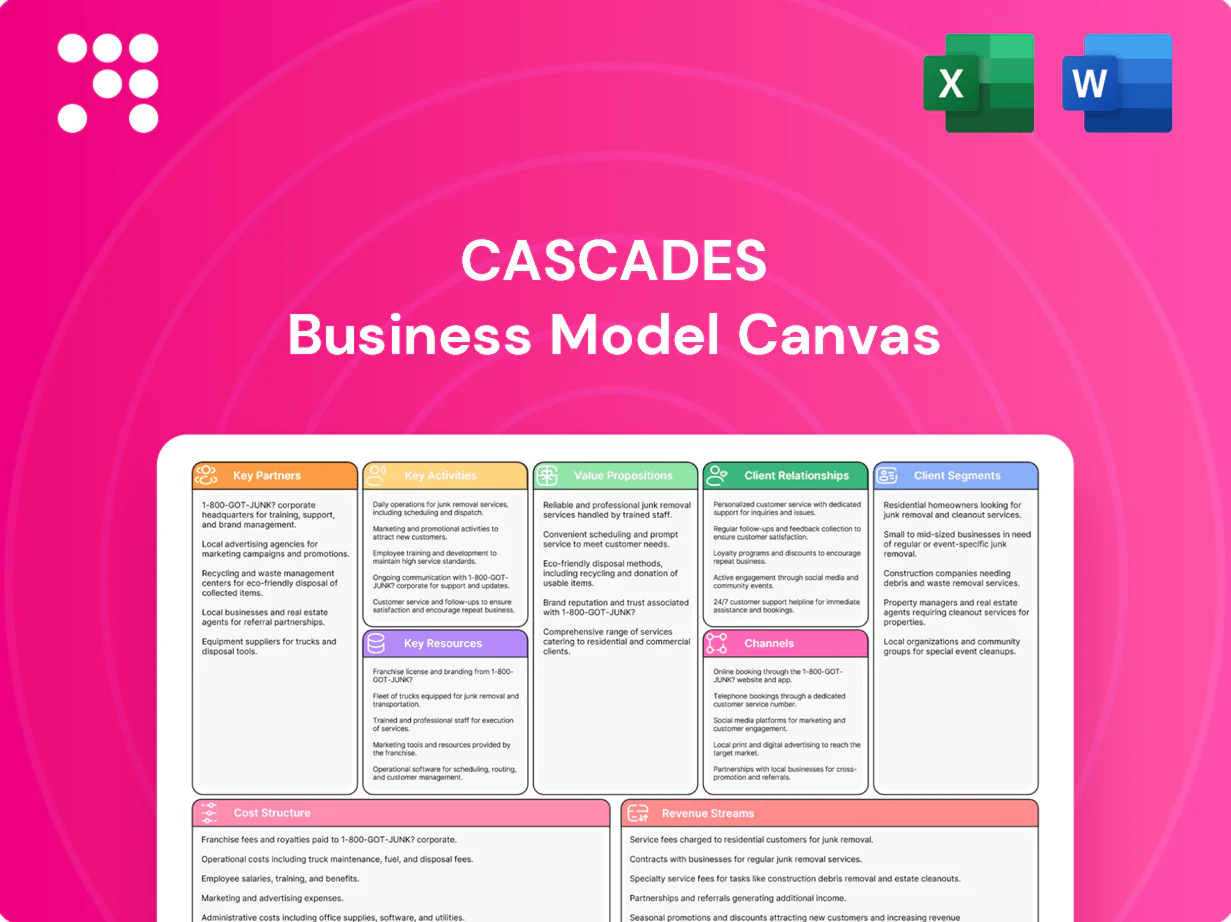
Cascades Business Model Canvas

Unlock the strategic Business Model Canvas: visualize value, partners, channels, and revenue
Unlock the full strategic blueprint behind Cascades's business model. This in-depth Business Model Canvas reveals how Cascades creates and captures value, from partnerships to revenue streams. Download the complete, editable Word/Excel canvas to benchmark, plan, and act.
Partnerships

Municipal recyclers & MRF operators
Partnerships with municipal recyclers and MRF operators secure a steady stream of recycled fiber, supporting Cascades’ supply chain while Canada’s paper recovery rate remained about 70% in 2024. Joint programs have reduced contamination and improved collection quality, lowering MRF reject rates. Long-term offtake agreements stabilize input prices and volumes, and shared data improves circularity metrics and ESG reporting.
Consumer brands & retailers (CPG/private label)
Collaborations with leading CPGs and retailers align packaging specs to Cascades’ 2024 sustainability targets, supporting its CAD 3.9 billion annual revenue base. Co-development projects cut material use and boost shelf and supply-chain performance, shortening lead times and improving unit economics. Private-label tissue partnerships drive volume and brand equity, while multi-year contracts (typically 3–7 years) underpin capacity planning and R&D pipelines.

Logistics and reverse logistics providers
Logistics partners optimize inbound recycled fiber and outbound finished goods flows, reducing transit times and stock buffers while supporting Cascades’ circular-product strategy. Reverse logistics enable closed-loop recovery from customers, increasing feedstock supply and diverting waste back into production. Route and mode optimization can cut transport emissions and costs by up to 30%, and service-level alignment ensures on-time deliveries and inventory reliability.

Technology, equipment, and chemical suppliers
OEMs and chemical suppliers drive efficiency, quality and lightweighting in Cascades lines; 2024 pilots with automation and AI showed productivity uplifts consistent with McKinsey 2024 industry ranges of 20–40% OEE improvement and measurable uptime gains. Sustainable chemistry partnerships advance de-inking and strength performance, while vendor-managed inventory programs can cut working capital and downtime risk by roughly 20–30%.
- OEMs: enable lightweighting, higher quality
- Automation/AI: +20–40% OEE (McKinsey 2024)
- Sustainable chemistry: better de-inking & strength
- VMI: −20–30% inventory & downtime risk
Standards bodies & sustainability certifiers
Engagement with FSC (226 million ha certified globally as of 2024) and ECOLOGO (over 11,000 certified products in 2024) validates Cascades' responsible sourcing and opens regulated markets in the EU and North America.
Certifications help customers meet procurement rules, joint initiatives improve value-chain transparency, and third-party audits materially strengthen ESG credibility and commercial differentiation.
- FSC: 226M ha (2024)
- ECOLOGO: >11,000 products (2024)
- Third-party audits: enhance ESG credibility
70% recycled fiber, CAD 3.9B revenue
Partnerships secure recycled fiber (~70% Canadian paper recovery, 2024), long-term offtakes stabilize costs, joint R&D with CPGs supports CAD 3.9B revenue, logistics and OEM ties cut emissions/costs and lift OEE 20–40% (2024 pilots).
| Metric | 2024 |
|---|---|
| Paper recovery | ~70% |
| Revenue | CAD 3.9B |
| OEE uplift (pilots) | 20–40% |
What is included in the product
 Detailed Word Document
A comprehensive, pre-written Business Model Canvas tailored to Cascades’ strategy, organized into the 9 classic BMC blocks with full narrative, value propositions, customer segments, channels and revenue streams. Reflects real-world operations, includes SWOT and competitive-analysis insights, and is ideal for presentations, investor discussions and strategic decision-making.

 Customizable Excel Spreadsheet
High-level, editable one-page canvas that condenses Cascades’ strategy into a clean snapshot, saving hours of formatting and structuring your own business model. Perfect for fast team collaboration, comparison across companies, and quick executive summaries.
Activities

Recovered fiber sourcing & quality control
Recovered fiber sourcing and quality control centers on secured collection, rigorous sorting and grading to meet paperboard specs while reducing contamination and controlling moisture through sealed transport and drying protocols. Supplier audits and inbound QA protocols enforce traceability and consistent bale quality. Fiber blends are optimized to balance strength, cost and availability across product lines.
Papermaking and converting operations
Produce board, containerboard and tissue parent rolls at scale—Cascades reported roughly CA$4.1B revenue in 2024 while focusing on core pulp and paper output. Convert parent rolls into boxes, food packaging and retail tissue across its converter footprint to capture value-added margins. Drive machine uptime to ~92%, improve yields by ~1.5% and shorten changeovers to cut costs. Implement continuous improvement programs and ISO-driven safety practices to reduce incidents and boost efficiency.

Sustainable product design & engineering
Sustainable product design focuses on recyclable, fiber-based alternatives to plastics and targets 10–30% SKU weight reductions while preserving performance. Cascades (2023 revenue CAD 4.9B) tailors barrier, print and form factors by segment and validates through lab testing and customer trials. Pilot runs report up to 90% recycled fiber in select SKUs and lab-confirmed shelf-life parity.

Sales, key account management & service
- Manage SLAs, forecasts, VMI, EDI, demand planning
- Provide technical support and packaging optimization
- Negotiate pricing, indexation, contract terms
ESG reporting, compliance & circular programs
Cascades tracks emissions, water and waste KPIs across its operations, runs customer take-back and closed-loop programs, ensures multi-jurisdictional regulatory compliance, and publishes sustainability disclosures to stakeholders; in 2024 it operated with about 11,000 employees across North America and Europe to scale these efforts.
- KPIs tracked: emissions, water, waste
- Programs: take-back, closed-loop
- Compliance: multi-market regulatory monitoring
- Reporting: regular sustainability disclosures
Recovered-fiber packaging posts CA$4.1B, ~92% uptime
Cascades secures recovered fiber via audited sourcing, strict QA and sealed logistics to meet paperboard specs. It produces parent rolls and converts packaging/tissue, targeting ~92% machine uptime and CA$4.1B revenue (2024). R&D drives recyclable designs, up to 90% recycled fiber in pilots. Sustainability KPIs (emissions, water, waste) and closed-loop programs scale across ~11,000 employees.
| Metric | 2024 |
|---|---|
| Revenue | CA$4.1B |
| Employees | ~11,000 |
| Uptime | ~92% |
| Recycled fiber | up to 90% (pilots) |
Delivered as Displayed
Business Model Canvas
The document you're previewing is the actual Cascades Business Model Canvas, not a mockup or sample. When you purchase, you'll receive this exact file with all sections included, ready to edit and present. No hidden pages or placeholders—what you see is what you get.

Unlock the strategic Business Model Canvas: visualize value, partners, channels, and revenue
Unlock the full strategic blueprint behind Cascades's business model. This in-depth Business Model Canvas reveals how Cascades creates and captures value, from partnerships to revenue streams. Download the complete, editable Word/Excel canvas to benchmark, plan, and act.
Partnerships
Municipal recyclers & MRF operators
Partnerships with municipal recyclers and MRF operators secure a steady stream of recycled fiber, supporting Cascades’ supply chain while Canada’s paper recovery rate remained about 70% in 2024. Joint programs have reduced contamination and improved collection quality, lowering MRF reject rates. Long-term offtake agreements stabilize input prices and volumes, and shared data improves circularity metrics and ESG reporting.
Consumer brands & retailers (CPG/private label)
Collaborations with leading CPGs and retailers align packaging specs to Cascades’ 2024 sustainability targets, supporting its CAD 3.9 billion annual revenue base. Co-development projects cut material use and boost shelf and supply-chain performance, shortening lead times and improving unit economics. Private-label tissue partnerships drive volume and brand equity, while multi-year contracts (typically 3–7 years) underpin capacity planning and R&D pipelines.
Logistics and reverse logistics providers
Logistics partners optimize inbound recycled fiber and outbound finished goods flows, reducing transit times and stock buffers while supporting Cascades’ circular-product strategy. Reverse logistics enable closed-loop recovery from customers, increasing feedstock supply and diverting waste back into production. Route and mode optimization can cut transport emissions and costs by up to 30%, and service-level alignment ensures on-time deliveries and inventory reliability.
Technology, equipment, and chemical suppliers
OEMs and chemical suppliers drive efficiency, quality and lightweighting in Cascades lines; 2024 pilots with automation and AI showed productivity uplifts consistent with McKinsey 2024 industry ranges of 20–40% OEE improvement and measurable uptime gains. Sustainable chemistry partnerships advance de-inking and strength performance, while vendor-managed inventory programs can cut working capital and downtime risk by roughly 20–30%.
- OEMs: enable lightweighting, higher quality
- Automation/AI: +20–40% OEE (McKinsey 2024)
- Sustainable chemistry: better de-inking & strength
- VMI: −20–30% inventory & downtime risk
Standards bodies & sustainability certifiers
Engagement with FSC (226 million ha certified globally as of 2024) and ECOLOGO (over 11,000 certified products in 2024) validates Cascades' responsible sourcing and opens regulated markets in the EU and North America.
Certifications help customers meet procurement rules, joint initiatives improve value-chain transparency, and third-party audits materially strengthen ESG credibility and commercial differentiation.
- FSC: 226M ha (2024)
- ECOLOGO: >11,000 products (2024)
- Third-party audits: enhance ESG credibility
70% recycled fiber, CAD 3.9B revenue
Partnerships secure recycled fiber (~70% Canadian paper recovery, 2024), long-term offtakes stabilize costs, joint R&D with CPGs supports CAD 3.9B revenue, logistics and OEM ties cut emissions/costs and lift OEE 20–40% (2024 pilots).
| Metric | 2024 |
|---|---|
| Paper recovery | ~70% |
| Revenue | CAD 3.9B |
| OEE uplift (pilots) | 20–40% |
What is included in the product
Detailed Word Document
A comprehensive, pre-written Business Model Canvas tailored to Cascades’ strategy, organized into the 9 classic BMC blocks with full narrative, value propositions, customer segments, channels and revenue streams. Reflects real-world operations, includes SWOT and competitive-analysis insights, and is ideal for presentations, investor discussions and strategic decision-making.
Customizable Excel Spreadsheet
High-level, editable one-page canvas that condenses Cascades’ strategy into a clean snapshot, saving hours of formatting and structuring your own business model. Perfect for fast team collaboration, comparison across companies, and quick executive summaries.
Activities
Recovered fiber sourcing & quality control
Recovered fiber sourcing and quality control centers on secured collection, rigorous sorting and grading to meet paperboard specs while reducing contamination and controlling moisture through sealed transport and drying protocols. Supplier audits and inbound QA protocols enforce traceability and consistent bale quality. Fiber blends are optimized to balance strength, cost and availability across product lines.
Papermaking and converting operations
Produce board, containerboard and tissue parent rolls at scale—Cascades reported roughly CA$4.1B revenue in 2024 while focusing on core pulp and paper output. Convert parent rolls into boxes, food packaging and retail tissue across its converter footprint to capture value-added margins. Drive machine uptime to ~92%, improve yields by ~1.5% and shorten changeovers to cut costs. Implement continuous improvement programs and ISO-driven safety practices to reduce incidents and boost efficiency.
Sustainable product design & engineering
Sustainable product design focuses on recyclable, fiber-based alternatives to plastics and targets 10–30% SKU weight reductions while preserving performance. Cascades (2023 revenue CAD 4.9B) tailors barrier, print and form factors by segment and validates through lab testing and customer trials. Pilot runs report up to 90% recycled fiber in select SKUs and lab-confirmed shelf-life parity.
Sales, key account management & service
- Manage SLAs, forecasts, VMI, EDI, demand planning
- Provide technical support and packaging optimization
- Negotiate pricing, indexation, contract terms
ESG reporting, compliance & circular programs
Cascades tracks emissions, water and waste KPIs across its operations, runs customer take-back and closed-loop programs, ensures multi-jurisdictional regulatory compliance, and publishes sustainability disclosures to stakeholders; in 2024 it operated with about 11,000 employees across North America and Europe to scale these efforts.
- KPIs tracked: emissions, water, waste
- Programs: take-back, closed-loop
- Compliance: multi-market regulatory monitoring
- Reporting: regular sustainability disclosures
Recovered-fiber packaging posts CA$4.1B, ~92% uptime
Cascades secures recovered fiber via audited sourcing, strict QA and sealed logistics to meet paperboard specs. It produces parent rolls and converts packaging/tissue, targeting ~92% machine uptime and CA$4.1B revenue (2024). R&D drives recyclable designs, up to 90% recycled fiber in pilots. Sustainability KPIs (emissions, water, waste) and closed-loop programs scale across ~11,000 employees.
| Metric | 2024 |
|---|---|
| Revenue | CA$4.1B |
| Employees | ~11,000 |
| Uptime | ~92% |
| Recycled fiber | up to 90% (pilots) |
Delivered as Displayed
Business Model Canvas
The document you're previewing is the actual Cascades Business Model Canvas, not a mockup or sample. When you purchase, you'll receive this exact file with all sections included, ready to edit and present. No hidden pages or placeholders—what you see is what you get.
Description
Unlock the strategic Business Model Canvas: visualize value, partners, channels, and revenue
Unlock the full strategic blueprint behind Cascades's business model. This in-depth Business Model Canvas reveals how Cascades creates and captures value, from partnerships to revenue streams. Download the complete, editable Word/Excel canvas to benchmark, plan, and act.
Partnerships
Municipal recyclers & MRF operators
Partnerships with municipal recyclers and MRF operators secure a steady stream of recycled fiber, supporting Cascades’ supply chain while Canada’s paper recovery rate remained about 70% in 2024. Joint programs have reduced contamination and improved collection quality, lowering MRF reject rates. Long-term offtake agreements stabilize input prices and volumes, and shared data improves circularity metrics and ESG reporting.
Consumer brands & retailers (CPG/private label)
Collaborations with leading CPGs and retailers align packaging specs to Cascades’ 2024 sustainability targets, supporting its CAD 3.9 billion annual revenue base. Co-development projects cut material use and boost shelf and supply-chain performance, shortening lead times and improving unit economics. Private-label tissue partnerships drive volume and brand equity, while multi-year contracts (typically 3–7 years) underpin capacity planning and R&D pipelines.
Logistics and reverse logistics providers
Logistics partners optimize inbound recycled fiber and outbound finished goods flows, reducing transit times and stock buffers while supporting Cascades’ circular-product strategy. Reverse logistics enable closed-loop recovery from customers, increasing feedstock supply and diverting waste back into production. Route and mode optimization can cut transport emissions and costs by up to 30%, and service-level alignment ensures on-time deliveries and inventory reliability.
Technology, equipment, and chemical suppliers
OEMs and chemical suppliers drive efficiency, quality and lightweighting in Cascades lines; 2024 pilots with automation and AI showed productivity uplifts consistent with McKinsey 2024 industry ranges of 20–40% OEE improvement and measurable uptime gains. Sustainable chemistry partnerships advance de-inking and strength performance, while vendor-managed inventory programs can cut working capital and downtime risk by roughly 20–30%.
- OEMs: enable lightweighting, higher quality
- Automation/AI: +20–40% OEE (McKinsey 2024)
- Sustainable chemistry: better de-inking & strength
- VMI: −20–30% inventory & downtime risk
Standards bodies & sustainability certifiers
Engagement with FSC (226 million ha certified globally as of 2024) and ECOLOGO (over 11,000 certified products in 2024) validates Cascades' responsible sourcing and opens regulated markets in the EU and North America.
Certifications help customers meet procurement rules, joint initiatives improve value-chain transparency, and third-party audits materially strengthen ESG credibility and commercial differentiation.
- FSC: 226M ha (2024)
- ECOLOGO: >11,000 products (2024)
- Third-party audits: enhance ESG credibility
70% recycled fiber, CAD 3.9B revenue
Partnerships secure recycled fiber (~70% Canadian paper recovery, 2024), long-term offtakes stabilize costs, joint R&D with CPGs supports CAD 3.9B revenue, logistics and OEM ties cut emissions/costs and lift OEE 20–40% (2024 pilots).
| Metric | 2024 |
|---|---|
| Paper recovery | ~70% |
| Revenue | CAD 3.9B |
| OEE uplift (pilots) | 20–40% |
What is included in the product
Detailed Word Document
A comprehensive, pre-written Business Model Canvas tailored to Cascades’ strategy, organized into the 9 classic BMC blocks with full narrative, value propositions, customer segments, channels and revenue streams. Reflects real-world operations, includes SWOT and competitive-analysis insights, and is ideal for presentations, investor discussions and strategic decision-making.
Customizable Excel Spreadsheet
High-level, editable one-page canvas that condenses Cascades’ strategy into a clean snapshot, saving hours of formatting and structuring your own business model. Perfect for fast team collaboration, comparison across companies, and quick executive summaries.
Activities
Recovered fiber sourcing & quality control
Recovered fiber sourcing and quality control centers on secured collection, rigorous sorting and grading to meet paperboard specs while reducing contamination and controlling moisture through sealed transport and drying protocols. Supplier audits and inbound QA protocols enforce traceability and consistent bale quality. Fiber blends are optimized to balance strength, cost and availability across product lines.
Papermaking and converting operations
Produce board, containerboard and tissue parent rolls at scale—Cascades reported roughly CA$4.1B revenue in 2024 while focusing on core pulp and paper output. Convert parent rolls into boxes, food packaging and retail tissue across its converter footprint to capture value-added margins. Drive machine uptime to ~92%, improve yields by ~1.5% and shorten changeovers to cut costs. Implement continuous improvement programs and ISO-driven safety practices to reduce incidents and boost efficiency.
Sustainable product design & engineering
Sustainable product design focuses on recyclable, fiber-based alternatives to plastics and targets 10–30% SKU weight reductions while preserving performance. Cascades (2023 revenue CAD 4.9B) tailors barrier, print and form factors by segment and validates through lab testing and customer trials. Pilot runs report up to 90% recycled fiber in select SKUs and lab-confirmed shelf-life parity.
Sales, key account management & service
- Manage SLAs, forecasts, VMI, EDI, demand planning
- Provide technical support and packaging optimization
- Negotiate pricing, indexation, contract terms
ESG reporting, compliance & circular programs
Cascades tracks emissions, water and waste KPIs across its operations, runs customer take-back and closed-loop programs, ensures multi-jurisdictional regulatory compliance, and publishes sustainability disclosures to stakeholders; in 2024 it operated with about 11,000 employees across North America and Europe to scale these efforts.
- KPIs tracked: emissions, water, waste
- Programs: take-back, closed-loop
- Compliance: multi-market regulatory monitoring
- Reporting: regular sustainability disclosures
Recovered-fiber packaging posts CA$4.1B, ~92% uptime
Cascades secures recovered fiber via audited sourcing, strict QA and sealed logistics to meet paperboard specs. It produces parent rolls and converts packaging/tissue, targeting ~92% machine uptime and CA$4.1B revenue (2024). R&D drives recyclable designs, up to 90% recycled fiber in pilots. Sustainability KPIs (emissions, water, waste) and closed-loop programs scale across ~11,000 employees.
| Metric | 2024 |
|---|---|
| Revenue | CA$4.1B |
| Employees | ~11,000 |
| Uptime | ~92% |
| Recycled fiber | up to 90% (pilots) |
Delivered as Displayed
Business Model Canvas
The document you're previewing is the actual Cascades Business Model Canvas, not a mockup or sample. When you purchase, you'll receive this exact file with all sections included, ready to edit and present. No hidden pages or placeholders—what you see is what you get.











