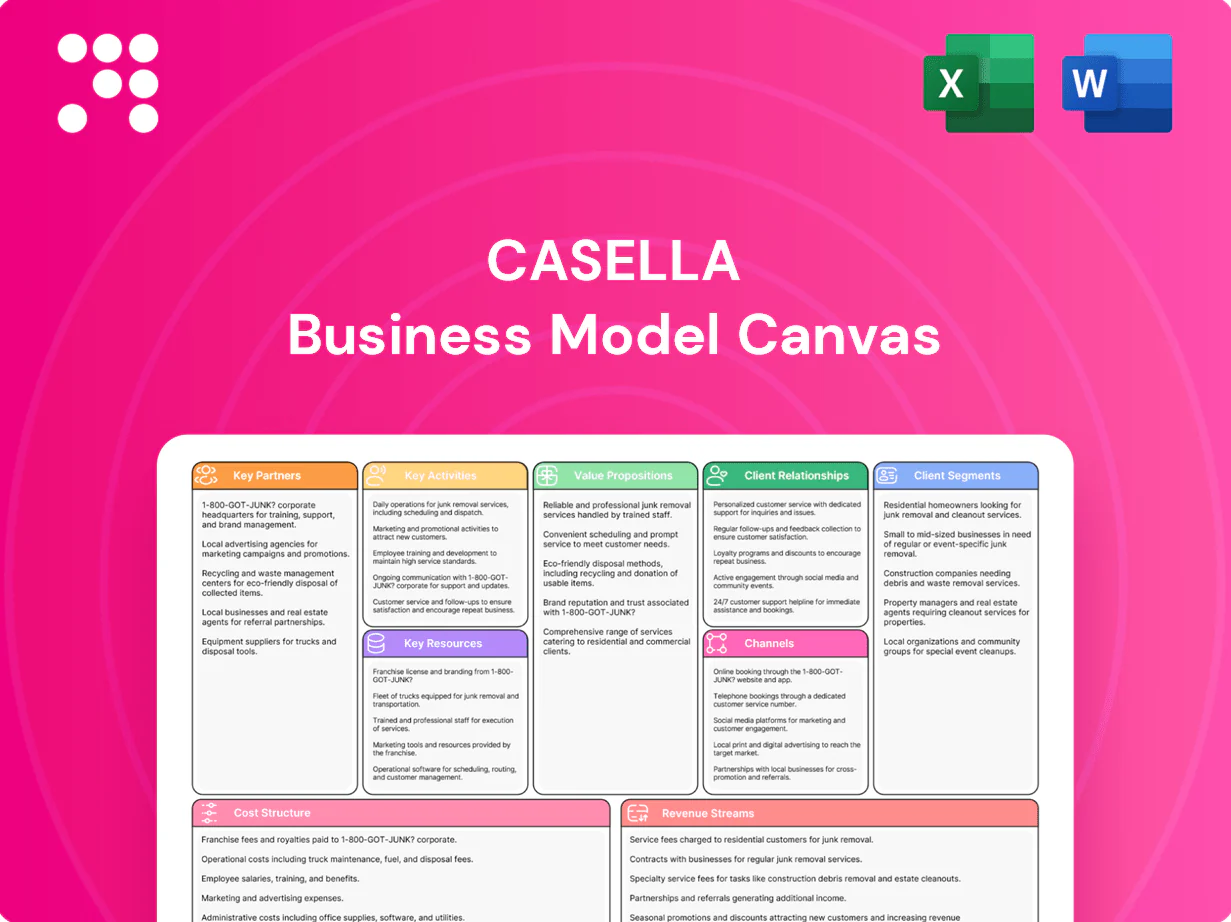
Casella Business Model Canvas

Unlock a strategic Business Model Canvas: actionable blueprint for investors and founders
Unlock Casella’s strategic playbook with the full Business Model Canvas—discover how value is created, scaled, and monetized across customer segments, partnerships, and cost drivers. Perfect for investors, consultants, and founders seeking a ready-to-use, editable blueprint to benchmark and act on growth opportunities—download now.
Partnerships

Municipal contracts
City and town governments award exclusive or competitive collection and disposal contracts to providers like Casella (NYSE: CWST), typically running 3–10 years, securing predictable route density and long-term volumes. These municipal partnerships enable coordinated recycling programs and public education campaigns across service territories. Renewal cycles for these contracts drive pricing pressure and service innovation as municipalities rebid or extend terms.
Industrial & commercial clients
Manufacturers, retailers, healthcare and construction firms contract with Casella for tailored waste streams, with over 1 million commercial and residential customers and revenue near $1.3B in 2024. Long-term service agreements stabilize throughput to transfer stations, MRFs and landfills, smoothing capacity planning. Embedded services—compactors, balers and scheduled hauls—reduce onsite costs. Detailed data reporting supports ESG targets and regulatory compliance.

Technology & equipment vendors
OEMs supply Casella with collection trucks, containers, compactors, sortation robotics and landfill equipment; fleet scale supports operational capacity and capital expenditure cycles. Telematics and route-optimization vendors reduce fuel use and idling by ~10–15% and improve safety. MRF automation partners raise recovery rates and purity by ~10–20%. Landfill-gas system vendors enable onsite renewable energy, typically 1–5 MW per project.

Environmental & regulatory bodies
State DEP/DEC, EPA, and local boards govern permits and compliance for Casella, ensuring landfill design, emissions controls, and leachate standards are met; EPA 2024 inventory cites landfills ≈14% of U.S. methane emissions, highlighting regulatory focus. Collaboration with agencies also facilitates access to recycling infrastructure grants and stakeholder engagement to reduce community impact and project risk.
- Permits & compliance oversight: DEP/DEC, EPA, local boards
- Standards enforced: design, emissions, leachate
- Grants access: recycling infrastructure funding
- Stakeholder engagement: reduces community impact & risk
Energy & recycling offtakers
Casella secures long-term offtakes with utilities and power marketers for landfill-gas-to-energy and RNG and sells recovered fiber, metals, plastics and glass to mills and secondary processors. Floor-price or indexed contracts help manage commodity volatility; Casella reported 2024 revenue of 1.06 billion, supported by contracted offtake volumes. Long-term offtake aligns capital investment with demand certainty and financing.
- Energy offtake: landfill gas/RNG to utilities and power marketers
- Materials offtake: recovered fiber, metals, plastics, glass to mills/processors
- Contracting: floor-price or indexed contracts to hedge volatility
- Finance: long-term offtake ties capex to demand
Municipal contracts plus tech drive 10-15% fuel savings and secure >1M customer volumes
Municipal contracts (3–10 yrs) secure route density and long-term volumes; Casella serves >1M customers. 2024 revenue: $1.06B with long-term commercial offtakes stabilizing throughput. OEMs and tech partners cut fuel/idling ~10–15%, boost MRF recovery ~10–20%, and enable LFG/RNG projects (typ. 1–5 MW); EPA 2024: landfills ≈14% US methane.
| Partner type | Role | 2024 metric |
|---|---|---|
| Municipal | Contracts, programs | 3–10 yr; route density |
| Customers/Offtakes | Volume & revenue | >1M customers; $1.06B rev |
| Tech/OEM | Efficiency & automation | Fuel −10–15%; MRF +10–20% |
| Regulators | Permits/compliance | Landfills ≈14% CH4 (EPA 2024) |
What is included in the product
 Detailed Word Document
A comprehensive pre-written Business Model Canvas for Casella detailing all nine BMC blocks—customer segments, value propositions, channels, relationships, revenue streams, key resources, activities, partners and cost structure—mapping real-world operations, competitive advantages, SWOT-linked insights and investor-ready presentation design.

 Customizable Excel Spreadsheet
Condenses Casella’s strategy into a clean, one-page Business Model Canvas that saves hours of structuring and formatting, making it easy to identify core components and relieve alignment pain points across teams; shareable and editable for fast collaboration and board-ready presentations.
Activities

Collection & routing
Residential, commercial and roll-off collection is routed for density and tight time windows, driving operational efficiency across Casella’s network; Casella reported FY2024 revenue of $1.16 billion, reflecting scale benefits. Telematics and predictive maintenance cut downtime and improve asset utilization, while route engineering lowers fuel burn and overtime—industry studies show optimization can reduce fuel use by up to 15%. Robust safety programs have lowered incidents and claims, supporting lower insurance and liability costs.
Transfer & logistics
Transfer stations consolidate loads to lower haul cost to disposal and MRFs, centralizing volume for route efficiency. Weighbridge control maintains revenue integrity and toll accuracy for every load. Backhaul planning boosts asset utilization and reduces empty miles. Compliance in 2024 ensured proper manifesting and end‑to‑end tracking for regulated waste streams.

Recycling processing
Casella’s recycling processing centers (MRFs) sort single-stream and commercial recyclables into marketable commodities, with 2024 investments in automation boosting throughput and purity. Rigorous contamination management preserves commodity margins by reducing reject rates and residue disposal costs. Real-time market analytics are used to time sales into favorable 2024 pricing windows, optimizing revenue capture.

Landfill operations
- Cell construction
- Daily cover
- Leachate control
- Methane capture
- Airspace management
- Env monitoring
- Equipment uptime
Energy recovery
Energy recovery captures landfill gas for on-site power or RNG upgrading, with energy marketing monetizing REC, LCFS and RIN credits where eligible. Rigorous uptime and flare management maintain emissions compliance and odor control. Continuous process improvements raise energy yield per ton through better capture and optimization.
- Landfill gas → power/RNG
- Monetize via REC, LCFS, RIN
- Uptime & flare controls → compliance
- Continuous yield improvement
Routing, MRF automation and landfill gas strategies drove $1.16B in FY2024
Residential, commercial and roll-off routing, transfer stations and MRFs drove FY2024 revenue of $1.16 billion while telematics, predictive maintenance and route engineering cut downtime, fuel and overtime (optimization can reduce fuel use up to 15%). Landfill cell construction, leachate control and methane capture support compliant disposal and energy recovery; RNG/REC/RIN markets monetize gas. Continuous automation and market analytics raised MRF throughput and commodity capture in 2024.
| Metric | 2024 |
|---|---|
| Revenue | $1.16B |
| Fuel reduction potential | up to 15% |
| MRF automation | increased throughput/purity |
| Energy credits | REC/LCFS/RIN monetized |
Delivered as Displayed
Business Model Canvas
The Casella Business Model Canvas preview shown here is the exact deliverable you’ll receive after purchase, not a mockup. When you buy, you’ll get the same fully editable file, formatted and complete. No placeholders, no extras—what you see is what you’ll download.

Unlock a strategic Business Model Canvas: actionable blueprint for investors and founders
Unlock Casella’s strategic playbook with the full Business Model Canvas—discover how value is created, scaled, and monetized across customer segments, partnerships, and cost drivers. Perfect for investors, consultants, and founders seeking a ready-to-use, editable blueprint to benchmark and act on growth opportunities—download now.
Partnerships
Municipal contracts
City and town governments award exclusive or competitive collection and disposal contracts to providers like Casella (NYSE: CWST), typically running 3–10 years, securing predictable route density and long-term volumes. These municipal partnerships enable coordinated recycling programs and public education campaigns across service territories. Renewal cycles for these contracts drive pricing pressure and service innovation as municipalities rebid or extend terms.
Industrial & commercial clients
Manufacturers, retailers, healthcare and construction firms contract with Casella for tailored waste streams, with over 1 million commercial and residential customers and revenue near $1.3B in 2024. Long-term service agreements stabilize throughput to transfer stations, MRFs and landfills, smoothing capacity planning. Embedded services—compactors, balers and scheduled hauls—reduce onsite costs. Detailed data reporting supports ESG targets and regulatory compliance.
Technology & equipment vendors
OEMs supply Casella with collection trucks, containers, compactors, sortation robotics and landfill equipment; fleet scale supports operational capacity and capital expenditure cycles. Telematics and route-optimization vendors reduce fuel use and idling by ~10–15% and improve safety. MRF automation partners raise recovery rates and purity by ~10–20%. Landfill-gas system vendors enable onsite renewable energy, typically 1–5 MW per project.
Environmental & regulatory bodies
State DEP/DEC, EPA, and local boards govern permits and compliance for Casella, ensuring landfill design, emissions controls, and leachate standards are met; EPA 2024 inventory cites landfills ≈14% of U.S. methane emissions, highlighting regulatory focus. Collaboration with agencies also facilitates access to recycling infrastructure grants and stakeholder engagement to reduce community impact and project risk.
- Permits & compliance oversight: DEP/DEC, EPA, local boards
- Standards enforced: design, emissions, leachate
- Grants access: recycling infrastructure funding
- Stakeholder engagement: reduces community impact & risk
Energy & recycling offtakers
Casella secures long-term offtakes with utilities and power marketers for landfill-gas-to-energy and RNG and sells recovered fiber, metals, plastics and glass to mills and secondary processors. Floor-price or indexed contracts help manage commodity volatility; Casella reported 2024 revenue of 1.06 billion, supported by contracted offtake volumes. Long-term offtake aligns capital investment with demand certainty and financing.
- Energy offtake: landfill gas/RNG to utilities and power marketers
- Materials offtake: recovered fiber, metals, plastics, glass to mills/processors
- Contracting: floor-price or indexed contracts to hedge volatility
- Finance: long-term offtake ties capex to demand
Municipal contracts plus tech drive 10-15% fuel savings and secure >1M customer volumes
Municipal contracts (3–10 yrs) secure route density and long-term volumes; Casella serves >1M customers. 2024 revenue: $1.06B with long-term commercial offtakes stabilizing throughput. OEMs and tech partners cut fuel/idling ~10–15%, boost MRF recovery ~10–20%, and enable LFG/RNG projects (typ. 1–5 MW); EPA 2024: landfills ≈14% US methane.
| Partner type | Role | 2024 metric |
|---|---|---|
| Municipal | Contracts, programs | 3–10 yr; route density |
| Customers/Offtakes | Volume & revenue | >1M customers; $1.06B rev |
| Tech/OEM | Efficiency & automation | Fuel −10–15%; MRF +10–20% |
| Regulators | Permits/compliance | Landfills ≈14% CH4 (EPA 2024) |
What is included in the product
Detailed Word Document
A comprehensive pre-written Business Model Canvas for Casella detailing all nine BMC blocks—customer segments, value propositions, channels, relationships, revenue streams, key resources, activities, partners and cost structure—mapping real-world operations, competitive advantages, SWOT-linked insights and investor-ready presentation design.
Customizable Excel Spreadsheet
Condenses Casella’s strategy into a clean, one-page Business Model Canvas that saves hours of structuring and formatting, making it easy to identify core components and relieve alignment pain points across teams; shareable and editable for fast collaboration and board-ready presentations.
Activities
Collection & routing
Residential, commercial and roll-off collection is routed for density and tight time windows, driving operational efficiency across Casella’s network; Casella reported FY2024 revenue of $1.16 billion, reflecting scale benefits. Telematics and predictive maintenance cut downtime and improve asset utilization, while route engineering lowers fuel burn and overtime—industry studies show optimization can reduce fuel use by up to 15%. Robust safety programs have lowered incidents and claims, supporting lower insurance and liability costs.
Transfer & logistics
Transfer stations consolidate loads to lower haul cost to disposal and MRFs, centralizing volume for route efficiency. Weighbridge control maintains revenue integrity and toll accuracy for every load. Backhaul planning boosts asset utilization and reduces empty miles. Compliance in 2024 ensured proper manifesting and end‑to‑end tracking for regulated waste streams.
Recycling processing
Casella’s recycling processing centers (MRFs) sort single-stream and commercial recyclables into marketable commodities, with 2024 investments in automation boosting throughput and purity. Rigorous contamination management preserves commodity margins by reducing reject rates and residue disposal costs. Real-time market analytics are used to time sales into favorable 2024 pricing windows, optimizing revenue capture.
Landfill operations
- Cell construction
- Daily cover
- Leachate control
- Methane capture
- Airspace management
- Env monitoring
- Equipment uptime
Energy recovery
Energy recovery captures landfill gas for on-site power or RNG upgrading, with energy marketing monetizing REC, LCFS and RIN credits where eligible. Rigorous uptime and flare management maintain emissions compliance and odor control. Continuous process improvements raise energy yield per ton through better capture and optimization.
- Landfill gas → power/RNG
- Monetize via REC, LCFS, RIN
- Uptime & flare controls → compliance
- Continuous yield improvement
Routing, MRF automation and landfill gas strategies drove $1.16B in FY2024
Residential, commercial and roll-off routing, transfer stations and MRFs drove FY2024 revenue of $1.16 billion while telematics, predictive maintenance and route engineering cut downtime, fuel and overtime (optimization can reduce fuel use up to 15%). Landfill cell construction, leachate control and methane capture support compliant disposal and energy recovery; RNG/REC/RIN markets monetize gas. Continuous automation and market analytics raised MRF throughput and commodity capture in 2024.
| Metric | 2024 |
|---|---|
| Revenue | $1.16B |
| Fuel reduction potential | up to 15% |
| MRF automation | increased throughput/purity |
| Energy credits | REC/LCFS/RIN monetized |
Delivered as Displayed
Business Model Canvas
The Casella Business Model Canvas preview shown here is the exact deliverable you’ll receive after purchase, not a mockup. When you buy, you’ll get the same fully editable file, formatted and complete. No placeholders, no extras—what you see is what you’ll download.
Original: $10.00
-65%$10.00
$3.50Description
Unlock a strategic Business Model Canvas: actionable blueprint for investors and founders
Unlock Casella’s strategic playbook with the full Business Model Canvas—discover how value is created, scaled, and monetized across customer segments, partnerships, and cost drivers. Perfect for investors, consultants, and founders seeking a ready-to-use, editable blueprint to benchmark and act on growth opportunities—download now.
Partnerships
Municipal contracts
City and town governments award exclusive or competitive collection and disposal contracts to providers like Casella (NYSE: CWST), typically running 3–10 years, securing predictable route density and long-term volumes. These municipal partnerships enable coordinated recycling programs and public education campaigns across service territories. Renewal cycles for these contracts drive pricing pressure and service innovation as municipalities rebid or extend terms.
Industrial & commercial clients
Manufacturers, retailers, healthcare and construction firms contract with Casella for tailored waste streams, with over 1 million commercial and residential customers and revenue near $1.3B in 2024. Long-term service agreements stabilize throughput to transfer stations, MRFs and landfills, smoothing capacity planning. Embedded services—compactors, balers and scheduled hauls—reduce onsite costs. Detailed data reporting supports ESG targets and regulatory compliance.
Technology & equipment vendors
OEMs supply Casella with collection trucks, containers, compactors, sortation robotics and landfill equipment; fleet scale supports operational capacity and capital expenditure cycles. Telematics and route-optimization vendors reduce fuel use and idling by ~10–15% and improve safety. MRF automation partners raise recovery rates and purity by ~10–20%. Landfill-gas system vendors enable onsite renewable energy, typically 1–5 MW per project.
Environmental & regulatory bodies
State DEP/DEC, EPA, and local boards govern permits and compliance for Casella, ensuring landfill design, emissions controls, and leachate standards are met; EPA 2024 inventory cites landfills ≈14% of U.S. methane emissions, highlighting regulatory focus. Collaboration with agencies also facilitates access to recycling infrastructure grants and stakeholder engagement to reduce community impact and project risk.
- Permits & compliance oversight: DEP/DEC, EPA, local boards
- Standards enforced: design, emissions, leachate
- Grants access: recycling infrastructure funding
- Stakeholder engagement: reduces community impact & risk
Energy & recycling offtakers
Casella secures long-term offtakes with utilities and power marketers for landfill-gas-to-energy and RNG and sells recovered fiber, metals, plastics and glass to mills and secondary processors. Floor-price or indexed contracts help manage commodity volatility; Casella reported 2024 revenue of 1.06 billion, supported by contracted offtake volumes. Long-term offtake aligns capital investment with demand certainty and financing.
- Energy offtake: landfill gas/RNG to utilities and power marketers
- Materials offtake: recovered fiber, metals, plastics, glass to mills/processors
- Contracting: floor-price or indexed contracts to hedge volatility
- Finance: long-term offtake ties capex to demand
Municipal contracts plus tech drive 10-15% fuel savings and secure >1M customer volumes
Municipal contracts (3–10 yrs) secure route density and long-term volumes; Casella serves >1M customers. 2024 revenue: $1.06B with long-term commercial offtakes stabilizing throughput. OEMs and tech partners cut fuel/idling ~10–15%, boost MRF recovery ~10–20%, and enable LFG/RNG projects (typ. 1–5 MW); EPA 2024: landfills ≈14% US methane.
| Partner type | Role | 2024 metric |
|---|---|---|
| Municipal | Contracts, programs | 3–10 yr; route density |
| Customers/Offtakes | Volume & revenue | >1M customers; $1.06B rev |
| Tech/OEM | Efficiency & automation | Fuel −10–15%; MRF +10–20% |
| Regulators | Permits/compliance | Landfills ≈14% CH4 (EPA 2024) |
What is included in the product
Detailed Word Document
A comprehensive pre-written Business Model Canvas for Casella detailing all nine BMC blocks—customer segments, value propositions, channels, relationships, revenue streams, key resources, activities, partners and cost structure—mapping real-world operations, competitive advantages, SWOT-linked insights and investor-ready presentation design.
Customizable Excel Spreadsheet
Condenses Casella’s strategy into a clean, one-page Business Model Canvas that saves hours of structuring and formatting, making it easy to identify core components and relieve alignment pain points across teams; shareable and editable for fast collaboration and board-ready presentations.
Activities
Collection & routing
Residential, commercial and roll-off collection is routed for density and tight time windows, driving operational efficiency across Casella’s network; Casella reported FY2024 revenue of $1.16 billion, reflecting scale benefits. Telematics and predictive maintenance cut downtime and improve asset utilization, while route engineering lowers fuel burn and overtime—industry studies show optimization can reduce fuel use by up to 15%. Robust safety programs have lowered incidents and claims, supporting lower insurance and liability costs.
Transfer & logistics
Transfer stations consolidate loads to lower haul cost to disposal and MRFs, centralizing volume for route efficiency. Weighbridge control maintains revenue integrity and toll accuracy for every load. Backhaul planning boosts asset utilization and reduces empty miles. Compliance in 2024 ensured proper manifesting and end‑to‑end tracking for regulated waste streams.
Recycling processing
Casella’s recycling processing centers (MRFs) sort single-stream and commercial recyclables into marketable commodities, with 2024 investments in automation boosting throughput and purity. Rigorous contamination management preserves commodity margins by reducing reject rates and residue disposal costs. Real-time market analytics are used to time sales into favorable 2024 pricing windows, optimizing revenue capture.
Landfill operations
- Cell construction
- Daily cover
- Leachate control
- Methane capture
- Airspace management
- Env monitoring
- Equipment uptime
Energy recovery
Energy recovery captures landfill gas for on-site power or RNG upgrading, with energy marketing monetizing REC, LCFS and RIN credits where eligible. Rigorous uptime and flare management maintain emissions compliance and odor control. Continuous process improvements raise energy yield per ton through better capture and optimization.
- Landfill gas → power/RNG
- Monetize via REC, LCFS, RIN
- Uptime & flare controls → compliance
- Continuous yield improvement
Routing, MRF automation and landfill gas strategies drove $1.16B in FY2024
Residential, commercial and roll-off routing, transfer stations and MRFs drove FY2024 revenue of $1.16 billion while telematics, predictive maintenance and route engineering cut downtime, fuel and overtime (optimization can reduce fuel use up to 15%). Landfill cell construction, leachate control and methane capture support compliant disposal and energy recovery; RNG/REC/RIN markets monetize gas. Continuous automation and market analytics raised MRF throughput and commodity capture in 2024.
| Metric | 2024 |
|---|---|
| Revenue | $1.16B |
| Fuel reduction potential | up to 15% |
| MRF automation | increased throughput/purity |
| Energy credits | REC/LCFS/RIN monetized |
Delivered as Displayed
Business Model Canvas
The Casella Business Model Canvas preview shown here is the exact deliverable you’ll receive after purchase, not a mockup. When you buy, you’ll get the same fully editable file, formatted and complete. No placeholders, no extras—what you see is what you’ll download.











