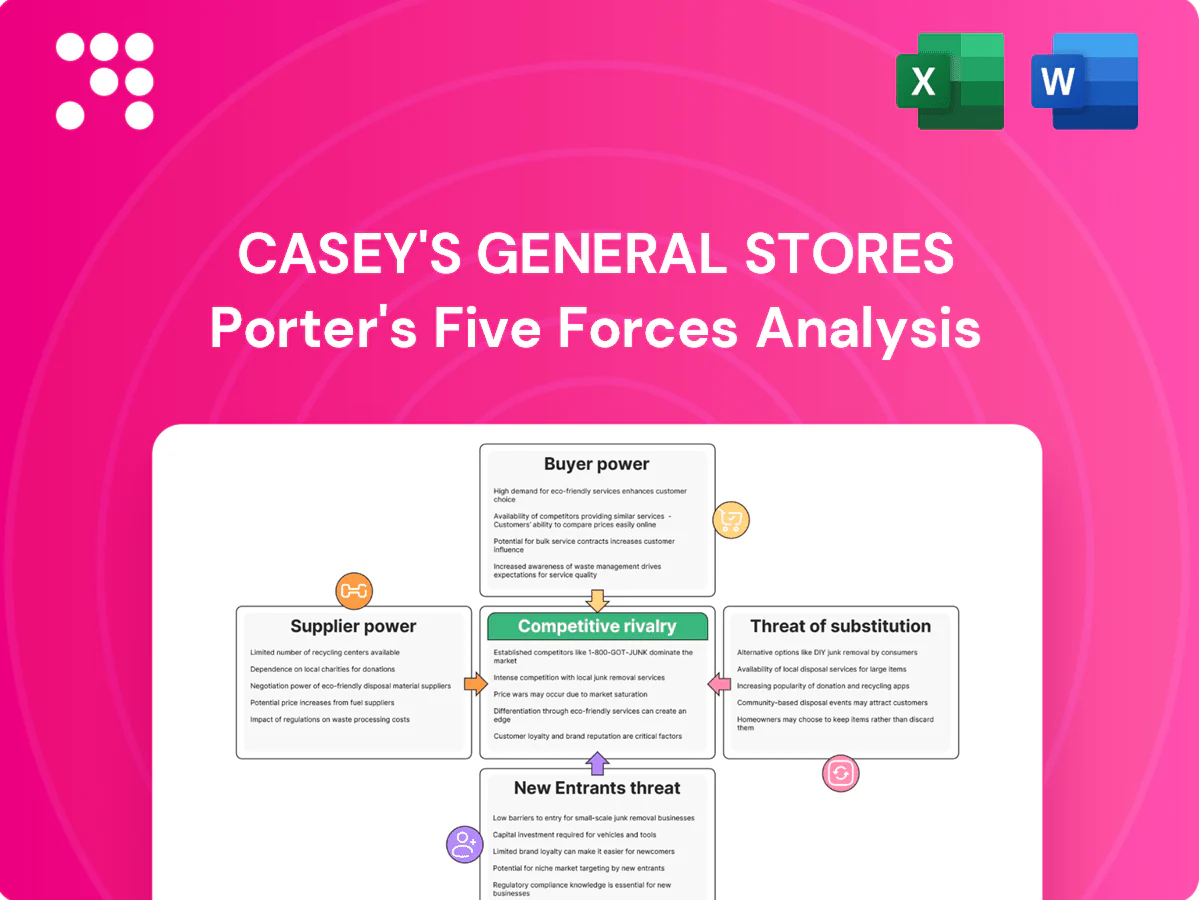
Casey's General Stores Porter's Five Forces Analysis

A Must-Have Tool for Decision-Makers
Casey’s faces intense competitive rivalry from national chains and local c-stores, while buyer power is moderate due to convenience-driven demand and loyalty programs. Supplier leverage is limited but fuel sourcing and private-label margins matter, and threats from substitutes and new entrants remain manageable yet evolving. This brief snapshot only scratches the surface—unlock the full Porter's Five Forces Analysis to explore Casey’s competitive dynamics, market pressures, and strategic advantages in detail.
Suppliers Bargaining Power

Fuel supply concentration
Refiners and wholesalers largely control gasoline, a volatile commodity, and branded fuel contracts plus pipeline access can constrain Casey’s switching in some regions. In 2024 Casey’s scale—about 2,600 stores—and multi-sourcing (roughly 2.0 billion gallons sold annually) strengthen negotiation and outage resilience. Its rural footprint, however, incurs logistics premiums that modestly raise supplier leverage.
Branded beverage duopoly
Coca‑Cola and PepsiCo exert strong influence over pricing, cooler placement, and promotional funds, together holding roughly 70% of U.S. soft‑drink retail share (industry reports 2024). National distribution contracts give Casey’s margin stability but limit pricing flexibility and promotional negotiation. Casey’s private‑label beverage assortment helps recapture margin. Limited cooler space increases supplier bargaining over category share and slotting.

Food ingredients fragmentation
Ingredients for pizza, bakery and prepared foods come from numerous distributors and manufacturers, so fragmentation limits any single supplier’s leverage and enables frequent rebids. Commodity swings in cheese, meats and wheat—which spiked in 2022–23 but moderated by 2024—continue to pressure margins. Casey’s menu engineering and targeted hedging programs partially smooth that volatility and preserve gross-profit resilience.

Packaging and supply chain logistics
Paper, packaging and kitchen supplies have multiple suppliers but face input-cost cycles and freight volatility; CASEY'S scale (about 2,600 stores in 2024) and its regional DC network (36 distribution centers) reduce supplier leverage, though rural delivery routes raise freight per-store and limit carrier alternatives. Long-term vendor agreements secure availability in tight markets.
- Scale: ~2,600 stores (2024)
- DC network: 36 centers
- Risk: higher rural freight
- Mitigation: long-term vendor contracts
Technology and fuel equipment vendors
POS, forecourt pumps and tank-monitoring systems are sourced from a small set of specialized vendors, with dispenser replacements commonly costing $25,000–$50,000 per unit (2024), creating capital lock-in and retraining expenses that increase supplier leverage; certified equipment is often required for EPA/state UST compliance, limiting switching; bulk purchasing and standardization typically secure better pricing and service levels.
- Key points: limited vendor pool; $25k–$50k/dispensers (2024); compliance ties; scale improves pricing/service
Refiners and soft-drink duopoly constrain margins; scale (~2,600 stores)
Refiners and wholesalers tightly control gasoline supply while branded fuel contracts and pipeline access limit switching; Casey’s 2024 scale (~2,600 stores, ~2.0bn gallons) gives negotiating leverage. Coca‑Cola and PepsiCo hold ~70% soft‑drink share, constraining pricing and cooler placement; private‑label recaptures margin. Equipment costs ($25k–$50k/dispense unit) and rural logistics raise supplier power despite 36 DCs.
| Metric | 2024 |
|---|---|
| Stores | ~2,600 |
| Fuel sold | ~2.0 bn gal |
| DCs | 36 |
| Soft‑drink share (Coke/Pepsi) | ~70% |
| Dispensers | $25k–$50k/unit |
What is included in the product
 Detailed Word Document
Tailored Porter's Five Forces analysis for Casey's General Stores examining competitive rivalry, buyer and supplier power, threat of new entrants and substitutes, and identifying disruptive trends (e.g., delivery, convenience formats) that influence pricing, margins, and market share.

 Customizable Excel Spreadsheet
A single-sheet Porter’s Five Forces for Casey’s General Stores—clarifies supplier, buyer, entrant, substitute, and competitive rivalry pressures for swift, board-ready strategic decisions.
Customers Bargaining Power

Fuel price transparency
Fuel price transparency via apps and roadside signs makes consumers highly price‑sensitive, with micro‑price moves of $0.05–$0.10 per gallon often enough to shift volumes between stations. Casey’s ~2,500 stores (2024) rely on ancillary in‑store sales to soften margin pressure, but those gains depend on pump traffic. Loyalty discounts and bundle offers keep retention higher despite visible pricing.
Limited alternatives in small towns
Rural customers, roughly 60 million Americans per the 2020 Census, face fewer nearby retail alternatives, which reduces buyer power for Casey’s. Operating across 16 Midwestern and Southern states, Casey’s leverages convenience and proximity to make small price differences less influential. Its fuel, coffee, and food offerings foster habitual visits, and deep local embeddedness and community presence further damp switching.

Menu quality and convenience
Prepared foods like pizza and donuts give Casey's product differentiation that lowers price elasticity and drives higher basket rings; Casey's operated about 2,600 stores in 2024, scaling these offers. Speed and one‑stop shopping for fuel, groceries and fresh food reduce customers’ willingness to bargain. Daypart variety (breakfast, lunch, dinner, snacks) captures multiple missions per visit. Consistent quality and freshness sustain pricing power.

Loyalty ecosystem effects
Casey's digital app, rewards and targeted offers personalize value, turning accrued points and fuel discounts into tangible switching costs that deter one-off purchases. Customer data enables dynamic, segment-specific promotions that raise marginal loyalty and lower price sensitivity. Over time this loyalty ecosystem compresses effective buyer power and strengthens store-level pricing leverage.
- Digital app personalization
- Accrued points = switching costs
- Fuel discounts lock frequency
- Data-driven dynamic promos
Cross‑channel comparison
Cross-channel comparison: customers can substitute Casey’s with grocery, dollar stores or QSRs for price or variety, and larger basket trips to grocers dilute Casey’s pricing latitude; however Casey’s scale—over 2,400 stores as of 2024—keeps convenience reach high and immediate consumption occasions sustain a convenience premium, while disciplined promo cadence is required to stay competitive without eroding margins.
- Substitution risk: grocery/dollar/QSR competition
- Scale: 2,400+ stores (2024)
- Advantage: immediate-consumption premium
- Tactic: balanced promo cadence to protect margins
Micro fuel price swings move volumes, but rural store scale and food/loyalty sustain premiums
Customers are highly price‑sensitive—micro moves of $0.05–$0.10/gal shift volumes—yet Casey’s ~2,600 stores (2024) offset pressure with in‑store food, loyalty and app-driven discounts that create switching costs. Rural footprint (~60M residents) lowers alternatives; prepared foods and daypart variety reduce elasticity and sustain a convenience premium.
| Metric | Value (2024) |
|---|---|
| Stores | ~2,600 |
| Rural population | ~60,000,000 (2020 Census) |
| Fuel price sensitivity | $0.05–$0.10/gal |
What You See Is What You Get
Casey's General Stores Porter's Five Forces Analysis
This preview shows the exact Porter’s Five Forces analysis of Casey's General Stores you'll receive immediately after purchase—no surprises, no placeholders. The document displayed is fully formatted and ready for download and use the moment you buy, covering supplier power, buyer power, competitive rivalry, threat of new entrants, and threats of substitutes. You’ll get instant access to this exact file.

A Must-Have Tool for Decision-Makers
Casey’s faces intense competitive rivalry from national chains and local c-stores, while buyer power is moderate due to convenience-driven demand and loyalty programs. Supplier leverage is limited but fuel sourcing and private-label margins matter, and threats from substitutes and new entrants remain manageable yet evolving. This brief snapshot only scratches the surface—unlock the full Porter's Five Forces Analysis to explore Casey’s competitive dynamics, market pressures, and strategic advantages in detail.
Suppliers Bargaining Power
Fuel supply concentration
Refiners and wholesalers largely control gasoline, a volatile commodity, and branded fuel contracts plus pipeline access can constrain Casey’s switching in some regions. In 2024 Casey’s scale—about 2,600 stores—and multi-sourcing (roughly 2.0 billion gallons sold annually) strengthen negotiation and outage resilience. Its rural footprint, however, incurs logistics premiums that modestly raise supplier leverage.
Branded beverage duopoly
Coca‑Cola and PepsiCo exert strong influence over pricing, cooler placement, and promotional funds, together holding roughly 70% of U.S. soft‑drink retail share (industry reports 2024). National distribution contracts give Casey’s margin stability but limit pricing flexibility and promotional negotiation. Casey’s private‑label beverage assortment helps recapture margin. Limited cooler space increases supplier bargaining over category share and slotting.
Food ingredients fragmentation
Ingredients for pizza, bakery and prepared foods come from numerous distributors and manufacturers, so fragmentation limits any single supplier’s leverage and enables frequent rebids. Commodity swings in cheese, meats and wheat—which spiked in 2022–23 but moderated by 2024—continue to pressure margins. Casey’s menu engineering and targeted hedging programs partially smooth that volatility and preserve gross-profit resilience.
Packaging and supply chain logistics
Paper, packaging and kitchen supplies have multiple suppliers but face input-cost cycles and freight volatility; CASEY'S scale (about 2,600 stores in 2024) and its regional DC network (36 distribution centers) reduce supplier leverage, though rural delivery routes raise freight per-store and limit carrier alternatives. Long-term vendor agreements secure availability in tight markets.
- Scale: ~2,600 stores (2024)
- DC network: 36 centers
- Risk: higher rural freight
- Mitigation: long-term vendor contracts
Technology and fuel equipment vendors
POS, forecourt pumps and tank-monitoring systems are sourced from a small set of specialized vendors, with dispenser replacements commonly costing $25,000–$50,000 per unit (2024), creating capital lock-in and retraining expenses that increase supplier leverage; certified equipment is often required for EPA/state UST compliance, limiting switching; bulk purchasing and standardization typically secure better pricing and service levels.
- Key points: limited vendor pool; $25k–$50k/dispensers (2024); compliance ties; scale improves pricing/service
Refiners and soft-drink duopoly constrain margins; scale (~2,600 stores)
Refiners and wholesalers tightly control gasoline supply while branded fuel contracts and pipeline access limit switching; Casey’s 2024 scale (~2,600 stores, ~2.0bn gallons) gives negotiating leverage. Coca‑Cola and PepsiCo hold ~70% soft‑drink share, constraining pricing and cooler placement; private‑label recaptures margin. Equipment costs ($25k–$50k/dispense unit) and rural logistics raise supplier power despite 36 DCs.
| Metric | 2024 |
|---|---|
| Stores | ~2,600 |
| Fuel sold | ~2.0 bn gal |
| DCs | 36 |
| Soft‑drink share (Coke/Pepsi) | ~70% |
| Dispensers | $25k–$50k/unit |
What is included in the product
Detailed Word Document
Tailored Porter's Five Forces analysis for Casey's General Stores examining competitive rivalry, buyer and supplier power, threat of new entrants and substitutes, and identifying disruptive trends (e.g., delivery, convenience formats) that influence pricing, margins, and market share.
Customizable Excel Spreadsheet
A single-sheet Porter’s Five Forces for Casey’s General Stores—clarifies supplier, buyer, entrant, substitute, and competitive rivalry pressures for swift, board-ready strategic decisions.
Customers Bargaining Power
Fuel price transparency
Fuel price transparency via apps and roadside signs makes consumers highly price‑sensitive, with micro‑price moves of $0.05–$0.10 per gallon often enough to shift volumes between stations. Casey’s ~2,500 stores (2024) rely on ancillary in‑store sales to soften margin pressure, but those gains depend on pump traffic. Loyalty discounts and bundle offers keep retention higher despite visible pricing.
Limited alternatives in small towns
Rural customers, roughly 60 million Americans per the 2020 Census, face fewer nearby retail alternatives, which reduces buyer power for Casey’s. Operating across 16 Midwestern and Southern states, Casey’s leverages convenience and proximity to make small price differences less influential. Its fuel, coffee, and food offerings foster habitual visits, and deep local embeddedness and community presence further damp switching.
Menu quality and convenience
Prepared foods like pizza and donuts give Casey's product differentiation that lowers price elasticity and drives higher basket rings; Casey's operated about 2,600 stores in 2024, scaling these offers. Speed and one‑stop shopping for fuel, groceries and fresh food reduce customers’ willingness to bargain. Daypart variety (breakfast, lunch, dinner, snacks) captures multiple missions per visit. Consistent quality and freshness sustain pricing power.
Loyalty ecosystem effects
Casey's digital app, rewards and targeted offers personalize value, turning accrued points and fuel discounts into tangible switching costs that deter one-off purchases. Customer data enables dynamic, segment-specific promotions that raise marginal loyalty and lower price sensitivity. Over time this loyalty ecosystem compresses effective buyer power and strengthens store-level pricing leverage.
- Digital app personalization
- Accrued points = switching costs
- Fuel discounts lock frequency
- Data-driven dynamic promos
Cross‑channel comparison
Cross-channel comparison: customers can substitute Casey’s with grocery, dollar stores or QSRs for price or variety, and larger basket trips to grocers dilute Casey’s pricing latitude; however Casey’s scale—over 2,400 stores as of 2024—keeps convenience reach high and immediate consumption occasions sustain a convenience premium, while disciplined promo cadence is required to stay competitive without eroding margins.
- Substitution risk: grocery/dollar/QSR competition
- Scale: 2,400+ stores (2024)
- Advantage: immediate-consumption premium
- Tactic: balanced promo cadence to protect margins
Micro fuel price swings move volumes, but rural store scale and food/loyalty sustain premiums
Customers are highly price‑sensitive—micro moves of $0.05–$0.10/gal shift volumes—yet Casey’s ~2,600 stores (2024) offset pressure with in‑store food, loyalty and app-driven discounts that create switching costs. Rural footprint (~60M residents) lowers alternatives; prepared foods and daypart variety reduce elasticity and sustain a convenience premium.
| Metric | Value (2024) |
|---|---|
| Stores | ~2,600 |
| Rural population | ~60,000,000 (2020 Census) |
| Fuel price sensitivity | $0.05–$0.10/gal |
What You See Is What You Get
Casey's General Stores Porter's Five Forces Analysis
This preview shows the exact Porter’s Five Forces analysis of Casey's General Stores you'll receive immediately after purchase—no surprises, no placeholders. The document displayed is fully formatted and ready for download and use the moment you buy, covering supplier power, buyer power, competitive rivalry, threat of new entrants, and threats of substitutes. You’ll get instant access to this exact file.
Original: $10.00
-65%$10.00
$3.50Description
A Must-Have Tool for Decision-Makers
Casey’s faces intense competitive rivalry from national chains and local c-stores, while buyer power is moderate due to convenience-driven demand and loyalty programs. Supplier leverage is limited but fuel sourcing and private-label margins matter, and threats from substitutes and new entrants remain manageable yet evolving. This brief snapshot only scratches the surface—unlock the full Porter's Five Forces Analysis to explore Casey’s competitive dynamics, market pressures, and strategic advantages in detail.
Suppliers Bargaining Power
Fuel supply concentration
Refiners and wholesalers largely control gasoline, a volatile commodity, and branded fuel contracts plus pipeline access can constrain Casey’s switching in some regions. In 2024 Casey’s scale—about 2,600 stores—and multi-sourcing (roughly 2.0 billion gallons sold annually) strengthen negotiation and outage resilience. Its rural footprint, however, incurs logistics premiums that modestly raise supplier leverage.
Branded beverage duopoly
Coca‑Cola and PepsiCo exert strong influence over pricing, cooler placement, and promotional funds, together holding roughly 70% of U.S. soft‑drink retail share (industry reports 2024). National distribution contracts give Casey’s margin stability but limit pricing flexibility and promotional negotiation. Casey’s private‑label beverage assortment helps recapture margin. Limited cooler space increases supplier bargaining over category share and slotting.
Food ingredients fragmentation
Ingredients for pizza, bakery and prepared foods come from numerous distributors and manufacturers, so fragmentation limits any single supplier’s leverage and enables frequent rebids. Commodity swings in cheese, meats and wheat—which spiked in 2022–23 but moderated by 2024—continue to pressure margins. Casey’s menu engineering and targeted hedging programs partially smooth that volatility and preserve gross-profit resilience.
Packaging and supply chain logistics
Paper, packaging and kitchen supplies have multiple suppliers but face input-cost cycles and freight volatility; CASEY'S scale (about 2,600 stores in 2024) and its regional DC network (36 distribution centers) reduce supplier leverage, though rural delivery routes raise freight per-store and limit carrier alternatives. Long-term vendor agreements secure availability in tight markets.
- Scale: ~2,600 stores (2024)
- DC network: 36 centers
- Risk: higher rural freight
- Mitigation: long-term vendor contracts
Technology and fuel equipment vendors
POS, forecourt pumps and tank-monitoring systems are sourced from a small set of specialized vendors, with dispenser replacements commonly costing $25,000–$50,000 per unit (2024), creating capital lock-in and retraining expenses that increase supplier leverage; certified equipment is often required for EPA/state UST compliance, limiting switching; bulk purchasing and standardization typically secure better pricing and service levels.
- Key points: limited vendor pool; $25k–$50k/dispensers (2024); compliance ties; scale improves pricing/service
Refiners and soft-drink duopoly constrain margins; scale (~2,600 stores)
Refiners and wholesalers tightly control gasoline supply while branded fuel contracts and pipeline access limit switching; Casey’s 2024 scale (~2,600 stores, ~2.0bn gallons) gives negotiating leverage. Coca‑Cola and PepsiCo hold ~70% soft‑drink share, constraining pricing and cooler placement; private‑label recaptures margin. Equipment costs ($25k–$50k/dispense unit) and rural logistics raise supplier power despite 36 DCs.
| Metric | 2024 |
|---|---|
| Stores | ~2,600 |
| Fuel sold | ~2.0 bn gal |
| DCs | 36 |
| Soft‑drink share (Coke/Pepsi) | ~70% |
| Dispensers | $25k–$50k/unit |
What is included in the product
Detailed Word Document
Tailored Porter's Five Forces analysis for Casey's General Stores examining competitive rivalry, buyer and supplier power, threat of new entrants and substitutes, and identifying disruptive trends (e.g., delivery, convenience formats) that influence pricing, margins, and market share.
Customizable Excel Spreadsheet
A single-sheet Porter’s Five Forces for Casey’s General Stores—clarifies supplier, buyer, entrant, substitute, and competitive rivalry pressures for swift, board-ready strategic decisions.
Customers Bargaining Power
Fuel price transparency
Fuel price transparency via apps and roadside signs makes consumers highly price‑sensitive, with micro‑price moves of $0.05–$0.10 per gallon often enough to shift volumes between stations. Casey’s ~2,500 stores (2024) rely on ancillary in‑store sales to soften margin pressure, but those gains depend on pump traffic. Loyalty discounts and bundle offers keep retention higher despite visible pricing.
Limited alternatives in small towns
Rural customers, roughly 60 million Americans per the 2020 Census, face fewer nearby retail alternatives, which reduces buyer power for Casey’s. Operating across 16 Midwestern and Southern states, Casey’s leverages convenience and proximity to make small price differences less influential. Its fuel, coffee, and food offerings foster habitual visits, and deep local embeddedness and community presence further damp switching.
Menu quality and convenience
Prepared foods like pizza and donuts give Casey's product differentiation that lowers price elasticity and drives higher basket rings; Casey's operated about 2,600 stores in 2024, scaling these offers. Speed and one‑stop shopping for fuel, groceries and fresh food reduce customers’ willingness to bargain. Daypart variety (breakfast, lunch, dinner, snacks) captures multiple missions per visit. Consistent quality and freshness sustain pricing power.
Loyalty ecosystem effects
Casey's digital app, rewards and targeted offers personalize value, turning accrued points and fuel discounts into tangible switching costs that deter one-off purchases. Customer data enables dynamic, segment-specific promotions that raise marginal loyalty and lower price sensitivity. Over time this loyalty ecosystem compresses effective buyer power and strengthens store-level pricing leverage.
- Digital app personalization
- Accrued points = switching costs
- Fuel discounts lock frequency
- Data-driven dynamic promos
Cross‑channel comparison
Cross-channel comparison: customers can substitute Casey’s with grocery, dollar stores or QSRs for price or variety, and larger basket trips to grocers dilute Casey’s pricing latitude; however Casey’s scale—over 2,400 stores as of 2024—keeps convenience reach high and immediate consumption occasions sustain a convenience premium, while disciplined promo cadence is required to stay competitive without eroding margins.
- Substitution risk: grocery/dollar/QSR competition
- Scale: 2,400+ stores (2024)
- Advantage: immediate-consumption premium
- Tactic: balanced promo cadence to protect margins
Micro fuel price swings move volumes, but rural store scale and food/loyalty sustain premiums
Customers are highly price‑sensitive—micro moves of $0.05–$0.10/gal shift volumes—yet Casey’s ~2,600 stores (2024) offset pressure with in‑store food, loyalty and app-driven discounts that create switching costs. Rural footprint (~60M residents) lowers alternatives; prepared foods and daypart variety reduce elasticity and sustain a convenience premium.
| Metric | Value (2024) |
|---|---|
| Stores | ~2,600 |
| Rural population | ~60,000,000 (2020 Census) |
| Fuel price sensitivity | $0.05–$0.10/gal |
What You See Is What You Get
Casey's General Stores Porter's Five Forces Analysis
This preview shows the exact Porter’s Five Forces analysis of Casey's General Stores you'll receive immediately after purchase—no surprises, no placeholders. The document displayed is fully formatted and ready for download and use the moment you buy, covering supplier power, buyer power, competitive rivalry, threat of new entrants, and threats of substitutes. You’ll get instant access to this exact file.











