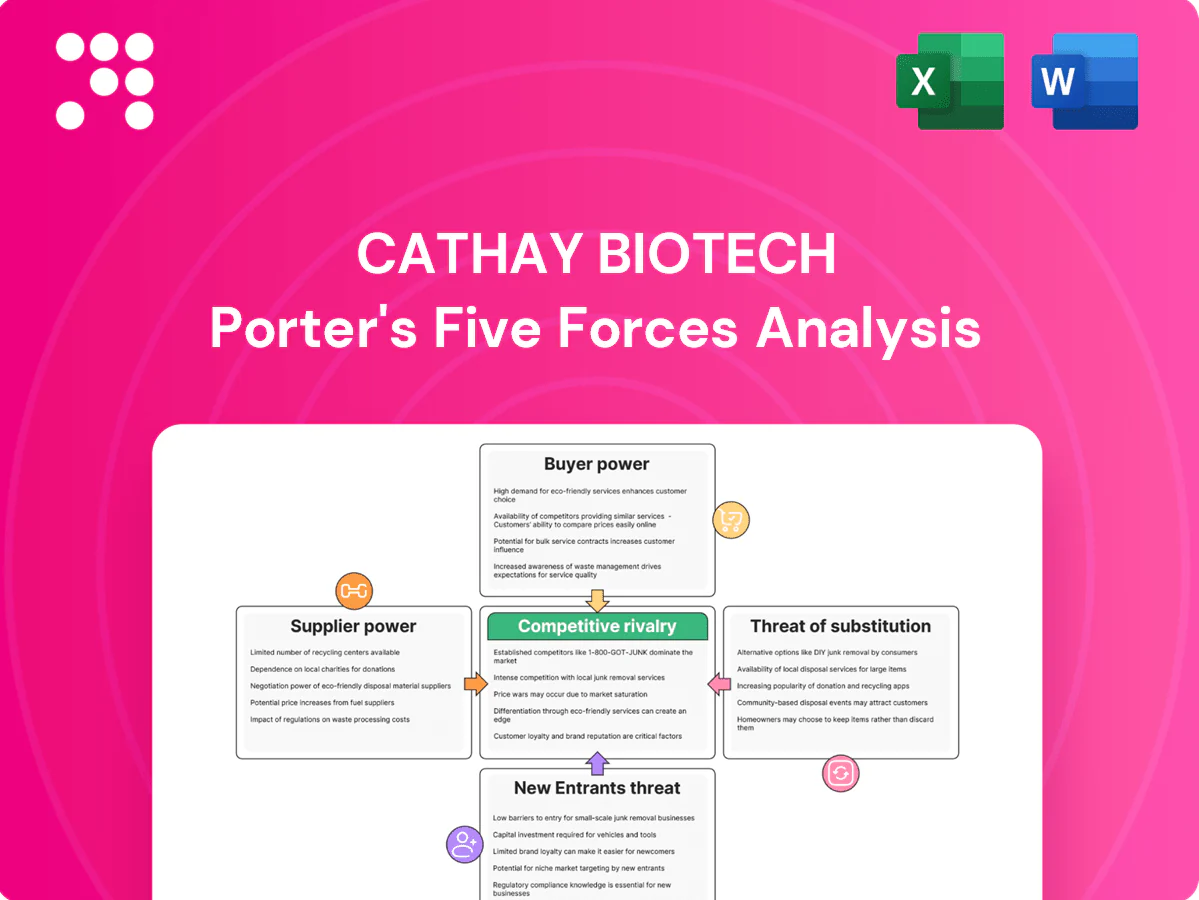
Cathay Biotech Porter's Five Forces Analysis

From Overview to Strategy Blueprint
Cathay Biotech faces intense competitive rivalry amid rapid biotech innovation, niche supplier leverage for specialized reagents, and moderate buyer power from institutional purchasers; regulatory and IP barriers shape entry and substitutes. This snapshot highlights key pressures and strategic levers you should watch. Unlock the full Porter’s Five Forces Analysis for force-by-force ratings, visuals, and actionable recommendations to inform investment or strategy.
Suppliers Bargaining Power

Feedstock concentration
Core inputs—sugars, plant oils, nutrients, enzymes and specialty media—are largely commodities (world sugar production ~170 million tonnes in 2024), which limits single-supplier leverage; however, strict quality/consistency needs for large-scale fermentation narrow viable vendors and create pockets of supplier power. Regional harvest cycles and episodic trade measures can tighten availability and spike supplier bargaining intermittently.
Specialty bioprocess inputs
High-performance strains, enzymes and fermentation aids are concentrated among a few vendors, with the specialty enzyme market valued at about $10.2B in 2024, amplifying supplier leverage. Technical lock-in and validation raise switching costs, while co-development or licensing often embeds exclusivity or volume commitments. These dynamics give suppliers outsized influence over pricing and lead times for critical consumables.

Utilities and capacity bottlenecks
Continuous fermentation depends on stable steam, power and water at scale, and in many 2024 industrial parks utility providers exhibit local monopoly traits that can delay capacity additions; in China industrial power averages ~0.6 CNY/kWh in 2024, illustrating material cost exposure. Utility upgrades often gate expansions, giving infrastructure suppliers indirect bargaining leverage. Long-term tariffs or take-or-pay contracts reduce but do not eliminate this risk.

Logistics and biosecurity constraints
Temperature-controlled storage, contamination prevention and timely transport directly affect Cathay Biotech's yield and product quality; specialized cold-chain requirements narrow qualified carriers and raise supplier leverage. Disruptions in 2024 tight freight markets amplified bargaining power for reliably certified logistics partners, increasing switch costs and delivery premiums. Multi-shipper contracting and near-site warehousing mitigate supplier dominance and preserve uptime.
- Temperature-control reduces carrier pool
- Biosecurity increases dependency on certified partners
- Multi-shipper contracts and near-site warehousing lower supplier leverage
Potential upstream partnerships
Cathay can neutralize supplier leverage via JVs, offtake agreements or co-location with feedstock providers, locking volumes and stabilizing pricing; 2024 industry reports estimate raw materials comprise 20–40% of bioprocess variable costs. Integrated QA/QC reduces quality variance, though partnership specificity raises exit costs and can shift bargaining power upstream.
- JV/offtake: secures >70% volume visibility
- Co-location: lowers logistics & QC variance
- Risk: higher exit costs, asset specificity
Commodities cap supplier leverage; specialty enzymes, utilities and logistics raise switching costs
Core commodities limit single-supplier leverage (world sugar ~170M t, raw materials 20–40% of variable costs in 2024), but specialty enzymes ($10.2B market 2024), qualified strains and certified cold-chain create pockets of power raising switching costs. Utilities (~0.6 CNY/kWh industrial power China 2024) and logistics bottlenecks amplify leverage. JVs/offtake/co-location can secure >70% volume visibility but raise asset specificity.
| Category | 2024 metric | Impact |
|---|---|---|
| Sugar production | 170M t | Low supplier leverage |
| Specialty enzymes | $10.2B | High supplier power |
| Raw material cost share | 20–40% | Material margin exposure |
| Industrial power (China) | ~0.6 CNY/kWh | Utility bargaining leverage |
| JV/offtake visibility | >70% | Mitigates price risk |
What is included in the product
 Detailed Word Document
Tailored exclusively for Cathay Biotech, this Porter's Five Forces analysis uncovers key drivers of competition, supplier/buyer power, and market entry risks, while identifying disruptive threats and substitutes that could erode market share.

 Customizable Excel Spreadsheet
A concise one-sheet Porter's Five Forces for Cathay Biotech that visualizes competitive pressure, lets you tweak inputs for scenario analysis, and exports clean charts and summaries ready for pitch decks or boardroom use.
Customers Bargaining Power

Large industrial customers
Buyers include polymer producers, engineering plastics makers, and coatings/adhesives formulators such as BASF, SABIC and Dow, many of which have sophisticated procurement teams and substantial volume leverage. These large industrial customers can demand price concessions, strict service-level agreements and bespoke technical support. Consolidation among chemicals customers through ongoing M&A has further concentrated purchasing power by 2024.
Qualification-driven stickiness
End-use approvals, specs and performance testing create high switching frictions—qualification cycles in 2024 commonly range 6–12 months, raising the bar for new suppliers. Once qualified, products often secure multi-year incumbency (typically 3–5 years) with predictable volumes, which moderates day-to-day buyer leverage despite hard initial negotiations. However, re-bids at renewal can reset terms aggressively, with 2024 industry data showing price concessions of 10–30% on contract renewals.

Price–performance trade-offs
Customers weigh mechanical properties, processability and total cost-in-use when negotiating with Cathay Biotech; superior performance or clear lifecycle benefits can lift pricing power, while commodity applications drive buyers to seek parity with petro alternatives. Global bioplastics capacity was about 2.2 Mt in 2023 (European Bioplastics), so the premium vs cost-sensitive segment mix sets average buyer leverage.

Sustainability premiums and mandates
Sustainability premiums and mandates raise buyer willingness to pay as Scope 3 often represents the majority of corporate emissions (>50%) and brands/OEMs race to meet bio-content targets and CSRD reporting requirements implemented in the EU from 2024. Preferential procurement for low-carbon materials reduces price sensitivity when robust documentation and third-party certification accompany deliveries, though weak macro conditions in 2023–24 compressed these premiums cyclically.
- Scope3: majority of value-chain emissions (>50%)
- Regulation: CSRD enforcement began 2024, driving disclosures
- Premiums: lower buyer sensitivity when certified documentation is present; cyclically compressed in 2023–24
Supply assurance and dual-sourcing
Buyers often mandate dual sourcing for critical monomers, raising leverage where alternative suppliers or petro-based substitutes exist; in 2024 industry procurement surveys showed dual-sourcing requirements in over 60% of large pharma contracts, increasing buyer bargaining power. Unique chemistries with limited equivalents shrink buyer options, while Cathay’s scale, >$300M annual capacity, reliability, and global logistics network mitigate that power.
- Dual-sourcing prevalence: >60% (2024)
- Substitute leverage: high where petro-based alternatives exist
- Unique chemistries: low buyer alternatives
- Cathay strengths: large capacity, global logistics, reliability
Buyers squeeze bioplastics: 10-30% price cuts, >60% dual-sourcing, 6-12m qualification
Large industrial buyers (BASF, SABIC, Dow) exert strong volume leverage, but high qualification frictions (6–12 months) and 3–5 year incumbency limit frequent switching. 2024 renewals compressed prices 10–30% while dual‑sourcing mandates exceeded 60% for major contracts. Sustainability mandates and CSRD (2024) raise willingness to pay when certified, supporting premium pricing for qualified suppliers like Cathay (>$300M capacity).
| Metric | Value (2023–24) |
|---|---|
| Global bioplastics capacity | 2.2 Mt (2023) |
| Qualification cycle | 6–12 months (2024) |
| Renewal price concessions | 10–30% (2024) |
| Dual‑sourcing prevalence | >60% (2024) |
| Cathay capacity | >$300M annual |
What You See Is What You Get
Cathay Biotech Porter's Five Forces Analysis
This preview shows the exact Cathay Biotech Porter's Five Forces analysis you'll receive after purchase—no placeholders or mockups. The file is fully formatted, comprehensive and ready for immediate download and use. What you see here is precisely what you'll get upon payment.

From Overview to Strategy Blueprint
Cathay Biotech faces intense competitive rivalry amid rapid biotech innovation, niche supplier leverage for specialized reagents, and moderate buyer power from institutional purchasers; regulatory and IP barriers shape entry and substitutes. This snapshot highlights key pressures and strategic levers you should watch. Unlock the full Porter’s Five Forces Analysis for force-by-force ratings, visuals, and actionable recommendations to inform investment or strategy.
Suppliers Bargaining Power
Feedstock concentration
Core inputs—sugars, plant oils, nutrients, enzymes and specialty media—are largely commodities (world sugar production ~170 million tonnes in 2024), which limits single-supplier leverage; however, strict quality/consistency needs for large-scale fermentation narrow viable vendors and create pockets of supplier power. Regional harvest cycles and episodic trade measures can tighten availability and spike supplier bargaining intermittently.
Specialty bioprocess inputs
High-performance strains, enzymes and fermentation aids are concentrated among a few vendors, with the specialty enzyme market valued at about $10.2B in 2024, amplifying supplier leverage. Technical lock-in and validation raise switching costs, while co-development or licensing often embeds exclusivity or volume commitments. These dynamics give suppliers outsized influence over pricing and lead times for critical consumables.
Utilities and capacity bottlenecks
Continuous fermentation depends on stable steam, power and water at scale, and in many 2024 industrial parks utility providers exhibit local monopoly traits that can delay capacity additions; in China industrial power averages ~0.6 CNY/kWh in 2024, illustrating material cost exposure. Utility upgrades often gate expansions, giving infrastructure suppliers indirect bargaining leverage. Long-term tariffs or take-or-pay contracts reduce but do not eliminate this risk.
Logistics and biosecurity constraints
Temperature-controlled storage, contamination prevention and timely transport directly affect Cathay Biotech's yield and product quality; specialized cold-chain requirements narrow qualified carriers and raise supplier leverage. Disruptions in 2024 tight freight markets amplified bargaining power for reliably certified logistics partners, increasing switch costs and delivery premiums. Multi-shipper contracting and near-site warehousing mitigate supplier dominance and preserve uptime.
- Temperature-control reduces carrier pool
- Biosecurity increases dependency on certified partners
- Multi-shipper contracts and near-site warehousing lower supplier leverage
Potential upstream partnerships
Cathay can neutralize supplier leverage via JVs, offtake agreements or co-location with feedstock providers, locking volumes and stabilizing pricing; 2024 industry reports estimate raw materials comprise 20–40% of bioprocess variable costs. Integrated QA/QC reduces quality variance, though partnership specificity raises exit costs and can shift bargaining power upstream.
- JV/offtake: secures >70% volume visibility
- Co-location: lowers logistics & QC variance
- Risk: higher exit costs, asset specificity
Commodities cap supplier leverage; specialty enzymes, utilities and logistics raise switching costs
Core commodities limit single-supplier leverage (world sugar ~170M t, raw materials 20–40% of variable costs in 2024), but specialty enzymes ($10.2B market 2024), qualified strains and certified cold-chain create pockets of power raising switching costs. Utilities (~0.6 CNY/kWh industrial power China 2024) and logistics bottlenecks amplify leverage. JVs/offtake/co-location can secure >70% volume visibility but raise asset specificity.
| Category | 2024 metric | Impact |
|---|---|---|
| Sugar production | 170M t | Low supplier leverage |
| Specialty enzymes | $10.2B | High supplier power |
| Raw material cost share | 20–40% | Material margin exposure |
| Industrial power (China) | ~0.6 CNY/kWh | Utility bargaining leverage |
| JV/offtake visibility | >70% | Mitigates price risk |
What is included in the product
Detailed Word Document
Tailored exclusively for Cathay Biotech, this Porter's Five Forces analysis uncovers key drivers of competition, supplier/buyer power, and market entry risks, while identifying disruptive threats and substitutes that could erode market share.
Customizable Excel Spreadsheet
A concise one-sheet Porter's Five Forces for Cathay Biotech that visualizes competitive pressure, lets you tweak inputs for scenario analysis, and exports clean charts and summaries ready for pitch decks or boardroom use.
Customers Bargaining Power
Large industrial customers
Buyers include polymer producers, engineering plastics makers, and coatings/adhesives formulators such as BASF, SABIC and Dow, many of which have sophisticated procurement teams and substantial volume leverage. These large industrial customers can demand price concessions, strict service-level agreements and bespoke technical support. Consolidation among chemicals customers through ongoing M&A has further concentrated purchasing power by 2024.
Qualification-driven stickiness
End-use approvals, specs and performance testing create high switching frictions—qualification cycles in 2024 commonly range 6–12 months, raising the bar for new suppliers. Once qualified, products often secure multi-year incumbency (typically 3–5 years) with predictable volumes, which moderates day-to-day buyer leverage despite hard initial negotiations. However, re-bids at renewal can reset terms aggressively, with 2024 industry data showing price concessions of 10–30% on contract renewals.
Price–performance trade-offs
Customers weigh mechanical properties, processability and total cost-in-use when negotiating with Cathay Biotech; superior performance or clear lifecycle benefits can lift pricing power, while commodity applications drive buyers to seek parity with petro alternatives. Global bioplastics capacity was about 2.2 Mt in 2023 (European Bioplastics), so the premium vs cost-sensitive segment mix sets average buyer leverage.
Sustainability premiums and mandates
Sustainability premiums and mandates raise buyer willingness to pay as Scope 3 often represents the majority of corporate emissions (>50%) and brands/OEMs race to meet bio-content targets and CSRD reporting requirements implemented in the EU from 2024. Preferential procurement for low-carbon materials reduces price sensitivity when robust documentation and third-party certification accompany deliveries, though weak macro conditions in 2023–24 compressed these premiums cyclically.
- Scope3: majority of value-chain emissions (>50%)
- Regulation: CSRD enforcement began 2024, driving disclosures
- Premiums: lower buyer sensitivity when certified documentation is present; cyclically compressed in 2023–24
Supply assurance and dual-sourcing
Buyers often mandate dual sourcing for critical monomers, raising leverage where alternative suppliers or petro-based substitutes exist; in 2024 industry procurement surveys showed dual-sourcing requirements in over 60% of large pharma contracts, increasing buyer bargaining power. Unique chemistries with limited equivalents shrink buyer options, while Cathay’s scale, >$300M annual capacity, reliability, and global logistics network mitigate that power.
- Dual-sourcing prevalence: >60% (2024)
- Substitute leverage: high where petro-based alternatives exist
- Unique chemistries: low buyer alternatives
- Cathay strengths: large capacity, global logistics, reliability
Buyers squeeze bioplastics: 10-30% price cuts, >60% dual-sourcing, 6-12m qualification
Large industrial buyers (BASF, SABIC, Dow) exert strong volume leverage, but high qualification frictions (6–12 months) and 3–5 year incumbency limit frequent switching. 2024 renewals compressed prices 10–30% while dual‑sourcing mandates exceeded 60% for major contracts. Sustainability mandates and CSRD (2024) raise willingness to pay when certified, supporting premium pricing for qualified suppliers like Cathay (>$300M capacity).
| Metric | Value (2023–24) |
|---|---|
| Global bioplastics capacity | 2.2 Mt (2023) |
| Qualification cycle | 6–12 months (2024) |
| Renewal price concessions | 10–30% (2024) |
| Dual‑sourcing prevalence | >60% (2024) |
| Cathay capacity | >$300M annual |
What You See Is What You Get
Cathay Biotech Porter's Five Forces Analysis
This preview shows the exact Cathay Biotech Porter's Five Forces analysis you'll receive after purchase—no placeholders or mockups. The file is fully formatted, comprehensive and ready for immediate download and use. What you see here is precisely what you'll get upon payment.
Original: $10.00
-65%$10.00
$3.50Description
From Overview to Strategy Blueprint
Cathay Biotech faces intense competitive rivalry amid rapid biotech innovation, niche supplier leverage for specialized reagents, and moderate buyer power from institutional purchasers; regulatory and IP barriers shape entry and substitutes. This snapshot highlights key pressures and strategic levers you should watch. Unlock the full Porter’s Five Forces Analysis for force-by-force ratings, visuals, and actionable recommendations to inform investment or strategy.
Suppliers Bargaining Power
Feedstock concentration
Core inputs—sugars, plant oils, nutrients, enzymes and specialty media—are largely commodities (world sugar production ~170 million tonnes in 2024), which limits single-supplier leverage; however, strict quality/consistency needs for large-scale fermentation narrow viable vendors and create pockets of supplier power. Regional harvest cycles and episodic trade measures can tighten availability and spike supplier bargaining intermittently.
Specialty bioprocess inputs
High-performance strains, enzymes and fermentation aids are concentrated among a few vendors, with the specialty enzyme market valued at about $10.2B in 2024, amplifying supplier leverage. Technical lock-in and validation raise switching costs, while co-development or licensing often embeds exclusivity or volume commitments. These dynamics give suppliers outsized influence over pricing and lead times for critical consumables.
Utilities and capacity bottlenecks
Continuous fermentation depends on stable steam, power and water at scale, and in many 2024 industrial parks utility providers exhibit local monopoly traits that can delay capacity additions; in China industrial power averages ~0.6 CNY/kWh in 2024, illustrating material cost exposure. Utility upgrades often gate expansions, giving infrastructure suppliers indirect bargaining leverage. Long-term tariffs or take-or-pay contracts reduce but do not eliminate this risk.
Logistics and biosecurity constraints
Temperature-controlled storage, contamination prevention and timely transport directly affect Cathay Biotech's yield and product quality; specialized cold-chain requirements narrow qualified carriers and raise supplier leverage. Disruptions in 2024 tight freight markets amplified bargaining power for reliably certified logistics partners, increasing switch costs and delivery premiums. Multi-shipper contracting and near-site warehousing mitigate supplier dominance and preserve uptime.
- Temperature-control reduces carrier pool
- Biosecurity increases dependency on certified partners
- Multi-shipper contracts and near-site warehousing lower supplier leverage
Potential upstream partnerships
Cathay can neutralize supplier leverage via JVs, offtake agreements or co-location with feedstock providers, locking volumes and stabilizing pricing; 2024 industry reports estimate raw materials comprise 20–40% of bioprocess variable costs. Integrated QA/QC reduces quality variance, though partnership specificity raises exit costs and can shift bargaining power upstream.
- JV/offtake: secures >70% volume visibility
- Co-location: lowers logistics & QC variance
- Risk: higher exit costs, asset specificity
Commodities cap supplier leverage; specialty enzymes, utilities and logistics raise switching costs
Core commodities limit single-supplier leverage (world sugar ~170M t, raw materials 20–40% of variable costs in 2024), but specialty enzymes ($10.2B market 2024), qualified strains and certified cold-chain create pockets of power raising switching costs. Utilities (~0.6 CNY/kWh industrial power China 2024) and logistics bottlenecks amplify leverage. JVs/offtake/co-location can secure >70% volume visibility but raise asset specificity.
| Category | 2024 metric | Impact |
|---|---|---|
| Sugar production | 170M t | Low supplier leverage |
| Specialty enzymes | $10.2B | High supplier power |
| Raw material cost share | 20–40% | Material margin exposure |
| Industrial power (China) | ~0.6 CNY/kWh | Utility bargaining leverage |
| JV/offtake visibility | >70% | Mitigates price risk |
What is included in the product
Detailed Word Document
Tailored exclusively for Cathay Biotech, this Porter's Five Forces analysis uncovers key drivers of competition, supplier/buyer power, and market entry risks, while identifying disruptive threats and substitutes that could erode market share.
Customizable Excel Spreadsheet
A concise one-sheet Porter's Five Forces for Cathay Biotech that visualizes competitive pressure, lets you tweak inputs for scenario analysis, and exports clean charts and summaries ready for pitch decks or boardroom use.
Customers Bargaining Power
Large industrial customers
Buyers include polymer producers, engineering plastics makers, and coatings/adhesives formulators such as BASF, SABIC and Dow, many of which have sophisticated procurement teams and substantial volume leverage. These large industrial customers can demand price concessions, strict service-level agreements and bespoke technical support. Consolidation among chemicals customers through ongoing M&A has further concentrated purchasing power by 2024.
Qualification-driven stickiness
End-use approvals, specs and performance testing create high switching frictions—qualification cycles in 2024 commonly range 6–12 months, raising the bar for new suppliers. Once qualified, products often secure multi-year incumbency (typically 3–5 years) with predictable volumes, which moderates day-to-day buyer leverage despite hard initial negotiations. However, re-bids at renewal can reset terms aggressively, with 2024 industry data showing price concessions of 10–30% on contract renewals.
Price–performance trade-offs
Customers weigh mechanical properties, processability and total cost-in-use when negotiating with Cathay Biotech; superior performance or clear lifecycle benefits can lift pricing power, while commodity applications drive buyers to seek parity with petro alternatives. Global bioplastics capacity was about 2.2 Mt in 2023 (European Bioplastics), so the premium vs cost-sensitive segment mix sets average buyer leverage.
Sustainability premiums and mandates
Sustainability premiums and mandates raise buyer willingness to pay as Scope 3 often represents the majority of corporate emissions (>50%) and brands/OEMs race to meet bio-content targets and CSRD reporting requirements implemented in the EU from 2024. Preferential procurement for low-carbon materials reduces price sensitivity when robust documentation and third-party certification accompany deliveries, though weak macro conditions in 2023–24 compressed these premiums cyclically.
- Scope3: majority of value-chain emissions (>50%)
- Regulation: CSRD enforcement began 2024, driving disclosures
- Premiums: lower buyer sensitivity when certified documentation is present; cyclically compressed in 2023–24
Supply assurance and dual-sourcing
Buyers often mandate dual sourcing for critical monomers, raising leverage where alternative suppliers or petro-based substitutes exist; in 2024 industry procurement surveys showed dual-sourcing requirements in over 60% of large pharma contracts, increasing buyer bargaining power. Unique chemistries with limited equivalents shrink buyer options, while Cathay’s scale, >$300M annual capacity, reliability, and global logistics network mitigate that power.
- Dual-sourcing prevalence: >60% (2024)
- Substitute leverage: high where petro-based alternatives exist
- Unique chemistries: low buyer alternatives
- Cathay strengths: large capacity, global logistics, reliability
Buyers squeeze bioplastics: 10-30% price cuts, >60% dual-sourcing, 6-12m qualification
Large industrial buyers (BASF, SABIC, Dow) exert strong volume leverage, but high qualification frictions (6–12 months) and 3–5 year incumbency limit frequent switching. 2024 renewals compressed prices 10–30% while dual‑sourcing mandates exceeded 60% for major contracts. Sustainability mandates and CSRD (2024) raise willingness to pay when certified, supporting premium pricing for qualified suppliers like Cathay (>$300M capacity).
| Metric | Value (2023–24) |
|---|---|
| Global bioplastics capacity | 2.2 Mt (2023) |
| Qualification cycle | 6–12 months (2024) |
| Renewal price concessions | 10–30% (2024) |
| Dual‑sourcing prevalence | >60% (2024) |
| Cathay capacity | >$300M annual |
What You See Is What You Get
Cathay Biotech Porter's Five Forces Analysis
This preview shows the exact Cathay Biotech Porter's Five Forces analysis you'll receive after purchase—no placeholders or mockups. The file is fully formatted, comprehensive and ready for immediate download and use. What you see here is precisely what you'll get upon payment.











