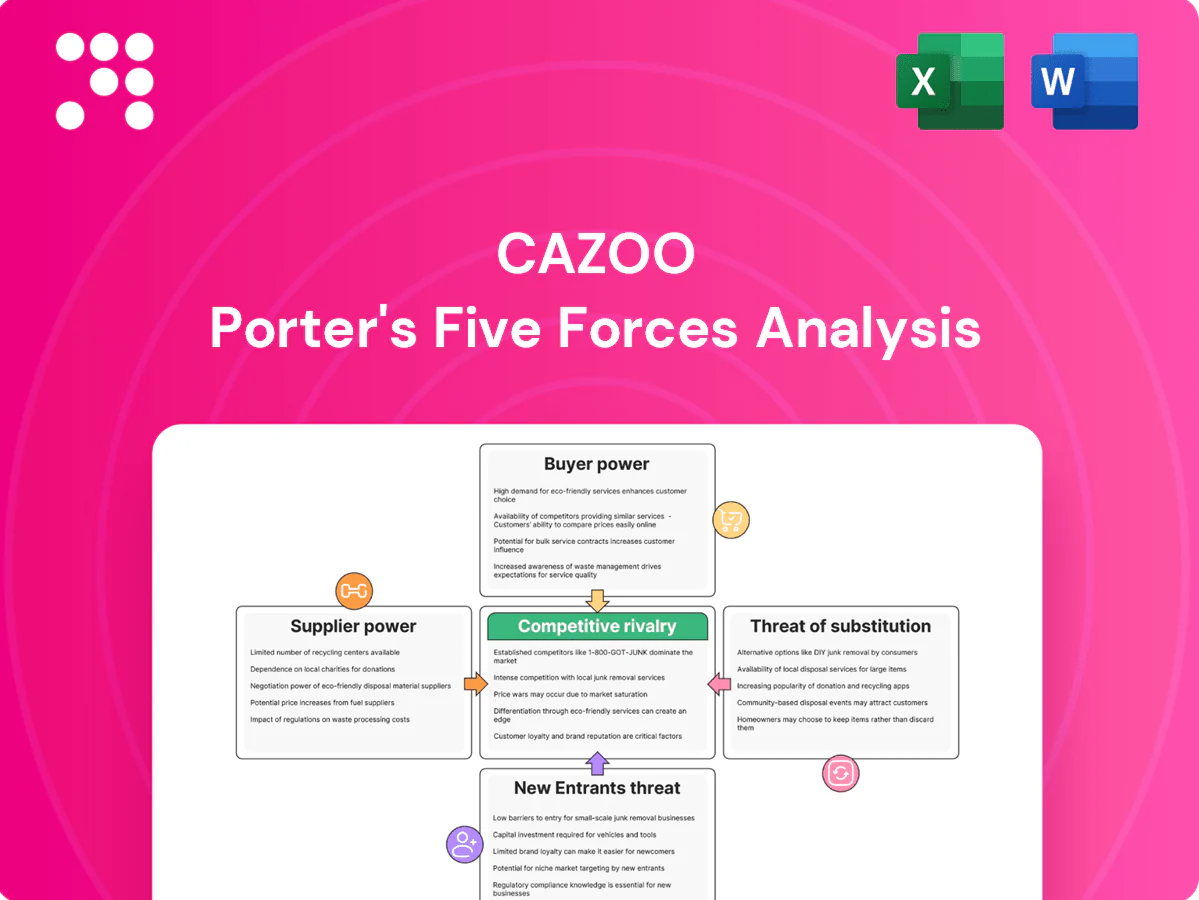
Cazoo Porter's Five Forces Analysis

Elevate Your Analysis with the Complete Porter's Five Forces Analysis
Cazoo faces intense rivalry from established and online used-car platforms, moderate supplier influence from financing and logistics partners, and strong buyer bargaining power as consumers hunt deals and convenience. Threats from new entrants and digital substitutes heighten margin pressure. Unlock the full Porter's Five Forces Analysis to explore Cazoo’s competitive dynamics, market pressures, and strategic advantages in detail.
Suppliers Bargaining Power

Concentrated vehicle sources
Cazoo sources used cars from auctions, leasing firms, fleets and consumer trade-ins, and large leasing/fleet operators controlling tens of thousands of vehicles can extract volume-driven concessions on price and terms.
Auction dynamics, particularly when supply tightens, push wholesale acquisition prices higher and compress Cazoo margins.
This concentration of supply among a few large players increases supplier bargaining power in the UK used-car market and heightens transaction risk for online retailers.
Reconditioning and parts vendors
Cazoo’s refurbishment model relies heavily on third-party reconditioning and parts vendors, with 2024 supply-chain dynamics still influencing margins. OEM parts scarcity or episodic price hikes in 2024 can compress gross margins and increase per-vehicle costs. Switching service vendors risks longer turnaround and inconsistent quality, raising warranty and customer satisfaction risks. Dependence on vendors meeting SLAs increases supplier bargaining power.

Logistics and last-mile delivery
Home delivery for Cazoo depends on third-party carriers and driver networks, giving those suppliers leverage over scheduling and capacity. Last-mile can represent up to 53% of total delivery costs, allowing carriers to pass through fuel, insurance and labor inflation to customers. Limited specialized enclosed transport for vehicles tightens supplier bargaining power. Delivery SLAs directly affect customer experience and can raise cancellation rates when missed.

Finance and warranty partners
Finance and warranty partners—retail lenders, GAP and warranty underwriters—directly shape attach and take rates, with changes in buy rates or risk appetite shifting pricing and conversions and thus per-unit margins. Concentration among a few FCA-regulated providers increases dependency and bargaining leverage. Renegotiations on fees or caps can compress unit economics quickly.
- Retail finance drives attach/take rates
- GAP/warranty underwriters set pricing & conversion
- FCA-regulated partner concentration raises dependency
- Renegotiations can compress per-unit margins
Data and marketplace platforms
Vehicle history and pricing feeds from platforms such as Auto Trader (≈20 million monthly visits in 2024) and HPI (>8 million checks annually in 2024) are quasi-essential for Cazoo; fee changes or access limits materially affect acquisition cost and sales velocity. Multi-homing across platforms reduces but does not eliminate dependence, and data asymmetry (platforms owning price and demand signals) strengthens supplier negotiation positions.
- Platform reach: Auto Trader ≈20M/mo (2024)
- Data checks: HPI >8M/year (2024)
- Impact: fee/access changes → slower turnover, higher acquisition costs
Top-5 fleets control ≈30% supply; platforms and partners push wholesale prices +12% YoY
Large fleets/lessors control volumes, extracting price concessions and raising supplier leverage (2024: top 5 fleets ≈30% of wholesale supply).
Auction tightness pushed wholesale prices +12% YoY in 2024, compressing Cazoo margins.
Third-party reconditioning, transport and finance partners are concentrated, increasing dependency and SLA risk.
Data platforms (Auto Trader ≈20M/mo, HPI >8M checks/yr) further strengthen supplier bargaining power.
| Metric | 2024 |
|---|---|
| Top-5 fleet share | ≈30% |
| Wholesale price change | +12% YoY |
| Auto Trader traffic | ≈20M/mo |
| HPI checks | >8M/yr |
What is included in the product
 Detailed Word Document
Tailored Porter's Five Forces analysis of Cazoo assessing rivalry, buyer and supplier bargaining power, substitution risk and barriers to entry; highlights pricing pressure, margin vulnerability and strategic levers. Includes strategic implications for market positioning, growth barriers and defensive moves to protect share and profitability.

 Customizable Excel Spreadsheet
One-page Cazoo Porter's Five Forces summary that pinpoints competitive pressures and recommended actions—perfect for quick strategic decisions and slide-ready reporting.
Customers Bargaining Power

High price transparency
Buyers compare prices across Cazoo, Cinch, dealers and marketplaces instantly, and UK average used-car prices around £18,000 in 2024 make visible differentials meaningful. Small price gaps compress gross margins, forcing Cazoo into sub-3% margin management and frequent promotions. Dynamic pricing engines are required to remain competitive, and customers exploit transparency to negotiate or switch platforms rapidly.
Low switching costs
Low switching costs mean consumers can abandon a car purchase with minimal friction—online cart abandonment averages ~70% (Baymard Institute)—and many rivals, including Cazoo, match 7-day/14-day return and delivery terms, empowering buyers to press for lower price or better specs; loyalty is fragile without strong brand trust.

Financing sensitivity
Approval odds and APRs heavily influence conversion for Cazoo as consumers respond to financing costs tied to the Bank of England base rate, which was 5.25% through much of 2024. Rate shopping across lenders gives buyers leverage, increasing demand for visible APR deals. In higher-rate environments buyers push for discounts to offset finance costs, so Cazoo must optimize lender mix and targeted promotions to protect conversion.

Return and warranty expectations
Generous returns and multi-year warranties are table stakes in online car retail, so Cazoo absorbs higher refurbishment, logistics and loss-on-sale costs as customers use policies to shift purchase risk; tightening policies would likely raise churn given high comparative switching in online auto markets. Best-in-class post-sale support and transparent repair histories can reduce buyer leverage by improving perceived risk-adjusted value.
- Returns increase operational spend
- Tightening policies risks customer churn
- Post-sale support lowers bargaining power
Reviews and social proof
Reputation on Trustpilot and social channels heavily sways Cazoo purchase decisions; BrightLocal 2024 found 79% of consumers trust online reviews as much as personal recommendations and 98% read reviews. Negative feedback can rapidly lower demand, buyers use reviews to negotiate or delay, and proactive service recovery reduces perceived switching benefits.
- Trustpilot/social sway: high
- 79% trust reviews (BrightLocal 2024)
- Negative feedback → rapid demand drop
- Service recovery lowers switching
Sub-£18k used-car market: sub-3% margins, 70% cart abandonment
Buyers compare prices across Cazoo, Cinch and dealers; UK average used-car price ~£18,000 (2024) makes small gaps meaningful, compressing gross margins to sub-3% and forcing promotions. Low switching costs and ~70% cart abandonment empower rapid platform switching. Financing sensitivity to 5.25% BoE rate (2024) raises APR pressure. Reviews matter: 79% trust online reviews (BrightLocal 2024).
| Metric | Value |
|---|---|
| Avg used-car price | £18,000 (2024) |
| Gross margin | <3% |
| Cart abandonment | ~70% |
| BoE base rate | 5.25% (2024) |
| Trust reviews | 79% (BrightLocal 2024) |
What You See Is What You Get
Cazoo Porter's Five Forces Analysis
This preview shows the exact Cazoo Porter's Five Forces Analysis you'll receive immediately after purchase—no surprises, no placeholders. The document displayed is the same professionally written, fully formatted analysis ready for download. Once you buy, you’ll get instant access to this exact file for immediate use.

Elevate Your Analysis with the Complete Porter's Five Forces Analysis
Cazoo faces intense rivalry from established and online used-car platforms, moderate supplier influence from financing and logistics partners, and strong buyer bargaining power as consumers hunt deals and convenience. Threats from new entrants and digital substitutes heighten margin pressure. Unlock the full Porter's Five Forces Analysis to explore Cazoo’s competitive dynamics, market pressures, and strategic advantages in detail.
Suppliers Bargaining Power
Concentrated vehicle sources
Cazoo sources used cars from auctions, leasing firms, fleets and consumer trade-ins, and large leasing/fleet operators controlling tens of thousands of vehicles can extract volume-driven concessions on price and terms.
Auction dynamics, particularly when supply tightens, push wholesale acquisition prices higher and compress Cazoo margins.
This concentration of supply among a few large players increases supplier bargaining power in the UK used-car market and heightens transaction risk for online retailers.
Reconditioning and parts vendors
Cazoo’s refurbishment model relies heavily on third-party reconditioning and parts vendors, with 2024 supply-chain dynamics still influencing margins. OEM parts scarcity or episodic price hikes in 2024 can compress gross margins and increase per-vehicle costs. Switching service vendors risks longer turnaround and inconsistent quality, raising warranty and customer satisfaction risks. Dependence on vendors meeting SLAs increases supplier bargaining power.
Logistics and last-mile delivery
Home delivery for Cazoo depends on third-party carriers and driver networks, giving those suppliers leverage over scheduling and capacity. Last-mile can represent up to 53% of total delivery costs, allowing carriers to pass through fuel, insurance and labor inflation to customers. Limited specialized enclosed transport for vehicles tightens supplier bargaining power. Delivery SLAs directly affect customer experience and can raise cancellation rates when missed.
Finance and warranty partners
Finance and warranty partners—retail lenders, GAP and warranty underwriters—directly shape attach and take rates, with changes in buy rates or risk appetite shifting pricing and conversions and thus per-unit margins. Concentration among a few FCA-regulated providers increases dependency and bargaining leverage. Renegotiations on fees or caps can compress unit economics quickly.
- Retail finance drives attach/take rates
- GAP/warranty underwriters set pricing & conversion
- FCA-regulated partner concentration raises dependency
- Renegotiations can compress per-unit margins
Data and marketplace platforms
Vehicle history and pricing feeds from platforms such as Auto Trader (≈20 million monthly visits in 2024) and HPI (>8 million checks annually in 2024) are quasi-essential for Cazoo; fee changes or access limits materially affect acquisition cost and sales velocity. Multi-homing across platforms reduces but does not eliminate dependence, and data asymmetry (platforms owning price and demand signals) strengthens supplier negotiation positions.
- Platform reach: Auto Trader ≈20M/mo (2024)
- Data checks: HPI >8M/year (2024)
- Impact: fee/access changes → slower turnover, higher acquisition costs
Top-5 fleets control ≈30% supply; platforms and partners push wholesale prices +12% YoY
Large fleets/lessors control volumes, extracting price concessions and raising supplier leverage (2024: top 5 fleets ≈30% of wholesale supply).
Auction tightness pushed wholesale prices +12% YoY in 2024, compressing Cazoo margins.
Third-party reconditioning, transport and finance partners are concentrated, increasing dependency and SLA risk.
Data platforms (Auto Trader ≈20M/mo, HPI >8M checks/yr) further strengthen supplier bargaining power.
| Metric | 2024 |
|---|---|
| Top-5 fleet share | ≈30% |
| Wholesale price change | +12% YoY |
| Auto Trader traffic | ≈20M/mo |
| HPI checks | >8M/yr |
What is included in the product
Detailed Word Document
Tailored Porter's Five Forces analysis of Cazoo assessing rivalry, buyer and supplier bargaining power, substitution risk and barriers to entry; highlights pricing pressure, margin vulnerability and strategic levers. Includes strategic implications for market positioning, growth barriers and defensive moves to protect share and profitability.
Customizable Excel Spreadsheet
One-page Cazoo Porter's Five Forces summary that pinpoints competitive pressures and recommended actions—perfect for quick strategic decisions and slide-ready reporting.
Customers Bargaining Power
High price transparency
Buyers compare prices across Cazoo, Cinch, dealers and marketplaces instantly, and UK average used-car prices around £18,000 in 2024 make visible differentials meaningful. Small price gaps compress gross margins, forcing Cazoo into sub-3% margin management and frequent promotions. Dynamic pricing engines are required to remain competitive, and customers exploit transparency to negotiate or switch platforms rapidly.
Low switching costs
Low switching costs mean consumers can abandon a car purchase with minimal friction—online cart abandonment averages ~70% (Baymard Institute)—and many rivals, including Cazoo, match 7-day/14-day return and delivery terms, empowering buyers to press for lower price or better specs; loyalty is fragile without strong brand trust.
Financing sensitivity
Approval odds and APRs heavily influence conversion for Cazoo as consumers respond to financing costs tied to the Bank of England base rate, which was 5.25% through much of 2024. Rate shopping across lenders gives buyers leverage, increasing demand for visible APR deals. In higher-rate environments buyers push for discounts to offset finance costs, so Cazoo must optimize lender mix and targeted promotions to protect conversion.
Return and warranty expectations
Generous returns and multi-year warranties are table stakes in online car retail, so Cazoo absorbs higher refurbishment, logistics and loss-on-sale costs as customers use policies to shift purchase risk; tightening policies would likely raise churn given high comparative switching in online auto markets. Best-in-class post-sale support and transparent repair histories can reduce buyer leverage by improving perceived risk-adjusted value.
- Returns increase operational spend
- Tightening policies risks customer churn
- Post-sale support lowers bargaining power
Reviews and social proof
Reputation on Trustpilot and social channels heavily sways Cazoo purchase decisions; BrightLocal 2024 found 79% of consumers trust online reviews as much as personal recommendations and 98% read reviews. Negative feedback can rapidly lower demand, buyers use reviews to negotiate or delay, and proactive service recovery reduces perceived switching benefits.
- Trustpilot/social sway: high
- 79% trust reviews (BrightLocal 2024)
- Negative feedback → rapid demand drop
- Service recovery lowers switching
Sub-£18k used-car market: sub-3% margins, 70% cart abandonment
Buyers compare prices across Cazoo, Cinch and dealers; UK average used-car price ~£18,000 (2024) makes small gaps meaningful, compressing gross margins to sub-3% and forcing promotions. Low switching costs and ~70% cart abandonment empower rapid platform switching. Financing sensitivity to 5.25% BoE rate (2024) raises APR pressure. Reviews matter: 79% trust online reviews (BrightLocal 2024).
| Metric | Value |
|---|---|
| Avg used-car price | £18,000 (2024) |
| Gross margin | <3% |
| Cart abandonment | ~70% |
| BoE base rate | 5.25% (2024) |
| Trust reviews | 79% (BrightLocal 2024) |
What You See Is What You Get
Cazoo Porter's Five Forces Analysis
This preview shows the exact Cazoo Porter's Five Forces Analysis you'll receive immediately after purchase—no surprises, no placeholders. The document displayed is the same professionally written, fully formatted analysis ready for download. Once you buy, you’ll get instant access to this exact file for immediate use.
Original: $10.00
-65%$10.00
$3.50Description
Elevate Your Analysis with the Complete Porter's Five Forces Analysis
Cazoo faces intense rivalry from established and online used-car platforms, moderate supplier influence from financing and logistics partners, and strong buyer bargaining power as consumers hunt deals and convenience. Threats from new entrants and digital substitutes heighten margin pressure. Unlock the full Porter's Five Forces Analysis to explore Cazoo’s competitive dynamics, market pressures, and strategic advantages in detail.
Suppliers Bargaining Power
Concentrated vehicle sources
Cazoo sources used cars from auctions, leasing firms, fleets and consumer trade-ins, and large leasing/fleet operators controlling tens of thousands of vehicles can extract volume-driven concessions on price and terms.
Auction dynamics, particularly when supply tightens, push wholesale acquisition prices higher and compress Cazoo margins.
This concentration of supply among a few large players increases supplier bargaining power in the UK used-car market and heightens transaction risk for online retailers.
Reconditioning and parts vendors
Cazoo’s refurbishment model relies heavily on third-party reconditioning and parts vendors, with 2024 supply-chain dynamics still influencing margins. OEM parts scarcity or episodic price hikes in 2024 can compress gross margins and increase per-vehicle costs. Switching service vendors risks longer turnaround and inconsistent quality, raising warranty and customer satisfaction risks. Dependence on vendors meeting SLAs increases supplier bargaining power.
Logistics and last-mile delivery
Home delivery for Cazoo depends on third-party carriers and driver networks, giving those suppliers leverage over scheduling and capacity. Last-mile can represent up to 53% of total delivery costs, allowing carriers to pass through fuel, insurance and labor inflation to customers. Limited specialized enclosed transport for vehicles tightens supplier bargaining power. Delivery SLAs directly affect customer experience and can raise cancellation rates when missed.
Finance and warranty partners
Finance and warranty partners—retail lenders, GAP and warranty underwriters—directly shape attach and take rates, with changes in buy rates or risk appetite shifting pricing and conversions and thus per-unit margins. Concentration among a few FCA-regulated providers increases dependency and bargaining leverage. Renegotiations on fees or caps can compress unit economics quickly.
- Retail finance drives attach/take rates
- GAP/warranty underwriters set pricing & conversion
- FCA-regulated partner concentration raises dependency
- Renegotiations can compress per-unit margins
Data and marketplace platforms
Vehicle history and pricing feeds from platforms such as Auto Trader (≈20 million monthly visits in 2024) and HPI (>8 million checks annually in 2024) are quasi-essential for Cazoo; fee changes or access limits materially affect acquisition cost and sales velocity. Multi-homing across platforms reduces but does not eliminate dependence, and data asymmetry (platforms owning price and demand signals) strengthens supplier negotiation positions.
- Platform reach: Auto Trader ≈20M/mo (2024)
- Data checks: HPI >8M/year (2024)
- Impact: fee/access changes → slower turnover, higher acquisition costs
Top-5 fleets control ≈30% supply; platforms and partners push wholesale prices +12% YoY
Large fleets/lessors control volumes, extracting price concessions and raising supplier leverage (2024: top 5 fleets ≈30% of wholesale supply).
Auction tightness pushed wholesale prices +12% YoY in 2024, compressing Cazoo margins.
Third-party reconditioning, transport and finance partners are concentrated, increasing dependency and SLA risk.
Data platforms (Auto Trader ≈20M/mo, HPI >8M checks/yr) further strengthen supplier bargaining power.
| Metric | 2024 |
|---|---|
| Top-5 fleet share | ≈30% |
| Wholesale price change | +12% YoY |
| Auto Trader traffic | ≈20M/mo |
| HPI checks | >8M/yr |
What is included in the product
Detailed Word Document
Tailored Porter's Five Forces analysis of Cazoo assessing rivalry, buyer and supplier bargaining power, substitution risk and barriers to entry; highlights pricing pressure, margin vulnerability and strategic levers. Includes strategic implications for market positioning, growth barriers and defensive moves to protect share and profitability.
Customizable Excel Spreadsheet
One-page Cazoo Porter's Five Forces summary that pinpoints competitive pressures and recommended actions—perfect for quick strategic decisions and slide-ready reporting.
Customers Bargaining Power
High price transparency
Buyers compare prices across Cazoo, Cinch, dealers and marketplaces instantly, and UK average used-car prices around £18,000 in 2024 make visible differentials meaningful. Small price gaps compress gross margins, forcing Cazoo into sub-3% margin management and frequent promotions. Dynamic pricing engines are required to remain competitive, and customers exploit transparency to negotiate or switch platforms rapidly.
Low switching costs
Low switching costs mean consumers can abandon a car purchase with minimal friction—online cart abandonment averages ~70% (Baymard Institute)—and many rivals, including Cazoo, match 7-day/14-day return and delivery terms, empowering buyers to press for lower price or better specs; loyalty is fragile without strong brand trust.
Financing sensitivity
Approval odds and APRs heavily influence conversion for Cazoo as consumers respond to financing costs tied to the Bank of England base rate, which was 5.25% through much of 2024. Rate shopping across lenders gives buyers leverage, increasing demand for visible APR deals. In higher-rate environments buyers push for discounts to offset finance costs, so Cazoo must optimize lender mix and targeted promotions to protect conversion.
Return and warranty expectations
Generous returns and multi-year warranties are table stakes in online car retail, so Cazoo absorbs higher refurbishment, logistics and loss-on-sale costs as customers use policies to shift purchase risk; tightening policies would likely raise churn given high comparative switching in online auto markets. Best-in-class post-sale support and transparent repair histories can reduce buyer leverage by improving perceived risk-adjusted value.
- Returns increase operational spend
- Tightening policies risks customer churn
- Post-sale support lowers bargaining power
Reviews and social proof
Reputation on Trustpilot and social channels heavily sways Cazoo purchase decisions; BrightLocal 2024 found 79% of consumers trust online reviews as much as personal recommendations and 98% read reviews. Negative feedback can rapidly lower demand, buyers use reviews to negotiate or delay, and proactive service recovery reduces perceived switching benefits.
- Trustpilot/social sway: high
- 79% trust reviews (BrightLocal 2024)
- Negative feedback → rapid demand drop
- Service recovery lowers switching
Sub-£18k used-car market: sub-3% margins, 70% cart abandonment
Buyers compare prices across Cazoo, Cinch and dealers; UK average used-car price ~£18,000 (2024) makes small gaps meaningful, compressing gross margins to sub-3% and forcing promotions. Low switching costs and ~70% cart abandonment empower rapid platform switching. Financing sensitivity to 5.25% BoE rate (2024) raises APR pressure. Reviews matter: 79% trust online reviews (BrightLocal 2024).
| Metric | Value |
|---|---|
| Avg used-car price | £18,000 (2024) |
| Gross margin | <3% |
| Cart abandonment | ~70% |
| BoE base rate | 5.25% (2024) |
| Trust reviews | 79% (BrightLocal 2024) |
What You See Is What You Get
Cazoo Porter's Five Forces Analysis
This preview shows the exact Cazoo Porter's Five Forces Analysis you'll receive immediately after purchase—no surprises, no placeholders. The document displayed is the same professionally written, fully formatted analysis ready for download. Once you buy, you’ll get instant access to this exact file for immediate use.











