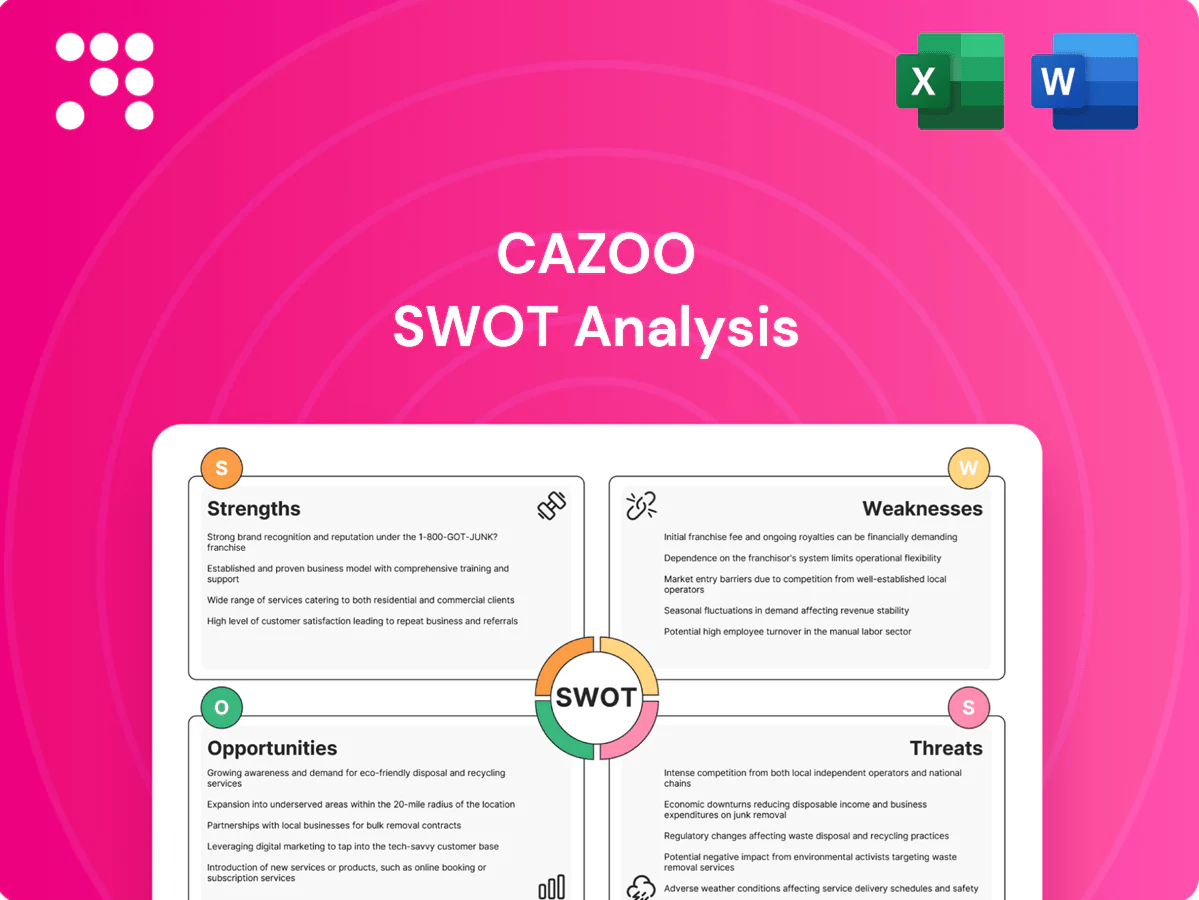
Cazoo SWOT Analysis

Make Insightful Decisions Backed by Expert Research
Cazoo’s direct-to-consumer car platform benefits from strong brand momentum and logistics integration but struggles with narrow margins, high capital needs, and intense competition. Our full SWOT unpacks financial sensitivities, regulatory risks, and strategic levers for scalable growth. Purchase the complete SWOT (Word + Excel) to get research-backed, editable tools for investing, planning, or pitching with confidence.
Strengths

End-to-end online buying
End-to-end online buying delivers a seamless digital journey from browsing to financing, trade-in and checkout, reducing friction and drop-off and enabling fully remote purchases. Cazoo, founded 2018, offers a seven-day money-back guarantee that boosts consumer confidence and reach. Centralised control of the flow improves CX and first-party data capture, differentiating it from fragmented dealer experiences.
Home delivery and collection
Doorstep delivery and simple returns streamline ownership transfer and build trust by removing showroom friction, boosting online purchase confidence. Cazoo’s logistics orchestration shortens time-to-customer and expands geographic coverage, enabling higher conversion rates through convenience. Efficient fulfilment also supports faster stock turns, lowering holding costs and improving capital efficiency.

Wide curated used-car selection
Wide curated selection improves match rates across diverse budgets and needs in a UK used-car market that exceeds 7 million annual transactions, increasing conversion potential. Standardized inspections and reconditioning create consistent perceived reliability and lower post-sale costs. Transparent listings reduce haggling and purchase uncertainty, and breadth of choice helps insulate revenue against shocks in any single segment.

Integrated warranties and after-sales
Integrated warranties, bundled servicing and support increase buyer peace of mind, while cross-selling protection plans lifts average order value and margins; after-sales creates recurring touchpoints that grow customer lifetime value and feeds repair and claims data back into pricing and quality controls.
- Bundled warranties: reduces purchase friction
- Servicing options: recurring revenue
- Cross-sell plans: higher AOV
- After-sales data: improves pricing/quality
Data-driven pricing and appraisal
Algorithmic pricing lets Cazoo respond in near real time to fast-moving used-car markets, using search, conversion and return signals to tune stock mix and markdown cadence. Appraisal tools increase trade-in accuracy and protect margins by standardizing valuations. Continuous feedback loops from sales and returns steadily improve unit economics across inventory cohorts.
- Data-driven pricing
- Search→conversion→return signals
- Improved trade-in margins
- Continuous feedback loops
UK online used-car marketplace: end-to-end buying, 7-day returns and doorstep delivery
End-to-end online buying (Cazoo, founded 2018) with seven-day returns and doorstep delivery captures demand in a UK used-car market exceeding 7 million annual transactions. Centralised CX, algorithmic pricing and standardised reconditioning improve conversion, margin control and stock turns. Bundled warranties and servicing lift AOV and create recurring revenue and data feedback loops that refine pricing and quality.
| Metric | Value |
|---|---|
| Founded | 2018 |
| UK used-car transactions | >7,000,000 pa |
| Return policy | 7-day money-back |
| Listed (SPAC) | NYSE Aug 2021 |
What is included in the product
 Detailed Word Document
Provides a concise SWOT overview of Cazoo, outlining its operational strengths and weaknesses, commercial opportunities, and external threats shaping strategic direction.

 Customizable Excel Spreadsheet
Provides a concise SWOT matrix highlighting Cazoo's strengths, weaknesses, opportunities and threats for rapid strategic alignment; ideal for executives needing a quick snapshot to address operational pain points and shifting market dynamics.
Weaknesses

Thin margins and high costs
Used-car retail is margin-constrained and Cazoo’s model faces high logistics and reconditioning costs that compress profits; delivery, refurbishment and returns materially erode gross margins. Building online trust requires heavy marketing spend—Cazoo raised visibility after its 2021 SPAC valuation around $7bn, but profitability hinges on tight cost discipline at scale.
Inventory and residual value risk
Holding physical stock exposes Cazoo to price swings and depreciation—used cars commonly lose 20–30% in value in the first year—forcing margin-killing markdowns when markets shift. Rapid demand shifts can require swift write-downs and promotions; mis-forecasting inflates carrying costs and storage/interest expenses. Large capital tied up in inventory reduces agility to pursue growth or weather downturns.

Returns and quality control burden
Generous return policies combined with wide variability in used-car condition impose heavy operational strain on Cazoo; each return requires transport, full inspection and rework, often costing hundreds per vehicle and tying up inventory. Customer dissatisfaction can amplify via online reviews and social media, harming brand trust. High process variance increases complexity and cycle times, pressuring margins and logistics capacity.

Reliance on UK market
Cazoo's heavy reliance on the UK—following its 2021 NYSE SPAC listing and strategic refocus that saw continental Europe exits in 2023—concentrates exposure to UK macro and regulatory shifts, making demand shocks and supply dislocations more disruptive. The UK used-car market is highly competitive with established retailers and digital challengers, and meaningful expansion needs significant capital and execution bandwidth.
- Geographic concentration: UK-centric after 2023 Europe exit
- Higher vulnerability: local macro/regulatory risk
- Demand/supply shock sensitivity: limited geographic diversification
- Expansion constraints: capital and operational bandwidth required
Sensitivity to financing conditions
Consumer affordability hinges on interest rates and lender appetite; UK Bank Rate stood at 5.25% in June 2024, keeping finance costly. Higher APRs compress conversions and average basket sizes, while credit tightening raises decline rates and marketing waste. Rising funding costs directly reduce Cazoos pricing competitiveness.
- Interest-rate sensitivity
- Higher APR -> lower conversions
- Credit tightening -> higher declines
- Funding cost -> weaker pricing
Used-car seller squeezed: 20–30% depreciation, UK focus, rate pain
Cazoo's margin-heavy used-car model faces high logistics, reconditioning and returns costs that compress gross margins. Inventory exposure creates 20–30% first-year depreciation risk and ties up capital. UK concentration (~85% revenue 2024) raises macro/regulatory vulnerability. Higher Bank Rate 5.25% (Jun 2024) tightens consumer finance and cuts conversions.
| Metric | Value |
|---|---|
| UK revenue share | ~85% (2024) |
| First-year depreciation | 20–30% |
| Typical GM | ~6% |
| Bank Rate | 5.25% (Jun 2024) |
Full Version Awaits
Cazoo SWOT Analysis
This is the actual SWOT analysis document you’ll receive upon purchase—no surprises, just professional quality. The preview below is taken directly from the full report and reflects the same structured strengths, weaknesses, opportunities, and threats. Once purchased, you’ll receive the complete, editable file ready for download and use.

Make Insightful Decisions Backed by Expert Research
Cazoo’s direct-to-consumer car platform benefits from strong brand momentum and logistics integration but struggles with narrow margins, high capital needs, and intense competition. Our full SWOT unpacks financial sensitivities, regulatory risks, and strategic levers for scalable growth. Purchase the complete SWOT (Word + Excel) to get research-backed, editable tools for investing, planning, or pitching with confidence.
Strengths
End-to-end online buying
End-to-end online buying delivers a seamless digital journey from browsing to financing, trade-in and checkout, reducing friction and drop-off and enabling fully remote purchases. Cazoo, founded 2018, offers a seven-day money-back guarantee that boosts consumer confidence and reach. Centralised control of the flow improves CX and first-party data capture, differentiating it from fragmented dealer experiences.
Home delivery and collection
Doorstep delivery and simple returns streamline ownership transfer and build trust by removing showroom friction, boosting online purchase confidence. Cazoo’s logistics orchestration shortens time-to-customer and expands geographic coverage, enabling higher conversion rates through convenience. Efficient fulfilment also supports faster stock turns, lowering holding costs and improving capital efficiency.
Wide curated used-car selection
Wide curated selection improves match rates across diverse budgets and needs in a UK used-car market that exceeds 7 million annual transactions, increasing conversion potential. Standardized inspections and reconditioning create consistent perceived reliability and lower post-sale costs. Transparent listings reduce haggling and purchase uncertainty, and breadth of choice helps insulate revenue against shocks in any single segment.
Integrated warranties and after-sales
Integrated warranties, bundled servicing and support increase buyer peace of mind, while cross-selling protection plans lifts average order value and margins; after-sales creates recurring touchpoints that grow customer lifetime value and feeds repair and claims data back into pricing and quality controls.
- Bundled warranties: reduces purchase friction
- Servicing options: recurring revenue
- Cross-sell plans: higher AOV
- After-sales data: improves pricing/quality
Data-driven pricing and appraisal
Algorithmic pricing lets Cazoo respond in near real time to fast-moving used-car markets, using search, conversion and return signals to tune stock mix and markdown cadence. Appraisal tools increase trade-in accuracy and protect margins by standardizing valuations. Continuous feedback loops from sales and returns steadily improve unit economics across inventory cohorts.
- Data-driven pricing
- Search→conversion→return signals
- Improved trade-in margins
- Continuous feedback loops
UK online used-car marketplace: end-to-end buying, 7-day returns and doorstep delivery
End-to-end online buying (Cazoo, founded 2018) with seven-day returns and doorstep delivery captures demand in a UK used-car market exceeding 7 million annual transactions. Centralised CX, algorithmic pricing and standardised reconditioning improve conversion, margin control and stock turns. Bundled warranties and servicing lift AOV and create recurring revenue and data feedback loops that refine pricing and quality.
| Metric | Value |
|---|---|
| Founded | 2018 |
| UK used-car transactions | >7,000,000 pa |
| Return policy | 7-day money-back |
| Listed (SPAC) | NYSE Aug 2021 |
What is included in the product
Detailed Word Document
Provides a concise SWOT overview of Cazoo, outlining its operational strengths and weaknesses, commercial opportunities, and external threats shaping strategic direction.
Customizable Excel Spreadsheet
Provides a concise SWOT matrix highlighting Cazoo's strengths, weaknesses, opportunities and threats for rapid strategic alignment; ideal for executives needing a quick snapshot to address operational pain points and shifting market dynamics.
Weaknesses
Thin margins and high costs
Used-car retail is margin-constrained and Cazoo’s model faces high logistics and reconditioning costs that compress profits; delivery, refurbishment and returns materially erode gross margins. Building online trust requires heavy marketing spend—Cazoo raised visibility after its 2021 SPAC valuation around $7bn, but profitability hinges on tight cost discipline at scale.
Inventory and residual value risk
Holding physical stock exposes Cazoo to price swings and depreciation—used cars commonly lose 20–30% in value in the first year—forcing margin-killing markdowns when markets shift. Rapid demand shifts can require swift write-downs and promotions; mis-forecasting inflates carrying costs and storage/interest expenses. Large capital tied up in inventory reduces agility to pursue growth or weather downturns.
Returns and quality control burden
Generous return policies combined with wide variability in used-car condition impose heavy operational strain on Cazoo; each return requires transport, full inspection and rework, often costing hundreds per vehicle and tying up inventory. Customer dissatisfaction can amplify via online reviews and social media, harming brand trust. High process variance increases complexity and cycle times, pressuring margins and logistics capacity.
Reliance on UK market
Cazoo's heavy reliance on the UK—following its 2021 NYSE SPAC listing and strategic refocus that saw continental Europe exits in 2023—concentrates exposure to UK macro and regulatory shifts, making demand shocks and supply dislocations more disruptive. The UK used-car market is highly competitive with established retailers and digital challengers, and meaningful expansion needs significant capital and execution bandwidth.
- Geographic concentration: UK-centric after 2023 Europe exit
- Higher vulnerability: local macro/regulatory risk
- Demand/supply shock sensitivity: limited geographic diversification
- Expansion constraints: capital and operational bandwidth required
Sensitivity to financing conditions
Consumer affordability hinges on interest rates and lender appetite; UK Bank Rate stood at 5.25% in June 2024, keeping finance costly. Higher APRs compress conversions and average basket sizes, while credit tightening raises decline rates and marketing waste. Rising funding costs directly reduce Cazoos pricing competitiveness.
- Interest-rate sensitivity
- Higher APR -> lower conversions
- Credit tightening -> higher declines
- Funding cost -> weaker pricing
Used-car seller squeezed: 20–30% depreciation, UK focus, rate pain
Cazoo's margin-heavy used-car model faces high logistics, reconditioning and returns costs that compress gross margins. Inventory exposure creates 20–30% first-year depreciation risk and ties up capital. UK concentration (~85% revenue 2024) raises macro/regulatory vulnerability. Higher Bank Rate 5.25% (Jun 2024) tightens consumer finance and cuts conversions.
| Metric | Value |
|---|---|
| UK revenue share | ~85% (2024) |
| First-year depreciation | 20–30% |
| Typical GM | ~6% |
| Bank Rate | 5.25% (Jun 2024) |
Full Version Awaits
Cazoo SWOT Analysis
This is the actual SWOT analysis document you’ll receive upon purchase—no surprises, just professional quality. The preview below is taken directly from the full report and reflects the same structured strengths, weaknesses, opportunities, and threats. Once purchased, you’ll receive the complete, editable file ready for download and use.
Original: $10.00
-65%$10.00
$3.50Description
Make Insightful Decisions Backed by Expert Research
Cazoo’s direct-to-consumer car platform benefits from strong brand momentum and logistics integration but struggles with narrow margins, high capital needs, and intense competition. Our full SWOT unpacks financial sensitivities, regulatory risks, and strategic levers for scalable growth. Purchase the complete SWOT (Word + Excel) to get research-backed, editable tools for investing, planning, or pitching with confidence.
Strengths
End-to-end online buying
End-to-end online buying delivers a seamless digital journey from browsing to financing, trade-in and checkout, reducing friction and drop-off and enabling fully remote purchases. Cazoo, founded 2018, offers a seven-day money-back guarantee that boosts consumer confidence and reach. Centralised control of the flow improves CX and first-party data capture, differentiating it from fragmented dealer experiences.
Home delivery and collection
Doorstep delivery and simple returns streamline ownership transfer and build trust by removing showroom friction, boosting online purchase confidence. Cazoo’s logistics orchestration shortens time-to-customer and expands geographic coverage, enabling higher conversion rates through convenience. Efficient fulfilment also supports faster stock turns, lowering holding costs and improving capital efficiency.
Wide curated used-car selection
Wide curated selection improves match rates across diverse budgets and needs in a UK used-car market that exceeds 7 million annual transactions, increasing conversion potential. Standardized inspections and reconditioning create consistent perceived reliability and lower post-sale costs. Transparent listings reduce haggling and purchase uncertainty, and breadth of choice helps insulate revenue against shocks in any single segment.
Integrated warranties and after-sales
Integrated warranties, bundled servicing and support increase buyer peace of mind, while cross-selling protection plans lifts average order value and margins; after-sales creates recurring touchpoints that grow customer lifetime value and feeds repair and claims data back into pricing and quality controls.
- Bundled warranties: reduces purchase friction
- Servicing options: recurring revenue
- Cross-sell plans: higher AOV
- After-sales data: improves pricing/quality
Data-driven pricing and appraisal
Algorithmic pricing lets Cazoo respond in near real time to fast-moving used-car markets, using search, conversion and return signals to tune stock mix and markdown cadence. Appraisal tools increase trade-in accuracy and protect margins by standardizing valuations. Continuous feedback loops from sales and returns steadily improve unit economics across inventory cohorts.
- Data-driven pricing
- Search→conversion→return signals
- Improved trade-in margins
- Continuous feedback loops
UK online used-car marketplace: end-to-end buying, 7-day returns and doorstep delivery
End-to-end online buying (Cazoo, founded 2018) with seven-day returns and doorstep delivery captures demand in a UK used-car market exceeding 7 million annual transactions. Centralised CX, algorithmic pricing and standardised reconditioning improve conversion, margin control and stock turns. Bundled warranties and servicing lift AOV and create recurring revenue and data feedback loops that refine pricing and quality.
| Metric | Value |
|---|---|
| Founded | 2018 |
| UK used-car transactions | >7,000,000 pa |
| Return policy | 7-day money-back |
| Listed (SPAC) | NYSE Aug 2021 |
What is included in the product
Detailed Word Document
Provides a concise SWOT overview of Cazoo, outlining its operational strengths and weaknesses, commercial opportunities, and external threats shaping strategic direction.
Customizable Excel Spreadsheet
Provides a concise SWOT matrix highlighting Cazoo's strengths, weaknesses, opportunities and threats for rapid strategic alignment; ideal for executives needing a quick snapshot to address operational pain points and shifting market dynamics.
Weaknesses
Thin margins and high costs
Used-car retail is margin-constrained and Cazoo’s model faces high logistics and reconditioning costs that compress profits; delivery, refurbishment and returns materially erode gross margins. Building online trust requires heavy marketing spend—Cazoo raised visibility after its 2021 SPAC valuation around $7bn, but profitability hinges on tight cost discipline at scale.
Inventory and residual value risk
Holding physical stock exposes Cazoo to price swings and depreciation—used cars commonly lose 20–30% in value in the first year—forcing margin-killing markdowns when markets shift. Rapid demand shifts can require swift write-downs and promotions; mis-forecasting inflates carrying costs and storage/interest expenses. Large capital tied up in inventory reduces agility to pursue growth or weather downturns.
Returns and quality control burden
Generous return policies combined with wide variability in used-car condition impose heavy operational strain on Cazoo; each return requires transport, full inspection and rework, often costing hundreds per vehicle and tying up inventory. Customer dissatisfaction can amplify via online reviews and social media, harming brand trust. High process variance increases complexity and cycle times, pressuring margins and logistics capacity.
Reliance on UK market
Cazoo's heavy reliance on the UK—following its 2021 NYSE SPAC listing and strategic refocus that saw continental Europe exits in 2023—concentrates exposure to UK macro and regulatory shifts, making demand shocks and supply dislocations more disruptive. The UK used-car market is highly competitive with established retailers and digital challengers, and meaningful expansion needs significant capital and execution bandwidth.
- Geographic concentration: UK-centric after 2023 Europe exit
- Higher vulnerability: local macro/regulatory risk
- Demand/supply shock sensitivity: limited geographic diversification
- Expansion constraints: capital and operational bandwidth required
Sensitivity to financing conditions
Consumer affordability hinges on interest rates and lender appetite; UK Bank Rate stood at 5.25% in June 2024, keeping finance costly. Higher APRs compress conversions and average basket sizes, while credit tightening raises decline rates and marketing waste. Rising funding costs directly reduce Cazoos pricing competitiveness.
- Interest-rate sensitivity
- Higher APR -> lower conversions
- Credit tightening -> higher declines
- Funding cost -> weaker pricing
Used-car seller squeezed: 20–30% depreciation, UK focus, rate pain
Cazoo's margin-heavy used-car model faces high logistics, reconditioning and returns costs that compress gross margins. Inventory exposure creates 20–30% first-year depreciation risk and ties up capital. UK concentration (~85% revenue 2024) raises macro/regulatory vulnerability. Higher Bank Rate 5.25% (Jun 2024) tightens consumer finance and cuts conversions.
| Metric | Value |
|---|---|
| UK revenue share | ~85% (2024) |
| First-year depreciation | 20–30% |
| Typical GM | ~6% |
| Bank Rate | 5.25% (Jun 2024) |
Full Version Awaits
Cazoo SWOT Analysis
This is the actual SWOT analysis document you’ll receive upon purchase—no surprises, just professional quality. The preview below is taken directly from the full report and reflects the same structured strengths, weaknesses, opportunities, and threats. Once purchased, you’ll receive the complete, editable file ready for download and use.











