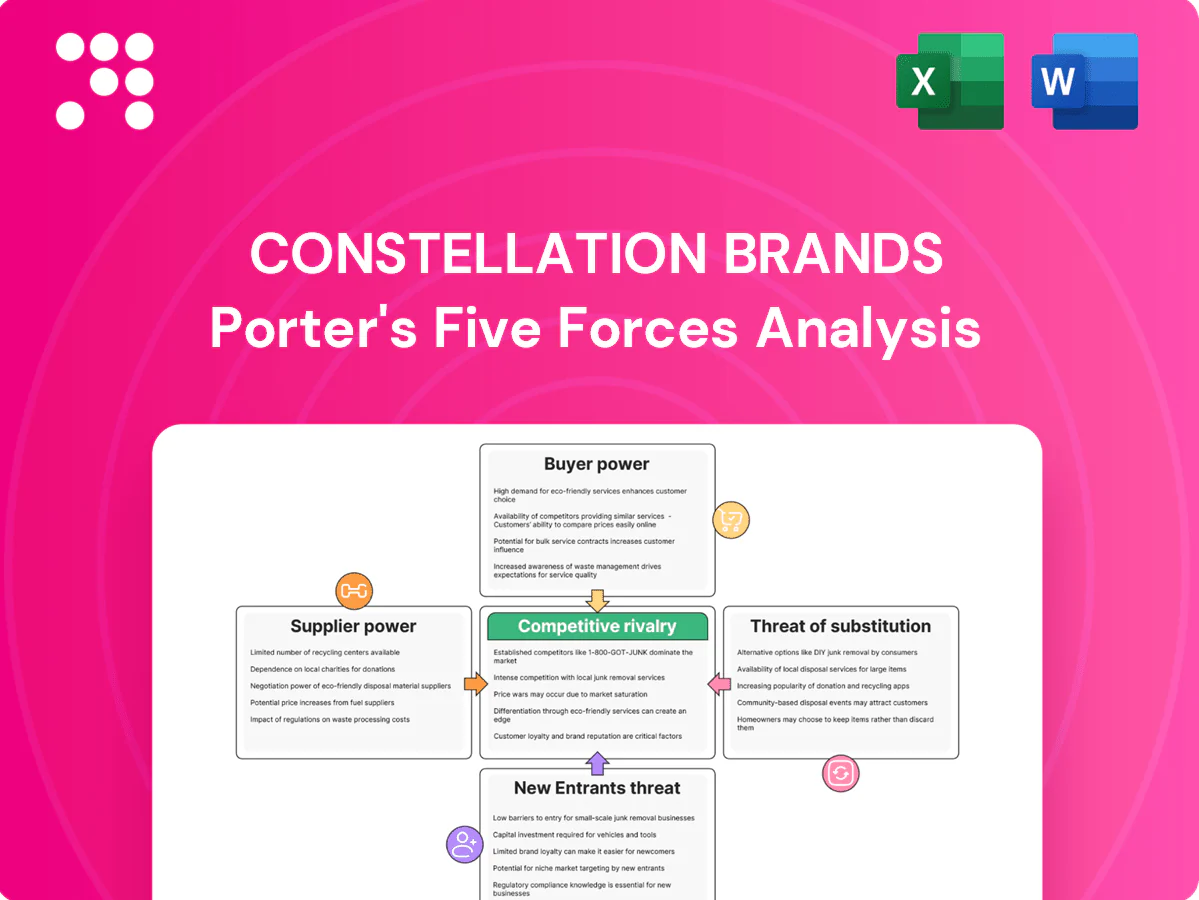
Constellation Brands Porter's Five Forces Analysis

From Overview to Strategy Blueprint
Constellation Brands faces strong retail buyer power, growing substitute threats from craft and spirits, and moderate supplier leverage, while scale and distribution intensity keep new entrants constrained. Competitive rivalry is high amid premiumization and input-cost volatility. This brief snapshot only scratches the surface. Unlock the full Porter's Five Forces Analysis to explore Constellation Brands’s competitive dynamics, market pressures, and strategic advantages in detail.
Suppliers Bargaining Power

Agri-input dependence
Constellation depends on hops, barley, grapes, agave and specialty ingredients that face yield variability and climate risk, with growers reporting up to 30% year-to-year swings in some specialty crops.
Crop scarcity or quality drops can strengthen supplier leverage and lift input costs; Constellation uses long-term contracts and diversified sourcing to mitigate volatility.
Premium pricing in 2024 helps pass through spikes but passthrough can lag several months, squeezing margins in the interim.
Packaging concentration
Glass bottle and aluminum can supply is concentrated—Ball, Crown and Ardagh remain the primary global beverage-packaging players in 2024—so energy-driven input cost swings feed directly into prices. Periodic can and bottle shortages have constrained volumes and reduced Constellation Brands’ negotiating leverage. Multi-year contracts and dual-sourcing mitigate but switching carries friction and lead times. Localized packaging investments near breweries lower freight costs and supply risk.

Mexican brewery inputs
Large-scale Mexican breweries rely on local utilities, municipal water and cross-border logistics; Mexico had about 128 million people in 2024, concentrating demand and supply pressures. CONAGUA has reported roughly 104 of 653 aquifers classified as overexploited, which can boost supplier/utility leverage and costs. Brewery scale and in-house treatment/logistics mitigate some risk. Permitting and community relations remain critical dependencies.

Specialty spirits materials
Specialty spirits materials give suppliers elevated leverage for Constellation Brands because agave harvests average 7–10 years and tequila production and whiskey maturation (commonly 4+ years) create long lead times; barrel scarcity tightened in 2023–24 as demand for aged spirits rose. Longer agricultural and maturation cycles increase supplier influence; forward contracts and strategic inventory management are primary hedges, while shifting brand mix (tequila vs wine/beer) helps navigate shortfalls.
- agave cycle: 7–10 years
- whiskey maturation: commonly 4+ years
- hedges: forward contracts, inventory buffers
- strategy: pivot brand mix to mitigate tight supply
Countervailing brand scale
Flagship brands Modelo and Corona deliver scale and visibility; Constellation reported fiscal 2024 net sales of about $11.6 billion, with beer as a core volume driver, which attracts suppliers and secures steady offtake. High, predictable demand grants Constellation negotiating clout and access to preferred terms. Suppliers value long-term partnerships, moderating overall supplier power despite pockets of tightness.
Water stress, long agave/whiskey cycles and packaging concentration increase supplier power
Constellation faces supplier power pockets from specialty ag inputs (agave 7–10y, whiskey 4+y) and concentrated packagers (Ball, Crown, Ardagh), which can spike costs and cause shortages.
Long contracts, dual‑sourcing, forward hedges and local packaging investments reduce leverage; flagship beer scale (FY2024 net sales ≈ $11.6B) preserves negotiating clout.
Water stress in Mexico (104 of 653 aquifers overexploited) and climate-driven yield swings (up to 30% in specialty crops) elevate supplier influence episodically.
| Metric | 2024/Note |
|---|---|
| FY2024 net sales | $11.6B |
| Agave cycle | 7–10 years |
| Whiskey maturation | 4+ years |
| Mexican aquifers overexploited | 104 of 653 (CONAGUA) |
| Packaging concentration | Ball, Crown, Ardagh |
What is included in the product
 Detailed Word Document
Uncovers key drivers of competition, buyer and supplier power, threat of substitutes, and entry barriers specific to Constellation Brands, identifying disruptive threats and strategic levers to protect market share and profitability.

 Customizable Excel Spreadsheet
Clear one-sheet Porter's Five Forces for Constellation Brands—instantly visualize competitive pressure and supplier/buyer leverage to speed strategic decisions. Customize force levels and swap in your own data for scenario analysis or pitch-ready slides without complex tools.
Customers Bargaining Power

Wholesaler leverage
U.S. three-tier distribution concentrates power in a few national wholesalers—eg Southern Glazer's (operates in 44 states) and RNDC (30+ states)—whose scale and portfolio breadth let them press for favorable terms and shelf placement. Their leverage is blunted where Constellation's must-win brands drive volume; Constellation reported roughly $8.9 billion in fiscal 2024 net sales so those SKUs gain priority. Performance incentives and co-marketing investments further align distributor-retailer execution.
Big-box retail
Big-box chains and club stores exert strong shelf-space and pricing influence, often extracting promotions and favorable trade terms from suppliers. Constellation’s high-velocity SKUs, led by Modelo and Corona, routinely secure endcaps and cooler placement, supporting off-premise performance. In FY2024 Constellation reported roughly $8.9 billion in net sales, with beer brands driving the bulk of growth. The company uses POS and category analytics to defend margin and negotiate terms.

On-premise accounts
Bars and restaurants push rotations, keg deals and exclusives to drive traffic, making on-premise accounts key for Constellation Brands. Volume per account can be meaningful but is fragmented across more than 660,000 U.S. restaurants and foodservice outlets in 2024, limiting coordinated bargaining power. Draft system investments and menu placement create switching costs, while strong premium beer demand supports pricing resilience.

Consumer price sensitivity
Constellation's premium positioning reduces price elasticity versus value tiers, but 2024 pressure on consumer spending led some trade-downs and smaller pack uptake; FY2024 net sales ~ $9.7B and beer segment resilience limited volume declines. Ongoing RTD innovation and portfolio premiumization sustain relevance across price points, and strong brand equity tempers buyer power.
- Price elasticity: lower in premium segments
- FY2024 net sales ~ $9.7B
- Macro: trade-downs, smaller packs
- RTD/innovation sustain demand
Private label threat
Retailer private-label wine can undercut pricing and win shelf space, pressuring margins for Constellation Brands; fiscal 2024 net sales were about $8.8 billion, highlighting exposure to trade dynamics. Constellation’s differentiated branding and quality cues for premium labels help protect share, while trade-ups to recognized imports offset down-market shifts. Assortment analytics and category data justify facings and defend placement.
- Private-label pricing pressure
- Branding/quality as defenses
- Trade-ups to imports support volume
- Assortment analytics justify facings
Premium spirits defend margins amid buyer pressure - FY2024 sales $8.9B
Customers hold moderate bargaining power: national wholesalers and big-box chains extract favorable terms, but Constellation's must-win brands (FY2024 net sales ~$8.9B) secure placement and incentives; on-premise is fragmented across 660,000+ U.S. outlets limiting coordinated pressure; premium positioning and RTD innovation reduce price elasticity.
| Metric | 2024 |
|---|---|
| FY net sales | $8.9B |
| U.S. foodservice outlets | 660,000+ |
Preview Before You Purchase
Constellation Brands Porter's Five Forces Analysis
This preview is the exact Constellation Brands Porter's Five Forces analysis you'll receive after purchase—fully formatted and ready to use. It covers supplier power, buyer power, competitive rivalry, threat of substitution, and entry barriers with actionable insights. No placeholders or samples; the file available for immediate download is this same document.

From Overview to Strategy Blueprint
Constellation Brands faces strong retail buyer power, growing substitute threats from craft and spirits, and moderate supplier leverage, while scale and distribution intensity keep new entrants constrained. Competitive rivalry is high amid premiumization and input-cost volatility. This brief snapshot only scratches the surface. Unlock the full Porter's Five Forces Analysis to explore Constellation Brands’s competitive dynamics, market pressures, and strategic advantages in detail.
Suppliers Bargaining Power
Agri-input dependence
Constellation depends on hops, barley, grapes, agave and specialty ingredients that face yield variability and climate risk, with growers reporting up to 30% year-to-year swings in some specialty crops.
Crop scarcity or quality drops can strengthen supplier leverage and lift input costs; Constellation uses long-term contracts and diversified sourcing to mitigate volatility.
Premium pricing in 2024 helps pass through spikes but passthrough can lag several months, squeezing margins in the interim.
Packaging concentration
Glass bottle and aluminum can supply is concentrated—Ball, Crown and Ardagh remain the primary global beverage-packaging players in 2024—so energy-driven input cost swings feed directly into prices. Periodic can and bottle shortages have constrained volumes and reduced Constellation Brands’ negotiating leverage. Multi-year contracts and dual-sourcing mitigate but switching carries friction and lead times. Localized packaging investments near breweries lower freight costs and supply risk.
Mexican brewery inputs
Large-scale Mexican breweries rely on local utilities, municipal water and cross-border logistics; Mexico had about 128 million people in 2024, concentrating demand and supply pressures. CONAGUA has reported roughly 104 of 653 aquifers classified as overexploited, which can boost supplier/utility leverage and costs. Brewery scale and in-house treatment/logistics mitigate some risk. Permitting and community relations remain critical dependencies.
Specialty spirits materials
Specialty spirits materials give suppliers elevated leverage for Constellation Brands because agave harvests average 7–10 years and tequila production and whiskey maturation (commonly 4+ years) create long lead times; barrel scarcity tightened in 2023–24 as demand for aged spirits rose. Longer agricultural and maturation cycles increase supplier influence; forward contracts and strategic inventory management are primary hedges, while shifting brand mix (tequila vs wine/beer) helps navigate shortfalls.
- agave cycle: 7–10 years
- whiskey maturation: commonly 4+ years
- hedges: forward contracts, inventory buffers
- strategy: pivot brand mix to mitigate tight supply
Countervailing brand scale
Flagship brands Modelo and Corona deliver scale and visibility; Constellation reported fiscal 2024 net sales of about $11.6 billion, with beer as a core volume driver, which attracts suppliers and secures steady offtake. High, predictable demand grants Constellation negotiating clout and access to preferred terms. Suppliers value long-term partnerships, moderating overall supplier power despite pockets of tightness.
Water stress, long agave/whiskey cycles and packaging concentration increase supplier power
Constellation faces supplier power pockets from specialty ag inputs (agave 7–10y, whiskey 4+y) and concentrated packagers (Ball, Crown, Ardagh), which can spike costs and cause shortages.
Long contracts, dual‑sourcing, forward hedges and local packaging investments reduce leverage; flagship beer scale (FY2024 net sales ≈ $11.6B) preserves negotiating clout.
Water stress in Mexico (104 of 653 aquifers overexploited) and climate-driven yield swings (up to 30% in specialty crops) elevate supplier influence episodically.
| Metric | 2024/Note |
|---|---|
| FY2024 net sales | $11.6B |
| Agave cycle | 7–10 years |
| Whiskey maturation | 4+ years |
| Mexican aquifers overexploited | 104 of 653 (CONAGUA) |
| Packaging concentration | Ball, Crown, Ardagh |
What is included in the product
Detailed Word Document
Uncovers key drivers of competition, buyer and supplier power, threat of substitutes, and entry barriers specific to Constellation Brands, identifying disruptive threats and strategic levers to protect market share and profitability.
Customizable Excel Spreadsheet
Clear one-sheet Porter's Five Forces for Constellation Brands—instantly visualize competitive pressure and supplier/buyer leverage to speed strategic decisions. Customize force levels and swap in your own data for scenario analysis or pitch-ready slides without complex tools.
Customers Bargaining Power
Wholesaler leverage
U.S. three-tier distribution concentrates power in a few national wholesalers—eg Southern Glazer's (operates in 44 states) and RNDC (30+ states)—whose scale and portfolio breadth let them press for favorable terms and shelf placement. Their leverage is blunted where Constellation's must-win brands drive volume; Constellation reported roughly $8.9 billion in fiscal 2024 net sales so those SKUs gain priority. Performance incentives and co-marketing investments further align distributor-retailer execution.
Big-box retail
Big-box chains and club stores exert strong shelf-space and pricing influence, often extracting promotions and favorable trade terms from suppliers. Constellation’s high-velocity SKUs, led by Modelo and Corona, routinely secure endcaps and cooler placement, supporting off-premise performance. In FY2024 Constellation reported roughly $8.9 billion in net sales, with beer brands driving the bulk of growth. The company uses POS and category analytics to defend margin and negotiate terms.
On-premise accounts
Bars and restaurants push rotations, keg deals and exclusives to drive traffic, making on-premise accounts key for Constellation Brands. Volume per account can be meaningful but is fragmented across more than 660,000 U.S. restaurants and foodservice outlets in 2024, limiting coordinated bargaining power. Draft system investments and menu placement create switching costs, while strong premium beer demand supports pricing resilience.
Consumer price sensitivity
Constellation's premium positioning reduces price elasticity versus value tiers, but 2024 pressure on consumer spending led some trade-downs and smaller pack uptake; FY2024 net sales ~ $9.7B and beer segment resilience limited volume declines. Ongoing RTD innovation and portfolio premiumization sustain relevance across price points, and strong brand equity tempers buyer power.
- Price elasticity: lower in premium segments
- FY2024 net sales ~ $9.7B
- Macro: trade-downs, smaller packs
- RTD/innovation sustain demand
Private label threat
Retailer private-label wine can undercut pricing and win shelf space, pressuring margins for Constellation Brands; fiscal 2024 net sales were about $8.8 billion, highlighting exposure to trade dynamics. Constellation’s differentiated branding and quality cues for premium labels help protect share, while trade-ups to recognized imports offset down-market shifts. Assortment analytics and category data justify facings and defend placement.
- Private-label pricing pressure
- Branding/quality as defenses
- Trade-ups to imports support volume
- Assortment analytics justify facings
Premium spirits defend margins amid buyer pressure - FY2024 sales $8.9B
Customers hold moderate bargaining power: national wholesalers and big-box chains extract favorable terms, but Constellation's must-win brands (FY2024 net sales ~$8.9B) secure placement and incentives; on-premise is fragmented across 660,000+ U.S. outlets limiting coordinated pressure; premium positioning and RTD innovation reduce price elasticity.
| Metric | 2024 |
|---|---|
| FY net sales | $8.9B |
| U.S. foodservice outlets | 660,000+ |
Preview Before You Purchase
Constellation Brands Porter's Five Forces Analysis
This preview is the exact Constellation Brands Porter's Five Forces analysis you'll receive after purchase—fully formatted and ready to use. It covers supplier power, buyer power, competitive rivalry, threat of substitution, and entry barriers with actionable insights. No placeholders or samples; the file available for immediate download is this same document.
Original: $10.00
-65%$10.00
$3.50Description
From Overview to Strategy Blueprint
Constellation Brands faces strong retail buyer power, growing substitute threats from craft and spirits, and moderate supplier leverage, while scale and distribution intensity keep new entrants constrained. Competitive rivalry is high amid premiumization and input-cost volatility. This brief snapshot only scratches the surface. Unlock the full Porter's Five Forces Analysis to explore Constellation Brands’s competitive dynamics, market pressures, and strategic advantages in detail.
Suppliers Bargaining Power
Agri-input dependence
Constellation depends on hops, barley, grapes, agave and specialty ingredients that face yield variability and climate risk, with growers reporting up to 30% year-to-year swings in some specialty crops.
Crop scarcity or quality drops can strengthen supplier leverage and lift input costs; Constellation uses long-term contracts and diversified sourcing to mitigate volatility.
Premium pricing in 2024 helps pass through spikes but passthrough can lag several months, squeezing margins in the interim.
Packaging concentration
Glass bottle and aluminum can supply is concentrated—Ball, Crown and Ardagh remain the primary global beverage-packaging players in 2024—so energy-driven input cost swings feed directly into prices. Periodic can and bottle shortages have constrained volumes and reduced Constellation Brands’ negotiating leverage. Multi-year contracts and dual-sourcing mitigate but switching carries friction and lead times. Localized packaging investments near breweries lower freight costs and supply risk.
Mexican brewery inputs
Large-scale Mexican breweries rely on local utilities, municipal water and cross-border logistics; Mexico had about 128 million people in 2024, concentrating demand and supply pressures. CONAGUA has reported roughly 104 of 653 aquifers classified as overexploited, which can boost supplier/utility leverage and costs. Brewery scale and in-house treatment/logistics mitigate some risk. Permitting and community relations remain critical dependencies.
Specialty spirits materials
Specialty spirits materials give suppliers elevated leverage for Constellation Brands because agave harvests average 7–10 years and tequila production and whiskey maturation (commonly 4+ years) create long lead times; barrel scarcity tightened in 2023–24 as demand for aged spirits rose. Longer agricultural and maturation cycles increase supplier influence; forward contracts and strategic inventory management are primary hedges, while shifting brand mix (tequila vs wine/beer) helps navigate shortfalls.
- agave cycle: 7–10 years
- whiskey maturation: commonly 4+ years
- hedges: forward contracts, inventory buffers
- strategy: pivot brand mix to mitigate tight supply
Countervailing brand scale
Flagship brands Modelo and Corona deliver scale and visibility; Constellation reported fiscal 2024 net sales of about $11.6 billion, with beer as a core volume driver, which attracts suppliers and secures steady offtake. High, predictable demand grants Constellation negotiating clout and access to preferred terms. Suppliers value long-term partnerships, moderating overall supplier power despite pockets of tightness.
Water stress, long agave/whiskey cycles and packaging concentration increase supplier power
Constellation faces supplier power pockets from specialty ag inputs (agave 7–10y, whiskey 4+y) and concentrated packagers (Ball, Crown, Ardagh), which can spike costs and cause shortages.
Long contracts, dual‑sourcing, forward hedges and local packaging investments reduce leverage; flagship beer scale (FY2024 net sales ≈ $11.6B) preserves negotiating clout.
Water stress in Mexico (104 of 653 aquifers overexploited) and climate-driven yield swings (up to 30% in specialty crops) elevate supplier influence episodically.
| Metric | 2024/Note |
|---|---|
| FY2024 net sales | $11.6B |
| Agave cycle | 7–10 years |
| Whiskey maturation | 4+ years |
| Mexican aquifers overexploited | 104 of 653 (CONAGUA) |
| Packaging concentration | Ball, Crown, Ardagh |
What is included in the product
Detailed Word Document
Uncovers key drivers of competition, buyer and supplier power, threat of substitutes, and entry barriers specific to Constellation Brands, identifying disruptive threats and strategic levers to protect market share and profitability.
Customizable Excel Spreadsheet
Clear one-sheet Porter's Five Forces for Constellation Brands—instantly visualize competitive pressure and supplier/buyer leverage to speed strategic decisions. Customize force levels and swap in your own data for scenario analysis or pitch-ready slides without complex tools.
Customers Bargaining Power
Wholesaler leverage
U.S. three-tier distribution concentrates power in a few national wholesalers—eg Southern Glazer's (operates in 44 states) and RNDC (30+ states)—whose scale and portfolio breadth let them press for favorable terms and shelf placement. Their leverage is blunted where Constellation's must-win brands drive volume; Constellation reported roughly $8.9 billion in fiscal 2024 net sales so those SKUs gain priority. Performance incentives and co-marketing investments further align distributor-retailer execution.
Big-box retail
Big-box chains and club stores exert strong shelf-space and pricing influence, often extracting promotions and favorable trade terms from suppliers. Constellation’s high-velocity SKUs, led by Modelo and Corona, routinely secure endcaps and cooler placement, supporting off-premise performance. In FY2024 Constellation reported roughly $8.9 billion in net sales, with beer brands driving the bulk of growth. The company uses POS and category analytics to defend margin and negotiate terms.
On-premise accounts
Bars and restaurants push rotations, keg deals and exclusives to drive traffic, making on-premise accounts key for Constellation Brands. Volume per account can be meaningful but is fragmented across more than 660,000 U.S. restaurants and foodservice outlets in 2024, limiting coordinated bargaining power. Draft system investments and menu placement create switching costs, while strong premium beer demand supports pricing resilience.
Consumer price sensitivity
Constellation's premium positioning reduces price elasticity versus value tiers, but 2024 pressure on consumer spending led some trade-downs and smaller pack uptake; FY2024 net sales ~ $9.7B and beer segment resilience limited volume declines. Ongoing RTD innovation and portfolio premiumization sustain relevance across price points, and strong brand equity tempers buyer power.
- Price elasticity: lower in premium segments
- FY2024 net sales ~ $9.7B
- Macro: trade-downs, smaller packs
- RTD/innovation sustain demand
Private label threat
Retailer private-label wine can undercut pricing and win shelf space, pressuring margins for Constellation Brands; fiscal 2024 net sales were about $8.8 billion, highlighting exposure to trade dynamics. Constellation’s differentiated branding and quality cues for premium labels help protect share, while trade-ups to recognized imports offset down-market shifts. Assortment analytics and category data justify facings and defend placement.
- Private-label pricing pressure
- Branding/quality as defenses
- Trade-ups to imports support volume
- Assortment analytics justify facings
Premium spirits defend margins amid buyer pressure - FY2024 sales $8.9B
Customers hold moderate bargaining power: national wholesalers and big-box chains extract favorable terms, but Constellation's must-win brands (FY2024 net sales ~$8.9B) secure placement and incentives; on-premise is fragmented across 660,000+ U.S. outlets limiting coordinated pressure; premium positioning and RTD innovation reduce price elasticity.
| Metric | 2024 |
|---|---|
| FY net sales | $8.9B |
| U.S. foodservice outlets | 660,000+ |
Preview Before You Purchase
Constellation Brands Porter's Five Forces Analysis
This preview is the exact Constellation Brands Porter's Five Forces analysis you'll receive after purchase—fully formatted and ready to use. It covers supplier power, buyer power, competitive rivalry, threat of substitution, and entry barriers with actionable insights. No placeholders or samples; the file available for immediate download is this same document.











