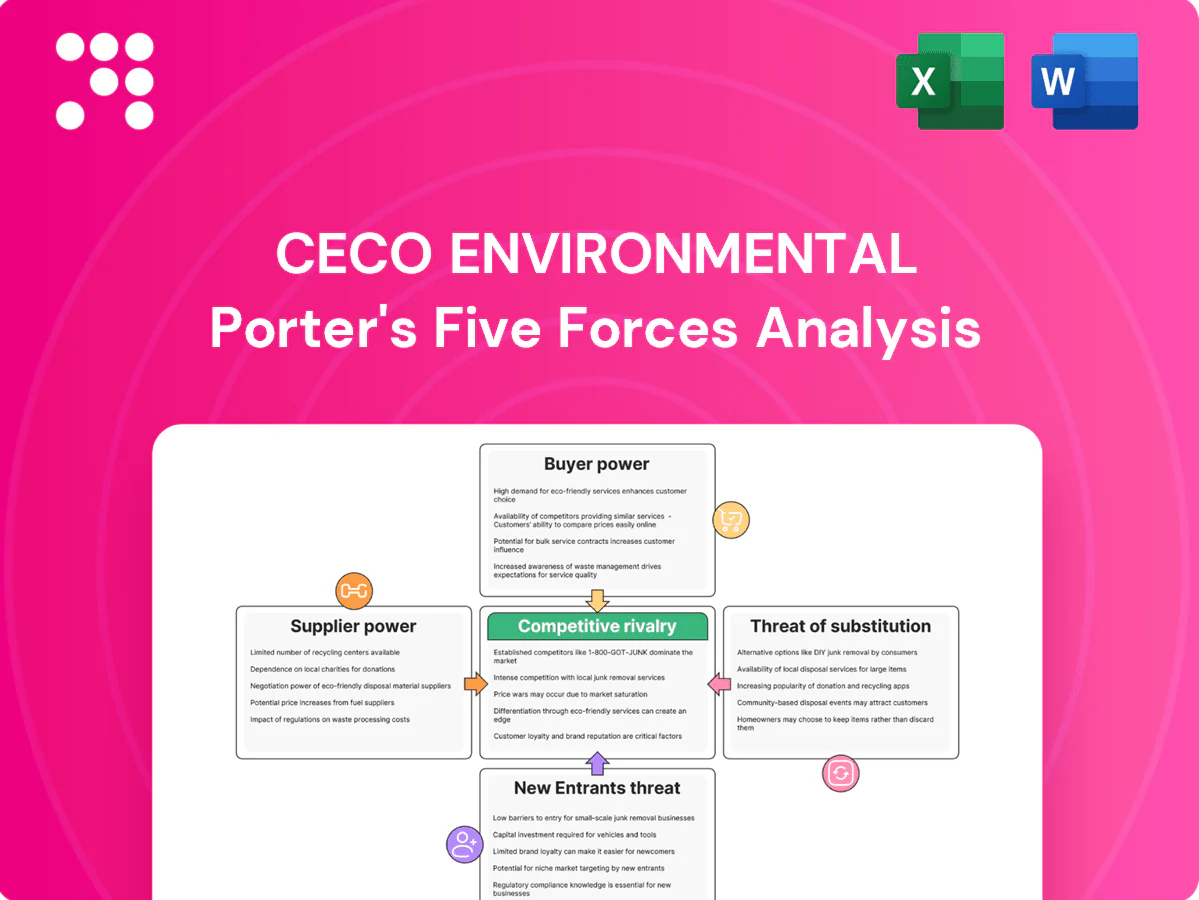
CECO Environmental Porter's Five Forces Analysis

A Must-Have Tool for Decision-Makers
CECO Environmental faces moderate supplier power, varied buyer sensitivity, and competitive rivalry driven by specialized filtration and emissions-control niches. Threat of new entrants is tempered by regulatory barriers and capital needs, while substitutes and tech shifts pose evolving risks. This snapshot highlights key dynamics but omits force-level ratings and strategic actions. Unlock the full Porter's Five Forces Analysis to explore CECO Environmental’s competitive dynamics, market pressures, and strategic advantages in detail.
Suppliers Bargaining Power

Specialized component concentration
CECO depends on engineered fans, pumps, filters, membranes and control systems from a small pool of qualified suppliers, concentrating bargaining power and raising switching costs and delivery risk. Dual-sourcing and multi-year supply agreements reduce vendor leverage, but qualification cycles commonly take 6–12 months and lead times can run several months. Supplier disruptions have historically delayed project milestones and increased project cost overruns.
Commodity metals volatility
Steel, stainless alloys and specialty coatings drive CECO’s material exposure, with global steel benchmarks swinging roughly 25% between 2023–24 and nickel-linked stainless volatility exceeding 40% YTD 2024, compressing margins on fixed-bid projects when escalation clauses are weak. Hedging and indexed contracts can cut realized volatility but are often infeasible for smaller orders. Extended lead-times and allocation have forced spot buys at 10–25% premiums.

Fabrication and machining capacity
Custom vessels, housings and skids need certified fabrication shops, and capacity limits or rework can sharply boost supplier leverage and delivery risk; large-structure lead times commonly range 8–16 weeks.
CECO’s vendor qualification program and manufacturing footprint across North America, Europe and Asia provide alternatives, lowering single-supplier dependence.
However, added cross-border logistics and import/export coordination routinely add weeks and cost, while proximity to end-markets constrains choices for very large structures.

Technological IP of component makers
Suppliers of proprietary control systems, sensors, and media hold technological IP that lets them demand favorable pricing or bundled contracts, which raises switching costs and can create vendor lock-in affecting system lifecycle economics; CECO Environmental Corp (NASDAQ: CECO) mitigates this by designing to industry standards and qualifying multiple technologies, though performance guarantees sometimes lock CECO into specific vendors.
- Proprietary IP increases supplier leverage
- Designing to standards reduces single-vendor risk
- Multiple approved technologies preserve flexibility
- Performance guarantees can create lock-in
Logistics and compliance requirements
Logistics for hazardous coatings, oversized loads, and cross-border shipments add regulatory and operational complexity that concentrates reliance on certified carriers and facilities; compliance documentation and testing must be performed by accredited labs or authorized service centers, creating supplier leverage over schedule and price. CECO’s advanced planning and QA lower disruption risk but cannot fully remove dependency on these specialized providers.
- Supply constraint: certified testing and handling required
- Cost leverage: specialized services command premium pricing
- Schedule risk: third-party lead times affect delivery
- Mitigation: CECO planning and QA reduce, not eliminate, leverage
Supplier squeeze: 6-16 weeks lead times; steel ~25%, stainless >40%, spot 10-25% premium
CECO faces concentrated supplier power for fans, pumps, membranes and proprietary controls, with lead times of 6–16 weeks and supplier qualification cycles of 6–12 months. Global steel swung ~25% in 2023–24 and nickel-linked stainless moved >40% YTD 2024, forcing spot buys at 10–25% premiums. Dual-sourcing, multi-year contracts and multi-region manufacturing reduce but do not eliminate vendor leverage.
| Metric | Value |
|---|---|
| Lead times | 6–16 weeks |
| Qualification | 6–12 months |
| Steel volatility (2023–24) | ~25% |
| Stainless volatility (YTD 2024) | >40% |
| Spot premium | 10–25% |
What is included in the product
 Detailed Word Document
Concise Porter's Five Forces assessment for CECO Environmental highlighting competitive rivalry, supplier and buyer power, threat of substitutes, and barriers to entry; pinpoints regulatory drivers, technological disruptors, and customer concentration that shape pricing and profitability. Tailored insights support strategic positioning, risk mitigation, and investment decisions.

 Customizable Excel Spreadsheet
A concise, one-sheet Porter's Five Forces for CECO Environmental that highlights competitive pressure, customizable scores and a ready-to-use spider chart—perfect for slides and fast strategic decisions.
Customers Bargaining Power

Large industrial buyers
Large industrial buyers in energy, manufacturing and process sectors run competitive RFPs, and in 2024 these procurement processes increasingly pushed suppliers on price, delivery and service levels. Their scale and sophisticated sourcing teams compress margins and demand stricter commercial terms, while multi-year framework agreements concentrate volume with select vendors. CECO must compete on measurable performance guarantees and lower lifecycle cost to win and retain that concentrated spend.
Project-based, lumpy demand
Project-based, lumpy demand ties CECO Environmental orders to capex cycles and regulatory deadlines, letting buyers delay or phase projects to extract concessions; pipeline visibility reduces surprise but customers can reprioritize backlog, creating pricing pressure. CECO mitigates this through diversified end-markets and a larger aftermarket/services mix that stabilizes revenue and shortens sales cycles.

High switching costs post-install
Once CECO systems are installed, integration, service contracts and OEM spare parts create significant lock-in that lowers buyer leverage on aftermarket pricing and upgrade cycles. Buyers retain strong bargaining power during initial bids by controlling technical specifications and supplier selection. Performance warranties and compliance risk-sharing are routinely used as negotiation levers. CECO trades on NASDAQ under CECO in 2024.

Outcome and compliance focus
Buyers prioritize uptime, emissions compliance, and energy efficiency over sticker price, shifting negotiations toward outcomes and total cost of ownership; documented performance data and proven compliance track records strengthen CECO Environmental’s negotiating position by narrowing viable alternatives for customers facing strict emissions rules.
- Outcome focus: uptime and TCO
- Compliance lock-in: limits substitutes
- Data leverage: documented performance
Global footprint expectations
Multinationals prioritize vendors with global service, local codes knowledge, and fast parts availability, enabling them to demand consistent SLAs across regions; CECO’s international service network reduces this buyer power by aligning uptime and response targets. Where CECO lacks coverage, regional buyers exploit supplier competition to secure lower prices or faster lead times, increasing their bargaining leverage.
- Global service reduces buyer leverage
- Local codes expertise supports SLA compliance
- Parts availability shortens downtime
- Coverage gaps raise regional buyer power
Buyers drive RFP pressure in 2024 - uptime, emissions and TCO decide winners
Large industrial buyers run competitive RFPs in 2024, pushing price, delivery and stricter terms; CECO faces concentrated procurement but wins on measurable performance and lifecycle cost.
Project-driven demand and regulatory timing give buyers leverage at bid stage; installed-system lock-in and service contracts reduce aftermarket pressure.
Buyers prioritize uptime, emissions compliance and TCO; CECO trades on NASDAQ under CECO in 2024.
| Metric | 2024 |
|---|---|
| NASDAQ ticker | CECO |
| Buyer focus | Uptime, compliance, TCO |
| Commercial dynamic | RFP price/delivery pressure |
Full Version Awaits
CECO Environmental Porter's Five Forces Analysis
This CECO Environmental Porter's Five Forces analysis is the exact, professionally formatted document you’re previewing and the same file you’ll receive immediately after purchase. It contains in-depth evaluation of competitive rivalry, supplier and buyer power, threat of entry and substitutes. No placeholders or samples—ready for download and use upon payment.

A Must-Have Tool for Decision-Makers
CECO Environmental faces moderate supplier power, varied buyer sensitivity, and competitive rivalry driven by specialized filtration and emissions-control niches. Threat of new entrants is tempered by regulatory barriers and capital needs, while substitutes and tech shifts pose evolving risks. This snapshot highlights key dynamics but omits force-level ratings and strategic actions. Unlock the full Porter's Five Forces Analysis to explore CECO Environmental’s competitive dynamics, market pressures, and strategic advantages in detail.
Suppliers Bargaining Power
Specialized component concentration
CECO depends on engineered fans, pumps, filters, membranes and control systems from a small pool of qualified suppliers, concentrating bargaining power and raising switching costs and delivery risk. Dual-sourcing and multi-year supply agreements reduce vendor leverage, but qualification cycles commonly take 6–12 months and lead times can run several months. Supplier disruptions have historically delayed project milestones and increased project cost overruns.
Commodity metals volatility
Steel, stainless alloys and specialty coatings drive CECO’s material exposure, with global steel benchmarks swinging roughly 25% between 2023–24 and nickel-linked stainless volatility exceeding 40% YTD 2024, compressing margins on fixed-bid projects when escalation clauses are weak. Hedging and indexed contracts can cut realized volatility but are often infeasible for smaller orders. Extended lead-times and allocation have forced spot buys at 10–25% premiums.
Fabrication and machining capacity
Custom vessels, housings and skids need certified fabrication shops, and capacity limits or rework can sharply boost supplier leverage and delivery risk; large-structure lead times commonly range 8–16 weeks.
CECO’s vendor qualification program and manufacturing footprint across North America, Europe and Asia provide alternatives, lowering single-supplier dependence.
However, added cross-border logistics and import/export coordination routinely add weeks and cost, while proximity to end-markets constrains choices for very large structures.
Technological IP of component makers
Suppliers of proprietary control systems, sensors, and media hold technological IP that lets them demand favorable pricing or bundled contracts, which raises switching costs and can create vendor lock-in affecting system lifecycle economics; CECO Environmental Corp (NASDAQ: CECO) mitigates this by designing to industry standards and qualifying multiple technologies, though performance guarantees sometimes lock CECO into specific vendors.
- Proprietary IP increases supplier leverage
- Designing to standards reduces single-vendor risk
- Multiple approved technologies preserve flexibility
- Performance guarantees can create lock-in
Logistics and compliance requirements
Logistics for hazardous coatings, oversized loads, and cross-border shipments add regulatory and operational complexity that concentrates reliance on certified carriers and facilities; compliance documentation and testing must be performed by accredited labs or authorized service centers, creating supplier leverage over schedule and price. CECO’s advanced planning and QA lower disruption risk but cannot fully remove dependency on these specialized providers.
- Supply constraint: certified testing and handling required
- Cost leverage: specialized services command premium pricing
- Schedule risk: third-party lead times affect delivery
- Mitigation: CECO planning and QA reduce, not eliminate, leverage
Supplier squeeze: 6-16 weeks lead times; steel ~25%, stainless >40%, spot 10-25% premium
CECO faces concentrated supplier power for fans, pumps, membranes and proprietary controls, with lead times of 6–16 weeks and supplier qualification cycles of 6–12 months. Global steel swung ~25% in 2023–24 and nickel-linked stainless moved >40% YTD 2024, forcing spot buys at 10–25% premiums. Dual-sourcing, multi-year contracts and multi-region manufacturing reduce but do not eliminate vendor leverage.
| Metric | Value |
|---|---|
| Lead times | 6–16 weeks |
| Qualification | 6–12 months |
| Steel volatility (2023–24) | ~25% |
| Stainless volatility (YTD 2024) | >40% |
| Spot premium | 10–25% |
What is included in the product
Detailed Word Document
Concise Porter's Five Forces assessment for CECO Environmental highlighting competitive rivalry, supplier and buyer power, threat of substitutes, and barriers to entry; pinpoints regulatory drivers, technological disruptors, and customer concentration that shape pricing and profitability. Tailored insights support strategic positioning, risk mitigation, and investment decisions.
Customizable Excel Spreadsheet
A concise, one-sheet Porter's Five Forces for CECO Environmental that highlights competitive pressure, customizable scores and a ready-to-use spider chart—perfect for slides and fast strategic decisions.
Customers Bargaining Power
Large industrial buyers
Large industrial buyers in energy, manufacturing and process sectors run competitive RFPs, and in 2024 these procurement processes increasingly pushed suppliers on price, delivery and service levels. Their scale and sophisticated sourcing teams compress margins and demand stricter commercial terms, while multi-year framework agreements concentrate volume with select vendors. CECO must compete on measurable performance guarantees and lower lifecycle cost to win and retain that concentrated spend.
Project-based, lumpy demand
Project-based, lumpy demand ties CECO Environmental orders to capex cycles and regulatory deadlines, letting buyers delay or phase projects to extract concessions; pipeline visibility reduces surprise but customers can reprioritize backlog, creating pricing pressure. CECO mitigates this through diversified end-markets and a larger aftermarket/services mix that stabilizes revenue and shortens sales cycles.
High switching costs post-install
Once CECO systems are installed, integration, service contracts and OEM spare parts create significant lock-in that lowers buyer leverage on aftermarket pricing and upgrade cycles. Buyers retain strong bargaining power during initial bids by controlling technical specifications and supplier selection. Performance warranties and compliance risk-sharing are routinely used as negotiation levers. CECO trades on NASDAQ under CECO in 2024.
Outcome and compliance focus
Buyers prioritize uptime, emissions compliance, and energy efficiency over sticker price, shifting negotiations toward outcomes and total cost of ownership; documented performance data and proven compliance track records strengthen CECO Environmental’s negotiating position by narrowing viable alternatives for customers facing strict emissions rules.
- Outcome focus: uptime and TCO
- Compliance lock-in: limits substitutes
- Data leverage: documented performance
Global footprint expectations
Multinationals prioritize vendors with global service, local codes knowledge, and fast parts availability, enabling them to demand consistent SLAs across regions; CECO’s international service network reduces this buyer power by aligning uptime and response targets. Where CECO lacks coverage, regional buyers exploit supplier competition to secure lower prices or faster lead times, increasing their bargaining leverage.
- Global service reduces buyer leverage
- Local codes expertise supports SLA compliance
- Parts availability shortens downtime
- Coverage gaps raise regional buyer power
Buyers drive RFP pressure in 2024 - uptime, emissions and TCO decide winners
Large industrial buyers run competitive RFPs in 2024, pushing price, delivery and stricter terms; CECO faces concentrated procurement but wins on measurable performance and lifecycle cost.
Project-driven demand and regulatory timing give buyers leverage at bid stage; installed-system lock-in and service contracts reduce aftermarket pressure.
Buyers prioritize uptime, emissions compliance and TCO; CECO trades on NASDAQ under CECO in 2024.
| Metric | 2024 |
|---|---|
| NASDAQ ticker | CECO |
| Buyer focus | Uptime, compliance, TCO |
| Commercial dynamic | RFP price/delivery pressure |
Full Version Awaits
CECO Environmental Porter's Five Forces Analysis
This CECO Environmental Porter's Five Forces analysis is the exact, professionally formatted document you’re previewing and the same file you’ll receive immediately after purchase. It contains in-depth evaluation of competitive rivalry, supplier and buyer power, threat of entry and substitutes. No placeholders or samples—ready for download and use upon payment.
Original: $10.00
-65%$10.00
$3.50Description
A Must-Have Tool for Decision-Makers
CECO Environmental faces moderate supplier power, varied buyer sensitivity, and competitive rivalry driven by specialized filtration and emissions-control niches. Threat of new entrants is tempered by regulatory barriers and capital needs, while substitutes and tech shifts pose evolving risks. This snapshot highlights key dynamics but omits force-level ratings and strategic actions. Unlock the full Porter's Five Forces Analysis to explore CECO Environmental’s competitive dynamics, market pressures, and strategic advantages in detail.
Suppliers Bargaining Power
Specialized component concentration
CECO depends on engineered fans, pumps, filters, membranes and control systems from a small pool of qualified suppliers, concentrating bargaining power and raising switching costs and delivery risk. Dual-sourcing and multi-year supply agreements reduce vendor leverage, but qualification cycles commonly take 6–12 months and lead times can run several months. Supplier disruptions have historically delayed project milestones and increased project cost overruns.
Commodity metals volatility
Steel, stainless alloys and specialty coatings drive CECO’s material exposure, with global steel benchmarks swinging roughly 25% between 2023–24 and nickel-linked stainless volatility exceeding 40% YTD 2024, compressing margins on fixed-bid projects when escalation clauses are weak. Hedging and indexed contracts can cut realized volatility but are often infeasible for smaller orders. Extended lead-times and allocation have forced spot buys at 10–25% premiums.
Fabrication and machining capacity
Custom vessels, housings and skids need certified fabrication shops, and capacity limits or rework can sharply boost supplier leverage and delivery risk; large-structure lead times commonly range 8–16 weeks.
CECO’s vendor qualification program and manufacturing footprint across North America, Europe and Asia provide alternatives, lowering single-supplier dependence.
However, added cross-border logistics and import/export coordination routinely add weeks and cost, while proximity to end-markets constrains choices for very large structures.
Technological IP of component makers
Suppliers of proprietary control systems, sensors, and media hold technological IP that lets them demand favorable pricing or bundled contracts, which raises switching costs and can create vendor lock-in affecting system lifecycle economics; CECO Environmental Corp (NASDAQ: CECO) mitigates this by designing to industry standards and qualifying multiple technologies, though performance guarantees sometimes lock CECO into specific vendors.
- Proprietary IP increases supplier leverage
- Designing to standards reduces single-vendor risk
- Multiple approved technologies preserve flexibility
- Performance guarantees can create lock-in
Logistics and compliance requirements
Logistics for hazardous coatings, oversized loads, and cross-border shipments add regulatory and operational complexity that concentrates reliance on certified carriers and facilities; compliance documentation and testing must be performed by accredited labs or authorized service centers, creating supplier leverage over schedule and price. CECO’s advanced planning and QA lower disruption risk but cannot fully remove dependency on these specialized providers.
- Supply constraint: certified testing and handling required
- Cost leverage: specialized services command premium pricing
- Schedule risk: third-party lead times affect delivery
- Mitigation: CECO planning and QA reduce, not eliminate, leverage
Supplier squeeze: 6-16 weeks lead times; steel ~25%, stainless >40%, spot 10-25% premium
CECO faces concentrated supplier power for fans, pumps, membranes and proprietary controls, with lead times of 6–16 weeks and supplier qualification cycles of 6–12 months. Global steel swung ~25% in 2023–24 and nickel-linked stainless moved >40% YTD 2024, forcing spot buys at 10–25% premiums. Dual-sourcing, multi-year contracts and multi-region manufacturing reduce but do not eliminate vendor leverage.
| Metric | Value |
|---|---|
| Lead times | 6–16 weeks |
| Qualification | 6–12 months |
| Steel volatility (2023–24) | ~25% |
| Stainless volatility (YTD 2024) | >40% |
| Spot premium | 10–25% |
What is included in the product
Detailed Word Document
Concise Porter's Five Forces assessment for CECO Environmental highlighting competitive rivalry, supplier and buyer power, threat of substitutes, and barriers to entry; pinpoints regulatory drivers, technological disruptors, and customer concentration that shape pricing and profitability. Tailored insights support strategic positioning, risk mitigation, and investment decisions.
Customizable Excel Spreadsheet
A concise, one-sheet Porter's Five Forces for CECO Environmental that highlights competitive pressure, customizable scores and a ready-to-use spider chart—perfect for slides and fast strategic decisions.
Customers Bargaining Power
Large industrial buyers
Large industrial buyers in energy, manufacturing and process sectors run competitive RFPs, and in 2024 these procurement processes increasingly pushed suppliers on price, delivery and service levels. Their scale and sophisticated sourcing teams compress margins and demand stricter commercial terms, while multi-year framework agreements concentrate volume with select vendors. CECO must compete on measurable performance guarantees and lower lifecycle cost to win and retain that concentrated spend.
Project-based, lumpy demand
Project-based, lumpy demand ties CECO Environmental orders to capex cycles and regulatory deadlines, letting buyers delay or phase projects to extract concessions; pipeline visibility reduces surprise but customers can reprioritize backlog, creating pricing pressure. CECO mitigates this through diversified end-markets and a larger aftermarket/services mix that stabilizes revenue and shortens sales cycles.
High switching costs post-install
Once CECO systems are installed, integration, service contracts and OEM spare parts create significant lock-in that lowers buyer leverage on aftermarket pricing and upgrade cycles. Buyers retain strong bargaining power during initial bids by controlling technical specifications and supplier selection. Performance warranties and compliance risk-sharing are routinely used as negotiation levers. CECO trades on NASDAQ under CECO in 2024.
Outcome and compliance focus
Buyers prioritize uptime, emissions compliance, and energy efficiency over sticker price, shifting negotiations toward outcomes and total cost of ownership; documented performance data and proven compliance track records strengthen CECO Environmental’s negotiating position by narrowing viable alternatives for customers facing strict emissions rules.
- Outcome focus: uptime and TCO
- Compliance lock-in: limits substitutes
- Data leverage: documented performance
Global footprint expectations
Multinationals prioritize vendors with global service, local codes knowledge, and fast parts availability, enabling them to demand consistent SLAs across regions; CECO’s international service network reduces this buyer power by aligning uptime and response targets. Where CECO lacks coverage, regional buyers exploit supplier competition to secure lower prices or faster lead times, increasing their bargaining leverage.
- Global service reduces buyer leverage
- Local codes expertise supports SLA compliance
- Parts availability shortens downtime
- Coverage gaps raise regional buyer power
Buyers drive RFP pressure in 2024 - uptime, emissions and TCO decide winners
Large industrial buyers run competitive RFPs in 2024, pushing price, delivery and stricter terms; CECO faces concentrated procurement but wins on measurable performance and lifecycle cost.
Project-driven demand and regulatory timing give buyers leverage at bid stage; installed-system lock-in and service contracts reduce aftermarket pressure.
Buyers prioritize uptime, emissions compliance and TCO; CECO trades on NASDAQ under CECO in 2024.
| Metric | 2024 |
|---|---|
| NASDAQ ticker | CECO |
| Buyer focus | Uptime, compliance, TCO |
| Commercial dynamic | RFP price/delivery pressure |
Full Version Awaits
CECO Environmental Porter's Five Forces Analysis
This CECO Environmental Porter's Five Forces analysis is the exact, professionally formatted document you’re previewing and the same file you’ll receive immediately after purchase. It contains in-depth evaluation of competitive rivalry, supplier and buyer power, threat of entry and substitutes. No placeholders or samples—ready for download and use upon payment.











