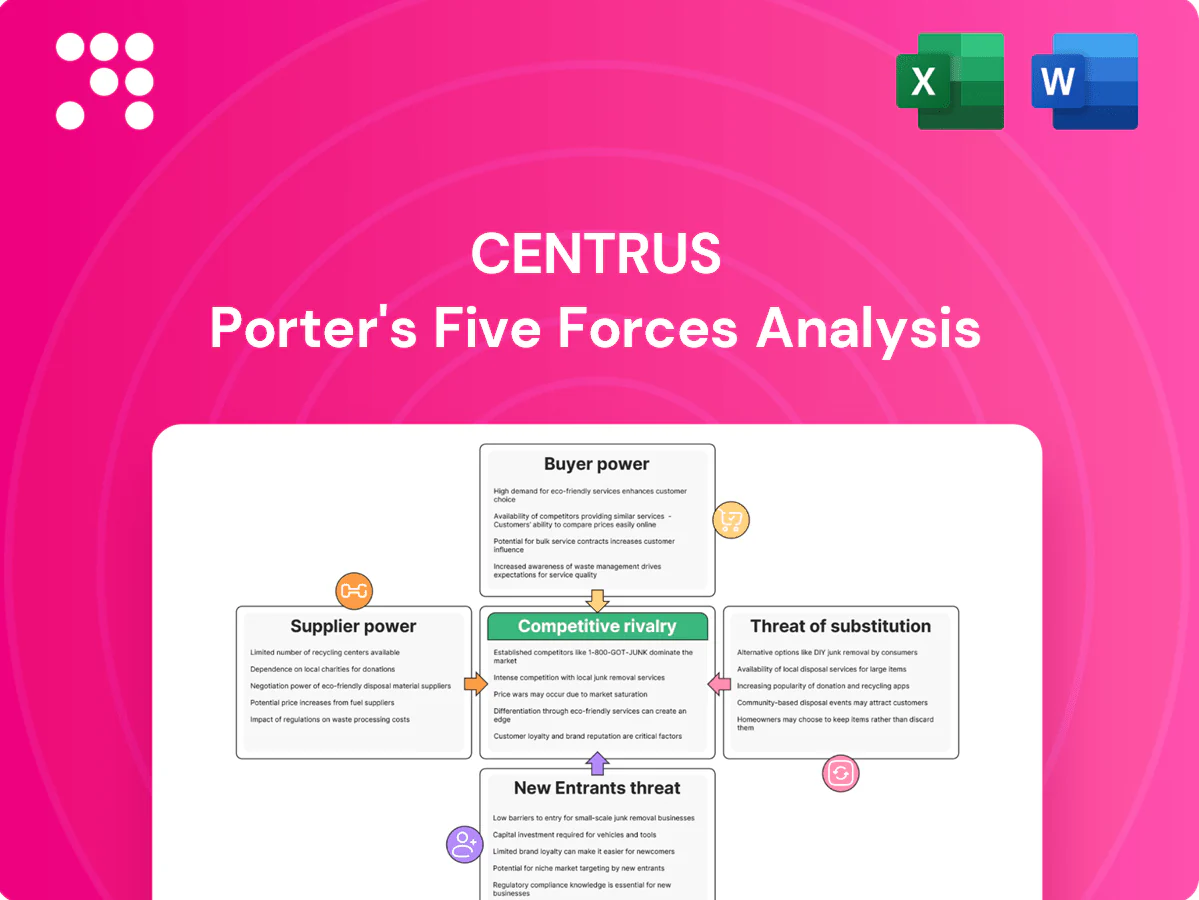
Centrus Porter's Five Forces Analysis

Go Beyond the Preview—Access the Full Strategic Report
Centrus operates in a niche, capital‑intensive market where supplier leverage and regulatory barriers shape margins, while buyer concentration and substitute technologies exert moderate pressure. Understanding these forces reveals strategic risks and growth levers. Unlock the full Porter's Five Forces Analysis for Centrus to see force ratings, visuals, and actionable recommendations.
Suppliers Bargaining Power

Concentrated uranium feedstock sources
Upstream uranium mining and conversion remain concentrated in 2024, with Kazakhstan supplying around 40% of mined uranium and major converters (Orano, Rosatom, CNNC) controlling a large share of UF6 conversion capacity, elevating supplier leverage on price and availability. Supply shocks from geopolitics or conversion bottlenecks quickly ripple into enrichment operations. Centrus’ reliance on steady UF6 feedstock limits substitution; long-term offtakes help but renegotiation power favors suppliers in tight markets.
Specialized centrifuge components
High-spec rotors, bearings, frequency drives and vacuum systems for centrifuges come from niche manufacturers subject to NRC/DOE oversight and EAR/ITAR export controls, concentrating supplier power. Qualification cycles and export licensing commonly require multiple months, constraining rapid vendor switching and elevating switching costs. Any supplier disruption or quality lapse can stall cascades and materially raise operating costs; dual-sourcing is possible but typically requires year-long regulatory and performance validation.

HALEU precursor constraints
HALEU requires specialized feedstock and processing that, as of 2024, only a handful of suppliers can provide, concentrating supplier power and creating dependence on select counterparties. This scarcity strengthens pricing leverage and stricter delivery terms, raising short-term margin risk for buyers. Planned capacity ramp-ups and DOE-backed initiatives in 2024 aim to ease constraints over time but near-term exposure remains material.

Regulatory and compliance inputs
Regulatory and compliance inputs function as quasi-suppliers for Centrus: compliance services, safeguards instrumentation and nuclear-grade QA/ISO frameworks dictate project timelines and cost structures. Audits and certification cycles take months to years and cannot be easily accelerated. Vendors with nuclear pedigree command premium commercial terms and limited competition, increasing supplier leverage.
- Compliance services: high influence
- Audits: months–years
- Nuclear vendors: premium terms
Energy and utilities as critical inputs
Enrichment is electricity-intensive, so power providers strongly influence Centrus operating costs; U.S. industrial electricity averaged about 8.0¢/kWh in 2024 (EIA), making energy a material input. Volatile wholesale power markets can erode margins if not hedged, and grid reliability directly affects uptime and separative work throughput. Long-dated power contracts mitigate price risk but constrain operational flexibility.
- Energy cost exposure: high
- 2024 industrial price: ~8.0¢/kWh (EIA)
- Reliability impacts throughput
- Long-term contracts lower price risk, reduce flexibility
Supplier power: ~40% KZ, HALEU scarce, energy 8.0¢/kWh
Supplier power is high: mined uranium concentrated (Kazakhstan ~40% of 2024 supply), major converters (Orano/Rosatom/CNNC) hold large UF6 capacity, HALEU feedstock limited to few suppliers, and energy costs (U.S. industrial ~8.0¢/kWh in 2024) materially affect margins; switching is slow due to regulation and qualification.
| Metric | 2024 Value |
|---|---|
| Kazakhstan share | ~40% |
| US industrial power | ~8.0¢/kWh |
| HALEU suppliers | Few (concentrated) |
What is included in the product
 Detailed Word Document
Uncovers key drivers of competition, customer influence, supplier power, substitutes, and entry risks for Centrus with force-by-force analysis, strategic implications, emerging threats, and a fully editable Word deliverable for investor materials, internal strategy decks, or academic use.

 Customizable Excel Spreadsheet
A concise, one-sheet Centrus Porter's Five Forces summary that instantly visualizes competitive pressure via a spider chart, is fully customizable for evolving market data, requires no macros, and slots seamlessly into pitch decks or executive reports to remove analysis friction.
Customers Bargaining Power

Concentrated utility customers
Nuclear utilities and fuel buyers are concentrated across about 30 countries and operate over 430 reactors worldwide (IAEA 2024), enabling coordinated procurement via consortia and strengthening buyer leverage. They routinely secure multi-year, index-linked contracts (typical tenors 3–10 years) and use stringent 12–18 month qualification processes to dictate specifications and delivery. Switching costs exist but are mitigated by portfolio sourcing from 3–5 suppliers.
Government and DOE programs
Public-sector demand, notably DOE programs for HALEU, introduces a large sophisticated buyer with strict procurement rules and milestone, reporting and pricing-transparency requirements. 2024 DOE guidance cites HALEU needs on the order of tens of kilograms to multiple tonnes as initial supply targets, creating timing risk tied to funding cycles. Policy support can underpin volume and implicit price floors, but contract stringency raises bargaining leverage for government purchasers.

Long-term contracting dynamics
Utilities push long-term SWU and EUP contracts with options and price ceilings, compressing Centrus margins and turning renewal windows into strong buyer leverage points. Performance guarantees and penalty clauses shift operational and market risk onto suppliers, raising capital and execution demands. Centrus defends pricing power with its unique HALEU enrichment capability and the premium value of domestic-origin supply for U.S. utilities.

Qualification and switching hurdles
Fuel qualification and licensing create strong lock-in with industry qualification timelines of 12–36 months and buyer planning horizons of 3–5 years (2024); approved vendor lists and certification requirements limit new sales until standards are met, after which price competition resumes and buyers benchmark offers against alternative enrichers.
- Qualification time: 12–36 months (2024)
- Buyer planning: 3–5 years
- Approved lists constrain entrants
- Post-qualification: price competition
- Alternate enrichers used for benchmarking
Price sensitivity amid cost pass-throughs
Buyers focus on total fuel-cycle costs and push contract formulas tied to U3O8, conversion and SWU indices to reduce volatility; in tight supply they accept premiums for security of supply, while in slack markets they demand concessions and flexible delivery.
- 2024: utilities moved to secure ~80% of near-term needs
- Index-linked pricing preferred
- Premiums accepted when supply tight
Buyers concentrated (≈430 reactors, ~30 countries) enforce 12–36m quals
Buyers are concentrated (≈430 reactors across ~30 countries in 2024) enabling consortium procurement and strong leverage. They secure multi-year, index-linked contracts (typical tenor 3–10 years) and enforce 12–36 month qualification processes, creating high entry barriers. Utilities secured ~80% of near-term needs in 2024, accepting premiums in tight markets but pushing price ceilings and heavy contractual protections.
| Metric | 2024 Value |
|---|---|
| Reactors | ≈430 |
| Countries | ≈30 |
| Qualification time | 12–36 months |
| Contract tenor | 3–10 years |
| Utilities secured near-term | ≈80% |
What You See Is What You Get
Centrus Porter's Five Forces Analysis
This preview shows the exact Centrus Porter’s Five Forces Analysis document you'll receive immediately after purchase—no surprises, no placeholders. You're viewing the professionally written, fully formatted analysis ready for immediate download and use the moment you buy. No mockups or samples; the file shown is precisely the deliverable available to you instantly after payment.

Go Beyond the Preview—Access the Full Strategic Report
Centrus operates in a niche, capital‑intensive market where supplier leverage and regulatory barriers shape margins, while buyer concentration and substitute technologies exert moderate pressure. Understanding these forces reveals strategic risks and growth levers. Unlock the full Porter's Five Forces Analysis for Centrus to see force ratings, visuals, and actionable recommendations.
Suppliers Bargaining Power
Concentrated uranium feedstock sources
Upstream uranium mining and conversion remain concentrated in 2024, with Kazakhstan supplying around 40% of mined uranium and major converters (Orano, Rosatom, CNNC) controlling a large share of UF6 conversion capacity, elevating supplier leverage on price and availability. Supply shocks from geopolitics or conversion bottlenecks quickly ripple into enrichment operations. Centrus’ reliance on steady UF6 feedstock limits substitution; long-term offtakes help but renegotiation power favors suppliers in tight markets.
Specialized centrifuge components
High-spec rotors, bearings, frequency drives and vacuum systems for centrifuges come from niche manufacturers subject to NRC/DOE oversight and EAR/ITAR export controls, concentrating supplier power. Qualification cycles and export licensing commonly require multiple months, constraining rapid vendor switching and elevating switching costs. Any supplier disruption or quality lapse can stall cascades and materially raise operating costs; dual-sourcing is possible but typically requires year-long regulatory and performance validation.
HALEU precursor constraints
HALEU requires specialized feedstock and processing that, as of 2024, only a handful of suppliers can provide, concentrating supplier power and creating dependence on select counterparties. This scarcity strengthens pricing leverage and stricter delivery terms, raising short-term margin risk for buyers. Planned capacity ramp-ups and DOE-backed initiatives in 2024 aim to ease constraints over time but near-term exposure remains material.
Regulatory and compliance inputs
Regulatory and compliance inputs function as quasi-suppliers for Centrus: compliance services, safeguards instrumentation and nuclear-grade QA/ISO frameworks dictate project timelines and cost structures. Audits and certification cycles take months to years and cannot be easily accelerated. Vendors with nuclear pedigree command premium commercial terms and limited competition, increasing supplier leverage.
- Compliance services: high influence
- Audits: months–years
- Nuclear vendors: premium terms
Energy and utilities as critical inputs
Enrichment is electricity-intensive, so power providers strongly influence Centrus operating costs; U.S. industrial electricity averaged about 8.0¢/kWh in 2024 (EIA), making energy a material input. Volatile wholesale power markets can erode margins if not hedged, and grid reliability directly affects uptime and separative work throughput. Long-dated power contracts mitigate price risk but constrain operational flexibility.
- Energy cost exposure: high
- 2024 industrial price: ~8.0¢/kWh (EIA)
- Reliability impacts throughput
- Long-term contracts lower price risk, reduce flexibility
Supplier power: ~40% KZ, HALEU scarce, energy 8.0¢/kWh
Supplier power is high: mined uranium concentrated (Kazakhstan ~40% of 2024 supply), major converters (Orano/Rosatom/CNNC) hold large UF6 capacity, HALEU feedstock limited to few suppliers, and energy costs (U.S. industrial ~8.0¢/kWh in 2024) materially affect margins; switching is slow due to regulation and qualification.
| Metric | 2024 Value |
|---|---|
| Kazakhstan share | ~40% |
| US industrial power | ~8.0¢/kWh |
| HALEU suppliers | Few (concentrated) |
What is included in the product
Detailed Word Document
Uncovers key drivers of competition, customer influence, supplier power, substitutes, and entry risks for Centrus with force-by-force analysis, strategic implications, emerging threats, and a fully editable Word deliverable for investor materials, internal strategy decks, or academic use.
Customizable Excel Spreadsheet
A concise, one-sheet Centrus Porter's Five Forces summary that instantly visualizes competitive pressure via a spider chart, is fully customizable for evolving market data, requires no macros, and slots seamlessly into pitch decks or executive reports to remove analysis friction.
Customers Bargaining Power
Concentrated utility customers
Nuclear utilities and fuel buyers are concentrated across about 30 countries and operate over 430 reactors worldwide (IAEA 2024), enabling coordinated procurement via consortia and strengthening buyer leverage. They routinely secure multi-year, index-linked contracts (typical tenors 3–10 years) and use stringent 12–18 month qualification processes to dictate specifications and delivery. Switching costs exist but are mitigated by portfolio sourcing from 3–5 suppliers.
Government and DOE programs
Public-sector demand, notably DOE programs for HALEU, introduces a large sophisticated buyer with strict procurement rules and milestone, reporting and pricing-transparency requirements. 2024 DOE guidance cites HALEU needs on the order of tens of kilograms to multiple tonnes as initial supply targets, creating timing risk tied to funding cycles. Policy support can underpin volume and implicit price floors, but contract stringency raises bargaining leverage for government purchasers.
Long-term contracting dynamics
Utilities push long-term SWU and EUP contracts with options and price ceilings, compressing Centrus margins and turning renewal windows into strong buyer leverage points. Performance guarantees and penalty clauses shift operational and market risk onto suppliers, raising capital and execution demands. Centrus defends pricing power with its unique HALEU enrichment capability and the premium value of domestic-origin supply for U.S. utilities.
Qualification and switching hurdles
Fuel qualification and licensing create strong lock-in with industry qualification timelines of 12–36 months and buyer planning horizons of 3–5 years (2024); approved vendor lists and certification requirements limit new sales until standards are met, after which price competition resumes and buyers benchmark offers against alternative enrichers.
- Qualification time: 12–36 months (2024)
- Buyer planning: 3–5 years
- Approved lists constrain entrants
- Post-qualification: price competition
- Alternate enrichers used for benchmarking
Price sensitivity amid cost pass-throughs
Buyers focus on total fuel-cycle costs and push contract formulas tied to U3O8, conversion and SWU indices to reduce volatility; in tight supply they accept premiums for security of supply, while in slack markets they demand concessions and flexible delivery.
- 2024: utilities moved to secure ~80% of near-term needs
- Index-linked pricing preferred
- Premiums accepted when supply tight
Buyers concentrated (≈430 reactors, ~30 countries) enforce 12–36m quals
Buyers are concentrated (≈430 reactors across ~30 countries in 2024) enabling consortium procurement and strong leverage. They secure multi-year, index-linked contracts (typical tenor 3–10 years) and enforce 12–36 month qualification processes, creating high entry barriers. Utilities secured ~80% of near-term needs in 2024, accepting premiums in tight markets but pushing price ceilings and heavy contractual protections.
| Metric | 2024 Value |
|---|---|
| Reactors | ≈430 |
| Countries | ≈30 |
| Qualification time | 12–36 months |
| Contract tenor | 3–10 years |
| Utilities secured near-term | ≈80% |
What You See Is What You Get
Centrus Porter's Five Forces Analysis
This preview shows the exact Centrus Porter’s Five Forces Analysis document you'll receive immediately after purchase—no surprises, no placeholders. You're viewing the professionally written, fully formatted analysis ready for immediate download and use the moment you buy. No mockups or samples; the file shown is precisely the deliverable available to you instantly after payment.
Original: $10.00
-65%$10.00
$3.50Description
Go Beyond the Preview—Access the Full Strategic Report
Centrus operates in a niche, capital‑intensive market where supplier leverage and regulatory barriers shape margins, while buyer concentration and substitute technologies exert moderate pressure. Understanding these forces reveals strategic risks and growth levers. Unlock the full Porter's Five Forces Analysis for Centrus to see force ratings, visuals, and actionable recommendations.
Suppliers Bargaining Power
Concentrated uranium feedstock sources
Upstream uranium mining and conversion remain concentrated in 2024, with Kazakhstan supplying around 40% of mined uranium and major converters (Orano, Rosatom, CNNC) controlling a large share of UF6 conversion capacity, elevating supplier leverage on price and availability. Supply shocks from geopolitics or conversion bottlenecks quickly ripple into enrichment operations. Centrus’ reliance on steady UF6 feedstock limits substitution; long-term offtakes help but renegotiation power favors suppliers in tight markets.
Specialized centrifuge components
High-spec rotors, bearings, frequency drives and vacuum systems for centrifuges come from niche manufacturers subject to NRC/DOE oversight and EAR/ITAR export controls, concentrating supplier power. Qualification cycles and export licensing commonly require multiple months, constraining rapid vendor switching and elevating switching costs. Any supplier disruption or quality lapse can stall cascades and materially raise operating costs; dual-sourcing is possible but typically requires year-long regulatory and performance validation.
HALEU precursor constraints
HALEU requires specialized feedstock and processing that, as of 2024, only a handful of suppliers can provide, concentrating supplier power and creating dependence on select counterparties. This scarcity strengthens pricing leverage and stricter delivery terms, raising short-term margin risk for buyers. Planned capacity ramp-ups and DOE-backed initiatives in 2024 aim to ease constraints over time but near-term exposure remains material.
Regulatory and compliance inputs
Regulatory and compliance inputs function as quasi-suppliers for Centrus: compliance services, safeguards instrumentation and nuclear-grade QA/ISO frameworks dictate project timelines and cost structures. Audits and certification cycles take months to years and cannot be easily accelerated. Vendors with nuclear pedigree command premium commercial terms and limited competition, increasing supplier leverage.
- Compliance services: high influence
- Audits: months–years
- Nuclear vendors: premium terms
Energy and utilities as critical inputs
Enrichment is electricity-intensive, so power providers strongly influence Centrus operating costs; U.S. industrial electricity averaged about 8.0¢/kWh in 2024 (EIA), making energy a material input. Volatile wholesale power markets can erode margins if not hedged, and grid reliability directly affects uptime and separative work throughput. Long-dated power contracts mitigate price risk but constrain operational flexibility.
- Energy cost exposure: high
- 2024 industrial price: ~8.0¢/kWh (EIA)
- Reliability impacts throughput
- Long-term contracts lower price risk, reduce flexibility
Supplier power: ~40% KZ, HALEU scarce, energy 8.0¢/kWh
Supplier power is high: mined uranium concentrated (Kazakhstan ~40% of 2024 supply), major converters (Orano/Rosatom/CNNC) hold large UF6 capacity, HALEU feedstock limited to few suppliers, and energy costs (U.S. industrial ~8.0¢/kWh in 2024) materially affect margins; switching is slow due to regulation and qualification.
| Metric | 2024 Value |
|---|---|
| Kazakhstan share | ~40% |
| US industrial power | ~8.0¢/kWh |
| HALEU suppliers | Few (concentrated) |
What is included in the product
Detailed Word Document
Uncovers key drivers of competition, customer influence, supplier power, substitutes, and entry risks for Centrus with force-by-force analysis, strategic implications, emerging threats, and a fully editable Word deliverable for investor materials, internal strategy decks, or academic use.
Customizable Excel Spreadsheet
A concise, one-sheet Centrus Porter's Five Forces summary that instantly visualizes competitive pressure via a spider chart, is fully customizable for evolving market data, requires no macros, and slots seamlessly into pitch decks or executive reports to remove analysis friction.
Customers Bargaining Power
Concentrated utility customers
Nuclear utilities and fuel buyers are concentrated across about 30 countries and operate over 430 reactors worldwide (IAEA 2024), enabling coordinated procurement via consortia and strengthening buyer leverage. They routinely secure multi-year, index-linked contracts (typical tenors 3–10 years) and use stringent 12–18 month qualification processes to dictate specifications and delivery. Switching costs exist but are mitigated by portfolio sourcing from 3–5 suppliers.
Government and DOE programs
Public-sector demand, notably DOE programs for HALEU, introduces a large sophisticated buyer with strict procurement rules and milestone, reporting and pricing-transparency requirements. 2024 DOE guidance cites HALEU needs on the order of tens of kilograms to multiple tonnes as initial supply targets, creating timing risk tied to funding cycles. Policy support can underpin volume and implicit price floors, but contract stringency raises bargaining leverage for government purchasers.
Long-term contracting dynamics
Utilities push long-term SWU and EUP contracts with options and price ceilings, compressing Centrus margins and turning renewal windows into strong buyer leverage points. Performance guarantees and penalty clauses shift operational and market risk onto suppliers, raising capital and execution demands. Centrus defends pricing power with its unique HALEU enrichment capability and the premium value of domestic-origin supply for U.S. utilities.
Qualification and switching hurdles
Fuel qualification and licensing create strong lock-in with industry qualification timelines of 12–36 months and buyer planning horizons of 3–5 years (2024); approved vendor lists and certification requirements limit new sales until standards are met, after which price competition resumes and buyers benchmark offers against alternative enrichers.
- Qualification time: 12–36 months (2024)
- Buyer planning: 3–5 years
- Approved lists constrain entrants
- Post-qualification: price competition
- Alternate enrichers used for benchmarking
Price sensitivity amid cost pass-throughs
Buyers focus on total fuel-cycle costs and push contract formulas tied to U3O8, conversion and SWU indices to reduce volatility; in tight supply they accept premiums for security of supply, while in slack markets they demand concessions and flexible delivery.
- 2024: utilities moved to secure ~80% of near-term needs
- Index-linked pricing preferred
- Premiums accepted when supply tight
Buyers concentrated (≈430 reactors, ~30 countries) enforce 12–36m quals
Buyers are concentrated (≈430 reactors across ~30 countries in 2024) enabling consortium procurement and strong leverage. They secure multi-year, index-linked contracts (typical tenor 3–10 years) and enforce 12–36 month qualification processes, creating high entry barriers. Utilities secured ~80% of near-term needs in 2024, accepting premiums in tight markets but pushing price ceilings and heavy contractual protections.
| Metric | 2024 Value |
|---|---|
| Reactors | ≈430 |
| Countries | ≈30 |
| Qualification time | 12–36 months |
| Contract tenor | 3–10 years |
| Utilities secured near-term | ≈80% |
What You See Is What You Get
Centrus Porter's Five Forces Analysis
This preview shows the exact Centrus Porter’s Five Forces Analysis document you'll receive immediately after purchase—no surprises, no placeholders. You're viewing the professionally written, fully formatted analysis ready for immediate download and use the moment you buy. No mockups or samples; the file shown is precisely the deliverable available to you instantly after payment.











