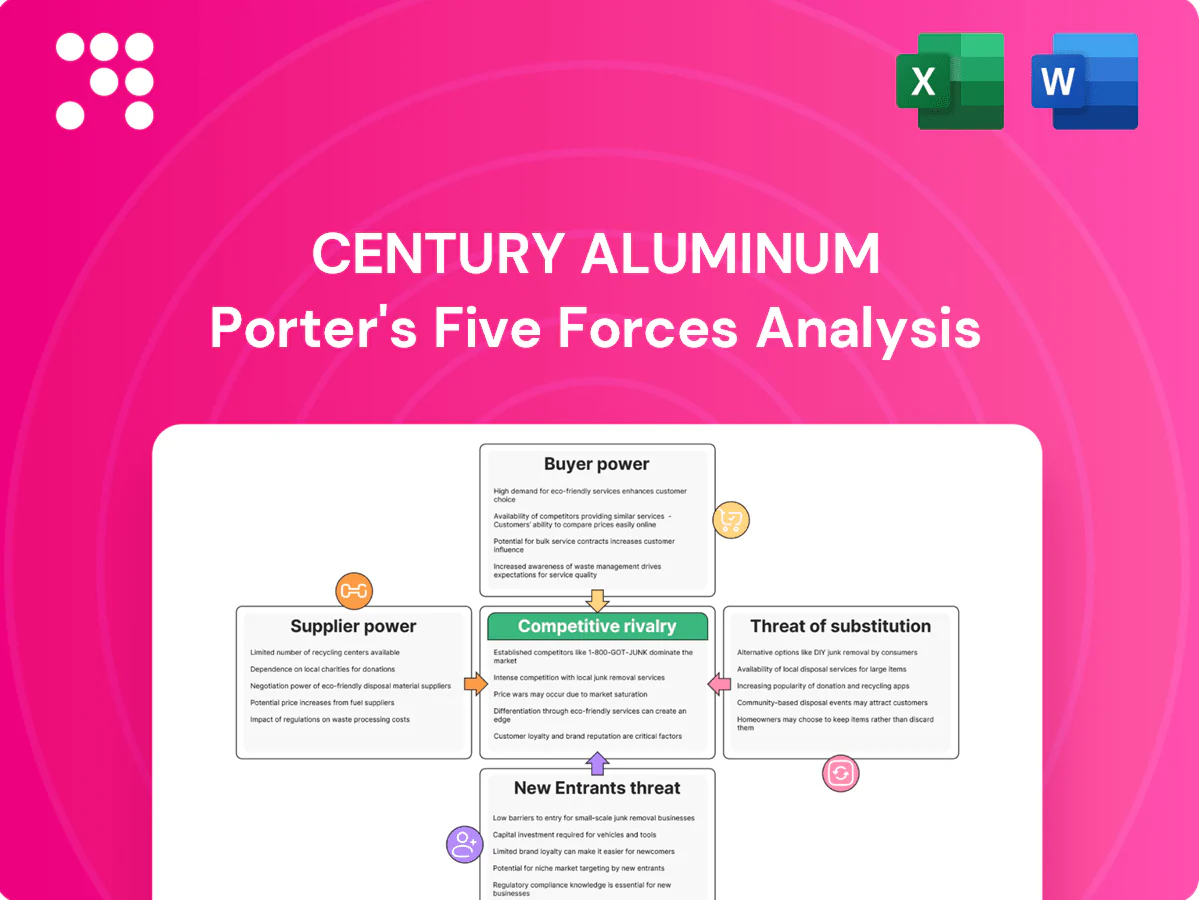
Century Aluminum Porter's Five Forces Analysis

From Overview to Strategy Blueprint
Century Aluminum faces intense input-cost pressure from powerful alumina and energy suppliers, cyclical buyer demand, and moderate threat from substitutes and new entrants given high capital needs; competitive rivalry is heightened by global overcapacity. This brief snapshot only scratches the surface—unlock the full Porter's Five Forces Analysis to explore force-by-force ratings, visuals, and strategic implications in detail.
Suppliers Bargaining Power

Concentrated alumina sources
Century Aluminum depends on a small set of large alumina refiners—with China accounting for roughly 60% of global alumina capacity in 2024—giving suppliers meaningful leverage on price and contractual terms. Spot alumina volatility (prices swung about 30% in parts of 2024) can rapidly compress smelter margins. Long-term offtake contracts blunt spikes but create take-or-pay exposure, and Century’s lack of refinery-scale backward integration keeps supplier power elevated.
Electricity as critical input
Electricity is the dominant cost for Century Aluminum, typically 30–45% of cash cost, giving utilities strong bargaining power. Limited availability of low‑cost, reliable renewables constrains switching; 2024 U.S. industrial prices averaged about 7.9¢/kWh (EIA). PPAs and hedges (commonly 10–20 year terms) lower volatility but lock in dependency, and curtailment risk rises sharply when market prices spike.

Carbon anodes and cathode materials
In 2024 carbon anode/cathode inputs (calcined coke, pitch, refractory) remain produced by a concentrated, specialized supplier base concentrated in China and India, limiting substitution and increasing supplier influence. Strict quality/spec requirements and periodic environmental shutdowns in 2023–24 have disrupted availability and shortened spot market liquidity. Price pass-through to smelters has been imperfect, squeezing Century Aluminum margins.

Logistics and freight dependencies
Logistics and bulk shipping for alumina, anodes and aluminum make Century Aluminum exposed to freight-rate cycles and bunker-fuel swings; 2024 shipping volatility tightened margins, while port congestion and US rail bottlenecks amplified carrier leverage. Take-or-pay contracts lower cost uncertainty but sacrifice routing flexibility; fuel surcharges have eroded realized premiums.
- Freight-cycle exposure
- Port/rail bottlenecks → supplier power
- Take-or-pay = less flexibility
- Fuel surcharges cut premiums
Limited substitution of inputs
Primary smelting has few inputs that can be substituted: alumina (~2.0 t per t Al) and anodes plus continuous power (13–15 MWh per t) remain essential; recycling cuts alumina demand but cannot replace the core inputs for primary output. In 2024 spot alumina averaged about $350–400/t, keeping supplier leverage high where regional scarcity tightens markets.
- Alumina intensity: ~2.0 t/t
- Energy: 13–15 MWh/t (2024)
- Spot alumina: ~$350–400/t (2024)
- Recycling reduces but does not remove primary input reliance
Alumina concentrated at ~60% and high energy costs squeeze aluminum margins
Century Aluminum faces high supplier bargaining power: alumina supply is concentrated (China ~60% of global capacity in 2024) and spot alumina averaged ~$350–400/t in 2024, while energy intensity (13–15 MWh/t) and limited low‑cost power sources keep utilities powerful. Take‑or‑pay contracts and freight/anode supplier concentration further reduce negotiating flexibility and compress margins.
| Metric | 2024 |
|---|---|
| China alumina capacity | ~60% |
| Spot alumina | $350–400/t |
| Energy intensity | 13–15 MWh/t |
| US industrial power | 7.9¢/kWh (EIA) |
What is included in the product
 Detailed Word Document
Tailored Porter's Five Forces analysis of Century Aluminum uncovering key competitive drivers, supplier and buyer power, substitute threats, entry barriers and disruptive risks, with strategic commentary for investors and planners.

 Customizable Excel Spreadsheet
A clear, one-sheet summary of all five forces—perfect for quick decision-making on Century Aluminum, with customizable pressure levels to reflect smelter costs, alumina supply risks, and trade policy shifts.
Customers Bargaining Power

Large, consolidated customers
Automotive, packaging and construction buyers are large, professionally procured accounts that command strong bargaining leverage over Century Aluminum; global primary aluminum production was about 68 million tonnes in 2024, concentrating buying power with OEMs and converters. Their scale forces tough negotiations on price and service, while vendor qualification creates switching costs that favor incumbents but extract price concessions. Volume commitments often require premium trade-offs such as priority allocations or longer contracts.
Commodity pricing and LME linkage
Century Aluminum faces constrained pricing because primary aluminium is tied to the LME benchmark (2024 average ~US$2,300/tonne) plus regional premiums typically ranging US$80–250/tonne, limiting seller discretion. Transparent LME-linked pricing enables buyers to arbitrage timing and sourcing across markets. Value-added product premiums (up to ~US$300/tonne) provide some differentiation but remain contested. Widespread buyer hedging (often 40–60% of volumes) mutes urgency to accept spot moves.

Switching costs are moderate
Shape, alloy and quality certifications create moderate switching frictions for buyers of Century Aluminum, since qualified suppliers must match specifications and certifications; yet in 2024 global primary aluminum output was about 70 million tonnes and multiple producers (top five supply roughly 40% of capacity) can qualify, keeping pressure on commercial terms. In downturns buyers diversify to capture concessions, while closer logistics can temporarily limit buyer options.

Demand cyclicality and scheduling
Auto and construction cycles drive volatile order books and frequent renegotiations for Century Aluminum, with buyers using flexible delivery windows to shift inventory risk upstream. Just-in-time practices impose penalties for supply disruptions, increasing buyer leverage. When buyer forecast accuracy drops, working capital burdens move to the smelter through inventory and standby capacity obligations.
- Buyers: flexible delivery windows
- JIT: penalty exposure
- Forecast errors: working capital shift
ESG and traceability requirements
OEMs in 2024 increasingly require low-carbon aluminum and end-to-end provenance tracking, with many automakers setting interim Scope 3 targets for 2030 and net-zero goals by 2050, shifting specification power to buyers; compliance costs and third-party audits raise barriers and favor large, traceable suppliers. Certified green premiums have emerged but remain uneven across regions and contracts, and failing to meet criteria can exclude producers from high-margin automotive and aerospace segments.
- Buyer-specification shift
- Compliance/audit cost pressure
- Emerging green premiums (uneven)
- Risk of exclusion from premium segments
Buyers dominate aluminium pricing; LME linkage, premiums and compliance favor large suppliers
Large OEMs and converters hold strong leverage over Century Aluminum, forcing price and service concessions; global primary aluminium output was about 68 Mt in 2024 concentrating buying power. LME linkage (2024 avg ~US$2,300/t) plus regional premiums (US$80–250/t) constrains seller pricing despite value-added premiums (~US$300/t). Buyer specifications for low-carbon aluminium and audits raise compliance costs and favor large, certified suppliers; widespread buyer hedging (40–60% volumes) mutes spot pricing pressure.
| Metric | 2024 |
|---|---|
| Global primary production | 68 Mt |
| LME avg price | ~US$2,300/t |
| Regional premiums | US$80–250/t |
| Buyer hedging | 40–60% volumes |
Same Document Delivered
Century Aluminum Porter's Five Forces Analysis
This preview shows the full Century Aluminum Porter’s Five Forces Analysis you’ll receive upon purchase—no placeholders or summaries. The document is professionally formatted and ready for immediate download and use. What you see here is exactly the deliverable you’ll get after payment.

From Overview to Strategy Blueprint
Century Aluminum faces intense input-cost pressure from powerful alumina and energy suppliers, cyclical buyer demand, and moderate threat from substitutes and new entrants given high capital needs; competitive rivalry is heightened by global overcapacity. This brief snapshot only scratches the surface—unlock the full Porter's Five Forces Analysis to explore force-by-force ratings, visuals, and strategic implications in detail.
Suppliers Bargaining Power
Concentrated alumina sources
Century Aluminum depends on a small set of large alumina refiners—with China accounting for roughly 60% of global alumina capacity in 2024—giving suppliers meaningful leverage on price and contractual terms. Spot alumina volatility (prices swung about 30% in parts of 2024) can rapidly compress smelter margins. Long-term offtake contracts blunt spikes but create take-or-pay exposure, and Century’s lack of refinery-scale backward integration keeps supplier power elevated.
Electricity as critical input
Electricity is the dominant cost for Century Aluminum, typically 30–45% of cash cost, giving utilities strong bargaining power. Limited availability of low‑cost, reliable renewables constrains switching; 2024 U.S. industrial prices averaged about 7.9¢/kWh (EIA). PPAs and hedges (commonly 10–20 year terms) lower volatility but lock in dependency, and curtailment risk rises sharply when market prices spike.
Carbon anodes and cathode materials
In 2024 carbon anode/cathode inputs (calcined coke, pitch, refractory) remain produced by a concentrated, specialized supplier base concentrated in China and India, limiting substitution and increasing supplier influence. Strict quality/spec requirements and periodic environmental shutdowns in 2023–24 have disrupted availability and shortened spot market liquidity. Price pass-through to smelters has been imperfect, squeezing Century Aluminum margins.
Logistics and freight dependencies
Logistics and bulk shipping for alumina, anodes and aluminum make Century Aluminum exposed to freight-rate cycles and bunker-fuel swings; 2024 shipping volatility tightened margins, while port congestion and US rail bottlenecks amplified carrier leverage. Take-or-pay contracts lower cost uncertainty but sacrifice routing flexibility; fuel surcharges have eroded realized premiums.
- Freight-cycle exposure
- Port/rail bottlenecks → supplier power
- Take-or-pay = less flexibility
- Fuel surcharges cut premiums
Limited substitution of inputs
Primary smelting has few inputs that can be substituted: alumina (~2.0 t per t Al) and anodes plus continuous power (13–15 MWh per t) remain essential; recycling cuts alumina demand but cannot replace the core inputs for primary output. In 2024 spot alumina averaged about $350–400/t, keeping supplier leverage high where regional scarcity tightens markets.
- Alumina intensity: ~2.0 t/t
- Energy: 13–15 MWh/t (2024)
- Spot alumina: ~$350–400/t (2024)
- Recycling reduces but does not remove primary input reliance
Alumina concentrated at ~60% and high energy costs squeeze aluminum margins
Century Aluminum faces high supplier bargaining power: alumina supply is concentrated (China ~60% of global capacity in 2024) and spot alumina averaged ~$350–400/t in 2024, while energy intensity (13–15 MWh/t) and limited low‑cost power sources keep utilities powerful. Take‑or‑pay contracts and freight/anode supplier concentration further reduce negotiating flexibility and compress margins.
| Metric | 2024 |
|---|---|
| China alumina capacity | ~60% |
| Spot alumina | $350–400/t |
| Energy intensity | 13–15 MWh/t |
| US industrial power | 7.9¢/kWh (EIA) |
What is included in the product
Detailed Word Document
Tailored Porter's Five Forces analysis of Century Aluminum uncovering key competitive drivers, supplier and buyer power, substitute threats, entry barriers and disruptive risks, with strategic commentary for investors and planners.
Customizable Excel Spreadsheet
A clear, one-sheet summary of all five forces—perfect for quick decision-making on Century Aluminum, with customizable pressure levels to reflect smelter costs, alumina supply risks, and trade policy shifts.
Customers Bargaining Power
Large, consolidated customers
Automotive, packaging and construction buyers are large, professionally procured accounts that command strong bargaining leverage over Century Aluminum; global primary aluminum production was about 68 million tonnes in 2024, concentrating buying power with OEMs and converters. Their scale forces tough negotiations on price and service, while vendor qualification creates switching costs that favor incumbents but extract price concessions. Volume commitments often require premium trade-offs such as priority allocations or longer contracts.
Commodity pricing and LME linkage
Century Aluminum faces constrained pricing because primary aluminium is tied to the LME benchmark (2024 average ~US$2,300/tonne) plus regional premiums typically ranging US$80–250/tonne, limiting seller discretion. Transparent LME-linked pricing enables buyers to arbitrage timing and sourcing across markets. Value-added product premiums (up to ~US$300/tonne) provide some differentiation but remain contested. Widespread buyer hedging (often 40–60% of volumes) mutes urgency to accept spot moves.
Switching costs are moderate
Shape, alloy and quality certifications create moderate switching frictions for buyers of Century Aluminum, since qualified suppliers must match specifications and certifications; yet in 2024 global primary aluminum output was about 70 million tonnes and multiple producers (top five supply roughly 40% of capacity) can qualify, keeping pressure on commercial terms. In downturns buyers diversify to capture concessions, while closer logistics can temporarily limit buyer options.
Demand cyclicality and scheduling
Auto and construction cycles drive volatile order books and frequent renegotiations for Century Aluminum, with buyers using flexible delivery windows to shift inventory risk upstream. Just-in-time practices impose penalties for supply disruptions, increasing buyer leverage. When buyer forecast accuracy drops, working capital burdens move to the smelter through inventory and standby capacity obligations.
- Buyers: flexible delivery windows
- JIT: penalty exposure
- Forecast errors: working capital shift
ESG and traceability requirements
OEMs in 2024 increasingly require low-carbon aluminum and end-to-end provenance tracking, with many automakers setting interim Scope 3 targets for 2030 and net-zero goals by 2050, shifting specification power to buyers; compliance costs and third-party audits raise barriers and favor large, traceable suppliers. Certified green premiums have emerged but remain uneven across regions and contracts, and failing to meet criteria can exclude producers from high-margin automotive and aerospace segments.
- Buyer-specification shift
- Compliance/audit cost pressure
- Emerging green premiums (uneven)
- Risk of exclusion from premium segments
Buyers dominate aluminium pricing; LME linkage, premiums and compliance favor large suppliers
Large OEMs and converters hold strong leverage over Century Aluminum, forcing price and service concessions; global primary aluminium output was about 68 Mt in 2024 concentrating buying power. LME linkage (2024 avg ~US$2,300/t) plus regional premiums (US$80–250/t) constrains seller pricing despite value-added premiums (~US$300/t). Buyer specifications for low-carbon aluminium and audits raise compliance costs and favor large, certified suppliers; widespread buyer hedging (40–60% volumes) mutes spot pricing pressure.
| Metric | 2024 |
|---|---|
| Global primary production | 68 Mt |
| LME avg price | ~US$2,300/t |
| Regional premiums | US$80–250/t |
| Buyer hedging | 40–60% volumes |
Same Document Delivered
Century Aluminum Porter's Five Forces Analysis
This preview shows the full Century Aluminum Porter’s Five Forces Analysis you’ll receive upon purchase—no placeholders or summaries. The document is professionally formatted and ready for immediate download and use. What you see here is exactly the deliverable you’ll get after payment.
Description
From Overview to Strategy Blueprint
Century Aluminum faces intense input-cost pressure from powerful alumina and energy suppliers, cyclical buyer demand, and moderate threat from substitutes and new entrants given high capital needs; competitive rivalry is heightened by global overcapacity. This brief snapshot only scratches the surface—unlock the full Porter's Five Forces Analysis to explore force-by-force ratings, visuals, and strategic implications in detail.
Suppliers Bargaining Power
Concentrated alumina sources
Century Aluminum depends on a small set of large alumina refiners—with China accounting for roughly 60% of global alumina capacity in 2024—giving suppliers meaningful leverage on price and contractual terms. Spot alumina volatility (prices swung about 30% in parts of 2024) can rapidly compress smelter margins. Long-term offtake contracts blunt spikes but create take-or-pay exposure, and Century’s lack of refinery-scale backward integration keeps supplier power elevated.
Electricity as critical input
Electricity is the dominant cost for Century Aluminum, typically 30–45% of cash cost, giving utilities strong bargaining power. Limited availability of low‑cost, reliable renewables constrains switching; 2024 U.S. industrial prices averaged about 7.9¢/kWh (EIA). PPAs and hedges (commonly 10–20 year terms) lower volatility but lock in dependency, and curtailment risk rises sharply when market prices spike.
Carbon anodes and cathode materials
In 2024 carbon anode/cathode inputs (calcined coke, pitch, refractory) remain produced by a concentrated, specialized supplier base concentrated in China and India, limiting substitution and increasing supplier influence. Strict quality/spec requirements and periodic environmental shutdowns in 2023–24 have disrupted availability and shortened spot market liquidity. Price pass-through to smelters has been imperfect, squeezing Century Aluminum margins.
Logistics and freight dependencies
Logistics and bulk shipping for alumina, anodes and aluminum make Century Aluminum exposed to freight-rate cycles and bunker-fuel swings; 2024 shipping volatility tightened margins, while port congestion and US rail bottlenecks amplified carrier leverage. Take-or-pay contracts lower cost uncertainty but sacrifice routing flexibility; fuel surcharges have eroded realized premiums.
- Freight-cycle exposure
- Port/rail bottlenecks → supplier power
- Take-or-pay = less flexibility
- Fuel surcharges cut premiums
Limited substitution of inputs
Primary smelting has few inputs that can be substituted: alumina (~2.0 t per t Al) and anodes plus continuous power (13–15 MWh per t) remain essential; recycling cuts alumina demand but cannot replace the core inputs for primary output. In 2024 spot alumina averaged about $350–400/t, keeping supplier leverage high where regional scarcity tightens markets.
- Alumina intensity: ~2.0 t/t
- Energy: 13–15 MWh/t (2024)
- Spot alumina: ~$350–400/t (2024)
- Recycling reduces but does not remove primary input reliance
Alumina concentrated at ~60% and high energy costs squeeze aluminum margins
Century Aluminum faces high supplier bargaining power: alumina supply is concentrated (China ~60% of global capacity in 2024) and spot alumina averaged ~$350–400/t in 2024, while energy intensity (13–15 MWh/t) and limited low‑cost power sources keep utilities powerful. Take‑or‑pay contracts and freight/anode supplier concentration further reduce negotiating flexibility and compress margins.
| Metric | 2024 |
|---|---|
| China alumina capacity | ~60% |
| Spot alumina | $350–400/t |
| Energy intensity | 13–15 MWh/t |
| US industrial power | 7.9¢/kWh (EIA) |
What is included in the product
Detailed Word Document
Tailored Porter's Five Forces analysis of Century Aluminum uncovering key competitive drivers, supplier and buyer power, substitute threats, entry barriers and disruptive risks, with strategic commentary for investors and planners.
Customizable Excel Spreadsheet
A clear, one-sheet summary of all five forces—perfect for quick decision-making on Century Aluminum, with customizable pressure levels to reflect smelter costs, alumina supply risks, and trade policy shifts.
Customers Bargaining Power
Large, consolidated customers
Automotive, packaging and construction buyers are large, professionally procured accounts that command strong bargaining leverage over Century Aluminum; global primary aluminum production was about 68 million tonnes in 2024, concentrating buying power with OEMs and converters. Their scale forces tough negotiations on price and service, while vendor qualification creates switching costs that favor incumbents but extract price concessions. Volume commitments often require premium trade-offs such as priority allocations or longer contracts.
Commodity pricing and LME linkage
Century Aluminum faces constrained pricing because primary aluminium is tied to the LME benchmark (2024 average ~US$2,300/tonne) plus regional premiums typically ranging US$80–250/tonne, limiting seller discretion. Transparent LME-linked pricing enables buyers to arbitrage timing and sourcing across markets. Value-added product premiums (up to ~US$300/tonne) provide some differentiation but remain contested. Widespread buyer hedging (often 40–60% of volumes) mutes urgency to accept spot moves.
Switching costs are moderate
Shape, alloy and quality certifications create moderate switching frictions for buyers of Century Aluminum, since qualified suppliers must match specifications and certifications; yet in 2024 global primary aluminum output was about 70 million tonnes and multiple producers (top five supply roughly 40% of capacity) can qualify, keeping pressure on commercial terms. In downturns buyers diversify to capture concessions, while closer logistics can temporarily limit buyer options.
Demand cyclicality and scheduling
Auto and construction cycles drive volatile order books and frequent renegotiations for Century Aluminum, with buyers using flexible delivery windows to shift inventory risk upstream. Just-in-time practices impose penalties for supply disruptions, increasing buyer leverage. When buyer forecast accuracy drops, working capital burdens move to the smelter through inventory and standby capacity obligations.
- Buyers: flexible delivery windows
- JIT: penalty exposure
- Forecast errors: working capital shift
ESG and traceability requirements
OEMs in 2024 increasingly require low-carbon aluminum and end-to-end provenance tracking, with many automakers setting interim Scope 3 targets for 2030 and net-zero goals by 2050, shifting specification power to buyers; compliance costs and third-party audits raise barriers and favor large, traceable suppliers. Certified green premiums have emerged but remain uneven across regions and contracts, and failing to meet criteria can exclude producers from high-margin automotive and aerospace segments.
- Buyer-specification shift
- Compliance/audit cost pressure
- Emerging green premiums (uneven)
- Risk of exclusion from premium segments
Buyers dominate aluminium pricing; LME linkage, premiums and compliance favor large suppliers
Large OEMs and converters hold strong leverage over Century Aluminum, forcing price and service concessions; global primary aluminium output was about 68 Mt in 2024 concentrating buying power. LME linkage (2024 avg ~US$2,300/t) plus regional premiums (US$80–250/t) constrains seller pricing despite value-added premiums (~US$300/t). Buyer specifications for low-carbon aluminium and audits raise compliance costs and favor large, certified suppliers; widespread buyer hedging (40–60% volumes) mutes spot pricing pressure.
| Metric | 2024 |
|---|---|
| Global primary production | 68 Mt |
| LME avg price | ~US$2,300/t |
| Regional premiums | US$80–250/t |
| Buyer hedging | 40–60% volumes |
Same Document Delivered
Century Aluminum Porter's Five Forces Analysis
This preview shows the full Century Aluminum Porter’s Five Forces Analysis you’ll receive upon purchase—no placeholders or summaries. The document is professionally formatted and ready for immediate download and use. What you see here is exactly the deliverable you’ll get after payment.











