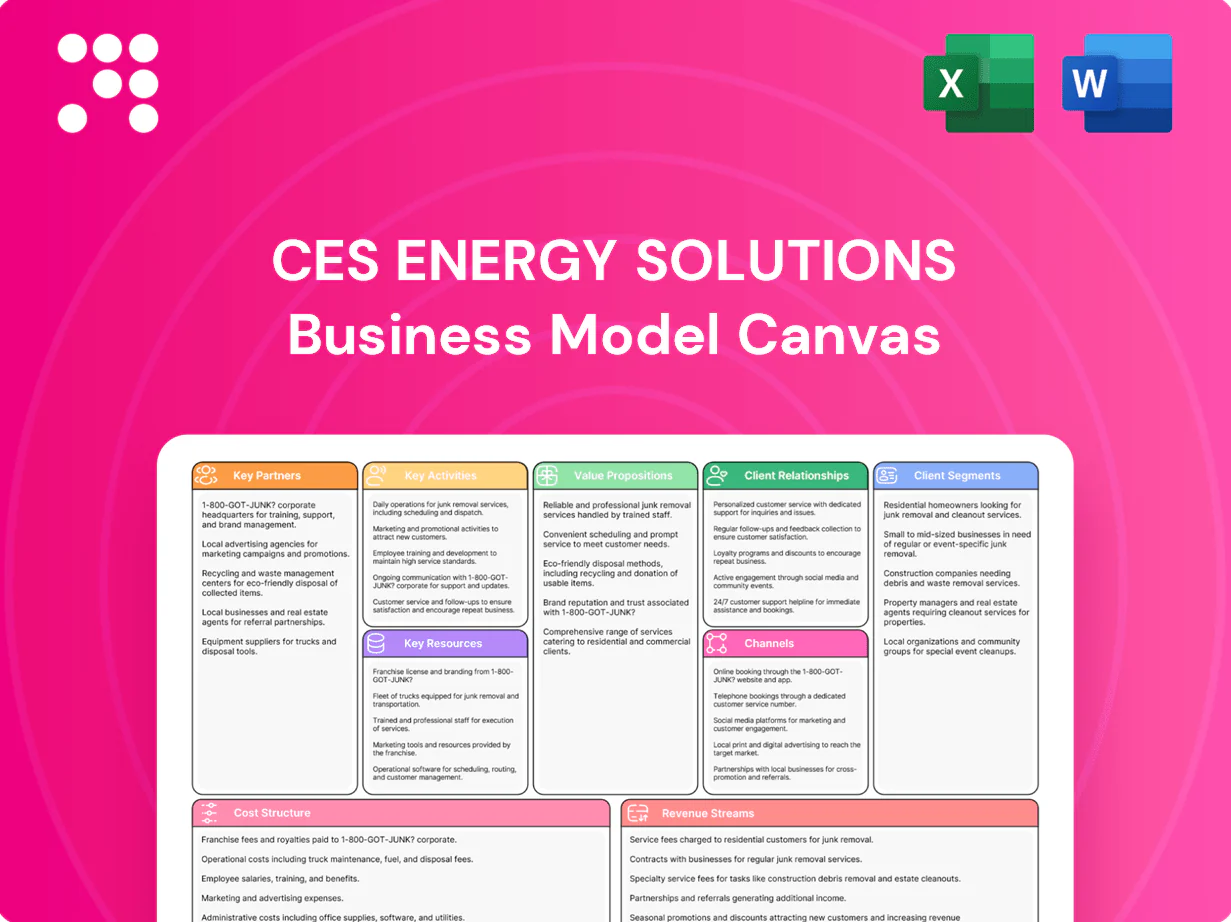
CES Energy Solutions Business Model Canvas

Business Model Canvas: Strategic Blueprint for Value, Partnerships and Revenue Growth
Unlock the full strategic blueprint behind CES Energy Solutions's business model. This Business Model Canvas shows how CES creates value, scales via partnerships and diversified revenue streams, and navigates cost pressures in volatile markets. Download the editable Word/Excel canvas to benchmark, plan, or present—purchase now for immediate, actionable insight.
Partnerships

E&P operator alliances
CES partners with upstream E&P operators to co-develop fit-for-purpose chemistries, using joint field trials that typically validate performance and speed adoption within months; the global oilfield chemicals market was estimated at about USD 9.2 billion in 2024, underscoring scale. Multi-year master service agreements stabilize demand and planning, while systematic feedback loops drive rapid formulation tweaks and continuous performance improvement.
Raw chemical suppliers
CES secures dependable supplies of surfactants, polymers, biocides and specialty additives through preferred partnerships with chemical manufacturers; dual-sourcing and strategic inventories (targeting 60–90 days cover) mitigate volatility and shortages. Co-innovation with suppliers produces proprietary blends for differentiated field performance, while volume agreements lower unit costs and shorten lead times.

Blending & logistics partners
Partner with toll blenders, rail/truck carriers and last-mile logistics providers to optimize regional plant capacity and in-basin delivery responsiveness, often enabling 24–48 hour fulfillment windows. Temperature-controlled and hazardous transport compliance follows Canadian TDG and US DOT HMR rules. Routing and scheduling integrations cut transit costs and non-productive time (NPT) through real-time ETAs and load consolidation.

Technology & lab collaborators
Technology & lab collaborators: CES Energy Solutions (TSX: CEU in 2024) partners with universities, independent labs and OEMs for testing and analytics, accessing advanced instrumentation to accelerate QA/QC and rapid screening; co-develops digital monitoring and dosing systems and uses shared IP frameworks to speed commercialization.
- University partnerships: testing & analytics
- Advanced instrumentation: rapid QA/QC
- Co-development: digital dosing/monitoring
- Shared IP: faster commercialization
Regulatory & ESG bodies
CES engages regulators and environmental partners to ensure compliance and stewardship, aligning formulations with evolving HSE standards and industry best practices.
Active participation in industry groups helps CES influence protocols and demonstrate transparency, building trust with operators and communities through 공개 reporting and third-party verification.
- Regulatory engagement
- HSE-aligned formulations
- Industry best-practice participation
- Transparency & community trust
MSAs and field trials speed oilfield-chem adoption; market USD 9.2B
CES partners with upstream E&P operators via multi-year MSAs and field trials that accelerate adoption; global oilfield chemicals market ~USD 9.2B in 2024. Preferred suppliers provide surfactants/polymers with dual-sourcing and 60–90 day inventories. Toll blenders/logistics enable 24–48h in-basin delivery; university/OEM collaborations speed QA and digital dosing.
| Partner Type | Role | 2024 Metric |
|---|---|---|
| Operators | Co-development/MSAs | Adoption in months |
| Suppliers | Materials/dual-source | 60–90 days inventory |
| Logistics & Labs | Delivery & QA | 24–48h fulfillment |
What is included in the product
 Detailed Word Document
A comprehensive, pre-written Business Model Canvas for CES Energy Solutions that maps customer segments, channels, value propositions and revenue streams across the 9 classic BMC blocks. Tailored to real-world operations, it includes competitive advantage analysis, SWOT-linked insights and polished narratives ideal for presentations, investor discussions and strategic decision-making.

 Customizable Excel Spreadsheet
High-level view of CES Energy Solutions' business model with editable cells to quickly pinpoint value propositions, cost drivers, and partner dependencies — ideal for cross-functional teams reducing analysis time and clarifying operational pain points.
Activities

R&D and formulation
CES designs bespoke chemical systems for drilling, completion, production and midstream, targeting basin-specific challenges. Lab testing simulates basin brines and temperatures, aligned with practices in the ~USD 10 billion oilfield chemicals market (2024). Rapid iteration moves formulations from screening to pilot often within 3–6 months. IP is protected via trade secrets and patents where applicable.
Manufacturing & blending
Manufacturing and blending occur at regional facilities to meet spec, quality and volume, supporting CES Energy Solutions’ 2024 operations with centralized QA/QC, batch traceability and strict HSE protocols that reduced incident rates year-over-year.
Scalable processes enable rapid ramp from pilot to full-field deployment, with modular blending lines and CAPEX-light expansions to contain unit costs and preserve margins.
Contingency inventory and surge plans cover peak demand, targeting 48–72 hour fulfillment windows for prioritized customers.

Field technical service
Field technical service delivers 24/7 on-site application engineering and optimization, continuously monitoring well performance, chemical dosage, and compatibility to maintain target KPIs. Rapid troubleshooting minimizes downtime and operating costs while operator-crew training ensures consistent execution and repeatable results across programs.

Supply chain & logistics
CES Energy Solutions forecasts demand and procures, warehouses, and delivers chemicals with a focus on safety and compliance, targeting 4–6 inventory turns and a 98% fill rate to balance service and working capital. Route and modal-mix optimization aims to reduce transport costs by ~10–15% while meeting speed needs; regulatory documentation and spill-response plans are maintained for all shipments.
- Inventory turns: 4–6
- Service level: 98% fill rate
- Transport savings target: 10–15%
- Full regulatory & spill preparedness
Data analytics & digital
Collect treatment, production and quality data to refine chemical programs, feeding predictive models that identify scaling, corrosion and emulsion risks and trigger alerts. Enable remote monitoring and automated dosing to optimize consumption and uptime. Deliver standardized ROI reports to customers showing chemical savings and performance gains.
- Data collection
- Predictive models
- Remote monitoring
- Automated dosing
- ROI reporting
Basin-specific oilfield chemicals: 3-6 mo lab-to-pilot, 48-72h fulfillment
CES formulates basin-specific oilfield chemicals, moving from lab to pilot in 3–6 months and protecting IP. Regional blending/QA supports scalable, CAPEX-light production with 48–72 hour surge fulfillment. Field service, remote monitoring and automated dosing target 4–6 inventory turns, 98% fill rate and ~10–15% transport savings (2024).
| Metric | Target/Value | 2024 |
|---|---|---|
| Lab→Pilot | 3–6 months | 2024 |
| Fulfillment | 48–72 hours | 2024 |
| Inventory turns | 4–6 | 2024 |
| Fill rate | 98% | 2024 |
| Transport savings | 10–15% | 2024 |
Full Version Awaits
Business Model Canvas
The CES Energy Solutions Business Model Canvas you’re previewing is the actual deliverable, not a mockup. It’s the same structured, editable file you’ll receive upon purchase. Once ordered, you’ll instantly download this complete document, formatted and ready for use in Word and Excel. No surprises—what you see is what you get.

Business Model Canvas: Strategic Blueprint for Value, Partnerships and Revenue Growth
Unlock the full strategic blueprint behind CES Energy Solutions's business model. This Business Model Canvas shows how CES creates value, scales via partnerships and diversified revenue streams, and navigates cost pressures in volatile markets. Download the editable Word/Excel canvas to benchmark, plan, or present—purchase now for immediate, actionable insight.
Partnerships
E&P operator alliances
CES partners with upstream E&P operators to co-develop fit-for-purpose chemistries, using joint field trials that typically validate performance and speed adoption within months; the global oilfield chemicals market was estimated at about USD 9.2 billion in 2024, underscoring scale. Multi-year master service agreements stabilize demand and planning, while systematic feedback loops drive rapid formulation tweaks and continuous performance improvement.
Raw chemical suppliers
CES secures dependable supplies of surfactants, polymers, biocides and specialty additives through preferred partnerships with chemical manufacturers; dual-sourcing and strategic inventories (targeting 60–90 days cover) mitigate volatility and shortages. Co-innovation with suppliers produces proprietary blends for differentiated field performance, while volume agreements lower unit costs and shorten lead times.
Blending & logistics partners
Partner with toll blenders, rail/truck carriers and last-mile logistics providers to optimize regional plant capacity and in-basin delivery responsiveness, often enabling 24–48 hour fulfillment windows. Temperature-controlled and hazardous transport compliance follows Canadian TDG and US DOT HMR rules. Routing and scheduling integrations cut transit costs and non-productive time (NPT) through real-time ETAs and load consolidation.
Technology & lab collaborators
Technology & lab collaborators: CES Energy Solutions (TSX: CEU in 2024) partners with universities, independent labs and OEMs for testing and analytics, accessing advanced instrumentation to accelerate QA/QC and rapid screening; co-develops digital monitoring and dosing systems and uses shared IP frameworks to speed commercialization.
- University partnerships: testing & analytics
- Advanced instrumentation: rapid QA/QC
- Co-development: digital dosing/monitoring
- Shared IP: faster commercialization
Regulatory & ESG bodies
CES engages regulators and environmental partners to ensure compliance and stewardship, aligning formulations with evolving HSE standards and industry best practices.
Active participation in industry groups helps CES influence protocols and demonstrate transparency, building trust with operators and communities through 공개 reporting and third-party verification.
- Regulatory engagement
- HSE-aligned formulations
- Industry best-practice participation
- Transparency & community trust
MSAs and field trials speed oilfield-chem adoption; market USD 9.2B
CES partners with upstream E&P operators via multi-year MSAs and field trials that accelerate adoption; global oilfield chemicals market ~USD 9.2B in 2024. Preferred suppliers provide surfactants/polymers with dual-sourcing and 60–90 day inventories. Toll blenders/logistics enable 24–48h in-basin delivery; university/OEM collaborations speed QA and digital dosing.
| Partner Type | Role | 2024 Metric |
|---|---|---|
| Operators | Co-development/MSAs | Adoption in months |
| Suppliers | Materials/dual-source | 60–90 days inventory |
| Logistics & Labs | Delivery & QA | 24–48h fulfillment |
What is included in the product
Detailed Word Document
A comprehensive, pre-written Business Model Canvas for CES Energy Solutions that maps customer segments, channels, value propositions and revenue streams across the 9 classic BMC blocks. Tailored to real-world operations, it includes competitive advantage analysis, SWOT-linked insights and polished narratives ideal for presentations, investor discussions and strategic decision-making.
Customizable Excel Spreadsheet
High-level view of CES Energy Solutions' business model with editable cells to quickly pinpoint value propositions, cost drivers, and partner dependencies — ideal for cross-functional teams reducing analysis time and clarifying operational pain points.
Activities
R&D and formulation
CES designs bespoke chemical systems for drilling, completion, production and midstream, targeting basin-specific challenges. Lab testing simulates basin brines and temperatures, aligned with practices in the ~USD 10 billion oilfield chemicals market (2024). Rapid iteration moves formulations from screening to pilot often within 3–6 months. IP is protected via trade secrets and patents where applicable.
Manufacturing & blending
Manufacturing and blending occur at regional facilities to meet spec, quality and volume, supporting CES Energy Solutions’ 2024 operations with centralized QA/QC, batch traceability and strict HSE protocols that reduced incident rates year-over-year.
Scalable processes enable rapid ramp from pilot to full-field deployment, with modular blending lines and CAPEX-light expansions to contain unit costs and preserve margins.
Contingency inventory and surge plans cover peak demand, targeting 48–72 hour fulfillment windows for prioritized customers.
Field technical service
Field technical service delivers 24/7 on-site application engineering and optimization, continuously monitoring well performance, chemical dosage, and compatibility to maintain target KPIs. Rapid troubleshooting minimizes downtime and operating costs while operator-crew training ensures consistent execution and repeatable results across programs.
Supply chain & logistics
CES Energy Solutions forecasts demand and procures, warehouses, and delivers chemicals with a focus on safety and compliance, targeting 4–6 inventory turns and a 98% fill rate to balance service and working capital. Route and modal-mix optimization aims to reduce transport costs by ~10–15% while meeting speed needs; regulatory documentation and spill-response plans are maintained for all shipments.
- Inventory turns: 4–6
- Service level: 98% fill rate
- Transport savings target: 10–15%
- Full regulatory & spill preparedness
Data analytics & digital
Collect treatment, production and quality data to refine chemical programs, feeding predictive models that identify scaling, corrosion and emulsion risks and trigger alerts. Enable remote monitoring and automated dosing to optimize consumption and uptime. Deliver standardized ROI reports to customers showing chemical savings and performance gains.
- Data collection
- Predictive models
- Remote monitoring
- Automated dosing
- ROI reporting
Basin-specific oilfield chemicals: 3-6 mo lab-to-pilot, 48-72h fulfillment
CES formulates basin-specific oilfield chemicals, moving from lab to pilot in 3–6 months and protecting IP. Regional blending/QA supports scalable, CAPEX-light production with 48–72 hour surge fulfillment. Field service, remote monitoring and automated dosing target 4–6 inventory turns, 98% fill rate and ~10–15% transport savings (2024).
| Metric | Target/Value | 2024 |
|---|---|---|
| Lab→Pilot | 3–6 months | 2024 |
| Fulfillment | 48–72 hours | 2024 |
| Inventory turns | 4–6 | 2024 |
| Fill rate | 98% | 2024 |
| Transport savings | 10–15% | 2024 |
Full Version Awaits
Business Model Canvas
The CES Energy Solutions Business Model Canvas you’re previewing is the actual deliverable, not a mockup. It’s the same structured, editable file you’ll receive upon purchase. Once ordered, you’ll instantly download this complete document, formatted and ready for use in Word and Excel. No surprises—what you see is what you get.
Original: $10.00
-65%$10.00
$3.50Description
Business Model Canvas: Strategic Blueprint for Value, Partnerships and Revenue Growth
Unlock the full strategic blueprint behind CES Energy Solutions's business model. This Business Model Canvas shows how CES creates value, scales via partnerships and diversified revenue streams, and navigates cost pressures in volatile markets. Download the editable Word/Excel canvas to benchmark, plan, or present—purchase now for immediate, actionable insight.
Partnerships
E&P operator alliances
CES partners with upstream E&P operators to co-develop fit-for-purpose chemistries, using joint field trials that typically validate performance and speed adoption within months; the global oilfield chemicals market was estimated at about USD 9.2 billion in 2024, underscoring scale. Multi-year master service agreements stabilize demand and planning, while systematic feedback loops drive rapid formulation tweaks and continuous performance improvement.
Raw chemical suppliers
CES secures dependable supplies of surfactants, polymers, biocides and specialty additives through preferred partnerships with chemical manufacturers; dual-sourcing and strategic inventories (targeting 60–90 days cover) mitigate volatility and shortages. Co-innovation with suppliers produces proprietary blends for differentiated field performance, while volume agreements lower unit costs and shorten lead times.
Blending & logistics partners
Partner with toll blenders, rail/truck carriers and last-mile logistics providers to optimize regional plant capacity and in-basin delivery responsiveness, often enabling 24–48 hour fulfillment windows. Temperature-controlled and hazardous transport compliance follows Canadian TDG and US DOT HMR rules. Routing and scheduling integrations cut transit costs and non-productive time (NPT) through real-time ETAs and load consolidation.
Technology & lab collaborators
Technology & lab collaborators: CES Energy Solutions (TSX: CEU in 2024) partners with universities, independent labs and OEMs for testing and analytics, accessing advanced instrumentation to accelerate QA/QC and rapid screening; co-develops digital monitoring and dosing systems and uses shared IP frameworks to speed commercialization.
- University partnerships: testing & analytics
- Advanced instrumentation: rapid QA/QC
- Co-development: digital dosing/monitoring
- Shared IP: faster commercialization
Regulatory & ESG bodies
CES engages regulators and environmental partners to ensure compliance and stewardship, aligning formulations with evolving HSE standards and industry best practices.
Active participation in industry groups helps CES influence protocols and demonstrate transparency, building trust with operators and communities through 공개 reporting and third-party verification.
- Regulatory engagement
- HSE-aligned formulations
- Industry best-practice participation
- Transparency & community trust
MSAs and field trials speed oilfield-chem adoption; market USD 9.2B
CES partners with upstream E&P operators via multi-year MSAs and field trials that accelerate adoption; global oilfield chemicals market ~USD 9.2B in 2024. Preferred suppliers provide surfactants/polymers with dual-sourcing and 60–90 day inventories. Toll blenders/logistics enable 24–48h in-basin delivery; university/OEM collaborations speed QA and digital dosing.
| Partner Type | Role | 2024 Metric |
|---|---|---|
| Operators | Co-development/MSAs | Adoption in months |
| Suppliers | Materials/dual-source | 60–90 days inventory |
| Logistics & Labs | Delivery & QA | 24–48h fulfillment |
What is included in the product
Detailed Word Document
A comprehensive, pre-written Business Model Canvas for CES Energy Solutions that maps customer segments, channels, value propositions and revenue streams across the 9 classic BMC blocks. Tailored to real-world operations, it includes competitive advantage analysis, SWOT-linked insights and polished narratives ideal for presentations, investor discussions and strategic decision-making.
Customizable Excel Spreadsheet
High-level view of CES Energy Solutions' business model with editable cells to quickly pinpoint value propositions, cost drivers, and partner dependencies — ideal for cross-functional teams reducing analysis time and clarifying operational pain points.
Activities
R&D and formulation
CES designs bespoke chemical systems for drilling, completion, production and midstream, targeting basin-specific challenges. Lab testing simulates basin brines and temperatures, aligned with practices in the ~USD 10 billion oilfield chemicals market (2024). Rapid iteration moves formulations from screening to pilot often within 3–6 months. IP is protected via trade secrets and patents where applicable.
Manufacturing & blending
Manufacturing and blending occur at regional facilities to meet spec, quality and volume, supporting CES Energy Solutions’ 2024 operations with centralized QA/QC, batch traceability and strict HSE protocols that reduced incident rates year-over-year.
Scalable processes enable rapid ramp from pilot to full-field deployment, with modular blending lines and CAPEX-light expansions to contain unit costs and preserve margins.
Contingency inventory and surge plans cover peak demand, targeting 48–72 hour fulfillment windows for prioritized customers.
Field technical service
Field technical service delivers 24/7 on-site application engineering and optimization, continuously monitoring well performance, chemical dosage, and compatibility to maintain target KPIs. Rapid troubleshooting minimizes downtime and operating costs while operator-crew training ensures consistent execution and repeatable results across programs.
Supply chain & logistics
CES Energy Solutions forecasts demand and procures, warehouses, and delivers chemicals with a focus on safety and compliance, targeting 4–6 inventory turns and a 98% fill rate to balance service and working capital. Route and modal-mix optimization aims to reduce transport costs by ~10–15% while meeting speed needs; regulatory documentation and spill-response plans are maintained for all shipments.
- Inventory turns: 4–6
- Service level: 98% fill rate
- Transport savings target: 10–15%
- Full regulatory & spill preparedness
Data analytics & digital
Collect treatment, production and quality data to refine chemical programs, feeding predictive models that identify scaling, corrosion and emulsion risks and trigger alerts. Enable remote monitoring and automated dosing to optimize consumption and uptime. Deliver standardized ROI reports to customers showing chemical savings and performance gains.
- Data collection
- Predictive models
- Remote monitoring
- Automated dosing
- ROI reporting
Basin-specific oilfield chemicals: 3-6 mo lab-to-pilot, 48-72h fulfillment
CES formulates basin-specific oilfield chemicals, moving from lab to pilot in 3–6 months and protecting IP. Regional blending/QA supports scalable, CAPEX-light production with 48–72 hour surge fulfillment. Field service, remote monitoring and automated dosing target 4–6 inventory turns, 98% fill rate and ~10–15% transport savings (2024).
| Metric | Target/Value | 2024 |
|---|---|---|
| Lab→Pilot | 3–6 months | 2024 |
| Fulfillment | 48–72 hours | 2024 |
| Inventory turns | 4–6 | 2024 |
| Fill rate | 98% | 2024 |
| Transport savings | 10–15% | 2024 |
Full Version Awaits
Business Model Canvas
The CES Energy Solutions Business Model Canvas you’re previewing is the actual deliverable, not a mockup. It’s the same structured, editable file you’ll receive upon purchase. Once ordered, you’ll instantly download this complete document, formatted and ready for use in Word and Excel. No surprises—what you see is what you get.











