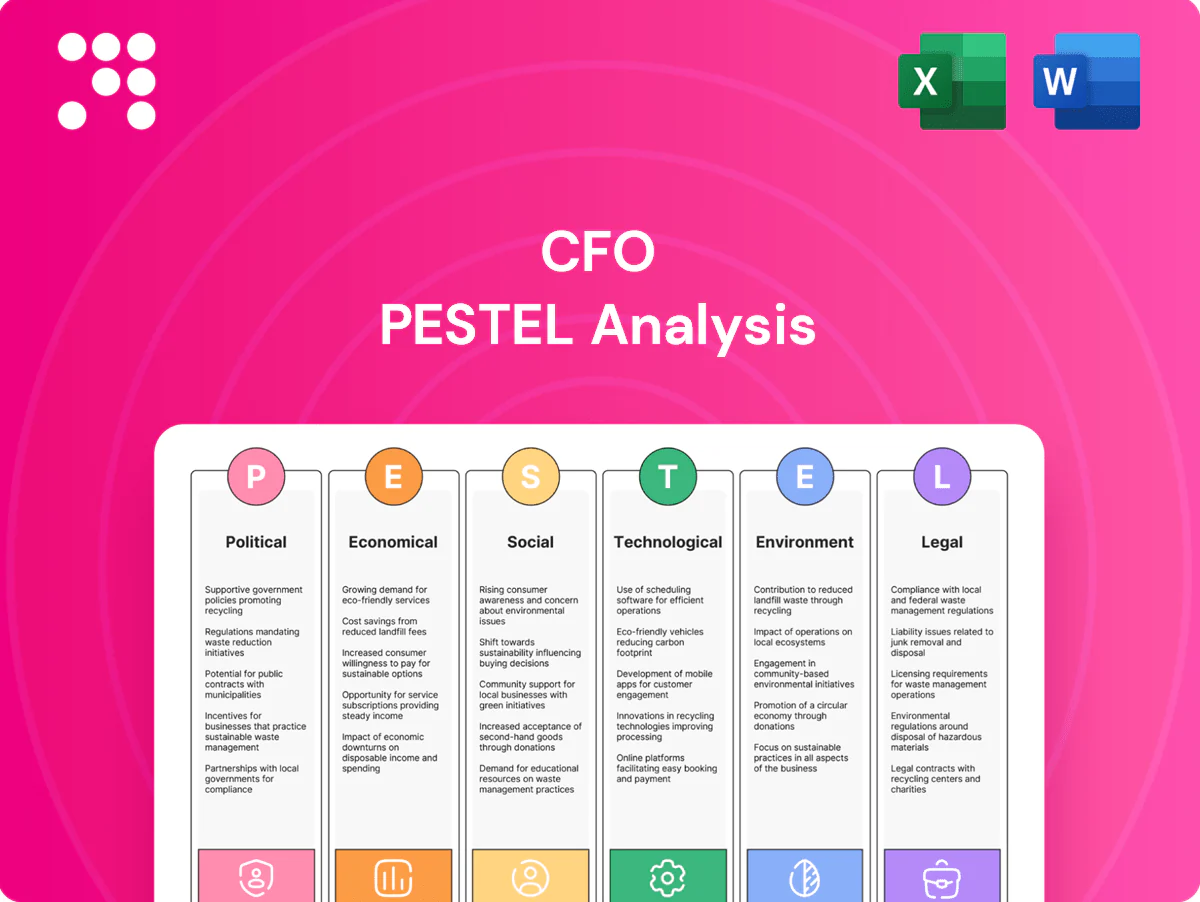
CFO PESTLE Analysis

Make Smarter Strategic Decisions with a Complete PESTEL View
Gain a strategic advantage with our PESTLE Analysis of CFO—clear, concise insights into political, economic, social, technological, legal, and environmental forces shaping the company’s trajectory. Ideal for investors and strategists; purchase the full report for the complete, editable breakdown and actionable recommendations.
Political factors

EU and national training funds
EU ESF+ has a 2021–27 envelope of about €99.3bn and Portugal 2030 mobilises roughly €23.4bn, both prioritising employability, digital and green skills. CFOs can access training grants via IEFP and regional authorities to subsidise courses and apprenticeships, though schemes vary by call. Funding rules change per notice, demanding compliance capacity and co‑financing. Overreliance on programming cycles risks funding volatility between periods.
Skills agenda priorities
Government roadmaps prioritize upskilling in digital, health, tourism, industry 4.0 and energy transition; aligning CFO workforce and training portfolios with these priorities increases eligibility for public grants and partnerships. The WEF estimates 69% of workers will need reskilling by 2027, so misalignment reduces approval odds and employer traction. Regular horizon scanning (quarterly) keeps portfolios current and fundable.

Regional development policy
EU Cohesion Policy directs roughly €23.4 billion to Portugal for 2021–2027, with a large share earmarked for training in less-developed regions, creating funded voucher pools CFOs can target. CFOs expanding satellite delivery and eligible course offerings can capture regional vouchers and increase market reach. Increased travel and logistics will raise per-delivery costs but can unlock new demand and higher contract values. Local stakeholder engagement improves bid competitiveness for Cohesion-funded projects.

Public–private partnerships
Policy now favors employer-led dual training with sector councils; CFOs can formalize public–private partnerships to co-design curricula and secure placements, while governance and accountability expectations are high; UK apprenticeship levy funding ~£3bn (2023–24) illustrates scale and the need for transparent impact reporting to sustain support.
- Dual training: employer + sector councils
- CFO role: formalize PPPs, secure placements
- Governance: high accountability, transparent impact reporting
Immigration and talent policy
Portugal’s immigration pathways shape learner pools and skills gaps: foreign resident stock reached about 760,000 in 2024, with net migration remaining a key driver of labor supply; CFOs can fund bridging, language, and credential adaptation programs to shorten time-to-productivity and protect revenue. Policy tightening could cut foreign learner intake; expansion of integration supports may raise enrollment and retention.
- Bridge programs: lower onboarding costs, faster ROI
- Language/credential services: improve retention, integration
CFOs: Align curricula to win €99.3bn ESF+ and €23.4bn Portugal 2030
EU ESF+ €99.3bn (2021–27) and Portugal 2030 €23.4bn prioritise digital, green and employability; CFOs must align curricula to win grants. WEF: 69% of workers need reskilling by 2027; migration stock ~760,000 in Portugal (2024) shapes learner supply. Governance and co‑financing rules raise compliance costs; UK apprenticeship levy ~£3bn (2023–24) shows public funding scale.
| Metric | Value |
|---|---|
| ESF+ | €99.3bn |
| PT 2030/Cohesion | €23.4bn |
| Reskilling need | 69% by 2027 |
| PT migrants | 760,000 (2024) |
| UK levy | £3bn (2023–24) |
What is included in the product
 Detailed Word Document
Explores how macro-environmental factors uniquely affect the CFO across Political, Economic, Social, Technological, Environmental and Legal dimensions, with data-backed trends, regional and industry specificity to identify strategic risks and opportunities for planning, funding and governance.

 Customizable Excel Spreadsheet
A concise, visually segmented CFO PESTLE summary that highlights external risks and opportunities, is easily editable for region or business line, and formatted for slide decks and cross-team sharing to speed strategic discussions and decision-making.
Economic factors

Labor demand and skill gaps
Portugal reports roughly 6.0% unemployment and a 2.8% job vacancy rate in 2024, with acute shortages in IT, healthcare, construction and green tech. CFOs can fund modular, job‑ready programs tied to live vacancies; real‑time employer input has been shown to raise placement rates materially. Misreading demand risks low enrollment and weak ROI on training investments.
Household income and price sensitivity
Disposable income constraints heighten sensitivity to tuition and payment plans, with US household savings rates near 3.6% in 2024 and US student loan debt outstanding about $1.74 trillion, raising sticker shock. Blended financing—grants, employer co-pay and ISAs—can widen access by reducing upfront cost. Clear ROI messaging (placement rates, salary uplift) lowers friction. Economic downturns push demand toward reskilling subsidies and subsidized short courses.

Inflation and cost structure
Rising wages (about 4% YoY in 2024), software license inflation (SaaS spend up ~18–20% YoY) and facility costs (commercial rents ~6% in 2024) compress margins. Indexing prices to demonstrated value and outcomes preserves competitiveness and supports price realization. Long-term vendor contracts and shared services hedge input volatility and capex exposure. Scaling online delivery and automation improves unit economics, cutting incremental costs per student/customer.

Business cycle exposure
Weak cycles raise demand for retraining while straining public budgets; IMF WEO 2024 projects global growth around 3.1%, pressuring fiscal capacity. CFOs should balance countercyclical public programs with targeted B2B upskilling, pursue diversified sector exposure to smooth revenue, and hold cash buffers to bridge funding delays and program timing mismatches.
- Countercyclical public spend vs B2B upskilling
- Diversify sector exposure to reduce cyclicality
- Maintain cash buffer (cover 3–6 months operating needs)
- Monitor IMF/OECD growth and fiscal stress indicators
Employer training budgets
Employer training budgets remain cyclic, with the global corporate training market estimated at about $350 billion in 2024, and spend varying strongly by sector performance—healthcare and tech allocate above-average per-employee budgets while retail and hospitality lag.
Offer modular micro-credentials mapped to competency frameworks to increase ROI, use outcome-based pricing to align incentives and shorten procurement cycles, as procurement readiness can accelerate enterprise deal closure.
CFOs: Align curricula to win €99.3bn ESF+ and €23.4bn Portugal 2030
Portugal unemployment ~6.0% and job vacancy 2.8% (2024); US household savings ~3.6% and student debt $1.74T; global training market ~$350B (2024). Wage growth ~4% YoY, SaaS spend +18–20%, rents +6% pressure margins; IMF WEO growth ~3.1% (2024) — CFOs should hold 3–6 months cash, diversify revenue and use outcome‑based pricing.
| Metric | 2024 |
|---|---|
| Portugal unemployment | 6.0% |
| US savings rate | 3.6% |
| Student debt | $1.74T |
| Training market | $350B |
Same Document Delivered
CFO PESTLE Analysis
The preview shown here is the exact CFO PESTLE Analysis document you’ll receive after purchase—fully formatted and ready to use. The content, layout, and strategic insights visible are identical to the downloadable file. No placeholders or edits; this is the finished, professional report you’ll get immediately after checkout.

Make Smarter Strategic Decisions with a Complete PESTEL View
Gain a strategic advantage with our PESTLE Analysis of CFO—clear, concise insights into political, economic, social, technological, legal, and environmental forces shaping the company’s trajectory. Ideal for investors and strategists; purchase the full report for the complete, editable breakdown and actionable recommendations.
Political factors
EU and national training funds
EU ESF+ has a 2021–27 envelope of about €99.3bn and Portugal 2030 mobilises roughly €23.4bn, both prioritising employability, digital and green skills. CFOs can access training grants via IEFP and regional authorities to subsidise courses and apprenticeships, though schemes vary by call. Funding rules change per notice, demanding compliance capacity and co‑financing. Overreliance on programming cycles risks funding volatility between periods.
Skills agenda priorities
Government roadmaps prioritize upskilling in digital, health, tourism, industry 4.0 and energy transition; aligning CFO workforce and training portfolios with these priorities increases eligibility for public grants and partnerships. The WEF estimates 69% of workers will need reskilling by 2027, so misalignment reduces approval odds and employer traction. Regular horizon scanning (quarterly) keeps portfolios current and fundable.
Regional development policy
EU Cohesion Policy directs roughly €23.4 billion to Portugal for 2021–2027, with a large share earmarked for training in less-developed regions, creating funded voucher pools CFOs can target. CFOs expanding satellite delivery and eligible course offerings can capture regional vouchers and increase market reach. Increased travel and logistics will raise per-delivery costs but can unlock new demand and higher contract values. Local stakeholder engagement improves bid competitiveness for Cohesion-funded projects.
Public–private partnerships
Policy now favors employer-led dual training with sector councils; CFOs can formalize public–private partnerships to co-design curricula and secure placements, while governance and accountability expectations are high; UK apprenticeship levy funding ~£3bn (2023–24) illustrates scale and the need for transparent impact reporting to sustain support.
- Dual training: employer + sector councils
- CFO role: formalize PPPs, secure placements
- Governance: high accountability, transparent impact reporting
Immigration and talent policy
Portugal’s immigration pathways shape learner pools and skills gaps: foreign resident stock reached about 760,000 in 2024, with net migration remaining a key driver of labor supply; CFOs can fund bridging, language, and credential adaptation programs to shorten time-to-productivity and protect revenue. Policy tightening could cut foreign learner intake; expansion of integration supports may raise enrollment and retention.
- Bridge programs: lower onboarding costs, faster ROI
- Language/credential services: improve retention, integration
CFOs: Align curricula to win €99.3bn ESF+ and €23.4bn Portugal 2030
EU ESF+ €99.3bn (2021–27) and Portugal 2030 €23.4bn prioritise digital, green and employability; CFOs must align curricula to win grants. WEF: 69% of workers need reskilling by 2027; migration stock ~760,000 in Portugal (2024) shapes learner supply. Governance and co‑financing rules raise compliance costs; UK apprenticeship levy ~£3bn (2023–24) shows public funding scale.
| Metric | Value |
|---|---|
| ESF+ | €99.3bn |
| PT 2030/Cohesion | €23.4bn |
| Reskilling need | 69% by 2027 |
| PT migrants | 760,000 (2024) |
| UK levy | £3bn (2023–24) |
What is included in the product
Detailed Word Document
Explores how macro-environmental factors uniquely affect the CFO across Political, Economic, Social, Technological, Environmental and Legal dimensions, with data-backed trends, regional and industry specificity to identify strategic risks and opportunities for planning, funding and governance.
Customizable Excel Spreadsheet
A concise, visually segmented CFO PESTLE summary that highlights external risks and opportunities, is easily editable for region or business line, and formatted for slide decks and cross-team sharing to speed strategic discussions and decision-making.
Economic factors
Labor demand and skill gaps
Portugal reports roughly 6.0% unemployment and a 2.8% job vacancy rate in 2024, with acute shortages in IT, healthcare, construction and green tech. CFOs can fund modular, job‑ready programs tied to live vacancies; real‑time employer input has been shown to raise placement rates materially. Misreading demand risks low enrollment and weak ROI on training investments.
Household income and price sensitivity
Disposable income constraints heighten sensitivity to tuition and payment plans, with US household savings rates near 3.6% in 2024 and US student loan debt outstanding about $1.74 trillion, raising sticker shock. Blended financing—grants, employer co-pay and ISAs—can widen access by reducing upfront cost. Clear ROI messaging (placement rates, salary uplift) lowers friction. Economic downturns push demand toward reskilling subsidies and subsidized short courses.
Inflation and cost structure
Rising wages (about 4% YoY in 2024), software license inflation (SaaS spend up ~18–20% YoY) and facility costs (commercial rents ~6% in 2024) compress margins. Indexing prices to demonstrated value and outcomes preserves competitiveness and supports price realization. Long-term vendor contracts and shared services hedge input volatility and capex exposure. Scaling online delivery and automation improves unit economics, cutting incremental costs per student/customer.
Business cycle exposure
Weak cycles raise demand for retraining while straining public budgets; IMF WEO 2024 projects global growth around 3.1%, pressuring fiscal capacity. CFOs should balance countercyclical public programs with targeted B2B upskilling, pursue diversified sector exposure to smooth revenue, and hold cash buffers to bridge funding delays and program timing mismatches.
- Countercyclical public spend vs B2B upskilling
- Diversify sector exposure to reduce cyclicality
- Maintain cash buffer (cover 3–6 months operating needs)
- Monitor IMF/OECD growth and fiscal stress indicators
Employer training budgets
Employer training budgets remain cyclic, with the global corporate training market estimated at about $350 billion in 2024, and spend varying strongly by sector performance—healthcare and tech allocate above-average per-employee budgets while retail and hospitality lag.
Offer modular micro-credentials mapped to competency frameworks to increase ROI, use outcome-based pricing to align incentives and shorten procurement cycles, as procurement readiness can accelerate enterprise deal closure.
CFOs: Align curricula to win €99.3bn ESF+ and €23.4bn Portugal 2030
Portugal unemployment ~6.0% and job vacancy 2.8% (2024); US household savings ~3.6% and student debt $1.74T; global training market ~$350B (2024). Wage growth ~4% YoY, SaaS spend +18–20%, rents +6% pressure margins; IMF WEO growth ~3.1% (2024) — CFOs should hold 3–6 months cash, diversify revenue and use outcome‑based pricing.
| Metric | 2024 |
|---|---|
| Portugal unemployment | 6.0% |
| US savings rate | 3.6% |
| Student debt | $1.74T |
| Training market | $350B |
Same Document Delivered
CFO PESTLE Analysis
The preview shown here is the exact CFO PESTLE Analysis document you’ll receive after purchase—fully formatted and ready to use. The content, layout, and strategic insights visible are identical to the downloadable file. No placeholders or edits; this is the finished, professional report you’ll get immediately after checkout.
Original: $10.00
-65%$10.00
$3.50Description
Make Smarter Strategic Decisions with a Complete PESTEL View
Gain a strategic advantage with our PESTLE Analysis of CFO—clear, concise insights into political, economic, social, technological, legal, and environmental forces shaping the company’s trajectory. Ideal for investors and strategists; purchase the full report for the complete, editable breakdown and actionable recommendations.
Political factors
EU and national training funds
EU ESF+ has a 2021–27 envelope of about €99.3bn and Portugal 2030 mobilises roughly €23.4bn, both prioritising employability, digital and green skills. CFOs can access training grants via IEFP and regional authorities to subsidise courses and apprenticeships, though schemes vary by call. Funding rules change per notice, demanding compliance capacity and co‑financing. Overreliance on programming cycles risks funding volatility between periods.
Skills agenda priorities
Government roadmaps prioritize upskilling in digital, health, tourism, industry 4.0 and energy transition; aligning CFO workforce and training portfolios with these priorities increases eligibility for public grants and partnerships. The WEF estimates 69% of workers will need reskilling by 2027, so misalignment reduces approval odds and employer traction. Regular horizon scanning (quarterly) keeps portfolios current and fundable.
Regional development policy
EU Cohesion Policy directs roughly €23.4 billion to Portugal for 2021–2027, with a large share earmarked for training in less-developed regions, creating funded voucher pools CFOs can target. CFOs expanding satellite delivery and eligible course offerings can capture regional vouchers and increase market reach. Increased travel and logistics will raise per-delivery costs but can unlock new demand and higher contract values. Local stakeholder engagement improves bid competitiveness for Cohesion-funded projects.
Public–private partnerships
Policy now favors employer-led dual training with sector councils; CFOs can formalize public–private partnerships to co-design curricula and secure placements, while governance and accountability expectations are high; UK apprenticeship levy funding ~£3bn (2023–24) illustrates scale and the need for transparent impact reporting to sustain support.
- Dual training: employer + sector councils
- CFO role: formalize PPPs, secure placements
- Governance: high accountability, transparent impact reporting
Immigration and talent policy
Portugal’s immigration pathways shape learner pools and skills gaps: foreign resident stock reached about 760,000 in 2024, with net migration remaining a key driver of labor supply; CFOs can fund bridging, language, and credential adaptation programs to shorten time-to-productivity and protect revenue. Policy tightening could cut foreign learner intake; expansion of integration supports may raise enrollment and retention.
- Bridge programs: lower onboarding costs, faster ROI
- Language/credential services: improve retention, integration
CFOs: Align curricula to win €99.3bn ESF+ and €23.4bn Portugal 2030
EU ESF+ €99.3bn (2021–27) and Portugal 2030 €23.4bn prioritise digital, green and employability; CFOs must align curricula to win grants. WEF: 69% of workers need reskilling by 2027; migration stock ~760,000 in Portugal (2024) shapes learner supply. Governance and co‑financing rules raise compliance costs; UK apprenticeship levy ~£3bn (2023–24) shows public funding scale.
| Metric | Value |
|---|---|
| ESF+ | €99.3bn |
| PT 2030/Cohesion | €23.4bn |
| Reskilling need | 69% by 2027 |
| PT migrants | 760,000 (2024) |
| UK levy | £3bn (2023–24) |
What is included in the product
Detailed Word Document
Explores how macro-environmental factors uniquely affect the CFO across Political, Economic, Social, Technological, Environmental and Legal dimensions, with data-backed trends, regional and industry specificity to identify strategic risks and opportunities for planning, funding and governance.
Customizable Excel Spreadsheet
A concise, visually segmented CFO PESTLE summary that highlights external risks and opportunities, is easily editable for region or business line, and formatted for slide decks and cross-team sharing to speed strategic discussions and decision-making.
Economic factors
Labor demand and skill gaps
Portugal reports roughly 6.0% unemployment and a 2.8% job vacancy rate in 2024, with acute shortages in IT, healthcare, construction and green tech. CFOs can fund modular, job‑ready programs tied to live vacancies; real‑time employer input has been shown to raise placement rates materially. Misreading demand risks low enrollment and weak ROI on training investments.
Household income and price sensitivity
Disposable income constraints heighten sensitivity to tuition and payment plans, with US household savings rates near 3.6% in 2024 and US student loan debt outstanding about $1.74 trillion, raising sticker shock. Blended financing—grants, employer co-pay and ISAs—can widen access by reducing upfront cost. Clear ROI messaging (placement rates, salary uplift) lowers friction. Economic downturns push demand toward reskilling subsidies and subsidized short courses.
Inflation and cost structure
Rising wages (about 4% YoY in 2024), software license inflation (SaaS spend up ~18–20% YoY) and facility costs (commercial rents ~6% in 2024) compress margins. Indexing prices to demonstrated value and outcomes preserves competitiveness and supports price realization. Long-term vendor contracts and shared services hedge input volatility and capex exposure. Scaling online delivery and automation improves unit economics, cutting incremental costs per student/customer.
Business cycle exposure
Weak cycles raise demand for retraining while straining public budgets; IMF WEO 2024 projects global growth around 3.1%, pressuring fiscal capacity. CFOs should balance countercyclical public programs with targeted B2B upskilling, pursue diversified sector exposure to smooth revenue, and hold cash buffers to bridge funding delays and program timing mismatches.
- Countercyclical public spend vs B2B upskilling
- Diversify sector exposure to reduce cyclicality
- Maintain cash buffer (cover 3–6 months operating needs)
- Monitor IMF/OECD growth and fiscal stress indicators
Employer training budgets
Employer training budgets remain cyclic, with the global corporate training market estimated at about $350 billion in 2024, and spend varying strongly by sector performance—healthcare and tech allocate above-average per-employee budgets while retail and hospitality lag.
Offer modular micro-credentials mapped to competency frameworks to increase ROI, use outcome-based pricing to align incentives and shorten procurement cycles, as procurement readiness can accelerate enterprise deal closure.
CFOs: Align curricula to win €99.3bn ESF+ and €23.4bn Portugal 2030
Portugal unemployment ~6.0% and job vacancy 2.8% (2024); US household savings ~3.6% and student debt $1.74T; global training market ~$350B (2024). Wage growth ~4% YoY, SaaS spend +18–20%, rents +6% pressure margins; IMF WEO growth ~3.1% (2024) — CFOs should hold 3–6 months cash, diversify revenue and use outcome‑based pricing.
| Metric | 2024 |
|---|---|
| Portugal unemployment | 6.0% |
| US savings rate | 3.6% |
| Student debt | $1.74T |
| Training market | $350B |
Same Document Delivered
CFO PESTLE Analysis
The preview shown here is the exact CFO PESTLE Analysis document you’ll receive after purchase—fully formatted and ready to use. The content, layout, and strategic insights visible are identical to the downloadable file. No placeholders or edits; this is the finished, professional report you’ll get immediately after checkout.











