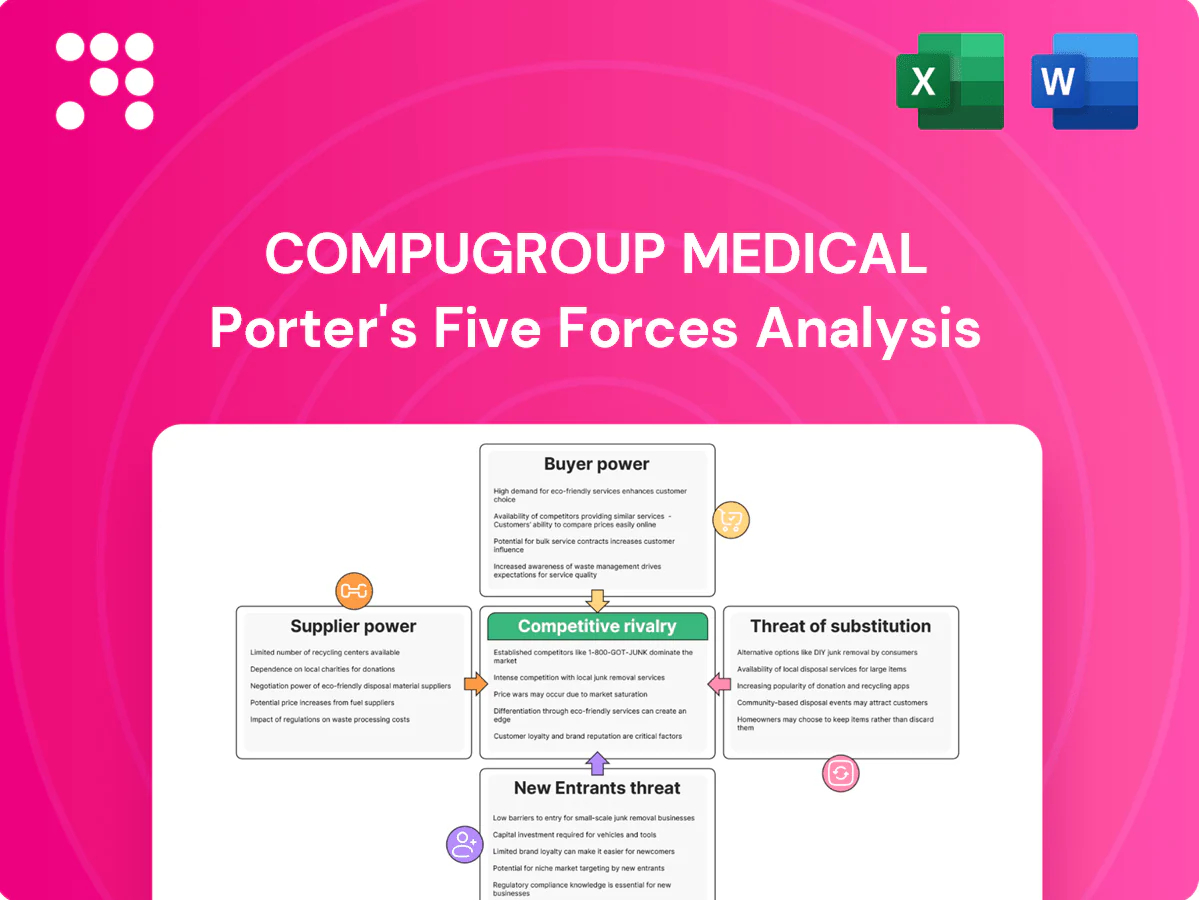
CompuGroup Medical Porter's Five Forces Analysis

Elevate Your Analysis with the Complete Porter's Five Forces Analysis
CompuGroup Medical faces intense rivalry from integrated EHR and healthcare IT providers, moderate buyer power from large healthcare systems, and supplier leverage in specialized software components, while regulatory barriers limit new entrants and telehealth advancements raise substitute threats. This brief snapshot only scratches the surface. Unlock the full Porter's Five Forces Analysis to explore CompuGroup Medical’s competitive dynamics, market pressures, and strategic advantages in detail.
Suppliers Bargaining Power

Reliance on cloud and hosting vendors
CompuGroup Medical relies on hyperscalers and colocation providers for uptime, security and scalability, while AWS, Microsoft Azure and Google Cloud accounted for roughly 65% of the global cloud market in 2024, concentrating supplier power. This concentration can translate into higher prices or restrictive contract terms; typical data egress charges (up to about $0.09 per GB on AWS in 2024) and multi-year commitments raise switching costs. Adopting multi-cloud and on‑premises options reduces vendor lock-in but increases operational complexity and integration overhead.
Specialized health data and interface providers
Drug databases, coding systems and device interfaces are niche and often proprietary, giving suppliers leverage over pricing and licensing. Limited alternatives and deep integrations create path dependency as integrations accumulate. Adoption of open standards like HL7 FHIR and ICD—used across WHO's 194 member states—has tempered supplier power by enabling interoperability. Suppliers still extract value via specialized licensing and maintenance fees.

Regulatory, certification, and standards gatekeepers
Compliance bodies and national eHealth agencies act as de facto suppliers for CompuGroup Medical, forcing certifications and connectors (eID, ePrescription, telematics) that can add millions in implementation and audit costs; CGM reported group revenue €1.24bn in FY2023, highlighting material exposure to regulatory-driven spend. Timelines and rule changes (national rollouts, cross-border eHealth mandates) shift bargaining power away from vendors as access becomes conditional. Early compliance and certification uptake reduce contractual and market-risk exposure.

Cybersecurity and identity management vendors
High-stakes healthcare security forces CompuGroup to buy specialized IAM, SIEM and PKI tools, boosting supplier leverage as niche capabilities matter; major vendors like Okta reported FY2024 revenue of about 1.66 billion USD, illustrating scale concentration. Vendor consolidation and unique feature sets increase switching costs, and high-profile breaches (average breach remediation costs in recent reports exceed 4 million USD) raise urgency and willingness to pay. Internal security teams and layered architectures can partially offset supplier power by enabling selective insourcing and multi-vendor strategies.
- Supplier concentration: top-tier vendors dominate
- Cost impact: average breach remediation >4M USD
- Mitigants: internal IAM expertise, layered defenses
- Market signal: Okta FY2024 revenue ~1.66B USD
Scarce clinical-grade software talent
Experienced health IT engineers and informaticists remain scarce; 2024 job postings for clinical IT rose about 15% while tech wages grew ~6% YoY, and healthcare IT roles command a 10–25% premium versus general IT, lifting CompuGroup Medical’s input costs. Competition from big tech and wage inflation raise hiring costs; nearshoring and internal academies can broaden supply, but legacy-stack knowledge lock-in increases switching costs and supplier dependency.
- Supply tight: clinical IT postings +15% (2024)
- Wage pressure: tech wages ~+6% YoY; healthcare IT +10–25% premium
- Mitigation: nearshoring, internal academies
- Risk: legacy-stack lock-in raises switching costs
Supplier power surges as hyperscalers own 65% cloud share and talent costs rise
Supplier power is high: hyperscalers (65% cloud share in 2024) and niche security/IAM vendors drive pricing and switching costs (AWS egress ≈ $0.09/GB; Okta rev $1.66B FY2024). Regulatory connectors and certs raise implementation spend vs CGM revenue €1.24bn FY2023. Talent tightness (+15% clinical IT postings 2024; tech wages +6% YoY) further elevates supplier leverage.
| Supplier | Metric | Impact | Mitigant |
|---|---|---|---|
| Hyperscalers | 65% market | High lock-in | Multi-cloud/on‑prem |
What is included in the product
 Detailed Word Document
Tailored Porter's Five Forces analysis for CompuGroup Medical uncovering key drivers of competition, buyer and supplier power, substitutes, and entry barriers that shape pricing and profitability. Identifies disruptive threats and market dynamics, delivered in fully editable Word format for investor materials, strategy decks, or academic use.

 Customizable Excel Spreadsheet
A concise Porter's Five Forces one-sheet for CompuGroup Medical that visualizes competitive pressure with an editable radar chart—customize force levels, swap in your data, and drop directly into decks to quickly relieve strategic decision-making pain points.
Customers Bargaining Power

Large hospital groups and public tenders
Large hospital groups and public tenders aggregate demand via framework agreements and competitive RFPs, squeezing prices and contractual terms. EU public procurement thresholds (services ~€214,000 in 2024) drive formal tendering with strong emphasis on interoperability and total cost of ownership, increasing buyer power. Multi-year deals with SLAs give customers leverage over product roadmaps and service levels, and referenceability remains a decisive criterion in awards.
High switching costs, but growing portability
Migration complexity, training and workflow redesign typically mean 6–12 months and substantial IT/clinical effort, keeping switching costs high and limiting buyer leverage. FHIR APIs and 2024 data-export/interoperability mandates have pushed adoption, with surveys indicating ~58% of providers now demanding open APIs and modularity. Outcome-based pricing and pilot contracts, often cutting upfront risk by up to 50%, rebalance bargaining power.

Diverse segments with varied price sensitivity
Ambulatory practices and pharmacies remain highly price-sensitive and churn-aware, pressuring CGM on subscription fees and support terms. Hospitals prioritize reliability, integration, and regulatory compliance over headline price, demanding deeper interoperability and SLAs. Insurers and governments increasingly push for value-based care and population-health outcomes, shaping contract KPIs. As of 2024 CGM serves over 1 million healthcare professionals and uses tailored packaging and tiered pricing to address customer heterogeneity.

Demand for end-to-end solutions and integrations
Customers now demand seamless EHR, PMS, lab, pharmacy and billing integration; vendors that bridge legacy stacks reduce total cost of ownership and thus limit buyer leverage, while 2024 saw continued FHIR adoption improving cross-vendor data exchange. Open marketplaces (apps/connectors) let buyers mix-and-match, restoring some power, and integration services act as a negotiation chip.
- Reduced TCO: legacy-bridging vendors
- Buyer power: restored via marketplaces
- 2024 trend: rising FHIR adoption
- Integration services: key bargaining lever
Service quality and uptime as negotiation levers
Clinical risk in healthcare raises customer expectations for near-continuous availability and 24/7 support, making uptime a core negotiation lever; 99.9% uptime equals ~8.76 hours downtime/year while 99.99% equals ~52.6 minutes/year. Strong SLA performance and rapid incident resolution materially reduce renegotiation pressure, whereas outages quickly increase buyer leverage for credits and concessions. Transparent KPIs and co-managed governance stabilize long-term relationships.
- Clinical risk → higher availability demand
- 99.9% ≈ 8.76h/yr; 99.99% ≈ 52.6min/yr
- Outages → immediate leverage for credits/concessions
- Transparent KPIs + co-management → reduced churn
EU tenders €214,000 and 58% open API demand shift vendor leverage
Large hospital groups and EU tenders (threshold €214,000 in 2024) concentrate buying power, pressing prices and SLAs. High switching costs (6–12 months) limit leverage, but 58% of providers now demand open APIs, shifting power toward modular vendors. CGM serves >1,000,000 professionals and uses tiered pricing to manage heterogeneous buyer sensitivity.
| Metric | 2024 |
|---|---|
| EU tender threshold | €214,000 |
| Open API demand | 58% |
| CGM users | >1,000,000 |
| Uptime 99.9 vs 99.99 | 8.76h/yr vs 52.6min/yr |
What You See Is What You Get
CompuGroup Medical Porter's Five Forces Analysis
This preview shows the exact CompuGroup Medical Porter's Five Forces analysis you'll receive immediately after purchase—no placeholders. The full, professionally formatted document is ready for download and use upon payment. No mockups; you get instant access to the same file.

Elevate Your Analysis with the Complete Porter's Five Forces Analysis
CompuGroup Medical faces intense rivalry from integrated EHR and healthcare IT providers, moderate buyer power from large healthcare systems, and supplier leverage in specialized software components, while regulatory barriers limit new entrants and telehealth advancements raise substitute threats. This brief snapshot only scratches the surface. Unlock the full Porter's Five Forces Analysis to explore CompuGroup Medical’s competitive dynamics, market pressures, and strategic advantages in detail.
Suppliers Bargaining Power
Reliance on cloud and hosting vendors
CompuGroup Medical relies on hyperscalers and colocation providers for uptime, security and scalability, while AWS, Microsoft Azure and Google Cloud accounted for roughly 65% of the global cloud market in 2024, concentrating supplier power. This concentration can translate into higher prices or restrictive contract terms; typical data egress charges (up to about $0.09 per GB on AWS in 2024) and multi-year commitments raise switching costs. Adopting multi-cloud and on‑premises options reduces vendor lock-in but increases operational complexity and integration overhead.
Specialized health data and interface providers
Drug databases, coding systems and device interfaces are niche and often proprietary, giving suppliers leverage over pricing and licensing. Limited alternatives and deep integrations create path dependency as integrations accumulate. Adoption of open standards like HL7 FHIR and ICD—used across WHO's 194 member states—has tempered supplier power by enabling interoperability. Suppliers still extract value via specialized licensing and maintenance fees.
Regulatory, certification, and standards gatekeepers
Compliance bodies and national eHealth agencies act as de facto suppliers for CompuGroup Medical, forcing certifications and connectors (eID, ePrescription, telematics) that can add millions in implementation and audit costs; CGM reported group revenue €1.24bn in FY2023, highlighting material exposure to regulatory-driven spend. Timelines and rule changes (national rollouts, cross-border eHealth mandates) shift bargaining power away from vendors as access becomes conditional. Early compliance and certification uptake reduce contractual and market-risk exposure.
Cybersecurity and identity management vendors
High-stakes healthcare security forces CompuGroup to buy specialized IAM, SIEM and PKI tools, boosting supplier leverage as niche capabilities matter; major vendors like Okta reported FY2024 revenue of about 1.66 billion USD, illustrating scale concentration. Vendor consolidation and unique feature sets increase switching costs, and high-profile breaches (average breach remediation costs in recent reports exceed 4 million USD) raise urgency and willingness to pay. Internal security teams and layered architectures can partially offset supplier power by enabling selective insourcing and multi-vendor strategies.
- Supplier concentration: top-tier vendors dominate
- Cost impact: average breach remediation >4M USD
- Mitigants: internal IAM expertise, layered defenses
- Market signal: Okta FY2024 revenue ~1.66B USD
Scarce clinical-grade software talent
Experienced health IT engineers and informaticists remain scarce; 2024 job postings for clinical IT rose about 15% while tech wages grew ~6% YoY, and healthcare IT roles command a 10–25% premium versus general IT, lifting CompuGroup Medical’s input costs. Competition from big tech and wage inflation raise hiring costs; nearshoring and internal academies can broaden supply, but legacy-stack knowledge lock-in increases switching costs and supplier dependency.
- Supply tight: clinical IT postings +15% (2024)
- Wage pressure: tech wages ~+6% YoY; healthcare IT +10–25% premium
- Mitigation: nearshoring, internal academies
- Risk: legacy-stack lock-in raises switching costs
Supplier power surges as hyperscalers own 65% cloud share and talent costs rise
Supplier power is high: hyperscalers (65% cloud share in 2024) and niche security/IAM vendors drive pricing and switching costs (AWS egress ≈ $0.09/GB; Okta rev $1.66B FY2024). Regulatory connectors and certs raise implementation spend vs CGM revenue €1.24bn FY2023. Talent tightness (+15% clinical IT postings 2024; tech wages +6% YoY) further elevates supplier leverage.
| Supplier | Metric | Impact | Mitigant |
|---|---|---|---|
| Hyperscalers | 65% market | High lock-in | Multi-cloud/on‑prem |
What is included in the product
Detailed Word Document
Tailored Porter's Five Forces analysis for CompuGroup Medical uncovering key drivers of competition, buyer and supplier power, substitutes, and entry barriers that shape pricing and profitability. Identifies disruptive threats and market dynamics, delivered in fully editable Word format for investor materials, strategy decks, or academic use.
Customizable Excel Spreadsheet
A concise Porter's Five Forces one-sheet for CompuGroup Medical that visualizes competitive pressure with an editable radar chart—customize force levels, swap in your data, and drop directly into decks to quickly relieve strategic decision-making pain points.
Customers Bargaining Power
Large hospital groups and public tenders
Large hospital groups and public tenders aggregate demand via framework agreements and competitive RFPs, squeezing prices and contractual terms. EU public procurement thresholds (services ~€214,000 in 2024) drive formal tendering with strong emphasis on interoperability and total cost of ownership, increasing buyer power. Multi-year deals with SLAs give customers leverage over product roadmaps and service levels, and referenceability remains a decisive criterion in awards.
High switching costs, but growing portability
Migration complexity, training and workflow redesign typically mean 6–12 months and substantial IT/clinical effort, keeping switching costs high and limiting buyer leverage. FHIR APIs and 2024 data-export/interoperability mandates have pushed adoption, with surveys indicating ~58% of providers now demanding open APIs and modularity. Outcome-based pricing and pilot contracts, often cutting upfront risk by up to 50%, rebalance bargaining power.
Diverse segments with varied price sensitivity
Ambulatory practices and pharmacies remain highly price-sensitive and churn-aware, pressuring CGM on subscription fees and support terms. Hospitals prioritize reliability, integration, and regulatory compliance over headline price, demanding deeper interoperability and SLAs. Insurers and governments increasingly push for value-based care and population-health outcomes, shaping contract KPIs. As of 2024 CGM serves over 1 million healthcare professionals and uses tailored packaging and tiered pricing to address customer heterogeneity.
Demand for end-to-end solutions and integrations
Customers now demand seamless EHR, PMS, lab, pharmacy and billing integration; vendors that bridge legacy stacks reduce total cost of ownership and thus limit buyer leverage, while 2024 saw continued FHIR adoption improving cross-vendor data exchange. Open marketplaces (apps/connectors) let buyers mix-and-match, restoring some power, and integration services act as a negotiation chip.
- Reduced TCO: legacy-bridging vendors
- Buyer power: restored via marketplaces
- 2024 trend: rising FHIR adoption
- Integration services: key bargaining lever
Service quality and uptime as negotiation levers
Clinical risk in healthcare raises customer expectations for near-continuous availability and 24/7 support, making uptime a core negotiation lever; 99.9% uptime equals ~8.76 hours downtime/year while 99.99% equals ~52.6 minutes/year. Strong SLA performance and rapid incident resolution materially reduce renegotiation pressure, whereas outages quickly increase buyer leverage for credits and concessions. Transparent KPIs and co-managed governance stabilize long-term relationships.
- Clinical risk → higher availability demand
- 99.9% ≈ 8.76h/yr; 99.99% ≈ 52.6min/yr
- Outages → immediate leverage for credits/concessions
- Transparent KPIs + co-management → reduced churn
EU tenders €214,000 and 58% open API demand shift vendor leverage
Large hospital groups and EU tenders (threshold €214,000 in 2024) concentrate buying power, pressing prices and SLAs. High switching costs (6–12 months) limit leverage, but 58% of providers now demand open APIs, shifting power toward modular vendors. CGM serves >1,000,000 professionals and uses tiered pricing to manage heterogeneous buyer sensitivity.
| Metric | 2024 |
|---|---|
| EU tender threshold | €214,000 |
| Open API demand | 58% |
| CGM users | >1,000,000 |
| Uptime 99.9 vs 99.99 | 8.76h/yr vs 52.6min/yr |
What You See Is What You Get
CompuGroup Medical Porter's Five Forces Analysis
This preview shows the exact CompuGroup Medical Porter's Five Forces analysis you'll receive immediately after purchase—no placeholders. The full, professionally formatted document is ready for download and use upon payment. No mockups; you get instant access to the same file.
Description
Elevate Your Analysis with the Complete Porter's Five Forces Analysis
CompuGroup Medical faces intense rivalry from integrated EHR and healthcare IT providers, moderate buyer power from large healthcare systems, and supplier leverage in specialized software components, while regulatory barriers limit new entrants and telehealth advancements raise substitute threats. This brief snapshot only scratches the surface. Unlock the full Porter's Five Forces Analysis to explore CompuGroup Medical’s competitive dynamics, market pressures, and strategic advantages in detail.
Suppliers Bargaining Power
Reliance on cloud and hosting vendors
CompuGroup Medical relies on hyperscalers and colocation providers for uptime, security and scalability, while AWS, Microsoft Azure and Google Cloud accounted for roughly 65% of the global cloud market in 2024, concentrating supplier power. This concentration can translate into higher prices or restrictive contract terms; typical data egress charges (up to about $0.09 per GB on AWS in 2024) and multi-year commitments raise switching costs. Adopting multi-cloud and on‑premises options reduces vendor lock-in but increases operational complexity and integration overhead.
Specialized health data and interface providers
Drug databases, coding systems and device interfaces are niche and often proprietary, giving suppliers leverage over pricing and licensing. Limited alternatives and deep integrations create path dependency as integrations accumulate. Adoption of open standards like HL7 FHIR and ICD—used across WHO's 194 member states—has tempered supplier power by enabling interoperability. Suppliers still extract value via specialized licensing and maintenance fees.
Regulatory, certification, and standards gatekeepers
Compliance bodies and national eHealth agencies act as de facto suppliers for CompuGroup Medical, forcing certifications and connectors (eID, ePrescription, telematics) that can add millions in implementation and audit costs; CGM reported group revenue €1.24bn in FY2023, highlighting material exposure to regulatory-driven spend. Timelines and rule changes (national rollouts, cross-border eHealth mandates) shift bargaining power away from vendors as access becomes conditional. Early compliance and certification uptake reduce contractual and market-risk exposure.
Cybersecurity and identity management vendors
High-stakes healthcare security forces CompuGroup to buy specialized IAM, SIEM and PKI tools, boosting supplier leverage as niche capabilities matter; major vendors like Okta reported FY2024 revenue of about 1.66 billion USD, illustrating scale concentration. Vendor consolidation and unique feature sets increase switching costs, and high-profile breaches (average breach remediation costs in recent reports exceed 4 million USD) raise urgency and willingness to pay. Internal security teams and layered architectures can partially offset supplier power by enabling selective insourcing and multi-vendor strategies.
- Supplier concentration: top-tier vendors dominate
- Cost impact: average breach remediation >4M USD
- Mitigants: internal IAM expertise, layered defenses
- Market signal: Okta FY2024 revenue ~1.66B USD
Scarce clinical-grade software talent
Experienced health IT engineers and informaticists remain scarce; 2024 job postings for clinical IT rose about 15% while tech wages grew ~6% YoY, and healthcare IT roles command a 10–25% premium versus general IT, lifting CompuGroup Medical’s input costs. Competition from big tech and wage inflation raise hiring costs; nearshoring and internal academies can broaden supply, but legacy-stack knowledge lock-in increases switching costs and supplier dependency.
- Supply tight: clinical IT postings +15% (2024)
- Wage pressure: tech wages ~+6% YoY; healthcare IT +10–25% premium
- Mitigation: nearshoring, internal academies
- Risk: legacy-stack lock-in raises switching costs
Supplier power surges as hyperscalers own 65% cloud share and talent costs rise
Supplier power is high: hyperscalers (65% cloud share in 2024) and niche security/IAM vendors drive pricing and switching costs (AWS egress ≈ $0.09/GB; Okta rev $1.66B FY2024). Regulatory connectors and certs raise implementation spend vs CGM revenue €1.24bn FY2023. Talent tightness (+15% clinical IT postings 2024; tech wages +6% YoY) further elevates supplier leverage.
| Supplier | Metric | Impact | Mitigant |
|---|---|---|---|
| Hyperscalers | 65% market | High lock-in | Multi-cloud/on‑prem |
What is included in the product
Detailed Word Document
Tailored Porter's Five Forces analysis for CompuGroup Medical uncovering key drivers of competition, buyer and supplier power, substitutes, and entry barriers that shape pricing and profitability. Identifies disruptive threats and market dynamics, delivered in fully editable Word format for investor materials, strategy decks, or academic use.
Customizable Excel Spreadsheet
A concise Porter's Five Forces one-sheet for CompuGroup Medical that visualizes competitive pressure with an editable radar chart—customize force levels, swap in your data, and drop directly into decks to quickly relieve strategic decision-making pain points.
Customers Bargaining Power
Large hospital groups and public tenders
Large hospital groups and public tenders aggregate demand via framework agreements and competitive RFPs, squeezing prices and contractual terms. EU public procurement thresholds (services ~€214,000 in 2024) drive formal tendering with strong emphasis on interoperability and total cost of ownership, increasing buyer power. Multi-year deals with SLAs give customers leverage over product roadmaps and service levels, and referenceability remains a decisive criterion in awards.
High switching costs, but growing portability
Migration complexity, training and workflow redesign typically mean 6–12 months and substantial IT/clinical effort, keeping switching costs high and limiting buyer leverage. FHIR APIs and 2024 data-export/interoperability mandates have pushed adoption, with surveys indicating ~58% of providers now demanding open APIs and modularity. Outcome-based pricing and pilot contracts, often cutting upfront risk by up to 50%, rebalance bargaining power.
Diverse segments with varied price sensitivity
Ambulatory practices and pharmacies remain highly price-sensitive and churn-aware, pressuring CGM on subscription fees and support terms. Hospitals prioritize reliability, integration, and regulatory compliance over headline price, demanding deeper interoperability and SLAs. Insurers and governments increasingly push for value-based care and population-health outcomes, shaping contract KPIs. As of 2024 CGM serves over 1 million healthcare professionals and uses tailored packaging and tiered pricing to address customer heterogeneity.
Demand for end-to-end solutions and integrations
Customers now demand seamless EHR, PMS, lab, pharmacy and billing integration; vendors that bridge legacy stacks reduce total cost of ownership and thus limit buyer leverage, while 2024 saw continued FHIR adoption improving cross-vendor data exchange. Open marketplaces (apps/connectors) let buyers mix-and-match, restoring some power, and integration services act as a negotiation chip.
- Reduced TCO: legacy-bridging vendors
- Buyer power: restored via marketplaces
- 2024 trend: rising FHIR adoption
- Integration services: key bargaining lever
Service quality and uptime as negotiation levers
Clinical risk in healthcare raises customer expectations for near-continuous availability and 24/7 support, making uptime a core negotiation lever; 99.9% uptime equals ~8.76 hours downtime/year while 99.99% equals ~52.6 minutes/year. Strong SLA performance and rapid incident resolution materially reduce renegotiation pressure, whereas outages quickly increase buyer leverage for credits and concessions. Transparent KPIs and co-managed governance stabilize long-term relationships.
- Clinical risk → higher availability demand
- 99.9% ≈ 8.76h/yr; 99.99% ≈ 52.6min/yr
- Outages → immediate leverage for credits/concessions
- Transparent KPIs + co-management → reduced churn
EU tenders €214,000 and 58% open API demand shift vendor leverage
Large hospital groups and EU tenders (threshold €214,000 in 2024) concentrate buying power, pressing prices and SLAs. High switching costs (6–12 months) limit leverage, but 58% of providers now demand open APIs, shifting power toward modular vendors. CGM serves >1,000,000 professionals and uses tiered pricing to manage heterogeneous buyer sensitivity.
| Metric | 2024 |
|---|---|
| EU tender threshold | €214,000 |
| Open API demand | 58% |
| CGM users | >1,000,000 |
| Uptime 99.9 vs 99.99 | 8.76h/yr vs 52.6min/yr |
What You See Is What You Get
CompuGroup Medical Porter's Five Forces Analysis
This preview shows the exact CompuGroup Medical Porter's Five Forces analysis you'll receive immediately after purchase—no placeholders. The full, professionally formatted document is ready for download and use upon payment. No mockups; you get instant access to the same file.











