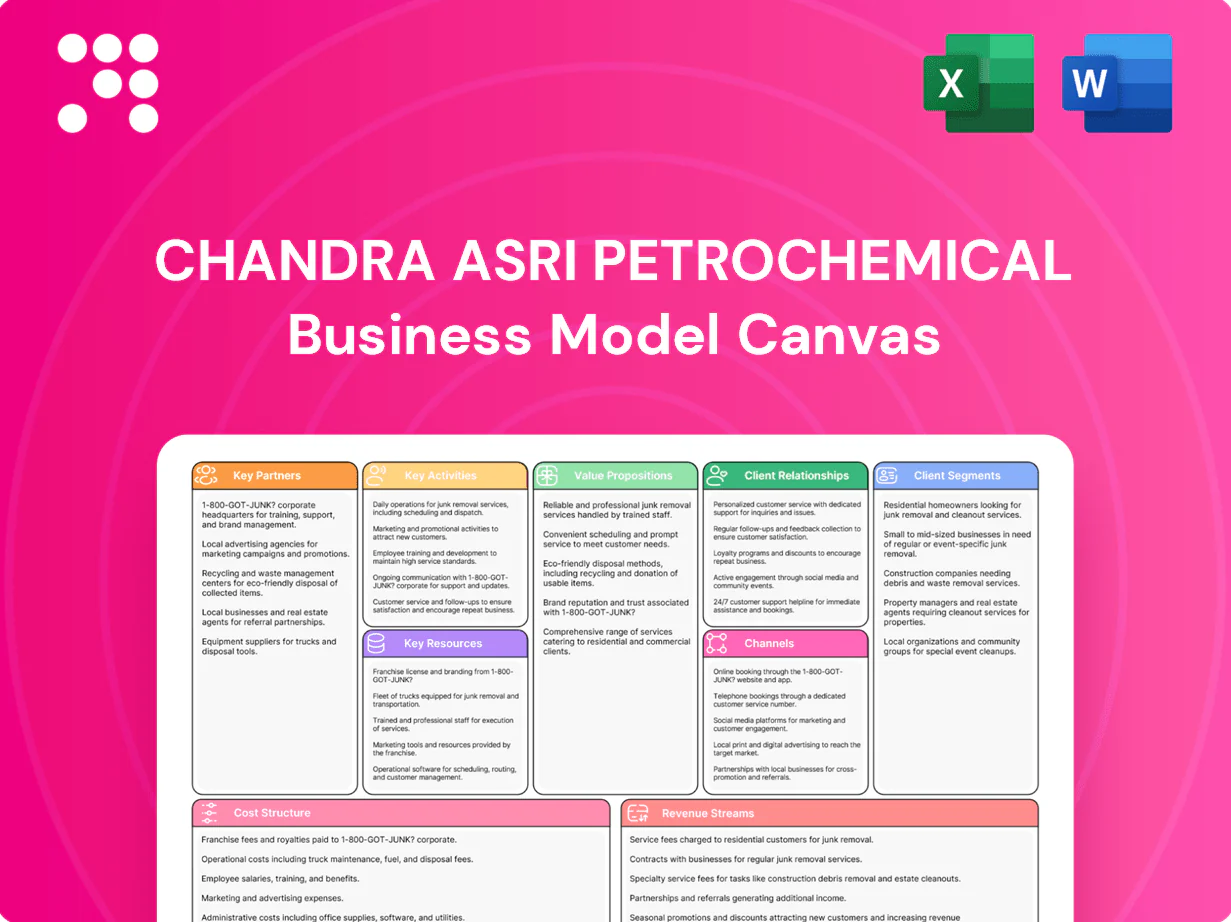
Chandra Asri Petrochemical Business Model Canvas

Petrochemical Business Model Canvas: Feedstock, Scale, Partnerships, and Margin Drivers
Explore Chandra Asri Petrochemical’s Business Model Canvas to see how the company converts feedstock, scale, and partnerships into competitive advantage and margin expansion. This concise snapshot highlights key customer segments, revenue streams, and cost drivers that fuel its market leadership. Purchase the full, editable Canvas to access section-by-section analysis, strategic implications, and ready-to-use templates for benchmarking or investment decisions.
Partnerships

Crude naphtha and feedstock suppliers
Long-term contracts with global and regional crude naphtha suppliers secure steady ethylene cracker feed and reduce spot exposure, while diversified sources cut price and disruption risk. Strategic ties with traders and refiners optimize timing and inventory rotation to protect margins. Local sourcing supports rupiah cost stability—IDR averaged about 15,300 per USD in 2024—helping align procurement with domestic policy.
Utility, logistics, and port operators
Chandra Asri, Indonesia’s largest integrated petrochemical producer headquartered in Cilegon, Banten and listed on the IDX as TPIA (2024), relies on utility partners for continuous power, steam, water and industrial gases to sustain its integrated crackers and derivatives units. Port concessions and tank-farm operators at Cilegon enable efficient import/export flows for feedstocks and polymers. Rail, road and coastal shipping partners underpin domestic distribution across Java and eastern Indonesia. Joint reliability programs with logistics providers target minimized demurrage and downtime to protect throughput and margins.

Engineering, EPC, and technology licensors
Licensors for cracking, polymerization and catalysts (supporting Chandra Asri’s status as Indonesia’s largest integrated petrochemical producer with ~1.05 Mtpa ethylene capacity) drive higher yields and product quality; EPC partners execute debottlenecking, expansions and turnarounds to raise utilization and lower per-ton costs. Joint R&D pilots new resin grades and process intensification, while technical alliances sustain safety, energy efficiency and emissions compliance.

Downstream converters and industrial clusters
Anchor customers co-develop grades for packaging, automotive, and construction, while industrial park collaboration synchronizes utilities and waste management. Long-term off-take agreements (typically 3–7 years as of 2024) stabilize plant loading and revenue visibility. Joint demand planning reduces bullwhip effects and can cut inventory costs materially.
- co-development: targeted grades for packaging/auto/const
- park synergy: shared utilities, centralized waste handling
- off-take: 3–7 year contracts for stable loading
- demand planning: lowers bullwhip and inventory costs
Government, regulators, and financiers
Policy alignment with Indonesia's import-substitution and domestic value-add agenda underpins Chandra Asri's growth, while permitting and ESG compliance demand continuous engagement with regulators to de-risk operations. Large capex cycles are financed through a mix of bank loans and bondholders, and targeted government incentives and risk-sharing mechanisms materially improve project bankability.
- Policy: import substitution support
- Regulators: active ESG/permitting engagement
- Finance: banks + bondholders for capex
- Incentives: improve bankability
Long-term naphtha deals, partners and 3–7y off-takes secure feedstock; IDR 15,300
Long-term naphtha contracts and diversified suppliers secure feedstock and reduce spot exposure; IDR averaged ~15,300/USD in 2024 stabilizes rupiah costs. Utility, port and logistics partners sustain integrated operations and domestic distribution. Licensors, EPCs and anchor customers (3–7y off-takes) enable debottlenecking, new grades and stable loading.
| Partner | Role | 2024 metric |
|---|---|---|
| Naphtha suppliers | Feedstock security | IDR ~15,300/USD |
| Licensors/EPC | Tech & expansions | Ethylene ~1.05 Mtpa |
| Customers | Off-take | 3–7 year contracts |
What is included in the product
 Detailed Word Document
A comprehensive Business Model Canvas for Chandra Asri Petrochemical detailing customer segments, channels, value propositions and the 9 BMC blocks, reflecting real-world operations, competitive advantages and linked SWOT insights—ideal for presentations, investor discussions and strategic decision-making.

 Customizable Excel Spreadsheet
High-level view of Chandra Asri Petrochemical’s business model with editable cells to quickly resolve strategic misalignment and information silos.
Activities

Integrated cracking and polymer production
Operate Chandra Asri's ethylene cracker (1.06 Mtpa) and downstream PE/PP units (combined ~970 ktpa) at on‑stream factors above 92% in 2024, optimizing feed slates and operating windows to lift margins; maintain strict process safety and environmental controls (zero LTI targets, emissions monitoring) while balancing domestic demand and roughly 30% export allocation to capture higher regional spreads.
Supply chain, trading, and inventory management
Chandra Asri secures feedstock via long-term LNG/naphtha contracts and financial hedges to mitigate price and currency swings, referencing Brent at about 80 USD/bbl average in 2024. Operations manage tanks, pipelines and coastal shipping for just-in-time flows into its ~1.1 million tpa steam cracker and downstream units. Blending teams allocate grades to meet customer specs across polyolefin and aromatic product lines. S&OP cycles align production with market signals and sales forecasts through weekly demand-review cadences.

Product development and technical service
Co-create resin grades with over 80 converter partners to tailor performance and processing for key segments. Run five application labs and field trials that have shortened qualification cycles by ~40%. Provide troubleshooting and optimization at 120+ customer sites to cut downtime and scrap. Translate site feedback into continuous formulation updates delivered quarterly.

Asset integrity and capacity expansion
Asset integrity and capacity expansion prioritize scheduled turnarounds, inspections and predictive maintenance to sustain Chandra Asri’s operating reliability while debottlenecking select units to raise throughput and energy efficiency by targeted single-digit percentages. Brownfield debottlenecks and greenfield projects aim to reduce Indonesia’s polymer import gap (about 3.2 Mt in 2023) by adding domestic volumes. Digital monitoring platforms drive uptime and mean-time-between-failure improvements.
- Schedule turnarounds, inspections, predictive maintenance
- Debottleneck units to lift throughput & energy efficiency
- Brownfield & greenfield expansions to close ~3.2 Mt import gap (2023)
- Implement digital monitoring for reliability gains
ESG, compliance, and risk management
Monitor emissions, flaring, effluents and waste streams through continuous measurement and third-party verification to reduce environmental impact and meet regulatory thresholds.
Ensure compliance with safety, quality and product stewardship standards across operations and supply chains, supported by audits and certification programs.
Manage market, credit and operational risks via hedging, counterparty assessments and contingency planning while engaging communities and stakeholders to sustain license to operate.
- ESG monitoring
- Compliance & audits
- Risk management
- Stakeholder engagement
1.06 Mtpa cracker, ~970 ktpa PE/PP, >92% uptime, safety & emissions
Operate 1.06 Mtpa steam cracker and ~970 ktpa PE/PP (~92%+ on‑stream in 2024), optimize feed slates and hedges vs Brent ~80 USD/bbl. Prioritize turnarounds, predictive maintenance and 1–3% debottleneck uplift; shrink import gap via expansions. Maintain zero LTI target, continuous emissions monitoring and stakeholder engagement.
| Metric | 2024 |
|---|---|
| Cracker | 1.06 Mtpa |
| Downstream | ~970 ktpa |
| On‑stream | 92%+ |
Preview Before You Purchase
Business Model Canvas
The Chandra Asri Petrochemical Business Model Canvas shown here is a true preview of the exact deliverable—not a mockup or sample—and contains the same content and structure you’ll receive after purchase. Upon ordering, you’ll download the complete document in editable Word and Excel formats. It’s ready to present, edit, and apply with no surprises.

Petrochemical Business Model Canvas: Feedstock, Scale, Partnerships, and Margin Drivers
Explore Chandra Asri Petrochemical’s Business Model Canvas to see how the company converts feedstock, scale, and partnerships into competitive advantage and margin expansion. This concise snapshot highlights key customer segments, revenue streams, and cost drivers that fuel its market leadership. Purchase the full, editable Canvas to access section-by-section analysis, strategic implications, and ready-to-use templates for benchmarking or investment decisions.
Partnerships
Crude naphtha and feedstock suppliers
Long-term contracts with global and regional crude naphtha suppliers secure steady ethylene cracker feed and reduce spot exposure, while diversified sources cut price and disruption risk. Strategic ties with traders and refiners optimize timing and inventory rotation to protect margins. Local sourcing supports rupiah cost stability—IDR averaged about 15,300 per USD in 2024—helping align procurement with domestic policy.
Utility, logistics, and port operators
Chandra Asri, Indonesia’s largest integrated petrochemical producer headquartered in Cilegon, Banten and listed on the IDX as TPIA (2024), relies on utility partners for continuous power, steam, water and industrial gases to sustain its integrated crackers and derivatives units. Port concessions and tank-farm operators at Cilegon enable efficient import/export flows for feedstocks and polymers. Rail, road and coastal shipping partners underpin domestic distribution across Java and eastern Indonesia. Joint reliability programs with logistics providers target minimized demurrage and downtime to protect throughput and margins.
Engineering, EPC, and technology licensors
Licensors for cracking, polymerization and catalysts (supporting Chandra Asri’s status as Indonesia’s largest integrated petrochemical producer with ~1.05 Mtpa ethylene capacity) drive higher yields and product quality; EPC partners execute debottlenecking, expansions and turnarounds to raise utilization and lower per-ton costs. Joint R&D pilots new resin grades and process intensification, while technical alliances sustain safety, energy efficiency and emissions compliance.
Downstream converters and industrial clusters
Anchor customers co-develop grades for packaging, automotive, and construction, while industrial park collaboration synchronizes utilities and waste management. Long-term off-take agreements (typically 3–7 years as of 2024) stabilize plant loading and revenue visibility. Joint demand planning reduces bullwhip effects and can cut inventory costs materially.
- co-development: targeted grades for packaging/auto/const
- park synergy: shared utilities, centralized waste handling
- off-take: 3–7 year contracts for stable loading
- demand planning: lowers bullwhip and inventory costs
Government, regulators, and financiers
Policy alignment with Indonesia's import-substitution and domestic value-add agenda underpins Chandra Asri's growth, while permitting and ESG compliance demand continuous engagement with regulators to de-risk operations. Large capex cycles are financed through a mix of bank loans and bondholders, and targeted government incentives and risk-sharing mechanisms materially improve project bankability.
- Policy: import substitution support
- Regulators: active ESG/permitting engagement
- Finance: banks + bondholders for capex
- Incentives: improve bankability
Long-term naphtha deals, partners and 3–7y off-takes secure feedstock; IDR 15,300
Long-term naphtha contracts and diversified suppliers secure feedstock and reduce spot exposure; IDR averaged ~15,300/USD in 2024 stabilizes rupiah costs. Utility, port and logistics partners sustain integrated operations and domestic distribution. Licensors, EPCs and anchor customers (3–7y off-takes) enable debottlenecking, new grades and stable loading.
| Partner | Role | 2024 metric |
|---|---|---|
| Naphtha suppliers | Feedstock security | IDR ~15,300/USD |
| Licensors/EPC | Tech & expansions | Ethylene ~1.05 Mtpa |
| Customers | Off-take | 3–7 year contracts |
What is included in the product
Detailed Word Document
A comprehensive Business Model Canvas for Chandra Asri Petrochemical detailing customer segments, channels, value propositions and the 9 BMC blocks, reflecting real-world operations, competitive advantages and linked SWOT insights—ideal for presentations, investor discussions and strategic decision-making.
Customizable Excel Spreadsheet
High-level view of Chandra Asri Petrochemical’s business model with editable cells to quickly resolve strategic misalignment and information silos.
Activities
Integrated cracking and polymer production
Operate Chandra Asri's ethylene cracker (1.06 Mtpa) and downstream PE/PP units (combined ~970 ktpa) at on‑stream factors above 92% in 2024, optimizing feed slates and operating windows to lift margins; maintain strict process safety and environmental controls (zero LTI targets, emissions monitoring) while balancing domestic demand and roughly 30% export allocation to capture higher regional spreads.
Supply chain, trading, and inventory management
Chandra Asri secures feedstock via long-term LNG/naphtha contracts and financial hedges to mitigate price and currency swings, referencing Brent at about 80 USD/bbl average in 2024. Operations manage tanks, pipelines and coastal shipping for just-in-time flows into its ~1.1 million tpa steam cracker and downstream units. Blending teams allocate grades to meet customer specs across polyolefin and aromatic product lines. S&OP cycles align production with market signals and sales forecasts through weekly demand-review cadences.
Product development and technical service
Co-create resin grades with over 80 converter partners to tailor performance and processing for key segments. Run five application labs and field trials that have shortened qualification cycles by ~40%. Provide troubleshooting and optimization at 120+ customer sites to cut downtime and scrap. Translate site feedback into continuous formulation updates delivered quarterly.
Asset integrity and capacity expansion
Asset integrity and capacity expansion prioritize scheduled turnarounds, inspections and predictive maintenance to sustain Chandra Asri’s operating reliability while debottlenecking select units to raise throughput and energy efficiency by targeted single-digit percentages. Brownfield debottlenecks and greenfield projects aim to reduce Indonesia’s polymer import gap (about 3.2 Mt in 2023) by adding domestic volumes. Digital monitoring platforms drive uptime and mean-time-between-failure improvements.
- Schedule turnarounds, inspections, predictive maintenance
- Debottleneck units to lift throughput & energy efficiency
- Brownfield & greenfield expansions to close ~3.2 Mt import gap (2023)
- Implement digital monitoring for reliability gains
ESG, compliance, and risk management
Monitor emissions, flaring, effluents and waste streams through continuous measurement and third-party verification to reduce environmental impact and meet regulatory thresholds.
Ensure compliance with safety, quality and product stewardship standards across operations and supply chains, supported by audits and certification programs.
Manage market, credit and operational risks via hedging, counterparty assessments and contingency planning while engaging communities and stakeholders to sustain license to operate.
- ESG monitoring
- Compliance & audits
- Risk management
- Stakeholder engagement
1.06 Mtpa cracker, ~970 ktpa PE/PP, >92% uptime, safety & emissions
Operate 1.06 Mtpa steam cracker and ~970 ktpa PE/PP (~92%+ on‑stream in 2024), optimize feed slates and hedges vs Brent ~80 USD/bbl. Prioritize turnarounds, predictive maintenance and 1–3% debottleneck uplift; shrink import gap via expansions. Maintain zero LTI target, continuous emissions monitoring and stakeholder engagement.
| Metric | 2024 |
|---|---|
| Cracker | 1.06 Mtpa |
| Downstream | ~970 ktpa |
| On‑stream | 92%+ |
Preview Before You Purchase
Business Model Canvas
The Chandra Asri Petrochemical Business Model Canvas shown here is a true preview of the exact deliverable—not a mockup or sample—and contains the same content and structure you’ll receive after purchase. Upon ordering, you’ll download the complete document in editable Word and Excel formats. It’s ready to present, edit, and apply with no surprises.
Original: $10.00
-65%$10.00
$3.50Description
Petrochemical Business Model Canvas: Feedstock, Scale, Partnerships, and Margin Drivers
Explore Chandra Asri Petrochemical’s Business Model Canvas to see how the company converts feedstock, scale, and partnerships into competitive advantage and margin expansion. This concise snapshot highlights key customer segments, revenue streams, and cost drivers that fuel its market leadership. Purchase the full, editable Canvas to access section-by-section analysis, strategic implications, and ready-to-use templates for benchmarking or investment decisions.
Partnerships
Crude naphtha and feedstock suppliers
Long-term contracts with global and regional crude naphtha suppliers secure steady ethylene cracker feed and reduce spot exposure, while diversified sources cut price and disruption risk. Strategic ties with traders and refiners optimize timing and inventory rotation to protect margins. Local sourcing supports rupiah cost stability—IDR averaged about 15,300 per USD in 2024—helping align procurement with domestic policy.
Utility, logistics, and port operators
Chandra Asri, Indonesia’s largest integrated petrochemical producer headquartered in Cilegon, Banten and listed on the IDX as TPIA (2024), relies on utility partners for continuous power, steam, water and industrial gases to sustain its integrated crackers and derivatives units. Port concessions and tank-farm operators at Cilegon enable efficient import/export flows for feedstocks and polymers. Rail, road and coastal shipping partners underpin domestic distribution across Java and eastern Indonesia. Joint reliability programs with logistics providers target minimized demurrage and downtime to protect throughput and margins.
Engineering, EPC, and technology licensors
Licensors for cracking, polymerization and catalysts (supporting Chandra Asri’s status as Indonesia’s largest integrated petrochemical producer with ~1.05 Mtpa ethylene capacity) drive higher yields and product quality; EPC partners execute debottlenecking, expansions and turnarounds to raise utilization and lower per-ton costs. Joint R&D pilots new resin grades and process intensification, while technical alliances sustain safety, energy efficiency and emissions compliance.
Downstream converters and industrial clusters
Anchor customers co-develop grades for packaging, automotive, and construction, while industrial park collaboration synchronizes utilities and waste management. Long-term off-take agreements (typically 3–7 years as of 2024) stabilize plant loading and revenue visibility. Joint demand planning reduces bullwhip effects and can cut inventory costs materially.
- co-development: targeted grades for packaging/auto/const
- park synergy: shared utilities, centralized waste handling
- off-take: 3–7 year contracts for stable loading
- demand planning: lowers bullwhip and inventory costs
Government, regulators, and financiers
Policy alignment with Indonesia's import-substitution and domestic value-add agenda underpins Chandra Asri's growth, while permitting and ESG compliance demand continuous engagement with regulators to de-risk operations. Large capex cycles are financed through a mix of bank loans and bondholders, and targeted government incentives and risk-sharing mechanisms materially improve project bankability.
- Policy: import substitution support
- Regulators: active ESG/permitting engagement
- Finance: banks + bondholders for capex
- Incentives: improve bankability
Long-term naphtha deals, partners and 3–7y off-takes secure feedstock; IDR 15,300
Long-term naphtha contracts and diversified suppliers secure feedstock and reduce spot exposure; IDR averaged ~15,300/USD in 2024 stabilizes rupiah costs. Utility, port and logistics partners sustain integrated operations and domestic distribution. Licensors, EPCs and anchor customers (3–7y off-takes) enable debottlenecking, new grades and stable loading.
| Partner | Role | 2024 metric |
|---|---|---|
| Naphtha suppliers | Feedstock security | IDR ~15,300/USD |
| Licensors/EPC | Tech & expansions | Ethylene ~1.05 Mtpa |
| Customers | Off-take | 3–7 year contracts |
What is included in the product
Detailed Word Document
A comprehensive Business Model Canvas for Chandra Asri Petrochemical detailing customer segments, channels, value propositions and the 9 BMC blocks, reflecting real-world operations, competitive advantages and linked SWOT insights—ideal for presentations, investor discussions and strategic decision-making.
Customizable Excel Spreadsheet
High-level view of Chandra Asri Petrochemical’s business model with editable cells to quickly resolve strategic misalignment and information silos.
Activities
Integrated cracking and polymer production
Operate Chandra Asri's ethylene cracker (1.06 Mtpa) and downstream PE/PP units (combined ~970 ktpa) at on‑stream factors above 92% in 2024, optimizing feed slates and operating windows to lift margins; maintain strict process safety and environmental controls (zero LTI targets, emissions monitoring) while balancing domestic demand and roughly 30% export allocation to capture higher regional spreads.
Supply chain, trading, and inventory management
Chandra Asri secures feedstock via long-term LNG/naphtha contracts and financial hedges to mitigate price and currency swings, referencing Brent at about 80 USD/bbl average in 2024. Operations manage tanks, pipelines and coastal shipping for just-in-time flows into its ~1.1 million tpa steam cracker and downstream units. Blending teams allocate grades to meet customer specs across polyolefin and aromatic product lines. S&OP cycles align production with market signals and sales forecasts through weekly demand-review cadences.
Product development and technical service
Co-create resin grades with over 80 converter partners to tailor performance and processing for key segments. Run five application labs and field trials that have shortened qualification cycles by ~40%. Provide troubleshooting and optimization at 120+ customer sites to cut downtime and scrap. Translate site feedback into continuous formulation updates delivered quarterly.
Asset integrity and capacity expansion
Asset integrity and capacity expansion prioritize scheduled turnarounds, inspections and predictive maintenance to sustain Chandra Asri’s operating reliability while debottlenecking select units to raise throughput and energy efficiency by targeted single-digit percentages. Brownfield debottlenecks and greenfield projects aim to reduce Indonesia’s polymer import gap (about 3.2 Mt in 2023) by adding domestic volumes. Digital monitoring platforms drive uptime and mean-time-between-failure improvements.
- Schedule turnarounds, inspections, predictive maintenance
- Debottleneck units to lift throughput & energy efficiency
- Brownfield & greenfield expansions to close ~3.2 Mt import gap (2023)
- Implement digital monitoring for reliability gains
ESG, compliance, and risk management
Monitor emissions, flaring, effluents and waste streams through continuous measurement and third-party verification to reduce environmental impact and meet regulatory thresholds.
Ensure compliance with safety, quality and product stewardship standards across operations and supply chains, supported by audits and certification programs.
Manage market, credit and operational risks via hedging, counterparty assessments and contingency planning while engaging communities and stakeholders to sustain license to operate.
- ESG monitoring
- Compliance & audits
- Risk management
- Stakeholder engagement
1.06 Mtpa cracker, ~970 ktpa PE/PP, >92% uptime, safety & emissions
Operate 1.06 Mtpa steam cracker and ~970 ktpa PE/PP (~92%+ on‑stream in 2024), optimize feed slates and hedges vs Brent ~80 USD/bbl. Prioritize turnarounds, predictive maintenance and 1–3% debottleneck uplift; shrink import gap via expansions. Maintain zero LTI target, continuous emissions monitoring and stakeholder engagement.
| Metric | 2024 |
|---|---|
| Cracker | 1.06 Mtpa |
| Downstream | ~970 ktpa |
| On‑stream | 92%+ |
Preview Before You Purchase
Business Model Canvas
The Chandra Asri Petrochemical Business Model Canvas shown here is a true preview of the exact deliverable—not a mockup or sample—and contains the same content and structure you’ll receive after purchase. Upon ordering, you’ll download the complete document in editable Word and Excel formats. It’s ready to present, edit, and apply with no surprises.











