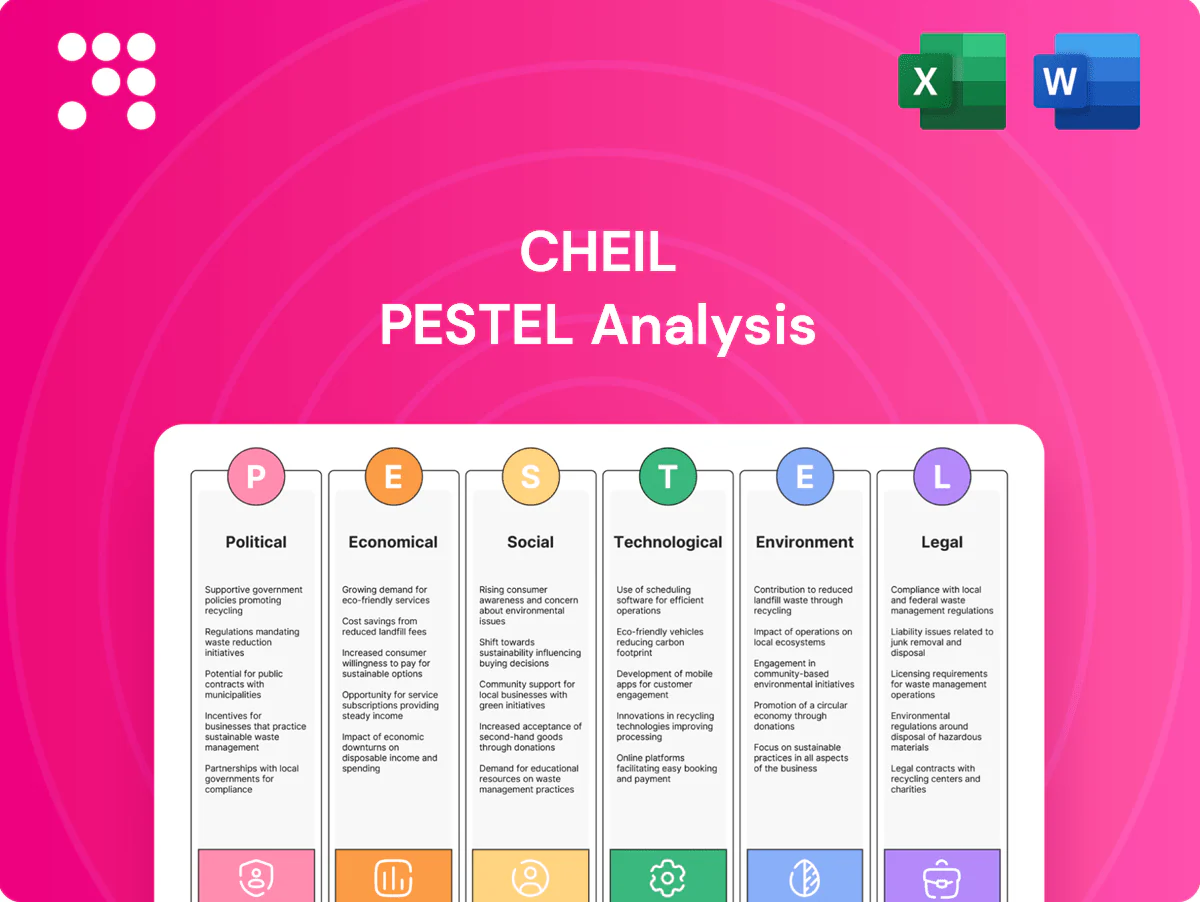
Cheil PESTLE Analysis

Plan Smarter. Present Sharper. Compete Stronger.
Discover how political shifts, economic trends, social dynamics, and technological advances are reshaping Cheil’s strategy in our concise PESTLE snapshot. Get actionable insights into regulatory risks and market opportunities to sharpen your decisions. Download the full PESTLE analysis now for the complete, editable report and strategic recommendations.
Political factors

Trade tensions
Global trade frictions can disrupt Cheil's cross-border campaigns, partnerships, and production logistics, raising lead times and compliance costs. Tariffs such as US duties on roughly 360 billion dollars of Chinese goods can increase expenses for experiential materials and retail fixtures. Tighter scrutiny of foreign media platforms limits reach in key markets, so Cheil must diversify suppliers and media channels to hedge geopolitical risk.
Data sovereignty
Governments increasingly mandate local data storage and processing for marketing analytics, with GDPR (EU, 27 states) allowing fines up to 4% of global turnover and China PIPL penalties up to RMB 50 million or 5% of revenue. This forces Cheil to design market-specific MarTech stacks and pick local cloud vendors to avoid penalties and campaign interruptions. Building regional data hubs preserves latency-sensitive performance while meeting political expectations.

Public-sector procurement
Winning government and state-owned enterprise briefs depends on strict procurement rules and local-content preferences; government procurement accounts for about 12% of GDP in OECD countries, underlining material opportunity size. Shifts in administration can quickly reprioritize budgets for public campaigns, altering demand cycles and timelines. Transparency and audit-ready reporting are critical to maintain eligibility and contestability. Cheil’s global-local teams can tailor bids to political sensitivities and compliance requirements.

Sanctions exposure
Evolving sanctions regimes are reshaping Cheils media buying, sponsorships and talent use across jurisdictions, raising legal and reputational risk from inadvertent placements with restricted entities. Accidental placement can prompt regulatory fines and client losses, so pre-flight compliance checks and partner whitelisting are essential. Centralized governance standardizes controls across markets to reduce exposure.
- Mandatory pre-flight compliance checks
- Whitelisting vetted partners
- Centralized governance for consistent controls
Regulatory nationalism
Regulatory nationalism raises demand for domestic platforms and agencies, pressuring foreign-led networks to localize services; content moderation rules in markets like South Korea and Southeast Asia increasingly restrict creative approaches in sensitive categories. Local partnerships and joint ventures help Cheil navigate political barriers, while Cheil’s in-market presence signals alignment with national priorities and client trust.
- Domestic-preference risk
- Content-moderation constraints
- JV/partnership mitigation
- In-market credibility advantage
Tariffs, data rules and government procurement shift ad and MarTech power to local partners
Geopolitical tensions and US tariffs on about 360 billion dollars of Chinese goods raise cross-border costs and supply risk. Data rules (GDPR fines up to 4% global turnover; China PIPL up to RMB 50 million or 5% revenue) force local MarTech and vendors. Government procurement (~12% of OECD GDP) and content moderation reshape demand and creative limits, advantaging in‑market partners.
| Metric | Value |
|---|---|
| US-China tariffs | $360bn |
| GDPR penalty | 4% global turnover |
| PIPL penalty | RMB 50m / 5% revenue |
| OECD govt procurement | ~12% GDP |
| Global ad spend 2024 | $873bn |
What is included in the product
 Detailed Word Document
Explores how macro-environmental factors uniquely affect Cheil across Political, Economic, Social, Technological, Environmental and Legal dimensions, with data-driven subpoints and industry-specific examples. Designed for executives and advisors, it delivers forward-looking insights to identify risks, spot opportunities and inform strategy, planning and investor communications.

 Customizable Excel Spreadsheet
A clean, summarized PESTLE of Cheil for easy reference in meetings or presentations, visually segmented by category and editable with custom notes; concise, shareable slides-ready format to align teams quickly.
Economic factors

Ad spend cyclicality
Advertising budgets expand and contract with GDP and consumer confidence; global ad spend was about $770 billion in 2024, highlighting sensitivity to macrocycles. Downturns drive clients toward performance-driven, lower-cost channels and tacticals, while recoveries tilt spend back to brand-building and experiential investments. Cheil’s balanced service mix across performance and creative offerings helps smooth revenue volatility.
FX volatility
Revenue billed in multiple currencies exposes Cheil to KRW/USD swings—USD/KRW traded near 1,300 in mid‑2025, amplifying margin risk on dollarized contracts. Media buys and production inputs often invoice in local currencies and do not move in tandem with billing, creating timing mismatches. Active hedging programs and currency pass‑through clauses reduce realized variance, while pricing discipline and near‑shore production bolster margin resilience.

Inflation pressures
Rising media CPMs and production costs are compressing client ROI, with programmatic CPMs rising about 10% year‑on‑year in 2024 while South Korea CPI averaged roughly 2.5% in 2024, increasing cost pressure on agencies. Procurement scrutiny has tightened, extending sales cycles and squeezing fees. Automation and standardized toolkits can protect project margins. Value‑based pricing tied to measurable outcomes can offset inflation headwinds.

Emerging market growth
Emerging market growth boosts Cheil as expanding middle classes across Asia, MENA and LATAM drive higher ad demand; Asia-Pacific accounted for roughly 40% of global ad spend in 2024, while digital adoption in MENA and LATAM grew double digits year-over-year. Local platform ecosystems and retail media networks are creating new spend pools Cheil can access with modular offerings and local talent. Early-mover partnerships can secure preferred partner status in fast-growing markets.
- Middle-class expansion: rising consumer spending in Asia, MENA, LATAM
- New spend pools: retail media networks, local platforms
- Scalability: modular services + local talent
- Advantage: early-mover preferred-partner potential
Sector concentration
Cheil, as a Samsung Group affiliate, retains material client concentration with Samsung and other large electronics customers, which heightens revenue risk if tech or consumer-electronics budgets are cut.
Sector-specific shocks in tech can rapidly compress client marketing spend; Cheil mitigates this by expanding cross-industry digital, CRM and e-commerce services to diversify revenue.
Account-based growth plans and upselling of digital/CRM offerings stabilize pipelines and reduce reliance on a few large clients.
- client_concentration: Samsung and major electronics clients dominate
- risk: tech/consumer-electronics shocks can cut marketing budgets
- mitigation: cross-industry digital/CRM diversification
- stabilizer: account-based upsell and pipeline management
Tariffs, data rules and government procurement shift ad and MarTech power to local partners
Advertising spend (global $770bn in 2024; APAC ~40%) ties Cheil to GDP/cycle; recoveries favor brand while downturns push performance. Currency exposure (USD/KRW ~1,300 mid‑2025) and rising CPMs (+10% programmatic YoY 2024; SK CPI 2.5% 2024) compress margins; hedging, pricing discipline and modular services mitigate risk.
| Metric | 2024/25 | Impact |
|---|---|---|
| Global ad spend | $770bn (2024) | Revenue sensitivity |
| APAC share | ~40% | Growth market |
| USD/KRW | ~1,300 (mid‑2025) | FX margin risk |
| Programmatic CPMs | +10% YoY (2024) | Cost pressure |
Full Version Awaits
Cheil PESTLE Analysis
The Cheil PESTLE Analysis preview shown here is the exact document you’ll receive after purchase—fully formatted, professionally structured, and ready to use. It contains the complete political, economic, social, technological, legal, and environmental assessment as displayed.

Plan Smarter. Present Sharper. Compete Stronger.
Discover how political shifts, economic trends, social dynamics, and technological advances are reshaping Cheil’s strategy in our concise PESTLE snapshot. Get actionable insights into regulatory risks and market opportunities to sharpen your decisions. Download the full PESTLE analysis now for the complete, editable report and strategic recommendations.
Political factors
Trade tensions
Global trade frictions can disrupt Cheil's cross-border campaigns, partnerships, and production logistics, raising lead times and compliance costs. Tariffs such as US duties on roughly 360 billion dollars of Chinese goods can increase expenses for experiential materials and retail fixtures. Tighter scrutiny of foreign media platforms limits reach in key markets, so Cheil must diversify suppliers and media channels to hedge geopolitical risk.
Data sovereignty
Governments increasingly mandate local data storage and processing for marketing analytics, with GDPR (EU, 27 states) allowing fines up to 4% of global turnover and China PIPL penalties up to RMB 50 million or 5% of revenue. This forces Cheil to design market-specific MarTech stacks and pick local cloud vendors to avoid penalties and campaign interruptions. Building regional data hubs preserves latency-sensitive performance while meeting political expectations.
Public-sector procurement
Winning government and state-owned enterprise briefs depends on strict procurement rules and local-content preferences; government procurement accounts for about 12% of GDP in OECD countries, underlining material opportunity size. Shifts in administration can quickly reprioritize budgets for public campaigns, altering demand cycles and timelines. Transparency and audit-ready reporting are critical to maintain eligibility and contestability. Cheil’s global-local teams can tailor bids to political sensitivities and compliance requirements.
Sanctions exposure
Evolving sanctions regimes are reshaping Cheils media buying, sponsorships and talent use across jurisdictions, raising legal and reputational risk from inadvertent placements with restricted entities. Accidental placement can prompt regulatory fines and client losses, so pre-flight compliance checks and partner whitelisting are essential. Centralized governance standardizes controls across markets to reduce exposure.
- Mandatory pre-flight compliance checks
- Whitelisting vetted partners
- Centralized governance for consistent controls
Regulatory nationalism
Regulatory nationalism raises demand for domestic platforms and agencies, pressuring foreign-led networks to localize services; content moderation rules in markets like South Korea and Southeast Asia increasingly restrict creative approaches in sensitive categories. Local partnerships and joint ventures help Cheil navigate political barriers, while Cheil’s in-market presence signals alignment with national priorities and client trust.
- Domestic-preference risk
- Content-moderation constraints
- JV/partnership mitigation
- In-market credibility advantage
Tariffs, data rules and government procurement shift ad and MarTech power to local partners
Geopolitical tensions and US tariffs on about 360 billion dollars of Chinese goods raise cross-border costs and supply risk. Data rules (GDPR fines up to 4% global turnover; China PIPL up to RMB 50 million or 5% revenue) force local MarTech and vendors. Government procurement (~12% of OECD GDP) and content moderation reshape demand and creative limits, advantaging in‑market partners.
| Metric | Value |
|---|---|
| US-China tariffs | $360bn |
| GDPR penalty | 4% global turnover |
| PIPL penalty | RMB 50m / 5% revenue |
| OECD govt procurement | ~12% GDP |
| Global ad spend 2024 | $873bn |
What is included in the product
Detailed Word Document
Explores how macro-environmental factors uniquely affect Cheil across Political, Economic, Social, Technological, Environmental and Legal dimensions, with data-driven subpoints and industry-specific examples. Designed for executives and advisors, it delivers forward-looking insights to identify risks, spot opportunities and inform strategy, planning and investor communications.
Customizable Excel Spreadsheet
A clean, summarized PESTLE of Cheil for easy reference in meetings or presentations, visually segmented by category and editable with custom notes; concise, shareable slides-ready format to align teams quickly.
Economic factors
Ad spend cyclicality
Advertising budgets expand and contract with GDP and consumer confidence; global ad spend was about $770 billion in 2024, highlighting sensitivity to macrocycles. Downturns drive clients toward performance-driven, lower-cost channels and tacticals, while recoveries tilt spend back to brand-building and experiential investments. Cheil’s balanced service mix across performance and creative offerings helps smooth revenue volatility.
FX volatility
Revenue billed in multiple currencies exposes Cheil to KRW/USD swings—USD/KRW traded near 1,300 in mid‑2025, amplifying margin risk on dollarized contracts. Media buys and production inputs often invoice in local currencies and do not move in tandem with billing, creating timing mismatches. Active hedging programs and currency pass‑through clauses reduce realized variance, while pricing discipline and near‑shore production bolster margin resilience.
Inflation pressures
Rising media CPMs and production costs are compressing client ROI, with programmatic CPMs rising about 10% year‑on‑year in 2024 while South Korea CPI averaged roughly 2.5% in 2024, increasing cost pressure on agencies. Procurement scrutiny has tightened, extending sales cycles and squeezing fees. Automation and standardized toolkits can protect project margins. Value‑based pricing tied to measurable outcomes can offset inflation headwinds.
Emerging market growth
Emerging market growth boosts Cheil as expanding middle classes across Asia, MENA and LATAM drive higher ad demand; Asia-Pacific accounted for roughly 40% of global ad spend in 2024, while digital adoption in MENA and LATAM grew double digits year-over-year. Local platform ecosystems and retail media networks are creating new spend pools Cheil can access with modular offerings and local talent. Early-mover partnerships can secure preferred partner status in fast-growing markets.
- Middle-class expansion: rising consumer spending in Asia, MENA, LATAM
- New spend pools: retail media networks, local platforms
- Scalability: modular services + local talent
- Advantage: early-mover preferred-partner potential
Sector concentration
Cheil, as a Samsung Group affiliate, retains material client concentration with Samsung and other large electronics customers, which heightens revenue risk if tech or consumer-electronics budgets are cut.
Sector-specific shocks in tech can rapidly compress client marketing spend; Cheil mitigates this by expanding cross-industry digital, CRM and e-commerce services to diversify revenue.
Account-based growth plans and upselling of digital/CRM offerings stabilize pipelines and reduce reliance on a few large clients.
- client_concentration: Samsung and major electronics clients dominate
- risk: tech/consumer-electronics shocks can cut marketing budgets
- mitigation: cross-industry digital/CRM diversification
- stabilizer: account-based upsell and pipeline management
Tariffs, data rules and government procurement shift ad and MarTech power to local partners
Advertising spend (global $770bn in 2024; APAC ~40%) ties Cheil to GDP/cycle; recoveries favor brand while downturns push performance. Currency exposure (USD/KRW ~1,300 mid‑2025) and rising CPMs (+10% programmatic YoY 2024; SK CPI 2.5% 2024) compress margins; hedging, pricing discipline and modular services mitigate risk.
| Metric | 2024/25 | Impact |
|---|---|---|
| Global ad spend | $770bn (2024) | Revenue sensitivity |
| APAC share | ~40% | Growth market |
| USD/KRW | ~1,300 (mid‑2025) | FX margin risk |
| Programmatic CPMs | +10% YoY (2024) | Cost pressure |
Full Version Awaits
Cheil PESTLE Analysis
The Cheil PESTLE Analysis preview shown here is the exact document you’ll receive after purchase—fully formatted, professionally structured, and ready to use. It contains the complete political, economic, social, technological, legal, and environmental assessment as displayed.
Original: $10.00
-65%$10.00
$3.50Description
Plan Smarter. Present Sharper. Compete Stronger.
Discover how political shifts, economic trends, social dynamics, and technological advances are reshaping Cheil’s strategy in our concise PESTLE snapshot. Get actionable insights into regulatory risks and market opportunities to sharpen your decisions. Download the full PESTLE analysis now for the complete, editable report and strategic recommendations.
Political factors
Trade tensions
Global trade frictions can disrupt Cheil's cross-border campaigns, partnerships, and production logistics, raising lead times and compliance costs. Tariffs such as US duties on roughly 360 billion dollars of Chinese goods can increase expenses for experiential materials and retail fixtures. Tighter scrutiny of foreign media platforms limits reach in key markets, so Cheil must diversify suppliers and media channels to hedge geopolitical risk.
Data sovereignty
Governments increasingly mandate local data storage and processing for marketing analytics, with GDPR (EU, 27 states) allowing fines up to 4% of global turnover and China PIPL penalties up to RMB 50 million or 5% of revenue. This forces Cheil to design market-specific MarTech stacks and pick local cloud vendors to avoid penalties and campaign interruptions. Building regional data hubs preserves latency-sensitive performance while meeting political expectations.
Public-sector procurement
Winning government and state-owned enterprise briefs depends on strict procurement rules and local-content preferences; government procurement accounts for about 12% of GDP in OECD countries, underlining material opportunity size. Shifts in administration can quickly reprioritize budgets for public campaigns, altering demand cycles and timelines. Transparency and audit-ready reporting are critical to maintain eligibility and contestability. Cheil’s global-local teams can tailor bids to political sensitivities and compliance requirements.
Sanctions exposure
Evolving sanctions regimes are reshaping Cheils media buying, sponsorships and talent use across jurisdictions, raising legal and reputational risk from inadvertent placements with restricted entities. Accidental placement can prompt regulatory fines and client losses, so pre-flight compliance checks and partner whitelisting are essential. Centralized governance standardizes controls across markets to reduce exposure.
- Mandatory pre-flight compliance checks
- Whitelisting vetted partners
- Centralized governance for consistent controls
Regulatory nationalism
Regulatory nationalism raises demand for domestic platforms and agencies, pressuring foreign-led networks to localize services; content moderation rules in markets like South Korea and Southeast Asia increasingly restrict creative approaches in sensitive categories. Local partnerships and joint ventures help Cheil navigate political barriers, while Cheil’s in-market presence signals alignment with national priorities and client trust.
- Domestic-preference risk
- Content-moderation constraints
- JV/partnership mitigation
- In-market credibility advantage
Tariffs, data rules and government procurement shift ad and MarTech power to local partners
Geopolitical tensions and US tariffs on about 360 billion dollars of Chinese goods raise cross-border costs and supply risk. Data rules (GDPR fines up to 4% global turnover; China PIPL up to RMB 50 million or 5% revenue) force local MarTech and vendors. Government procurement (~12% of OECD GDP) and content moderation reshape demand and creative limits, advantaging in‑market partners.
| Metric | Value |
|---|---|
| US-China tariffs | $360bn |
| GDPR penalty | 4% global turnover |
| PIPL penalty | RMB 50m / 5% revenue |
| OECD govt procurement | ~12% GDP |
| Global ad spend 2024 | $873bn |
What is included in the product
Detailed Word Document
Explores how macro-environmental factors uniquely affect Cheil across Political, Economic, Social, Technological, Environmental and Legal dimensions, with data-driven subpoints and industry-specific examples. Designed for executives and advisors, it delivers forward-looking insights to identify risks, spot opportunities and inform strategy, planning and investor communications.
Customizable Excel Spreadsheet
A clean, summarized PESTLE of Cheil for easy reference in meetings or presentations, visually segmented by category and editable with custom notes; concise, shareable slides-ready format to align teams quickly.
Economic factors
Ad spend cyclicality
Advertising budgets expand and contract with GDP and consumer confidence; global ad spend was about $770 billion in 2024, highlighting sensitivity to macrocycles. Downturns drive clients toward performance-driven, lower-cost channels and tacticals, while recoveries tilt spend back to brand-building and experiential investments. Cheil’s balanced service mix across performance and creative offerings helps smooth revenue volatility.
FX volatility
Revenue billed in multiple currencies exposes Cheil to KRW/USD swings—USD/KRW traded near 1,300 in mid‑2025, amplifying margin risk on dollarized contracts. Media buys and production inputs often invoice in local currencies and do not move in tandem with billing, creating timing mismatches. Active hedging programs and currency pass‑through clauses reduce realized variance, while pricing discipline and near‑shore production bolster margin resilience.
Inflation pressures
Rising media CPMs and production costs are compressing client ROI, with programmatic CPMs rising about 10% year‑on‑year in 2024 while South Korea CPI averaged roughly 2.5% in 2024, increasing cost pressure on agencies. Procurement scrutiny has tightened, extending sales cycles and squeezing fees. Automation and standardized toolkits can protect project margins. Value‑based pricing tied to measurable outcomes can offset inflation headwinds.
Emerging market growth
Emerging market growth boosts Cheil as expanding middle classes across Asia, MENA and LATAM drive higher ad demand; Asia-Pacific accounted for roughly 40% of global ad spend in 2024, while digital adoption in MENA and LATAM grew double digits year-over-year. Local platform ecosystems and retail media networks are creating new spend pools Cheil can access with modular offerings and local talent. Early-mover partnerships can secure preferred partner status in fast-growing markets.
- Middle-class expansion: rising consumer spending in Asia, MENA, LATAM
- New spend pools: retail media networks, local platforms
- Scalability: modular services + local talent
- Advantage: early-mover preferred-partner potential
Sector concentration
Cheil, as a Samsung Group affiliate, retains material client concentration with Samsung and other large electronics customers, which heightens revenue risk if tech or consumer-electronics budgets are cut.
Sector-specific shocks in tech can rapidly compress client marketing spend; Cheil mitigates this by expanding cross-industry digital, CRM and e-commerce services to diversify revenue.
Account-based growth plans and upselling of digital/CRM offerings stabilize pipelines and reduce reliance on a few large clients.
- client_concentration: Samsung and major electronics clients dominate
- risk: tech/consumer-electronics shocks can cut marketing budgets
- mitigation: cross-industry digital/CRM diversification
- stabilizer: account-based upsell and pipeline management
Tariffs, data rules and government procurement shift ad and MarTech power to local partners
Advertising spend (global $770bn in 2024; APAC ~40%) ties Cheil to GDP/cycle; recoveries favor brand while downturns push performance. Currency exposure (USD/KRW ~1,300 mid‑2025) and rising CPMs (+10% programmatic YoY 2024; SK CPI 2.5% 2024) compress margins; hedging, pricing discipline and modular services mitigate risk.
| Metric | 2024/25 | Impact |
|---|---|---|
| Global ad spend | $770bn (2024) | Revenue sensitivity |
| APAC share | ~40% | Growth market |
| USD/KRW | ~1,300 (mid‑2025) | FX margin risk |
| Programmatic CPMs | +10% YoY (2024) | Cost pressure |
Full Version Awaits
Cheil PESTLE Analysis
The Cheil PESTLE Analysis preview shown here is the exact document you’ll receive after purchase—fully formatted, professionally structured, and ready to use. It contains the complete political, economic, social, technological, legal, and environmental assessment as displayed.











