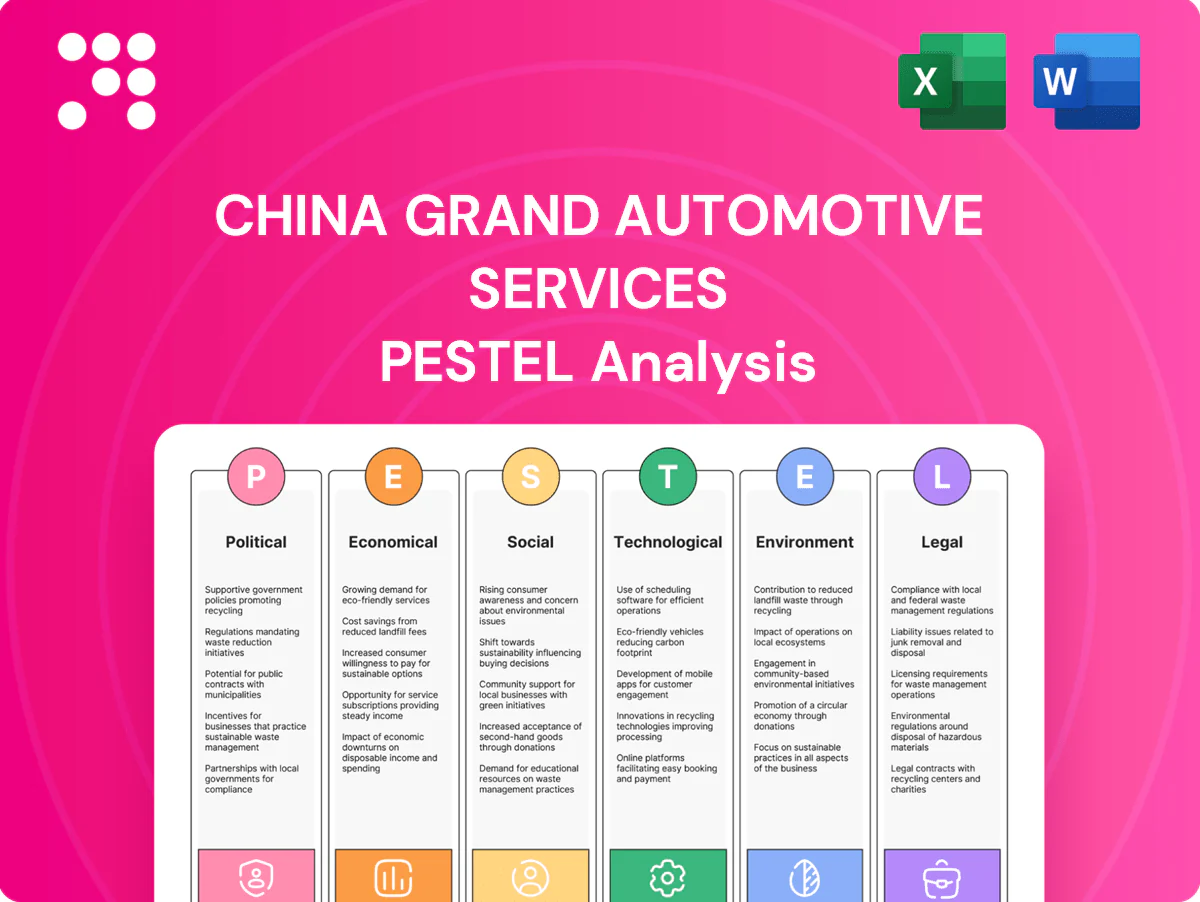
China Grand Automotive Services PESTLE Analysis

Make Smarter Strategic Decisions with a Complete PESTEL View
Discover how political regulation, shifting consumer income, digital disruption, environmental mandates, and legal compliance collectively shape China Grand Automotive Services' strategic outlook in our concise PESTLE overview. Use this snapshot to spot risks and opportunities—buy the full PESTLE report to access detailed, actionable insights and ready-to-use charts for decision-making.
Political factors

Industrial policy on NEVs and electrification
China’s state-led push for new energy vehicles shapes brand mix, inventory and service capabilities as NEV sales reached about 9.3 million units in 2024 (CAAM), driving dealers to stock EV-focused OEMs and parts. Central subsidies have been phased down with emphasis on local incentives and tax breaks, shifting demand timing and pricing strategies. Dealerships must expand EV after-sales; policy tapering risks sales volatility and margin pressure.
Trade and geopolitics impacting supply chains
Tariffs and export controls, including standard 2.5% MFN duties on passenger cars in major markets, plus tightening export restrictions since 2022, push up costs and shrink availability of certain imported brands and parts. Volatility in cross-border logistics has lengthened lead times and risks after-sales parts shortages, raising inventory carry costs. The company must diversify suppliers, prioritize domestic sourcing and adopt agile procurement and inventory planning to absorb rapid regulatory shifts.

Local government regulations and license plate quotas
City-level license restrictions and lottery/quota systems directly shape vehicle demand and model mix, with dozens of major cities imposing caps while NEV exemptions have helped NEVs capture roughly one-third of new-car sales in China by 2024. Preferential NEV treatment skews sales toward EVs, forcing dealerships to tailor locality-specific marketing to capture quota-driven demand. Sudden policy shifts can rapidly change showroom traffic and auto-finance uptake.

State influence on credit conditions
Macro policy steering by the PBOC (1yr LPR 3.45%, 5yr LPR 3.65% as of mid‑2025) and state banks directly affects auto loan availability and pricing; tighter credit suppresses new/used sales while easing can unlock pent‑up demand. Dealer‑arranged financing must follow evolving guidance and close alignment with bank partners is essential to maintain throughput.
- Policy levers: LPR levels
- Risk: tighter credit → lower volume
- Action: compliance + bank alignment
Provincial protectionism and market entry rules
Provincial protectionism in China affects Grand Automotive Services: local procurement/priorities and administrative processes can advantage incumbent brands or dealer groups across 31 provincial-level jurisdictions, while approval processes for opening outlets vary by region, slowing expansion. Building government relations eases zoning, permits and incentive access; uneven enforcement creates operational complexity.
- Local procurement bias
- Variable outlet approval
- Govt relations critical
- Uneven enforcement across provinces
NEV surge 9.3m (≈33%) reshapes inventory; 2.5% MFN, 31 provinces
State NEV push (9.3m NEVs 2024; NEVs ~33% market) plus phased subsidies reshapes inventory and after‑sales; 1yr LPR 3.45% / 5yr LPR 3.65% (mid‑2025) alters financing demand. 2.5% MFN tariffs and tightened export controls since 2022 raise import costs and lead times. Provincial protectionism across 31 regions complicates expansion and permit timing.
| Factor | Metric | Impact | Action |
|---|---|---|---|
| NEV policy | 9.3m (2024) | Inventory/after‑sales shift | Expand EV service |
| Credit policy | 1yr/5yr LPR 3.45/3.65% | Sales sensitivity | Align bank partners |
| Trade & local rules | 2.5% MFN; 31 provinces | Cost/expansion risk | Local sourcing & govt relations |
What is included in the product
 Detailed Word Document
Explores how Political, Economic, Social, Technological, Environmental and Legal factors uniquely affect China Grand Automotive Services, providing data-driven insights and forward-looking implications to help executives, investors and entrepreneurs identify risks, opportunities and strategic responses.

 Customizable Excel Spreadsheet
A concise, visually segmented PESTLE snapshot of China Grand Automotive Services that relieves research pain points by enabling quick meeting-ready summaries, editable notes for regional or business-line context, and easy drop-in slides to align teams on external risks and market positioning.
Economic factors

Consumer demand amid slower GDP growth
Moderating GDP growth, 5.2% in 2024 per IMF, and ongoing property-sector stress are weighing on big-ticket auto purchases. Households are trading down, delaying upgrades or shifting to value brands and used cars as sensitivity to price and total cost of ownership rises. Targeted promotions, model-level discounts and flexible financing (longer terms, lower rates) can help sustain volumes. Dealers must monitor demand elasticity closely.
Used car market liberalization and growth
Policy support easing interprovincial transfers and reduced VAT has boosted used-car liquidity in China, with used-car transactions reaching 16.1 million in 2023 (CADA). Higher turnover improves margins and finance/insurance attachments, lifting per-unit profitability. Robust appraisal and reconditioning capabilities are key differentiators, and rigorous residual-value management is crucial for leasing and trade-in programs.

Interest rates, credit access, and auto finance
Changes in the 1-year LPR (3.45% as of 2024) and banks’ tighter risk appetite directly compress consumer affordability and approval volumes for CNGS in auto finance.
Co-branded lender and captive partnerships (e.g., OEM captives holding ~20–30% of new-car finance in China) stabilize approval rates and margins.
Rising delinquencies—urban surveyed unemployment near 5.3% in 2024—require close monitoring, while dynamic pricing and term adjustments improve conversion and credit loss control.

RMB fluctuations and import cost exposure
RMB volatility raised costs for imported models and parts, squeezing margins after a roughly 3% CNY depreciation vs USD in 2024 and continued volatility into H1 2025; hedging and inventory timing have been used to blunt impacts, while shifting sales toward domestic brands reduces FX exposure and transparent pricing preserves customer trust during price swings.
- FX exposure: imported parts cost pressure
- Mitigants: currency hedges, inventory timing
- Strategy: emphasize domestic brands to cut FX risk
- Customer-facing: transparent pricing to maintain trust
Consolidation and competition intensity
Large dealer groups and OEM-direct models raise competitive pressure; BYD, the largest Chinese OEM, sold 3,019,104 vehicles in 2023, highlighting OEM scale encroaching on traditional retail channels. Scale delivers purchasing discounts and digital CRM tools that compress smaller rivals, forcing China Grand Automotive Services to defend margins via network breadth and higher-margin after-sales. Targeted M&A can expand footprint and service capabilities.
- Competitive pressure: OEM direct expansion (BYD 3,019,104 units 2023)
- Scale effects: purchasing & digital advantages
- Defensive levers: network breadth + after-sales
- M&A: footprint and capability expansion
NEV surge 9.3m (≈33%) reshapes inventory; 2.5% MFN, 31 provinces
Modest GDP slowdown (IMF 5.2% 2024), property stress and urban unemployment ~5.3% (2024) curb big-ticket auto demand, boosting value/used sales (16.1m used cars 2023). LPR 1yr 3.45% and tighter bank lending squeeze affordability; OEM scale (BYD 3,019,104 units 2023) and ~3% CNY depreciation vs USD 2024 raise cost and competition; hedging, financing flexibility and after-sales lift resilience.
| Metric | Value |
|---|---|
| China GDP 2024 | 5.2% |
| Used car 2023 | 16.1m |
| LPR 1yr 2024 | 3.45% |
| Urban unemployment 2024 | 5.3% |
| BYD 2023 sales | 3,019,104 |
| CNY vs USD 2024 | -3% |
Preview Before You Purchase
China Grand Automotive Services PESTLE Analysis
This PESTLE analysis details the Political, Economic, Social, Technological, Legal and Environmental factors affecting China Grand Automotive Services, highlighting risks, opportunities and strategic implications. The preview shown here is the exact document you’ll receive after purchase—fully formatted and ready to use. Delivered for immediate use in due diligence, presentations and strategy planning.

Make Smarter Strategic Decisions with a Complete PESTEL View
Discover how political regulation, shifting consumer income, digital disruption, environmental mandates, and legal compliance collectively shape China Grand Automotive Services' strategic outlook in our concise PESTLE overview. Use this snapshot to spot risks and opportunities—buy the full PESTLE report to access detailed, actionable insights and ready-to-use charts for decision-making.
Political factors
Industrial policy on NEVs and electrification
China’s state-led push for new energy vehicles shapes brand mix, inventory and service capabilities as NEV sales reached about 9.3 million units in 2024 (CAAM), driving dealers to stock EV-focused OEMs and parts. Central subsidies have been phased down with emphasis on local incentives and tax breaks, shifting demand timing and pricing strategies. Dealerships must expand EV after-sales; policy tapering risks sales volatility and margin pressure.
Trade and geopolitics impacting supply chains
Tariffs and export controls, including standard 2.5% MFN duties on passenger cars in major markets, plus tightening export restrictions since 2022, push up costs and shrink availability of certain imported brands and parts. Volatility in cross-border logistics has lengthened lead times and risks after-sales parts shortages, raising inventory carry costs. The company must diversify suppliers, prioritize domestic sourcing and adopt agile procurement and inventory planning to absorb rapid regulatory shifts.
Local government regulations and license plate quotas
City-level license restrictions and lottery/quota systems directly shape vehicle demand and model mix, with dozens of major cities imposing caps while NEV exemptions have helped NEVs capture roughly one-third of new-car sales in China by 2024. Preferential NEV treatment skews sales toward EVs, forcing dealerships to tailor locality-specific marketing to capture quota-driven demand. Sudden policy shifts can rapidly change showroom traffic and auto-finance uptake.
State influence on credit conditions
Macro policy steering by the PBOC (1yr LPR 3.45%, 5yr LPR 3.65% as of mid‑2025) and state banks directly affects auto loan availability and pricing; tighter credit suppresses new/used sales while easing can unlock pent‑up demand. Dealer‑arranged financing must follow evolving guidance and close alignment with bank partners is essential to maintain throughput.
- Policy levers: LPR levels
- Risk: tighter credit → lower volume
- Action: compliance + bank alignment
Provincial protectionism and market entry rules
Provincial protectionism in China affects Grand Automotive Services: local procurement/priorities and administrative processes can advantage incumbent brands or dealer groups across 31 provincial-level jurisdictions, while approval processes for opening outlets vary by region, slowing expansion. Building government relations eases zoning, permits and incentive access; uneven enforcement creates operational complexity.
- Local procurement bias
- Variable outlet approval
- Govt relations critical
- Uneven enforcement across provinces
NEV surge 9.3m (≈33%) reshapes inventory; 2.5% MFN, 31 provinces
State NEV push (9.3m NEVs 2024; NEVs ~33% market) plus phased subsidies reshapes inventory and after‑sales; 1yr LPR 3.45% / 5yr LPR 3.65% (mid‑2025) alters financing demand. 2.5% MFN tariffs and tightened export controls since 2022 raise import costs and lead times. Provincial protectionism across 31 regions complicates expansion and permit timing.
| Factor | Metric | Impact | Action |
|---|---|---|---|
| NEV policy | 9.3m (2024) | Inventory/after‑sales shift | Expand EV service |
| Credit policy | 1yr/5yr LPR 3.45/3.65% | Sales sensitivity | Align bank partners |
| Trade & local rules | 2.5% MFN; 31 provinces | Cost/expansion risk | Local sourcing & govt relations |
What is included in the product
Detailed Word Document
Explores how Political, Economic, Social, Technological, Environmental and Legal factors uniquely affect China Grand Automotive Services, providing data-driven insights and forward-looking implications to help executives, investors and entrepreneurs identify risks, opportunities and strategic responses.
Customizable Excel Spreadsheet
A concise, visually segmented PESTLE snapshot of China Grand Automotive Services that relieves research pain points by enabling quick meeting-ready summaries, editable notes for regional or business-line context, and easy drop-in slides to align teams on external risks and market positioning.
Economic factors
Consumer demand amid slower GDP growth
Moderating GDP growth, 5.2% in 2024 per IMF, and ongoing property-sector stress are weighing on big-ticket auto purchases. Households are trading down, delaying upgrades or shifting to value brands and used cars as sensitivity to price and total cost of ownership rises. Targeted promotions, model-level discounts and flexible financing (longer terms, lower rates) can help sustain volumes. Dealers must monitor demand elasticity closely.
Used car market liberalization and growth
Policy support easing interprovincial transfers and reduced VAT has boosted used-car liquidity in China, with used-car transactions reaching 16.1 million in 2023 (CADA). Higher turnover improves margins and finance/insurance attachments, lifting per-unit profitability. Robust appraisal and reconditioning capabilities are key differentiators, and rigorous residual-value management is crucial for leasing and trade-in programs.
Interest rates, credit access, and auto finance
Changes in the 1-year LPR (3.45% as of 2024) and banks’ tighter risk appetite directly compress consumer affordability and approval volumes for CNGS in auto finance.
Co-branded lender and captive partnerships (e.g., OEM captives holding ~20–30% of new-car finance in China) stabilize approval rates and margins.
Rising delinquencies—urban surveyed unemployment near 5.3% in 2024—require close monitoring, while dynamic pricing and term adjustments improve conversion and credit loss control.
RMB fluctuations and import cost exposure
RMB volatility raised costs for imported models and parts, squeezing margins after a roughly 3% CNY depreciation vs USD in 2024 and continued volatility into H1 2025; hedging and inventory timing have been used to blunt impacts, while shifting sales toward domestic brands reduces FX exposure and transparent pricing preserves customer trust during price swings.
- FX exposure: imported parts cost pressure
- Mitigants: currency hedges, inventory timing
- Strategy: emphasize domestic brands to cut FX risk
- Customer-facing: transparent pricing to maintain trust
Consolidation and competition intensity
Large dealer groups and OEM-direct models raise competitive pressure; BYD, the largest Chinese OEM, sold 3,019,104 vehicles in 2023, highlighting OEM scale encroaching on traditional retail channels. Scale delivers purchasing discounts and digital CRM tools that compress smaller rivals, forcing China Grand Automotive Services to defend margins via network breadth and higher-margin after-sales. Targeted M&A can expand footprint and service capabilities.
- Competitive pressure: OEM direct expansion (BYD 3,019,104 units 2023)
- Scale effects: purchasing & digital advantages
- Defensive levers: network breadth + after-sales
- M&A: footprint and capability expansion
NEV surge 9.3m (≈33%) reshapes inventory; 2.5% MFN, 31 provinces
Modest GDP slowdown (IMF 5.2% 2024), property stress and urban unemployment ~5.3% (2024) curb big-ticket auto demand, boosting value/used sales (16.1m used cars 2023). LPR 1yr 3.45% and tighter bank lending squeeze affordability; OEM scale (BYD 3,019,104 units 2023) and ~3% CNY depreciation vs USD 2024 raise cost and competition; hedging, financing flexibility and after-sales lift resilience.
| Metric | Value |
|---|---|
| China GDP 2024 | 5.2% |
| Used car 2023 | 16.1m |
| LPR 1yr 2024 | 3.45% |
| Urban unemployment 2024 | 5.3% |
| BYD 2023 sales | 3,019,104 |
| CNY vs USD 2024 | -3% |
Preview Before You Purchase
China Grand Automotive Services PESTLE Analysis
This PESTLE analysis details the Political, Economic, Social, Technological, Legal and Environmental factors affecting China Grand Automotive Services, highlighting risks, opportunities and strategic implications. The preview shown here is the exact document you’ll receive after purchase—fully formatted and ready to use. Delivered for immediate use in due diligence, presentations and strategy planning.
Original: $10.00
-65%$10.00
$3.50Description
Make Smarter Strategic Decisions with a Complete PESTEL View
Discover how political regulation, shifting consumer income, digital disruption, environmental mandates, and legal compliance collectively shape China Grand Automotive Services' strategic outlook in our concise PESTLE overview. Use this snapshot to spot risks and opportunities—buy the full PESTLE report to access detailed, actionable insights and ready-to-use charts for decision-making.
Political factors
Industrial policy on NEVs and electrification
China’s state-led push for new energy vehicles shapes brand mix, inventory and service capabilities as NEV sales reached about 9.3 million units in 2024 (CAAM), driving dealers to stock EV-focused OEMs and parts. Central subsidies have been phased down with emphasis on local incentives and tax breaks, shifting demand timing and pricing strategies. Dealerships must expand EV after-sales; policy tapering risks sales volatility and margin pressure.
Trade and geopolitics impacting supply chains
Tariffs and export controls, including standard 2.5% MFN duties on passenger cars in major markets, plus tightening export restrictions since 2022, push up costs and shrink availability of certain imported brands and parts. Volatility in cross-border logistics has lengthened lead times and risks after-sales parts shortages, raising inventory carry costs. The company must diversify suppliers, prioritize domestic sourcing and adopt agile procurement and inventory planning to absorb rapid regulatory shifts.
Local government regulations and license plate quotas
City-level license restrictions and lottery/quota systems directly shape vehicle demand and model mix, with dozens of major cities imposing caps while NEV exemptions have helped NEVs capture roughly one-third of new-car sales in China by 2024. Preferential NEV treatment skews sales toward EVs, forcing dealerships to tailor locality-specific marketing to capture quota-driven demand. Sudden policy shifts can rapidly change showroom traffic and auto-finance uptake.
State influence on credit conditions
Macro policy steering by the PBOC (1yr LPR 3.45%, 5yr LPR 3.65% as of mid‑2025) and state banks directly affects auto loan availability and pricing; tighter credit suppresses new/used sales while easing can unlock pent‑up demand. Dealer‑arranged financing must follow evolving guidance and close alignment with bank partners is essential to maintain throughput.
- Policy levers: LPR levels
- Risk: tighter credit → lower volume
- Action: compliance + bank alignment
Provincial protectionism and market entry rules
Provincial protectionism in China affects Grand Automotive Services: local procurement/priorities and administrative processes can advantage incumbent brands or dealer groups across 31 provincial-level jurisdictions, while approval processes for opening outlets vary by region, slowing expansion. Building government relations eases zoning, permits and incentive access; uneven enforcement creates operational complexity.
- Local procurement bias
- Variable outlet approval
- Govt relations critical
- Uneven enforcement across provinces
NEV surge 9.3m (≈33%) reshapes inventory; 2.5% MFN, 31 provinces
State NEV push (9.3m NEVs 2024; NEVs ~33% market) plus phased subsidies reshapes inventory and after‑sales; 1yr LPR 3.45% / 5yr LPR 3.65% (mid‑2025) alters financing demand. 2.5% MFN tariffs and tightened export controls since 2022 raise import costs and lead times. Provincial protectionism across 31 regions complicates expansion and permit timing.
| Factor | Metric | Impact | Action |
|---|---|---|---|
| NEV policy | 9.3m (2024) | Inventory/after‑sales shift | Expand EV service |
| Credit policy | 1yr/5yr LPR 3.45/3.65% | Sales sensitivity | Align bank partners |
| Trade & local rules | 2.5% MFN; 31 provinces | Cost/expansion risk | Local sourcing & govt relations |
What is included in the product
Detailed Word Document
Explores how Political, Economic, Social, Technological, Environmental and Legal factors uniquely affect China Grand Automotive Services, providing data-driven insights and forward-looking implications to help executives, investors and entrepreneurs identify risks, opportunities and strategic responses.
Customizable Excel Spreadsheet
A concise, visually segmented PESTLE snapshot of China Grand Automotive Services that relieves research pain points by enabling quick meeting-ready summaries, editable notes for regional or business-line context, and easy drop-in slides to align teams on external risks and market positioning.
Economic factors
Consumer demand amid slower GDP growth
Moderating GDP growth, 5.2% in 2024 per IMF, and ongoing property-sector stress are weighing on big-ticket auto purchases. Households are trading down, delaying upgrades or shifting to value brands and used cars as sensitivity to price and total cost of ownership rises. Targeted promotions, model-level discounts and flexible financing (longer terms, lower rates) can help sustain volumes. Dealers must monitor demand elasticity closely.
Used car market liberalization and growth
Policy support easing interprovincial transfers and reduced VAT has boosted used-car liquidity in China, with used-car transactions reaching 16.1 million in 2023 (CADA). Higher turnover improves margins and finance/insurance attachments, lifting per-unit profitability. Robust appraisal and reconditioning capabilities are key differentiators, and rigorous residual-value management is crucial for leasing and trade-in programs.
Interest rates, credit access, and auto finance
Changes in the 1-year LPR (3.45% as of 2024) and banks’ tighter risk appetite directly compress consumer affordability and approval volumes for CNGS in auto finance.
Co-branded lender and captive partnerships (e.g., OEM captives holding ~20–30% of new-car finance in China) stabilize approval rates and margins.
Rising delinquencies—urban surveyed unemployment near 5.3% in 2024—require close monitoring, while dynamic pricing and term adjustments improve conversion and credit loss control.
RMB fluctuations and import cost exposure
RMB volatility raised costs for imported models and parts, squeezing margins after a roughly 3% CNY depreciation vs USD in 2024 and continued volatility into H1 2025; hedging and inventory timing have been used to blunt impacts, while shifting sales toward domestic brands reduces FX exposure and transparent pricing preserves customer trust during price swings.
- FX exposure: imported parts cost pressure
- Mitigants: currency hedges, inventory timing
- Strategy: emphasize domestic brands to cut FX risk
- Customer-facing: transparent pricing to maintain trust
Consolidation and competition intensity
Large dealer groups and OEM-direct models raise competitive pressure; BYD, the largest Chinese OEM, sold 3,019,104 vehicles in 2023, highlighting OEM scale encroaching on traditional retail channels. Scale delivers purchasing discounts and digital CRM tools that compress smaller rivals, forcing China Grand Automotive Services to defend margins via network breadth and higher-margin after-sales. Targeted M&A can expand footprint and service capabilities.
- Competitive pressure: OEM direct expansion (BYD 3,019,104 units 2023)
- Scale effects: purchasing & digital advantages
- Defensive levers: network breadth + after-sales
- M&A: footprint and capability expansion
NEV surge 9.3m (≈33%) reshapes inventory; 2.5% MFN, 31 provinces
Modest GDP slowdown (IMF 5.2% 2024), property stress and urban unemployment ~5.3% (2024) curb big-ticket auto demand, boosting value/used sales (16.1m used cars 2023). LPR 1yr 3.45% and tighter bank lending squeeze affordability; OEM scale (BYD 3,019,104 units 2023) and ~3% CNY depreciation vs USD 2024 raise cost and competition; hedging, financing flexibility and after-sales lift resilience.
| Metric | Value |
|---|---|
| China GDP 2024 | 5.2% |
| Used car 2023 | 16.1m |
| LPR 1yr 2024 | 3.45% |
| Urban unemployment 2024 | 5.3% |
| BYD 2023 sales | 3,019,104 |
| CNY vs USD 2024 | -3% |
Preview Before You Purchase
China Grand Automotive Services PESTLE Analysis
This PESTLE analysis details the Political, Economic, Social, Technological, Legal and Environmental factors affecting China Grand Automotive Services, highlighting risks, opportunities and strategic implications. The preview shown here is the exact document you’ll receive after purchase—fully formatted and ready to use. Delivered for immediate use in due diligence, presentations and strategy planning.











