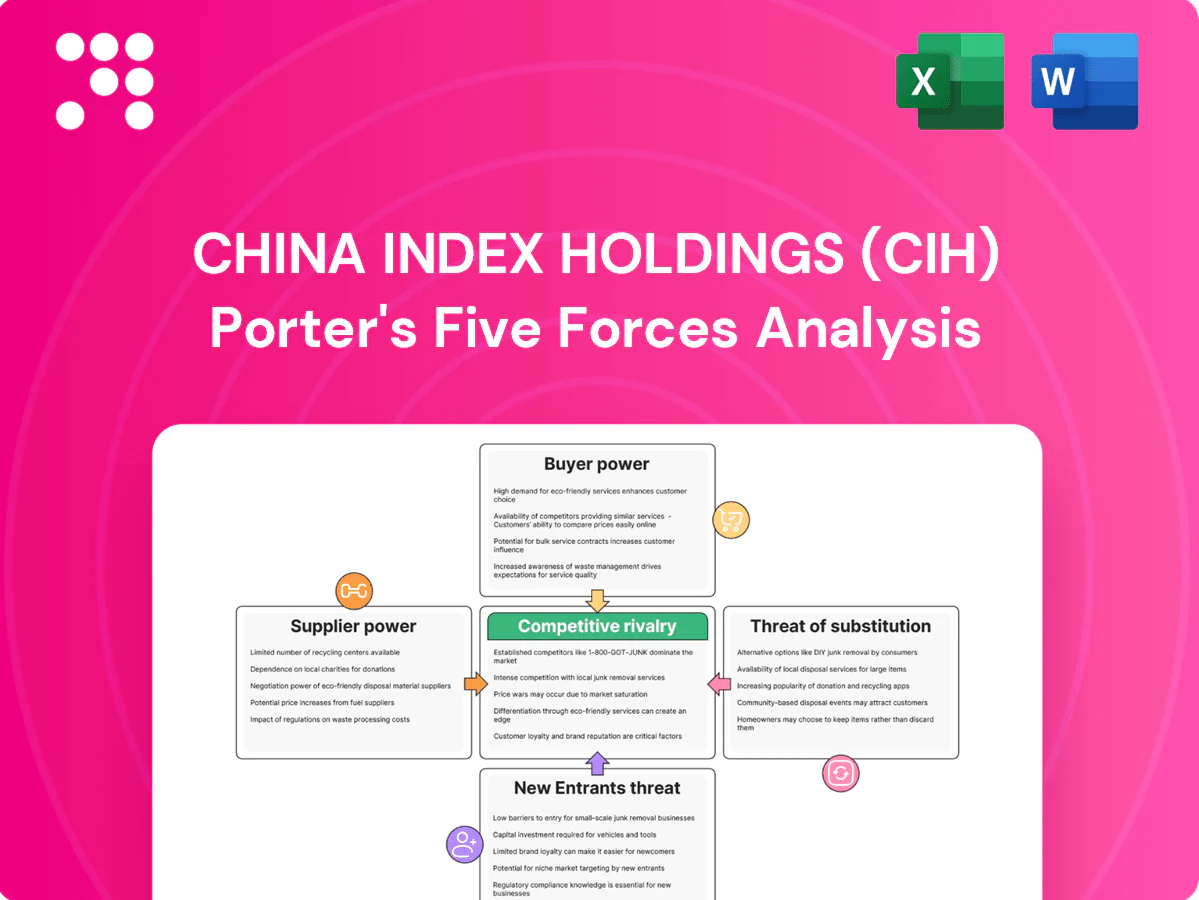
China Index Holdings (CIH) Porter's Five Forces Analysis

Elevate Your Analysis with the Complete Porter's Five Forces Analysis
China Index Holdings (CIH) faces intense rivalry from established index and analytics firms, moderate-high buyer power from institutional clients, moderate supplier power for data inputs, low threat of new entrants, and growing risk from substitute analytics platforms. This brief snapshot only scratches the surface. Unlock the full Porter's Five Forces Analysis to explore CIH’s competitive dynamics in detail.
Suppliers Bargaining Power

Concentrated critical data sources
CIH depends on a finite set of authoritative suppliers—government registries (eg National Enterprise Credit Information Publicity System), mapping platforms (Gaode, Baidu Maps) and large broker/developer feeds—which concentrates pricing and access leverage over data refresh cycles. CIH reduces risk via multi-sourcing and proprietary aggregation pipelines and normalization layers. Loss of any top-tier source would materially degrade coverage and product quality, forcing costly remediation or sourcing delays.
Regulatory and licensing gatekeepers
Permits for data usage, cross-border transfers and real-estate analytics must comply with PIPL and the Data Security Law (both 2021), and evolving CAC rules, making regulators de facto suppliers who shape dataset scope and timeliness. Regulatory shifts can raise costs or restrict products — Didi’s 8.026 billion RMB fine in 2022 exemplifies enforcement risk. Ongoing compliance spend mitigates but does not remove this supplier power.

Cloud, AI, and geospatial infrastructure
CIH relies on cloud compute, storage, AI tooling and satellite/imaging APIs; Alibaba Cloud (≈33% China IaaS share in 2023) and a crowded vendor set reduce single-supplier risk. Switching at scale is hard due to integration, latency and data residency, and vendors can erode unit economics via pricing or egress fees. Long-term contracts and modular multi-cloud/edge architectures limit supplier leverage.

Broker and developer data contributors
Large brokerages and developers supply CIH with transaction, listing and pipeline feeds that materially enrich coverage; access often depends on reciprocity, branding exposure or commercial terms. If key contributors curtail feeds or insist on exclusivity, CIH’s dataset breadth and timeliness can shrink, raising competitive and valuation risks. Robust partnership frameworks and contributor incentives mitigate supplier leverage.
- Data sources: brokerages, developers
- Sharing drivers: reciprocity, branding, monetization
- Risk: feed limits or exclusivity
- Countermeasures: contracts, incentives, revenue share
Third-party alternative data providers
Third-party mobile location, payments and logistics datasets materially boost CIH analytics, but the supplier ecosystem remained fragmented in 2024 with over 1,000 alternative data vendors globally; many control unique signals with limited substitutes, creating bargaining power. Dependency on proprietary feature pipelines risks vendor lock-in; CIH can triangulate signals and build in-house feature engineering to cut that exposure.
- 2024: >1,000 vendors
- Risk: proprietary-method lock-in
- Mitigation: triangulation + in-house features
Supplier concentration, cloud dependence and regulatory fines threaten data feeds
CIH faces concentrated supplier power from government registries, major brokers/developers and mapping platforms, making coverage sensitive to feed loss. Regulatory bodies (PIPL, Data Security Law 2021) act as suppliers shaping data scope — enforcement risk proven by Didi’s 8.026 billion RMB fine (2022). Cloud/vendor dependence (Alibaba Cloud ≈33% China IaaS 2023) and >1,000 alt-data vendors (2024) raise switching costs; multi-sourcing and contracts mitigate.
| Supplier | Metric | Year |
|---|---|---|
| Alibaba Cloud | ≈33% China IaaS share | 2023 |
| Didi enforcement | Fine 8.026 billion RMB | 2022 |
| Alt-data vendors | >1,000 vendors | 2024 |
| Regulatory laws | PIPL & Data Security Law | 2021 |
What is included in the product
 Detailed Word Document
Uncovers key drivers of competition, customer influence, and market entry risks tailored to China Index Holdings (CIH), detailing supplier/buyer power, substitutes, rivalry, and entrant threats while identifying disruptive forces and strategic protections to inform investor and management decisions.

 Customizable Excel Spreadsheet
One-sheet Porter's Five Forces for China Index Holdings that distills competitive pressures into a clear radar chart, lets you tweak force levels with new data, and exports cleanly into decks or dashboards for fast, boardroom-ready decisions.
Customers Bargaining Power

Large institutional clients negotiate hard
Large institutional clients—real estate developers, banks, and broker networks—represent a high share of CIH contract value and leverage scale for volume discounts, custom SLAs, and strict data delivery terms; multiyear deals are routinely exchanged for lower pricing. In 2024 CIH must offset discount pressure by selling differentiated, high‑value analytics and bespoke feeds to protect margins.
High ability to multi-home
Buyers increasingly multi-home, using multiple data/analytics vendors plus internal teams, which in 2024 amplifies price sensitivity and lowers effective switching costs. Feature overlap across providers intensifies RFP competition and commoditizes offerings. CIH must anchor proprietary datasets and differentiated models to reduce comparability and defend margins. Tangible unique data links are essential to shift buyers from price to value.

Outcome-driven purchase criteria
Clients evaluate CIH chiefly on forecast accuracy, coverage, timeliness and demonstrable ROI in deal underwriting and risk control. When outputs fail to materially improve decisions, buyers push for fee reductions or churn. Robust backtests and published case studies reduce this bargaining power. Deep workflow integrations increase switching costs and raise exit friction.

Customization demands raise service load
Enterprise clients often demand tailored reports, segment cuts and consulting, which increases delivery complexity and per-project costs while creating concessions that strengthen buyer leverage; clear packaging and modular add-ons help monetize variability and cap margin erosion.
- Tailored reports raise per-engagement costs
- Modular pricing monetizes variability
- Scope governance limits concession drift
- Sticky clients increase bargaining power
Macroeconomic cyclicality influences budgets
Macroeconomic cyclicality in 2024 tightened client budgets as property downturns and credit squeeze made customers scrutinize data spend, driving double-digit cuts in marketing and analytics budgets in many real-estate firms; consolidation of vendors and delayed renewals amplified buyer leverage. Stress raised demand for risk analytics but intensified price negotiation, making flexible pricing tiers crucial to retain clients while protecting yield.
- Clients: tighter budgets, delayed renewals
- Market: vendor consolidation increases buyer power
- Demand: risk analytics up, pricing leverage up
- Strategy: flexible tiers balance retention and margin
Institutional clients drive 68% revenue; upsell analytics as budgets drop 15%
Large institutional clients drive ~68% of CIH revenue, forcing volume discounts and bespoke SLAs; in 2024 CIH must upsell high‑value analytics to protect margins. Multi‑vendor buying and feature overlap raise price sensitivity; documented ROI and workflow integration raise switching costs. 2024 property downturn cut customer analytics budgets ~15%, increasing renewal pressure.
| Metric | 2024 |
|---|---|
| Revenue share top 20 clients | 68% |
| Avg client budget cut | −15% |
| Churn risk (est.) | 12% |
Preview Before You Purchase
China Index Holdings (CIH) Porter's Five Forces Analysis
This Porter’s Five Forces analysis of China Index Holdings assesses competitive rivalry, buyer and supplier power, threat of new entrants, and substitution with evidence-backed insights on CIH’s market positioning and margins. The review highlights high rivalry and moderate buyer power, limited supplier leverage, niche barriers that constrain new entrants, and substitution risk from tech-enabled platforms. This preview shows the exact document you'll receive immediately after purchase—no surprises, no placeholders.

Elevate Your Analysis with the Complete Porter's Five Forces Analysis
China Index Holdings (CIH) faces intense rivalry from established index and analytics firms, moderate-high buyer power from institutional clients, moderate supplier power for data inputs, low threat of new entrants, and growing risk from substitute analytics platforms. This brief snapshot only scratches the surface. Unlock the full Porter's Five Forces Analysis to explore CIH’s competitive dynamics in detail.
Suppliers Bargaining Power
Concentrated critical data sources
CIH depends on a finite set of authoritative suppliers—government registries (eg National Enterprise Credit Information Publicity System), mapping platforms (Gaode, Baidu Maps) and large broker/developer feeds—which concentrates pricing and access leverage over data refresh cycles. CIH reduces risk via multi-sourcing and proprietary aggregation pipelines and normalization layers. Loss of any top-tier source would materially degrade coverage and product quality, forcing costly remediation or sourcing delays.
Regulatory and licensing gatekeepers
Permits for data usage, cross-border transfers and real-estate analytics must comply with PIPL and the Data Security Law (both 2021), and evolving CAC rules, making regulators de facto suppliers who shape dataset scope and timeliness. Regulatory shifts can raise costs or restrict products — Didi’s 8.026 billion RMB fine in 2022 exemplifies enforcement risk. Ongoing compliance spend mitigates but does not remove this supplier power.
Cloud, AI, and geospatial infrastructure
CIH relies on cloud compute, storage, AI tooling and satellite/imaging APIs; Alibaba Cloud (≈33% China IaaS share in 2023) and a crowded vendor set reduce single-supplier risk. Switching at scale is hard due to integration, latency and data residency, and vendors can erode unit economics via pricing or egress fees. Long-term contracts and modular multi-cloud/edge architectures limit supplier leverage.
Broker and developer data contributors
Large brokerages and developers supply CIH with transaction, listing and pipeline feeds that materially enrich coverage; access often depends on reciprocity, branding exposure or commercial terms. If key contributors curtail feeds or insist on exclusivity, CIH’s dataset breadth and timeliness can shrink, raising competitive and valuation risks. Robust partnership frameworks and contributor incentives mitigate supplier leverage.
- Data sources: brokerages, developers
- Sharing drivers: reciprocity, branding, monetization
- Risk: feed limits or exclusivity
- Countermeasures: contracts, incentives, revenue share
Third-party alternative data providers
Third-party mobile location, payments and logistics datasets materially boost CIH analytics, but the supplier ecosystem remained fragmented in 2024 with over 1,000 alternative data vendors globally; many control unique signals with limited substitutes, creating bargaining power. Dependency on proprietary feature pipelines risks vendor lock-in; CIH can triangulate signals and build in-house feature engineering to cut that exposure.
- 2024: >1,000 vendors
- Risk: proprietary-method lock-in
- Mitigation: triangulation + in-house features
Supplier concentration, cloud dependence and regulatory fines threaten data feeds
CIH faces concentrated supplier power from government registries, major brokers/developers and mapping platforms, making coverage sensitive to feed loss. Regulatory bodies (PIPL, Data Security Law 2021) act as suppliers shaping data scope — enforcement risk proven by Didi’s 8.026 billion RMB fine (2022). Cloud/vendor dependence (Alibaba Cloud ≈33% China IaaS 2023) and >1,000 alt-data vendors (2024) raise switching costs; multi-sourcing and contracts mitigate.
| Supplier | Metric | Year |
|---|---|---|
| Alibaba Cloud | ≈33% China IaaS share | 2023 |
| Didi enforcement | Fine 8.026 billion RMB | 2022 |
| Alt-data vendors | >1,000 vendors | 2024 |
| Regulatory laws | PIPL & Data Security Law | 2021 |
What is included in the product
Detailed Word Document
Uncovers key drivers of competition, customer influence, and market entry risks tailored to China Index Holdings (CIH), detailing supplier/buyer power, substitutes, rivalry, and entrant threats while identifying disruptive forces and strategic protections to inform investor and management decisions.
Customizable Excel Spreadsheet
One-sheet Porter's Five Forces for China Index Holdings that distills competitive pressures into a clear radar chart, lets you tweak force levels with new data, and exports cleanly into decks or dashboards for fast, boardroom-ready decisions.
Customers Bargaining Power
Large institutional clients negotiate hard
Large institutional clients—real estate developers, banks, and broker networks—represent a high share of CIH contract value and leverage scale for volume discounts, custom SLAs, and strict data delivery terms; multiyear deals are routinely exchanged for lower pricing. In 2024 CIH must offset discount pressure by selling differentiated, high‑value analytics and bespoke feeds to protect margins.
High ability to multi-home
Buyers increasingly multi-home, using multiple data/analytics vendors plus internal teams, which in 2024 amplifies price sensitivity and lowers effective switching costs. Feature overlap across providers intensifies RFP competition and commoditizes offerings. CIH must anchor proprietary datasets and differentiated models to reduce comparability and defend margins. Tangible unique data links are essential to shift buyers from price to value.
Outcome-driven purchase criteria
Clients evaluate CIH chiefly on forecast accuracy, coverage, timeliness and demonstrable ROI in deal underwriting and risk control. When outputs fail to materially improve decisions, buyers push for fee reductions or churn. Robust backtests and published case studies reduce this bargaining power. Deep workflow integrations increase switching costs and raise exit friction.
Customization demands raise service load
Enterprise clients often demand tailored reports, segment cuts and consulting, which increases delivery complexity and per-project costs while creating concessions that strengthen buyer leverage; clear packaging and modular add-ons help monetize variability and cap margin erosion.
- Tailored reports raise per-engagement costs
- Modular pricing monetizes variability
- Scope governance limits concession drift
- Sticky clients increase bargaining power
Macroeconomic cyclicality influences budgets
Macroeconomic cyclicality in 2024 tightened client budgets as property downturns and credit squeeze made customers scrutinize data spend, driving double-digit cuts in marketing and analytics budgets in many real-estate firms; consolidation of vendors and delayed renewals amplified buyer leverage. Stress raised demand for risk analytics but intensified price negotiation, making flexible pricing tiers crucial to retain clients while protecting yield.
- Clients: tighter budgets, delayed renewals
- Market: vendor consolidation increases buyer power
- Demand: risk analytics up, pricing leverage up
- Strategy: flexible tiers balance retention and margin
Institutional clients drive 68% revenue; upsell analytics as budgets drop 15%
Large institutional clients drive ~68% of CIH revenue, forcing volume discounts and bespoke SLAs; in 2024 CIH must upsell high‑value analytics to protect margins. Multi‑vendor buying and feature overlap raise price sensitivity; documented ROI and workflow integration raise switching costs. 2024 property downturn cut customer analytics budgets ~15%, increasing renewal pressure.
| Metric | 2024 |
|---|---|
| Revenue share top 20 clients | 68% |
| Avg client budget cut | −15% |
| Churn risk (est.) | 12% |
Preview Before You Purchase
China Index Holdings (CIH) Porter's Five Forces Analysis
This Porter’s Five Forces analysis of China Index Holdings assesses competitive rivalry, buyer and supplier power, threat of new entrants, and substitution with evidence-backed insights on CIH’s market positioning and margins. The review highlights high rivalry and moderate buyer power, limited supplier leverage, niche barriers that constrain new entrants, and substitution risk from tech-enabled platforms. This preview shows the exact document you'll receive immediately after purchase—no surprises, no placeholders.
Description
Elevate Your Analysis with the Complete Porter's Five Forces Analysis
China Index Holdings (CIH) faces intense rivalry from established index and analytics firms, moderate-high buyer power from institutional clients, moderate supplier power for data inputs, low threat of new entrants, and growing risk from substitute analytics platforms. This brief snapshot only scratches the surface. Unlock the full Porter's Five Forces Analysis to explore CIH’s competitive dynamics in detail.
Suppliers Bargaining Power
Concentrated critical data sources
CIH depends on a finite set of authoritative suppliers—government registries (eg National Enterprise Credit Information Publicity System), mapping platforms (Gaode, Baidu Maps) and large broker/developer feeds—which concentrates pricing and access leverage over data refresh cycles. CIH reduces risk via multi-sourcing and proprietary aggregation pipelines and normalization layers. Loss of any top-tier source would materially degrade coverage and product quality, forcing costly remediation or sourcing delays.
Regulatory and licensing gatekeepers
Permits for data usage, cross-border transfers and real-estate analytics must comply with PIPL and the Data Security Law (both 2021), and evolving CAC rules, making regulators de facto suppliers who shape dataset scope and timeliness. Regulatory shifts can raise costs or restrict products — Didi’s 8.026 billion RMB fine in 2022 exemplifies enforcement risk. Ongoing compliance spend mitigates but does not remove this supplier power.
Cloud, AI, and geospatial infrastructure
CIH relies on cloud compute, storage, AI tooling and satellite/imaging APIs; Alibaba Cloud (≈33% China IaaS share in 2023) and a crowded vendor set reduce single-supplier risk. Switching at scale is hard due to integration, latency and data residency, and vendors can erode unit economics via pricing or egress fees. Long-term contracts and modular multi-cloud/edge architectures limit supplier leverage.
Broker and developer data contributors
Large brokerages and developers supply CIH with transaction, listing and pipeline feeds that materially enrich coverage; access often depends on reciprocity, branding exposure or commercial terms. If key contributors curtail feeds or insist on exclusivity, CIH’s dataset breadth and timeliness can shrink, raising competitive and valuation risks. Robust partnership frameworks and contributor incentives mitigate supplier leverage.
- Data sources: brokerages, developers
- Sharing drivers: reciprocity, branding, monetization
- Risk: feed limits or exclusivity
- Countermeasures: contracts, incentives, revenue share
Third-party alternative data providers
Third-party mobile location, payments and logistics datasets materially boost CIH analytics, but the supplier ecosystem remained fragmented in 2024 with over 1,000 alternative data vendors globally; many control unique signals with limited substitutes, creating bargaining power. Dependency on proprietary feature pipelines risks vendor lock-in; CIH can triangulate signals and build in-house feature engineering to cut that exposure.
- 2024: >1,000 vendors
- Risk: proprietary-method lock-in
- Mitigation: triangulation + in-house features
Supplier concentration, cloud dependence and regulatory fines threaten data feeds
CIH faces concentrated supplier power from government registries, major brokers/developers and mapping platforms, making coverage sensitive to feed loss. Regulatory bodies (PIPL, Data Security Law 2021) act as suppliers shaping data scope — enforcement risk proven by Didi’s 8.026 billion RMB fine (2022). Cloud/vendor dependence (Alibaba Cloud ≈33% China IaaS 2023) and >1,000 alt-data vendors (2024) raise switching costs; multi-sourcing and contracts mitigate.
| Supplier | Metric | Year |
|---|---|---|
| Alibaba Cloud | ≈33% China IaaS share | 2023 |
| Didi enforcement | Fine 8.026 billion RMB | 2022 |
| Alt-data vendors | >1,000 vendors | 2024 |
| Regulatory laws | PIPL & Data Security Law | 2021 |
What is included in the product
Detailed Word Document
Uncovers key drivers of competition, customer influence, and market entry risks tailored to China Index Holdings (CIH), detailing supplier/buyer power, substitutes, rivalry, and entrant threats while identifying disruptive forces and strategic protections to inform investor and management decisions.
Customizable Excel Spreadsheet
One-sheet Porter's Five Forces for China Index Holdings that distills competitive pressures into a clear radar chart, lets you tweak force levels with new data, and exports cleanly into decks or dashboards for fast, boardroom-ready decisions.
Customers Bargaining Power
Large institutional clients negotiate hard
Large institutional clients—real estate developers, banks, and broker networks—represent a high share of CIH contract value and leverage scale for volume discounts, custom SLAs, and strict data delivery terms; multiyear deals are routinely exchanged for lower pricing. In 2024 CIH must offset discount pressure by selling differentiated, high‑value analytics and bespoke feeds to protect margins.
High ability to multi-home
Buyers increasingly multi-home, using multiple data/analytics vendors plus internal teams, which in 2024 amplifies price sensitivity and lowers effective switching costs. Feature overlap across providers intensifies RFP competition and commoditizes offerings. CIH must anchor proprietary datasets and differentiated models to reduce comparability and defend margins. Tangible unique data links are essential to shift buyers from price to value.
Outcome-driven purchase criteria
Clients evaluate CIH chiefly on forecast accuracy, coverage, timeliness and demonstrable ROI in deal underwriting and risk control. When outputs fail to materially improve decisions, buyers push for fee reductions or churn. Robust backtests and published case studies reduce this bargaining power. Deep workflow integrations increase switching costs and raise exit friction.
Customization demands raise service load
Enterprise clients often demand tailored reports, segment cuts and consulting, which increases delivery complexity and per-project costs while creating concessions that strengthen buyer leverage; clear packaging and modular add-ons help monetize variability and cap margin erosion.
- Tailored reports raise per-engagement costs
- Modular pricing monetizes variability
- Scope governance limits concession drift
- Sticky clients increase bargaining power
Macroeconomic cyclicality influences budgets
Macroeconomic cyclicality in 2024 tightened client budgets as property downturns and credit squeeze made customers scrutinize data spend, driving double-digit cuts in marketing and analytics budgets in many real-estate firms; consolidation of vendors and delayed renewals amplified buyer leverage. Stress raised demand for risk analytics but intensified price negotiation, making flexible pricing tiers crucial to retain clients while protecting yield.
- Clients: tighter budgets, delayed renewals
- Market: vendor consolidation increases buyer power
- Demand: risk analytics up, pricing leverage up
- Strategy: flexible tiers balance retention and margin
Institutional clients drive 68% revenue; upsell analytics as budgets drop 15%
Large institutional clients drive ~68% of CIH revenue, forcing volume discounts and bespoke SLAs; in 2024 CIH must upsell high‑value analytics to protect margins. Multi‑vendor buying and feature overlap raise price sensitivity; documented ROI and workflow integration raise switching costs. 2024 property downturn cut customer analytics budgets ~15%, increasing renewal pressure.
| Metric | 2024 |
|---|---|
| Revenue share top 20 clients | 68% |
| Avg client budget cut | −15% |
| Churn risk (est.) | 12% |
Preview Before You Purchase
China Index Holdings (CIH) Porter's Five Forces Analysis
This Porter’s Five Forces analysis of China Index Holdings assesses competitive rivalry, buyer and supplier power, threat of new entrants, and substitution with evidence-backed insights on CIH’s market positioning and margins. The review highlights high rivalry and moderate buyer power, limited supplier leverage, niche barriers that constrain new entrants, and substitution risk from tech-enabled platforms. This preview shows the exact document you'll receive immediately after purchase—no surprises, no placeholders.











