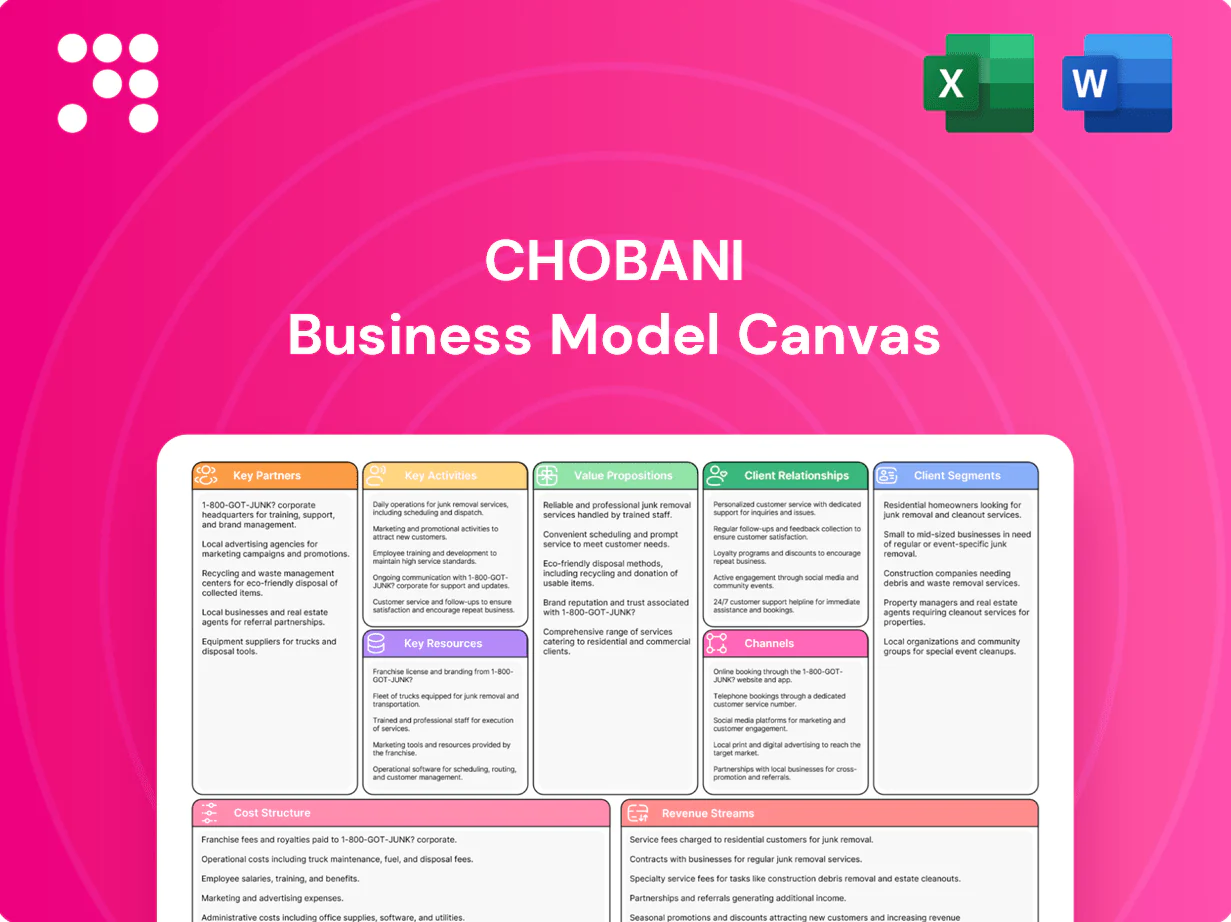
Chobani Business Model Canvas

Business Model Canvas: strategic blueprint of a leading yogurt company
Unlock the full strategic blueprint behind Chobani’s business model. This concise Business Model Canvas maps value propositions, customer segments, key partners and revenue levers that drive its growth. Download the full Word/Excel canvas for section-by-section insights ideal for investors, founders, and consultants.
Partnerships

Dairy farmers and milk cooperatives
Chobani relies on a stable, high-quality milk supply from partnered dairy farmers and cooperatives to ensure consistent yogurt production. In 2024 these partnerships emphasized consistent pricing, full traceability and agreed animal welfare standards across supply chains. Long-term contracts reduce volatility and secure processing capacity, while collaborative quality programs preserve taste and texture consistency.
Oat and plant-based ingredient suppliers
Non-dairy lines demand premium oats and specialty ingredients to meet Chobani quality standards; oat milk captured about 30% of US plant-based milk dollar share in 2024, driving higher-grade sourcing. Strategic sourcing ensures clean-label inputs and gluten-free compliance through certified suppliers and audits. Joint development agreements with ingredient partners accelerate texture and flavor optimization, while a diversified supplier base mitigates crop and climate risk.

Retailers and distributors
Grocery, mass, club, and convenience partners drive shelf presence and velocity for Chobani, with distribution in over 60,000 retail doors across 48 US states. Joint category management with major retailers lifts placement and promotional RPMs by roughly 15% on promoted SKUs. National and regional distributors extend service levels and cold-chain reach. Shared POS and shipment data improve demand planning and assortment accuracy.

Co-packers and equipment vendors
Co-packers provide surge capacity and format flexibility for Chobani, enabling rapid SKU scaling during peak demand; equipment partners deliver high-speed filling and advanced packaging innovation; preventive maintenance programs reduce unplanned downtime; technology upgrades in 2024 support operational efficiency and sustainability targets.
- Surge capacity
- Format flexibility
- High-speed filling
- Preventive maintenance
- Efficiency & sustainability
Logistics and cold-chain providers
Perishables require reliable refrigerated transport and warehousing to preserve Chobani’s yogurt quality across its national distribution network.
Strategic 3PL partners optimize routes and reduce spoilage while real-time tracking in 2024 improved on-time delivery and freshness metrics for chilled foods.
Close collaboration with logistics providers smooths seasonal demand swings and supports new product launches with scalable cold-chain capacity.
- 3PL optimization
- Refrigerated warehousing
- Real-time tracking (2024)
- Seasonal scalability
Traceable farmer contracts boost premium oat milk; 30% share, ~60k doors
Chobani secures high-quality milk via long-term farmer contracts and traceability standards to stabilize supply and quality. Non-dairy sourcing focused on premium oats as oat milk held about 30% of US plant-based milk dollar share in 2024. Retail and distributor partners placed products in ~60,000 doors across 48 states, with joint category promos lifting promoted SKU RPMs ~15%.
| Metric | 2024 |
|---|---|
| Oat milk US plant-based dollar share | 30% |
| Retail doors | ~60,000 |
| States | 48 |
| Promoted SKU RPM lift | ~15% |
What is included in the product
 Detailed Word Document
A comprehensive Business Model Canvas for Chobani outlining its nine blocks—customer segments, value propositions, channels, customer relationships, revenue streams, key resources, key activities, key partnerships, and cost structure—reflecting real-world operations and strategic plans. Ideal for presentations and investor discussions, it includes competitive advantages and linked SWOT insights to support decision-making.

 Customizable Excel Spreadsheet
Condenses Chobani’s strategy into a digestible, one-page Business Model Canvas with editable cells to quickly relieve the pain of scattered planning and lengthy reports. Perfect for boardrooms or teams needing a clean, shareable snapshot to speed decision-making and preserve structure while adapting to new insights.
Activities

Product R&D and formulation
Developing new flavors, textures and nutrition profiles sustains growth for Chobani, which reached roughly $2 billion in sales by 2021 and continues expanding product lines into plant-based and low-sugar segments. Iterative lab and pilot-batch testing ensures clean-label compliance and taste, with rapid prototyping shortening time-to-market. Sensory panels of 50–200 target consumers validate preferences before scale-up.
Supply sourcing and quality assurance
As of 2024 Chobani enforces rigorous standards for milk, oats, cultures and flavors, specifying sourcing specifications and acceptance criteria. Regular supplier audits and in-house and third-party lab testing ensure safety and batch-to-batch consistency. Supplier scorecards measure quality, delivery and sustainability to drive continuous improvement, while traceability systems enable rapid recalls and regulatory compliance.

Manufacturing and packaging
High-volume Chobani plants produce yogurt, oat milk and creamers with integrated automation to maintain hygiene and fill accuracy across continuous lines.
Flexible packaging systems enable singles and multipacks, supporting retail and foodservice assortments while reducing changeover time.
Lean manufacturing practices lower waste and energy use through continuous improvement and standardized work across facilities.

Brand marketing and trade promotion
Brand campaigns emphasize natural ingredients and nutrition, referencing Chobani’s 2024 emphasis on clean-label messaging across TV and digital to sustain premium positioning.
In-store promotions and price features in 2024 drove trial and repeat purchase acceleration through featured displays and price-pack architecture in key retailers.
Digital content in 2024 prioritized education and engagement via short-form video and owned channels, lifting loyalty program enrollment and repeat purchase rates.
Category-level storytelling secured shelf space and endcap displays with coop-funded plans in major chains during 2024 merchandising cycles.
- Campaigns: clean-label + nutrition focus (2024)
- Promos: in-store displays, price features → trial/repeat (2024)
- Digital: short-form education → higher engagement (2024)
- Category: coop-funded shelf/display wins (2024)
Distribution and demand planning
Distribution and demand planning aligns Chobani production with retailer orders and seasonality, using demand signals to match supply to peaks; Chobani reported about $1.5B revenue in 2023, underscoring scale needs. Cold-chain coordination minimizes spoilage and out-of-stocks across refrigerated SKUs. Route-to-market optimization lowers logistics cost while collaboration with retailers raises service levels.
- Forecasting: aligns production with retail orders
- Cold-chain: reduces spoilage, prevents OOS
- Routing: lowers distribution costs
- Retail collaboration: improves fill rates and promotions
SKU development, pilot sensory tests and supplier audits speed lean cold-chain launches
Developing SKUs, pilot testing and sensory validation accelerate product launches; Chobani hit ~$2B sales in 2021 and ~$1.5B in 2023, expanding oat and low‑sugar lines in 2024. Supplier audits, traceability and scorecards ensure quality. Automated plants, lean ops and cold‑chain logistics reduce waste and OOS.
| Metric | Value |
|---|---|
| Revenue 2021 | $2B |
| Revenue 2023 | $1.5B |
| Panels | 50–200 |
Preview Before You Purchase
Business Model Canvas
The Chobani Business Model Canvas shown here is the actual deliverable, not a mockup. When you purchase, you’ll receive this same complete document—structured and formatted exactly as previewed. The file is ready-to-edit for presentation or analysis in Word and Excel formats. No placeholders, no surprises—what you see is what you get.

Business Model Canvas: strategic blueprint of a leading yogurt company
Unlock the full strategic blueprint behind Chobani’s business model. This concise Business Model Canvas maps value propositions, customer segments, key partners and revenue levers that drive its growth. Download the full Word/Excel canvas for section-by-section insights ideal for investors, founders, and consultants.
Partnerships
Dairy farmers and milk cooperatives
Chobani relies on a stable, high-quality milk supply from partnered dairy farmers and cooperatives to ensure consistent yogurt production. In 2024 these partnerships emphasized consistent pricing, full traceability and agreed animal welfare standards across supply chains. Long-term contracts reduce volatility and secure processing capacity, while collaborative quality programs preserve taste and texture consistency.
Oat and plant-based ingredient suppliers
Non-dairy lines demand premium oats and specialty ingredients to meet Chobani quality standards; oat milk captured about 30% of US plant-based milk dollar share in 2024, driving higher-grade sourcing. Strategic sourcing ensures clean-label inputs and gluten-free compliance through certified suppliers and audits. Joint development agreements with ingredient partners accelerate texture and flavor optimization, while a diversified supplier base mitigates crop and climate risk.
Retailers and distributors
Grocery, mass, club, and convenience partners drive shelf presence and velocity for Chobani, with distribution in over 60,000 retail doors across 48 US states. Joint category management with major retailers lifts placement and promotional RPMs by roughly 15% on promoted SKUs. National and regional distributors extend service levels and cold-chain reach. Shared POS and shipment data improve demand planning and assortment accuracy.
Co-packers and equipment vendors
Co-packers provide surge capacity and format flexibility for Chobani, enabling rapid SKU scaling during peak demand; equipment partners deliver high-speed filling and advanced packaging innovation; preventive maintenance programs reduce unplanned downtime; technology upgrades in 2024 support operational efficiency and sustainability targets.
- Surge capacity
- Format flexibility
- High-speed filling
- Preventive maintenance
- Efficiency & sustainability
Logistics and cold-chain providers
Perishables require reliable refrigerated transport and warehousing to preserve Chobani’s yogurt quality across its national distribution network.
Strategic 3PL partners optimize routes and reduce spoilage while real-time tracking in 2024 improved on-time delivery and freshness metrics for chilled foods.
Close collaboration with logistics providers smooths seasonal demand swings and supports new product launches with scalable cold-chain capacity.
- 3PL optimization
- Refrigerated warehousing
- Real-time tracking (2024)
- Seasonal scalability
Traceable farmer contracts boost premium oat milk; 30% share, ~60k doors
Chobani secures high-quality milk via long-term farmer contracts and traceability standards to stabilize supply and quality. Non-dairy sourcing focused on premium oats as oat milk held about 30% of US plant-based milk dollar share in 2024. Retail and distributor partners placed products in ~60,000 doors across 48 states, with joint category promos lifting promoted SKU RPMs ~15%.
| Metric | 2024 |
|---|---|
| Oat milk US plant-based dollar share | 30% |
| Retail doors | ~60,000 |
| States | 48 |
| Promoted SKU RPM lift | ~15% |
What is included in the product
Detailed Word Document
A comprehensive Business Model Canvas for Chobani outlining its nine blocks—customer segments, value propositions, channels, customer relationships, revenue streams, key resources, key activities, key partnerships, and cost structure—reflecting real-world operations and strategic plans. Ideal for presentations and investor discussions, it includes competitive advantages and linked SWOT insights to support decision-making.
Customizable Excel Spreadsheet
Condenses Chobani’s strategy into a digestible, one-page Business Model Canvas with editable cells to quickly relieve the pain of scattered planning and lengthy reports. Perfect for boardrooms or teams needing a clean, shareable snapshot to speed decision-making and preserve structure while adapting to new insights.
Activities
Product R&D and formulation
Developing new flavors, textures and nutrition profiles sustains growth for Chobani, which reached roughly $2 billion in sales by 2021 and continues expanding product lines into plant-based and low-sugar segments. Iterative lab and pilot-batch testing ensures clean-label compliance and taste, with rapid prototyping shortening time-to-market. Sensory panels of 50–200 target consumers validate preferences before scale-up.
Supply sourcing and quality assurance
As of 2024 Chobani enforces rigorous standards for milk, oats, cultures and flavors, specifying sourcing specifications and acceptance criteria. Regular supplier audits and in-house and third-party lab testing ensure safety and batch-to-batch consistency. Supplier scorecards measure quality, delivery and sustainability to drive continuous improvement, while traceability systems enable rapid recalls and regulatory compliance.
Manufacturing and packaging
High-volume Chobani plants produce yogurt, oat milk and creamers with integrated automation to maintain hygiene and fill accuracy across continuous lines.
Flexible packaging systems enable singles and multipacks, supporting retail and foodservice assortments while reducing changeover time.
Lean manufacturing practices lower waste and energy use through continuous improvement and standardized work across facilities.
Brand marketing and trade promotion
Brand campaigns emphasize natural ingredients and nutrition, referencing Chobani’s 2024 emphasis on clean-label messaging across TV and digital to sustain premium positioning.
In-store promotions and price features in 2024 drove trial and repeat purchase acceleration through featured displays and price-pack architecture in key retailers.
Digital content in 2024 prioritized education and engagement via short-form video and owned channels, lifting loyalty program enrollment and repeat purchase rates.
Category-level storytelling secured shelf space and endcap displays with coop-funded plans in major chains during 2024 merchandising cycles.
- Campaigns: clean-label + nutrition focus (2024)
- Promos: in-store displays, price features → trial/repeat (2024)
- Digital: short-form education → higher engagement (2024)
- Category: coop-funded shelf/display wins (2024)
Distribution and demand planning
Distribution and demand planning aligns Chobani production with retailer orders and seasonality, using demand signals to match supply to peaks; Chobani reported about $1.5B revenue in 2023, underscoring scale needs. Cold-chain coordination minimizes spoilage and out-of-stocks across refrigerated SKUs. Route-to-market optimization lowers logistics cost while collaboration with retailers raises service levels.
- Forecasting: aligns production with retail orders
- Cold-chain: reduces spoilage, prevents OOS
- Routing: lowers distribution costs
- Retail collaboration: improves fill rates and promotions
SKU development, pilot sensory tests and supplier audits speed lean cold-chain launches
Developing SKUs, pilot testing and sensory validation accelerate product launches; Chobani hit ~$2B sales in 2021 and ~$1.5B in 2023, expanding oat and low‑sugar lines in 2024. Supplier audits, traceability and scorecards ensure quality. Automated plants, lean ops and cold‑chain logistics reduce waste and OOS.
| Metric | Value |
|---|---|
| Revenue 2021 | $2B |
| Revenue 2023 | $1.5B |
| Panels | 50–200 |
Preview Before You Purchase
Business Model Canvas
The Chobani Business Model Canvas shown here is the actual deliverable, not a mockup. When you purchase, you’ll receive this same complete document—structured and formatted exactly as previewed. The file is ready-to-edit for presentation or analysis in Word and Excel formats. No placeholders, no surprises—what you see is what you get.
Description
Business Model Canvas: strategic blueprint of a leading yogurt company
Unlock the full strategic blueprint behind Chobani’s business model. This concise Business Model Canvas maps value propositions, customer segments, key partners and revenue levers that drive its growth. Download the full Word/Excel canvas for section-by-section insights ideal for investors, founders, and consultants.
Partnerships
Dairy farmers and milk cooperatives
Chobani relies on a stable, high-quality milk supply from partnered dairy farmers and cooperatives to ensure consistent yogurt production. In 2024 these partnerships emphasized consistent pricing, full traceability and agreed animal welfare standards across supply chains. Long-term contracts reduce volatility and secure processing capacity, while collaborative quality programs preserve taste and texture consistency.
Oat and plant-based ingredient suppliers
Non-dairy lines demand premium oats and specialty ingredients to meet Chobani quality standards; oat milk captured about 30% of US plant-based milk dollar share in 2024, driving higher-grade sourcing. Strategic sourcing ensures clean-label inputs and gluten-free compliance through certified suppliers and audits. Joint development agreements with ingredient partners accelerate texture and flavor optimization, while a diversified supplier base mitigates crop and climate risk.
Retailers and distributors
Grocery, mass, club, and convenience partners drive shelf presence and velocity for Chobani, with distribution in over 60,000 retail doors across 48 US states. Joint category management with major retailers lifts placement and promotional RPMs by roughly 15% on promoted SKUs. National and regional distributors extend service levels and cold-chain reach. Shared POS and shipment data improve demand planning and assortment accuracy.
Co-packers and equipment vendors
Co-packers provide surge capacity and format flexibility for Chobani, enabling rapid SKU scaling during peak demand; equipment partners deliver high-speed filling and advanced packaging innovation; preventive maintenance programs reduce unplanned downtime; technology upgrades in 2024 support operational efficiency and sustainability targets.
- Surge capacity
- Format flexibility
- High-speed filling
- Preventive maintenance
- Efficiency & sustainability
Logistics and cold-chain providers
Perishables require reliable refrigerated transport and warehousing to preserve Chobani’s yogurt quality across its national distribution network.
Strategic 3PL partners optimize routes and reduce spoilage while real-time tracking in 2024 improved on-time delivery and freshness metrics for chilled foods.
Close collaboration with logistics providers smooths seasonal demand swings and supports new product launches with scalable cold-chain capacity.
- 3PL optimization
- Refrigerated warehousing
- Real-time tracking (2024)
- Seasonal scalability
Traceable farmer contracts boost premium oat milk; 30% share, ~60k doors
Chobani secures high-quality milk via long-term farmer contracts and traceability standards to stabilize supply and quality. Non-dairy sourcing focused on premium oats as oat milk held about 30% of US plant-based milk dollar share in 2024. Retail and distributor partners placed products in ~60,000 doors across 48 states, with joint category promos lifting promoted SKU RPMs ~15%.
| Metric | 2024 |
|---|---|
| Oat milk US plant-based dollar share | 30% |
| Retail doors | ~60,000 |
| States | 48 |
| Promoted SKU RPM lift | ~15% |
What is included in the product
Detailed Word Document
A comprehensive Business Model Canvas for Chobani outlining its nine blocks—customer segments, value propositions, channels, customer relationships, revenue streams, key resources, key activities, key partnerships, and cost structure—reflecting real-world operations and strategic plans. Ideal for presentations and investor discussions, it includes competitive advantages and linked SWOT insights to support decision-making.
Customizable Excel Spreadsheet
Condenses Chobani’s strategy into a digestible, one-page Business Model Canvas with editable cells to quickly relieve the pain of scattered planning and lengthy reports. Perfect for boardrooms or teams needing a clean, shareable snapshot to speed decision-making and preserve structure while adapting to new insights.
Activities
Product R&D and formulation
Developing new flavors, textures and nutrition profiles sustains growth for Chobani, which reached roughly $2 billion in sales by 2021 and continues expanding product lines into plant-based and low-sugar segments. Iterative lab and pilot-batch testing ensures clean-label compliance and taste, with rapid prototyping shortening time-to-market. Sensory panels of 50–200 target consumers validate preferences before scale-up.
Supply sourcing and quality assurance
As of 2024 Chobani enforces rigorous standards for milk, oats, cultures and flavors, specifying sourcing specifications and acceptance criteria. Regular supplier audits and in-house and third-party lab testing ensure safety and batch-to-batch consistency. Supplier scorecards measure quality, delivery and sustainability to drive continuous improvement, while traceability systems enable rapid recalls and regulatory compliance.
Manufacturing and packaging
High-volume Chobani plants produce yogurt, oat milk and creamers with integrated automation to maintain hygiene and fill accuracy across continuous lines.
Flexible packaging systems enable singles and multipacks, supporting retail and foodservice assortments while reducing changeover time.
Lean manufacturing practices lower waste and energy use through continuous improvement and standardized work across facilities.
Brand marketing and trade promotion
Brand campaigns emphasize natural ingredients and nutrition, referencing Chobani’s 2024 emphasis on clean-label messaging across TV and digital to sustain premium positioning.
In-store promotions and price features in 2024 drove trial and repeat purchase acceleration through featured displays and price-pack architecture in key retailers.
Digital content in 2024 prioritized education and engagement via short-form video and owned channels, lifting loyalty program enrollment and repeat purchase rates.
Category-level storytelling secured shelf space and endcap displays with coop-funded plans in major chains during 2024 merchandising cycles.
- Campaigns: clean-label + nutrition focus (2024)
- Promos: in-store displays, price features → trial/repeat (2024)
- Digital: short-form education → higher engagement (2024)
- Category: coop-funded shelf/display wins (2024)
Distribution and demand planning
Distribution and demand planning aligns Chobani production with retailer orders and seasonality, using demand signals to match supply to peaks; Chobani reported about $1.5B revenue in 2023, underscoring scale needs. Cold-chain coordination minimizes spoilage and out-of-stocks across refrigerated SKUs. Route-to-market optimization lowers logistics cost while collaboration with retailers raises service levels.
- Forecasting: aligns production with retail orders
- Cold-chain: reduces spoilage, prevents OOS
- Routing: lowers distribution costs
- Retail collaboration: improves fill rates and promotions
SKU development, pilot sensory tests and supplier audits speed lean cold-chain launches
Developing SKUs, pilot testing and sensory validation accelerate product launches; Chobani hit ~$2B sales in 2021 and ~$1.5B in 2023, expanding oat and low‑sugar lines in 2024. Supplier audits, traceability and scorecards ensure quality. Automated plants, lean ops and cold‑chain logistics reduce waste and OOS.
| Metric | Value |
|---|---|
| Revenue 2021 | $2B |
| Revenue 2023 | $1.5B |
| Panels | 50–200 |
Preview Before You Purchase
Business Model Canvas
The Chobani Business Model Canvas shown here is the actual deliverable, not a mockup. When you purchase, you’ll receive this same complete document—structured and formatted exactly as previewed. The file is ready-to-edit for presentation or analysis in Word and Excel formats. No placeholders, no surprises—what you see is what you get.











