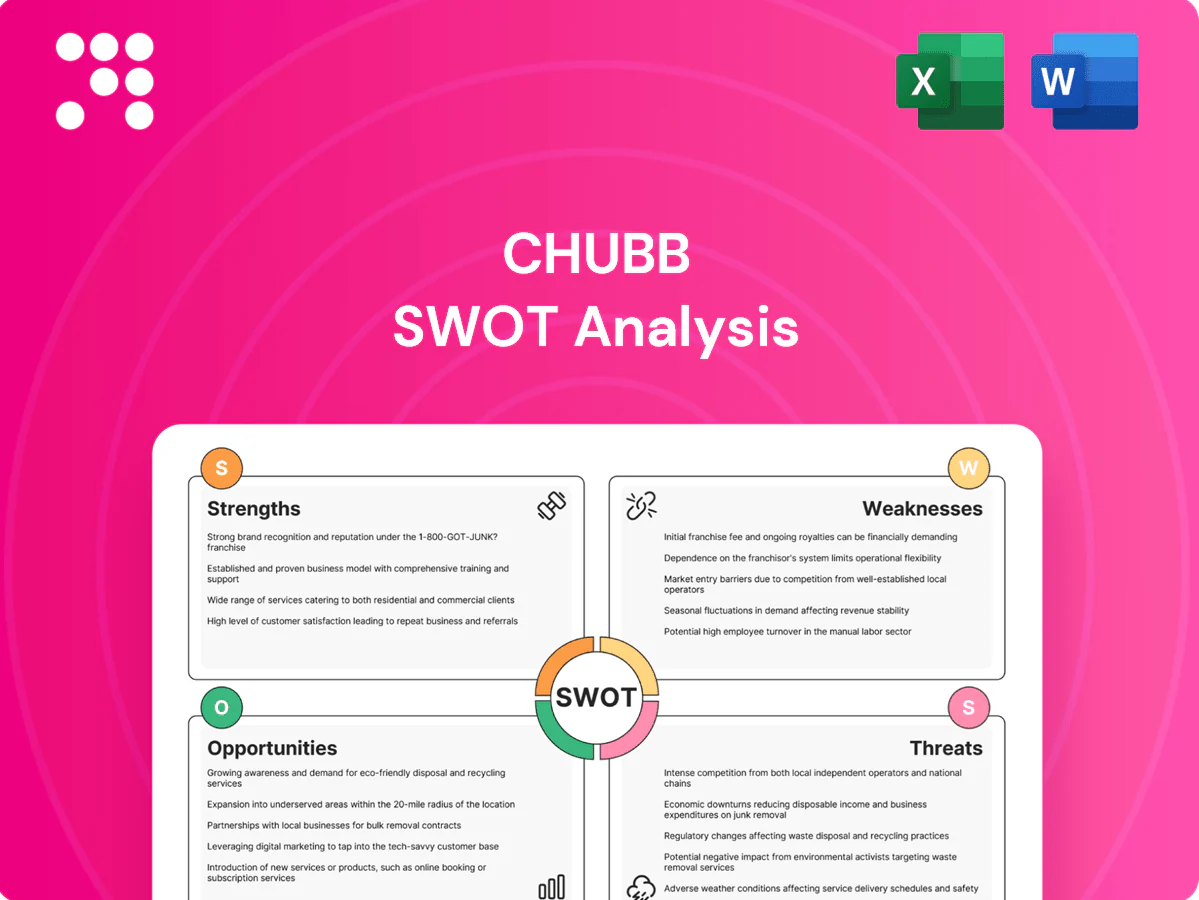
Chubb SWOT Analysis

Make Insightful Decisions Backed by Expert Research
Chubb's SWOT highlights robust underwriting discipline, diversified global footprint, and strong capital position, tempered by catastrophe exposure and evolving regulatory pressures. Our full SWOT unpacks financial metrics, strategic implications, and competitive risks with clear recommendations. Want the complete, editable report? Purchase the full analysis for Word and Excel deliverables to support investment or strategy work.
Strengths

Diversified P&C and A&H portfolio
Chubb spans commercial and personal P&C, accident & health and select life across about 54 countries and territories, spreading risk across lines and geographies. This diversification supports steady premium inflows and mitigates single-line shocks while enabling cross-selling and tailored solutions for large and retail clients. The breadth and global footprint, backed by an A++ AM Best rating, enhances resilience through cycles.
Global scale and distribution reach
Chubb operates in more than 50 countries and territories with roughly 31,000 employees, using independent agents, brokers and direct channels to secure broad market access. Its deep broker relationships win large commercial accounts and specialty risks, supporting commercial lines that drive a substantial portion of premiums. Multichannel distribution reduces reliance on any single route to market, while the global footprint supports growth and risk diversification.

Underwriting discipline and risk expertise
Chubb's A++ AM Best rating and global footprint in 54 countries, backed by roughly 33,000 employees, underpins market trust in its rigorous underwriting and specialty expertise. Deep capabilities in cyber, D&O and marine, plus advanced pricing analytics, contribute to historically superior combined ratios. The track record strengthens broker and client relationships and improves loss outcomes.

Robust capital strength and claims-paying ability
Chubb's robust capital and high-quality reinsurance programs underpin financial stability, with shareholders' equity of about $47 billion at 12/31/2024 and strong liquidity to support large risks. Ratings from A.M. Best (A++), S&P (AA) and Fitch (AA) bolster broker and customer confidence. This capacity enables participation in multi-hundred-million to billion-dollar placements and funds opportunistic M&A.
- Shareholders' equity ~47B (12/31/2024)
- AM Best A++; S&P AA; Fitch AA
- Supports $100M–$1B+ placements
- Capital for opportunistic M&A
Brand and service quality in commercial lines
Chubb's well-regarded service and claims handling, together with multinational program capabilities, attract large enterprises and supported net premiums written of $52.6 billion in 2024 and an industry-leading combined ratio near 87.6% that underpins profitability. Global policy issuance and compliance support simplify cross-border coverage and boost retention. High responsiveness strengthens pricing power in targeted commercial niches and reinforces distribution leverage.
- Well-regarded service: drives enterprise wins
- Global issuance: simplifies cross-border programs
- Retention/pricing: backed by ~87.6% combined ratio (2024)
- Scale: $52.6B net premiums written (2024)
Insurer with $52.6B NPW and ~87.6% combined ratio
Chubb's diversified P&C, A&H and select life operations across ~54 countries support steady premiums and cross-selling, with ~33,000 employees and multichannel distribution. Strong capital (shareholders' equity ~$47B at 12/31/2024) and ratings (A.M. Best A++; S&P AA; Fitch AA) enable $100M–$1B+ placements and opportunistic M&A. Financial strength: $52.6B net premiums written (2024) and industry-leading combined ratio ~87.6%.
| Metric | 2024 / Note |
|---|---|
| Shareholders' equity | $47B |
| Net premiums written | $52.6B |
| Combined ratio | ~87.6% |
| Employees | ~33,000 |
| Ratings | A.M. Best A++; S&P AA; Fitch AA |
What is included in the product
 Detailed Word Document
Delivers a strategic overview of Chubb’s internal and external business factors, outlining strengths, weaknesses, opportunities, and threats to assess its competitive position, growth drivers, operational gaps, and the risks shaping its future.

 Customizable Excel Spreadsheet
Provides a concise, visually clear SWOT summary tailored to Chubb for rapid strategic alignment and executive decision-making, enabling quick updates as market conditions or underwriting priorities change.
Weaknesses

Exposure to catastrophe volatility
Chubbs global property footprint creates high sensitivity to hurricanes, wildfires, floods and convective storms, exposing underwriting to large loss events. The US saw 28 billion-dollar weather disasters in 2023 totaling about 86 billion, per NOAA, highlighting rising frequency and severity. Cat losses can still materially swing Chubbs quarterly earnings despite reinsurance, prompting investors to seek higher returns for added volatility.
Complexity across products and geographies
Managing diverse lines across 50+ countries and roughly 33,000 employees adds operational and compliance complexity for Chubb, increasing coordination and oversight burdens. Fragmented systems and legacy platforms slow product innovation and digital rollout, lengthening time-to-market. This complexity elevates expense ratios and execution risk as integration of data and processes remains challenging at scale.

Dependence on broker intermediaries
Chubb’s commercial lines depend heavily on broker distribution for placement, which increases commission costs and can compress underwriting margins. Reliance on brokers also reduces direct control over customer relationships and retention, leaving client data and pricing levers with intermediaries. Competitive dynamics are broker-driven, amplifying price sensitivity and deal fragmentation, while growing digital disintermediation from insurtechs presents an escalating distribution risk.

Limited direct-to-consumer brand in personal lines
Chubb’s consumer brand awareness in personal lines trails direct-to-consumer leaders, constraining reach in mass-market segments. Without robust DTC channels, customer acquisition costs tend to be higher and retention more reliant on brokers. Scaling digitally across home and auto may lag peers with established DTC engines, capping growth in higher-volume retail cohorts.
- Lower DTC brand visibility
- Higher customer acquisition costs vs DTC peers
- Slower digital scaling in personal lines
- Limited growth in mass-market segments
Investment and reserve sensitivity
Chubb's underwriting earnings remain sensitive to investment income and reserve adequacy; in 2024 investment income contributed materially to overall results while reserve development in prior years reduced underwriting margins.
Market volatility and interest-rate moves can dent portfolio returns; adverse reserve development—notably in long-tail liability lines such as professional liability and casualty—can strain capital and profitability.
- 2024: reserve development pressured underwriting margins
- Long-tail liabilities: higher uncertainty and potential multi-year development
- Market/interest-rate risk: direct impact on investment returns and surplus
Catastrophe volatility, reserve strain and broker dependence pressure insurer earnings
Chubb remains highly exposed to catastrophe volatility after 2023 saw 28 billion-dollar disasters totaling about $86B (NOAA), making cat losses a material swing to quarterly earnings. Global scale (50+ countries, ~33,000 employees) raises operational, regulatory and legacy-IT complexity that slows digital rollout. Heavy broker reliance increases commission drag and weak DTC brand limits mass-market growth. 2024 reserve development pressured underwriting margins and investment sensitivity weighs on returns.
| Metric | Value |
|---|---|
| Billion-dollar weather events (2023) | 28 events / $86B (NOAA) |
| Geographic footprint / Employees | 50+ countries / ~33,000 |
| Distribution risk | High broker dependence |
| Reserve development (2024) | Pressured underwriting margins |
Full Version Awaits
Chubb SWOT Analysis
This is the actual SWOT analysis document you’ll receive upon purchase—no surprises, just professional quality. The preview below is taken directly from the full SWOT report you'll get, covering Chubb's strengths, weaknesses, opportunities and threats with industry context and actionable insights. Purchase unlocks the complete, editable version ready for download.

Make Insightful Decisions Backed by Expert Research
Chubb's SWOT highlights robust underwriting discipline, diversified global footprint, and strong capital position, tempered by catastrophe exposure and evolving regulatory pressures. Our full SWOT unpacks financial metrics, strategic implications, and competitive risks with clear recommendations. Want the complete, editable report? Purchase the full analysis for Word and Excel deliverables to support investment or strategy work.
Strengths
Diversified P&C and A&H portfolio
Chubb spans commercial and personal P&C, accident & health and select life across about 54 countries and territories, spreading risk across lines and geographies. This diversification supports steady premium inflows and mitigates single-line shocks while enabling cross-selling and tailored solutions for large and retail clients. The breadth and global footprint, backed by an A++ AM Best rating, enhances resilience through cycles.
Global scale and distribution reach
Chubb operates in more than 50 countries and territories with roughly 31,000 employees, using independent agents, brokers and direct channels to secure broad market access. Its deep broker relationships win large commercial accounts and specialty risks, supporting commercial lines that drive a substantial portion of premiums. Multichannel distribution reduces reliance on any single route to market, while the global footprint supports growth and risk diversification.
Underwriting discipline and risk expertise
Chubb's A++ AM Best rating and global footprint in 54 countries, backed by roughly 33,000 employees, underpins market trust in its rigorous underwriting and specialty expertise. Deep capabilities in cyber, D&O and marine, plus advanced pricing analytics, contribute to historically superior combined ratios. The track record strengthens broker and client relationships and improves loss outcomes.
Robust capital strength and claims-paying ability
Chubb's robust capital and high-quality reinsurance programs underpin financial stability, with shareholders' equity of about $47 billion at 12/31/2024 and strong liquidity to support large risks. Ratings from A.M. Best (A++), S&P (AA) and Fitch (AA) bolster broker and customer confidence. This capacity enables participation in multi-hundred-million to billion-dollar placements and funds opportunistic M&A.
- Shareholders' equity ~47B (12/31/2024)
- AM Best A++; S&P AA; Fitch AA
- Supports $100M–$1B+ placements
- Capital for opportunistic M&A
Brand and service quality in commercial lines
Chubb's well-regarded service and claims handling, together with multinational program capabilities, attract large enterprises and supported net premiums written of $52.6 billion in 2024 and an industry-leading combined ratio near 87.6% that underpins profitability. Global policy issuance and compliance support simplify cross-border coverage and boost retention. High responsiveness strengthens pricing power in targeted commercial niches and reinforces distribution leverage.
- Well-regarded service: drives enterprise wins
- Global issuance: simplifies cross-border programs
- Retention/pricing: backed by ~87.6% combined ratio (2024)
- Scale: $52.6B net premiums written (2024)
Insurer with $52.6B NPW and ~87.6% combined ratio
Chubb's diversified P&C, A&H and select life operations across ~54 countries support steady premiums and cross-selling, with ~33,000 employees and multichannel distribution. Strong capital (shareholders' equity ~$47B at 12/31/2024) and ratings (A.M. Best A++; S&P AA; Fitch AA) enable $100M–$1B+ placements and opportunistic M&A. Financial strength: $52.6B net premiums written (2024) and industry-leading combined ratio ~87.6%.
| Metric | 2024 / Note |
|---|---|
| Shareholders' equity | $47B |
| Net premiums written | $52.6B |
| Combined ratio | ~87.6% |
| Employees | ~33,000 |
| Ratings | A.M. Best A++; S&P AA; Fitch AA |
What is included in the product
Detailed Word Document
Delivers a strategic overview of Chubb’s internal and external business factors, outlining strengths, weaknesses, opportunities, and threats to assess its competitive position, growth drivers, operational gaps, and the risks shaping its future.
Customizable Excel Spreadsheet
Provides a concise, visually clear SWOT summary tailored to Chubb for rapid strategic alignment and executive decision-making, enabling quick updates as market conditions or underwriting priorities change.
Weaknesses
Exposure to catastrophe volatility
Chubbs global property footprint creates high sensitivity to hurricanes, wildfires, floods and convective storms, exposing underwriting to large loss events. The US saw 28 billion-dollar weather disasters in 2023 totaling about 86 billion, per NOAA, highlighting rising frequency and severity. Cat losses can still materially swing Chubbs quarterly earnings despite reinsurance, prompting investors to seek higher returns for added volatility.
Complexity across products and geographies
Managing diverse lines across 50+ countries and roughly 33,000 employees adds operational and compliance complexity for Chubb, increasing coordination and oversight burdens. Fragmented systems and legacy platforms slow product innovation and digital rollout, lengthening time-to-market. This complexity elevates expense ratios and execution risk as integration of data and processes remains challenging at scale.
Dependence on broker intermediaries
Chubb’s commercial lines depend heavily on broker distribution for placement, which increases commission costs and can compress underwriting margins. Reliance on brokers also reduces direct control over customer relationships and retention, leaving client data and pricing levers with intermediaries. Competitive dynamics are broker-driven, amplifying price sensitivity and deal fragmentation, while growing digital disintermediation from insurtechs presents an escalating distribution risk.
Limited direct-to-consumer brand in personal lines
Chubb’s consumer brand awareness in personal lines trails direct-to-consumer leaders, constraining reach in mass-market segments. Without robust DTC channels, customer acquisition costs tend to be higher and retention more reliant on brokers. Scaling digitally across home and auto may lag peers with established DTC engines, capping growth in higher-volume retail cohorts.
- Lower DTC brand visibility
- Higher customer acquisition costs vs DTC peers
- Slower digital scaling in personal lines
- Limited growth in mass-market segments
Investment and reserve sensitivity
Chubb's underwriting earnings remain sensitive to investment income and reserve adequacy; in 2024 investment income contributed materially to overall results while reserve development in prior years reduced underwriting margins.
Market volatility and interest-rate moves can dent portfolio returns; adverse reserve development—notably in long-tail liability lines such as professional liability and casualty—can strain capital and profitability.
- 2024: reserve development pressured underwriting margins
- Long-tail liabilities: higher uncertainty and potential multi-year development
- Market/interest-rate risk: direct impact on investment returns and surplus
Catastrophe volatility, reserve strain and broker dependence pressure insurer earnings
Chubb remains highly exposed to catastrophe volatility after 2023 saw 28 billion-dollar disasters totaling about $86B (NOAA), making cat losses a material swing to quarterly earnings. Global scale (50+ countries, ~33,000 employees) raises operational, regulatory and legacy-IT complexity that slows digital rollout. Heavy broker reliance increases commission drag and weak DTC brand limits mass-market growth. 2024 reserve development pressured underwriting margins and investment sensitivity weighs on returns.
| Metric | Value |
|---|---|
| Billion-dollar weather events (2023) | 28 events / $86B (NOAA) |
| Geographic footprint / Employees | 50+ countries / ~33,000 |
| Distribution risk | High broker dependence |
| Reserve development (2024) | Pressured underwriting margins |
Full Version Awaits
Chubb SWOT Analysis
This is the actual SWOT analysis document you’ll receive upon purchase—no surprises, just professional quality. The preview below is taken directly from the full SWOT report you'll get, covering Chubb's strengths, weaknesses, opportunities and threats with industry context and actionable insights. Purchase unlocks the complete, editable version ready for download.
Original: $10.00
-65%$10.00
$3.50Description
Make Insightful Decisions Backed by Expert Research
Chubb's SWOT highlights robust underwriting discipline, diversified global footprint, and strong capital position, tempered by catastrophe exposure and evolving regulatory pressures. Our full SWOT unpacks financial metrics, strategic implications, and competitive risks with clear recommendations. Want the complete, editable report? Purchase the full analysis for Word and Excel deliverables to support investment or strategy work.
Strengths
Diversified P&C and A&H portfolio
Chubb spans commercial and personal P&C, accident & health and select life across about 54 countries and territories, spreading risk across lines and geographies. This diversification supports steady premium inflows and mitigates single-line shocks while enabling cross-selling and tailored solutions for large and retail clients. The breadth and global footprint, backed by an A++ AM Best rating, enhances resilience through cycles.
Global scale and distribution reach
Chubb operates in more than 50 countries and territories with roughly 31,000 employees, using independent agents, brokers and direct channels to secure broad market access. Its deep broker relationships win large commercial accounts and specialty risks, supporting commercial lines that drive a substantial portion of premiums. Multichannel distribution reduces reliance on any single route to market, while the global footprint supports growth and risk diversification.
Underwriting discipline and risk expertise
Chubb's A++ AM Best rating and global footprint in 54 countries, backed by roughly 33,000 employees, underpins market trust in its rigorous underwriting and specialty expertise. Deep capabilities in cyber, D&O and marine, plus advanced pricing analytics, contribute to historically superior combined ratios. The track record strengthens broker and client relationships and improves loss outcomes.
Robust capital strength and claims-paying ability
Chubb's robust capital and high-quality reinsurance programs underpin financial stability, with shareholders' equity of about $47 billion at 12/31/2024 and strong liquidity to support large risks. Ratings from A.M. Best (A++), S&P (AA) and Fitch (AA) bolster broker and customer confidence. This capacity enables participation in multi-hundred-million to billion-dollar placements and funds opportunistic M&A.
- Shareholders' equity ~47B (12/31/2024)
- AM Best A++; S&P AA; Fitch AA
- Supports $100M–$1B+ placements
- Capital for opportunistic M&A
Brand and service quality in commercial lines
Chubb's well-regarded service and claims handling, together with multinational program capabilities, attract large enterprises and supported net premiums written of $52.6 billion in 2024 and an industry-leading combined ratio near 87.6% that underpins profitability. Global policy issuance and compliance support simplify cross-border coverage and boost retention. High responsiveness strengthens pricing power in targeted commercial niches and reinforces distribution leverage.
- Well-regarded service: drives enterprise wins
- Global issuance: simplifies cross-border programs
- Retention/pricing: backed by ~87.6% combined ratio (2024)
- Scale: $52.6B net premiums written (2024)
Insurer with $52.6B NPW and ~87.6% combined ratio
Chubb's diversified P&C, A&H and select life operations across ~54 countries support steady premiums and cross-selling, with ~33,000 employees and multichannel distribution. Strong capital (shareholders' equity ~$47B at 12/31/2024) and ratings (A.M. Best A++; S&P AA; Fitch AA) enable $100M–$1B+ placements and opportunistic M&A. Financial strength: $52.6B net premiums written (2024) and industry-leading combined ratio ~87.6%.
| Metric | 2024 / Note |
|---|---|
| Shareholders' equity | $47B |
| Net premiums written | $52.6B |
| Combined ratio | ~87.6% |
| Employees | ~33,000 |
| Ratings | A.M. Best A++; S&P AA; Fitch AA |
What is included in the product
Detailed Word Document
Delivers a strategic overview of Chubb’s internal and external business factors, outlining strengths, weaknesses, opportunities, and threats to assess its competitive position, growth drivers, operational gaps, and the risks shaping its future.
Customizable Excel Spreadsheet
Provides a concise, visually clear SWOT summary tailored to Chubb for rapid strategic alignment and executive decision-making, enabling quick updates as market conditions or underwriting priorities change.
Weaknesses
Exposure to catastrophe volatility
Chubbs global property footprint creates high sensitivity to hurricanes, wildfires, floods and convective storms, exposing underwriting to large loss events. The US saw 28 billion-dollar weather disasters in 2023 totaling about 86 billion, per NOAA, highlighting rising frequency and severity. Cat losses can still materially swing Chubbs quarterly earnings despite reinsurance, prompting investors to seek higher returns for added volatility.
Complexity across products and geographies
Managing diverse lines across 50+ countries and roughly 33,000 employees adds operational and compliance complexity for Chubb, increasing coordination and oversight burdens. Fragmented systems and legacy platforms slow product innovation and digital rollout, lengthening time-to-market. This complexity elevates expense ratios and execution risk as integration of data and processes remains challenging at scale.
Dependence on broker intermediaries
Chubb’s commercial lines depend heavily on broker distribution for placement, which increases commission costs and can compress underwriting margins. Reliance on brokers also reduces direct control over customer relationships and retention, leaving client data and pricing levers with intermediaries. Competitive dynamics are broker-driven, amplifying price sensitivity and deal fragmentation, while growing digital disintermediation from insurtechs presents an escalating distribution risk.
Limited direct-to-consumer brand in personal lines
Chubb’s consumer brand awareness in personal lines trails direct-to-consumer leaders, constraining reach in mass-market segments. Without robust DTC channels, customer acquisition costs tend to be higher and retention more reliant on brokers. Scaling digitally across home and auto may lag peers with established DTC engines, capping growth in higher-volume retail cohorts.
- Lower DTC brand visibility
- Higher customer acquisition costs vs DTC peers
- Slower digital scaling in personal lines
- Limited growth in mass-market segments
Investment and reserve sensitivity
Chubb's underwriting earnings remain sensitive to investment income and reserve adequacy; in 2024 investment income contributed materially to overall results while reserve development in prior years reduced underwriting margins.
Market volatility and interest-rate moves can dent portfolio returns; adverse reserve development—notably in long-tail liability lines such as professional liability and casualty—can strain capital and profitability.
- 2024: reserve development pressured underwriting margins
- Long-tail liabilities: higher uncertainty and potential multi-year development
- Market/interest-rate risk: direct impact on investment returns and surplus
Catastrophe volatility, reserve strain and broker dependence pressure insurer earnings
Chubb remains highly exposed to catastrophe volatility after 2023 saw 28 billion-dollar disasters totaling about $86B (NOAA), making cat losses a material swing to quarterly earnings. Global scale (50+ countries, ~33,000 employees) raises operational, regulatory and legacy-IT complexity that slows digital rollout. Heavy broker reliance increases commission drag and weak DTC brand limits mass-market growth. 2024 reserve development pressured underwriting margins and investment sensitivity weighs on returns.
| Metric | Value |
|---|---|
| Billion-dollar weather events (2023) | 28 events / $86B (NOAA) |
| Geographic footprint / Employees | 50+ countries / ~33,000 |
| Distribution risk | High broker dependence |
| Reserve development (2024) | Pressured underwriting margins |
Full Version Awaits
Chubb SWOT Analysis
This is the actual SWOT analysis document you’ll receive upon purchase—no surprises, just professional quality. The preview below is taken directly from the full SWOT report you'll get, covering Chubb's strengths, weaknesses, opportunities and threats with industry context and actionable insights. Purchase unlocks the complete, editable version ready for download.











