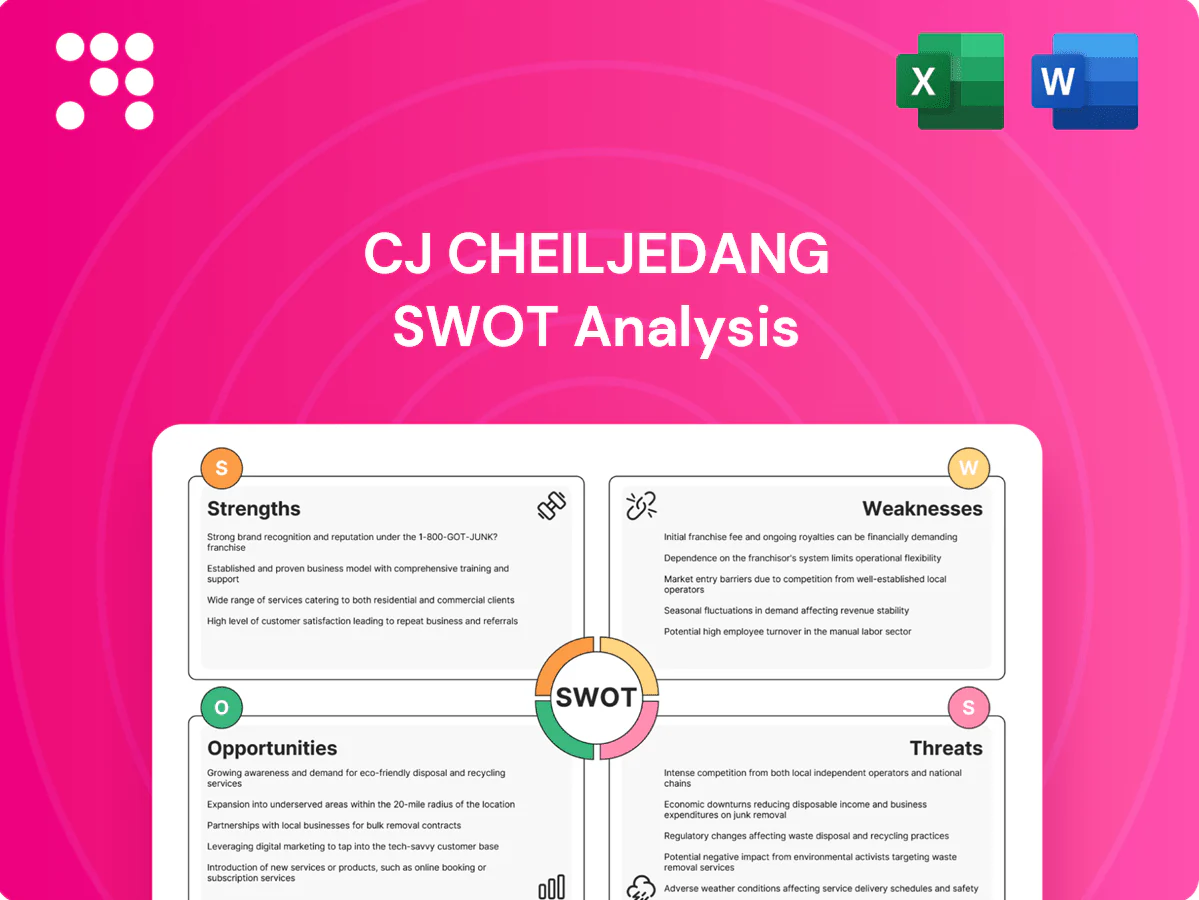
CJ Cheiljedang SWOT Analysis

Elevate Your Analysis with the Complete SWOT Report
CJ CheilJedang's diversified food and biotech portfolio, strong R&D and global supply chain are clear strengths, while commodity volatility, regulatory risk, and intensifying competition present threats. Growth drivers include plant‑based products and biotech expansion. Purchase the full SWOT for a research-backed, editable Word + Excel report to support investment, strategy, and presentations.
Strengths

Diversified portfolio
Balanced exposure across branded foods, ingredients, feed and bio-ingredients stabilizes cash flows, with CJ CheilJedang reporting consolidated revenue of KRW 20.8 trillion and operating profit of KRW 1.2 trillion in 2023. Cross-segment synergies improve raw material and by-product utilization, lowering input costs and waste. Diversification reduces dependence on any single category or geography and enables portfolio rotation as consumer and industrial cycles shift.
Biotech leadership
CJ CheilJedang leverages scale fermentation and amino-acid capacity to drive cost and quality advantages, supporting broad bio-ingredient sales across food, animal feed and pharma. Proprietary strains, process know-how and IP deepen barriers to entry, underpinning the company’s reported 2024 revenues of about 18.6 trillion KRW and resilient bio margins versus commoditized food processing. This platform supports diversification and margin resilience.

Strong brands
Bibigo and CJ CheilJedang core pantry brands hold top recognition in Korea and are in 80+ international markets, enabling brand equity that supports premium pricing and share defense; CJ reported food division international sales growth in 2023–24 driving faster global retail and foodservice adoption. Marketing and rapid product-innovation cycles are leveraged across channels to accelerate expansion.

Global footprint
CJ CheilJedang’s manufacturing and distribution footprint across Asia, North America and Europe diversifies demand and mitigates regional shocks, while localized production lowers logistics costs and tariff exposure.
Proximity to customers enhances service levels and product customization, and global sourcing secures access to competitive raw-material inputs and alternative suppliers.
- Manufacturing across Asia/NA/EU
- Localized production reduces logistics/tariffs
- Near-customer customization/service
- Global sourcing broadens input access
Operational scale
Operational scale gives CJ CheilJedang strong purchasing power in grains, sugars and packaging, enabling lower input costs and stable supply; integrated supply chains boost efficiency and quality control across sourcing and manufacturing; shared services and R&D dilute fixed costs, while scale accelerates nationwide and international new product rollouts in 2024.
- Purchasing power: lower input costs
- Integrated supply: efficiency & quality
- Shared R&D: spreads fixed costs
- Scale: faster 2024 product rollouts
Diversified food-to-bio portfolio; KRW 20.8T, 80+ markets
Balanced portfolio across food, ingredients, feed and bio stabilizes cash flows; 2023 consolidated revenue KRW 20.8T and operating profit KRW 1.2T, with 2024 revenue ~KRW 18.6T. Scale fermentation, proprietary IP and bio capacity support premium margins and multi‑channel sales. Global footprint (80+ markets) plus Asia/NA/EU manufacturing and purchasing power lower input costs and outage risk.
| Metric | Value |
|---|---|
| 2023 Revenue | KRW 20.8T |
| 2023 Operating Profit | KRW 1.2T |
| 2024 Revenue (reported) | ~KRW 18.6T |
| International Reach | 80+ markets |
What is included in the product
 Detailed Word Document
Provides a concise SWOT analysis of CJ Cheiljedang, outlining its core strengths and weaknesses and mapping market opportunities and external threats to assess strategic positioning and growth potential.

 Customizable Excel Spreadsheet
Provides a concise SWOT matrix for CJ CheilJedang to quickly identify strengths, weaknesses, opportunities and threats, easing strategic alignment and fast stakeholder briefings.
Weaknesses

Commodity exposure
Earnings are highly sensitive to corn, wheat, sugar and energy swings, which in 2024 elevated input costs and compressed food and feed margins for CJ CheilJedang; cost pass-through to customers often lags, tightening operating profits. Hedging programs disclosed by the company only partially mitigate volatility, leaving feed and basic ingredient units particularly vulnerable to global commodity shocks.
Margin pressure
Processed-foods and feed face intense promotion-led competition, eroding margins as private labels and regional players cap pricing power; CJ reported narrower segmental margins in recent quarters amid this pressure. Rising labor costs — South Korea's 2024 minimum wage was 9,620 KRW/hour — and logistics expenses (logistics up roughly 10% y/y in recent industry reports) can outpace productivity gains. Mix upgrades demand sustained brand investment to protect margins over time.

Complex structure
Multi-business operations spanning food and bio increase managerial complexity and execution risk, especially after the 2024 push into higher-capex bio projects. Capital allocation trade-offs between mature food margins and growth-hungry bio investments can dilute strategic focus. Recent acquisitions require tight integration to avoid operational friction and cost overruns. Clear governance and capital allocation rules are essential to prevent value leakage.

FX and leverage
Multi-currency revenues and costs expose CJ CheilJedang to translation and transaction FX risk, increasing earnings volatility across quarters. Expansion-funded debt raises interest-expense sensitivity and can strain covenants when rates rise. Rate volatility pressures cash flow and working capital; hedging reduces but does not eliminate swings and adds cost, compressing margins.
- FX translation/transaction risk
- Higher interest sensitivity from expansion debt
- Rate volatility → cash flow/covenant pressure
- Hedging costs may not fully offset swings
Regulatory burden
Regulatory burden: stringent, evolving food safety, labeling and bio/pharma compliance (MFDS, FDA, EU) increase approval times and audit frequency, delaying launches and raising compliance costs; trade remedies and quotas complicate cross-border flows, while non-compliance risks recalls, fines and reputational damage.
- Food safety & labeling: stricter audits
- Bio/pharma: longer approval cycles
- Trade: quotas/anti‑dumping barriers
- Risks: recalls, fines, brand harm
Commodity swings, rising logistics and debt squeeze margins; hedges only partially protect
Earnings remain highly exposed to 2024 commodity swings (corn/wheat/sugar) and energy costs, compressing margins; hedging is partial. Promotion-led competition and 2024 logistics +10% y/y pressure processed-food margins. Expansion debt raises interest sensitivity amid FX volatility.
| Metric | 2024/data |
|---|---|
| KR min wage | 9,620 KRW/hr |
| Logistics cost | +10% y/y |
What You See Is What You Get
CJ Cheiljedang SWOT Analysis
This is a real excerpt from the complete CJ Cheiljedang SWOT analysis document you’ll receive upon purchase—no surprises, just professional quality. The preview below is taken directly from the full report and reflects the structure, findings and editable format included in the download. Buy now to unlock the entire, detailed version.

Elevate Your Analysis with the Complete SWOT Report
CJ CheilJedang's diversified food and biotech portfolio, strong R&D and global supply chain are clear strengths, while commodity volatility, regulatory risk, and intensifying competition present threats. Growth drivers include plant‑based products and biotech expansion. Purchase the full SWOT for a research-backed, editable Word + Excel report to support investment, strategy, and presentations.
Strengths
Diversified portfolio
Balanced exposure across branded foods, ingredients, feed and bio-ingredients stabilizes cash flows, with CJ CheilJedang reporting consolidated revenue of KRW 20.8 trillion and operating profit of KRW 1.2 trillion in 2023. Cross-segment synergies improve raw material and by-product utilization, lowering input costs and waste. Diversification reduces dependence on any single category or geography and enables portfolio rotation as consumer and industrial cycles shift.
Biotech leadership
CJ CheilJedang leverages scale fermentation and amino-acid capacity to drive cost and quality advantages, supporting broad bio-ingredient sales across food, animal feed and pharma. Proprietary strains, process know-how and IP deepen barriers to entry, underpinning the company’s reported 2024 revenues of about 18.6 trillion KRW and resilient bio margins versus commoditized food processing. This platform supports diversification and margin resilience.
Strong brands
Bibigo and CJ CheilJedang core pantry brands hold top recognition in Korea and are in 80+ international markets, enabling brand equity that supports premium pricing and share defense; CJ reported food division international sales growth in 2023–24 driving faster global retail and foodservice adoption. Marketing and rapid product-innovation cycles are leveraged across channels to accelerate expansion.
Global footprint
CJ CheilJedang’s manufacturing and distribution footprint across Asia, North America and Europe diversifies demand and mitigates regional shocks, while localized production lowers logistics costs and tariff exposure.
Proximity to customers enhances service levels and product customization, and global sourcing secures access to competitive raw-material inputs and alternative suppliers.
- Manufacturing across Asia/NA/EU
- Localized production reduces logistics/tariffs
- Near-customer customization/service
- Global sourcing broadens input access
Operational scale
Operational scale gives CJ CheilJedang strong purchasing power in grains, sugars and packaging, enabling lower input costs and stable supply; integrated supply chains boost efficiency and quality control across sourcing and manufacturing; shared services and R&D dilute fixed costs, while scale accelerates nationwide and international new product rollouts in 2024.
- Purchasing power: lower input costs
- Integrated supply: efficiency & quality
- Shared R&D: spreads fixed costs
- Scale: faster 2024 product rollouts
Diversified food-to-bio portfolio; KRW 20.8T, 80+ markets
Balanced portfolio across food, ingredients, feed and bio stabilizes cash flows; 2023 consolidated revenue KRW 20.8T and operating profit KRW 1.2T, with 2024 revenue ~KRW 18.6T. Scale fermentation, proprietary IP and bio capacity support premium margins and multi‑channel sales. Global footprint (80+ markets) plus Asia/NA/EU manufacturing and purchasing power lower input costs and outage risk.
| Metric | Value |
|---|---|
| 2023 Revenue | KRW 20.8T |
| 2023 Operating Profit | KRW 1.2T |
| 2024 Revenue (reported) | ~KRW 18.6T |
| International Reach | 80+ markets |
What is included in the product
Detailed Word Document
Provides a concise SWOT analysis of CJ Cheiljedang, outlining its core strengths and weaknesses and mapping market opportunities and external threats to assess strategic positioning and growth potential.
Customizable Excel Spreadsheet
Provides a concise SWOT matrix for CJ CheilJedang to quickly identify strengths, weaknesses, opportunities and threats, easing strategic alignment and fast stakeholder briefings.
Weaknesses
Commodity exposure
Earnings are highly sensitive to corn, wheat, sugar and energy swings, which in 2024 elevated input costs and compressed food and feed margins for CJ CheilJedang; cost pass-through to customers often lags, tightening operating profits. Hedging programs disclosed by the company only partially mitigate volatility, leaving feed and basic ingredient units particularly vulnerable to global commodity shocks.
Margin pressure
Processed-foods and feed face intense promotion-led competition, eroding margins as private labels and regional players cap pricing power; CJ reported narrower segmental margins in recent quarters amid this pressure. Rising labor costs — South Korea's 2024 minimum wage was 9,620 KRW/hour — and logistics expenses (logistics up roughly 10% y/y in recent industry reports) can outpace productivity gains. Mix upgrades demand sustained brand investment to protect margins over time.
Complex structure
Multi-business operations spanning food and bio increase managerial complexity and execution risk, especially after the 2024 push into higher-capex bio projects. Capital allocation trade-offs between mature food margins and growth-hungry bio investments can dilute strategic focus. Recent acquisitions require tight integration to avoid operational friction and cost overruns. Clear governance and capital allocation rules are essential to prevent value leakage.
FX and leverage
Multi-currency revenues and costs expose CJ CheilJedang to translation and transaction FX risk, increasing earnings volatility across quarters. Expansion-funded debt raises interest-expense sensitivity and can strain covenants when rates rise. Rate volatility pressures cash flow and working capital; hedging reduces but does not eliminate swings and adds cost, compressing margins.
- FX translation/transaction risk
- Higher interest sensitivity from expansion debt
- Rate volatility → cash flow/covenant pressure
- Hedging costs may not fully offset swings
Regulatory burden
Regulatory burden: stringent, evolving food safety, labeling and bio/pharma compliance (MFDS, FDA, EU) increase approval times and audit frequency, delaying launches and raising compliance costs; trade remedies and quotas complicate cross-border flows, while non-compliance risks recalls, fines and reputational damage.
- Food safety & labeling: stricter audits
- Bio/pharma: longer approval cycles
- Trade: quotas/anti‑dumping barriers
- Risks: recalls, fines, brand harm
Commodity swings, rising logistics and debt squeeze margins; hedges only partially protect
Earnings remain highly exposed to 2024 commodity swings (corn/wheat/sugar) and energy costs, compressing margins; hedging is partial. Promotion-led competition and 2024 logistics +10% y/y pressure processed-food margins. Expansion debt raises interest sensitivity amid FX volatility.
| Metric | 2024/data |
|---|---|
| KR min wage | 9,620 KRW/hr |
| Logistics cost | +10% y/y |
What You See Is What You Get
CJ Cheiljedang SWOT Analysis
This is a real excerpt from the complete CJ Cheiljedang SWOT analysis document you’ll receive upon purchase—no surprises, just professional quality. The preview below is taken directly from the full report and reflects the structure, findings and editable format included in the download. Buy now to unlock the entire, detailed version.
Original: $10.00
-65%$10.00
$3.50Description
Elevate Your Analysis with the Complete SWOT Report
CJ CheilJedang's diversified food and biotech portfolio, strong R&D and global supply chain are clear strengths, while commodity volatility, regulatory risk, and intensifying competition present threats. Growth drivers include plant‑based products and biotech expansion. Purchase the full SWOT for a research-backed, editable Word + Excel report to support investment, strategy, and presentations.
Strengths
Diversified portfolio
Balanced exposure across branded foods, ingredients, feed and bio-ingredients stabilizes cash flows, with CJ CheilJedang reporting consolidated revenue of KRW 20.8 trillion and operating profit of KRW 1.2 trillion in 2023. Cross-segment synergies improve raw material and by-product utilization, lowering input costs and waste. Diversification reduces dependence on any single category or geography and enables portfolio rotation as consumer and industrial cycles shift.
Biotech leadership
CJ CheilJedang leverages scale fermentation and amino-acid capacity to drive cost and quality advantages, supporting broad bio-ingredient sales across food, animal feed and pharma. Proprietary strains, process know-how and IP deepen barriers to entry, underpinning the company’s reported 2024 revenues of about 18.6 trillion KRW and resilient bio margins versus commoditized food processing. This platform supports diversification and margin resilience.
Strong brands
Bibigo and CJ CheilJedang core pantry brands hold top recognition in Korea and are in 80+ international markets, enabling brand equity that supports premium pricing and share defense; CJ reported food division international sales growth in 2023–24 driving faster global retail and foodservice adoption. Marketing and rapid product-innovation cycles are leveraged across channels to accelerate expansion.
Global footprint
CJ CheilJedang’s manufacturing and distribution footprint across Asia, North America and Europe diversifies demand and mitigates regional shocks, while localized production lowers logistics costs and tariff exposure.
Proximity to customers enhances service levels and product customization, and global sourcing secures access to competitive raw-material inputs and alternative suppliers.
- Manufacturing across Asia/NA/EU
- Localized production reduces logistics/tariffs
- Near-customer customization/service
- Global sourcing broadens input access
Operational scale
Operational scale gives CJ CheilJedang strong purchasing power in grains, sugars and packaging, enabling lower input costs and stable supply; integrated supply chains boost efficiency and quality control across sourcing and manufacturing; shared services and R&D dilute fixed costs, while scale accelerates nationwide and international new product rollouts in 2024.
- Purchasing power: lower input costs
- Integrated supply: efficiency & quality
- Shared R&D: spreads fixed costs
- Scale: faster 2024 product rollouts
Diversified food-to-bio portfolio; KRW 20.8T, 80+ markets
Balanced portfolio across food, ingredients, feed and bio stabilizes cash flows; 2023 consolidated revenue KRW 20.8T and operating profit KRW 1.2T, with 2024 revenue ~KRW 18.6T. Scale fermentation, proprietary IP and bio capacity support premium margins and multi‑channel sales. Global footprint (80+ markets) plus Asia/NA/EU manufacturing and purchasing power lower input costs and outage risk.
| Metric | Value |
|---|---|
| 2023 Revenue | KRW 20.8T |
| 2023 Operating Profit | KRW 1.2T |
| 2024 Revenue (reported) | ~KRW 18.6T |
| International Reach | 80+ markets |
What is included in the product
Detailed Word Document
Provides a concise SWOT analysis of CJ Cheiljedang, outlining its core strengths and weaknesses and mapping market opportunities and external threats to assess strategic positioning and growth potential.
Customizable Excel Spreadsheet
Provides a concise SWOT matrix for CJ CheilJedang to quickly identify strengths, weaknesses, opportunities and threats, easing strategic alignment and fast stakeholder briefings.
Weaknesses
Commodity exposure
Earnings are highly sensitive to corn, wheat, sugar and energy swings, which in 2024 elevated input costs and compressed food and feed margins for CJ CheilJedang; cost pass-through to customers often lags, tightening operating profits. Hedging programs disclosed by the company only partially mitigate volatility, leaving feed and basic ingredient units particularly vulnerable to global commodity shocks.
Margin pressure
Processed-foods and feed face intense promotion-led competition, eroding margins as private labels and regional players cap pricing power; CJ reported narrower segmental margins in recent quarters amid this pressure. Rising labor costs — South Korea's 2024 minimum wage was 9,620 KRW/hour — and logistics expenses (logistics up roughly 10% y/y in recent industry reports) can outpace productivity gains. Mix upgrades demand sustained brand investment to protect margins over time.
Complex structure
Multi-business operations spanning food and bio increase managerial complexity and execution risk, especially after the 2024 push into higher-capex bio projects. Capital allocation trade-offs between mature food margins and growth-hungry bio investments can dilute strategic focus. Recent acquisitions require tight integration to avoid operational friction and cost overruns. Clear governance and capital allocation rules are essential to prevent value leakage.
FX and leverage
Multi-currency revenues and costs expose CJ CheilJedang to translation and transaction FX risk, increasing earnings volatility across quarters. Expansion-funded debt raises interest-expense sensitivity and can strain covenants when rates rise. Rate volatility pressures cash flow and working capital; hedging reduces but does not eliminate swings and adds cost, compressing margins.
- FX translation/transaction risk
- Higher interest sensitivity from expansion debt
- Rate volatility → cash flow/covenant pressure
- Hedging costs may not fully offset swings
Regulatory burden
Regulatory burden: stringent, evolving food safety, labeling and bio/pharma compliance (MFDS, FDA, EU) increase approval times and audit frequency, delaying launches and raising compliance costs; trade remedies and quotas complicate cross-border flows, while non-compliance risks recalls, fines and reputational damage.
- Food safety & labeling: stricter audits
- Bio/pharma: longer approval cycles
- Trade: quotas/anti‑dumping barriers
- Risks: recalls, fines, brand harm
Commodity swings, rising logistics and debt squeeze margins; hedges only partially protect
Earnings remain highly exposed to 2024 commodity swings (corn/wheat/sugar) and energy costs, compressing margins; hedging is partial. Promotion-led competition and 2024 logistics +10% y/y pressure processed-food margins. Expansion debt raises interest sensitivity amid FX volatility.
| Metric | 2024/data |
|---|---|
| KR min wage | 9,620 KRW/hr |
| Logistics cost | +10% y/y |
What You See Is What You Get
CJ Cheiljedang SWOT Analysis
This is a real excerpt from the complete CJ Cheiljedang SWOT analysis document you’ll receive upon purchase—no surprises, just professional quality. The preview below is taken directly from the full report and reflects the structure, findings and editable format included in the download. Buy now to unlock the entire, detailed version.











