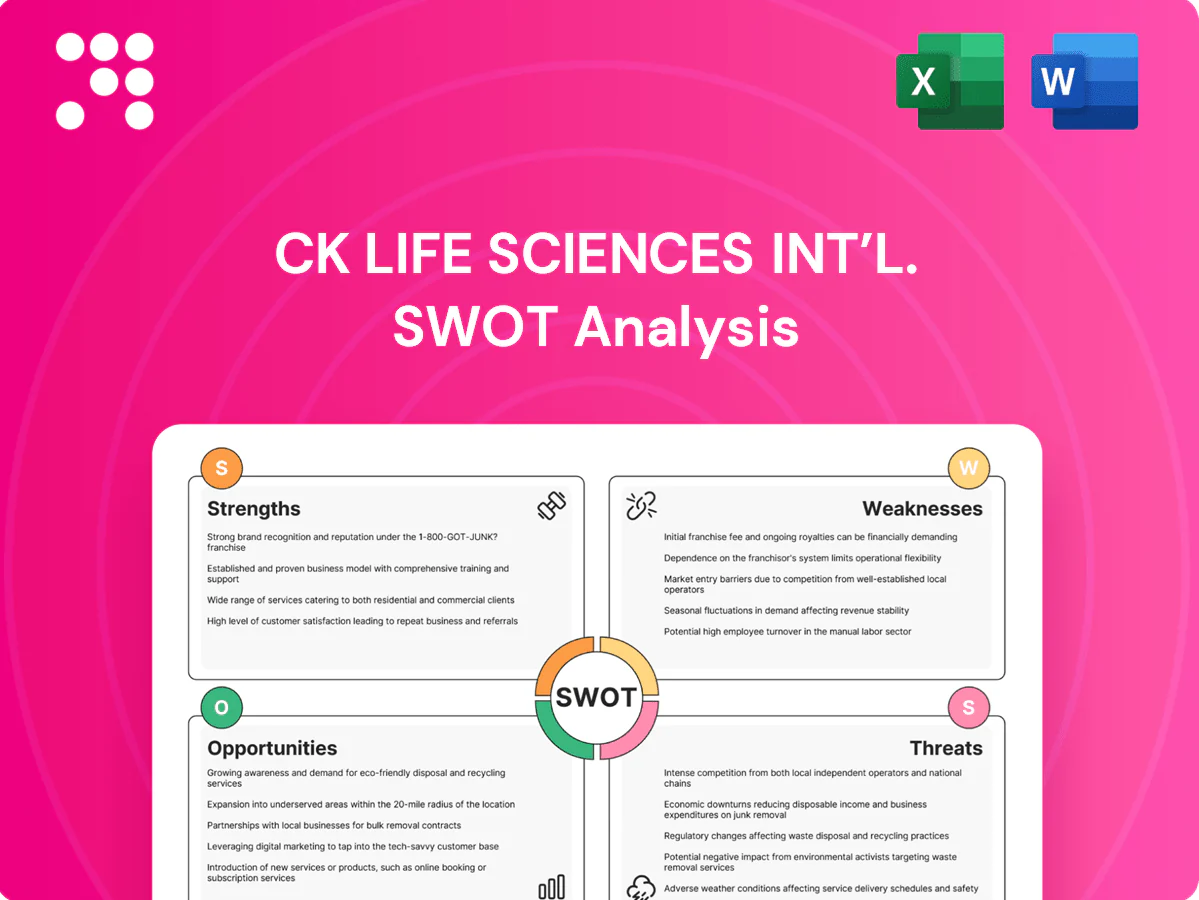
CK Life Sciences Int’l. SWOT Analysis

Elevate Your Analysis with the Complete SWOT Report
CK Life Sciences Int’l leverages a diversified biotech pipeline and strong parent-group backing. It faces R&D intensity, regulatory hurdles and competitive pressure. Purchase the full SWOT analysis for a detailed, editable report to guide investment and strategy.
Strengths

Diversified health and agri portfolio
Operating across pharmaceuticals, nutraceuticals and agricultural products spreads revenue risk and buffers sector cyclicality by diversifying demand drivers and payor mixes. Cross-segment insights accelerate product iteration and pipeline prioritization, enabling faster translation of efficacy or formulation learnings between human and crop health. Diversification opens multiple regulatory and reimbursement pathways and enables tailored growth strategies by market and margin profile.
Biotechnology-driven innovation engine
CK Life Sciences (HKEX: 0775) leverages biotechnology capabilities to build differentiated products with defensible performance claims, supporting commercial positioning across therapeutic, nutrition and crop-use markets. Its platform science enables reuse of discovery tools across indications, shortening development cycles and improving R&D ROI. This strategy underpins a steady pipeline aligned to unmet needs and scalable commercialization pathways.

End-to-end R&D-to-commercialization
As part of CK Hutchison (CK Life Sciences Intl., 0775.HK), end-to-end R&D-to-commercialization lets the group control speed and quality from lab to market. Customer feedback loops directly inform next-gen formulations and trial design, per its 2024 annual report. In-house production supports cost discipline and supply reliability while traceability strengthens brand trust.

Health and sustainability positioning
CK Life Sciences Int’l (HKEx: 0775) focuses on human health and environmental sustainability, aligning with tightening global policy and rising consumer demand for greener products.
Effective, lower-footprint products aid regulatory acceptance and retailer listings, supporting premium segmentation and pricing power.
- health-alignment
- sustainability-premium
- regulatory-access
- retailer-partnerships
Regulatory and scientific know-how
Regulatory and scientific know-how at CK Life Sciences (HKEX: 0775) creates a durable moat by enabling approvals across pharma, nutrition and agri inputs; high-quality dossiers and data integrity are core to success. Robust QA/QC and compliance lower recall and liability risk and materially boost partner confidence for co-development and licensing.
- HKEX: 0775 — part of CK Group
- Dossier quality reduces approval risk and recall exposure
- Strong QA/QC improves licensing and co-development deal flow
Three-segment life sciences platform: pharma, nutraceuticals, agriculture and in-house manufacturing
Three-segment portfolio (pharmaceuticals, nutraceuticals, agricultural) diversifies revenue and payor mixes; biotech platform accelerates cross-indication R&D; in-house manufacturing and QA/QC reduce recall risk and support licensing; part of CK Hutchison (HKEX: 0775) with strategic alignment to sustainability and regulatory pathways (2024 annual report).
| Item | Value |
|---|---|
| HKEX | 0775 |
| Parent | CK Hutchison |
| Segments | 3 |
| Source | 2024 annual report |
What is included in the product
 Detailed Word Document
Provides a concise SWOT analysis of CK Life Sciences Int’l., outlining internal strengths and weaknesses alongside external opportunities and threats to assess its competitive position and growth prospects.

 Customizable Excel Spreadsheet
Provides a concise SWOT matrix tailored to CK Life Sciences Int’l. for fast strategy alignment, highlighting R&D strengths, patent and regulatory risks, market opportunities, and competitive threats to speed executive decision-making.
Weaknesses

Capital-intensive, long development cycles
Biotech and regulated products require significant upfront R&D and trial spend (Tufts CSDD 2014 estimate $2.6bn per new drug) and average time to approval ~10.4 years (BIO 2021), straining CK Life Sciences’ cash flows, raising hurdle rates for innovation and risking revenue gaps from delayed portfolio launches.
Regulatory complexity across segments
CK Life Sciences (HKEX 0775) faces regulatory complexity as pharma, nutraceuticals and agricultural inputs each follow distinct, evolving rules; FDA drug review averages 10 months (standard) while EMA’s centralised review runs up to 210 days, forcing parallel compliance that raises costs and organizational burden. Divergent country requirements fragment launches and noncompliance risks delays, fines or product withdrawals that can halt revenue streams.

Potential scale disadvantages vs majors
Global incumbents in pharma, nutrition and agrochemicals each invest roughly $8–13 billion annually in R&D (eg Roche, J&J, Pfizer), enabling scale in trials, marketing and distribution that CK Life Sciences cannot match. Their larger field and market-access budgets can compress margins and slow CK Life’s share gains in core segments. As a result, partnering for commercialization is often essential, but typically dilutes margins and equity.

Portfolio complexity and focus risk
Operating across pharmaceuticals, agriculture and biotech diffuses leadership focus and can force resource trade-offs that underfund high-potential assets, raising execution risk and slowing commercialization.
- Fragmented branding dilutes consumer recognition
- Resource allocation trade-offs
- Higher operational and execution complexity
Clinical and market adoption uncertainty
Efficacy in controlled trials may not replicate in real-world settings; industry clinical success rates from Phase I to approval average about 10–15%, raising commercial risk. Slow physician/consumer/farmer switching (often 2–3 years) and weaker-than-expected pricing or reimbursement can push payback timelines out several years.
- Trial-to-approval success: ~10–15%
- Adoption lag: ~2–3 years
- Pricing/reimbursement shortfalls lengthen payback
High R&D costs, decade-long approvals and low trial success squeeze biotech cashflows
High upfront R&D (Tufts $2.6bn per new drug) and long approval timelines (BIO 2021: 10.4 years) strain CK Life Sciences (HKEX 0775) cash flow and raise portfolio risk; trial-to-approval success ~10–15% and real-world adoption lags 2–3 years. Fragmented branding and multi-sector regulation (FDA ~10 months, EMA up to 210 days) increase costs and execution complexity versus incumbents (R&D $8–13bn).
| Metric | Value |
|---|---|
| R&D cost per drug | $2.6bn (Tufts 2014) |
| Avg approval time | 10.4 years (BIO 2021) |
| Phase I→Approval | 10–15% |
| Incumbent R&D | $8–13bn pa |
| FDA review | ~10 months |
| EMA review | up to 210 days |
| Adoption lag | 2–3 years |
Same Document Delivered
CK Life Sciences Int’l. SWOT Analysis
This is the actual CK Life Sciences Int’l. SWOT analysis document you’ll receive upon purchase—no surprises, just professional quality. The preview below is taken directly from the full report; buying unlocks the entire in-depth, editable version. You’re viewing a live excerpt of the real file, ready for immediate download after checkout.

Elevate Your Analysis with the Complete SWOT Report
CK Life Sciences Int’l leverages a diversified biotech pipeline and strong parent-group backing. It faces R&D intensity, regulatory hurdles and competitive pressure. Purchase the full SWOT analysis for a detailed, editable report to guide investment and strategy.
Strengths
Diversified health and agri portfolio
Operating across pharmaceuticals, nutraceuticals and agricultural products spreads revenue risk and buffers sector cyclicality by diversifying demand drivers and payor mixes. Cross-segment insights accelerate product iteration and pipeline prioritization, enabling faster translation of efficacy or formulation learnings between human and crop health. Diversification opens multiple regulatory and reimbursement pathways and enables tailored growth strategies by market and margin profile.
Biotechnology-driven innovation engine
CK Life Sciences (HKEX: 0775) leverages biotechnology capabilities to build differentiated products with defensible performance claims, supporting commercial positioning across therapeutic, nutrition and crop-use markets. Its platform science enables reuse of discovery tools across indications, shortening development cycles and improving R&D ROI. This strategy underpins a steady pipeline aligned to unmet needs and scalable commercialization pathways.
End-to-end R&D-to-commercialization
As part of CK Hutchison (CK Life Sciences Intl., 0775.HK), end-to-end R&D-to-commercialization lets the group control speed and quality from lab to market. Customer feedback loops directly inform next-gen formulations and trial design, per its 2024 annual report. In-house production supports cost discipline and supply reliability while traceability strengthens brand trust.
Health and sustainability positioning
CK Life Sciences Int’l (HKEx: 0775) focuses on human health and environmental sustainability, aligning with tightening global policy and rising consumer demand for greener products.
Effective, lower-footprint products aid regulatory acceptance and retailer listings, supporting premium segmentation and pricing power.
- health-alignment
- sustainability-premium
- regulatory-access
- retailer-partnerships
Regulatory and scientific know-how
Regulatory and scientific know-how at CK Life Sciences (HKEX: 0775) creates a durable moat by enabling approvals across pharma, nutrition and agri inputs; high-quality dossiers and data integrity are core to success. Robust QA/QC and compliance lower recall and liability risk and materially boost partner confidence for co-development and licensing.
- HKEX: 0775 — part of CK Group
- Dossier quality reduces approval risk and recall exposure
- Strong QA/QC improves licensing and co-development deal flow
Three-segment life sciences platform: pharma, nutraceuticals, agriculture and in-house manufacturing
Three-segment portfolio (pharmaceuticals, nutraceuticals, agricultural) diversifies revenue and payor mixes; biotech platform accelerates cross-indication R&D; in-house manufacturing and QA/QC reduce recall risk and support licensing; part of CK Hutchison (HKEX: 0775) with strategic alignment to sustainability and regulatory pathways (2024 annual report).
| Item | Value |
|---|---|
| HKEX | 0775 |
| Parent | CK Hutchison |
| Segments | 3 |
| Source | 2024 annual report |
What is included in the product
Detailed Word Document
Provides a concise SWOT analysis of CK Life Sciences Int’l., outlining internal strengths and weaknesses alongside external opportunities and threats to assess its competitive position and growth prospects.
Customizable Excel Spreadsheet
Provides a concise SWOT matrix tailored to CK Life Sciences Int’l. for fast strategy alignment, highlighting R&D strengths, patent and regulatory risks, market opportunities, and competitive threats to speed executive decision-making.
Weaknesses
Capital-intensive, long development cycles
Biotech and regulated products require significant upfront R&D and trial spend (Tufts CSDD 2014 estimate $2.6bn per new drug) and average time to approval ~10.4 years (BIO 2021), straining CK Life Sciences’ cash flows, raising hurdle rates for innovation and risking revenue gaps from delayed portfolio launches.
Regulatory complexity across segments
CK Life Sciences (HKEX 0775) faces regulatory complexity as pharma, nutraceuticals and agricultural inputs each follow distinct, evolving rules; FDA drug review averages 10 months (standard) while EMA’s centralised review runs up to 210 days, forcing parallel compliance that raises costs and organizational burden. Divergent country requirements fragment launches and noncompliance risks delays, fines or product withdrawals that can halt revenue streams.
Potential scale disadvantages vs majors
Global incumbents in pharma, nutrition and agrochemicals each invest roughly $8–13 billion annually in R&D (eg Roche, J&J, Pfizer), enabling scale in trials, marketing and distribution that CK Life Sciences cannot match. Their larger field and market-access budgets can compress margins and slow CK Life’s share gains in core segments. As a result, partnering for commercialization is often essential, but typically dilutes margins and equity.
Portfolio complexity and focus risk
Operating across pharmaceuticals, agriculture and biotech diffuses leadership focus and can force resource trade-offs that underfund high-potential assets, raising execution risk and slowing commercialization.
- Fragmented branding dilutes consumer recognition
- Resource allocation trade-offs
- Higher operational and execution complexity
Clinical and market adoption uncertainty
Efficacy in controlled trials may not replicate in real-world settings; industry clinical success rates from Phase I to approval average about 10–15%, raising commercial risk. Slow physician/consumer/farmer switching (often 2–3 years) and weaker-than-expected pricing or reimbursement can push payback timelines out several years.
- Trial-to-approval success: ~10–15%
- Adoption lag: ~2–3 years
- Pricing/reimbursement shortfalls lengthen payback
High R&D costs, decade-long approvals and low trial success squeeze biotech cashflows
High upfront R&D (Tufts $2.6bn per new drug) and long approval timelines (BIO 2021: 10.4 years) strain CK Life Sciences (HKEX 0775) cash flow and raise portfolio risk; trial-to-approval success ~10–15% and real-world adoption lags 2–3 years. Fragmented branding and multi-sector regulation (FDA ~10 months, EMA up to 210 days) increase costs and execution complexity versus incumbents (R&D $8–13bn).
| Metric | Value |
|---|---|
| R&D cost per drug | $2.6bn (Tufts 2014) |
| Avg approval time | 10.4 years (BIO 2021) |
| Phase I→Approval | 10–15% |
| Incumbent R&D | $8–13bn pa |
| FDA review | ~10 months |
| EMA review | up to 210 days |
| Adoption lag | 2–3 years |
Same Document Delivered
CK Life Sciences Int’l. SWOT Analysis
This is the actual CK Life Sciences Int’l. SWOT analysis document you’ll receive upon purchase—no surprises, just professional quality. The preview below is taken directly from the full report; buying unlocks the entire in-depth, editable version. You’re viewing a live excerpt of the real file, ready for immediate download after checkout.
Original: $10.00
-65%$10.00
$3.50Description
Elevate Your Analysis with the Complete SWOT Report
CK Life Sciences Int’l leverages a diversified biotech pipeline and strong parent-group backing. It faces R&D intensity, regulatory hurdles and competitive pressure. Purchase the full SWOT analysis for a detailed, editable report to guide investment and strategy.
Strengths
Diversified health and agri portfolio
Operating across pharmaceuticals, nutraceuticals and agricultural products spreads revenue risk and buffers sector cyclicality by diversifying demand drivers and payor mixes. Cross-segment insights accelerate product iteration and pipeline prioritization, enabling faster translation of efficacy or formulation learnings between human and crop health. Diversification opens multiple regulatory and reimbursement pathways and enables tailored growth strategies by market and margin profile.
Biotechnology-driven innovation engine
CK Life Sciences (HKEX: 0775) leverages biotechnology capabilities to build differentiated products with defensible performance claims, supporting commercial positioning across therapeutic, nutrition and crop-use markets. Its platform science enables reuse of discovery tools across indications, shortening development cycles and improving R&D ROI. This strategy underpins a steady pipeline aligned to unmet needs and scalable commercialization pathways.
End-to-end R&D-to-commercialization
As part of CK Hutchison (CK Life Sciences Intl., 0775.HK), end-to-end R&D-to-commercialization lets the group control speed and quality from lab to market. Customer feedback loops directly inform next-gen formulations and trial design, per its 2024 annual report. In-house production supports cost discipline and supply reliability while traceability strengthens brand trust.
Health and sustainability positioning
CK Life Sciences Int’l (HKEx: 0775) focuses on human health and environmental sustainability, aligning with tightening global policy and rising consumer demand for greener products.
Effective, lower-footprint products aid regulatory acceptance and retailer listings, supporting premium segmentation and pricing power.
- health-alignment
- sustainability-premium
- regulatory-access
- retailer-partnerships
Regulatory and scientific know-how
Regulatory and scientific know-how at CK Life Sciences (HKEX: 0775) creates a durable moat by enabling approvals across pharma, nutrition and agri inputs; high-quality dossiers and data integrity are core to success. Robust QA/QC and compliance lower recall and liability risk and materially boost partner confidence for co-development and licensing.
- HKEX: 0775 — part of CK Group
- Dossier quality reduces approval risk and recall exposure
- Strong QA/QC improves licensing and co-development deal flow
Three-segment life sciences platform: pharma, nutraceuticals, agriculture and in-house manufacturing
Three-segment portfolio (pharmaceuticals, nutraceuticals, agricultural) diversifies revenue and payor mixes; biotech platform accelerates cross-indication R&D; in-house manufacturing and QA/QC reduce recall risk and support licensing; part of CK Hutchison (HKEX: 0775) with strategic alignment to sustainability and regulatory pathways (2024 annual report).
| Item | Value |
|---|---|
| HKEX | 0775 |
| Parent | CK Hutchison |
| Segments | 3 |
| Source | 2024 annual report |
What is included in the product
Detailed Word Document
Provides a concise SWOT analysis of CK Life Sciences Int’l., outlining internal strengths and weaknesses alongside external opportunities and threats to assess its competitive position and growth prospects.
Customizable Excel Spreadsheet
Provides a concise SWOT matrix tailored to CK Life Sciences Int’l. for fast strategy alignment, highlighting R&D strengths, patent and regulatory risks, market opportunities, and competitive threats to speed executive decision-making.
Weaknesses
Capital-intensive, long development cycles
Biotech and regulated products require significant upfront R&D and trial spend (Tufts CSDD 2014 estimate $2.6bn per new drug) and average time to approval ~10.4 years (BIO 2021), straining CK Life Sciences’ cash flows, raising hurdle rates for innovation and risking revenue gaps from delayed portfolio launches.
Regulatory complexity across segments
CK Life Sciences (HKEX 0775) faces regulatory complexity as pharma, nutraceuticals and agricultural inputs each follow distinct, evolving rules; FDA drug review averages 10 months (standard) while EMA’s centralised review runs up to 210 days, forcing parallel compliance that raises costs and organizational burden. Divergent country requirements fragment launches and noncompliance risks delays, fines or product withdrawals that can halt revenue streams.
Potential scale disadvantages vs majors
Global incumbents in pharma, nutrition and agrochemicals each invest roughly $8–13 billion annually in R&D (eg Roche, J&J, Pfizer), enabling scale in trials, marketing and distribution that CK Life Sciences cannot match. Their larger field and market-access budgets can compress margins and slow CK Life’s share gains in core segments. As a result, partnering for commercialization is often essential, but typically dilutes margins and equity.
Portfolio complexity and focus risk
Operating across pharmaceuticals, agriculture and biotech diffuses leadership focus and can force resource trade-offs that underfund high-potential assets, raising execution risk and slowing commercialization.
- Fragmented branding dilutes consumer recognition
- Resource allocation trade-offs
- Higher operational and execution complexity
Clinical and market adoption uncertainty
Efficacy in controlled trials may not replicate in real-world settings; industry clinical success rates from Phase I to approval average about 10–15%, raising commercial risk. Slow physician/consumer/farmer switching (often 2–3 years) and weaker-than-expected pricing or reimbursement can push payback timelines out several years.
- Trial-to-approval success: ~10–15%
- Adoption lag: ~2–3 years
- Pricing/reimbursement shortfalls lengthen payback
High R&D costs, decade-long approvals and low trial success squeeze biotech cashflows
High upfront R&D (Tufts $2.6bn per new drug) and long approval timelines (BIO 2021: 10.4 years) strain CK Life Sciences (HKEX 0775) cash flow and raise portfolio risk; trial-to-approval success ~10–15% and real-world adoption lags 2–3 years. Fragmented branding and multi-sector regulation (FDA ~10 months, EMA up to 210 days) increase costs and execution complexity versus incumbents (R&D $8–13bn).
| Metric | Value |
|---|---|
| R&D cost per drug | $2.6bn (Tufts 2014) |
| Avg approval time | 10.4 years (BIO 2021) |
| Phase I→Approval | 10–15% |
| Incumbent R&D | $8–13bn pa |
| FDA review | ~10 months |
| EMA review | up to 210 days |
| Adoption lag | 2–3 years |
Same Document Delivered
CK Life Sciences Int’l. SWOT Analysis
This is the actual CK Life Sciences Int’l. SWOT analysis document you’ll receive upon purchase—no surprises, just professional quality. The preview below is taken directly from the full report; buying unlocks the entire in-depth, editable version. You’re viewing a live excerpt of the real file, ready for immediate download after checkout.











