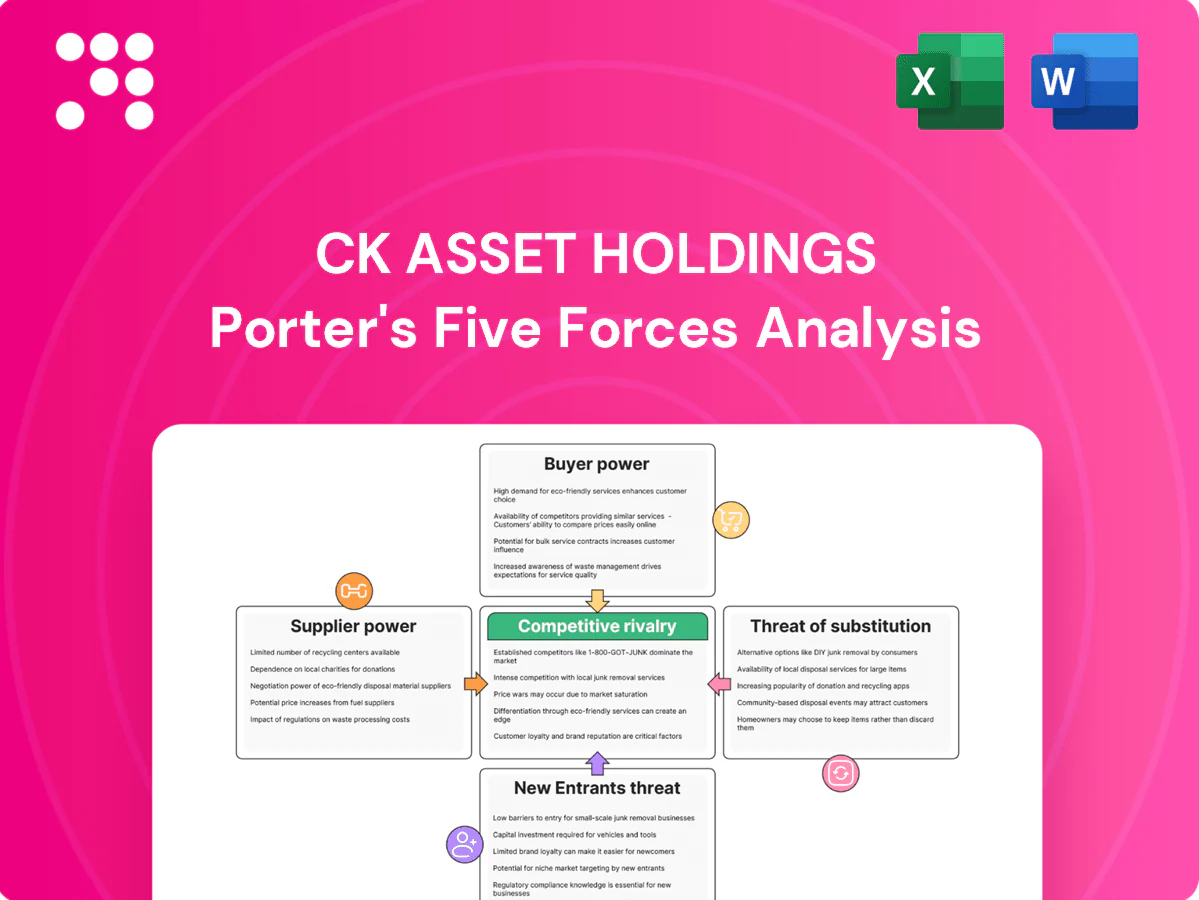
CK Asset Holdings Porter's Five Forces Analysis

Elevate Your Analysis with the Complete Porter's Five Forces Analysis
CK Asset faces intense rivalry in Hong Kong and China property markets, tempered supplier leverage but heightened regulatory and financing risks; buyer power and substitute threats (REITs, build-to-rent) are rising while barriers still limit new entrants. This brief snapshot only scratches the surface. Unlock the full Porter's Five Forces Analysis to explore CK Asset Holdings’s competitive dynamics, market pressures, and strategic advantages in detail.
Suppliers Bargaining Power

Concentrated land and zoning access
Hong Kong and major Mainland cities tightly control land through government lease systems and annual Land Sale Programmes, with governments offering only dozens of sites a year, making access a critical bottleneck and shifting pricing power to the land “supplier.” Auction schedules, tender terms and zoning via the Town Planning Ordinance can quickly alter developer margins. CK Asset, as a top Hong Kong-listed developer (HKEX: 1113), leverages scale, a large landbank and partner prequalification to mitigate supplier power. Policy or zoning shifts, however, can rapidly increase effective supplier leverage.
Construction materials and key trades
Steel, cement, glass and MEP systems face cyclical price swings and regional concentration that pressure margins, while specialist contractors and subcontractors gain leverage during upcycles or labor shortages. CK Asset’s multi-project pipeline supports volume purchasing and standardization to negotiate improved rates. Fast-track timelines and strict quality specifications, however, keep critical suppliers with outsized bargaining power.

Skilled labor and professional services
Architects, engineers and project managers with local credentials are scarce in top-tier Hong Kong and UK markets, giving suppliers leverage; wage inflation rose c.4% year-on-year in 2024 in many construction markets, and tighter regulatory compliance increases costs. CK Asset’s strong reputation aids talent attraction and long-term vendor ties, but peak-cycle tightness and cross-border projects can push switching costs materially higher.

Financing and capital providers
Banks, bondholders and JV equity partners supply capital to CK Asset and influence deal economics via interest, tenor and covenant terms; tight credit cycles or sector risk aversion raise funding costs and tighten covenants. CK Asset’s diversified cash flows and historically strong balance sheet improve its bargaining position, though macro rate trajectories and regulatory lending caps limit flexibility.
- Stock code: 1113.HK
- Capital providers set rates, covenants
- Balance-sheet strength = better terms
Hotel brands, tech, and facility systems
For hospitality and property management, brand affiliations, PMS/BMS vendors, and elevator/HVAC providers are critical; certification, maintenance contracts and vendor lock-in create dependency, but CK Asset’s scale enables multi-vendor sourcing and stronger lifecycle-cost negotiations, while upgrade cycles and strict SLAs keep supplier power moderate.
- Brand affiliation dependency
- PMS/BMS vendor lock-in
- Maintenance & certification risk
- Scale enables multi-vendor leverage
- Upgrade cycles/SLA sustain moderate power
Moderate-high supplier power: limited land auctions, rising wages and tighter capital terms
Supplier power is moderate-high: land auctions supply only dozens of sites yearly, shifting pricing power to governments; materials and contractors exert pressure in upcycles; talent costs rose c.4% y/y in 2024; capital providers set terms but CK Asset (1113.HK) benefits from scale and a large landbank, though policy or cycle shifts can quickly raise supplier leverage.
| Metric | 2024 data |
|---|---|
| Land supply | dozens sites/year |
| Wage inflation | c.4% y/y |
| Ticker | 1113.HK |
What is included in the product
 Detailed Word Document
Tailored Porter's Five Forces analysis for CK Asset Holdings that uncovers key competitive drivers, buyer and supplier power, entry barriers, substitutes, and emerging threats, with strategic commentary on how these forces shape the company’s pricing power and long-term profitability.

 Customizable Excel Spreadsheet
One-sheet Porter's Five Forces for CK Asset Holdings that converts complex market pressures into a clear radar view—customize force levels, swap in your data, and drop straight into pitch decks or executive reports for faster, board-ready decisions.
Customers Bargaining Power

Price-sensitive residential buyers
Homebuyers increasingly compare developers on price, location and unit features, with a 2024 survey showing 72% of prospective buyers prioritising price and amenities when choosing projects. Mortgage caps and stricter affordability metrics in 2024 amplified buyer price sensitivity, pressuring margins. CK Asset defends pricing via strong brand trust, premium amenities and flexible payment schemes. Still, discounting and purchaser incentives frequently decide deals in slower 2024 market conditions.
Corporate and retail tenants
Office and retail tenants negotiate rents, fit-out allowances and lease flexibility, with Grade A office vacancy in Hong Kong around 16% in 2024, increasing tenant leverage in soft leasing conditions and under remote-work pressure. CK Asset mitigates this through prime locations, mixed-use synergies and asset repositioning to preserve rents. Anchor tenants still command favorable terms and sizable fit-out allowances.

Hotel guests and corporate travel buyers
Hospitality customers are highly price-transparent via OTAs, with Booking and Expedia together accounting for roughly 70% of global OTA gross bookings in 2023, enforcing rate parity pressures on CK Asset's hotels. Corporate travel desks and group buyers routinely negotiate bulk rates and benefits, often securing discounts in the low-double-digit range and preferred payment/credit terms. CK Asset mitigates buyer power by segmenting demand, managing revenue yield, cross-selling serviced suites and leveraging loyalty programs (major chains reported >150 million members by 2024) and prime locations, which temper but do not eliminate customer bargaining power.

Institutional asset buyers
Institutional asset buyers—REITs, insurers and funds—scrutinize stabilized yields and cap rates, with many targeting stabilized yields around 4–6% in 2024 and pushing higher in risk-off conditions that pressure exit pricing. CK Asset’s development capability and longstanding track record attract deep-pocketed buyers despite cyclical swings. Capital market cycles in 2024 materially swing bargaining strength.
- REITs/insurers: stabilize yields ~4–6% (2024)
- Risk-off: higher return demands, lower exit prices
- CK Asset: strong development track record attracts buyers
- Cycle volatility: bargaining power swings materially in 2024
Property management clients
Property management clients, including owners’ committees and landlords, increasingly benchmark service fees across providers; SLA transparency and digital reporting make hourly cost and KPI comparability routine. CK Asset (HKEx: 1113) leverages integrated services and scale to secure multi-asset mandates, raising switching costs. Nevertheless regular rebids and KPI penalty clauses preserve significant client negotiating leverage.
Buyers hold sway as 16% Grade A vacancy and tight mortgage affordability squeeze margins
Customers exert strong price and contract leverage across residential, leasing, hospitality and institutional sales in 2024, amplified by 16% Grade A office vacancy and tight mortgage affordability. CK Asset counters with brand, location, mixed-use synergies and integrated services but discounting and yield demands compress margins.
| Segment | 2024 Metric | Buyer Power |
|---|---|---|
| Residential | 72% price-focused | High |
| Office | 16% Grade A vacancy | High |
| Hospitality | 70% OTA share (2023) | High |
| Institutional | Stab yields 4–6% | Medium-High |
Preview the Actual Deliverable
CK Asset Holdings Porter's Five Forces Analysis
This preview shows the exact Porter’s Five Forces analysis of CK Asset Holdings you'll receive—no placeholders or mockups. The document is the fully formatted, professionally written file included with your purchase. Once you complete payment you’ll get immediate access to this identical, ready-to-use report.

Elevate Your Analysis with the Complete Porter's Five Forces Analysis
CK Asset faces intense rivalry in Hong Kong and China property markets, tempered supplier leverage but heightened regulatory and financing risks; buyer power and substitute threats (REITs, build-to-rent) are rising while barriers still limit new entrants. This brief snapshot only scratches the surface. Unlock the full Porter's Five Forces Analysis to explore CK Asset Holdings’s competitive dynamics, market pressures, and strategic advantages in detail.
Suppliers Bargaining Power
Concentrated land and zoning access
Hong Kong and major Mainland cities tightly control land through government lease systems and annual Land Sale Programmes, with governments offering only dozens of sites a year, making access a critical bottleneck and shifting pricing power to the land “supplier.” Auction schedules, tender terms and zoning via the Town Planning Ordinance can quickly alter developer margins. CK Asset, as a top Hong Kong-listed developer (HKEX: 1113), leverages scale, a large landbank and partner prequalification to mitigate supplier power. Policy or zoning shifts, however, can rapidly increase effective supplier leverage.
Construction materials and key trades
Steel, cement, glass and MEP systems face cyclical price swings and regional concentration that pressure margins, while specialist contractors and subcontractors gain leverage during upcycles or labor shortages. CK Asset’s multi-project pipeline supports volume purchasing and standardization to negotiate improved rates. Fast-track timelines and strict quality specifications, however, keep critical suppliers with outsized bargaining power.
Skilled labor and professional services
Architects, engineers and project managers with local credentials are scarce in top-tier Hong Kong and UK markets, giving suppliers leverage; wage inflation rose c.4% year-on-year in 2024 in many construction markets, and tighter regulatory compliance increases costs. CK Asset’s strong reputation aids talent attraction and long-term vendor ties, but peak-cycle tightness and cross-border projects can push switching costs materially higher.
Financing and capital providers
Banks, bondholders and JV equity partners supply capital to CK Asset and influence deal economics via interest, tenor and covenant terms; tight credit cycles or sector risk aversion raise funding costs and tighten covenants. CK Asset’s diversified cash flows and historically strong balance sheet improve its bargaining position, though macro rate trajectories and regulatory lending caps limit flexibility.
- Stock code: 1113.HK
- Capital providers set rates, covenants
- Balance-sheet strength = better terms
Hotel brands, tech, and facility systems
For hospitality and property management, brand affiliations, PMS/BMS vendors, and elevator/HVAC providers are critical; certification, maintenance contracts and vendor lock-in create dependency, but CK Asset’s scale enables multi-vendor sourcing and stronger lifecycle-cost negotiations, while upgrade cycles and strict SLAs keep supplier power moderate.
- Brand affiliation dependency
- PMS/BMS vendor lock-in
- Maintenance & certification risk
- Scale enables multi-vendor leverage
- Upgrade cycles/SLA sustain moderate power
Moderate-high supplier power: limited land auctions, rising wages and tighter capital terms
Supplier power is moderate-high: land auctions supply only dozens of sites yearly, shifting pricing power to governments; materials and contractors exert pressure in upcycles; talent costs rose c.4% y/y in 2024; capital providers set terms but CK Asset (1113.HK) benefits from scale and a large landbank, though policy or cycle shifts can quickly raise supplier leverage.
| Metric | 2024 data |
|---|---|
| Land supply | dozens sites/year |
| Wage inflation | c.4% y/y |
| Ticker | 1113.HK |
What is included in the product
Detailed Word Document
Tailored Porter's Five Forces analysis for CK Asset Holdings that uncovers key competitive drivers, buyer and supplier power, entry barriers, substitutes, and emerging threats, with strategic commentary on how these forces shape the company’s pricing power and long-term profitability.
Customizable Excel Spreadsheet
One-sheet Porter's Five Forces for CK Asset Holdings that converts complex market pressures into a clear radar view—customize force levels, swap in your data, and drop straight into pitch decks or executive reports for faster, board-ready decisions.
Customers Bargaining Power
Price-sensitive residential buyers
Homebuyers increasingly compare developers on price, location and unit features, with a 2024 survey showing 72% of prospective buyers prioritising price and amenities when choosing projects. Mortgage caps and stricter affordability metrics in 2024 amplified buyer price sensitivity, pressuring margins. CK Asset defends pricing via strong brand trust, premium amenities and flexible payment schemes. Still, discounting and purchaser incentives frequently decide deals in slower 2024 market conditions.
Corporate and retail tenants
Office and retail tenants negotiate rents, fit-out allowances and lease flexibility, with Grade A office vacancy in Hong Kong around 16% in 2024, increasing tenant leverage in soft leasing conditions and under remote-work pressure. CK Asset mitigates this through prime locations, mixed-use synergies and asset repositioning to preserve rents. Anchor tenants still command favorable terms and sizable fit-out allowances.
Hotel guests and corporate travel buyers
Hospitality customers are highly price-transparent via OTAs, with Booking and Expedia together accounting for roughly 70% of global OTA gross bookings in 2023, enforcing rate parity pressures on CK Asset's hotels. Corporate travel desks and group buyers routinely negotiate bulk rates and benefits, often securing discounts in the low-double-digit range and preferred payment/credit terms. CK Asset mitigates buyer power by segmenting demand, managing revenue yield, cross-selling serviced suites and leveraging loyalty programs (major chains reported >150 million members by 2024) and prime locations, which temper but do not eliminate customer bargaining power.
Institutional asset buyers
Institutional asset buyers—REITs, insurers and funds—scrutinize stabilized yields and cap rates, with many targeting stabilized yields around 4–6% in 2024 and pushing higher in risk-off conditions that pressure exit pricing. CK Asset’s development capability and longstanding track record attract deep-pocketed buyers despite cyclical swings. Capital market cycles in 2024 materially swing bargaining strength.
- REITs/insurers: stabilize yields ~4–6% (2024)
- Risk-off: higher return demands, lower exit prices
- CK Asset: strong development track record attracts buyers
- Cycle volatility: bargaining power swings materially in 2024
Property management clients
Property management clients, including owners’ committees and landlords, increasingly benchmark service fees across providers; SLA transparency and digital reporting make hourly cost and KPI comparability routine. CK Asset (HKEx: 1113) leverages integrated services and scale to secure multi-asset mandates, raising switching costs. Nevertheless regular rebids and KPI penalty clauses preserve significant client negotiating leverage.
Buyers hold sway as 16% Grade A vacancy and tight mortgage affordability squeeze margins
Customers exert strong price and contract leverage across residential, leasing, hospitality and institutional sales in 2024, amplified by 16% Grade A office vacancy and tight mortgage affordability. CK Asset counters with brand, location, mixed-use synergies and integrated services but discounting and yield demands compress margins.
| Segment | 2024 Metric | Buyer Power |
|---|---|---|
| Residential | 72% price-focused | High |
| Office | 16% Grade A vacancy | High |
| Hospitality | 70% OTA share (2023) | High |
| Institutional | Stab yields 4–6% | Medium-High |
Preview the Actual Deliverable
CK Asset Holdings Porter's Five Forces Analysis
This preview shows the exact Porter’s Five Forces analysis of CK Asset Holdings you'll receive—no placeholders or mockups. The document is the fully formatted, professionally written file included with your purchase. Once you complete payment you’ll get immediate access to this identical, ready-to-use report.
Description
Elevate Your Analysis with the Complete Porter's Five Forces Analysis
CK Asset faces intense rivalry in Hong Kong and China property markets, tempered supplier leverage but heightened regulatory and financing risks; buyer power and substitute threats (REITs, build-to-rent) are rising while barriers still limit new entrants. This brief snapshot only scratches the surface. Unlock the full Porter's Five Forces Analysis to explore CK Asset Holdings’s competitive dynamics, market pressures, and strategic advantages in detail.
Suppliers Bargaining Power
Concentrated land and zoning access
Hong Kong and major Mainland cities tightly control land through government lease systems and annual Land Sale Programmes, with governments offering only dozens of sites a year, making access a critical bottleneck and shifting pricing power to the land “supplier.” Auction schedules, tender terms and zoning via the Town Planning Ordinance can quickly alter developer margins. CK Asset, as a top Hong Kong-listed developer (HKEX: 1113), leverages scale, a large landbank and partner prequalification to mitigate supplier power. Policy or zoning shifts, however, can rapidly increase effective supplier leverage.
Construction materials and key trades
Steel, cement, glass and MEP systems face cyclical price swings and regional concentration that pressure margins, while specialist contractors and subcontractors gain leverage during upcycles or labor shortages. CK Asset’s multi-project pipeline supports volume purchasing and standardization to negotiate improved rates. Fast-track timelines and strict quality specifications, however, keep critical suppliers with outsized bargaining power.
Skilled labor and professional services
Architects, engineers and project managers with local credentials are scarce in top-tier Hong Kong and UK markets, giving suppliers leverage; wage inflation rose c.4% year-on-year in 2024 in many construction markets, and tighter regulatory compliance increases costs. CK Asset’s strong reputation aids talent attraction and long-term vendor ties, but peak-cycle tightness and cross-border projects can push switching costs materially higher.
Financing and capital providers
Banks, bondholders and JV equity partners supply capital to CK Asset and influence deal economics via interest, tenor and covenant terms; tight credit cycles or sector risk aversion raise funding costs and tighten covenants. CK Asset’s diversified cash flows and historically strong balance sheet improve its bargaining position, though macro rate trajectories and regulatory lending caps limit flexibility.
- Stock code: 1113.HK
- Capital providers set rates, covenants
- Balance-sheet strength = better terms
Hotel brands, tech, and facility systems
For hospitality and property management, brand affiliations, PMS/BMS vendors, and elevator/HVAC providers are critical; certification, maintenance contracts and vendor lock-in create dependency, but CK Asset’s scale enables multi-vendor sourcing and stronger lifecycle-cost negotiations, while upgrade cycles and strict SLAs keep supplier power moderate.
- Brand affiliation dependency
- PMS/BMS vendor lock-in
- Maintenance & certification risk
- Scale enables multi-vendor leverage
- Upgrade cycles/SLA sustain moderate power
Moderate-high supplier power: limited land auctions, rising wages and tighter capital terms
Supplier power is moderate-high: land auctions supply only dozens of sites yearly, shifting pricing power to governments; materials and contractors exert pressure in upcycles; talent costs rose c.4% y/y in 2024; capital providers set terms but CK Asset (1113.HK) benefits from scale and a large landbank, though policy or cycle shifts can quickly raise supplier leverage.
| Metric | 2024 data |
|---|---|
| Land supply | dozens sites/year |
| Wage inflation | c.4% y/y |
| Ticker | 1113.HK |
What is included in the product
Detailed Word Document
Tailored Porter's Five Forces analysis for CK Asset Holdings that uncovers key competitive drivers, buyer and supplier power, entry barriers, substitutes, and emerging threats, with strategic commentary on how these forces shape the company’s pricing power and long-term profitability.
Customizable Excel Spreadsheet
One-sheet Porter's Five Forces for CK Asset Holdings that converts complex market pressures into a clear radar view—customize force levels, swap in your data, and drop straight into pitch decks or executive reports for faster, board-ready decisions.
Customers Bargaining Power
Price-sensitive residential buyers
Homebuyers increasingly compare developers on price, location and unit features, with a 2024 survey showing 72% of prospective buyers prioritising price and amenities when choosing projects. Mortgage caps and stricter affordability metrics in 2024 amplified buyer price sensitivity, pressuring margins. CK Asset defends pricing via strong brand trust, premium amenities and flexible payment schemes. Still, discounting and purchaser incentives frequently decide deals in slower 2024 market conditions.
Corporate and retail tenants
Office and retail tenants negotiate rents, fit-out allowances and lease flexibility, with Grade A office vacancy in Hong Kong around 16% in 2024, increasing tenant leverage in soft leasing conditions and under remote-work pressure. CK Asset mitigates this through prime locations, mixed-use synergies and asset repositioning to preserve rents. Anchor tenants still command favorable terms and sizable fit-out allowances.
Hotel guests and corporate travel buyers
Hospitality customers are highly price-transparent via OTAs, with Booking and Expedia together accounting for roughly 70% of global OTA gross bookings in 2023, enforcing rate parity pressures on CK Asset's hotels. Corporate travel desks and group buyers routinely negotiate bulk rates and benefits, often securing discounts in the low-double-digit range and preferred payment/credit terms. CK Asset mitigates buyer power by segmenting demand, managing revenue yield, cross-selling serviced suites and leveraging loyalty programs (major chains reported >150 million members by 2024) and prime locations, which temper but do not eliminate customer bargaining power.
Institutional asset buyers
Institutional asset buyers—REITs, insurers and funds—scrutinize stabilized yields and cap rates, with many targeting stabilized yields around 4–6% in 2024 and pushing higher in risk-off conditions that pressure exit pricing. CK Asset’s development capability and longstanding track record attract deep-pocketed buyers despite cyclical swings. Capital market cycles in 2024 materially swing bargaining strength.
- REITs/insurers: stabilize yields ~4–6% (2024)
- Risk-off: higher return demands, lower exit prices
- CK Asset: strong development track record attracts buyers
- Cycle volatility: bargaining power swings materially in 2024
Property management clients
Property management clients, including owners’ committees and landlords, increasingly benchmark service fees across providers; SLA transparency and digital reporting make hourly cost and KPI comparability routine. CK Asset (HKEx: 1113) leverages integrated services and scale to secure multi-asset mandates, raising switching costs. Nevertheless regular rebids and KPI penalty clauses preserve significant client negotiating leverage.
Buyers hold sway as 16% Grade A vacancy and tight mortgage affordability squeeze margins
Customers exert strong price and contract leverage across residential, leasing, hospitality and institutional sales in 2024, amplified by 16% Grade A office vacancy and tight mortgage affordability. CK Asset counters with brand, location, mixed-use synergies and integrated services but discounting and yield demands compress margins.
| Segment | 2024 Metric | Buyer Power |
|---|---|---|
| Residential | 72% price-focused | High |
| Office | 16% Grade A vacancy | High |
| Hospitality | 70% OTA share (2023) | High |
| Institutional | Stab yields 4–6% | Medium-High |
Preview the Actual Deliverable
CK Asset Holdings Porter's Five Forces Analysis
This preview shows the exact Porter’s Five Forces analysis of CK Asset Holdings you'll receive—no placeholders or mockups. The document is the fully formatted, professionally written file included with your purchase. Once you complete payment you’ll get immediate access to this identical, ready-to-use report.











