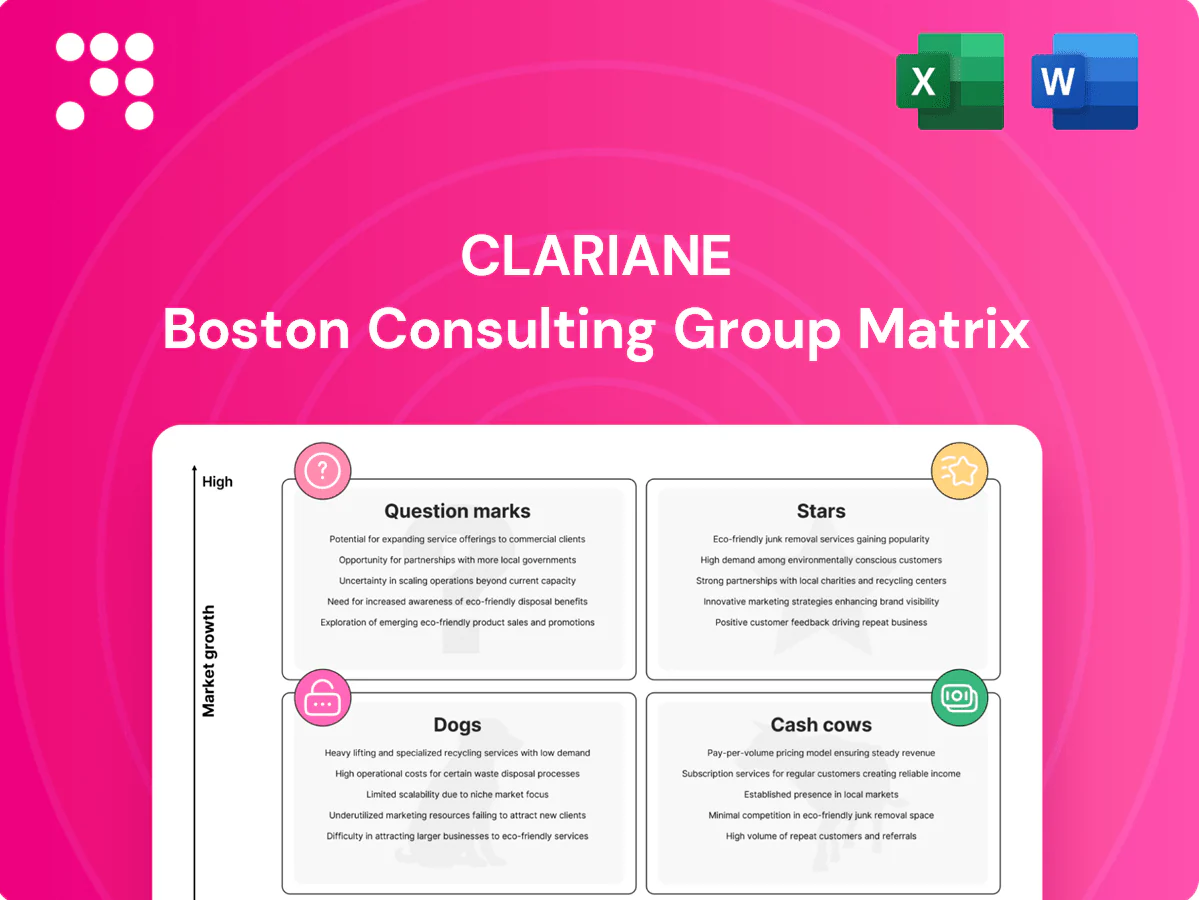
Clariane Boston Consulting Group Matrix

Visual. Strategic. Downloadable.
Curious where Clariane’s products sit—Stars, Cash Cows, Dogs, or Question Marks? This snapshot hints at positioning, but the full Clariane BCG Matrix gives quadrant-by-quadrant clarity, data-backed moves, and a ready-to-use Word report plus an Excel summary. Buy the full version to stop guessing and start allocating capital with confidence.
Stars

Flagship nursing homes in core EU markets
Flagship nursing homes in core EU markets are high-occupancy, well-rated facilities that anchor Clariane’s country leadership and drive referrals and talent. With EU population aged 65+ at about 21.8% in 2024 (Eurostat), demand continues climbing and growth remains hot. They require steady capex to maintain standards but, if share is held, mature into significant cash engines.
Specialized memory care programs
Alzheimer’s and dementia affect roughly 10 million people in Europe, and specialized memory units report occupancy above 90% with wait times often measured in months, so Clariane’s clinical edge drives strong utilization and patient demand. Growth is robust, but staffing and training account for about 60–70% of operating costs and safety/upgrades require significant capex. Invest to defend leadership and scale carefully to sustain margins.

Post‑acute rehab pathways with hospital partners
Short-stay rehab linked to discharge flows is growing rapidly; the global post-acute market was valued near $250 billion in 2024 with mid-single-digit to high-single-digit CAGR in many markets. Clariane’s integrated medical + paramedical model aligns with payors, driving volume growth, while throughput and equipment demand require capital investment and tight operations. Maintain share now; these units can become cash cows as markets mature.

Integrated care campuses (care continuum hubs)
Integrated care campuses combine assisted living, nursing, and clinics to create sticky ecosystems that capture multiple stages of a resident’s journey, forming a durable strategic moat. Markets reward continuity: 2024 forecasts project ~6.5% CAGR in integrated senior-care demand through 2030, with occupancy and revenue premiums often cited near 10–15%. Building and staffing require heavy capex and OPEX, but high growth and high share justify defend-and-expand strategies.
- HighGrowth
- HighShare
- StrategicMoat
- CapExHeavy
- OPEXIntensive
- ContinuityPremium
Premium urban residences with medical hospitality
Premium urban residences with medical hospitality meet affluent families seeking hotel-level comfort plus clinical depth; in 2024 the global healthcare sector exceeded $11 trillion, underpinning willingness to pay for integrated care and convenience.
Clariane’s brand and scale enable premium pricing and rapid bed fill—leading premium hospital occupancy often runs above 75% in major metros—driving strong revenue per bed despite high service intensity.
Growth remains rapid but margins are compressed by high staff and compliance costs; continue targeted capex to secure first-mover advantage and reinforce network effects through referral and loyalty pipelines.
- Position: Star
- Demand: affluent urban households; >75% occupancy
- Cash: high revenue, high operating cost
- Action: keep investing to lock network effects
EU aging drives $250B post-acute play: memory, rehab, flagship campuses
Flagship nursing, memory units, short-stay rehab and integrated campuses are Stars: EU 65+ 21.8% (2024); 10M Europeans with dementia; post-acute market ~$250B (2024); occupancy 75–90%. Heavy capex/OPEX—invest to defend and scale.
| Seg | 2024 | Occ | Action |
|---|---|---|---|
| Memory | 10M pts | 90% | Defend |
| Rehab | $250B | 80% | Scale |
What is included in the product
 Detailed Word Document
Comprehensive BCG-style review of Clariane’s units, mapping Stars, Cash Cows, Question Marks, Dogs with actionable invest/hold/divest guidance.

 Customizable Excel Spreadsheet
One-page Clariane BCG Matrix placing units in quadrants to clarify priorities and speed strategic decisions.
Cash Cows

Stabilized long‑term care beds in mature regions
Stabilized long‑term care beds in mature regions hold high market share with predictable occupancy (around 80–85% in 2024) and steady reimbursements; industry growth is low (<1–2% CAGR) but reliable EBITDA margins (roughly 12–18%) when operations are tight. Minimal promotion is required; efficiency and compliance drive cash generation, making these beds consistent cash cows for reinvestment.
Assisted living with steady waitlists
Established assisted‑living residences in suburbs and tier‑2 cities maintain high occupancy (around 88%) with low churn (~10%), modest capex (roughly 3–5% of revenue), and brand-driven marketing lowering acquisition costs. Targeted incremental upgrades lift yields by 3–5% annually; keep operations lean and let steady waitlists and cash flow fund growth.

Ancillary services: catering, laundry, logistics
Owned and tightly managed ancillaries — catering, laundry, logistics — lower unit costs and lift margins, with Clariane leveraging scale to achieve double-digit EBITDA margins in 2024. The global ancillary services market is mature with mid-single-digit growth; Clariane’s volume leadership and centralized ops yield dependable contribution (~15% of group cash flow). Growth is modest but steady; invest in automation (robotics, AI scheduling) to squeeze incremental cash.

Long‑term public payor contracts
Long-term public payor contracts provide predictable rates and volumes that underwrite the P&L, with OECD data showing government/compulsory schemes covered 72% of health spending on average (OECD Health Statistics 2024); they require admin-heavy setup but light ongoing operations and must be actively protected and renewed while optimizing staff mix to sustain margin.
- Stable revenue: predictable volumes/rates
- 72% OECD government share (2024)
- High upfront admin, low ongoing ops
- Protect, renew, optimize staff mix for margin
Therapies and paramedical routines at scale
Therapies and paramedical routines are standardized across Clariane facilities, delivering repeatable physio and occupational therapy workflows with consistent demand and predictable input costs as of 2024. Process discipline raises margins through reduced variability and higher throughput; maintaining strict protocols preserves capacity and unit economics. Focus on scheduling, staffing ratios, and protocol adherence to sustain volume.
- 2024: standardized protocols across network
- Consistent demand; known unit costs
- Margin uplift via process discipline and throughput
- Action: maintain protocols, optimize scheduling
Stabilized LTC & assisted‑living cash flow: automate ancillaries, renew contracts
Clariane cash cows: stabilized long‑term care beds (occ 80–85% in 2024) and assisted‑living (occ ~88%) deliver steady cash with EBITDA ~12–18% and ~10–15% respectively; ancillaries yield double‑digit margins (~15%) and public payor contracts (OECD gov't share 72% 2024) secure volumes. Focus: efficiency, renew contracts, automate ancillaries.
| Asset | Occ 2024 | EBITDA% | Cash% |
|---|---|---|---|
| LTC beds | 80–85% | 12–18% | 40% |
| Assisted living | ~88% | 10–15% | 30% |
| Ancillaries | n/a | ~15% | 15% |
| Public contracts | Stable | Supports margin | 15% |
What You’re Viewing Is Included
Clariane BCG Matrix
The file you’re previewing here is the exact Clariane BCG Matrix you’ll receive after purchase. No watermarks, no placeholders—just the finished, professionally formatted strategic report. It’s ready to download, edit, print, or present to stakeholders right away. Purchase sends the full file straight to your inbox with no surprises. Use it immediately in planning, pitching, or board discussions.

Visual. Strategic. Downloadable.
Curious where Clariane’s products sit—Stars, Cash Cows, Dogs, or Question Marks? This snapshot hints at positioning, but the full Clariane BCG Matrix gives quadrant-by-quadrant clarity, data-backed moves, and a ready-to-use Word report plus an Excel summary. Buy the full version to stop guessing and start allocating capital with confidence.
Stars
Flagship nursing homes in core EU markets
Flagship nursing homes in core EU markets are high-occupancy, well-rated facilities that anchor Clariane’s country leadership and drive referrals and talent. With EU population aged 65+ at about 21.8% in 2024 (Eurostat), demand continues climbing and growth remains hot. They require steady capex to maintain standards but, if share is held, mature into significant cash engines.
Specialized memory care programs
Alzheimer’s and dementia affect roughly 10 million people in Europe, and specialized memory units report occupancy above 90% with wait times often measured in months, so Clariane’s clinical edge drives strong utilization and patient demand. Growth is robust, but staffing and training account for about 60–70% of operating costs and safety/upgrades require significant capex. Invest to defend leadership and scale carefully to sustain margins.
Post‑acute rehab pathways with hospital partners
Short-stay rehab linked to discharge flows is growing rapidly; the global post-acute market was valued near $250 billion in 2024 with mid-single-digit to high-single-digit CAGR in many markets. Clariane’s integrated medical + paramedical model aligns with payors, driving volume growth, while throughput and equipment demand require capital investment and tight operations. Maintain share now; these units can become cash cows as markets mature.
Integrated care campuses (care continuum hubs)
Integrated care campuses combine assisted living, nursing, and clinics to create sticky ecosystems that capture multiple stages of a resident’s journey, forming a durable strategic moat. Markets reward continuity: 2024 forecasts project ~6.5% CAGR in integrated senior-care demand through 2030, with occupancy and revenue premiums often cited near 10–15%. Building and staffing require heavy capex and OPEX, but high growth and high share justify defend-and-expand strategies.
- HighGrowth
- HighShare
- StrategicMoat
- CapExHeavy
- OPEXIntensive
- ContinuityPremium
Premium urban residences with medical hospitality
Premium urban residences with medical hospitality meet affluent families seeking hotel-level comfort plus clinical depth; in 2024 the global healthcare sector exceeded $11 trillion, underpinning willingness to pay for integrated care and convenience.
Clariane’s brand and scale enable premium pricing and rapid bed fill—leading premium hospital occupancy often runs above 75% in major metros—driving strong revenue per bed despite high service intensity.
Growth remains rapid but margins are compressed by high staff and compliance costs; continue targeted capex to secure first-mover advantage and reinforce network effects through referral and loyalty pipelines.
- Position: Star
- Demand: affluent urban households; >75% occupancy
- Cash: high revenue, high operating cost
- Action: keep investing to lock network effects
EU aging drives $250B post-acute play: memory, rehab, flagship campuses
Flagship nursing, memory units, short-stay rehab and integrated campuses are Stars: EU 65+ 21.8% (2024); 10M Europeans with dementia; post-acute market ~$250B (2024); occupancy 75–90%. Heavy capex/OPEX—invest to defend and scale.
| Seg | 2024 | Occ | Action |
|---|---|---|---|
| Memory | 10M pts | 90% | Defend |
| Rehab | $250B | 80% | Scale |
What is included in the product
Detailed Word Document
Comprehensive BCG-style review of Clariane’s units, mapping Stars, Cash Cows, Question Marks, Dogs with actionable invest/hold/divest guidance.
Customizable Excel Spreadsheet
One-page Clariane BCG Matrix placing units in quadrants to clarify priorities and speed strategic decisions.
Cash Cows
Stabilized long‑term care beds in mature regions
Stabilized long‑term care beds in mature regions hold high market share with predictable occupancy (around 80–85% in 2024) and steady reimbursements; industry growth is low (<1–2% CAGR) but reliable EBITDA margins (roughly 12–18%) when operations are tight. Minimal promotion is required; efficiency and compliance drive cash generation, making these beds consistent cash cows for reinvestment.
Assisted living with steady waitlists
Established assisted‑living residences in suburbs and tier‑2 cities maintain high occupancy (around 88%) with low churn (~10%), modest capex (roughly 3–5% of revenue), and brand-driven marketing lowering acquisition costs. Targeted incremental upgrades lift yields by 3–5% annually; keep operations lean and let steady waitlists and cash flow fund growth.
Ancillary services: catering, laundry, logistics
Owned and tightly managed ancillaries — catering, laundry, logistics — lower unit costs and lift margins, with Clariane leveraging scale to achieve double-digit EBITDA margins in 2024. The global ancillary services market is mature with mid-single-digit growth; Clariane’s volume leadership and centralized ops yield dependable contribution (~15% of group cash flow). Growth is modest but steady; invest in automation (robotics, AI scheduling) to squeeze incremental cash.
Long‑term public payor contracts
Long-term public payor contracts provide predictable rates and volumes that underwrite the P&L, with OECD data showing government/compulsory schemes covered 72% of health spending on average (OECD Health Statistics 2024); they require admin-heavy setup but light ongoing operations and must be actively protected and renewed while optimizing staff mix to sustain margin.
- Stable revenue: predictable volumes/rates
- 72% OECD government share (2024)
- High upfront admin, low ongoing ops
- Protect, renew, optimize staff mix for margin
Therapies and paramedical routines at scale
Therapies and paramedical routines are standardized across Clariane facilities, delivering repeatable physio and occupational therapy workflows with consistent demand and predictable input costs as of 2024. Process discipline raises margins through reduced variability and higher throughput; maintaining strict protocols preserves capacity and unit economics. Focus on scheduling, staffing ratios, and protocol adherence to sustain volume.
- 2024: standardized protocols across network
- Consistent demand; known unit costs
- Margin uplift via process discipline and throughput
- Action: maintain protocols, optimize scheduling
Stabilized LTC & assisted‑living cash flow: automate ancillaries, renew contracts
Clariane cash cows: stabilized long‑term care beds (occ 80–85% in 2024) and assisted‑living (occ ~88%) deliver steady cash with EBITDA ~12–18% and ~10–15% respectively; ancillaries yield double‑digit margins (~15%) and public payor contracts (OECD gov't share 72% 2024) secure volumes. Focus: efficiency, renew contracts, automate ancillaries.
| Asset | Occ 2024 | EBITDA% | Cash% |
|---|---|---|---|
| LTC beds | 80–85% | 12–18% | 40% |
| Assisted living | ~88% | 10–15% | 30% |
| Ancillaries | n/a | ~15% | 15% |
| Public contracts | Stable | Supports margin | 15% |
What You’re Viewing Is Included
Clariane BCG Matrix
The file you’re previewing here is the exact Clariane BCG Matrix you’ll receive after purchase. No watermarks, no placeholders—just the finished, professionally formatted strategic report. It’s ready to download, edit, print, or present to stakeholders right away. Purchase sends the full file straight to your inbox with no surprises. Use it immediately in planning, pitching, or board discussions.
Description
Visual. Strategic. Downloadable.
Curious where Clariane’s products sit—Stars, Cash Cows, Dogs, or Question Marks? This snapshot hints at positioning, but the full Clariane BCG Matrix gives quadrant-by-quadrant clarity, data-backed moves, and a ready-to-use Word report plus an Excel summary. Buy the full version to stop guessing and start allocating capital with confidence.
Stars
Flagship nursing homes in core EU markets
Flagship nursing homes in core EU markets are high-occupancy, well-rated facilities that anchor Clariane’s country leadership and drive referrals and talent. With EU population aged 65+ at about 21.8% in 2024 (Eurostat), demand continues climbing and growth remains hot. They require steady capex to maintain standards but, if share is held, mature into significant cash engines.
Specialized memory care programs
Alzheimer’s and dementia affect roughly 10 million people in Europe, and specialized memory units report occupancy above 90% with wait times often measured in months, so Clariane’s clinical edge drives strong utilization and patient demand. Growth is robust, but staffing and training account for about 60–70% of operating costs and safety/upgrades require significant capex. Invest to defend leadership and scale carefully to sustain margins.
Post‑acute rehab pathways with hospital partners
Short-stay rehab linked to discharge flows is growing rapidly; the global post-acute market was valued near $250 billion in 2024 with mid-single-digit to high-single-digit CAGR in many markets. Clariane’s integrated medical + paramedical model aligns with payors, driving volume growth, while throughput and equipment demand require capital investment and tight operations. Maintain share now; these units can become cash cows as markets mature.
Integrated care campuses (care continuum hubs)
Integrated care campuses combine assisted living, nursing, and clinics to create sticky ecosystems that capture multiple stages of a resident’s journey, forming a durable strategic moat. Markets reward continuity: 2024 forecasts project ~6.5% CAGR in integrated senior-care demand through 2030, with occupancy and revenue premiums often cited near 10–15%. Building and staffing require heavy capex and OPEX, but high growth and high share justify defend-and-expand strategies.
- HighGrowth
- HighShare
- StrategicMoat
- CapExHeavy
- OPEXIntensive
- ContinuityPremium
Premium urban residences with medical hospitality
Premium urban residences with medical hospitality meet affluent families seeking hotel-level comfort plus clinical depth; in 2024 the global healthcare sector exceeded $11 trillion, underpinning willingness to pay for integrated care and convenience.
Clariane’s brand and scale enable premium pricing and rapid bed fill—leading premium hospital occupancy often runs above 75% in major metros—driving strong revenue per bed despite high service intensity.
Growth remains rapid but margins are compressed by high staff and compliance costs; continue targeted capex to secure first-mover advantage and reinforce network effects through referral and loyalty pipelines.
- Position: Star
- Demand: affluent urban households; >75% occupancy
- Cash: high revenue, high operating cost
- Action: keep investing to lock network effects
EU aging drives $250B post-acute play: memory, rehab, flagship campuses
Flagship nursing, memory units, short-stay rehab and integrated campuses are Stars: EU 65+ 21.8% (2024); 10M Europeans with dementia; post-acute market ~$250B (2024); occupancy 75–90%. Heavy capex/OPEX—invest to defend and scale.
| Seg | 2024 | Occ | Action |
|---|---|---|---|
| Memory | 10M pts | 90% | Defend |
| Rehab | $250B | 80% | Scale |
What is included in the product
Detailed Word Document
Comprehensive BCG-style review of Clariane’s units, mapping Stars, Cash Cows, Question Marks, Dogs with actionable invest/hold/divest guidance.
Customizable Excel Spreadsheet
One-page Clariane BCG Matrix placing units in quadrants to clarify priorities and speed strategic decisions.
Cash Cows
Stabilized long‑term care beds in mature regions
Stabilized long‑term care beds in mature regions hold high market share with predictable occupancy (around 80–85% in 2024) and steady reimbursements; industry growth is low (<1–2% CAGR) but reliable EBITDA margins (roughly 12–18%) when operations are tight. Minimal promotion is required; efficiency and compliance drive cash generation, making these beds consistent cash cows for reinvestment.
Assisted living with steady waitlists
Established assisted‑living residences in suburbs and tier‑2 cities maintain high occupancy (around 88%) with low churn (~10%), modest capex (roughly 3–5% of revenue), and brand-driven marketing lowering acquisition costs. Targeted incremental upgrades lift yields by 3–5% annually; keep operations lean and let steady waitlists and cash flow fund growth.
Ancillary services: catering, laundry, logistics
Owned and tightly managed ancillaries — catering, laundry, logistics — lower unit costs and lift margins, with Clariane leveraging scale to achieve double-digit EBITDA margins in 2024. The global ancillary services market is mature with mid-single-digit growth; Clariane’s volume leadership and centralized ops yield dependable contribution (~15% of group cash flow). Growth is modest but steady; invest in automation (robotics, AI scheduling) to squeeze incremental cash.
Long‑term public payor contracts
Long-term public payor contracts provide predictable rates and volumes that underwrite the P&L, with OECD data showing government/compulsory schemes covered 72% of health spending on average (OECD Health Statistics 2024); they require admin-heavy setup but light ongoing operations and must be actively protected and renewed while optimizing staff mix to sustain margin.
- Stable revenue: predictable volumes/rates
- 72% OECD government share (2024)
- High upfront admin, low ongoing ops
- Protect, renew, optimize staff mix for margin
Therapies and paramedical routines at scale
Therapies and paramedical routines are standardized across Clariane facilities, delivering repeatable physio and occupational therapy workflows with consistent demand and predictable input costs as of 2024. Process discipline raises margins through reduced variability and higher throughput; maintaining strict protocols preserves capacity and unit economics. Focus on scheduling, staffing ratios, and protocol adherence to sustain volume.
- 2024: standardized protocols across network
- Consistent demand; known unit costs
- Margin uplift via process discipline and throughput
- Action: maintain protocols, optimize scheduling
Stabilized LTC & assisted‑living cash flow: automate ancillaries, renew contracts
Clariane cash cows: stabilized long‑term care beds (occ 80–85% in 2024) and assisted‑living (occ ~88%) deliver steady cash with EBITDA ~12–18% and ~10–15% respectively; ancillaries yield double‑digit margins (~15%) and public payor contracts (OECD gov't share 72% 2024) secure volumes. Focus: efficiency, renew contracts, automate ancillaries.
| Asset | Occ 2024 | EBITDA% | Cash% |
|---|---|---|---|
| LTC beds | 80–85% | 12–18% | 40% |
| Assisted living | ~88% | 10–15% | 30% |
| Ancillaries | n/a | ~15% | 15% |
| Public contracts | Stable | Supports margin | 15% |
What You’re Viewing Is Included
Clariane BCG Matrix
The file you’re previewing here is the exact Clariane BCG Matrix you’ll receive after purchase. No watermarks, no placeholders—just the finished, professionally formatted strategic report. It’s ready to download, edit, print, or present to stakeholders right away. Purchase sends the full file straight to your inbox with no surprises. Use it immediately in planning, pitching, or board discussions.











