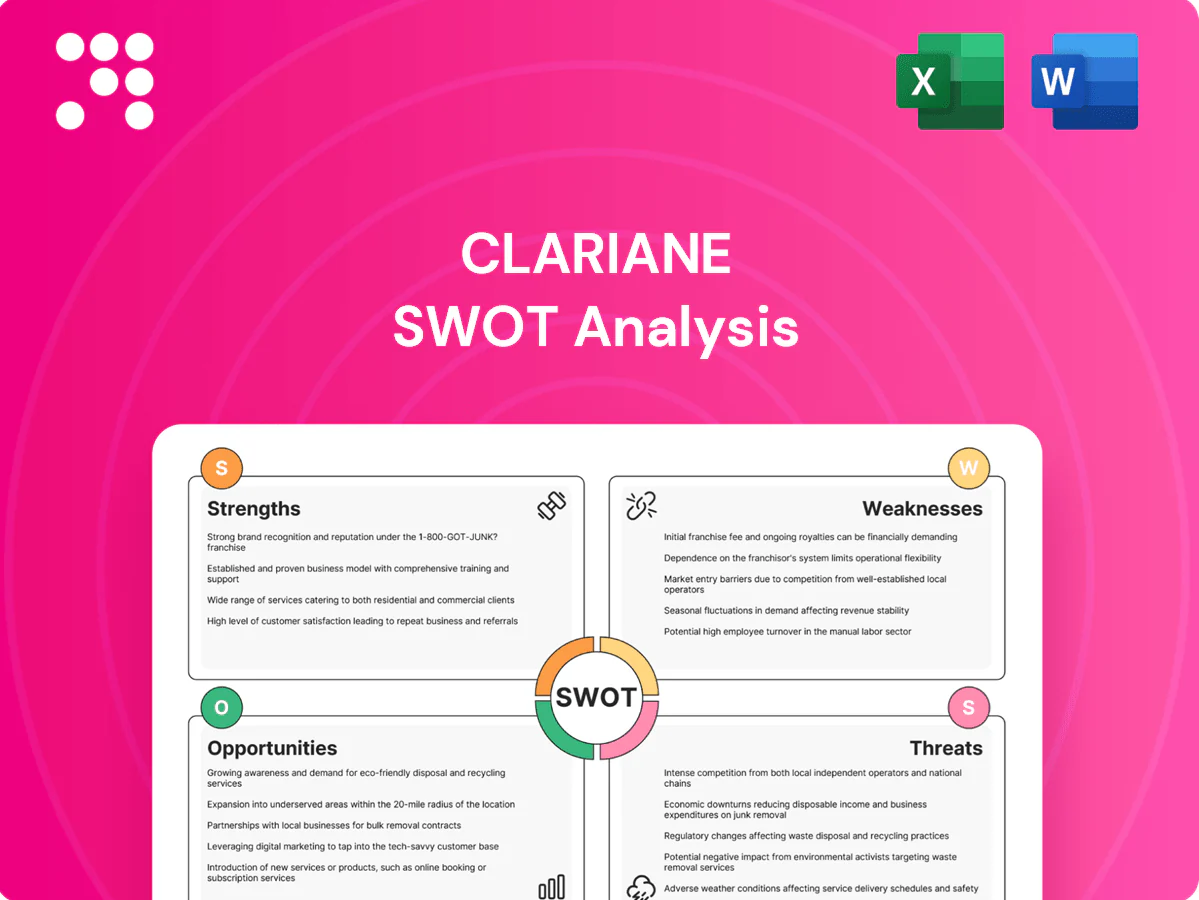
Clariane SWOT Analysis

Dive Deeper Into the Company’s Strategic Blueprint
Clariane SWOT Analysis highlights the company’s competitive strengths, emerging risks, and key growth drivers in a concise, actionable format. Ideal for investors, strategists, and advisors, it pinpoints opportunities and mitigation strategies. Purchase the full SWOT for a professional, editable Word and Excel package packed with research-backed insights.
Strengths

Pan-European care network
Operating across multiple European countries gives Clariane scale, diversification and richer referral depth, aligning with an EU health market that spends roughly 10% of GDP and about €3,000 per capita (2022–23). A wide footprint enables rapid transfer of best practices and load balancing of capacity across sites, strengthening payer negotiations and rising brand visibility. Geographic spread also reduces exposure to localized demand shocks.
Comprehensive continuum of services
Clariane’s comprehensive continuum from short-term rehab to long-term residential care captures more of the patient journey, supporting higher lifetime utilization and addressing transitions that reduce gaps in care. Cross-selling across nursing homes, clinics and assisted living drives utilization—U.S. SNF occupancy averaged ~78% in 2024—while bundled referrals lift internal conversion rates. Integrated medical and paramedical support is associated with roughly 20% lower readmissions in meta-analyses, elevating outcomes and retention. This breadth differentiates Clariane versus single-format rivals by offering end-to-end care pathways and higher per-patient revenue capture.

Personalized, quality-focused care model
Clariane’s individualized care plans drive higher patient satisfaction and measurable clinical gains, reflected in HCAHPS-linked revenue premiums and lower readmission trends; hospitals with top patient-experience scores report roughly 10% higher net revenue per admission. Higher perceived quality supports occupancy (US hospital average ~65% in 2024) and pricing power. Robust hospitality and well-being services strengthen family trust and quality credentials bolster payer and insurer relationships.

Operational know-how and protocols
Operational know-how and protocols yield scaled staffing, compliance, and clinical pathways that raise throughput and reduce variation across sites. Centralized procurement and standardized clinical protocols cut costs and supply variability while data from a large resident base drives continuous improvement and benchmarking. Institutional expertise shortens ramp-up time and lowers execution risk for new sites.
- Scaled staffing, compliance, pathways
- Centralized procurement reduces cost/variation
- Resident-data for continuous improvement
- Expertise lowers ramp-up risk
Brand recognition in senior care
Brand leadership confers credibility with regulators and communities, reinforcing oversight trust and easing local approvals; trusted branding accelerates facility fill-up above market averages—US senior housing occupancy averaged 78% in 2024 (NIC MAP). Established reputation eases recruitment and partnerships amid tight labor markets and supports selective premium offerings that can command higher ADRs.
- Credibility with regulators and communities
- Eases recruitment and partnerships
- Accelerates fill-up (US senior housing occ. 78% in 2024)
- Supports premium, higher-ADR offerings
Pan-European care scale boosts referrals, cuts readmissions ~20% and raises occupancy.
Pan-European scale and diversified sites drive referral depth, cost synergies and lower localized risk; EU health spends ~10% GDP (~€3,000 p.c., 2023). Integrated continuum (rehab to LTC) boosts lifetime utilization and internal referrals, lowering readmissions ~20%. Strong brand and standardized operations accelerate occupancy (~78% US senior housing, 2024) and reduce ramp-up risk.
| Metric | Value |
|---|---|
| EU health spend | ~10% GDP / €3,000 p.c. (2023) |
| Readmission reduction | ~20% |
| Occupancy benchmark | 78% (US senior housing, 2024) |
What is included in the product
 Detailed Word Document
Provides a concise SWOT overview of Clariane, highlighting internal strengths and weaknesses alongside external opportunities and threats to assess its strategic position, growth drivers, and key risks.

 Customizable Excel Spreadsheet
Delivers a concise, visual Clariane SWOT matrix to rapidly identify strategic gaps and relieve decision-making bottlenecks. Editable format lets teams update priorities and integrate findings into reports and presentations.
Weaknesses

High fixed-cost and capital intensity
High fixed-costs in real estate, medical equipment and regulatory compliance lock up capital and raise operating leverage, amplifying losses during downturns. Maintenance capex stays elevated to preserve clinical quality, limiting free cash flow and reinvestment flexibility. The asset-heavy model also slows strategic pivots and M&A responsiveness.
Exposure to staffing constraints
Chronic shortages — WHO estimated a global shortfall of 5.9 million nurses and midwives in 2020 — continue to pressure Clariane’s service levels and occupancy. Wage inflation (roughly 5–7% annual increases in recent years) compresses margins and complicates scheduling. Reliance on agency staff, often 30–50% costlier, raises operating costs and hurts continuity. Expanding training pipelines takes 2–4 years to materially scale staffing.

Regulatory complexity across markets
Regulatory complexity across markets raises compliance burden and audit risk for Clariane, with 72% of multinationals citing cross-border regulation as a top risk (Deloitte 2024). Divergent standards hinder operational standardization and strain IT systems, often requiring multi‑million-dollar integrations. Licensing delays of 6–18 months can stall expansions or refurbishments, while non‑compliance risks fines and severe reputational damage.

Occupancy and case-mix sensitivity
Revenue hinges on sustaining high bed utilization; US skilled nursing occupancy averaged about 78% in 2023, so dips materially cut yield. Shifts toward lower-acuity, lower-reimbursed residents compress per-patient revenue and lengthen breakeven; seasonal peaks and variable hospital discharges add quarter-to-quarter volatility. High clinical and nonclinical turnover—often 50%+ annually—raises acquisition and onboarding costs.
- Occupancy sensitivity: 78% average (2023)
- Case-mix risk: lower-acuity reduces reimbursement mix
- Seasonality: discharge flow-driven volatility
- Turnover cost: staff turnover ~50%+ raises hiring/onboarding spend
Funding and leverage constraints
Care operators often carry high leverage to fund property and working capital, and rising policy rates (around 4–5% in 2024) have pushed interest costs higher, squeezing free cash flow; bank covenant headroom can limit M&A or capex, while concentrated refinancing maturities in 2024–25 increase the risk of disrupted investment plans.
- Net leverage pressure: high debt-funded assets
- Interest cost squeeze: policy rates ~4–5% (2024)
- Covenant constraints: restrict strategic flexibility
- Refinancing risk: clustered maturities 2024–25
Asset-heavy care model, staffing shortfalls and rising rates compress cash flow
High fixed-cost, asset-heavy model limits free cash flow and slows pivots; maintenance capex and real estate leverage amplify downside. Staffing shortages (WHO shortfall 5.9M) and wage inflation (5–7% recently) raise costs; turnover ~50%+ disrupts care. Occupancy sensitivity (78% avg 2023) and rising rates (~4–5% 2024) squeeze margins and heighten refinancing risk.
| Metric | Value |
|---|---|
| Occupancy | 78% (2023) |
| Nurse shortfall | 5.9M (2020) |
| Wage inflation | 5–7% (recent) |
| Turnover | 50%+ |
| Policy rates | ~4–5% (2024) |
Preview Before You Purchase
Clariane SWOT Analysis
This is the actual Clariane SWOT analysis document you’ll receive upon purchase—no surprises, just professional quality. The preview below is taken directly from the full report and reflects the same structured, editable content. Buy now to unlock the complete, downloadable version.

Dive Deeper Into the Company’s Strategic Blueprint
Clariane SWOT Analysis highlights the company’s competitive strengths, emerging risks, and key growth drivers in a concise, actionable format. Ideal for investors, strategists, and advisors, it pinpoints opportunities and mitigation strategies. Purchase the full SWOT for a professional, editable Word and Excel package packed with research-backed insights.
Strengths
Pan-European care network
Operating across multiple European countries gives Clariane scale, diversification and richer referral depth, aligning with an EU health market that spends roughly 10% of GDP and about €3,000 per capita (2022–23). A wide footprint enables rapid transfer of best practices and load balancing of capacity across sites, strengthening payer negotiations and rising brand visibility. Geographic spread also reduces exposure to localized demand shocks.
Comprehensive continuum of services
Clariane’s comprehensive continuum from short-term rehab to long-term residential care captures more of the patient journey, supporting higher lifetime utilization and addressing transitions that reduce gaps in care. Cross-selling across nursing homes, clinics and assisted living drives utilization—U.S. SNF occupancy averaged ~78% in 2024—while bundled referrals lift internal conversion rates. Integrated medical and paramedical support is associated with roughly 20% lower readmissions in meta-analyses, elevating outcomes and retention. This breadth differentiates Clariane versus single-format rivals by offering end-to-end care pathways and higher per-patient revenue capture.
Personalized, quality-focused care model
Clariane’s individualized care plans drive higher patient satisfaction and measurable clinical gains, reflected in HCAHPS-linked revenue premiums and lower readmission trends; hospitals with top patient-experience scores report roughly 10% higher net revenue per admission. Higher perceived quality supports occupancy (US hospital average ~65% in 2024) and pricing power. Robust hospitality and well-being services strengthen family trust and quality credentials bolster payer and insurer relationships.
Operational know-how and protocols
Operational know-how and protocols yield scaled staffing, compliance, and clinical pathways that raise throughput and reduce variation across sites. Centralized procurement and standardized clinical protocols cut costs and supply variability while data from a large resident base drives continuous improvement and benchmarking. Institutional expertise shortens ramp-up time and lowers execution risk for new sites.
- Scaled staffing, compliance, pathways
- Centralized procurement reduces cost/variation
- Resident-data for continuous improvement
- Expertise lowers ramp-up risk
Brand recognition in senior care
Brand leadership confers credibility with regulators and communities, reinforcing oversight trust and easing local approvals; trusted branding accelerates facility fill-up above market averages—US senior housing occupancy averaged 78% in 2024 (NIC MAP). Established reputation eases recruitment and partnerships amid tight labor markets and supports selective premium offerings that can command higher ADRs.
- Credibility with regulators and communities
- Eases recruitment and partnerships
- Accelerates fill-up (US senior housing occ. 78% in 2024)
- Supports premium, higher-ADR offerings
Pan-European care scale boosts referrals, cuts readmissions ~20% and raises occupancy.
Pan-European scale and diversified sites drive referral depth, cost synergies and lower localized risk; EU health spends ~10% GDP (~€3,000 p.c., 2023). Integrated continuum (rehab to LTC) boosts lifetime utilization and internal referrals, lowering readmissions ~20%. Strong brand and standardized operations accelerate occupancy (~78% US senior housing, 2024) and reduce ramp-up risk.
| Metric | Value |
|---|---|
| EU health spend | ~10% GDP / €3,000 p.c. (2023) |
| Readmission reduction | ~20% |
| Occupancy benchmark | 78% (US senior housing, 2024) |
What is included in the product
Detailed Word Document
Provides a concise SWOT overview of Clariane, highlighting internal strengths and weaknesses alongside external opportunities and threats to assess its strategic position, growth drivers, and key risks.
Customizable Excel Spreadsheet
Delivers a concise, visual Clariane SWOT matrix to rapidly identify strategic gaps and relieve decision-making bottlenecks. Editable format lets teams update priorities and integrate findings into reports and presentations.
Weaknesses
High fixed-cost and capital intensity
High fixed-costs in real estate, medical equipment and regulatory compliance lock up capital and raise operating leverage, amplifying losses during downturns. Maintenance capex stays elevated to preserve clinical quality, limiting free cash flow and reinvestment flexibility. The asset-heavy model also slows strategic pivots and M&A responsiveness.
Exposure to staffing constraints
Chronic shortages — WHO estimated a global shortfall of 5.9 million nurses and midwives in 2020 — continue to pressure Clariane’s service levels and occupancy. Wage inflation (roughly 5–7% annual increases in recent years) compresses margins and complicates scheduling. Reliance on agency staff, often 30–50% costlier, raises operating costs and hurts continuity. Expanding training pipelines takes 2–4 years to materially scale staffing.
Regulatory complexity across markets
Regulatory complexity across markets raises compliance burden and audit risk for Clariane, with 72% of multinationals citing cross-border regulation as a top risk (Deloitte 2024). Divergent standards hinder operational standardization and strain IT systems, often requiring multi‑million-dollar integrations. Licensing delays of 6–18 months can stall expansions or refurbishments, while non‑compliance risks fines and severe reputational damage.
Occupancy and case-mix sensitivity
Revenue hinges on sustaining high bed utilization; US skilled nursing occupancy averaged about 78% in 2023, so dips materially cut yield. Shifts toward lower-acuity, lower-reimbursed residents compress per-patient revenue and lengthen breakeven; seasonal peaks and variable hospital discharges add quarter-to-quarter volatility. High clinical and nonclinical turnover—often 50%+ annually—raises acquisition and onboarding costs.
- Occupancy sensitivity: 78% average (2023)
- Case-mix risk: lower-acuity reduces reimbursement mix
- Seasonality: discharge flow-driven volatility
- Turnover cost: staff turnover ~50%+ raises hiring/onboarding spend
Funding and leverage constraints
Care operators often carry high leverage to fund property and working capital, and rising policy rates (around 4–5% in 2024) have pushed interest costs higher, squeezing free cash flow; bank covenant headroom can limit M&A or capex, while concentrated refinancing maturities in 2024–25 increase the risk of disrupted investment plans.
- Net leverage pressure: high debt-funded assets
- Interest cost squeeze: policy rates ~4–5% (2024)
- Covenant constraints: restrict strategic flexibility
- Refinancing risk: clustered maturities 2024–25
Asset-heavy care model, staffing shortfalls and rising rates compress cash flow
High fixed-cost, asset-heavy model limits free cash flow and slows pivots; maintenance capex and real estate leverage amplify downside. Staffing shortages (WHO shortfall 5.9M) and wage inflation (5–7% recently) raise costs; turnover ~50%+ disrupts care. Occupancy sensitivity (78% avg 2023) and rising rates (~4–5% 2024) squeeze margins and heighten refinancing risk.
| Metric | Value |
|---|---|
| Occupancy | 78% (2023) |
| Nurse shortfall | 5.9M (2020) |
| Wage inflation | 5–7% (recent) |
| Turnover | 50%+ |
| Policy rates | ~4–5% (2024) |
Preview Before You Purchase
Clariane SWOT Analysis
This is the actual Clariane SWOT analysis document you’ll receive upon purchase—no surprises, just professional quality. The preview below is taken directly from the full report and reflects the same structured, editable content. Buy now to unlock the complete, downloadable version.
Description
Dive Deeper Into the Company’s Strategic Blueprint
Clariane SWOT Analysis highlights the company’s competitive strengths, emerging risks, and key growth drivers in a concise, actionable format. Ideal for investors, strategists, and advisors, it pinpoints opportunities and mitigation strategies. Purchase the full SWOT for a professional, editable Word and Excel package packed with research-backed insights.
Strengths
Pan-European care network
Operating across multiple European countries gives Clariane scale, diversification and richer referral depth, aligning with an EU health market that spends roughly 10% of GDP and about €3,000 per capita (2022–23). A wide footprint enables rapid transfer of best practices and load balancing of capacity across sites, strengthening payer negotiations and rising brand visibility. Geographic spread also reduces exposure to localized demand shocks.
Comprehensive continuum of services
Clariane’s comprehensive continuum from short-term rehab to long-term residential care captures more of the patient journey, supporting higher lifetime utilization and addressing transitions that reduce gaps in care. Cross-selling across nursing homes, clinics and assisted living drives utilization—U.S. SNF occupancy averaged ~78% in 2024—while bundled referrals lift internal conversion rates. Integrated medical and paramedical support is associated with roughly 20% lower readmissions in meta-analyses, elevating outcomes and retention. This breadth differentiates Clariane versus single-format rivals by offering end-to-end care pathways and higher per-patient revenue capture.
Personalized, quality-focused care model
Clariane’s individualized care plans drive higher patient satisfaction and measurable clinical gains, reflected in HCAHPS-linked revenue premiums and lower readmission trends; hospitals with top patient-experience scores report roughly 10% higher net revenue per admission. Higher perceived quality supports occupancy (US hospital average ~65% in 2024) and pricing power. Robust hospitality and well-being services strengthen family trust and quality credentials bolster payer and insurer relationships.
Operational know-how and protocols
Operational know-how and protocols yield scaled staffing, compliance, and clinical pathways that raise throughput and reduce variation across sites. Centralized procurement and standardized clinical protocols cut costs and supply variability while data from a large resident base drives continuous improvement and benchmarking. Institutional expertise shortens ramp-up time and lowers execution risk for new sites.
- Scaled staffing, compliance, pathways
- Centralized procurement reduces cost/variation
- Resident-data for continuous improvement
- Expertise lowers ramp-up risk
Brand recognition in senior care
Brand leadership confers credibility with regulators and communities, reinforcing oversight trust and easing local approvals; trusted branding accelerates facility fill-up above market averages—US senior housing occupancy averaged 78% in 2024 (NIC MAP). Established reputation eases recruitment and partnerships amid tight labor markets and supports selective premium offerings that can command higher ADRs.
- Credibility with regulators and communities
- Eases recruitment and partnerships
- Accelerates fill-up (US senior housing occ. 78% in 2024)
- Supports premium, higher-ADR offerings
Pan-European care scale boosts referrals, cuts readmissions ~20% and raises occupancy.
Pan-European scale and diversified sites drive referral depth, cost synergies and lower localized risk; EU health spends ~10% GDP (~€3,000 p.c., 2023). Integrated continuum (rehab to LTC) boosts lifetime utilization and internal referrals, lowering readmissions ~20%. Strong brand and standardized operations accelerate occupancy (~78% US senior housing, 2024) and reduce ramp-up risk.
| Metric | Value |
|---|---|
| EU health spend | ~10% GDP / €3,000 p.c. (2023) |
| Readmission reduction | ~20% |
| Occupancy benchmark | 78% (US senior housing, 2024) |
What is included in the product
Detailed Word Document
Provides a concise SWOT overview of Clariane, highlighting internal strengths and weaknesses alongside external opportunities and threats to assess its strategic position, growth drivers, and key risks.
Customizable Excel Spreadsheet
Delivers a concise, visual Clariane SWOT matrix to rapidly identify strategic gaps and relieve decision-making bottlenecks. Editable format lets teams update priorities and integrate findings into reports and presentations.
Weaknesses
High fixed-cost and capital intensity
High fixed-costs in real estate, medical equipment and regulatory compliance lock up capital and raise operating leverage, amplifying losses during downturns. Maintenance capex stays elevated to preserve clinical quality, limiting free cash flow and reinvestment flexibility. The asset-heavy model also slows strategic pivots and M&A responsiveness.
Exposure to staffing constraints
Chronic shortages — WHO estimated a global shortfall of 5.9 million nurses and midwives in 2020 — continue to pressure Clariane’s service levels and occupancy. Wage inflation (roughly 5–7% annual increases in recent years) compresses margins and complicates scheduling. Reliance on agency staff, often 30–50% costlier, raises operating costs and hurts continuity. Expanding training pipelines takes 2–4 years to materially scale staffing.
Regulatory complexity across markets
Regulatory complexity across markets raises compliance burden and audit risk for Clariane, with 72% of multinationals citing cross-border regulation as a top risk (Deloitte 2024). Divergent standards hinder operational standardization and strain IT systems, often requiring multi‑million-dollar integrations. Licensing delays of 6–18 months can stall expansions or refurbishments, while non‑compliance risks fines and severe reputational damage.
Occupancy and case-mix sensitivity
Revenue hinges on sustaining high bed utilization; US skilled nursing occupancy averaged about 78% in 2023, so dips materially cut yield. Shifts toward lower-acuity, lower-reimbursed residents compress per-patient revenue and lengthen breakeven; seasonal peaks and variable hospital discharges add quarter-to-quarter volatility. High clinical and nonclinical turnover—often 50%+ annually—raises acquisition and onboarding costs.
- Occupancy sensitivity: 78% average (2023)
- Case-mix risk: lower-acuity reduces reimbursement mix
- Seasonality: discharge flow-driven volatility
- Turnover cost: staff turnover ~50%+ raises hiring/onboarding spend
Funding and leverage constraints
Care operators often carry high leverage to fund property and working capital, and rising policy rates (around 4–5% in 2024) have pushed interest costs higher, squeezing free cash flow; bank covenant headroom can limit M&A or capex, while concentrated refinancing maturities in 2024–25 increase the risk of disrupted investment plans.
- Net leverage pressure: high debt-funded assets
- Interest cost squeeze: policy rates ~4–5% (2024)
- Covenant constraints: restrict strategic flexibility
- Refinancing risk: clustered maturities 2024–25
Asset-heavy care model, staffing shortfalls and rising rates compress cash flow
High fixed-cost, asset-heavy model limits free cash flow and slows pivots; maintenance capex and real estate leverage amplify downside. Staffing shortages (WHO shortfall 5.9M) and wage inflation (5–7% recently) raise costs; turnover ~50%+ disrupts care. Occupancy sensitivity (78% avg 2023) and rising rates (~4–5% 2024) squeeze margins and heighten refinancing risk.
| Metric | Value |
|---|---|
| Occupancy | 78% (2023) |
| Nurse shortfall | 5.9M (2020) |
| Wage inflation | 5–7% (recent) |
| Turnover | 50%+ |
| Policy rates | ~4–5% (2024) |
Preview Before You Purchase
Clariane SWOT Analysis
This is the actual Clariane SWOT analysis document you’ll receive upon purchase—no surprises, just professional quality. The preview below is taken directly from the full report and reflects the same structured, editable content. Buy now to unlock the complete, downloadable version.











