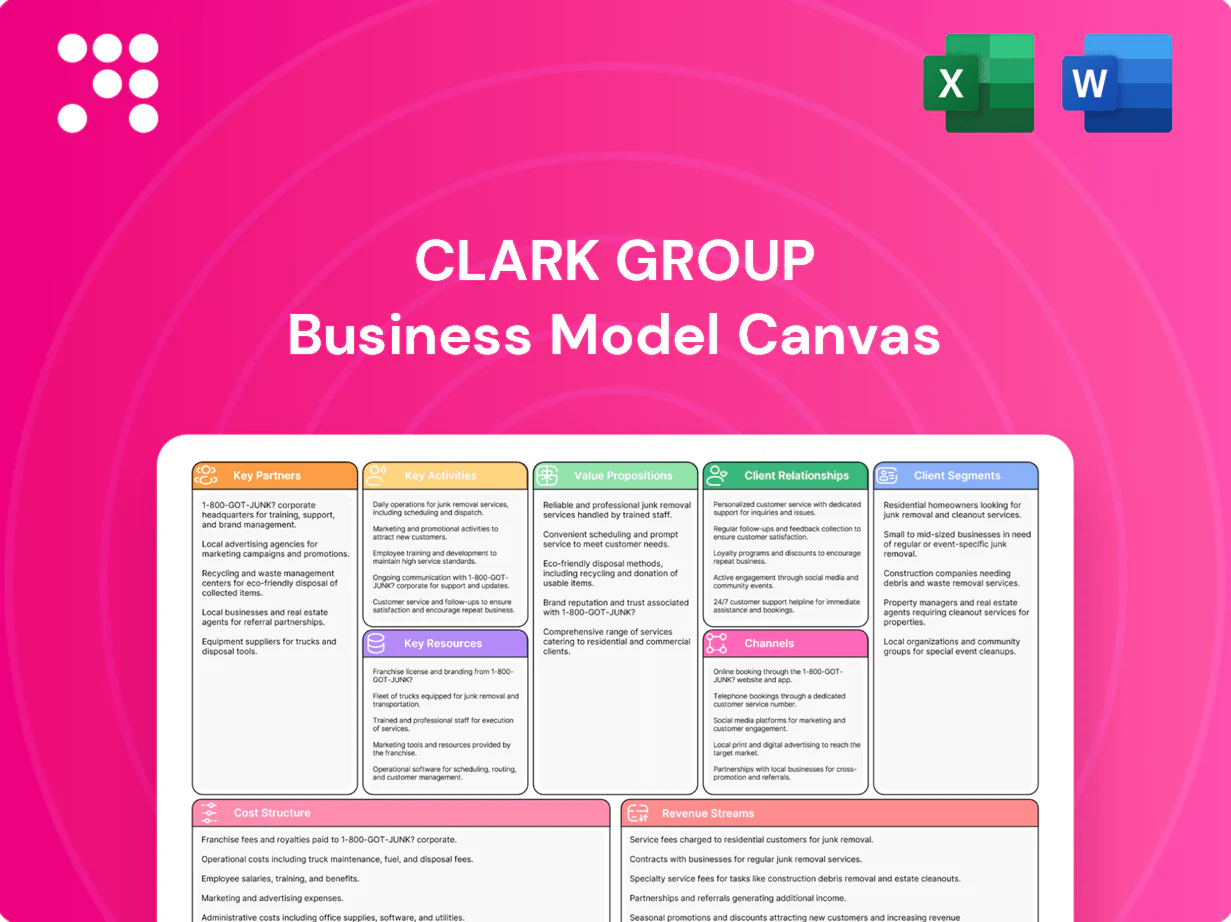
Clark Group Business Model Canvas

Download the editable Business Model Canvas mapping value, customers, partners, and revenue
Unlock the full strategic blueprint behind Clark Group’s business model with our in-depth Business Model Canvas that maps value propositions, customer segments, key partners, and revenue streams. Perfect for entrepreneurs, investors, and consultants seeking actionable insights and benchmarking tools. Download the complete, editable Word and Excel canvas to analyze, adapt, and apply Clark Group’s proven strategies now.
Partnerships

Trade Subcontractors
Specialty trades deliver core scopes such as MEP, concrete, and interiors at scale, representing roughly 70% of project scope by value in typical large-scale builds. Reliable partners enable pricing accuracy and schedule certainty, cutting change-order exposure and compressing timelines. Prequalified subs reduce risk and improve safety outcomes, often lowering incident rates and insurance costs. Strategic alliances support geographic and sector expansion.
Design Firms
Architects and engineers collaborate on design-build and preconstruction to integrate design and delivery early, optimizing constructability, cost, and sustainability. Early integration improves scheduling and reduces change orders. BIM coordination reduces clashes and redesign through coordinated models and clash detection. Trusted design partners strengthen proposals and help win complex pursuits.

Suppliers & Manufacturers
Tier-1 material vendors secure supply, pricing and lead times through long-term contracts and centralized procurement, reducing disruption for major Clark Group projects. Framework agreements with suppliers mitigate volatility in steel, concrete and equipment markets. Direct coordination with manufacturers enables prefabrication and product innovation, accelerating on-site assembly. Rigorous quality assurance programs improve asset performance and lifecycle costs.

Technology Providers
Clark Group partners with BIM, VDC, scheduling and field-management platforms to boost productivity—BIM adoption reached ~70% among large contractors in 2024, and integrated scheduling/cloud tools cut rework by about 25% on benchmark projects. Data integrations enable cost, safety and quality analytics; reality capture and drones accelerate progress tracking (inspections 3–4x faster). Cybersecure systems protect client and project information amid rising sector threats and over $3.2B in security-related construction tech investments in 2024.
- BIM/VDC: ~70% adoption (2024)
- Rework reduction: ~25% via integrations
- Drones/Reality capture: inspections 3–4x faster
- Security spend: >$3.2B in 2024
Owners, Agencies & JV Partners
Public owners, private developers and P3 stakeholders dictate delivery models and risk allocation; JV partners expand capacity, credentials and local presence to win larger bids. Sureties typically bond 100% of contract value while lenders provide construction financing often at 60–80% LTV. Agency relationships accelerate permitting and compliance workflows.
- Public owners: delivery/risk
- JV partners: capacity/credentials
- Sureties: 100% bonding
- Lenders: 60–80% LTV
- Agencies: permitting/compliance
Specialty trades drive ~70% of project value; BIM (~70% adoption) trims rework ~25%
Specialty trades deliver ~70% of project value, underpinning pricing and schedule certainty. Early design partners and BIM (~70% adoption in 2024) cut rework ~25% and change orders. Tier‑1 suppliers, long‑term contracts and prefabrication secure lead times; security tech spend topped >$3.2B in 2024. Sureties commonly bond 100% and lenders provide 60–80% LTV.
| Metric | Value |
|---|---|
| Specialty trades | ~70% project value |
| BIM adoption (2024) | ~70% |
| Rework reduction | ~25% |
| Security spend (2024) | >$3.2B |
| Surety bonding | 100% |
| Lender LTV | 60–80% |
What is included in the product
 Detailed Word Document
A concise, pre-written Business Model Canvas for Clark Group covering all 9 blocks with detailed value propositions, customer segments, channels and revenue streams. Ideal for investor presentations, it links SWOT and competitive advantages to real-world operations to support strategic decisions and funding discussions.

 Customizable Excel Spreadsheet
High-level, shareable Business Model Canvas for Clark Group that saves hours of setup by condensing strategy into editable cells—ideal for quick boardroom reviews, team collaboration, and side-by-side comparisons.
Activities

Preconstruction
Preconstruction combines detailed estimating, target value design, and value engineering to set firm cost baselines and drive early-cost certainty; constructability reviews identify and mitigate schedule and safety risks before mobilization. Procurement strategies secure pricing and material availability, while phased sequencing and logistics planning streamline site operations and minimize on-site congestion and rework.
Project Management
Schedule, cost and change management drive on-time delivery; large projects often face overruns (McKinsey finding: ~20% longer, ~80% higher cost on major projects). Subcontract administration and coordination keep workflows moving across hundreds of trade partners. Daily risk, safety and quality programs aim to hold TRIR near industry levels (~3.0, BLS 2023) while real-time reporting dashboards provide stakeholders live KPI visibility.

Design-Build Integration
Single-point responsibility in design-build aligns design with budget and schedule, with DBIA noting delivery can be up to 33% faster and lifecycle costs often 6–8% lower. BIM-enabled coordination eliminates clashes early—Autodesk reports clash detection reduces on-site coordination time dramatically, cutting rework rates. Proactive design management accelerates permitting and secures long-lead purchases sooner, shortening start timelines. Formal commissioning plans drive verified performance, with DOE data showing commissioning can cut energy use ~16%.

Self-Perform & Field Operations
Self-perform scopes are selected to stabilize schedule and quality, leveraging Clark Group’s in-house trades to reduce subcontract handoffs and rework; Clark reported performing core trades on roughly 30% of project labor hours in recent portfolios. Site supervision orchestrates trades and logistics with typical supervision ratios near 1:20 to maintain flow and safety. Inspections validate specs and code compliance, while rigorous punchlist and turnover processes drive owner acceptance and final payments.
- Self-perform scope: ~30% of labor hours
- Supervision ratio: ~1:20
- Inspections: continuous QC checkpoints
- Punchlist: formal turnover to secure final payment
Business Development & Bidding
Business Development & Bidding pursues public and private opportunities nationwide, with proposal development emphasizing technical competence and documented past performance to differentiate Clark Group. Competitive bidding balances price and risk to protect margins while pursuing strategic contracts. Ongoing relationship management with owners and primes improves win rates and repeat business.
- Nationwide pursuits
- Proposals: technical + past performance
- Competitive bids: price vs risk
- Relationship management: higher win rates
Design-build + BIM cuts schedules up to 33%
Clark’s key activities compress risk through preconstruction, BIM coordination and design-build single‑point delivery to accelerate schedules and cut lifecycle costs; self‑perform trades (~30% labor) stabilize quality and schedule. Rigorous procurement, phased logistics and subcontract coordination drive on‑time, on‑budget delivery with TRIR ~3.0 (BLS 2024).
| Metric | Value | Source (2024) |
|---|---|---|
| Self‑perform | ~30% labor hrs | Clark portfolios |
| TRIR | ~3.0 | BLS 2024 |
| DB delivery speed | up to 33% faster | DBIA |
| Energy savings (commissioning) | ~16% | DOE |
Preview Before You Purchase
Business Model Canvas
The document you're previewing is the exact Clark Group Business Model Canvas you'll receive after purchase. This preview is not a mockup but a direct extract from the final editable file. After buying, you'll download the complete, fully formatted Word and Excel versions ready to edit, present, or share. No hidden content—what you see is what you get.

Download the editable Business Model Canvas mapping value, customers, partners, and revenue
Unlock the full strategic blueprint behind Clark Group’s business model with our in-depth Business Model Canvas that maps value propositions, customer segments, key partners, and revenue streams. Perfect for entrepreneurs, investors, and consultants seeking actionable insights and benchmarking tools. Download the complete, editable Word and Excel canvas to analyze, adapt, and apply Clark Group’s proven strategies now.
Partnerships
Trade Subcontractors
Specialty trades deliver core scopes such as MEP, concrete, and interiors at scale, representing roughly 70% of project scope by value in typical large-scale builds. Reliable partners enable pricing accuracy and schedule certainty, cutting change-order exposure and compressing timelines. Prequalified subs reduce risk and improve safety outcomes, often lowering incident rates and insurance costs. Strategic alliances support geographic and sector expansion.
Design Firms
Architects and engineers collaborate on design-build and preconstruction to integrate design and delivery early, optimizing constructability, cost, and sustainability. Early integration improves scheduling and reduces change orders. BIM coordination reduces clashes and redesign through coordinated models and clash detection. Trusted design partners strengthen proposals and help win complex pursuits.
Suppliers & Manufacturers
Tier-1 material vendors secure supply, pricing and lead times through long-term contracts and centralized procurement, reducing disruption for major Clark Group projects. Framework agreements with suppliers mitigate volatility in steel, concrete and equipment markets. Direct coordination with manufacturers enables prefabrication and product innovation, accelerating on-site assembly. Rigorous quality assurance programs improve asset performance and lifecycle costs.
Technology Providers
Clark Group partners with BIM, VDC, scheduling and field-management platforms to boost productivity—BIM adoption reached ~70% among large contractors in 2024, and integrated scheduling/cloud tools cut rework by about 25% on benchmark projects. Data integrations enable cost, safety and quality analytics; reality capture and drones accelerate progress tracking (inspections 3–4x faster). Cybersecure systems protect client and project information amid rising sector threats and over $3.2B in security-related construction tech investments in 2024.
- BIM/VDC: ~70% adoption (2024)
- Rework reduction: ~25% via integrations
- Drones/Reality capture: inspections 3–4x faster
- Security spend: >$3.2B in 2024
Owners, Agencies & JV Partners
Public owners, private developers and P3 stakeholders dictate delivery models and risk allocation; JV partners expand capacity, credentials and local presence to win larger bids. Sureties typically bond 100% of contract value while lenders provide construction financing often at 60–80% LTV. Agency relationships accelerate permitting and compliance workflows.
- Public owners: delivery/risk
- JV partners: capacity/credentials
- Sureties: 100% bonding
- Lenders: 60–80% LTV
- Agencies: permitting/compliance
Specialty trades drive ~70% of project value; BIM (~70% adoption) trims rework ~25%
Specialty trades deliver ~70% of project value, underpinning pricing and schedule certainty. Early design partners and BIM (~70% adoption in 2024) cut rework ~25% and change orders. Tier‑1 suppliers, long‑term contracts and prefabrication secure lead times; security tech spend topped >$3.2B in 2024. Sureties commonly bond 100% and lenders provide 60–80% LTV.
| Metric | Value |
|---|---|
| Specialty trades | ~70% project value |
| BIM adoption (2024) | ~70% |
| Rework reduction | ~25% |
| Security spend (2024) | >$3.2B |
| Surety bonding | 100% |
| Lender LTV | 60–80% |
What is included in the product
Detailed Word Document
A concise, pre-written Business Model Canvas for Clark Group covering all 9 blocks with detailed value propositions, customer segments, channels and revenue streams. Ideal for investor presentations, it links SWOT and competitive advantages to real-world operations to support strategic decisions and funding discussions.
Customizable Excel Spreadsheet
High-level, shareable Business Model Canvas for Clark Group that saves hours of setup by condensing strategy into editable cells—ideal for quick boardroom reviews, team collaboration, and side-by-side comparisons.
Activities
Preconstruction
Preconstruction combines detailed estimating, target value design, and value engineering to set firm cost baselines and drive early-cost certainty; constructability reviews identify and mitigate schedule and safety risks before mobilization. Procurement strategies secure pricing and material availability, while phased sequencing and logistics planning streamline site operations and minimize on-site congestion and rework.
Project Management
Schedule, cost and change management drive on-time delivery; large projects often face overruns (McKinsey finding: ~20% longer, ~80% higher cost on major projects). Subcontract administration and coordination keep workflows moving across hundreds of trade partners. Daily risk, safety and quality programs aim to hold TRIR near industry levels (~3.0, BLS 2023) while real-time reporting dashboards provide stakeholders live KPI visibility.
Design-Build Integration
Single-point responsibility in design-build aligns design with budget and schedule, with DBIA noting delivery can be up to 33% faster and lifecycle costs often 6–8% lower. BIM-enabled coordination eliminates clashes early—Autodesk reports clash detection reduces on-site coordination time dramatically, cutting rework rates. Proactive design management accelerates permitting and secures long-lead purchases sooner, shortening start timelines. Formal commissioning plans drive verified performance, with DOE data showing commissioning can cut energy use ~16%.
Self-Perform & Field Operations
Self-perform scopes are selected to stabilize schedule and quality, leveraging Clark Group’s in-house trades to reduce subcontract handoffs and rework; Clark reported performing core trades on roughly 30% of project labor hours in recent portfolios. Site supervision orchestrates trades and logistics with typical supervision ratios near 1:20 to maintain flow and safety. Inspections validate specs and code compliance, while rigorous punchlist and turnover processes drive owner acceptance and final payments.
- Self-perform scope: ~30% of labor hours
- Supervision ratio: ~1:20
- Inspections: continuous QC checkpoints
- Punchlist: formal turnover to secure final payment
Business Development & Bidding
Business Development & Bidding pursues public and private opportunities nationwide, with proposal development emphasizing technical competence and documented past performance to differentiate Clark Group. Competitive bidding balances price and risk to protect margins while pursuing strategic contracts. Ongoing relationship management with owners and primes improves win rates and repeat business.
- Nationwide pursuits
- Proposals: technical + past performance
- Competitive bids: price vs risk
- Relationship management: higher win rates
Design-build + BIM cuts schedules up to 33%
Clark’s key activities compress risk through preconstruction, BIM coordination and design-build single‑point delivery to accelerate schedules and cut lifecycle costs; self‑perform trades (~30% labor) stabilize quality and schedule. Rigorous procurement, phased logistics and subcontract coordination drive on‑time, on‑budget delivery with TRIR ~3.0 (BLS 2024).
| Metric | Value | Source (2024) |
|---|---|---|
| Self‑perform | ~30% labor hrs | Clark portfolios |
| TRIR | ~3.0 | BLS 2024 |
| DB delivery speed | up to 33% faster | DBIA |
| Energy savings (commissioning) | ~16% | DOE |
Preview Before You Purchase
Business Model Canvas
The document you're previewing is the exact Clark Group Business Model Canvas you'll receive after purchase. This preview is not a mockup but a direct extract from the final editable file. After buying, you'll download the complete, fully formatted Word and Excel versions ready to edit, present, or share. No hidden content—what you see is what you get.
Original: $10.00
-65%$10.00
$3.50Description
Download the editable Business Model Canvas mapping value, customers, partners, and revenue
Unlock the full strategic blueprint behind Clark Group’s business model with our in-depth Business Model Canvas that maps value propositions, customer segments, key partners, and revenue streams. Perfect for entrepreneurs, investors, and consultants seeking actionable insights and benchmarking tools. Download the complete, editable Word and Excel canvas to analyze, adapt, and apply Clark Group’s proven strategies now.
Partnerships
Trade Subcontractors
Specialty trades deliver core scopes such as MEP, concrete, and interiors at scale, representing roughly 70% of project scope by value in typical large-scale builds. Reliable partners enable pricing accuracy and schedule certainty, cutting change-order exposure and compressing timelines. Prequalified subs reduce risk and improve safety outcomes, often lowering incident rates and insurance costs. Strategic alliances support geographic and sector expansion.
Design Firms
Architects and engineers collaborate on design-build and preconstruction to integrate design and delivery early, optimizing constructability, cost, and sustainability. Early integration improves scheduling and reduces change orders. BIM coordination reduces clashes and redesign through coordinated models and clash detection. Trusted design partners strengthen proposals and help win complex pursuits.
Suppliers & Manufacturers
Tier-1 material vendors secure supply, pricing and lead times through long-term contracts and centralized procurement, reducing disruption for major Clark Group projects. Framework agreements with suppliers mitigate volatility in steel, concrete and equipment markets. Direct coordination with manufacturers enables prefabrication and product innovation, accelerating on-site assembly. Rigorous quality assurance programs improve asset performance and lifecycle costs.
Technology Providers
Clark Group partners with BIM, VDC, scheduling and field-management platforms to boost productivity—BIM adoption reached ~70% among large contractors in 2024, and integrated scheduling/cloud tools cut rework by about 25% on benchmark projects. Data integrations enable cost, safety and quality analytics; reality capture and drones accelerate progress tracking (inspections 3–4x faster). Cybersecure systems protect client and project information amid rising sector threats and over $3.2B in security-related construction tech investments in 2024.
- BIM/VDC: ~70% adoption (2024)
- Rework reduction: ~25% via integrations
- Drones/Reality capture: inspections 3–4x faster
- Security spend: >$3.2B in 2024
Owners, Agencies & JV Partners
Public owners, private developers and P3 stakeholders dictate delivery models and risk allocation; JV partners expand capacity, credentials and local presence to win larger bids. Sureties typically bond 100% of contract value while lenders provide construction financing often at 60–80% LTV. Agency relationships accelerate permitting and compliance workflows.
- Public owners: delivery/risk
- JV partners: capacity/credentials
- Sureties: 100% bonding
- Lenders: 60–80% LTV
- Agencies: permitting/compliance
Specialty trades drive ~70% of project value; BIM (~70% adoption) trims rework ~25%
Specialty trades deliver ~70% of project value, underpinning pricing and schedule certainty. Early design partners and BIM (~70% adoption in 2024) cut rework ~25% and change orders. Tier‑1 suppliers, long‑term contracts and prefabrication secure lead times; security tech spend topped >$3.2B in 2024. Sureties commonly bond 100% and lenders provide 60–80% LTV.
| Metric | Value |
|---|---|
| Specialty trades | ~70% project value |
| BIM adoption (2024) | ~70% |
| Rework reduction | ~25% |
| Security spend (2024) | >$3.2B |
| Surety bonding | 100% |
| Lender LTV | 60–80% |
What is included in the product
Detailed Word Document
A concise, pre-written Business Model Canvas for Clark Group covering all 9 blocks with detailed value propositions, customer segments, channels and revenue streams. Ideal for investor presentations, it links SWOT and competitive advantages to real-world operations to support strategic decisions and funding discussions.
Customizable Excel Spreadsheet
High-level, shareable Business Model Canvas for Clark Group that saves hours of setup by condensing strategy into editable cells—ideal for quick boardroom reviews, team collaboration, and side-by-side comparisons.
Activities
Preconstruction
Preconstruction combines detailed estimating, target value design, and value engineering to set firm cost baselines and drive early-cost certainty; constructability reviews identify and mitigate schedule and safety risks before mobilization. Procurement strategies secure pricing and material availability, while phased sequencing and logistics planning streamline site operations and minimize on-site congestion and rework.
Project Management
Schedule, cost and change management drive on-time delivery; large projects often face overruns (McKinsey finding: ~20% longer, ~80% higher cost on major projects). Subcontract administration and coordination keep workflows moving across hundreds of trade partners. Daily risk, safety and quality programs aim to hold TRIR near industry levels (~3.0, BLS 2023) while real-time reporting dashboards provide stakeholders live KPI visibility.
Design-Build Integration
Single-point responsibility in design-build aligns design with budget and schedule, with DBIA noting delivery can be up to 33% faster and lifecycle costs often 6–8% lower. BIM-enabled coordination eliminates clashes early—Autodesk reports clash detection reduces on-site coordination time dramatically, cutting rework rates. Proactive design management accelerates permitting and secures long-lead purchases sooner, shortening start timelines. Formal commissioning plans drive verified performance, with DOE data showing commissioning can cut energy use ~16%.
Self-Perform & Field Operations
Self-perform scopes are selected to stabilize schedule and quality, leveraging Clark Group’s in-house trades to reduce subcontract handoffs and rework; Clark reported performing core trades on roughly 30% of project labor hours in recent portfolios. Site supervision orchestrates trades and logistics with typical supervision ratios near 1:20 to maintain flow and safety. Inspections validate specs and code compliance, while rigorous punchlist and turnover processes drive owner acceptance and final payments.
- Self-perform scope: ~30% of labor hours
- Supervision ratio: ~1:20
- Inspections: continuous QC checkpoints
- Punchlist: formal turnover to secure final payment
Business Development & Bidding
Business Development & Bidding pursues public and private opportunities nationwide, with proposal development emphasizing technical competence and documented past performance to differentiate Clark Group. Competitive bidding balances price and risk to protect margins while pursuing strategic contracts. Ongoing relationship management with owners and primes improves win rates and repeat business.
- Nationwide pursuits
- Proposals: technical + past performance
- Competitive bids: price vs risk
- Relationship management: higher win rates
Design-build + BIM cuts schedules up to 33%
Clark’s key activities compress risk through preconstruction, BIM coordination and design-build single‑point delivery to accelerate schedules and cut lifecycle costs; self‑perform trades (~30% labor) stabilize quality and schedule. Rigorous procurement, phased logistics and subcontract coordination drive on‑time, on‑budget delivery with TRIR ~3.0 (BLS 2024).
| Metric | Value | Source (2024) |
|---|---|---|
| Self‑perform | ~30% labor hrs | Clark portfolios |
| TRIR | ~3.0 | BLS 2024 |
| DB delivery speed | up to 33% faster | DBIA |
| Energy savings (commissioning) | ~16% | DOE |
Preview Before You Purchase
Business Model Canvas
The document you're previewing is the exact Clark Group Business Model Canvas you'll receive after purchase. This preview is not a mockup but a direct extract from the final editable file. After buying, you'll download the complete, fully formatted Word and Excel versions ready to edit, present, or share. No hidden content—what you see is what you get.











