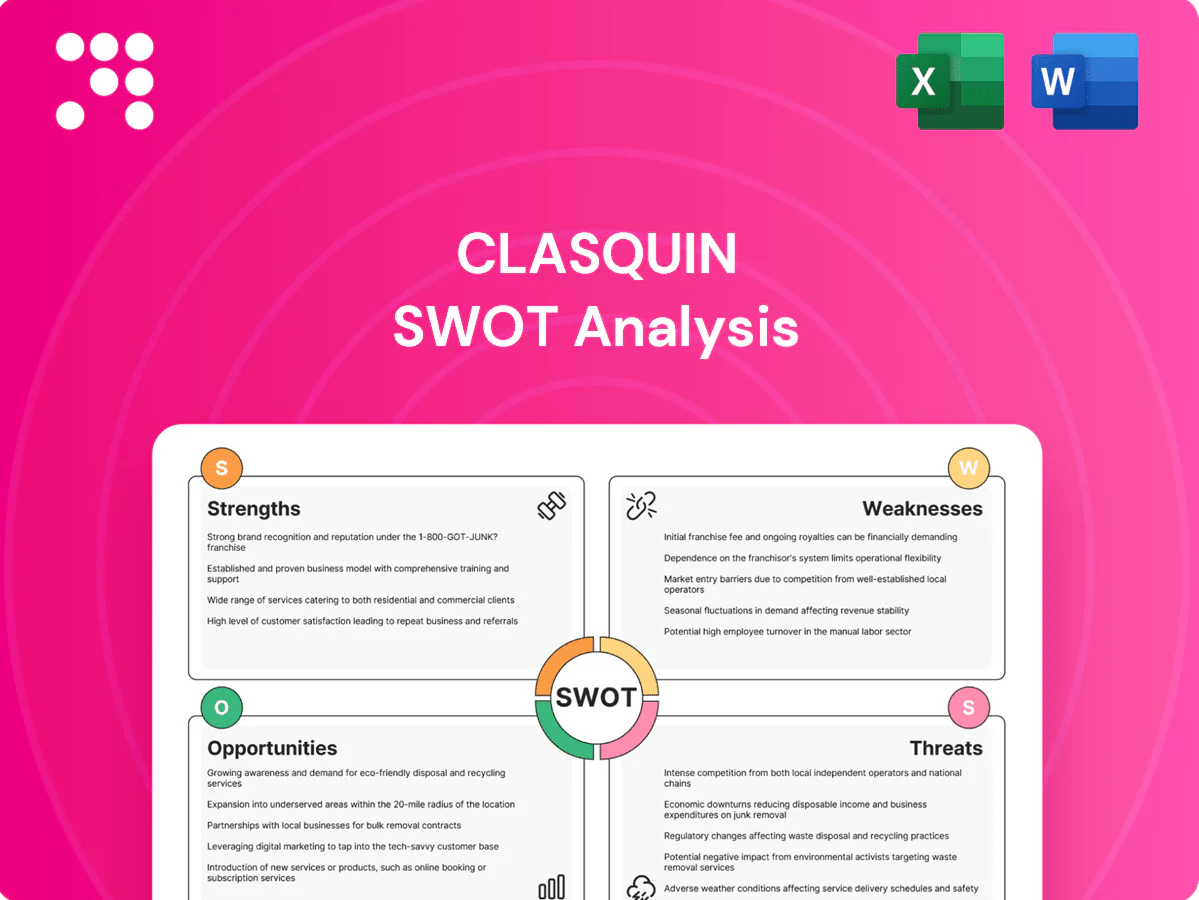
Clasquin SWOT Analysis

Go Beyond the Preview—Access the Full Strategic Report
Explore a concise glimpse of Clasquin’s strategic stance—its logistics strengths, market opportunities, and operational risks—so you can judge competitive fit and growth potential. Want a thorough, research-backed evaluation? Purchase the full SWOT analysis for a professionally formatted Word report and editable Excel matrix to support strategy, pitches, and investment decisions.
Strengths

End-to-end logistics portfolio
Clasquin combines 6 core services—air, ocean, road, customs brokerage, warehousing and supply chain management—under one roof, enabling integrated solutions with single-SLA accountability. This end-to-end portfolio drives cross-modal cost and time optimization across nodes and routes. Unified offerings facilitate cross-selling to increase wallet share and improve client retention. Integrated control reduces handoffs and simplifies performance tracking.
Expertise in international freight forwarding
Clasquin's deep know-how in cross-border flows, trade lanes and compliance underpins reliable execution across 30+ markets and multimodal corridors. Established relationships with 50+ carriers help secure capacity and keep rates competitive. Optimized route design and consolidation can cut transit times and improve yield by up to 15%. This expertise reduces client risk in volatile logistics markets.

Digital tools for visibility and efficiency
Clasquin leverages digital platforms for tracking, documentation, and workflow automation to enhance end-to-end visibility across multimodal shipments. Real-time visibility improves exception management and customer satisfaction by enabling timely interventions and clearer communication. Data analytics drive network optimization and dynamic pricing while automation reduces manual errors and shortens cycle times.

Agile mid-cap operator
As an agile mid-cap operator, Clasquin tailors solutions and moves faster in niche segments than mega-forwarders, with shorter decision cycles enabling rapid response to client needs and tight operational windows. Customized service allows the firm to command premium pricing on specialized lanes, and agility supports profitable specialization on selected trade lanes.
- Tailored niche solutions
- Short decision cycles
- Premium pricing on specialized services
- Profitable lane specialization
Customs and compliance capabilities
Clasquin’s in-house brokerage and regulatory expertise streamlines border clearance, ensuring accurate, timely filings that minimize penalties and operational delays while providing trade-rule advisory services that go beyond transport. This compliance-driven approach builds trust with regulated industries by reducing customs risk and improving supply chain predictability.
- In-house brokerage
- Timely, accurate filings
- Trade-rule advisory
- Trust with regulated sectors
Integrated multimodal logistics across 30+ markets, 6 services — boost yield up to 15%
Clasquin delivers integrated air, ocean, road, customs, warehousing and SCM under one SLA, enabling cross-modal cost/time optimization across 30+ markets and 6 services. Established ties with 50+ carriers secure capacity and support yield improvements up to 15% via consolidation and route design. Digital platforms provide real-time visibility, analytics and automation to reduce errors and shorten cycle times while agile mid-cap focus enables premium pricing on niche lanes.
| Metric | Value |
|---|---|
| Services | 6 |
| Markets | 30+ |
| Carrier partners | 50+ |
| Yield improvement | up to 15% |
What is included in the product
 Detailed Word Document
Provides a concise SWOT analysis of Clasquin, highlighting internal strengths and weaknesses alongside external opportunities and threats to map growth drivers, operational gaps, and market risks shaping the company’s strategic position.

 Customizable Excel Spreadsheet
Provides a concise Clasquin-specific SWOT matrix for fast, visual strategy alignment that pinpoints and helps resolve operational pain points.
Weaknesses

Scale disadvantage versus global giants
Lower volumes limit Clasquin’s rate leverage with carriers, reducing bargaining power on spot and contract rates. Network breadth and buying power lag top-tier global competitors, constraining access to premium capacity and negotiated surcharges. In commoditized lanes this pressure can compress margins, while larger rivals outspend on advanced TMS platforms and marketing to capture share.
Exposure to cyclical freight markets
Clasquin’s results track cyclical global trade and freight-rate swings; container rates collapsed by over 70% from 2021 peaks into 2023, illustrating volatility. Downturns compress pricing and vessel/aircraft utilization, while clients often defer shipments or renegotiate contracts. That behavior, seen across suppliers, makes demand forecasting and margin visibility markedly harder in volatile periods.

Potential geographic and sector concentration
Overweight exposure to specific regions and industries leaves Clasquin vulnerable; in 2024 roughly 65% of volumes flowed on Europe–Asia and Mediterranean lanes, amplifying lane-specific shocks. Revenue swings from port disruptions or freight-rate drops can disproportionately hit results, and top-five customers represented about 42% of revenue in 2024, so customer churn would have an outsized impact. Diversification appears incomplete versus larger global peers.

Technology investment constraints
Keeping pace with AI, automation and platform integrations demands sustained capex and opex, straining a mid-sized balance sheet and slowing rollout speed. Legacy systems limit interoperability with partners and cloud-native platforms, raising integration costs. Competition for digital talent is intense, inflating hiring and retention expenses.
- capex/opex pressure
- mid-sized balance sheet limits
- legacy interoperability issues
- digital talent scarcity
Limited asset ownership
As a forwarder, Clasquin depends on third-party carriers and warehouses, so capacity shortages or upstream service failures can cascade to clients and compress margins; control over service quality remains indirect. Differentiation must come from process excellence, IT, and customer service rather than asset ownership, raising vulnerability to carrier price shifts and capacity allocation policies.
- Reliance on carriers
- Indirect quality control
- Service-based differentiation
Europe-Asia dependence and 65% lane share heighten 42% customer concentration risk
Clasquin’s limited volumes reduce carrier leverage and buying power versus top-tier peers, compressing margins in commoditized lanes. Container rates fell over 70% from 2021 peaks into 2023, exposing revenue and utilization volatility. In 2024 roughly 65% of volumes were on Europe–Asia/Mediterranean lanes and top-five customers made ~42% of revenue, concentrating risk and elevating churn impact.
| Metric | Value |
|---|---|
| Europe–Asia/Mediterranean share (2024) | ~65% |
| Top-5 customers share (2024) | ~42% |
| Container rate decline (2021–2023) | >70% |
Preview the Actual Deliverable
Clasquin SWOT Analysis
This is the actual Clasquin SWOT analysis document you’ll receive upon purchase—no surprises, just professional quality. The preview below is taken directly from the full report; buy now to unlock the complete, editable version. The file shown is the real analysis you’ll download immediately after payment.

Go Beyond the Preview—Access the Full Strategic Report
Explore a concise glimpse of Clasquin’s strategic stance—its logistics strengths, market opportunities, and operational risks—so you can judge competitive fit and growth potential. Want a thorough, research-backed evaluation? Purchase the full SWOT analysis for a professionally formatted Word report and editable Excel matrix to support strategy, pitches, and investment decisions.
Strengths
End-to-end logistics portfolio
Clasquin combines 6 core services—air, ocean, road, customs brokerage, warehousing and supply chain management—under one roof, enabling integrated solutions with single-SLA accountability. This end-to-end portfolio drives cross-modal cost and time optimization across nodes and routes. Unified offerings facilitate cross-selling to increase wallet share and improve client retention. Integrated control reduces handoffs and simplifies performance tracking.
Expertise in international freight forwarding
Clasquin's deep know-how in cross-border flows, trade lanes and compliance underpins reliable execution across 30+ markets and multimodal corridors. Established relationships with 50+ carriers help secure capacity and keep rates competitive. Optimized route design and consolidation can cut transit times and improve yield by up to 15%. This expertise reduces client risk in volatile logistics markets.
Digital tools for visibility and efficiency
Clasquin leverages digital platforms for tracking, documentation, and workflow automation to enhance end-to-end visibility across multimodal shipments. Real-time visibility improves exception management and customer satisfaction by enabling timely interventions and clearer communication. Data analytics drive network optimization and dynamic pricing while automation reduces manual errors and shortens cycle times.
Agile mid-cap operator
As an agile mid-cap operator, Clasquin tailors solutions and moves faster in niche segments than mega-forwarders, with shorter decision cycles enabling rapid response to client needs and tight operational windows. Customized service allows the firm to command premium pricing on specialized lanes, and agility supports profitable specialization on selected trade lanes.
- Tailored niche solutions
- Short decision cycles
- Premium pricing on specialized services
- Profitable lane specialization
Customs and compliance capabilities
Clasquin’s in-house brokerage and regulatory expertise streamlines border clearance, ensuring accurate, timely filings that minimize penalties and operational delays while providing trade-rule advisory services that go beyond transport. This compliance-driven approach builds trust with regulated industries by reducing customs risk and improving supply chain predictability.
- In-house brokerage
- Timely, accurate filings
- Trade-rule advisory
- Trust with regulated sectors
Integrated multimodal logistics across 30+ markets, 6 services — boost yield up to 15%
Clasquin delivers integrated air, ocean, road, customs, warehousing and SCM under one SLA, enabling cross-modal cost/time optimization across 30+ markets and 6 services. Established ties with 50+ carriers secure capacity and support yield improvements up to 15% via consolidation and route design. Digital platforms provide real-time visibility, analytics and automation to reduce errors and shorten cycle times while agile mid-cap focus enables premium pricing on niche lanes.
| Metric | Value |
|---|---|
| Services | 6 |
| Markets | 30+ |
| Carrier partners | 50+ |
| Yield improvement | up to 15% |
What is included in the product
Detailed Word Document
Provides a concise SWOT analysis of Clasquin, highlighting internal strengths and weaknesses alongside external opportunities and threats to map growth drivers, operational gaps, and market risks shaping the company’s strategic position.
Customizable Excel Spreadsheet
Provides a concise Clasquin-specific SWOT matrix for fast, visual strategy alignment that pinpoints and helps resolve operational pain points.
Weaknesses
Scale disadvantage versus global giants
Lower volumes limit Clasquin’s rate leverage with carriers, reducing bargaining power on spot and contract rates. Network breadth and buying power lag top-tier global competitors, constraining access to premium capacity and negotiated surcharges. In commoditized lanes this pressure can compress margins, while larger rivals outspend on advanced TMS platforms and marketing to capture share.
Exposure to cyclical freight markets
Clasquin’s results track cyclical global trade and freight-rate swings; container rates collapsed by over 70% from 2021 peaks into 2023, illustrating volatility. Downturns compress pricing and vessel/aircraft utilization, while clients often defer shipments or renegotiate contracts. That behavior, seen across suppliers, makes demand forecasting and margin visibility markedly harder in volatile periods.
Potential geographic and sector concentration
Overweight exposure to specific regions and industries leaves Clasquin vulnerable; in 2024 roughly 65% of volumes flowed on Europe–Asia and Mediterranean lanes, amplifying lane-specific shocks. Revenue swings from port disruptions or freight-rate drops can disproportionately hit results, and top-five customers represented about 42% of revenue in 2024, so customer churn would have an outsized impact. Diversification appears incomplete versus larger global peers.
Technology investment constraints
Keeping pace with AI, automation and platform integrations demands sustained capex and opex, straining a mid-sized balance sheet and slowing rollout speed. Legacy systems limit interoperability with partners and cloud-native platforms, raising integration costs. Competition for digital talent is intense, inflating hiring and retention expenses.
- capex/opex pressure
- mid-sized balance sheet limits
- legacy interoperability issues
- digital talent scarcity
Limited asset ownership
As a forwarder, Clasquin depends on third-party carriers and warehouses, so capacity shortages or upstream service failures can cascade to clients and compress margins; control over service quality remains indirect. Differentiation must come from process excellence, IT, and customer service rather than asset ownership, raising vulnerability to carrier price shifts and capacity allocation policies.
- Reliance on carriers
- Indirect quality control
- Service-based differentiation
Europe-Asia dependence and 65% lane share heighten 42% customer concentration risk
Clasquin’s limited volumes reduce carrier leverage and buying power versus top-tier peers, compressing margins in commoditized lanes. Container rates fell over 70% from 2021 peaks into 2023, exposing revenue and utilization volatility. In 2024 roughly 65% of volumes were on Europe–Asia/Mediterranean lanes and top-five customers made ~42% of revenue, concentrating risk and elevating churn impact.
| Metric | Value |
|---|---|
| Europe–Asia/Mediterranean share (2024) | ~65% |
| Top-5 customers share (2024) | ~42% |
| Container rate decline (2021–2023) | >70% |
Preview the Actual Deliverable
Clasquin SWOT Analysis
This is the actual Clasquin SWOT analysis document you’ll receive upon purchase—no surprises, just professional quality. The preview below is taken directly from the full report; buy now to unlock the complete, editable version. The file shown is the real analysis you’ll download immediately after payment.
Original: $10.00
-65%$10.00
$3.50Description
Go Beyond the Preview—Access the Full Strategic Report
Explore a concise glimpse of Clasquin’s strategic stance—its logistics strengths, market opportunities, and operational risks—so you can judge competitive fit and growth potential. Want a thorough, research-backed evaluation? Purchase the full SWOT analysis for a professionally formatted Word report and editable Excel matrix to support strategy, pitches, and investment decisions.
Strengths
End-to-end logistics portfolio
Clasquin combines 6 core services—air, ocean, road, customs brokerage, warehousing and supply chain management—under one roof, enabling integrated solutions with single-SLA accountability. This end-to-end portfolio drives cross-modal cost and time optimization across nodes and routes. Unified offerings facilitate cross-selling to increase wallet share and improve client retention. Integrated control reduces handoffs and simplifies performance tracking.
Expertise in international freight forwarding
Clasquin's deep know-how in cross-border flows, trade lanes and compliance underpins reliable execution across 30+ markets and multimodal corridors. Established relationships with 50+ carriers help secure capacity and keep rates competitive. Optimized route design and consolidation can cut transit times and improve yield by up to 15%. This expertise reduces client risk in volatile logistics markets.
Digital tools for visibility and efficiency
Clasquin leverages digital platforms for tracking, documentation, and workflow automation to enhance end-to-end visibility across multimodal shipments. Real-time visibility improves exception management and customer satisfaction by enabling timely interventions and clearer communication. Data analytics drive network optimization and dynamic pricing while automation reduces manual errors and shortens cycle times.
Agile mid-cap operator
As an agile mid-cap operator, Clasquin tailors solutions and moves faster in niche segments than mega-forwarders, with shorter decision cycles enabling rapid response to client needs and tight operational windows. Customized service allows the firm to command premium pricing on specialized lanes, and agility supports profitable specialization on selected trade lanes.
- Tailored niche solutions
- Short decision cycles
- Premium pricing on specialized services
- Profitable lane specialization
Customs and compliance capabilities
Clasquin’s in-house brokerage and regulatory expertise streamlines border clearance, ensuring accurate, timely filings that minimize penalties and operational delays while providing trade-rule advisory services that go beyond transport. This compliance-driven approach builds trust with regulated industries by reducing customs risk and improving supply chain predictability.
- In-house brokerage
- Timely, accurate filings
- Trade-rule advisory
- Trust with regulated sectors
Integrated multimodal logistics across 30+ markets, 6 services — boost yield up to 15%
Clasquin delivers integrated air, ocean, road, customs, warehousing and SCM under one SLA, enabling cross-modal cost/time optimization across 30+ markets and 6 services. Established ties with 50+ carriers secure capacity and support yield improvements up to 15% via consolidation and route design. Digital platforms provide real-time visibility, analytics and automation to reduce errors and shorten cycle times while agile mid-cap focus enables premium pricing on niche lanes.
| Metric | Value |
|---|---|
| Services | 6 |
| Markets | 30+ |
| Carrier partners | 50+ |
| Yield improvement | up to 15% |
What is included in the product
Detailed Word Document
Provides a concise SWOT analysis of Clasquin, highlighting internal strengths and weaknesses alongside external opportunities and threats to map growth drivers, operational gaps, and market risks shaping the company’s strategic position.
Customizable Excel Spreadsheet
Provides a concise Clasquin-specific SWOT matrix for fast, visual strategy alignment that pinpoints and helps resolve operational pain points.
Weaknesses
Scale disadvantage versus global giants
Lower volumes limit Clasquin’s rate leverage with carriers, reducing bargaining power on spot and contract rates. Network breadth and buying power lag top-tier global competitors, constraining access to premium capacity and negotiated surcharges. In commoditized lanes this pressure can compress margins, while larger rivals outspend on advanced TMS platforms and marketing to capture share.
Exposure to cyclical freight markets
Clasquin’s results track cyclical global trade and freight-rate swings; container rates collapsed by over 70% from 2021 peaks into 2023, illustrating volatility. Downturns compress pricing and vessel/aircraft utilization, while clients often defer shipments or renegotiate contracts. That behavior, seen across suppliers, makes demand forecasting and margin visibility markedly harder in volatile periods.
Potential geographic and sector concentration
Overweight exposure to specific regions and industries leaves Clasquin vulnerable; in 2024 roughly 65% of volumes flowed on Europe–Asia and Mediterranean lanes, amplifying lane-specific shocks. Revenue swings from port disruptions or freight-rate drops can disproportionately hit results, and top-five customers represented about 42% of revenue in 2024, so customer churn would have an outsized impact. Diversification appears incomplete versus larger global peers.
Technology investment constraints
Keeping pace with AI, automation and platform integrations demands sustained capex and opex, straining a mid-sized balance sheet and slowing rollout speed. Legacy systems limit interoperability with partners and cloud-native platforms, raising integration costs. Competition for digital talent is intense, inflating hiring and retention expenses.
- capex/opex pressure
- mid-sized balance sheet limits
- legacy interoperability issues
- digital talent scarcity
Limited asset ownership
As a forwarder, Clasquin depends on third-party carriers and warehouses, so capacity shortages or upstream service failures can cascade to clients and compress margins; control over service quality remains indirect. Differentiation must come from process excellence, IT, and customer service rather than asset ownership, raising vulnerability to carrier price shifts and capacity allocation policies.
- Reliance on carriers
- Indirect quality control
- Service-based differentiation
Europe-Asia dependence and 65% lane share heighten 42% customer concentration risk
Clasquin’s limited volumes reduce carrier leverage and buying power versus top-tier peers, compressing margins in commoditized lanes. Container rates fell over 70% from 2021 peaks into 2023, exposing revenue and utilization volatility. In 2024 roughly 65% of volumes were on Europe–Asia/Mediterranean lanes and top-five customers made ~42% of revenue, concentrating risk and elevating churn impact.
| Metric | Value |
|---|---|
| Europe–Asia/Mediterranean share (2024) | ~65% |
| Top-5 customers share (2024) | ~42% |
| Container rate decline (2021–2023) | >70% |
Preview the Actual Deliverable
Clasquin SWOT Analysis
This is the actual Clasquin SWOT analysis document you’ll receive upon purchase—no surprises, just professional quality. The preview below is taken directly from the full report; buy now to unlock the complete, editable version. The file shown is the real analysis you’ll download immediately after payment.











