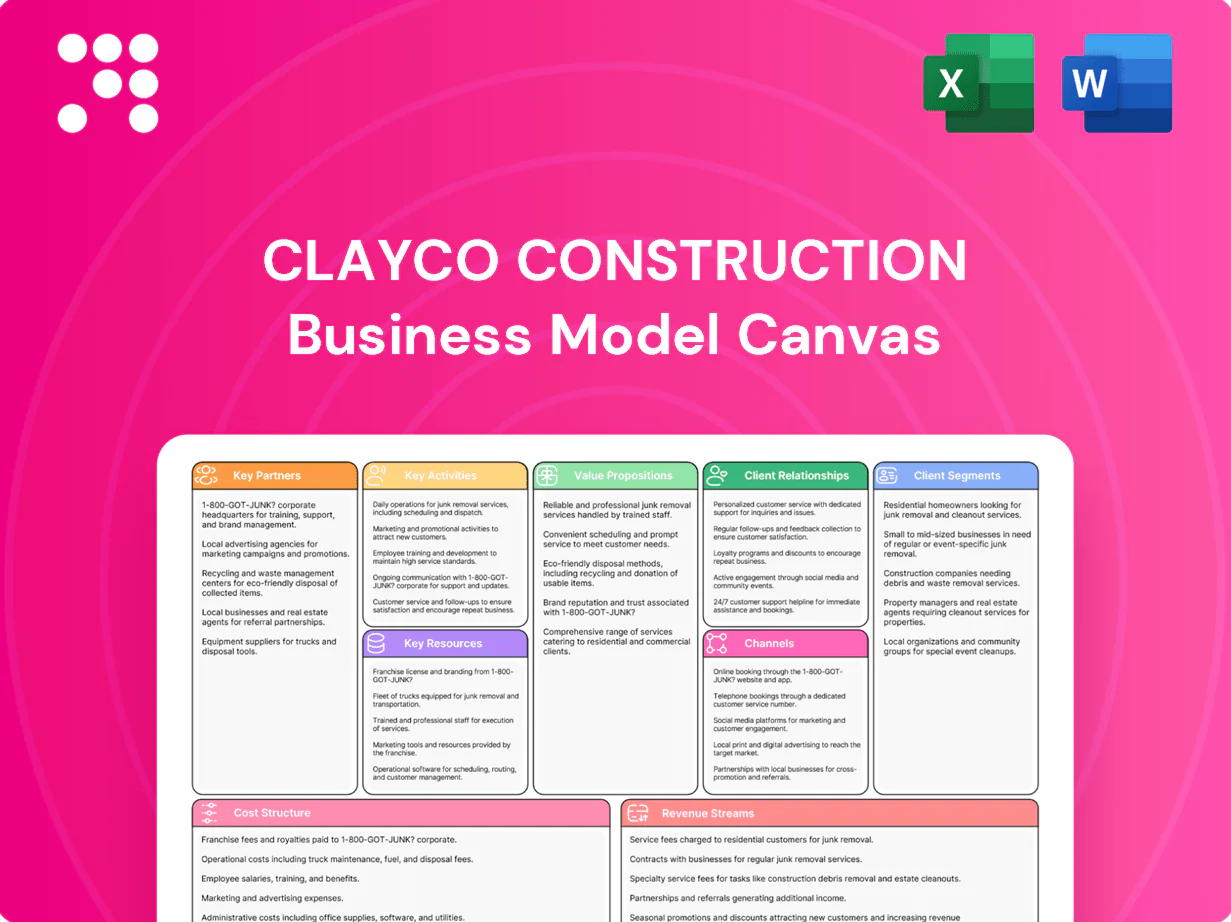
Clayco Construction Business Model Canvas

Unlock the strategic blueprint for construction firms with a ready Business Model Canvas
Unlock the full strategic blueprint behind Clayco Construction with our Business Model Canvas—detailing value propositions, key partners, and revenue mechanisms that fuel its growth. Perfect for investors, consultants, and founders, this downloadable canvas offers actionable insights and ready-to-use templates to benchmark and scale. Purchase the complete Word & Excel package to dive deeper and apply proven strategies today.
Partnerships

Architects and engineers
Strategic alliances with top A/E firms augment Clayco’s in‑house talent for complex projects, leveraging partners’ niche structural, MEP and sustainability expertise. Joint design charrettes accelerate decision cycles and can cut RFIs and rework, supporting faster delivery; design‑build delivery represented about 40% of US nonresidential starts in 2024 (Dodge Data & Analytics). Co‑branding improves competitiveness on large bids and integrated delivery scopes.
Specialty subcontractors
Trusted trade partners in concrete, steel, MEP and interiors deliver quality and schedule certainty, with subcontractors typically representing 60–70% of project costs. Prequalified subs meet OSHA and Lean standards, where Lean methods cut waste 10–25% (Lean Construction Institute, 2024). Early trade engagement can reduce change orders by about 20%, and long-term partnerships stabilize capacity across markets.

Real estate and finance partners
Developers, lenders and equity partners support Clayco on site selection and project financing, enabling larger scale and faster capital deployment. Build-to-suit and public-private collaborations unlock complex brownfield and institutional deals that typical GC models avoid. Sophisticated financial structuring shifts delivery risk to capital providers, protecting owner returns. Repeat partners accelerate approvals and closings through institutional trust and playbook reuse.

Technology and BIM providers
Partnerships with BIM, VDC, and project-management platforms enable integrated delivery across design and build, reducing schedule variance and supporting Clayco’s prefabrication strategy; by 2024 BIM adoption among large contractors exceeded 60% and digital twin deployments surpassed $7 billion in market value, accelerating handover and O&M. Reality capture, digital twin, and AI tools drive efficiency and analytics, cutting rework by up to 25% in pilot programs. Data interoperability across platforms reduces waste and rework through shared models and federated QA. Joint pilots with providers enable continuous innovation at scale and faster ROI on tech investments.
- Tag:BIM_adoption_2024
- Tag:digital_twin_>$7B_2024
- Tag:rework_reduction_~25%
- Tag:joint_pilots_scale
Suppliers and manufacturers
Direct ties with OEMs and material suppliers lock pricing, shorten lead times and uphold quality; prefab and modular partners enable off-site construction, cutting on-site schedules by 20–50% (industry studies) and improving predictability. Strategic sourcing reduces price volatility and can lower embodied carbon by substantial margins; vendor-managed inventory supports fast-track jobs by lowering stockouts and lead times.
- OEM contracts: stable pricing & quality
- Prefab partners: −20–50% schedule
- Strategic sourcing: lower volatility & carbon
- VMI: fewer stockouts, faster turnover
Design‑build dominance, prefab cuts schedules 20–50%, digital twin boosts O&M value
Clayco leverages A/E alliances, trade partners and financiers to secure schedule, quality and capital; design‑build ~40% of 2024 US nonresidential starts boosts win rates. Prequalified subs (60–70% cost share) and prefab partners cut schedules 20–50% and rework ~25%. BIM/digital twin adoption >60% in large contractors (2024); digital twin market >$7B, improving handover and O&M.
| Partner | Impact | 2024 metric |
|---|---|---|
| A/E | Design capacity, bids | Design‑build ~40% |
| Trades | Execution, cost | 60–70% costs |
| Prefab/Tech | Speed, quality | Schedule −20–50%; DT>$7B |
What is included in the product
 Detailed Word Document
A comprehensive, pre-written Business Model Canvas for Clayco Construction capturing customer segments, value propositions, channels, revenue streams, key partners, resources, activities, cost structure and governance in one cohesive framework. Ideal for presentations, investor discussions and strategic planning with SWOT-linked insights and competitive advantages per BMC block.

 Customizable Excel Spreadsheet
High-level view of Clayco’s business model with editable cells to pinpoint construction pain points, align stakeholders, and streamline project delivery for faster decision-making.
Activities

Design-build integration
Unifying architecture, engineering, and construction into one workflow, Clayco’s design-build model enables early design participation to align scope, budget, and schedule; the approach mirrors industry trends where design-build represented about 44% of U.S. nonresidential construction (DBIA, 2022), while rapid VDC-driven iterations compress timelines and single-point accountability measurably improves project outcomes.
Preconstruction and estimating
Rigorous budgeting, value engineering, and procurement strategy in preconstruction set projects up for success by aligning scope and cost through target value design. Risk analysis and phasing plans de-risk delivery and shorten schedule exposure. Market intel in 2024 guided buyout timing to capitalize on material and labor cycles. These practices drive predictability and protect margins for large mixed-use and industrial programs.

Project and construction management
Coordinating field operations, safety, quality and schedule across multimillion-dollar projects ensures on-time delivery and zero-tolerance safety culture; Lean planning and Last Planner System sustain flow, improving Percent Plan Complete by roughly 15–25% (Lean Construction Institute benchmarks). Strategic self-perform capabilities are deployed where they cut schedule risk and cost, while transparent, real-time reporting boosts client trust and decision speed.

Site selection and development
Site selection and development combines data-driven location analysis for access, utilities, and incentives with entitlement and permitting navigation to accelerate starts; infrastructure coordination ensures readiness while early due diligence uncovers soils, wetlands, title and utility risks to mitigate surprises.
- Data-driven site scoring
- Permitting acceleration
- Infrastructure coordination
- Early due diligence
Facility turnover and lifecycle services
Commissioning, closeout, and digital handover streamline occupancy by delivering validated systems and as-built models for operations; digital FM packages reduce handover time and minimize startup defects.
O&M training and facility management support extend asset value through operator upskilling and preventative regimes; warranty and service programs maintain performance with rapid-response protocols.
Post-occupancy evaluations feed measured KPIs into continuous improvement loops to optimize energy, space use, and lifecycle costs.
- Digital handover: reduced startup defects
- O&M training: extends asset life
- Post-occupancy KPIs: inform improvements
- Warranty/service: maintain uptime
Design-build + VDC speed delivery; 44%, PCP +15-25%
Integrated design-build and VDC shorten schedules and align scope/budget; design-build accounted for about 44% of U.S. nonresidential projects (DBIA, 2022) and Lean planning lifts Percent Plan Complete ~15–25% (Lean Construction Institute). Rigorous preconstruction, value engineering and targeted buyouts in 2024 preserved margins on large mixed-use and industrial programs. Self-perform trades and real-time reporting drive quality, safety and client trust.
| Activity | Metric | 2024 Impact |
|---|---|---|
| Design-build/VDC | 44% market share; PCP +15–25% | Faster delivery, fewer change orders |
What You See Is What You Get
Business Model Canvas
The Clayco Construction Business Model Canvas you’re previewing is the actual deliverable, not a mockup, and contains the same content and structure you’ll receive after purchase. Upon completing your order you’ll instantly download this exact file—ready to edit, present, and apply with no hidden sections or surprises. The document is formatted professionally for immediate use and distribution.

Unlock the strategic blueprint for construction firms with a ready Business Model Canvas
Unlock the full strategic blueprint behind Clayco Construction with our Business Model Canvas—detailing value propositions, key partners, and revenue mechanisms that fuel its growth. Perfect for investors, consultants, and founders, this downloadable canvas offers actionable insights and ready-to-use templates to benchmark and scale. Purchase the complete Word & Excel package to dive deeper and apply proven strategies today.
Partnerships
Architects and engineers
Strategic alliances with top A/E firms augment Clayco’s in‑house talent for complex projects, leveraging partners’ niche structural, MEP and sustainability expertise. Joint design charrettes accelerate decision cycles and can cut RFIs and rework, supporting faster delivery; design‑build delivery represented about 40% of US nonresidential starts in 2024 (Dodge Data & Analytics). Co‑branding improves competitiveness on large bids and integrated delivery scopes.
Specialty subcontractors
Trusted trade partners in concrete, steel, MEP and interiors deliver quality and schedule certainty, with subcontractors typically representing 60–70% of project costs. Prequalified subs meet OSHA and Lean standards, where Lean methods cut waste 10–25% (Lean Construction Institute, 2024). Early trade engagement can reduce change orders by about 20%, and long-term partnerships stabilize capacity across markets.
Real estate and finance partners
Developers, lenders and equity partners support Clayco on site selection and project financing, enabling larger scale and faster capital deployment. Build-to-suit and public-private collaborations unlock complex brownfield and institutional deals that typical GC models avoid. Sophisticated financial structuring shifts delivery risk to capital providers, protecting owner returns. Repeat partners accelerate approvals and closings through institutional trust and playbook reuse.
Technology and BIM providers
Partnerships with BIM, VDC, and project-management platforms enable integrated delivery across design and build, reducing schedule variance and supporting Clayco’s prefabrication strategy; by 2024 BIM adoption among large contractors exceeded 60% and digital twin deployments surpassed $7 billion in market value, accelerating handover and O&M. Reality capture, digital twin, and AI tools drive efficiency and analytics, cutting rework by up to 25% in pilot programs. Data interoperability across platforms reduces waste and rework through shared models and federated QA. Joint pilots with providers enable continuous innovation at scale and faster ROI on tech investments.
- Tag:BIM_adoption_2024
- Tag:digital_twin_>$7B_2024
- Tag:rework_reduction_~25%
- Tag:joint_pilots_scale
Suppliers and manufacturers
Direct ties with OEMs and material suppliers lock pricing, shorten lead times and uphold quality; prefab and modular partners enable off-site construction, cutting on-site schedules by 20–50% (industry studies) and improving predictability. Strategic sourcing reduces price volatility and can lower embodied carbon by substantial margins; vendor-managed inventory supports fast-track jobs by lowering stockouts and lead times.
- OEM contracts: stable pricing & quality
- Prefab partners: −20–50% schedule
- Strategic sourcing: lower volatility & carbon
- VMI: fewer stockouts, faster turnover
Design‑build dominance, prefab cuts schedules 20–50%, digital twin boosts O&M value
Clayco leverages A/E alliances, trade partners and financiers to secure schedule, quality and capital; design‑build ~40% of 2024 US nonresidential starts boosts win rates. Prequalified subs (60–70% cost share) and prefab partners cut schedules 20–50% and rework ~25%. BIM/digital twin adoption >60% in large contractors (2024); digital twin market >$7B, improving handover and O&M.
| Partner | Impact | 2024 metric |
|---|---|---|
| A/E | Design capacity, bids | Design‑build ~40% |
| Trades | Execution, cost | 60–70% costs |
| Prefab/Tech | Speed, quality | Schedule −20–50%; DT>$7B |
What is included in the product
Detailed Word Document
A comprehensive, pre-written Business Model Canvas for Clayco Construction capturing customer segments, value propositions, channels, revenue streams, key partners, resources, activities, cost structure and governance in one cohesive framework. Ideal for presentations, investor discussions and strategic planning with SWOT-linked insights and competitive advantages per BMC block.
Customizable Excel Spreadsheet
High-level view of Clayco’s business model with editable cells to pinpoint construction pain points, align stakeholders, and streamline project delivery for faster decision-making.
Activities
Design-build integration
Unifying architecture, engineering, and construction into one workflow, Clayco’s design-build model enables early design participation to align scope, budget, and schedule; the approach mirrors industry trends where design-build represented about 44% of U.S. nonresidential construction (DBIA, 2022), while rapid VDC-driven iterations compress timelines and single-point accountability measurably improves project outcomes.
Preconstruction and estimating
Rigorous budgeting, value engineering, and procurement strategy in preconstruction set projects up for success by aligning scope and cost through target value design. Risk analysis and phasing plans de-risk delivery and shorten schedule exposure. Market intel in 2024 guided buyout timing to capitalize on material and labor cycles. These practices drive predictability and protect margins for large mixed-use and industrial programs.
Project and construction management
Coordinating field operations, safety, quality and schedule across multimillion-dollar projects ensures on-time delivery and zero-tolerance safety culture; Lean planning and Last Planner System sustain flow, improving Percent Plan Complete by roughly 15–25% (Lean Construction Institute benchmarks). Strategic self-perform capabilities are deployed where they cut schedule risk and cost, while transparent, real-time reporting boosts client trust and decision speed.
Site selection and development
Site selection and development combines data-driven location analysis for access, utilities, and incentives with entitlement and permitting navigation to accelerate starts; infrastructure coordination ensures readiness while early due diligence uncovers soils, wetlands, title and utility risks to mitigate surprises.
- Data-driven site scoring
- Permitting acceleration
- Infrastructure coordination
- Early due diligence
Facility turnover and lifecycle services
Commissioning, closeout, and digital handover streamline occupancy by delivering validated systems and as-built models for operations; digital FM packages reduce handover time and minimize startup defects.
O&M training and facility management support extend asset value through operator upskilling and preventative regimes; warranty and service programs maintain performance with rapid-response protocols.
Post-occupancy evaluations feed measured KPIs into continuous improvement loops to optimize energy, space use, and lifecycle costs.
- Digital handover: reduced startup defects
- O&M training: extends asset life
- Post-occupancy KPIs: inform improvements
- Warranty/service: maintain uptime
Design-build + VDC speed delivery; 44%, PCP +15-25%
Integrated design-build and VDC shorten schedules and align scope/budget; design-build accounted for about 44% of U.S. nonresidential projects (DBIA, 2022) and Lean planning lifts Percent Plan Complete ~15–25% (Lean Construction Institute). Rigorous preconstruction, value engineering and targeted buyouts in 2024 preserved margins on large mixed-use and industrial programs. Self-perform trades and real-time reporting drive quality, safety and client trust.
| Activity | Metric | 2024 Impact |
|---|---|---|
| Design-build/VDC | 44% market share; PCP +15–25% | Faster delivery, fewer change orders |
What You See Is What You Get
Business Model Canvas
The Clayco Construction Business Model Canvas you’re previewing is the actual deliverable, not a mockup, and contains the same content and structure you’ll receive after purchase. Upon completing your order you’ll instantly download this exact file—ready to edit, present, and apply with no hidden sections or surprises. The document is formatted professionally for immediate use and distribution.
Original: $10.00
-65%$10.00
$3.50Description
Unlock the strategic blueprint for construction firms with a ready Business Model Canvas
Unlock the full strategic blueprint behind Clayco Construction with our Business Model Canvas—detailing value propositions, key partners, and revenue mechanisms that fuel its growth. Perfect for investors, consultants, and founders, this downloadable canvas offers actionable insights and ready-to-use templates to benchmark and scale. Purchase the complete Word & Excel package to dive deeper and apply proven strategies today.
Partnerships
Architects and engineers
Strategic alliances with top A/E firms augment Clayco’s in‑house talent for complex projects, leveraging partners’ niche structural, MEP and sustainability expertise. Joint design charrettes accelerate decision cycles and can cut RFIs and rework, supporting faster delivery; design‑build delivery represented about 40% of US nonresidential starts in 2024 (Dodge Data & Analytics). Co‑branding improves competitiveness on large bids and integrated delivery scopes.
Specialty subcontractors
Trusted trade partners in concrete, steel, MEP and interiors deliver quality and schedule certainty, with subcontractors typically representing 60–70% of project costs. Prequalified subs meet OSHA and Lean standards, where Lean methods cut waste 10–25% (Lean Construction Institute, 2024). Early trade engagement can reduce change orders by about 20%, and long-term partnerships stabilize capacity across markets.
Real estate and finance partners
Developers, lenders and equity partners support Clayco on site selection and project financing, enabling larger scale and faster capital deployment. Build-to-suit and public-private collaborations unlock complex brownfield and institutional deals that typical GC models avoid. Sophisticated financial structuring shifts delivery risk to capital providers, protecting owner returns. Repeat partners accelerate approvals and closings through institutional trust and playbook reuse.
Technology and BIM providers
Partnerships with BIM, VDC, and project-management platforms enable integrated delivery across design and build, reducing schedule variance and supporting Clayco’s prefabrication strategy; by 2024 BIM adoption among large contractors exceeded 60% and digital twin deployments surpassed $7 billion in market value, accelerating handover and O&M. Reality capture, digital twin, and AI tools drive efficiency and analytics, cutting rework by up to 25% in pilot programs. Data interoperability across platforms reduces waste and rework through shared models and federated QA. Joint pilots with providers enable continuous innovation at scale and faster ROI on tech investments.
- Tag:BIM_adoption_2024
- Tag:digital_twin_>$7B_2024
- Tag:rework_reduction_~25%
- Tag:joint_pilots_scale
Suppliers and manufacturers
Direct ties with OEMs and material suppliers lock pricing, shorten lead times and uphold quality; prefab and modular partners enable off-site construction, cutting on-site schedules by 20–50% (industry studies) and improving predictability. Strategic sourcing reduces price volatility and can lower embodied carbon by substantial margins; vendor-managed inventory supports fast-track jobs by lowering stockouts and lead times.
- OEM contracts: stable pricing & quality
- Prefab partners: −20–50% schedule
- Strategic sourcing: lower volatility & carbon
- VMI: fewer stockouts, faster turnover
Design‑build dominance, prefab cuts schedules 20–50%, digital twin boosts O&M value
Clayco leverages A/E alliances, trade partners and financiers to secure schedule, quality and capital; design‑build ~40% of 2024 US nonresidential starts boosts win rates. Prequalified subs (60–70% cost share) and prefab partners cut schedules 20–50% and rework ~25%. BIM/digital twin adoption >60% in large contractors (2024); digital twin market >$7B, improving handover and O&M.
| Partner | Impact | 2024 metric |
|---|---|---|
| A/E | Design capacity, bids | Design‑build ~40% |
| Trades | Execution, cost | 60–70% costs |
| Prefab/Tech | Speed, quality | Schedule −20–50%; DT>$7B |
What is included in the product
Detailed Word Document
A comprehensive, pre-written Business Model Canvas for Clayco Construction capturing customer segments, value propositions, channels, revenue streams, key partners, resources, activities, cost structure and governance in one cohesive framework. Ideal for presentations, investor discussions and strategic planning with SWOT-linked insights and competitive advantages per BMC block.
Customizable Excel Spreadsheet
High-level view of Clayco’s business model with editable cells to pinpoint construction pain points, align stakeholders, and streamline project delivery for faster decision-making.
Activities
Design-build integration
Unifying architecture, engineering, and construction into one workflow, Clayco’s design-build model enables early design participation to align scope, budget, and schedule; the approach mirrors industry trends where design-build represented about 44% of U.S. nonresidential construction (DBIA, 2022), while rapid VDC-driven iterations compress timelines and single-point accountability measurably improves project outcomes.
Preconstruction and estimating
Rigorous budgeting, value engineering, and procurement strategy in preconstruction set projects up for success by aligning scope and cost through target value design. Risk analysis and phasing plans de-risk delivery and shorten schedule exposure. Market intel in 2024 guided buyout timing to capitalize on material and labor cycles. These practices drive predictability and protect margins for large mixed-use and industrial programs.
Project and construction management
Coordinating field operations, safety, quality and schedule across multimillion-dollar projects ensures on-time delivery and zero-tolerance safety culture; Lean planning and Last Planner System sustain flow, improving Percent Plan Complete by roughly 15–25% (Lean Construction Institute benchmarks). Strategic self-perform capabilities are deployed where they cut schedule risk and cost, while transparent, real-time reporting boosts client trust and decision speed.
Site selection and development
Site selection and development combines data-driven location analysis for access, utilities, and incentives with entitlement and permitting navigation to accelerate starts; infrastructure coordination ensures readiness while early due diligence uncovers soils, wetlands, title and utility risks to mitigate surprises.
- Data-driven site scoring
- Permitting acceleration
- Infrastructure coordination
- Early due diligence
Facility turnover and lifecycle services
Commissioning, closeout, and digital handover streamline occupancy by delivering validated systems and as-built models for operations; digital FM packages reduce handover time and minimize startup defects.
O&M training and facility management support extend asset value through operator upskilling and preventative regimes; warranty and service programs maintain performance with rapid-response protocols.
Post-occupancy evaluations feed measured KPIs into continuous improvement loops to optimize energy, space use, and lifecycle costs.
- Digital handover: reduced startup defects
- O&M training: extends asset life
- Post-occupancy KPIs: inform improvements
- Warranty/service: maintain uptime
Design-build + VDC speed delivery; 44%, PCP +15-25%
Integrated design-build and VDC shorten schedules and align scope/budget; design-build accounted for about 44% of U.S. nonresidential projects (DBIA, 2022) and Lean planning lifts Percent Plan Complete ~15–25% (Lean Construction Institute). Rigorous preconstruction, value engineering and targeted buyouts in 2024 preserved margins on large mixed-use and industrial programs. Self-perform trades and real-time reporting drive quality, safety and client trust.
| Activity | Metric | 2024 Impact |
|---|---|---|
| Design-build/VDC | 44% market share; PCP +15–25% | Faster delivery, fewer change orders |
What You See Is What You Get
Business Model Canvas
The Clayco Construction Business Model Canvas you’re previewing is the actual deliverable, not a mockup, and contains the same content and structure you’ll receive after purchase. Upon completing your order you’ll instantly download this exact file—ready to edit, present, and apply with no hidden sections or surprises. The document is formatted professionally for immediate use and distribution.











